This is topic Rick McCallum, Star Wars producer on the expected film presentation of Episode III in forum Film Handlers' Forum at Film-Tech Forum ARCHIVE.
To visit this topic, use this URL:
https://ft-forum.com/ft/cgi-bin/ubb/ultimatebb.cgi?ubb=get_topic;f=1;t=006775
Posted by Mark J. Marshall (Member # 1409) on 12-11-2004, 10:57 PM:
I found this really interesting. This is a quote from an article on the pay side of starwars.com. I'll post the link, but you need to be a member to get there. I won't quote the whole article, because that would probably violate some copyright or some such thing, but I'll only post the part that's relevant to discussion here.
Link Here
quote:
Rick [McCallum, Producer,] notes that none of the [Episode III] shots have been timed yet. "And once it'll get down to film, there'll be an amazing loss of resolution," he says, echoing a common frustration at the disparity between what we see here in the perfect screening room, and what the majority of filmgoers will see in theaters.
"Is the darkness a concern?" asks [David] Tattersall, [Director of Photography,] though he's not talking about the content or events of Episode III. Rather, he's worried about how dark the film frame is, the density of the shadows. "Will that be a problem when it gets down to film?"
"No," assures McCallum. "But who knows when it gets to theaters."
It's a constant concern, having to compensate for poor theatrical conditions. With only about 200 digital theaters in North America, McCallum and Lucas realize that most people won't be able to see Episode III as they intended it.
"It's scary, but it'll get there," says Rick optimistically, before adding, "Say the movie opens at midnight on a Friday. By Saturday night, the picture's gone. The experience is gone." Such is the fragility of film and the relentless erosion of exhibition.
Posted by Barry Martin (Member # 1376) on 12-11-2004, 11:19 PM:
quote:
"It's scary, but it'll get there," says Rick optimistically, before adding, "Say the movie opens at midnight on a Friday. By Saturday night, the picture's gone. The experience is gone." Such is the fragility of film and the relentless erosion of exhibition.
Are you sure you got this from Starwars.com and not Joke.com? RIDICULOUS!
Posted by Mark J. Marshall (Member # 1409) on 12-12-2004, 12:23 AM:
Yep, I'm sure.
I like George Lucas, and Rick McCallum, but frankly, I resent those statements.
Edit: Unless he's talking about our sister theater down the street, in which case, I agree with him.
Posted by Brad Miller (Member # 2) on 12-12-2004, 04:13 AM:
Those boys need to get their uninformed butts out to my theater. That comment is stupid anyway. Even if NOTHING is done to try and keep the presentation top notch, barring a misthread, EVERYONE's prints will look nice for the first couple of weeks.
Posted by Michael Schaffer (Member # 1204) on 12-12-2004, 07:29 AM:
Well, if they really feel that way, why don't they just release the movie in digital only?
Posted by John Hawkinson (Member # 1135) on 12-12-2004, 08:05 AM:
I'm confused about the loss of resolution comment. ![[Confused]](confused.gif)
Do they perhaps mean they are shooting with one resolution and recording the film at a lower resolution? Or was it a comment towards exhibitors?
--jhawk
Posted by Mark Gulbrandsen (Member # 72) on 12-12-2004, 09:04 AM:
I could care less if the film ever gets released. All of the last installments are pure crap anyway.
Mark
Posted by Matthew Jaro (Member # 1786) on 12-12-2004, 10:17 AM:
I know that Lucas had wanted to release Episode II in digital only, but obviously there were not enough venues for projection.
I don't know of any video projection system that can handle the 4000 line high-end digital format (I'm not sure if I have the terminology correct). The maximum I know of is 1280 pixels vertically. This is certainly much worse than film. So they can't be seeing their film in super high resolution. I believe that Kodak estimates that there are the equivalent of 13 million pixels on a 35mm frame. Since the grain is not in the same place on every frame, the average must be greater than this. (John can correct me if this is wrong).
I recently saw a couple of minutes of "Alexander" in DLP, and it looked awful. While I couldn't see the pixels, the detail of film was just not there. Further, the border between objects have an electronic look that makes the whole image look artificial.
Finally, barring scratches from platter mis-alignment, the projectors only handle the film by the edges, so there should be no image deterioration. The only problem might be wear on the SRD track (or ugh! SDDS). The new estar base films are very strong. So what the hell are the Lucas guys talking about? How could they be professionals and not notice these things? Hmm -- I wonder, --- is there another agenda here???
Posted by Brad Miller (Member # 2) on 12-12-2004, 11:05 AM:
Other than scratching, Lucasfilm is speaking of dirt on the film as deterioration.
Posted by Bobby Henderson (Member # 840) on 12-12-2004, 03:13 PM:
Rick McCallum's comments make him sound just like some of the dishonest sales droids I have encountered in various electronics stores. Some sales guys like flat out lie about product specifications and other items just to make a sale. And I have to wonder if Lucas Digital is getting some kind of a payment from companies like Texas Instruments to lie about the strengths and limits of film and video. They're obviously pushing the DLP thing.
If those guys really cared about having the very best image quality and presentation available, they would have filmed these Star Wars prequels on 65mm film and distributed a bunch of 70mm prints. I think the larger issue is the making money thing and tie-ins to consumer electronics, which is what the whole "digital projection" thing is realy about. It is just a slick way to sell more TVs. The sad thing is DLP is just not the best way to do it.
Posted by Frank Angel (Member # 248) on 12-12-2004, 04:40 PM:
Dear GOD will we ever be free of this interminable B-grade sci-fi drivel and the accompanying digital vs film babble that LucasFilm (FILM?!!) draged out before the release of each one of these dogs? I'll be a happy man when this final chapter is done an burried, and given the reviews and short life of the last one, the end to Ep III should be swift, albeit not quick enough for me.
As for the digital/film nonsense, it's the same tired, hackneed crap we have heard ever since SW Ep I, The Digital Menace; it's just gimmick their publicity dept used tried to jump start the media coverage. Hold a press conference....announce how concerned you are for the filmgoer and how digital is a gift from God, who, by-the-way speaks directly to George....digitally, of course. Funny, there was precious little talk in any of those press conferences about the actual MOVIE -- just about how their shitty film will look shitty on film in all those shitty theatres that didn't have the sense to spend $200,000 on a digital projector.
As for Lucas's "concern" about what the filmgoer is seeing in the theatre, again, I contend they couldn't care less, otherwise they wouldn't have booked it into theatres which time had forgot....you know, those that had, say MONO SOUND! It was all hype to get the media ball rolling. And the reason Lucas hardly ever spoke about his movie, was, methinks, that even he knew, as Mark so delicately put it, the last installments are pure crap . Hear hear.
Just like when Lucas held a press conference and announced to no one in particular and to the world in general (as if anyone gave a damn), that they absolutely wouldn't release Ep I to the drive-ins because they were "too far below Lucas's standards"....again this feigned concern about the filmgoer's experience didn't stop them from booking it into every rat-hole grind house across the country. Then, of course, after the film opened for a few weeks, Fox quietly booked it into any DI that would still play it, which was precious few because none of them held off booking other summer titles in the off-chance that Lucas would change his mind. Seems that once the press wasn't looking, DIs "low quality" no longer bothered Lucas -- to hell with the moviegoer -- this is CASH we are talking about, baby! Oh, and then the terms were so ridiculous -- the DIs couldn't play it with another feature (double features are part of the DI culture) and they had to hold it over for 18 weeks or something like that, no matter what business it was doing.
Winds up, they didn't care what it looked like to the view; they booked Star Wars in any hardtop dive or DI that would pay for it; they are no different than the rest of the Hollywood whores, only they are in low rez digital.
Posted by Mark J. Marshall (Member # 1409) on 12-12-2004, 04:42 PM:
quote: Matthew Jaro
I recently saw a couple of minutes of "Alexander" in DLP, and it looked awful.
I saw Alexander in 35mm, which was on Vision Premier 2393 film stock, and even though the movie sucked, it LOOKED awesome IMO.
Seems to me that Episode II was released on standard 2383 stock. While I agree with the 65mm/70mm comment, I would add that if they cared even a LITTLE BIT about the quality of the film version, they would release Episode III on 2393 stock. We'll see.
Posted by Steve Kraus (Member # 476) on 12-12-2004, 04:42 PM:
It's shot in 24p Hi Def video, not in some ultra rez system just for originating for cinema. That's 1920 x 1080 but they are cropping to 2.39 : 1 so make that 1920 x (about) 803. Camera negative stock would easily blow that away and intermediate & print stocks, because they don't need great sensitivity, VASTLY exceed that resolution. So the comment is BS. And digital projection, once it is no longer a new toy, will suffer from dirty lenses and projection ports and other resolution killers as well.
The one thing they have done this time to improve image quality is to record using a system that isn't so laughably low in resolution as HDCam.
Posted by Mike Blakesley (Member # 26) on 12-12-2004, 09:37 PM:
This kind of quote makes me sick, because there are plenty of people in the world who look up to Lucas and his "people" and trust what they say. Many of them are just mindless droids, unfortunately.
Also, to add to the above comments, if they were AT ALL concerned about quality, they would never release the movie on video at all! Who knows, some people might play it on a 10-year-old 13" Zenith TV with poor color balance, and that just wouldn't be right!
It truly is all about the cash and ONLY about the cash. Count me as another who will be glad to see this crapola come to an end....although I still would bet $$$ that Lucas will have an epiphany in about 3 years and announce that there will be 3 more episodes to follow "Jedi."
Posted by Frank Angel (Member # 248) on 12-12-2004, 10:20 PM:
Someplace back in my mind I recall that Lucas, 30 years ago when he actually was a filmmaker and story teller and not the self-appointed spokesperson for TI's nano-mirror technology, said he invisioned making Star Wars as a 9 (that's NINE, boys and girls) episode story.
Not if there's a truly Merciful God he won't.
Posted by Mark J. Marshall (Member # 1409) on 12-12-2004, 11:19 PM:
He did, but has since changed his mind. This is the last movie, although Star Wars will probably come to TV soon.
Let's cut the generallized Star Wars bashing and stick to the topic please.
Thanks.
Posted by Aaron Sisemore (Member # 145) on 12-12-2004, 11:24 PM:
quote:
...LucasFilm (FILM?!!)
FWIW, the official name of the company is now Lucas Digital, though they are still using the 'Lucasfilm' logo on the release prints...
-Aaron
Posted by Joe Redifer (Member # 3) on 12-12-2004, 11:42 PM:
My question is how did Rick McCallum get to be a movie producer with the incredibly limited amount of brain power he possesses? He obviously knows nothing about either film or digital presentations. He should know by now, though, that his whining will change nothing since people have learned not to listen to him or Star Wars fans since those movies never live up to the hype.
I challenge Ricky-poo to a debate here on Film-Tech. It can also be posted on Starwars.com if he wants or even newspapers and Boxoffice magazine, I don't care. But someone really needs to smack some intelligence into him.
Posted by Dean Kollet (Member # 1789) on 12-13-2004, 12:36 AM:
easy Joe, $$$ and nice lips
Posted by Bobby Henderson (Member # 840) on 12-13-2004, 12:43 AM:
I contend Rick McCallum knows the technical claims he is making are pure bullshit. He knows it. I'm sure George Lucas is aware of it as well. Their whole view of digital projection is just a bunch of spin to sell that technology. It's a big business money making scheme. Nothing more. I don't know their angle. Maybe they have a ton of TI stock or something. But there just has to be some kind of monetary incentive there somewhere.
I'm sure there's plenty of filmmakers out there who would love the opportunity to make a fantastic looking large format film, be it 5/70 or even IMAX. And maybe some would love to do that in response to the movement toward video. But today's business model of movie distribution doesn't support it. Movies are rushed in and out of theatrical release as fast as possible so the studios can cash in on DVD sales. 70mm roadshow doesn't fit in with that. Without studio interest in things like 70mm, there isn't anything out there for audiences to see to counter all the pro-video production and projection talk.
For something like 70mm to make a resurgence, it would take a concentrated effort on the part of several players. You have to have a good filmmaker with a project worth a damn shooting in 70mm. Not just some dress up period piece or overlong bible epic either. The movie studio would have to work with exhibitors and other technical companies to get the release properly supported. I just don't think all those involved are willing to spend the extra money and extra effort for such a thing. Most of those guys think it is good enough to strike 7000 prints, have a theatrical run of about 6 weeks and have the DVD on store shelves 4 months after the premiere.
Posted by Alan Dallas (Member # 2537) on 12-13-2004, 05:44 AM:
Ya know what? Since Rick had to go and make those comments... I don't think I'll run our print(s) of EP3 through any type of film cleaner the whole time I have them.
Just to be spitefull. ![[evil]](graemlins/evil.gif)
Posted by Joe Redifer (Member # 3) on 12-13-2004, 08:37 AM:
You'll only prove him right, then. Instead, you just shouldn't run the movie at all at your theater or any other theater in the world.
Posted by Mark J. Marshall (Member # 1409) on 12-13-2004, 08:53 AM:
Speaking as someone with absolutely no experience in shooting and producing/editing a movie, I understand George's desire to shoot the thing in a format that is more friendly to all the post production CG work that has to go into this particular movie. I mean if the whole movie has to be scanned into the digital realm anyway because practically every single shot has at least one effect in it, then why not save that step? And why not push the technique forward? And if he chooses to do it at the expense of the quality of his current movie, then so be it. It's his money after all.
The problem is, as everyone has said, they're lying about their product's capabilities, and worse, they're lying about their competing technology's capabilities, which stabs me right in the heart. Especially after all the work I went through to make sure that Episode II looked stunningly perfect for every single show, and that the prints left in better condition than they were in when they arrived. Don't get me wrong. Episode II didn't get any special treatment. We do that with EVERY print we handle, as I'm sure everyone else here strives to do as well.
It's high time someone called them on this crap. I say we should all go join the Star Wars.com forums and start blasting away at these two knuckleheads. I'm what you could call a "rabid Star Wars fan." I've seen Episode II in digital projection, and I've seen it in 35mm in a THX theater, and I've seen it in IMAX. And I'm sick and tired of being told that my presentation is substandard to the digital one I saw. About the only thing digital projection has on me and my 35mm projection is superior sound. And DTS is working on fixing that.
Posted by Mike Blakesley (Member # 26) on 12-13-2004, 04:39 PM:
quote: Mark J. Marshall
It's his money after all.
Well there's a problem there. It's NOT just his money he's playing with. By dissing film, he's costing "film" theatres money by either encouraging people to wait for the DVD, or by encouraging them to travel distances (wasting gas and time) to see a "digital" presentation that may or may not be any better than the film presentation they could see in their own city.
He never worries about spending money, no matter whose it is. He only worries about MAKING money.
Posted by Bobby Henderson (Member # 840) on 12-13-2004, 06:43 PM:
quote: Mark J. Marshall
I mean if the whole movie has to be scanned into the digital realm anyway because practically every single shot has at least one effect in it, then why not save that step?
Why? It brings up the old graphic arts proverb: "garbage in, garbage out." Digital video may be "digital," but it sure is not "perfect."
35mm film captures a lot more image detail than any digital video format. The tape format used for "Episode II" didn't even come close to matching the 1080 HD standard, much less stand up to the defacto 2,000 line CGI standard. That's one reason why the CGI effects looked sharper than the live action video elements on Ep II 35mm prints. Usually you see the reverse with 35mm live action footage looking sharper than the CGI stuff. This difference is why some movement is finally being made to shift motion picture CGI work to the 4,000 line standard. Film is flexible and can work in varying and improving standards of digital manipulation. When you shoot in video, you're stuck at the native resolution of that camera's recording format.
The only thing video production adds to a movie shoot is convenience, and some cost savings depending on the equipment used. But shooting digitally does absolutely nothing to improve image quality. There's absolutely nothing wrong with low budget projects being produced in video. And video can look great if shot properly. But it's just not a superior format to film.
For any major movie production, the best image quality results are going to be attained on film. I don't think a major production should be shot on video unless the video medium itself has some part to play in the dramatics of the show. And if that is the case, then the whole movie should look like video, not film. I don't like the fake looking photo-chemical steps used so often for video-based shoots. It may be necessary for 35mm print release. But when the show comes out on DVD, I think it should look like video. I would have applauded Michael Mann if he would have had the new "Collateral" DVD released where the show looked totally video-sourced. But the post production folks have tried as hard as possible to make it look like film. Really, if the show was supposed to look like film it should have been shot on film.
Posted by Matt Manalis (Member # 2367) on 12-13-2004, 08:15 PM:
off the star wars topic and onto the collateral topic. i reackon colateral looked so fake, was this because of these steps they took to make it look like film or was it just because it was shot in digital and looked like total crap, people walking around in the movie looked to be walking funny and stupid things like that did anyone else pick that up????
Posted by Thomas Procyk (Member # 1170) on 12-13-2004, 08:40 PM:
quote: Bobby Henderson
I don't like the fake looking photo-chemical steps used so often for video-based shoots. It may be necessary for 35mm print release. But when the show comes out on DVD, I think it should look like video.
Agreed. This was my major (but not only) annoyance with The Blair Witch Project. Shot on video, transferred to film, then the film was transferred back to video. The result was the soupy-looking washed-out image. Compare the feature with the "newly discovered footage" they add at the end on the video/dvd. Funny how the "new footage" is 30fps and looks like VIDEO when the rest looks like video-on-film.
Another example is 28 Days Later. In the theater, I found myself squinting for details that weren't there. On the DVD, I noticed an unnatural progression in the frame rate, like it was 30fps, downsampled to 24fps, then back up to 30. Lots of trails and unusual jerkyness (best to see this is the beginning where he's walking around the hospital, phones swinging, etc.)
Anything shot on video looks horrible on film. And I think that's the "proof" that these digital jockeys use to say, "See? We told you so."
Take "Once Upon A Time in Mexico" for example. The fire on-screen looks worse than CGI. Totally fake, solid colors, and it looks like it's "burned" into the image. (Kind of like those old tube TV cameras that left a smear for a few seconds if you pointed them at a light).
The list goes on...
But you know, nobody will agree to a debate they know they're going to lose. Or attempt to realize that their own knowledge contradics their claims. Liars are the worst kind of people, but they also have the most money. Imagine that. ![[Roll Eyes]](rolleyes.gif)
=TMP=
Posted by Mark J. Marshall (Member # 1409) on 12-13-2004, 11:26 PM:
quote: Mike Blakesley
It's NOT just his money he's playing with.
It is when it comes to making the movie. That was my point. It's his money, it's his movie, and if he wants to take shortcuts and have his movie look horrible, then it's on him. But I think I clearly drew the line at lying about the digital presentation of his movie being better than the 35mm presentation. When he does that, he's costing the film theaters money for the reasons you stated.
quote: Bobby Henderson
Why? It brings up the old graphic arts proverb: "garbage in, garbage out." Digital video may be "digital," but it sure is not "perfect."
I agree, although I thought it was a computer programming term. ![[Wink]](wink.gif) And I agree with everything else you said. But if it works for him, and he doesn't mind the lower quality for his movie, then so be it. I mean I guess we could say, "You have to shoot it better George, it looks like shit," but I don't care if he wants to make a movie that looks like shit. I do care when he says that the way I present film looks worse than his digital presentation, because it doesn't.
And I agree with everything else you said. But if it works for him, and he doesn't mind the lower quality for his movie, then so be it. I mean I guess we could say, "You have to shoot it better George, it looks like shit," but I don't care if he wants to make a movie that looks like shit. I do care when he says that the way I present film looks worse than his digital presentation, because it doesn't.
We're probably all in agreement. I guess I'm just focusing on the "digital is better" lie.
Posted by Michael Schaffer (Member # 1204) on 12-14-2004, 12:25 AM:
I have for a long time thought that McCallum might be one of the reasons why the new movies suck so much. Not to shift all the blame from Lucas, but he didn't make the original ones all by himself either. He worked with a lot of talented people who provided input and ideas, great design work etc.
I am sure McCallum is a very competent producer from the administrative point of view, but when you hear him talking, you immediately know he is just a hollow yes-man, not somebody who would say "George, no, this looks really crappy" or "No, George, Jar-Jar Binks sucks enormously because you don't have a sense of humor. Let's bring in another writer to write funny dialog and iron the kinks out of the script".
Posted by Brian Guckian (Member # 1678) on 12-14-2004, 08:01 AM:
It's been said before but worth repeating...
Film and Digital should be seen as two distinct media with their own strengths, weaknesses and possibilities. They should complement and not compete with each other.
The metaphor of the artists' palette is useful...you can paint in watercolours, or acrylics, or oils. One is not better than the other.
With heavy CGI-based releases today, the task should be "How do we optimise the film for both film and digital projection? What processes, what techniques can we use to make this happen?".
The film v. digital mentality has been unhelpful and seems to have caused more aggravation than anything else.
Posted by John Pytlak (Member # 331) on 12-14-2004, 10:42 AM:
quote: Brian Guckian
The film v. digital mentality has been unhelpful and seems to have caused more aggravation than anything else.
Kodak provides state-of-the-art products and services for BOTH film and digital productions:
http://www.kodak.com/country/US/en/motion/products/v2/sehlin.shtml
quote:
A Glimpse Of The Future Of Film In A Hybrid World
With the introduction of the next generation of Kodak motion picture film technology, it seems an appropriate time to ask Richard C. Sehlin, director of the Systems Development, about the long-term future. Sehlin discussed the convergence of film and digital technologies and the role that he expects Kodak to play in the future of the motion imaging industry. Following are excerpts of that conversation:
- What does the future hold for film, digital and hybrid technology?
- How involved is Kodak in developing digital imaging technologies?
- Does Kodak perceive digital cinema as a threat?
- Can you foresee a time when Kodak will abandon film in favor of digital image capture?
http://www.kodak.com/go/dcinema quote:
"We are committed to doing our part to help ensure that the digital projection technology of the future matches or exceeds the best possible image quality that exhibitors can present with 35 mm equipment," says Kodak Entertainment Imaging Division President Eric Rodli. "We believe that will ultimately require higher resolution digital projectors with a capacity for faithfully reproducing the full dynamic range of nuances in colors and contrast that today's films are capable of recording."
The Kodak CineServer unveiled at the conference is designed to enable exhibitors to decrypt, decompress and send content to up to 2K resolution projectors. Rodli says that Kodak is committed to a 4K system and will provide leadership as digital projection technology continues to evolve. He also stresses that film quality sets a moving target.
"We have made a quantum leap forward in emulsion technology with the new generation of KODAK VISION2 films," Rodli says. "When you couple that ongoing progress with gains being made in digital intermediate technology, the possibilities for creating more nuanced and visually compelling motion pictures are unlimited."
Posted by Edward Jurich (Member # 1787) on 12-14-2004, 11:34 AM:
quote: Brad Miller
Other than scratching, Lucasfilm is speaking of dirt on the film as deterioration.
I've wondered how bad (dirty) a booth has to be for dirt to collect on film. The film surface is not exposed on the platter, only while actual projection is taking place. I've run films for weeks without any noticeable dirt (or scratch) pickup and that's with minimal cleaning.
Posted by John Pytlak (Member # 331) on 12-14-2004, 12:40 PM:
quote: Edward Jurich
I've run films for weeks without any noticeable dirt (or scratch) pickup and that's with minimal cleaning.
Electrostatic attraction of dirt was one of the primary reasons prints used to pick up dirt. Much less of a problem since Kodak introduced Kodak VISION Color Print Film in 1998, which has a transparent conductive backing layer to control static buildup. Also helps reduce annoying shocks when rewinding film, and greatly reduces "static cling" on platters.
Posted by Steve Scott (Member # 630) on 12-14-2004, 02:14 PM:
I've been having the same debate with another guy who works in my booth. He is damn committed to the fact that a print needs to be covered when it's not running, otherwise it'll get dusty and look bad. He sticks to this point despite the fact that he's seen me slick the prints with FG EVERY WEEK!
Some people in this industry find a special spot to stay in and criticize everone who won't do as much/as little work as they mandate is necessary. Some people really care about the art invovlved in the process. And some people just work it like its a job, and don't care if/why what they do is wrong. I'm stuck in the misfortune of having to work with and manage the ideals all three types. ![[Frown]](frown.gif)
Posted by Mark J. Marshall (Member # 1409) on 12-14-2004, 03:19 PM:
quote: John Pytlak
Also helps reduce annoying shocks when rewinding film,
THANK YOU!!! ![[Big Grin]](biggrin.gif)
![[thumbsup]](graemlins/thumbsup.gif)
Posted by William Hooper (Member # 71) on 12-15-2004, 01:52 AM:
The cool thing about Lucas making the "film looks crummy" statements is that they can't lose! When the movie comes out & it looks crummy because of low-res acquisition or intermediates, they can say, "See, what did we tell you."
Chatter about it only serves to keep the hype going for Lucas, as all they have to do is keep saying "No, digital is better than film, I'm George Lucas" for every response.
If you're serious about examining the acquisition, storage, & projection issues related to the Star Wars movies, the best way to do it is just put together a study. That's simple - you just put up a web page, break it into 3 parts (1 concerning each movie).
For each movie:
State the title, date of production, & date of release
Research & post the specs of the acquisition, intermediate, & storage used
Research & post the locations of theatres which ran it with digital projection
Research & post the specs of those projectors.
It would be interesting, & everybody would probably like to see that lined up to look at. Otherwise, talk is just more gas moving through the catalytic converter.
Geocities is great for one-offs like this; Michael Coate's pages are good examples of how to approach survey-type reports.
If you use "Star Wars" graphics on a site which goes against the Lucas line, be prepared for threats & intimidation, so stick with examples that stay within "fair use" exemption.
Posted by Brian Guckian (Member # 1678) on 12-15-2004, 07:11 AM:
That's a really great idea William, and it would get to the truth of the matter.
(BTW is it not reasonable to expect Lucasfilm to defend their copyright vis-a-vis images and graphics? ).
Going back to the website article, it is curious that Lucasfilm are taking this new line in thinking, since only 2 years ago they were highlighting how the trailers for Episode II would be of much higher quality than usual, due to the elimination of one of the intermediate printing steps using digital technology.
Here was just one example of how digital techniques can improve film presentation, and of how the two media can work together.
Also from Mr. Pytlak's post above, it's really great to see companies like Kodak taking such an enlightened approach and not "throwing the baby out with the bathwater" so to speak.
Posted by Mark J. Marshall (Member # 1409) on 12-15-2004, 09:44 AM:
I don't know how you EVER are going to get to the level of blackness you can with Vision Premier film stock using the current type of digital design. Something will almost have to block the light from coming out of the projector to achieve that I think.
For those of you that don't know what I'm talking about, that run snipes and/or spliced on trailers in front of your prints, have you ever noticed a splice from regular Vision or Fuji stock to Vision Premier stock? Try watching the first splice that attaches the end of the trailer pack to the head of the feature on The Incredibles or Alexander. Watch how the last trailer before the splice fades to black, and then the feature after the splice goes to "blacker than black". If you didn't know better, you'd think the projector just shut off.
I don't know how digital projection is ever going to approach that "blacker than black."
[ 12-15-2004, 12:03 PM: Message edited by: Mark J. Marshall ]
Posted by John Pytlak (Member # 331) on 12-15-2004, 10:18 AM:
quote: Mark J. Marshall
I don't know how you EVER are going to get to the level of blackness you can with Vision Premier film stock using the current type of digital design. Something will almost have to block the light from coming out of the projector to achieve that I think....
I don't know how digital projection is ever going to approach that "blacker than black."
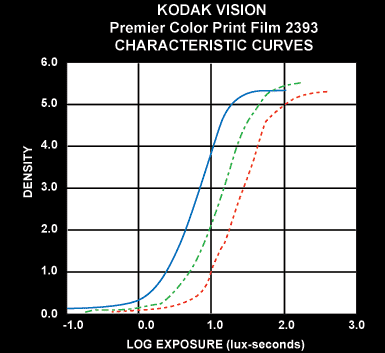
Here are the characteristic (sensitometric) curves for Kodak VISION and VISION Premier Color Print Films:
http://www.kodak.com/global/images/en/motion/products/lab/2393Char.gif
http://www.kodak.com/global/images/en/motion/products/lab/f002_1254ac.gif
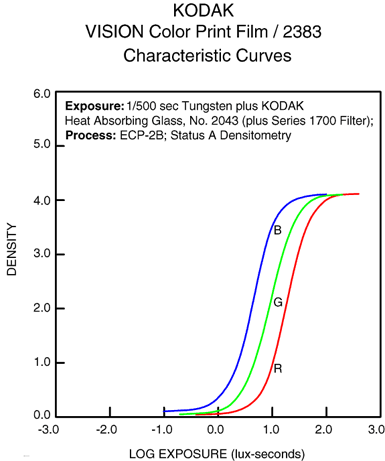
For 2393, the maximum density of greater than 5.0 means that it is possible to make a print with a black area that lets only 1/100000 of the projector's light through the film! (i.e., The film print can have a contrast ratio of over 100,000:1 between the lightest and darkest area.)
Even 2383 has a maximum density greater than 4.0, meaning that the blackest black will let only 1/10000 of the projector's light through the film. ![[Cool]](cool.gif)
No ![[dlp]](graemlins/dlp.gif) digital imaging device can even come close!
digital imaging device can even come close! ![[Razz]](tongue.gif)
Posted by Mattias Ohlson (Member # 1662) on 12-15-2004, 12:01 PM:
Mr Pytlak
I am not impressed by the blackness of black at my local cinema. Why am I not getting treated to Vision Premiere every time I visit the movies? Also how much of that capacity is used in real practice taking into considerations other things in how the print looks, 4 orders and 10000:1 with the premiere stuff?
Everybody
Actuallly there is a laser projector that is capable of 100000:1. You could also use a 4 panel approach to get 100000:1+ if you want to but that is probably not practical.
What is likely is that you control the light hitting the microdisplay or exiting the lens in real time or both. With this in practise dlp should deliver a dynamic range of 10000:1+.
At that level and even before that safety regulations have probably killed the possible black level anyway.
Posted by Mark J. Marshall (Member # 1409) on 12-15-2004, 12:19 PM:
Thanks, John. That's interesting. Do you know of a similar chart for dye transfer? One of the blackest blacks I ever saw I think was on an IB print of Snoopy Come Home. Lucy's hair, Snoopy's nose, etc., just looked like there was a hole in the screen.
Posted by David Stambaugh (Member # 1102) on 12-15-2004, 01:14 PM:
The blackest black I ever saw (or at least, that I noticed) was in "Minority Report". At the splice point for the end of the theater policy and the start of the feature, the screen went BLACK. I honestly thought the film had shut down or something. Never seen a screen that dark before while a film was actually running.
Posted by Mark J. Marshall (Member # 1409) on 12-15-2004, 01:23 PM:
Minority Report Technical Specs
quote:
35 mm (anamorphic) (Kodak Vision Premier 2393)
Told ya.
Posted by Mattias Ohlson (Member # 1662) on 12-15-2004, 05:01 PM:
Does this mean that all prints for all theaters went out with Vision premier 2393? Is there a way for bad equipment or a bad projectionist to screw up that black level potential?
Posted by Stephen Furley (Member # 1277) on 12-15-2004, 05:15 PM:
Light spill onto the screen has that effect.
Posted by Brad Miller (Member # 2) on 12-15-2004, 05:15 PM:
Yes.
*Crappy lenses
*Crappy port window
*Dirty lenses
*Dirty port window
*Stray light hitting the screen
*Poor light level from lamphouse (actually this would create darker blacks, but pathetic whites)
...lots of stuff.
Posted by Bobby Henderson (Member # 840) on 12-15-2004, 06:27 PM:
Please note, all the problems Brad listed can occur in a digital projection setup. They're not exclusive to film.
Posted by John Hawkinson (Member # 1135) on 12-15-2004, 06:39 PM:
Minority Report also used skip-bleach processing (I think Technicolor's ENR process), which darkens everything substantially, and should exceed the max that you'd see on the normal curves for 2393.
John P., do you know how dark bleach bypass can get? It wasn't obvious from the 5222 or 5231 curves, because they don't go to the right of 0...
--jhawk
Posted by Mattias Ohlson (Member # 1662) on 12-16-2004, 05:26 AM:
Brad Miller
Well, having a clean port window and lens does not sound impossible. A better lens and better port window obviously helps. I understand that safety lights destroys some of the potential.
Is there a way for light to escape around the film rather than through the film to leak light to the screen. Is this a common problem in "film done wrong"?
Probably external stray light is the big killer since conrast figures I have read are in the range 1000-2000:1 projected.
Mr Pytlak
You once commented on the effect that light can spread side ways in the film and not just straight through. Do you have any graph or numbers on this effect?
Posted by John Pytlak (Member # 331) on 12-16-2004, 05:34 AM:
quote: Mattias Ohlson
Why am I not getting treated to Vision Premiere every time I visit the movies?
The distributor decides whether to print using Kodak VISION Premier Color Print Film 2393. Among the films that used Premier are "Gladiator", "Minority Report", "The Incredibles".
If your theatre consistently has poor black levels, they need to work on "Conquering Contrast Killers":
Conquering Contrast Killers
quote:
Hopefully, this article helped identify factors in your theatre that will improve
screen contrast, to deliver the sharp, vibrant images that only film is capable
of delivering today. By showing the full contrast range available on today's
films, you can assure that the filmmakers' vision and artistry is put on your
screen in its entire visual splendor. So, go conquer those contrast killers now.
quote: Mattias Ohlson
You once commented on the effect that light can spread side ways in the film and not just straight through. Do you have any graph or numbers on this effect?
I think you are referring to the issue of a misaligned lamphouse, as discussed in my article.
quote: John Hawkinson
John P., do you know how dark bleach bypass can get? It wasn't obvious from the 5222 or 5231 curves, because they don't go to the right of 0...
"Silver Retention" processes vary, but potentially could add about another 2.0 density to the overall density of the black areas. A 6.0 total density would mean only 1/1000000 of the light can get through the black areas.
Posted by Steve Kraus (Member # 476) on 12-16-2004, 11:10 AM:
I was talking recently with the editor of a major film about to be released with prints with significant silver retention and I asked if the stock was Vision Premiere and he said no for that degree the standard Vision stock works better. Just thought I would share that little factoid. Or opinionoid.
Posted by Thomas Procyk (Member # 1170) on 12-16-2004, 12:43 PM:
quote: Bobby Henderson
Please note, all the problems Brad listed can occur in a digital projection setup. They're not exclusive to film.
Yep! Seen it happen. In fact, when some or all of those factors affect a digital presentation, the distractions are even worse.
Last DLP show I saw, the image was cockeyed. Same as if someone hadn't closed the lens turret all the way or siply moved the projector out of alignment. The left side of the screen was quite a bit out of focus and had a black bar on the left, while the right side was sharp as a tack, but bled over onto the curtains.
The side that was out of focus also showed HORRIBLE convergence problems. Reds bled to the right, blues bled to the left... a total mess. I noticed this on my home 3-panel LCD projector when I defocus it, too. The colors "split apart" at the edges of objects onscreen.
Not to mention, the lamphouse was misaligned and had a bad flicker. This was especially irritating in DLP since everything else on the image is rock-solid.
Oh, and the movie crashed and they had to reboot the server... on-screen!
To me, occasional dirt specks are much easier to ignore than convergence issues.
=TMP=
Posted by Mark J. Marshall (Member # 1409) on 12-16-2004, 01:19 PM:
quote:
Oh, and the movie crashed and they had to reboot the server... on-screen!
What OS was it using?
Just out of curiosity... I recently was trying to download and watch a few windows media files, but they would reach a point of corruption (pretty much when I hit "PLAY") and the audio would play fine, but there was no video, and then explorer would crash. What happens if the D-Cinema file becomes corrupted to the degree that it won't play? Is the theater down until it can be reloaded? How long does it take to reload it? And how often does that happen, if at all?
Is it one enormously large file, or a bunch of smaller large files?
Posted by John Pytlak (Member # 331) on 12-16-2004, 01:36 PM:
quote: Steve Kraus
I was talking recently with the editor of a major film about to be released with prints with significant silver retention and I asked if the stock was Vision Premiere and he said no for that degree the standard Vision stock works better.
It really depends on the "look" the director and cinematographer want. Silver retention processes have been done with both 2383 and 2393 -- of course, 2393 already is higher in contrast and has much "richer" blacks to begin with.
Cost is also a factor, as both "silver retention" and Kodak VISION Premier Color Print film cost somewhat more than "normal" print film and processing. The 2393 has significantly more silver and dye-forming couplers, so it costs more to manufacture.
quote: Thomas Procyk
Last DLP show I saw, the image was cockeyed. Same as if someone hadn't closed the lens turret all the way or siply moved the projector out of alignment. The left side of the screen was quite a bit out of focus and had a black bar on the left, while the right side was sharp as a tack, but bled over onto the curtains.
The side that was out of focus also showed HORRIBLE convergence problems. Reds bled to the right, blues bled to the left... a total mess. I noticed this on my home 3-panel LCD projector when I defocus it, too. The colors "split apart" at the edges of objects onscreen.
Not to mention, the lamphouse was misaligned and had a bad flicker. This was especially irritating in DLP since everything else on the image is rock-solid.
Oh, and the movie crashed and they had to reboot the server... on-screen!
And so what did the theatre manager say when you complained about the lack of presentation quality? (You did complain, didn't you?)
Like you, I've certainly seen Digital Cinema presentations with contrast and tone scale issues. I've also documented a complete failure and having to go to a back-up film print for the "Digital Hiccup" problem with the Digital Cinema presentation of "Ice Age" at the AMC Empire 25 in NYC.
Posted by Mark J. Marshall (Member # 1409) on 12-16-2004, 01:44 PM:
How much more expensive is Vision Premier than Vision? Talking about a run of 2000 prints, just a ballpark figure. 10% more? 50%? Just curious as to a best guess.
Posted by John Pytlak (Member # 331) on 12-16-2004, 01:54 PM:
The October 2004 Kodak Motion Picture Price Catalog lists 2383 at $0.0869 per foot, and 2393 at $0.0947 per foot in bulk quantities. (Same price as the January 2002 catalog). So VISION Premier 2393 is less than a penny per foot more than 2383.
Posted by Mattias Ohlson (Member # 1662) on 12-16-2004, 05:54 PM:
Are exhibitors insane when not using 2393? The price differential is not that big.
Posted by John Pytlak (Member # 331) on 12-16-2004, 06:24 PM:
As mentioned, the choice of which print film to use often depends on the "look" desired, as well as the cost. A penny more per foot is still about $100 more for a 10,000 foot print.
Powered by Infopop Corporation
UBB.classicTM
6.3.1.2