This is topic Bad Judgement = Damaged Equipment = Destroyed Print = Cancelled Show in forum Film Handlers' Forum at Film-Tech Forum ARCHIVE.
To visit this topic, use this URL:
https://ft-forum.com/ft/cgi-bin/ubb/ultimatebb.cgi?ubb=get_topic;f=1;t=006787
Posted by Ever Gonzalez (Member # 2794) on 12-18-2004, 05:04 AM:
So today I was at the other theatre helping with their 5 prints this morning. Came in about 5am to take care of these prints. I was screening "Spanglish" when the projectionist asked for one of us to come over to projector 13. I waited a little bit and the Manager that I have been training for the past 3 months decided to go on up. So I was just chillin and she then calls for me.
Great, now what?
I asked her what the problem was and she said that the tail got entangled or something. So I thought I was going to show her how to fix a simple tail wrap. I head on up and as I turn the corner from the distance of about 50 feet I see bundles and bundles of film on the top platter of 13! I was amazed at this sight of film everywhere. As I got closer I could smell something burning. I looked at the motor (Christie AW3 Platter System) I saw film entangled within it. I figured the smell was from the film being caught between the motor and the platter. I was speechless and then I looked a little closer and I could actually see smoke coming out of the area in the tree where all the cards that control the platters are located. I unscrewed the bolt and opened it up and my jaw dropped to the floor. All 3 platter cards were blown. The transformer and the wire harness was burned to hell! The projectionist basically blew the whole platter system!
It was obvious that after he had put the last 6000 reel on he took off at full speed AND walked away. I couldn't see any other way this could have happened the way it did. The motor was too hot to even touch and the entire print was destroyed. There was no way we were going to be able to salvage the print of Snicket.
I paged our tech and he was just down the street at my theatre and when he came over he mentioned that he has never seen anything like this before either. I feel bad for him, because he had to drive to LA to get the parts to get this platter system up and running ASAP. He said, "maybe by tonight, but for sure by tomorrow."
We pulled the platter off and we just took the print apart and threw it on a few 6000's. We ordered a new print and it would be at our theatre around 4pm. This incident occured around 11am. There was no point on trying to put the print back together in its proper reels. So much film was destroyed that it really didn't matter. Parts of the film were clear. You could see right through it!
The brain was pulled right out of its place and entangled within the bundles of film. One of the pylons to the brain was snapped off, the other was bent, and the third was loose. The motor was damaged.
Now to those of you who are new at building up, there are rules that you need to follow.
1. Do not build fast!
2. DO NOT BUILD FAST!
3. Never ever walk away from a platter system when a print is going onto platters. Keep it in sight when you are building and then move it over to the correct house.
4. How fast should u go? I'd say about as fast as you would like to go if you were on a Mary-go-round.
It took 3 hours with 3 of us to clean up the print. This was with us not caring what order we were putting the film back onto reels.
I took pictures, but I forgot to send them to my home e-mail address. I will post some later when I get them.
Today sucked so much ass! ![[Eek!]](eek.gif)
So I was able to get the pictures. The camera at that theatre isn't the greatest.
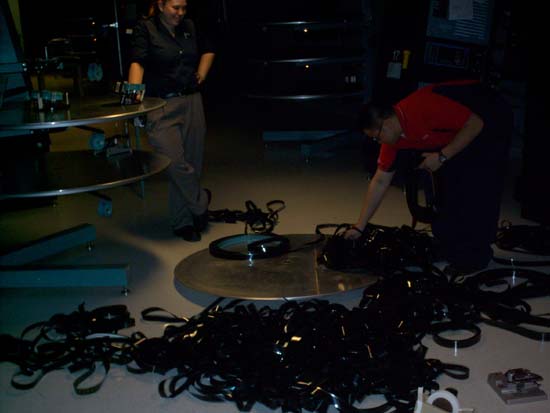
Here is the mess. We had to remove the platter in order to untangle the mess.
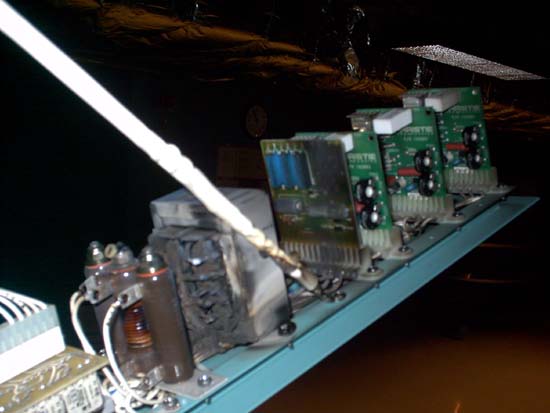
No explanation needed.
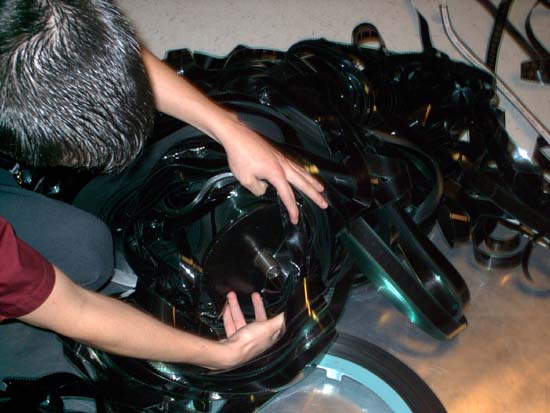
The brain that was pulled out of its home and lost in all the film.
[ 12-19-2004, 02:49 AM: Message edited by: Ever Gonzalez ]
Posted by Brad Miller (Member # 2) on 12-18-2004, 05:24 AM:
quote: Ever Gonzalez
Keep it in sight when you are building and then move it over to the correct house.
No, this is incredibly stupid. Load the print on whichever platter will be paying out it's first run through (whether that is a screening show or the first public show). You risk cinch scratching when you move a print before it has been ran once.
Tip of the day: buy a Goldberg "show shipper" platter reel and forget about all this ridiculous "loading the film" nonsense.
Posted by Edward Jurich (Member # 1787) on 12-18-2004, 09:36 AM:
quote: Brad Miller
You risk cinch scratching when you move a print before it has been ran once.
I agree, the film tension is not equal right after building a print. I'm not fond of clamping and moving prints anyway. I had to build an old print of "Way Out West" that someone clamped and did a lot of edge damage to the old acetate print.
Posted by Ken Layton (Member # 133) on 12-18-2004, 11:41 AM:
If the wiring harness and the circuit boards were fried, I'd say a fast trip to Christie's parts department is in order.
Posted by William Valdes (Member # 2690) on 12-18-2004, 11:53 AM:
quote: Edward Jurich
I'm not fond of clamping and moving prints anyway.
We're pretty much screwed with print moves as there are typically moved all over the booth. Sometimes, the powers that be, decide they want to schedule a movie to play in one theater and then schedule the following show time at the other end of the booth just five minutes later. That can occur several times a day!
Ever, that really sucks. It sounds like something that happened to us that same morning with only a small fraction of the consequences you experienced. Somebody built the second half of Lemony Snicket on to a platter and when it finished the tail got wrapped in the brain causing a "film cone" I had heard about this before but up until then, I had never actually seen it or have had to fix one. It took both myself and another projectionist forty-five minutes to fix. This has never once happened to a film I've built <knock on wood> I'm also very careful but I get more and more paranoid the more I hear about this problem. How common is this problem? Anybody else have any tips for this?
Posted by Ever Gonzalez (Member # 2794) on 12-18-2004, 01:23 PM:
I totally agree with you Brad, but when you have as many prints that open up and a booth that is so huge and you can't keep an eye on the print, it is better to keep it close and not risk destroying the print. I am actually saving up for one of those platter reels. Trust me, my projectionist already know about the plan on getting one and it will be a huge weight off their shoulders from the few prints a week we get only 2 hours before showtime for screenings.
I love Paramount and their $50 rewards for sending back trailers. Almost there to be able to purchase one! ![[thumbsup]](graemlins/thumbsup.gif)
Plus we run into screening prints just prior to it being shown to the public. We have to run it in a auditorium that its not going to start in the first place and still print move it to the correct house. Either way we are moving the print, especially during this busy season when we will be adding midnights in an open auditorium.
William I heard about your little Mis-hap when I called over to check up and see how things were going. Good thing I had that Booth Meeting to show you how to fix stuff huh?
Cinch marks? I rarely see them and when I do its in a trailer that got tossed around.
I'll see if I can get those pictures today.
Posted by Brad Miller (Member # 2) on 12-18-2004, 02:39 PM:
quote: Ever Gonzalez
We have to run it in a auditorium that its not going to start in the first place and still print move it to the correct house.
Sounds like you still don't get the point. When you load a print to the platter, you do not have even winding tension throughout the roll. The film MUST be played one time or more before you move it to prevent cinch damage. Once it has been played through a projector at least once, moving it is nowhere near as big of a deal. So if you are going to open the print in #5 to the public, but you are going to screen it in #8, you must build the print to platter #8, run it that one time for your screening, then move it wherever you want (in this case #5).
Everyone should just set up platter arrays. This print moving nonsense is for the birds! ![[fu]](graemlins/fu.gif)
There is a trick if you HAVE to leave the MUT unattended.
*Always put the last roller of the MUT no more than 2 inches away from the edge of the deck. (By this I mean 2 inches away horizontally, not "too high" or "too low".)
*If you have to walk away, lower the speed to something fairly slow. (Christie no more than 50% - Strong no more than 30% - new SPECO MUTs no more than 50%)
This way when the film tails off of the reel, the last roller is close enough to the platter that it won't initiate a tail wrap, plus the deck itself is not spinning fast enough to slap the tail off of the edge.
***No I am NOT advocating unattended loading, but sometimes you have no other choice. In those instances, please do it as I wrote above. You will thank me later. ![[Wink]](wink.gif)
Posted by Monte L Fullmer (Member # 2797) on 12-18-2004, 03:14 PM:
quote: Brad Miller
There is a trick if you HAVE to leave the MUT unattended
Answer to the trick: TURN THE DAMNED THING OFF! I "punish" operators for leaving a MUT unattended when in the "make/break" mode.
Posted by Ever Gonzalez (Member # 2794) on 12-18-2004, 04:25 PM:
Yes, that is what we do. We build it, screen it, move it to the correct house, unless we have the time to build it onto the correct house, then we do.
Oh yeah, and we also build fairly close to the platter as well. The employee that destroyed everything yesterday HAD to be going more than half the speed for that type of damage to be created.
Our booth is a maze and crammed, so running prints from platters to whatever projector you want it to is out of the question.
Posted by Randy Stankey (Member # 64) on 12-18-2004, 06:54 PM:
The first day I train any new person in the booth, the FIRST thing I teach them is where the [POWER OFF] switch is.
Rule #1 is, "If you have trouble and you don't know what to do, TURN IT OFF then call me right away."
Even if it turns out to be something minor, I'd rather have customers sitting in the dark for a minute or two than to have equipment be damaged and end up cancelling the whole show.
I promise them that, if they follow rule #1, I won't blame them.
(Unless they did something blatant.)
I give your assistant a point of credit for calling you.
I would subtract a point for leaving the equipment unattended. (Unless you never told them that.)
But, don't feel bad. Your guy just made a dumb-ass mistake. I know a guy who actually beat a projector with a BALL PEIN HAMMER! ![[Embarrassed]](redface.gif)
Posted by Scott Norwood (Member # 30) on 12-18-2004, 07:29 PM:
Agreed 100% to everything Brad said.
Don't move a print from one platter to another without running it first. There isn't enough tension to keep the film from sliding against itself and cinching when it is moved.
I personally don't have any problem walking away from a Christie MUT while it is running in makeup mode feeding a 6000' reel onto a platter deck _if_ it is running at 25-50% of full speed and if it is near enough to the rewind bench to be checked on every few minutes.. If it runs any faster than 50%, the film will likely bounce against the deck, anyway, causing scratches. I'm not "recommending" this, but was often necessary when I used to regularly do makeup and breakdown at a platter house.
Posted by Randy Stankey (Member # 64) on 12-18-2004, 09:53 PM:
One question comes to mind:
Has anybody been Jerry Rigging fuses?
That's just about the only thing I can think of that would cause a platter (or just about anything) to blow up that badly. Yes, I've seen control cards that got fried. I've seen motors, wires and switches fry. But I've never seen ALL the cards and wires fry along with the motor! In a situation like you describe I can't imagine why the fuse didn't blow before such damage occurred.
When I just started out at Cinemark, the fuse in one of our platters went out. (Speco LP-270. They used to blow fuses when you cranked the speed on the MUT too fast. Problem since resolved.) Well, instead of making a run to the store for some more fuses some genius got the bright idea to wrap a piece of metal foil cue tape around the fuse and stick it back in, thereby bypassing the fuse.
As you know, temporary fixes like that often become permanent. That rigged fuse stayed in there for months before anybody discovered it. The moment of discovery was when smoke started coming out of the platter! I don't remember the whole situation but, like you, that platter was out of commission. It was down for a few days while parts were ordered.
This is why I am reminded to ask you the question... Do you think it could have happened because somebody rigged the fuse?
In my opinion, this bears investigating.
Posted by Michael Barry (Member # 237) on 12-18-2004, 11:50 PM:
A lot of people here know that I'm very partial to a certain German brand of projection equipment (Kinoton).
At the risk of being boring, it seems relevant to point out that using the latest of their make-up tables (which are totally tension-controlled) it is absolutely possible to make up a print and the wind on that print will be absolutely identical to a print that had been through the projector.
So you can make up a print, then simply pick it up. No cinching - the wind is perfect.
[ 12-19-2004, 01:57 AM: Message edited by: Michael Barry ]
Posted by Steve Guttag (Member # 268) on 12-19-2004, 12:21 AM:
Don't forget to mention that when the film stops moving on the make up table (i.e. the tail runs through)...it stops the platter and MUT (going in either direction).
Steve
Posted by Aaron Garman (Member # 1653) on 12-19-2004, 01:14 AM:
Brad,
Say we have to build a print for a house that is split, and all platters are in use. In an ideal world, we'd build it on another platter, screen it, and then move it. But, in our booth, sometimes that is not possible. I never knew one could scratch a print like this. How exactly would these scratches appear on the film?
AJG
Posted by Monte L Fullmer (Member # 2797) on 12-19-2004, 02:19 AM:
I can see the scratches coming from the "squirm" and "squeeze" from when prints are moved using the clamps on new builds-nothing to keep the print flat as if it was on the platter.
Most of the theatres that I worked at had platter "pancake" scoopers-homemade boards of 1/4" plywood 4 ft square, with a 2x6 mounted on one end with a circular cutout in the middle the shape of the completed film wind, and a hole in the middle for a hand hold-to "cradle" the print during moving, eliminating the "squirm and "squeeze' of a clamped, unsupported print.
Nothing more aggravating when moving a print and one of the clamps decides to be not too tight and slip down to the bottom, and hope that the ring doesn't pop out, or you're in deep doo-doo for the rest of the night. One of our guys did that-didn't tightened one of the clamps tight enough, ring popped out and he had an 7 reeler slop down like a wet rag on the floor. Luckilly, it wasn't too bad of a mess, so we scooped up that mess with our board mover, and plopped that print on the platter. Then, threaded that mess for a fast-forward wind through the platter only, grabbed the good ol' Kelmar cleaner, soaked up a full roll of media with "Mr. Miller's Fantastic, Amazing, Miraculous and All-around 'Film Guard'", mounted that cleaner on the platter tower(AW3R) and let 'er rip, and two hours later, we had all that film wound neatly back on the ring, the cleaner got most of the "dust-bunnies" that the film picked up from the booth carpet (actually, passed that print through about 3 more times to get rid all the "dust-bunnies"), and "we're back in business, boys, and girls.."
Now, here's a good one: I'm getting to notice, with used prints, that the tail leader is cut off from even with the last reel-right after the rating tag.
Is this something new, or are we seeing lazy operators/booth personnel who doesn't know where to place the shutdown cue tape so the dowser will drop before the tail runout through the machine-to eliminate the end run visual through the machine, including the sound?
Quite annoying to have to re-connect this tail leader, since I have to have that leader on for proper shutdown sequence.
Used to see this long ago when theatres would stack prints together as a dbl feature bill with a cue in the middle to send the unit into "intermission" mode.
thx-Monte
Posted by Ever Gonzalez (Member # 2794) on 12-19-2004, 02:57 AM:
Monte -
We have those same type of print movers custom made for is. They work perfect and last a few years. They do not scratch the platters and are not that heavy. Gotta love them. We even have a big one for those 9 plus prints with little cut-outs that make a handle to hold onto.
Randy -
Nobody in that projection booth knows anything electrical. They are a bunch of kids and they are all almost new. The just know the basics, so I coudn't tell you why the platter system blew.
I posted pics on my original post.
Oh yeah, we also need a new platter. That platter was warped too!
Posted by Nate Lehrke (Member # 1460) on 12-19-2004, 03:12 AM:
Could someone elaborate on "cinching" for me. What is actually occuring?
Edit: Did a search on it & understand now.
Posted by Monte L Fullmer (Member # 2797) on 12-19-2004, 03:22 AM:
That's a bit of a nasty one with that one pix with the film being slung on the floor like that. True, you do have it a bit cramped up there where this occured-not much room to breathe in certain areas.
Makes you wonder if a voltage spike came down the pipe, or the transformer shorted across inside sending huge amounts of current in that controller area, shorting out diodes to let the AC through and taking everything in sight. Pretty sad when an AW3 platter can get warped. They're pretty sturdy units. But, never know...
But, been there and done that as well-cut, flop,untangle, and wind as best as can to get it all back together, or back on the reels. I've helped other booth employees clean up messes like this when especially when they're breaking down and they don't notice the ring was missing in the first place-they can sling that film pretty far down the floor!
Now.. I have to ask a question, and this might sound a bit strange: I've read in this thread of operators using the 6K reels to build from the MUT to the platter. Do most of the films come in tails out, or is a policy of sorts to build first to 6K reels, rewind that 6k reel, then to the platter? I've never done this. If a reel comes in tails out, I would simply rewind that reel to a 2k reel to make heads, then mount that reel to the platter. Seems like extra work to me...but I was just asking...
-thx Monte
thx-Monte
Posted by Ever Gonzalez (Member # 2794) on 12-19-2004, 08:40 AM:
Monte-
In my experience building straight to the platter is faster, but there is limited space to work around. Also there is a higher chance of causing damage to a print. I would prefer the prints to come tails out so that I wouldn't have to rewind the 6000 reel. But yes, we build onto 6000's, rewind, and then onto the platters.
This booth is actually pretty open and has a lot of light. My theatre is the one that is a maze and is crammed in many areas. Very dark too. If you see the booth for the AMC Grand 24 pics, its similar to that. Built around the same time.
Posted by Jon Miller (Member # 163) on 12-19-2004, 09:11 AM:
Monte, with about 97% of the prints I handle for film festivals coming on cores, building onto 6000-footers on a bench is IMHO the only logical way to "do film right." A Kelmar bench handles a split reel much easier than a Christie MUT, a 6000' reel has less inertia than a platter deck, and the ergonomics of a bench compared to a MUT makes it easier to catch and fix bad splices, not to mention check heads and tails, apply cue tape, etc. Yes, it does take considerably more time to build a print that way, but the ease and quality is worth it.
Posted by Barry Martin (Member # 1376) on 12-19-2004, 10:03 AM:
When first reading the tips section I came across this method of building onto 6k's first then onto the MUT. If I was still at my 20 screener I might try this and judge from there, but at the twin I work now my "workbench" is basically hand made by the previous owner and has a bit of nostalgia to it. The spindles are hand-cranked so reels are loaded OVER the bench, not hanging off the side. For some reason, despite the fact he owned (and we inherited) about fifteen 6k reels, the 6k's do not fit over the bench on the spindles. One of the spindles is motor driven but that is also mickey-moused in and not very strong (can't even build a trailer program using the motor because when the trailer gets close to the core it is too difficult for the motor to pull). My guess is I will have to re-make a workbench with our carpenter, but I look forward to that. Have everything the way I want it. So for the meantime I build straight to platter, have not had any ill-effects such as increased static or any scratching.
Posted by Scott Norwood (Member # 30) on 12-19-2004, 10:31 AM:
I prefer to do actual film inspection at a rewind bench, rather than at a platter MUT. It's just a personal preference and, yes, it does take longer than when making up directly to a platter (assuming that the print arrives heads out), but I feel that I can do a more effective job inspecting and repairing (if necessary) the print at the bench. As Jon mentioned, winding directly onto a platter isn't an option when prints arrive on cores, anyway.
The only time I'd make up film directly onto a platter would be if I absolutely had to get the film on the screen in the least possible amount of time and if I were confident that the print wouldn't require extensive repairs. Or if the booth didn't have a usable rewind bench, which is an unfortunate situation that I have encountered twice.
Edit: I should add that I always break down prints directly onto shipping reels at the MUT, unless the print came on cores, in which case I'd break it down onto 6000' reels and then finish the job at the bench. It's probably been six months or more since I've last done film work in a platter house, but I get to run some shows on an evil Super Platter this weekend. Wish me luck.
[ 12-19-2004, 12:29 PM: Message edited by: Scott Norwood ]
Posted by Matthew Jaro (Member # 1786) on 12-19-2004, 10:33 AM:
This is what you get for not running two projector changeover systems. ![[Big Grin]](biggrin.gif)
Posted by Gracia L. Babbidge (Member # 582) on 12-19-2004, 10:52 AM:
Alas, those of us in c/o house can still find ourselves sorting out some lovely 'presents' left us by people that handled the prints before us. ![[Razz]](tongue.gif)
And something else that can really suck in a c/o booth - the rewind bench taking it upon itself to cease functioning properly during a second matinee show. ![[uhoh]](graemlins/uhoh.gif) Then to make things more entertaining, this happens while you're on break, and a far less seasoned operator is on duty, and she gives no thought to calling the manager (sure it was his day off, but a lot of the weenie mishaps with the equipment are well within his ability to fix, thus reducing our need to pester a tech). So I get back early from my break, and immediately jump on trying to assess the problem, and realize that I can't reassemble that which broke, and call the manager, to relay the pertinent info to his voice mail. Fortune granted us a little reprieve, this happened when we had two prints, alternating showtimes. So the un-rewound print didn't play until the second evening show, but since the rewinder was looking at not getting fixed until 30-45 minutes before that show, I ended up rewinding a trailer reel, and about 4.5 reels of a feature by hand. Quite sucky.
Then to make things more entertaining, this happens while you're on break, and a far less seasoned operator is on duty, and she gives no thought to calling the manager (sure it was his day off, but a lot of the weenie mishaps with the equipment are well within his ability to fix, thus reducing our need to pester a tech). So I get back early from my break, and immediately jump on trying to assess the problem, and realize that I can't reassemble that which broke, and call the manager, to relay the pertinent info to his voice mail. Fortune granted us a little reprieve, this happened when we had two prints, alternating showtimes. So the un-rewound print didn't play until the second evening show, but since the rewinder was looking at not getting fixed until 30-45 minutes before that show, I ended up rewinding a trailer reel, and about 4.5 reels of a feature by hand. Quite sucky.
Sure would have been nice had the other operator thought to do that to a couple of the reels while I was on break.
Posted by Scott Norwood (Member # 30) on 12-19-2004, 11:35 AM:
Booths with handcrank benches are fun!
I've worked in two (Hanscom AFB and the Avon Cinema; there are pics of both in the galleries) where the motorized rewinders are only suitable for rewinding (no variable speed) and prints need to be inspected on the handcrank bench. I actually prefer the handcrank arrangement for trailer work, but I'll take a Kelmar bench any day for feature work.
Wow, Gracia...projectionists get "breaks" at your theatre? I've never heard of that happening before!
Posted by Randy Stankey (Member # 64) on 12-19-2004, 12:11 PM:
In the picture it looks like the ceramic resistor in the center is fried but the two on either side are mostly OK but for some smoke. Then the transformer looks totally beat. I can't tell from the picture but the power control board and the two platter control boards look mostly OK. It's hard to tell from a picture so I'm just guessing.
I hope I'm proven wrong but, I'm sorry, I can't see how that could have happened unless something was out of whack.
Posted by Thomas Procyk (Member # 1170) on 12-19-2004, 12:38 PM:
Re: Leaving MUTs unattended.
In some of the lesser operations I've worked for, it had to be done. Otherwise I would end up staying there so long that I might as well thread up the first set. The main problem was that they would only have ONE -- ME -- person building prints. With 5 to build and 2 technicolors to break, the hands have to be doing something other than leaning on a mut.
I think that as long as you're within eye's and ear's distance (which means 4-6 BIG steps away max) everything should be fine. If your Mut's are so bad that you can't leave them for a second, then there's a serious problem with them. What could happen that would not be related to operator error in the middle of a build that would send film flying?
There was even a theater I worked at where it was MANDATORY to set the film up on the mut, flip it on and GO DOWNSTAIRS to help them do inane tasks like change posters or marquee. Despite my protests and complaints, the policy stood until a print tailed out into the film that was being built and disaster struck. Then came a harsh, all-caps memo saying we are not to leave the booth unattended when building. Don't you love it when managers steal ideas they protested to in the past? ![[Roll Eyes]](rolleyes.gif)
Re: Moving Prints
Sometimes there's no option. Sometimes you have to build onto whatever platter is empty and then -- yes -- move the print before it's played through. Especially when your theater LOVES to double-up almost every house. A platter reel wouldn't solve this since the print would have to sit on it for a good hour or two until the proper deck(s) open up. (Could be the end of the night when the show is done, even)
I'm not saying any of this is right or proper, just that it's usually unavoidable. Minimum wage gives you little to no clout to demand proper equipment and supplies. ![[Frown]](frown.gif)
On a side note, I've been reading of all the recent print/booth problems on here and was wondering... how many MF prints of Lemony Snicket got trashed to ![[bs]](graemlins/bs.gif) this weekend?!?!?!
this weekend?!?!?! ![[Mad]](mad.gif)
That could explain its meager $30m opening.
=TMP=
Posted by Frank Angel (Member # 248) on 12-19-2004, 03:29 PM:
Geez, how is it that there are no more robust safety devices on this unit? -- switches, fuses, even mechanical fail-safe mechanisms that would stop such a massive damage somewhere earlier in the event? I mean, even if the film were caught under the platter motor and it overheated, wouldn't the extra aperage it would draw cause a fuse to blow before taking out EVERY card? And how could the entire control unit self-destruct for all the platters rather than just the one that was in trouble? I was always under the impression that platters were self-contained units with their own controllers, power supplies and safety switches/mechanisms. What's the advantage of a single controller that operates every platter? (obviously this is one major DISADVANTAGE, eh?).
I bet if you really worked on it, you could probably salvage most of the reels of that print. Although it looks like an godawful mess, most of the damage will probably be in one area of the print. You might get away with having to replace only one or two reels, rather than the whole print -- a much less costly a proposition, the difference perhaps between having the boss look at the print replacement bill and either gasping and clutching his heart and then immediatley firing the guy, or if only a reel or two, perhaps just cursing and maybe even docking the cost from the guy's paycheck but keeping him on.
Posted by Ever Gonzalez (Member # 2794) on 12-19-2004, 04:30 PM:
Randy -
I wish I took a picture of the other side. The back of the platter control cards show that they are blown too. Every single thing in that picture was blown.
Frank -
The trailer ring and half of the first reel was OK. Then there was a section that looked OK, but it was another half of two random reels still together. Other then that, there was damage to every reel. Like I mentioned, it wasn't worth saving.
Posted by Monte L Fullmer (Member # 2797) on 12-19-2004, 08:06 PM:
Hi again all:
Thx for your input on my question of the 6K reel topic. It helped out considerably.
Once in a great while we would get new prints on cores. Then, that was the reason for 6K builds before the MUT.
Growing up and working in a c/o carbon arc booth for almost 20yrs, where new and used prints, being on the triacetate stock, and wet splicing was the norm, it was a mandatory thing for me and the rest who was opening shows, to slap the reels on the Neumade bench with the Neumade crank arms, manually inspect every reel by hand, feeling for the spices, redoing the splices if necessary (since most of the wet splices that were made were so weak and crappy anywho..I can go through a small can of Griswald film cement in 6 months fixing all of the unacceptable splices that I would find), before sending the reels to the house reels in the Goldberg rewinding machine. Even to this day, esp. with kid shows, is to inspect these prints, even though on the "poly" stock nowdays, for you can find some areas in these prints that needs to be repaired.
thx-Monte
Posted by Aaron Sisemore (Member # 145) on 12-19-2004, 11:32 PM:
I fail to see how a MUT can fry EVERY board on an AW3, especially since the MUT is its own motor controller (the round circuit board behind the big knob in the middle, unless you have an ancient AW3 with the two AW3 cards in it).
By chance did it fry the MUT as well (have you tried this MUT on another platter system)?
Fried AW3 guts might be due to:
The '$300 Switch': maybe, but the usual result of failure here is simply a dead deck in all modes and burned off traces on the switch circuit board (easily repaired in most cases with jumpers)...
Shorted motors: Another classic killer of AW3 circuit boards.
Something other than unattended make-up is responsible for the frying of this platter.
-Aaron
Posted by Stephen Jones (Member # 16) on 12-20-2004, 12:03 AM:
I cant see why you need to load film onto the platter like a bat out of hell as that can cause damage as well as shifting prints around.I run all prints onto the platter at a gentle speed and still get all prints made up in time.Even though I have Kinoton Platters and Muts I never leave film running on unattended I always turn off before I walk away, prevention is better than cure as they say even if the muts auto shut off when the reel finishes runing on.
Steve
Posted by David Yauch (Member # 2754) on 12-20-2004, 02:41 AM:
I find with our MUTs that you have to run them at a fairly quick speed. If you run them too slow it seems the film likes to bounce more and more and you risk your film smacking against the platters. I was able to run a MUT at about 90% speed the other day(attended the whole time) while building phantom of the opera and the result was a smooth wind and a perfectly/quickly built print. Maybe our MUTs are just strange, but they tend to work better at higher speeds(there are still limits, of course)
Posted by Monte L Fullmer (Member # 2797) on 12-20-2004, 03:30 AM:
HI David - what kind of transport systems do you have? Are the rings out of round to where they are almost oval,where the film is being pulled faster at the "lobes" and slower at the "equator" of the ring?
If a Strong MUT: check the freewheel friction pad. could be dry and needs oiled. Shaft and bearing could be worn.
If a CHR MUT: Is the pulley belt aligned with the motor? Is the motor aligned with the pulley?
If a LP-271 MUT (Speco): check the freewheel spindle. And doing this by taking off the clutch dog from the motor end and unscrewing the table top off. Spindle sleeve could be worn and dry. Also, check the cinch nut at the end of this spindle. They love to work themselves loose.
If Strong and CHR platter decks: the main axle shaft can work themselves loose enough where the deck has massive wobble. Take the decks off and check for looseness. If loose, tighten up the big nut at the end of the shaft. These nuts do love to come loose at times.
good luck - thx Monte
Posted by David Yauch (Member # 2754) on 12-20-2004, 04:38 PM:
You know, I feel like a real dumbass for not knowing this for sure but i'm almost positive they are all christie MUTs.
I am positive we have christie AW3 platter systems on all of our houses. I also know that this problem happens with all of our MUTs. It could be a maintenace issue, as our engineering dept. will only maintain if we complain.
Posted by Rich Ferrando (Member # 2056) on 12-20-2004, 05:00 PM:
On Moving Prints:
The big fun we have to deal with on a regular basis is the fact that our thrown-together booth has two Strong platters and one Christie platter. Therefore, if we have a print on the Strong and have to move it to the Christie, or vice versa, the center rings aren't compatible, so the print is almost always slightly off-center, and has to be watched closely. I'm thinking of drilling extra holes in the Strong platters to accomodate the wider Christie rings.
Not to mention the evilness that they won't let me change- when we have to share a print with our sister theatre, which is about 10 miles away, we are forced by management to clamp the print, move it down the stairs, and load it into an employee's car. Luckily I've been able to save some big flat boxes that we can load the prints into to prevent any excess dust or debris from getting on the film, but still, this is one big sticky wicket for which my demands have gone unheeded, and a large reason why sometimes the evil Corporate folks won't let a theatre become fully compliant with Film Done Right.
I hate them all.
Posted by David Yauch (Member # 2754) on 12-20-2004, 05:06 PM:
You could always buy some christie print stoppers(not sure if there is another name they go by). If you clean them once every week or so and keep your platters clean they will stick so hard that you have to be careful not to rip them in half while removing them. We have actually had a few rip in half because the projectionist after they were cleaned just tried to pull them off by the top handle. I cant see any print going anywhere if you keep them clean.
Posted by Rich Ferrando (Member # 2056) on 12-20-2004, 05:10 PM:
We do have suction cups for the platters, and they stick very nicely, but I'm a skeptical bastard, and don't trust anything. ![[Smile]](smile.gif)
Posted by David Yauch (Member # 2754) on 12-20-2004, 05:20 PM:
Well then click on the products link on the left of your screen and buy some of those blue plastic thingies that brad came up with. Surely THAT must be good enough?
Posted by Monte L Fullmer (Member # 2797) on 12-22-2004, 02:38 AM:
Strong does have an optional 19inch ring for trailer building within a film wind that fits in the existing 13inch holes of the Stong platters. Check the manual tab and go down to the bulletin listing of this.
Don't drill new ones, for trying to get dead center spacing with the pin holes so the CHR ring will be dead center, is quite touchy to accomplish. This was the big problem with AW2s with that compound/formica covered decks that they had. The holes would widen out do to age and some operators would drill new holes to begin anew, but would never get the holes centered.
If anyone wants to make a "pizza" board, here's a couple of pix of one.
Materials:
4'x4'x 1/4 sheet plywood
2x6x4 pine board with a circular cutout to rest film on end.
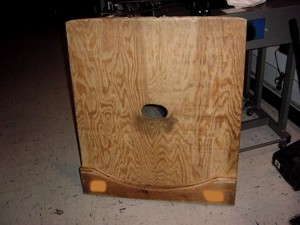
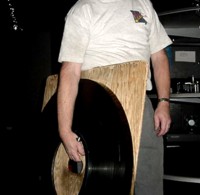
router the edges smooth and round and the front lip, cut to a taper to "knife" under the film to scoop.
Also, if some theatres have the LP-270', AW2's, and the older AW3(not the "R") a variant of this board can be built. Instead of the solid piece shown, just cut out a 8 inch slot to the middle of the plywood, in the middle of the plywood board to allow the same "scoop" but will clear the brain assembly when inserting the board under the print, and allow the print to clear the brain when lifting up.
This board, with the assistance of the clamps, does a nice job of moving prints from one theatre to another with one person doing this task by himself (course, it's nice to have a pickup truck, or station wagon..but...we all can't be picky.. course, I've moved prints before across town using the board only-just have to be more careful obviously..don't want that ring to pop out..lol.)
good luck- Monte
Posted by John Pytlak (Member # 331) on 12-22-2004, 06:01 AM:
Nice design, Monte.
I would suggest using a plastic laminate surface on the plywood or use pre-finished paneling. At the very least, try a hard coat of polyurethane floor finish that won't chip or dust.
Posted by Gracia L. Babbidge (Member # 582) on 12-22-2004, 11:50 AM:
Yes, projectionists get breaks where I work - due to our rather unusual schedule. ![[eyes]](graemlins/eyes.gif)
For instance, this week we have shows at 1:30, 4, 6:30 & 8:45.
When I worked Sunday, I projected the 1:30 & the 6:30, and ran the box office for all four shows, and did closing paperwork. I arrived at 1:00, had a break from about 4:10 to 6:00, then was out for the night by about 9:15.
The person who worked with me projected the 4 & the 8:45, and helped with concessions for all four shows. She arrived a bit before 12:30 to open, then had a break from about 1:40 to 3:30, then the second break from about 6:40 to 8:15, and she cleaned the concession area while running the last show.
So we alternate shows in such a way that there are two people behind the counter right around showtime.
A lot of patrons find it fascinating that they can see the projectors from downstairs.
Then again, it's also handy for us to be able to see the stand from the booth. As all of us at this small theater have to do everything from cleaning the auditorium to projection, as there's usually only one person on duty while a show is running.
Posted by Monte L Fullmer (Member # 2797) on 12-22-2004, 02:48 PM:
Thx John, but I didn't build this one. Yet, I do fully agree with you with the covering and coating ideas (a hint for others to think about...). plus, the edges would be covered as well, for the edges after awhile, do get splinters. One place that I worked at, we wrapped the edge of a board with duct tape to contain such splintering. - Monte
Posted by Aaron Sisemore (Member # 145) on 12-22-2004, 05:40 PM:
quote: David Yauch
You could always buy some christie print stoppers(not sure if there is another name they go by).
It's also known as the BEVAN-POO® ... A review of it is found here .
-Aaron
Posted by Neil Robinson (Member # 2459) on 12-22-2004, 05:56 PM:
I worked in a cinema that had Christie auto wind 3 platters, we had nothing but problems with them from day one, very similar to pictures above like when prints where thrown during shows on several occasions, I know you guys in the US are fans of Christie but here in the UK, they not very popular with some projection staff, I know we damaged several prints on the Christie platter, these where replaced eventually with Strong which caused no problems what so ever.
Posted by Jason Gazaille (Member # 2846) on 12-22-2004, 06:33 PM:
I've worked with Strong Simplex and Christie SL-20's during my short 3 years as a projectionist, and I don't like Christie projectors at all. We've had no problems with the Autowind 3's, though. All of our problems have been with the way the gates destroy the film, even after 2 visits from a Christie technician. From the people I know, most of us actually don't like Christie equipment. They are cheaper and that's why the corporate people like them, but they are a lot of trouble. At least ours are.
Posted by Aaron Sisemore (Member # 145) on 12-22-2004, 07:34 PM:
quote:
I worked in a cinema that had Christie auto wind 3 platters, we had nothing but problems with them from day one, very similar to pictures above like when prints where thrown during shows on several occasions,
Try timing the AW3's using the Film-Tech method , you will NEVER have another thrown print!
-Aaron
Posted by Neil Robinson (Member # 2459) on 12-22-2004, 08:47 PM:
Aaron, one of the problems we also found on the auto wide 3 was when we ran a print direct from the m.u.t to the platter, when the centre ring was removed the film was very tight and would be miss shapen, which caused problems when the print was ran for the first time as the plate would slow down then speed up at high speed due to the fact the film was not feeding through the brain smoothly due the shape of the film, the only way around this was to place a suction cup onto the brain casting to provent the control arm been able to move far enough to speed the plate up to much, I totally agree with michael the kinoton platter is and its M.U.T are superb, for example a cinema near me has 3 original Philips kinoton platters that where instaled in the 70s still running problem free
Posted by David Yauch (Member # 2754) on 12-22-2004, 11:14 PM:
Neil it sounds like you had some royally screwed up MUTs. NO MUT should be winding a film so tight that it becomes misshapen when the center ring is removed. I haven't been in projection for long, but I've never seen a film wound tighter from a MUT than it will get from being ran through the projector.
Posted by Monte L Fullmer (Member # 2797) on 12-22-2004, 11:32 PM:
..on your CHR MUTs:
If the print is being wound too tight to the platter, take the bottom cover plate off of the MUT, take the motor belt off and let the reel spindle spin freely. This will lessen the tension on builds. For it's not fun trying to pull that ring out with a print wind when wound so tight. And when the ring finally frees, the center portion of the film wind springs inward and has to be monitored on the first pass through the machine.
Some of the newer CHR MUTS have the newer, smaller motor pulleys that raise havoc with tight winding on buildups. Either order the larger motor pulley for replacement, or just take off the belt on buildups and do as above.
Just remember to replace the belt for breakdowns.
quote:
Try timing the AW3's using the Film-Tech method , you will NEVER have another thrown print!
That's the "AMEN" truth! If one knows how to time CHR-AW3/R platters this and the correct way, AW3/R's can be your best friend in the world. Big thing is to order the CHR "Platter TACH" - best tool in timing platter RPM speed.
Only thing is to watch out, with the AW3/R units, is for the LED sensors in the arm assembly, for they like to short out which causes the infamous "platter creep."
If you have a platter that's creeping, even with the adustments in the correct place, the brain is closed, or removed, take the sensor out and take a look in the glass of the photosensor. If the white space between the lines in the photosensor has dark areas or spots, the photosensor is shorting out which causes this "creep."
And, this is with both versions of the AW3.
good luck-
thx-Monte
Posted by Brad Miller (Member # 2) on 12-23-2004, 03:37 AM:
I've never seen a Christie MUT wind too tight on buildup. I know lots of operators are from the school of "keep your hand on the edge of the reel to provide backtension", and this is NOT something that should be done on a Christie. It was properly designed from the get-go, and doesn't need that extra "helping hand" nor does it need deck braking on breakdown like many other junk platters on the market do.
If you aren't hand braking the reel during loading, I would replace the motor. Taking the belt off should be an emergency measure only, as every time you start and stop the platter during buildup in this manner, you are going to be cinching the film. Depending on the severity of it (and the amount of light you have on screen), it may show itself as scratching. Regardless of whether you are seeing it on YOUR screen or not, the odds are there is small damage being done to the print, so please do not do this. Order a replacement motor.
Posted by Tony Bandiera Jr (Member # 2365) on 12-23-2004, 11:54 PM:
Regarding the damage to the control system on the AW3:
When building up/tearing down, the cards and transformer in the platter HAVE NOTHING TO DO with driving the motor of the deck or table. That is done through the control card on the MUT, which has NO FUSES. The large resistors to the left of the transformer in the pic are used to limit the current to the motor when the MUT is connected. Look closely at the AW3 schematic.
The reason the whole system burned out is because:
The motor was stalled by the film jam, drawing too much current (which the MUT didn't cut off because it has no fuses), the resistor became red hot, overheating the transformer which joined the fun and shorted out, which in turn took out the cards. What is known as a "cascading failure."
Bevan can give more insight to this......
Edit next line: Missed Aaron's note and link...
Oh, BTW, the Christie platter film keepers are known as "Bevan-Poos"
Posted by Frank Angel (Member # 248) on 12-24-2004, 10:33 AM:
Cascading failure is a result of poor design. There is no reason why segments of a complex system can't be protected if they have the potential to distroy the whole system.
Posted by Tony Bandiera Jr (Member # 2365) on 12-24-2004, 05:49 PM:
Absolutely, Frank. Poor design indeed. Remember the old AW2's? If the power cord or plug was replaced (or if the outlet was wired wrong) and the incoming AC had hot and neutral reversed it would instantly destroy all the control modules!!
I still rebuild AW2 modules on occasion, but any burned out by that cause can't be repaired.
The older MUTS using the single or dual control cards could be updated with the late model fused cards which might have prevented this meltdown.
My old Miniwind's MUT had a fuse installed by the previous owner.
Posted by Frank Bruno (Member # 1871) on 12-28-2004, 02:01 AM:
Moving prints at the AMC Bridgewater Commons 7:
The print is run onto the flat bottom side of ancient grey static boards (the side without the course material)during it's last pre-move run. This is then put onto a former icecream freezer-cart thingy & pushed to the house where it's headed. Our clamps are for too old & bent to be trusted.
New prints that cannot be built up where they will first play are built up using 6000fters & our stately old Christie MUTs & platters onto upside down old static boards as well, then moved to their new home. This makes me a little nervous, as I worry that (rather ironically) a static board put to other uses could cause a static related tragedy. This has thankfully not happened yet. I don't tend to walk away from my MUTS while they are on, but if I must & I'm feeling safe will lower to speed to around 25-40%.
Is there anything really disgusting about this process? It's the best we can do, although it is rather ghetto, like us.
Powered by Infopop Corporation
UBB.classicTM
6.3.1.2