This is topic Super 35 explained in forum Film Handlers' Forum at Film-Tech Forum ARCHIVE.
To visit this topic, use this URL:
https://ft-forum.com/ft/cgi-bin/ubb/ultimatebb.cgi?ubb=get_topic;f=1;t=006790
Posted by Steve Kraus (Member # 476) on 12-19-2004, 11:57 PM:
In another thread I mentioned screening in native Super 35 format. This is one of those terms that many of us take for granted but I thought it might be instructive for some to show exactly what is going on.
In the past if you had a movie in "Scope" format it most likely was shot with camera lenses not unlike the anamorphic lenses you will use to project it. A wide image is squeezed by a 2:1 compression factor into a relatively square frame. Your projection lens stretches it back out.
Many filmmakers like the 2.39 : 1 aspect ratio but don't particularly want to shoot with anamorphic lenses (for reasons we won't get into here). With improved film stocks it's possible to shoot with conventional lenses, confine the desired part of the image to a widescreen segment of the frame and then have the lab blow up, squeeze, and reposition the image to make anamorphic (squeezed image) prints that pretty much resemble "real" Scope format prints except that they aren't as sharp due to the smaller original negative. The blowup is usually done on an optical printer although it can now be done as part of a digital intermediate as well.
"Super" is of course a misnomer since the format is considerally smaller than the real deal. Super apparently refers to the fact that the full width of the print is used instead of leaving space for the soundtrack.
Since dailies and workprints are contact printed from the camera negative they are "native" Super 35 before the blowup. Here is a framing leader from some "The Matrix" footage I screened. You can see the projectable area and how it fills the width of the film.
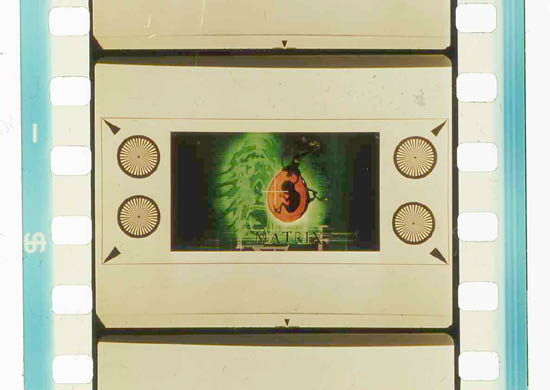
The rectangle whose corners the arrows point to outlines the area that is being used. (The artwork in the middle has no significance.)
Here is a Photoshopped example of how that same image would look like after conversion to anamorphic:
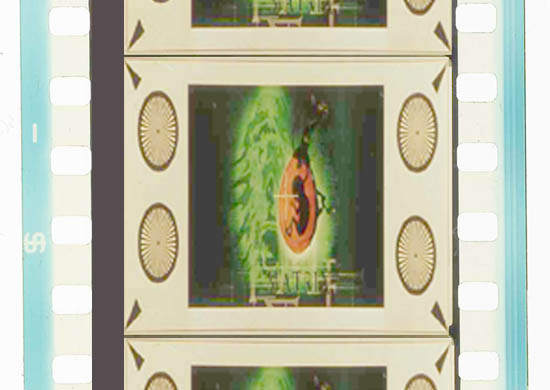
Nowadays it seems like as many as 2/3 of Scope format movies are Super 35 rather than true anamorphic. It's also possible to do Super 35 1.85 but that's rare. With digital intermediates however there may be renewed interest. In this case the original negative sees an increase in area so in theory the quality would be improved. For the 2.39 Scope format films it's a substantially smaller film area than real anamorphic and often the image quality suffers as a result.
Edit: Clarification added.
[ 12-20-2004, 11:43 PM: Message edited by: Steve Kraus ]
Posted by John Hawkinson (Member # 1135) on 12-20-2004, 01:06 AM:
Lemony Snicket's A Series of Unfortunate Events was Super 1.85, FYI. See the December American Cinematographer.
--jhawk
Posted by William Hooper (Member # 71) on 12-20-2004, 01:39 AM:
That's really interesting. Is only the leader, or all of it like that? So much of the frame is taken up with those registration targets or whatever those things are, that the image area is smaller than that for 1.85! I always thought the idea of S35 was to utilize the entire frame for image area to somewhat ameliorate the quality loss of not shooting anamorphic.
Posted by Leo Enticknap (Member # 534) on 12-20-2004, 02:04 AM:
quote: Steve Kraus
It's also possible to do Super 35 1.85 but that's rare. With digital intermediates however there may be renewed interest.
Why might digital intermediates revive the process? Because scanning a full-width 1.85 frame and then lasering out to a conventional one (which makes room for the soundtrack, and therefore covers a signficantly smaller surface area) loses less resolution than optically reduction printing it?
Posted by Monte L Fullmer (Member # 2797) on 12-20-2004, 02:55 AM:
Course, wasn't S-35 basically created for shooting a wide screen movie and not to lose the "depth of field" with using regular F/stop lenses, which was "the curse" with anamorphic lenses on cameras-anamorphic lenses not being able to capture the "depth of field" as with the regular(flat)lenses?
BTW: Steve, I check out your site with that screening room, and also the picts of the screening room with those 12, small JBL surrounds around the back half of the auditorium. Very impressive with all of this.
Question may I ask: would you say that if one was to design a home theatre configuration, would this be the most effective way in presenting surround sound in a confined space, as such as the size of this screening room, to not to "localized the surround information", yet carry the larger speakers behind screen, as so mentioned?
thx-Monte
Posted by Steve Kraus (Member # 476) on 12-20-2004, 06:50 AM:
I'm not sure, Monte. I didn't design this installation.
The reason DI (digital intermediate) might jumpstart Super 1.85 is...well basically, why not? If you know you are going DI then why not film composing the picture for full width (presuming you can get cameras with lens mounts centered that way and all lenses cover the full width). I'm not sure how advantageous the slightly greater width is with 2K DI but as 4K becomes more common I'm sure there will be a feeling that the negative "real estate" is paid for so might as well use it.
Without DI it's an optical printer blowup which conveys certain disadvantages and many would feel that it's not worth the bother (and expense) for the small increase in area. Some years back a camera rental house was touting the format claiming that the improvement was such that it made release prints look as sharp as dailies but I kinda doubt that was the case.
William: You can hardly use the entire frame top to bottom when you need a rectangular 2.39 shape. Yes, that is just a framing leader. Many films shoot a roll of focus target and then the editors will attach a dozen or so feet of positive print to the head of each roll of dailies (and of course does not focus the same as film fresh out of the processor LOL). The actual Super 35 footage would most often be full frame images with tons of surplus head and foot room. (In this particular case I was showing effects from 3 different effects houses; I don't recall the frame dimensions.)
I should mention that before DI an easy way to determine a Super 35 release print was the lack of negative splices (white lines at scene changes). The negative is cut and spliced before the blowup is done and since the optical printer camera is only photographing the 2.39 area it doesn't come anywhere near the physical splice so the frame line at scene changes looks like any other frame line. You can sometimes also tell from the leader if the leader masters were applied before the blowup there is a peculiar cropped and squeezed and off center look to them although that's not the case if the leader masters are applied after the blowup.
DI on the other hand often reveals itself, whether on Super 35 or any other format, by certain test patterns you may see in the tail leader although that will vary with who did the DI.
Posted by John Pytlak (Member # 331) on 12-20-2004, 08:44 AM:
Steve: Nice explanation of Super-35. ![[Cool]](cool.gif)
If a Digital Intermediate is going to be used for color manipulation or digital effects anyway, shooting 1.85:1 using the wider Super-35 negative area makes lots of sense. Since the area on the camera negative that ends up on the screen is 0.945 x 0.511 inches, instead of 0.825 x 0.446 inches, the graininess should be reduced. The added sharpness would likely require a 4K scan to fully appreciate.
http://www.cinesite.com/?1221&0&3821
quote:
2K, 4K or 6K scanning (35mm)and Datacine scanning (16mm) for Look Creation, Color Correction and Digital Answer Printing for all or a portion of Feature Films, Long Form Broadcast, Titles & Trailers. Mastering to all formats --Film, Video (HD, SD, DVD), and Digital Cinema.
THE PROCESS
With Cinesite's Digital Intermediate process, the interactive color-grading and image processing tools of the telecine suite are now available at the film level. The Digital Intermediate process starts with the digitizing (scanning) of select takes or the entire original negative @ 2K, 4K or 6K resolution. Utilizing a Northlight or Kodak's Lightning Scanners, film is digitized to 2K data files and loaded to a Spectre Virtual Datacine for more flexible realtime manipulation.
DIGITAL COLORIST
A skilled colorist, working with the filmmaker, grades the shots using a Pandora MegaDef or DaVinci color corrector. In addition to the basic RGB color timing controls of the traditional film color timing process, the colorist has the full range of primary and secondary color correction, including the ability to selectively grade individual elements within a shot. The colorist also controls image processing capabilities such as contrast, sharpness and grain. Using "power windows" the colorist can isolate and manipulate very specific areas of the frame to achieve a desired look.
EDITING/TIME FRAME
In creating the Digital Intermediate, an edit decision list (EDL) can be imported from an off-line editor and utilized to digitally conform live action sequences, optical effects and visual effects.
The Digital Intermediate also compresses the traditional time frame required for answer printing and telecine video mastering. A single scan produces a digital master file for both film record-out and for all video formats. Once the film version is color corrected, the video and digital cinema versions will need a "trim" pass, but essentially they are color-corrected.
THE OUTPUTS - FILM, VIDEO, DIGITAL CINEMA
The Digital Intermediate can be output to three formats.
Film: The file can be recorded to a film inter-negative (IN) or inter-positive (IP) using Kodak Lightning laser film recorders. This IN and/or IP will have all the scene-to-scene color grading applied to it, thereby simplifying the answer printing operations in the film lab. And, by producing an IP, one film processing stage can be eliminated. Cinesite can also apply a digital squeeze on the output, thereby producing an anamorphic IP or IN for widescreen release. Our tests have shown that this digital squeeze is substantially sharper than the traditional process of producing an anamorphic IN with an optical printer. Additionally Super 16mm can be digitally "blown up" to 35mm, providing a less grainy image than an optical blow up.
Video: The Digital Intermediate is also the starting point for creating the various videotape masters for multi-format release. Starting with the digital files from the film version, the colorist can quickly re-grade and re-format the files for the various video formats (HD, SD, DVD). This delivery path from digital files to film results in time and money saved and produces a higher quality image due to minimal film handling. The process of scanning film to data also produces higher resolution video.
Digital Cinema: The Digital Intermediate can also be output to a third format - a 24P playback source suitable for digital projection.
END-TO-END SOLUTION
After the Digital Intermediate process is complete, Cinesite also offers digital archiving of the digital files (color-corrected or uncolor-corrected) and traditional film archiving for the film negative and other components. If the client prefers, this can all be accomplished at PRO-TEK, Kodak's state-or-the-art ANSI standard (45%BA Fahrenheit, 25% humidity) facility in Burbank.
SUMMARY
Digital Intermediate depends on more than the hardware and software tools that enable it. The quality and consistency of the output images require a thorough understanding of the end-to-end (film/video finishing) process involving carefully implemented calibration and quality control procedures. With Kodak's color science behind Cinesite's innovation and service, the feasibility of the Digital Intermediate process is now a reality and has been proven in the pioneering "look-driven" films O Brother, Where Art Thou? and Traffic onto today's current releases. Films seeking more conventional color timing or specific fine tuning, such as the ground breaking Conspiracy: The Meeting at Wansee (an HBO film shot on 16mm, scanned once, color-timed and output to both video and film) and Open Range, have also benefited from the Digital Intermediate process.
Every project is unique, yet requires the highest quality images demanded by the filmmaker's vision. With Cinesite's adaptability, experience and sophisticated technology, this goal can now be achieved.
http://www.laserpacific.com/news_highlights/news_rels_17.htm
quote:
Eastman Kodak Company announced today that it will concentrate all of its digital intermediate and other postproduction services for the motion picture and television industries in North America here at LaserPacific, a wholly owned subsidiary that the company acquired last October. LaserPacific CEO and President Emory Cohen says that the extraordinary capabilities at Cinesite Hollywood will be centralized as part of LaserPacific in their ongoing effort to focus on innovation and service for customers. The facility plans to open a fourth state-of-the-art digital intermediate suite in a theater environment before the end of the year.
"By focusing our resources, we are better positioned to provide our customers with the latest advances in hybrid and digital technologies and services," says Eric Rodli, president of Kodak's Entertainment Imaging division. "Our primary goal is to enable filmmakers to more easily and efficiently control and manipulate the images they create from pre-production through post-production. The evolution of digital intermediate technology will help ensure that audiences experience films the way they are intended to be seen on cinema and TV screens."
Posted by Christian Volpi (Member # 2370) on 12-20-2004, 08:59 AM:
I should probably know this after being in this business for almost 9 years but why are some prints scope and others flat?
Posted by John Pytlak (Member # 331) on 12-20-2004, 09:09 AM:
quote: Christian Volpi
I should probably know this after being in this business for almost 9 years but why are some prints scope and others flat?
"Scope" prints are used for the 2.39:1 aspect ratio, and allow much more efficient utilization of the area on the frame, but a 2X anamorphic lens is required to "unsqueeze" the image. "Flat" is normally used for 1.85:1, and is not nearly as efficient, but does not require an anamorphic lens.
Some tutorials:
Scope and Flat
http://www.widescreenmuseum.com/widescreen/lobby.htm
http://www.widescreenmuseum.com/widescreen/squeeze.htm
http://www.film-tech.com/manuals/H5041.pdf (article about advantages of "Scope" format)
Posted by David Stambaugh (Member # 1102) on 12-20-2004, 09:28 AM:
jhawk: Thanks for that link.
Posted by Steve Kraus (Member # 476) on 12-20-2004, 10:00 AM:
Under Technical Specs the AC article includes the ridiculous statement:
Super 1.85
(Super 35mm 2.35:1 for 1.85:1 extraction)
Um...what the hey does 2.35 have to do with anything? Just say Super 35mm for 1.85 extraction and be done with it.
Posted by Steve Guttag (Member # 268) on 12-20-2004, 10:46 AM:
M. Night films tend to Super-35 1.85.
Steve
Posted by Monte L Fullmer (Member # 2797) on 12-20-2004, 02:04 PM:
Okey, here's another goodie of a question:
First, we had 2.66/1 (full frame image without soundtrack. Prints using external mag dubbers)
Second, we had 2.55/1 (full frame with 4trk mag only. no optical)
Third, we had 2.35/1 (full frame with full soundtrack. optical with standard sprocketholes and mag/optical using the "fox" sprockethole arrangement)
Where did 2.39/1 come into play? Just the decision to file out the aperture a bit more?
-thx Monte
Posted by Lyle Romer (Member # 1266) on 12-20-2004, 02:41 PM:
I always thought that the 2.39 came about (after 2.35) from adding more masking to the top and bottom of the frame to hide framelines/splices. Correct me if I'm wrong.
Posted by Bobby Henderson (Member # 840) on 12-20-2004, 02:45 PM:
quote: Steve Kraus
Some years back a camera rental house was touting the format claiming that the improvement was such that it made release prints look as sharp as dailies but I kinda doubt that was the case.
I remember the ads Clairmont Camera ran in issues of American Cinematographer back in the late 1980's specifically touting Super 1.85.
One area where Super35/Super 1.85 can do pretty well is in 70mm blow up prints. I remember how much better 70mm prints of shows like "The Abyss" looked versus their 35mm counterparts.
Posted by Steve Kraus (Member # 476) on 12-20-2004, 03:23 PM:
Lyle is correct. The height was reduced slightly to reduce appearance of negative splices. There were more changes over the years than in Monte's list but those are the major ones. I don't know how widely the double system 2.66 : 1 system was ever used.
Posted by John Pytlak (Member # 331) on 12-20-2004, 04:10 PM:
Here's the history of the "Scope" projectable image area:
http://www.widescreenmuseum.com/widescreen/apertures.htm
quote:
From 1957 through today, there have been a number of small changes to the anamorphic projector aperture recommended standards. John P. Pytlak of Eastman Kodak dug through countless back issues of the SMPTE Journal in order to provide the following chronology of the changes to the standards:
The March 1957 SMPTE Journal has PH22.104-1957, the standard for 2.55:1 anamorphic (no optical track), with an aperture size of 0.912 X 0.715 inches. Notice of withdrawal of this standard was in the January 1964 Journal.
The December 1957 SMPTE Journal has PH22.106-1957 for 2.35:1 anamorphic, with an aperture of 0.839 X 0.715 inches. It was unchanged in the September 1964 Journal. The November 1965 SMPTE Journal published PH22.106-1965 still with the 0.839 X 0.715 aperture size.
In the September 1970 SMPTE Journal, a new draft of PH22.106 was proposed, with an aperture size of 0.838 X 0.700 inches, to minimize the flashes at splices. This was republished as standard PH22.106-1971 in the October 1971 issue.
In the June 1976 SMPTE Journal, the two (flat and scope) projectable image area standards (PH22.58 and PH22.106) were consolidated into one standard and renamed PH22.195. The publication of PH22.195-1984 in the October 1984 Journal still had the scope area as 0.700 X 0.838 inches.
The June 1992 SMPTE Journal published a proposed revision, with a scope area of 0.690 X 0.825 inches. In August 1993, the standard was published as SMPTE 195-1993, with the current area of 0.690 X 0.825 inches. So August 1993 is when the two formats became the same width of 0.825 inches.
John P. Pytlak
Posted by Dominic Case (Member # 1830) on 12-20-2004, 05:00 PM:
quote:
So much of the frame is taken up with those registration targets or whatever those things are, that the image area is smaller than that for 1.85!
The frame that Steve posted may have been misleading: WIlliam Hooper is right that
quote: William Hooper
the idea of S35 was to utilize the entire frame for image area
. In fact Super 35 does indeed use the full width of the frame (perf to perf) as indicated by the little arrows pointing to the four extreme corners of the frame. It's not just the area of the smaller image in the test frame shown.
When a super 35 frame is reformatted for anamorphic theatrical prints, the top and bottom quarters of the image on the negative are cropped (as the image is stretched to nearly double height and squeezed in just the 10% to clear the soundtrack area). This pays off when these shows are transferred to TV or video in a 4x3 format, as the telecine can zoom out a little to include some of the cropped top and bottom, reducing the need to crop left and right so much in the pan and scan. It's a compromise though, as keeping that top and bottom area clear of mike booms and cables has some penalties.
The other benefit of S35 - using spherical lenses on the camera - is that you can use better lenses. Asking one optic to be anamorphic and be capable of zooming, focussing well at a wide range of distances, and reasonably fast, is a big ask. At least by taking the squeezing function away and putting it onto a fixed optical printer (or now, you can make it a digital function), you can get better lenses on the camera.
The point of using full width of the negative is simply that you can. With conventional 1.85:1 or anamorphic pictures, you contact print everything, so neg and print must be indentical. Once you go to an optical or digital duplication porcess, you are liberated from that. So Steve's point that DI might boost Super 35 is a good one.
Posted by Paul Vollmers (Member # 927) on 12-20-2004, 05:22 PM:
If you can use better lens on Super 35.........why then does the projected picture look somewhat grainy etc. ?
Paul--
Posted by Bobby Henderson (Member # 840) on 12-20-2004, 06:17 PM:
The grain in Super35 tends to be more noticeable because it is being blown up both vertically and horizontally. In true anamorphic 'scope, you only have the horizontal axis expanded.
I liken the difference between true 'scope photography and Super35 to the difference between anamorphic enhanced and non-anamorphic enhanced DVDs. A 16x9 enhanced DVD looks pretty good on a widescreen TV, whereas the image quality on non-anamorphic DVDs like "The Abyss" tends to look like crap.
Posted by Mark Gulbrandsen (Member # 72) on 12-20-2004, 07:58 PM:
quote: Bobby Henderson
One area where Super35/Super 1.85 can do pretty well is in 70mm blow up prints. I remember how much better 70mm prints of shows like "The Abyss" looked versus their 35mm counterparts.
Bobby, you should see Super 35 dailies if you want to see just how good it can look(or how bad). True Lies dailies looked like it was being run in 70mm. Ultra sharp and great depth of field... almost looked as good as VistaVision.
Mark
Posted by Phil Hill (Member # 371) on 12-20-2004, 08:03 PM:
quote: Bobby Henderson
The grain in Super35 tends to be more noticeable because it is being blown up both vertically and horizontally. In true anamorphic 'scope, you only have the horizontal axis expanded
I agree with Bobby... Super 35 is a waste. If ya wanna use it, shoot 3-perf.
Posted by Mark Gulbrandsen (Member # 72) on 12-20-2004, 08:07 PM:
Phil,
3 perf is used alot for TV filming today. I don't know why it hasn't really caught on for feature work....
Mark
Posted by Phil Hill (Member # 371) on 12-20-2004, 08:13 PM:
I know Mark. I haven't got a clue as to why the "feature boys" have not bought into 3-perf. I mean, if ya want crap, It make lots more sense than Super 35.
Posted by Peter Mork (Member # 1336) on 12-21-2004, 07:12 AM:
quote: Mark Gulbrandsen
Bobby, you should see Super 35 dailies if you want to see just how good it can look(or how bad). True Lies dailies looked like it was being run in 70mm. Ultra sharp and great depth of field... almost looked as good as VistaVision.
Relating to this: I once read that long ago all release prints were made from the actual camera negative; I believe King Kong was used as the example. Those prints must have looked superb. I wonder if anyone would dare do this today? (Of course, you couldn't use Super 35 or anything like it, and you'd have to time each print but that is easy to do.)
Posted by John Pytlak (Member # 331) on 12-21-2004, 07:41 AM:
It is foolhardy to make more than a few prints from the cut original negative. Once the final answer print is approved, any wet gate master positives should be made (for making the duplicate negatives used for release printing, video transfer, and for preservation), as well as any B&W silver separations (used for archival keeping). If a continuous contact printer is used, optimum steadiness and sharpness is obtained by making the master positives on long pitch (e.g., DH-1870 perforations) stock, and using a pin-registered step printer to make the duplicate negatives. The cut negative should then go into a long term film storage facility.
Kodak has an online interactive tutorial about "The Motion Picture Imaging Chain":
Motion Picture Imaging Chain
The biggest risk in printing the cut original negative is that one of the hundreds of splices may fail, and printing does entail some cumulative risk of scratching and embedded dirt.
Fortunately, modern duplicating stocks like KODAK VISION Color Intermediate Film allow making duplicate negatives that produce release prints almost indistinguishable from direct prints:
KODAK VISION Color Intermediate Film
quote:
For the filmmaker, these intermediate films help to preserve all the sharpness, clarity, and color of the original images and carry them more faithfully to the final display screen.
For the laboratory, VISION Color Intermediate Films enable the production of printing elements that are closer in quality to the look of a print made directly from the original negative.
Postproduction facilities will appreciate the features of the VISION Color Intermediate Films, especially improved sharpness for digital output. They're the choice for production of masters for theatrical re-release, video and DVD release, satellite, cable or broadcast TV presentation - or use in any media of the future.
And, audiences will also see the difference - in movies that tell stories with fewer distractions, films with fewer physical imperfections.
KODAK VISION Color Intermediate Films. They're the final link in the motion picture production chain. The bridge that carries all the quality of the original to the final print. And, they're the first intermediate films worthy of the KODAK VISION Film family name.
Posted by Lyle Romer (Member # 1266) on 12-21-2004, 10:27 AM:
This may be a stupid question but:
What types of splices are done on the camera negatives? I would think that a normal tape splice would show some kind of line or something on duplicates.
Posted by Steve Kraus (Member # 476) on 12-21-2004, 10:39 AM:
AFAIK they are still hot splices with solvent cement. Negs are still mostly on acetate stock which why this is still possible. The alternative with polyester stock would be ultrasonic. Can John or Dominic verify?
Posted by John Pytlak (Member # 331) on 12-21-2004, 02:15 PM:
Almost all camera original film is still on triacetate base, and cement splices are used. Polyester (ESTAR) base is used for some specialized applications (very high speed cameras, filming in outer space).
Posted by Stephen Furley (Member # 1277) on 12-21-2004, 02:41 PM:
quote: John Pytlak
filming in outer space
Why?
Posted by John Pytlak (Member # 331) on 12-21-2004, 02:45 PM:
The IMAX Corporation used ESTAR base Kodak camera films for some of their movies about the shuttle and space station. Polyester maintains its physical characteristics over a wider range of temperature, and the thinner polyester base allows longer lengths of film to fit in the camera magazines, reducing the need for reloading.
Posted by Stephen Furley (Member # 1277) on 12-21-2004, 03:25 PM:
Thanks John.
Posted by Dominic Case (Member # 1830) on 12-21-2004, 04:37 PM:
quote:
I once read that long ago all release prints were made from the actual camera negative;
Totally impractical with the release print runs today. Some show prints are made from the original negative, but the printer must run a lot slower to accomodate the grading (timing) light changes for every shot. For a big modern feature you'd still be waiting for your prints! Previously, print orders were very much less, and (as John points out) dupe stocks are much better now. In those days you would do anything you could think of to avoid having to duplicate.
I believe that many Indian (Bollywood etc) films are printed from the original negative. They tend to go for much smaller print runs (maybe 100 copies) which then go from theatre to theatre. It's a cost-saving thing as well.
Posted by Bobby Henderson (Member # 840) on 12-21-2004, 07:05 PM:
Very obviously, protection of the O-neg is one area where digital intermediate processes can have some advantage. Your original is a digital file that can be perfectly duplicated many times. Unfortunately, most DI work is at resolutions of 2K or HD res; not on par with a 35mm camera negative.
Hopefully higher standards like 4K, 6K and higher can take hold. Computer processing power and storage capacities have been making great leaps just over the last few years and will continue to bound forward. That's making those better standards much more feasible. The trick though is getting the bean counters at the film studios to use the improving computer power to make movies look better instead of doing standard 2K work even more fast and cheap.
Posted by Peter Mork (Member # 1336) on 12-22-2004, 03:24 AM:
quote: Dominic Case
Totally impractical with the release print runs today.
Well, let me reframe my question. What if you were doing a smaller run, 100 prints or so. Your goal is to get prints with tip-top sharpness, contrast, etc. like those famous dailies. Any effects you want, you do them optically and splice them in with the camera original like they used to do (so if you watch old movies, you can always tell when a dissolve is about to happen because the image suddenly gets a little more unsharp and contrasty).
Of course, you want the lab to be gentle with your Work of Art, but you aren't fussy about normal wear and tear and are willing to accept imperfections that may show up on some prints and even the chance that something bad could happen and a splice or two may have to be made.
Question now is, if you took this job to a modern lab (outside of Bollywood) would they be game or would they give you funny looks, like "you must be nuts, NOBODY does that", etc., along with a song-and-dance about how prints from internegatives look just as good and similar tommyrot?
Posted by John Pytlak (Member # 331) on 12-22-2004, 05:55 AM:
quote: Peter Mork
Question now is, if you took this job to a modern lab (outside of Bollywood) would they be game or would they give you funny looks, like "you must be nuts, NOBODY does that", etc., along with a song-and-dance about how prints from internegatives look just as good and similar tommyrot?
I would still urge that protection masters and B&W separations be made right after the answer print is approved. But if the filmmaker realizes the risks of making a hundred or more prints from a cut negative, that's their decision. The cost of each print will be much greater, since they will require a slow printing speed (the need to make scene-to-scene color changes each pass through the printer), and likely would be on a wet-gate printer.
Posted by John Hawkinson (Member # 1135) on 12-22-2004, 08:09 AM:
Hmm; that brings to my mind a question: at what point does it actually become cheaper to use an IP/IN with high-speed printing than to make all prints direct from the o-neg?
I'm sure that accurately calculating that depends on proprietary information from labs, etc., etc., but is the ballpark likely to be in the tens, hundreds, or thousands of prints? [Alternatively, I guess the question could be interpretted as asking what the relative cost of time is on a slow aperture-changing printer versus a high-speed one-light printer.]
While I'm at it, here's another: Looking at Kodak's documentation of the ECP-2D process, it looks like most of the speed-related difficulties involve application of viscous soundtrack redeveloper at high speeds. Is that the limiting factor? Will we see even higher speed printing (with or without a quality change?) with cyan dye soundtracks?
--jhawk
Posted by John Pytlak (Member # 331) on 12-22-2004, 09:19 AM:
quote: John Hawkinson
While I'm at it, here's another: Looking at Kodak's documentation of the ECP-2D process, it looks like most of the speed-related difficulties involve application of viscous soundtrack redeveloper at high speeds. Is that the limiting factor? Will we see even higher speed printing (with or without a quality change?) with cyan dye soundtracks?
Soundtrack developer application is a quality and environmental issue, but not usually the limiting factor for higher speed processing. Today's high speed machines usually use a hopper or extrusion type applicator for the viscous soundtrack developer, rather than the wheel-type applicators used on slower machines. The real issues in attaining higher processing speeds are the liquid "drag" of the film going though the processing solutions, and controlling the carry-over of solutions from one tank to another in the machine. Another issue is the laminar layer of solution that forms on the film at higher speeds, which makes it more difficult to assure good solution agitation at the emulsion surface. Oxidation of the developer by air bubbles drawn into the solution by the moving film also needs to be controlled in the fast machines.
Printing speed is not affected by the type of analog soundtrack used.
quote: John Hawkinson
...at what point does it actually become cheaper to use an IP/IN with high-speed printing than to make all prints direct from the o-neg?
The cost of making a duplicate negative is usually offset by the greater efficiency at only a few dozen prints. Not to mention minimizing the risk of damaging the original cut negative, which contains the entire value of the production. I wouldn't be surprised if production insurance companies specify that protection masters be made.
Posted by Leo Enticknap (Member # 534) on 12-22-2004, 10:28 AM:
quote: Dominic Case
I believe that many Indian (Bollywood etc) films are printed from the original negative.
Wasn't there a query posted on the AMIA list way back by an Indian DoP who'd had the cut camera negative of quite a well-known Bollywood epic Scotchgarded after it had virtually fallen to bits as the result of having had around 300 release prints contact struck directly off it? However much the propsect of either action (release printing off a camera neg or Scotchgarding it) would make any archivist shudder, one thing's for sure: those prints must have been among the clearest and sharpest ever shown in a theatre.
quote: Dominic Case
They tend to go for much smaller print runs (maybe 100 copies) which then go from theatre to theatre. It's a cost-saving thing as well.
That used to be what happened in Britain. I've seen an article in a trade paper from 1946 in which the manager of a lab stated that a typical print run for a Hollywood A-picture in Britain was 40-50 prints. He further wrote that this figure hadn't been significantly affected by the war. If you think of the use those prints must have got, in the days when cinemas changed their programmes twice weekly and there were 4,000 to 5,000 screens in the UK, the standard of film handling in projection boxes must have been very high for prints to withstand that pattern of usage (even though nitrate, when new, was a lot tougher and more scratch-resistant than triacetate).
Posted by Stephen Furley (Member # 1277) on 12-22-2004, 12:55 PM:
London alone was three release zones; even in my time, in the '60s there were still two. I doubt if I ever saw a 'new' print, i.e. one at its first theatre, as all of the films would have been running in North London the previous week. Some cinemas even ran the newsreel from the previous week. The prints always seemed to be in very good condition.
Posted by Dominic Case (Member # 1830) on 12-22-2004, 07:15 PM:
quote: Peter Mork
Question now is, if you took this job to a modern lab (outside of Bollywood) would they be game or would they give you funny looks
They'd probably discuss just how many you really needed to be off the original, but the bottom line is . . . the bottom line. Most labs have a price for prints off original neg, and a price for prints off a dupe neg. AS John says, it costs more off original because it's a slower printer, wetgate, with light changes etc. But you'd have to look carefully at the price point for each lab, there's probably no general answer to the question of how many prints off a dupe you would need, to save he cost of the dupe.
I'd always recommend very strongly making a safety IP before going with many prints off the original neg.
quote: Peter Mork
(so if you watch old movies, you can always tell when a dissolve is about to happen because the image suddenly gets a little more unsharp and contrasty).
Dissolves were printed optically, but only for the duration of the dissolve (I guess there was a cost factor as well), thereby necessitating a cut from original neg to dup neg in mid-shot. Earlier dupe stocks were quite bad and this drew attention to the cut. The jump in graininess is compounded when you see a newer print from these old negs, because the original neg and the optical dupeneg have invaribly faded differently. When dupe stocks got better, it became usual to do the entire shot as an optical effect.
Posted by Stephen Furley (Member # 1277) on 12-23-2004, 02:46 AM:
When optical printing you could save one generation by using CRI, but then you would be causing problems for the future due to its much worse fading.
Have there been any films in recent times which wave done optical effects in camera on the origiinal negative?
Posted by Leo Enticknap (Member # 534) on 12-23-2004, 03:37 AM:
If our collection is anything to go by, TV and documentary drama made the most extensive use of CRIs, probably because they needed to introduce opticals which required the extra generation, but only needed one TX print and final mix track (usually sepmag - they'd only make a sound neg and combined print if the programme was being shown at a festival or something) as the end product.
And yes, most of our CRIs are gruesomely faded. When this material is requested by clients we normally TK the TX print if it survives, for obvious reasons.
Powered by Infopop Corporation
UBB.classicTM
6.3.1.2