This is topic Help needed in identifying a test film in forum Film Handlers' Forum at Film-Tech Forum ARCHIVE.
To visit this topic, use this URL:
https://ft-forum.com/ft/cgi-bin/ubb/ultimatebb.cgi?ubb=get_topic;f=1;t=006799
Posted by Luciano Brigite (Member # 1104) on 12-24-2004, 06:45 PM:
Hello,
After a long time trying to get new test films for me,I finally got them.However when I received the reels, instead of getting this test film (picture bellow) :

I received this one:
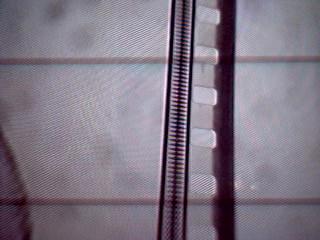
I have no idea what it is, if it's another kind of test film for optical alignment of analog readers or some other kind of test tone .
Could someone point out what it is and in case it is another kind of alignment film for optics, how it is used?
I tried to use it to align lateral position of a sound reader but couldn't do much with it and didn't get more than the cell reading picture edges or perforation ![[Frown]](frown.gif)
Thanks.
Posted by Steve Guttag (Member # 268) on 12-24-2004, 07:08 PM:
The upper film looks like the original style "Buzz-Track" aka P35-BT.
The lower film is 1KHz tone...aka P35-SL
Steve
Merry X-Mass
Posted by Luciano Brigite (Member # 1104) on 12-24-2004, 07:28 PM:
Uh oh..
I received the wrong film then and it had to be the film that was more expensive.. I ordered buzz track and got 1KHz tone.. ![[Roll Eyes]](rolleyes.gif)
Now what to do with it....umm.. maybe I should hang it around the xmass tree ![[Razz]](tongue.gif) kidding..will see if I can exchange it for the film I originally ordered.
kidding..will see if I can exchange it for the film I originally ordered.
Thanks Steve.
and a merry xmass to you too. (and to everyone else too!)
Posted by Christos Mitsakis (Member # 143) on 12-25-2004, 08:28 AM:
It is strange that the original "buzz track" had modulation only on the left channel side, so I suppose you set the scaning beam by reading that modulation and the one "produced" by the sprocket holes, adjusting the slit to project right inbetween.
There is nothing much nowdays to do with a 1KHz mono track. This test film is of archival significance. Steve, what was its original use anyway?
Best Wishes, and All my Seasons Greetings to All.
Christos.
Posted by Gordon McLeod (Member # 33) on 12-25-2004, 12:48 PM:
"It is strange that the original "buzz track" had modulation only on the left channel side, so I suppose you set the scaning beam by reading that modulation and the one "produced" by the sprocket holes, adjusting the slit to project right inbetween."
Not true there is a high frequency tone on the perf edge
Posted by Monte L Fullmer (Member # 2797) on 12-26-2004, 03:09 AM:
...looks like more of a DTS test/alignment strip of sorts, being the signal is on the inboard edge of the soundtrack. - Monte
Posted by Steve Guttag (Member # 268) on 12-26-2004, 09:19 AM:
As Gordon sez...
The Buzz track test film (original style) did indeed have both tones. The photo didn't do it justice by resolving the higher pitched tone (finer resolution needed). It had gard bands, unlike the current version so you see the solid line outside of the square wave signals.
The 1KHz film was used primarily for balancing the level between two or more projectors. This was long before the 85dB thing and Dolby. However, you would want the two machines balanced on changeover.
Another use for 1KHz is that it makes for easy projector speed calibration or checking...just thread up some 1KHz and hook up a frequency counter to the sound system and whola. I found it easy to use for setting other speeds for silent film projection too...sure one can use a "strobe" on the shutter or sprockets but I liked the film the best.
We have a stash of P16-SL (400Hz tone and 16mm)...and still use it to balance the sound on 16mm changeover. It also is recorded at 100% modulation (or thereabouts) so balancing the 16mm levels to 35mm is a bit more precise and predictable before the first 16mm feature is shown.
Steve
Posted by Michael Schaffer (Member # 1204) on 12-26-2004, 09:30 AM:
quote: Monte L Fullmer
...looks like more of a DTS test/alignment strip of sorts, being the signal is on the inboard edge of the soundtrack. - Monte
Actually the DTS reader alignment film looks very different from this. But you cannot buy it, so chances are slim that you will ever see it. In the place of the DTS timecode, it has - nothing. Outside the TC area, there are parallel bars which are at 90° to the direction of film travel. They are offset so that when you have a bar on the inside, you don't have one on the outside, and the other way around. The idea is to look at the signal on the scope and then adjust for minimum signal because the bars and spaces on opposing sides will ideally cancel each other out, basically a buzz track derived concept. The difference is that the two alignment tracks are read at the same time and summed, but the same concept of having nothing in the scanning area is the same.
Luciano - you can order the buzz track directly from the SMPTE website, they also ship to Brazil. When you get the film through a dealer, they do the same thing and mark it up. So just go there and order it yourself.
Posted by Gordon McLeod (Member # 33) on 12-26-2004, 09:46 AM:
Steve was the old SMPTE 1k recorded at 100% mod?
Posted by Luciano Brigite (Member # 1104) on 12-26-2004, 11:13 AM:
I tried to scan both films but all I got was a black bar ,I don't have a film scanner,then I took the two pictures by placing the films against the computer monitor and taking a shot with the webcam that's why the high tone isn't showing .that's the leftover of my last loop of buzz track,cracks and some sprocket damage can be seen too. The second picture is what I got instead of buzz track 15Ft of a film that has no use for me and a nice loss of some good $$
Posted by Christos Mitsakis (Member # 143) on 12-26-2004, 11:43 AM:
Thank you Steve and Gordon, the photo doesn't show enough details (I admit, at first sight I took it as a leader with DTS code start).
On a domestic print I found a tail end with a 400Hz dual lateral track at 50% modulation, apparently for level settings (and yes I did make a loop of it, regardless that I don't use it for this purpose). Dolby tone on a print tail is a rare occasion, but something that I saw once.
Christos.
Posted by John Hawkinson (Member # 1135) on 12-26-2004, 11:58 AM:
Steve, my experience was the 1k tone was not a very good frequency reference -- I don't remember exactly how far off it was, but I seem to recall that, in comparison with a strobe, the 1k tone was off by almost 100Hz [Edit: This is wrong. See my later post. It's more like 20Hz]. At the time, I concluded this was because the 1k tone was intended as a gain calibration tool but not a frequency calibration tool. Was I wrong, or did I have a bad batch of 1k tone?
Of course, it is still useful for relative frequency measurements, or if you know what the actual frequency of the tone is...
--jhawk
[ 12-27-2004, 11:06 AM: Message edited by: John Hawkinson ]
Posted by Tim Reed (Member # 137) on 12-26-2004, 12:15 PM:
John, the tone was for balancing two (or more) reproducers in a changeover environment. It wasn't even used to set them to a specific level, only to make them the same.
Posted by Steve Guttag (Member # 268) on 12-26-2004, 09:34 PM:
Gord,
I don't believe that the 1K tone (P35-SL) was recorded to a 100% level or a specified level (in the instruction document).
As to its accuracy...it was not off by 100Hz (in the batches I used). I think it came in at somewhere around 997 at its worst...and closer to 1K most of the time.
That said...one should always (and I think Mark G. will back me on this one) try to verify one's test materials and equipment. For instance...Cat. 69...no two batches have ever been the same, B&W or color....however much of the color stuff has had some significant problems (poor HF response...so-so balance on the tones). We even documented this for Dolby with an R-2 analyzer and comparing various B&W batches to the color batches...their response was less than enthusiastic, in my opinion though I believe they did make a correction to Cat 69P to deal with the excessive HF roll-off in response. That is one of the problems of private materials...they are only as good as the name on them. It also raises questions that if their test film is all over the place...what about the prints themselves...do the test films represent them?
Here is another one...USL used to make TT-1...it looked like the old Cat. 69 (B&W) both Dolby and USL used NTAV to make their films...the level balance and azimuth didn't agree with each other. USL's TT-1 had a benefit that their PN was recorded higher
But back to the 1KHz film...with Cat. 69...so long as one uses the same film for both machines...if you were running mono one could balance two projectors. If the theatre had Dolby Stereo...then setting the Dolby-Level meters would also have the machines bananced...thereby leaving P35-SL with no need.
Now the Azimuth and Focus films by SMPTE (5K and 9K) did continue. For setting up a mono system...the 9KHz could allow one to set focus and azimuth rather quickly and easily with nothing more than a good booth monitor or possibly a VOM.
Now that virtually all are stereo...they too are no longer needed or made.
Steve
Posted by Tim Reed (Member # 137) on 12-27-2004, 07:55 AM:
quote: Steve Guttag
We even documented this for Dolby with an R-2 analyzer and comparing various B&W batches to the color batches...
Better watch your step, you're walking a line very close to heresy. My friend, the Great One from Massachusetts -- whose name this forum's software won't let me mention -- was onto this years ago.
Posted by Richard Fowler (Member # 893) on 12-27-2004, 09:44 AM:
The SMPTE 9KHZ is out of stock and has been for a couple of years. I have clients who still prefer to have this film as part of their kit....
Posted by John Hawkinson (Member # 1135) on 12-27-2004, 11:05 AM:
Sigh. I said, " I don't remember exactly how far off it was, but I seem to recall that, in comparison with a strobe, the 1k tone was off by almost 100Hz". That'll teach me to trust my memory.
Steve replied, "As to its accuracy...it was not off by 100Hz (in the batches I used). I think it came in at somewhere around 997 at its worst...and closer to 1K most of the time.."
I seem to be having trouble interpretting my fragementary notes from when I did this, but it looks like the 1k tone I had was somewher around 982Hz. Sorry for any confusion.
--jhawk
Posted by Gordon McLeod (Member # 33) on 12-27-2004, 11:13 AM:
Tim almost everyone who did any large amount of alignments has been aware of the issues with the pinknoise and tone inconsistancies for a very long time long before the unamed wrote his article
Posted by Michael Schaffer (Member # 1204) on 12-27-2004, 01:58 PM:
quote: Steve Guttag
For instance...Cat. 69...no two batches have ever been the same, B&W or color....however much of the color stuff has had some significant problems (poor HF response...so-so balance on the tones)
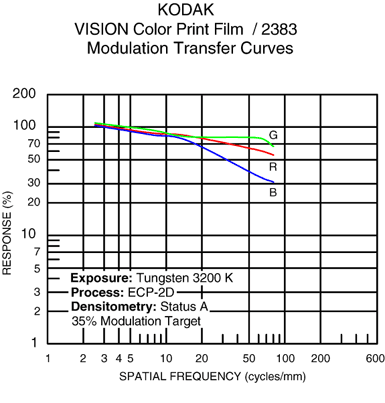
Why is that? I understand why the absolute level can drift on both b&w and color stock and therefore affect the level setting, but isn't HF response irrespective of the level and only a matter of optical resolution? Or is that the problem, that the films are simply not printed with enough detail resolution in the HF area anymore?
Posted by John Pytlak (Member # 331) on 12-27-2004, 02:17 PM:
quote: Michael Schaffer
Why is that? I understand why the absolute level can drift on both b&w and color stock and therefore affect the level setting, but isn't HF response irrespective of the level and only a matter of optical resolution? Or is that the problem, that the films are simply not printed with enough detail resolution in the HF area anymore?
HF response is also a function of exposure (which also affects distortion) and slippage in the printer. On a color print film, the topmost (magenta) imaging layer is the sharpest, with the middle (cyan) layer close behind. The bottom (yellow) layer is the least sharp and most grainy, and is not used for analog soundtracks. Here is the MTF curve for Kodak VISION Color Print Film 2383:
http://www.kodak.com/US/en/motion/products/print/2383.jhtml?id=0.1.4.8.4.7&lc=en
Posted by Steve Guttag (Member # 268) on 12-27-2004, 02:19 PM:
I am not familiar with Dolby's process or quality control procedures with their test films to comment on why they have poor batch to batch consistency. That is a question for them.
I can only state that they do not have good consistency and as you may have read already, we are not the only ones to have noticed and measured it.
You compare that to say 35-PA and P35-BT from SMPTE where they are camera orignal films that are measured. Note too that the cost of a Dolby test film is substantially less than either of the films from SMPTE. Even Schneider's target film is near SMPTE's price and is pretty darn consistant from batch to batch.
I have not located any test film documentation on the SMPTE P35-SL (other than catalog pages). Maybe our document master, John Pytlak has the instruction documents on P35-SL and the method of its manufacture.
As a side note, The outboard (high) "tone" on P35-BT (Buzz track) is supposed to be 1KHz.
Steve
Posted by John Pytlak (Member # 331) on 12-27-2004, 02:43 PM:
I can not find a Recommended Practice specifying P35-SL. A sample I have has a peak-to-peak excursion of 1.50mm out of the scanned width of 2.13mm specified by SMPTE 40. The width of the clear area on the P35-SL track I have measures 1.93mm, which agrees with SMPTE 40 (D-C = 7.14-5.21 = 1.93mm)
Posted by Gordon McLeod (Member # 33) on 12-27-2004, 03:07 PM:
I have often wondered why pink noise and 50% mod tone could not be recorded as a full width Mono VD track at 50% modulation and the negaive be used as the finished test film as a vd track at 50% mod should be identical to the print in density?
Being a full width mono azimuth should be mutch easier to attain as well
Powered by Infopop Corporation
UBB.classicTM
6.3.1.2