This is topic How did 24 frams a sec. come about???? in forum Film Handlers' Forum at Film-Tech Forum ARCHIVE.
To visit this topic, use this URL:
https://ft-forum.com/ft/cgi-bin/ubb/ultimatebb.cgi?ubb=get_topic;f=1;t=006820
Posted by Eric Webb (Member # 2772) on 01-01-2005, 03:28 AM:
I've heard different stories on how it might have came about but i have been researching it and haven't found the answer
Does anybody have any ideas??
Posted by Jeffry L. Johnson (Member # 453) on 01-01-2005, 11:00 AM:
Scott Eyman's "The Speed of Sound : Hollywood and the talkie revolution
1926-1930" states on page 112:
quote:
The speed of the film bearing the sound track had been standardized at 90 feet a minute, 24 frames a second. Although tradition has had it that 90 feet a minute was the optimum speed for the quality of sound reproduction, the fact of the matter was that, originally, Earl Sponable and Theodore Case had been experimenting with a speed of 85 feet a minute, which appears
to have worked satisfactorily. As Sponable said, "After our affiliation with the [Fox company] this was changed to ninety feet a minute in order to use the controlled motors already worked out and used in the Vitaphone system."* The standardization, then, was not made for purposes of sound quality, but for maximum profits for Western Electric.
* Western Electric engineer Stanley Watkins averred that 24 frames per second for Vitaphone was not part of a capitalist plot, but a purely arbitrary decision. "According to strict laboratory procedures, we should have made exhaustive tests and calculations and six months later come up with the correct answer," he related in 1961. "What happened was that we got together with Warners' chief projectionist and asked him how fast they ran the [silent] film in theaters. He told us it went at eighty to ninety feet per minute in the best first-run houses and in the small ones anything from one hundred feet up, according to how many shows they wanted to get in during the day. After a little thought, we settled on ninety feet a minute as a reasonable compromise."
Posted by Gordon McLeod (Member # 33) on 01-01-2005, 11:01 AM:
According to Erpi it was the average speed that was measured in several downtown Chicago booths that the projectors were being cranked at
Posted by Randy Stankey (Member # 64) on 01-01-2005, 08:06 PM:
As with many things, people just make it up as they go.
When somebody who invents a machine starts out they make their best educated guess as to how it should work and they try it out in real life. If it works they keep doing it. If it doesn't they modify their original design and try again. After several "design-test" cycles, the resulting machine may or may not resemble the original design at all.
The way I tell it is:
Thomas Edison pretty much arbitrarily decided that movie film would move at 60 feet per minute and 12 frames per foot. (12 frames per sec.) Nice, round numbers. After some experimenting, Edison (and all the other people who helped invent motion pictures) it was decided that 12 frames per second sucked because the picture was too jerky. (Too low frame rate.) It was cranked up to 16 frames per second.
Aside for some adjustments in the size of the frames on the film, movies stayed pretty much at 16 fps for a while, until they started trying to add sound to the films. After several more rounds of experimentation, movies were cranked up to 24 fps and 90 ft/min.
And, there it has stayed ever since. It probably will stay like that until the next big "revolution" in film making... which will probably be the "Digital Revolution". But that won't be for at least another 10 years. (IMHO)
Posted by Mike Bianchi (Member # 271) on 01-01-2005, 09:03 PM:
... and if it ain't broke, don't fix it. 24 frames /48 images per second works well for the principle of persistance of vision, enough for the eyes to trick the brain into believing it is a constant motion.
Posted by Monte L Fullmer (Member # 2797) on 01-02-2005, 03:00 AM:
..also, I heard that the 16/18fps came about to the metronome timing of a song for the silent cameras that Edison created.
Then, when sound came into being, with the shutter swinging around twice per each frame, that the slow silent frame rate was too bothersome with the light pulsating at 32 pulses per second.
Then the speed was implemented up to the 24fps, being that the pulsating rate from the shutter went up to 48 pulses per second - which got out of the sense for human vision and still saved on the fps of the film stock in the camera and the projector.
..just something that I read about and heard. - thx Monte
Posted by Stephen Furley (Member # 1277) on 01-02-2005, 04:27 AM:
quote: Randy Stankey
12 frames per foot
You've got some strange film there Randy, the pictures would be almost square, and you'd need 5 1/3 perfs per frame.
Edison actually started with film running much faster; I can't remember the exact speed, but it was somewhere around 40 fps. Ths was in the Kinetoscope, which used continuously moving film, and a shutter with just a narrow slit in it; It worked for direct viewing, but wouldn't have been very suitable for projection.
Le Cinématographe Lumière was desinged for projection (it also served as a camera) and ran the film intermittantly at much more conventional speeds. The film stock used was almost identical to Edison's, except that it had just a single round perforation on each side, pulled down by a pair of pins. It is actually possible to run modern 35mm film on a Cinématographe, I've seen it done. The pins will fit the third pair of perforations in each frame. The height of the perforations is rather more than it should be, but it does work.
Of course, there were no standards; film ran at whatever speed the operator cared to turn the handle, except for the Kinetoscope which, unusually, was motorised. The Cinématographe had two problems which would have had to be considered when deciding on a speed for it. Firstly, it was something of a film shreader, which could be improved by running it slowly. Secondly, it had a single-bladed, camera style, shutter which caused terrible flicker when used as a projector. This could be improved by running it quickly, so the actual speed had to be a compromise between these two requirements.
Some very early, pre-Edison, machines ran the film very slowly. Le Prince used one of his cameras, the single lens one, to film traffic on Leeds Bridge. Looking at the movement in the subject between frames, this machine probably managed about 6-8 fps. Obviously not fast enough.
During silent days film speeds tended to gradually increase, and it was generally recommended to project films slightly faster than they were shot. By the end of the silent era most cinemas were probably running their projectors at about 20-22 fps. For sound there obviously had to be a standard speed. With optical sound there would have been improved sound quality at a higher speed, but the difference between say 20 and 24 fps would have been prety minimal. It's certainly not the case that 24 was the lowest speed possible for sound recording; within a few years sound was being recorded at much lower speeds on 16mm film. 24 fps was also adopted for sound on disk, where it would have no direct effect on the sound quality. It is said that the 33 1/3 rpm disk speed, certainly not standard at that time, and which would have resulted in a reduction in sound quality, was chosen as it was the highest speed at which a 16 inch disk, the largest that existing presses could produce, would hold the sound for a full 1000 foot reel at 24 fps (11 minutes). I don't know if this was really the case.
I think it was probably a question of needing to set a standard, of recognising that higher speeds gave better results and therefore taking the highest speeds then in use, and rounding up slightly. Increasing the speed much more would have increased costs, but would also have created problems in projection, some of the reels of 'The Jazz Singer' for example are very short. Given that after each changeover the previous reel would have to be taken out to the rewind room, the gate cleaned, the carbons possibly changed, the needle changed, the disk changed, the next reel brought in, laced up, the disk synchronised and everythiing checked before the next changeover I think the projection box must have been a pretty busy place. I'm not sure when 2000 foot double reels were introduced for projection, but I suspect that the increased speed may have had something to do with it. Of course, this was only possible with optical sound.
I doubt that any consideration was given to television transmission when the 24 fps speed was selected; television was still in it's earliest experimental days at that time.
Posted by Hugh McCullough (Member # 1542) on 01-02-2005, 06:52 AM:
Stephen said
quote: Stephen Furley
I'm not sure when 2000 foot double reels were introduced for projection
Probably when safety film became the norm for projection. When I started in 1958 we were allowed to double up reels to 2000ft if it was safety film. If it was nitrate, and there was still some about at this time, mostly European copies, we were only allowed to have 1000ft of film on each projector at any one time. I last showed nitrate in the 1970s, during the London Film Festival, at the Odeon Leicester Square. We were the only west end cinema to still have a nitrate licence. I think it was a Polish film.
I like to think that 24fps came about because the projectionist wanted to get home early.
Posted by Jeffry L. Johnson (Member # 453) on 01-02-2005, 10:01 AM:
Report of the Standards and Nomenclature Committee September, 1927
Camera and Projector Speeds
Silent Film Speed
Silent Films: What Was the Right Speed?
The Silent Film Bookshelf
Speed of Projection
Cause of Speedy Projection
A.S.C. Advocates Holding 60 Ft. per Minute Taking Speed
Problems of a Projectionist
Prompts and Cues for Picture Operators
Posted by Jeffry L. Johnson (Member # 453) on 01-02-2005, 09:22 PM:
Edison's 1891-1893 experiments with the kinetograph and kinetoscope recorded images at 46 frames per second. Early work was a horizontal feed with 3/4 inch wide film. In 1892 Edison, Dickson, and Heise constructed a vertical feed camera that used 1 1/2 inch and later 1 9/16 inch wide film.
Edison Motion Pictures, 1890-1900 : an annotated filmography. Charles Musser. ISBN 1-56098-567-4.
quote:
One 35mm foot of film contains 16 different images or frames. Although projection speed varied, one foot of film equaled approximately half a second of running time in 1894-1896 (when Edison films were taken and shown roughly between 30 and 36 frames per second) and closer to one second in 1898-1900 (when Edison films were taken and shown at roughly between 18 and 20 frames per second.)
The Speed of Sound : Hollywood and the talkie revolution. Scott Eyman. ISBN 0-684-81162-6.
quote:
Likewise the decision about the size and speed of the sound discs revolved around manufacturing expedience. "We had our discs processed by the commercial record companies," said Watkins, "and the largest diameter they could handle was about seventeen inches. With a record of that size, the optimum speed to get the ten minutes of recording time we needed was somewhere around 35 revolutions a minute. We standardized at 33 1/3 because that happened to fit best with the gearing arrangements our engineers were working out for coupling the turntable to the picture machine."
Posted by Matthew Jaro (Member # 1786) on 01-03-2005, 09:53 AM:
The Vitaphone disks were 12 inch, not 16 inch and could handle a full 1000 foot reel. The speed was 33 1/3 RPM, and the groove went from the inside to the outside.
About persistence of vision: 48 interruptions per second are not enough to avoid flicker in bright scenes or on a white screen (no film in the projector). Also 48 produces motion artifacts such as a stepping during horizontal pans.
The three blade shutters (72 interruptions per second) totally eliminate flicker and improve motion. However, the best solution would have been to use a higher projection speed (like Todd-A-O). I think IMAX has a speed of 30 fps.
Posted by John Pytlak (Member # 331) on 01-03-2005, 10:09 AM:
Almost all 70mm 15-perf films have been 24fps, and a very few at 48fps (e.g., IMAX-HD feature "Momentum").
Posted by Mitchell Dvoskin (Member # 751) on 01-03-2005, 11:38 AM:
While there were 12" Vitaphone disks for trailers, most Vitaphone disks were indeed 16" for features.
Posted by Stephen Furley (Member # 1277) on 01-03-2005, 12:00 PM:
The Vtaphone Project web page
It's amasing how many of these disks have managed to survive. I even knew somebody, now dead, who had a couple of the matrices from which they were pressed.
I have a print of a short from several years after sound on disk finished, which has the Vitaphone logo on it, so it wasn't only used for disk releases.
Posted by Monte L Fullmer (Member # 2797) on 01-03-2005, 02:12 PM:
quote: Matthew Jaro
The three blade shutters (72 interruptions per second) totally eliminate flicker and improve motion.
True, but needs tons of light to fire through those three swinging blades. Like 16mm telecine machines with their 5 bladed shutters-tons of light.
Posted by Charlie Frisby (Member # 2927) on 01-03-2005, 05:06 PM:
In that same respect what was the "Original" screen format that edison used with his 14 fps?
Posted by Tao Yue (Member # 836) on 01-03-2005, 07:00 PM:
I'm not sure what you mean by "screen format," but if you're talking about aspect ratio, then there's a story about how Edison arbitrarily decided on the 1.33 silent aspect ratio.
From: http://www.cinemasource.com/articles/aspect_ratios.pdf
quote:
As the story goes, Dickson was working with a new 70MM celluloid-based film stock supplied by photographic entrepreneur George Eastman. Because the 70MM format was considered unnecessarily wasteful by Edison, he asked Dickson to cut it down into smaller strips. When Dickson asked Edison what shape he wanted imaged on these strips, Edison replied, "about like this" and held his fingers apart in the shape of a rectangle with approximately a 4:3 aspect ratio. Over the years there has been quite a bit of conjecture about what Edison had in mind when he dictated this shape ... Whatever the true story may be, Edison's 4:3 aspect ratio was officially adopted in 1917 by the Society Of Motion Picture Engineers as their first engineering standard, and the film industry used it almost exclusively for the next 35 years.
The 70mm film mentioned is probably more accurately referred to as 2 3/4 inch film.
Posted by Dominic Case (Member # 1830) on 01-03-2005, 07:12 PM:
quote: Stephen Furley
It's amasing how many of these disks have managed to survive.
They were manufactured in massive quantities, because the disks were very soft, and tended to wear out after a few plays. According to Scott Eyman (The Speed of Sound - referenced repeatedly in this thread, and it's a great book), the disks came with a label that had to be ticked each time they were played. After 24 plays they were to be discarded.
So far as the "standard" speed is concerned, most cameras were operated normally at 16fps, because camera operators had learnt to pace their cranking at 2 turns per second (8 frames per turn). At other speeds they were less consistent. However, films were projected increasingly quickly through the '10s and '20s up to the coming of sound. Filmmakers were reluctant to run the cameras faster as it would use more stock (and require more light): theatres were reluctant to play any slower as it reduced the number of houses per night that could be fitted in. I also guess that audiences were becoming film-literate faster than the filmmakers realised, and were quite happy to get the story told a little faster.
Posted by Larry Myers (Member # 738) on 01-03-2005, 08:27 PM:
Years ago in one of my Photo Science classes at RIT in Rochester, the subject of 24 FPS motion picture speed came up. If I can remember correctly, a study was done with 50 or so viewers. This group was shown various subjects projected from 18 fps on up to about 30 fps.
The study group without knowing the film speed marked down on a sheet of paper their subjective impressions of each presentation.
By analyzing the data, the 24 second speed was selected. Findings were most viewers could not tell much difference between speeds between 22 to 30 seconds but could tell a big difference between speeds of 21 fps and slower. The 24 fps was selected as a safe point that most of the 50 viewers could not tell the difference in image quality and flicker.
Larry
Posted by Dominic Case (Member # 1830) on 01-04-2005, 05:24 PM:
Larry Myers says: quote: Larry Myers
The 24 fps was selected as a safe point that most of the 50 viewers could not tell the difference in image quality and flicker.
Interesting: but this result would depend a lot on the screen brightness.
I suspect that flicker was one of the factors that pushed projectionists faster in the early silent days (apart from a hurry to get home ![[Smile]](smile.gif) ), but I haven't ever seen any discussion of screen brightness in the context of screening speeds in those days.
), but I haven't ever seen any discussion of screen brightness in the context of screening speeds in those days.
Randy Starkey says: quote: Randy Stankey
As with many things, people just make it up as they go.
(I meant to add this before):
As you so clearly have done in your own post, Randy ![[Wink]](wink.gif)
Posted by Larry Myers (Member # 738) on 01-05-2005, 10:57 AM:
In otherwords the 24 fps was selected as a curve of best fit. You still have some flicker, just that most people (typical viewers not in the industry) really don't see it or know the difference to see it.
Larry
Posted by Leo Enticknap (Member # 534) on 01-05-2005, 05:59 PM:
Dominic and Monte have got it, IMHO. The flicker/luminance trade off was the key issue, and the driving force behind it was a change in cinema exhibition patterns. Before WWI films were shown in multipurpose venues, they were relatively short and they were projected using portable projectors and limelight. The emergence of a Hollywood-led global film industry from the late teens onwards promoted a trend towards larger, purpose-built auditoria. The screens became bigger, as did the throw from projector to screen. Despite the introduction of carbon arcs, light output became a valuable commodity - hence the move from three to two-blade shutters and the consequent increase in projection speeds to get rid of the flicker.
At this point it wasn't 100% necessary to standardise shooting and projection speeds, as a margin of error exists within which most viewers won't notice that what they are seeing was shot a little faster or slower than the speed at which it's being projected. But the arrival of sound forced the issue, because the human ear is far more sensitive with audio.
The links to the SMPTE Journal reprints on David Pierce's website posted by Jeffrey tell the whole story. In addition (and as well as Eyman) the following are well worth a look, IMHO:
Kevin Brownlow, 'Silent films - What was the right speed?', Sight and Sound, 49/3 (Summer 1980), pp. 164-167.
Charlotte Herzog, 'The Motion Picture Theater and Film Exhibition, 1896-1932', PhD Thesis, Northwestern University (also 1980), UMI no. 8026823.
...plus also the numerous technical manuals written by a James Cameron (no relation of the director, AFAIK!) in the late '20s to early '30s for projectionists dealing with the rollout of synch sound, for a contemporary view of the standardisation process.
Posted by Jeffry L. Johnson (Member # 453) on 01-06-2005, 08:09 PM:
"Edison Motion Pictures, 1890-1900 : an annotated filmography". Charles
Musser. ©1997. ISBN 1-56098-567-4.
quote:
Page 69:
1888-1890
Initial Formulations
Edison wrote a second and third caveat in March and August 1889; the
ideas articulated in these documents tried to solve some of the problems
inherent in his initial formulation. The inventor's fourth and last
motion picture caveat, of November 1889, was heavily indebted to the
serial photographic work of Étienne-Jules Marey, whom Edison met in
Paris while attending the 1889 Paris Exposition. This document outlined
a contrivance that passed a tape-like band of film past a camera lens,
halting and then exposing a single frame of film for a brief fraction of
a second, after which the strip was again moved forward, until the next
frame of film was halted in front of the lens and likewise exposed.
Despite the promising direction of this last formulation, Edison pursued
his cylinder experiments, from the time he opened a kinetoscope account
in February 1889 until sometime in late 1890.
Page 73:
1891
First Films
After the cylinder experiments Dickson and Heise began to explore the
possibilities inherent in the fourth, Marey-inspired caveat, in which a
narrow band of photographic film was passed through the camera. Heise
had been brought onto the project, in part, because he was expert in
devising ways to move tape-like strips of paper (or other materials)
through a machine. The Edison-Dickson-Heise experimental
horizontal-feed kinetograph camera and kinetoscope viewer, which used
3/4 [inch] wide film, were completed in the spring of 1891.
Page 79:
1892
Perfecting the Technology
Although the 3/4 [inch] horizontal feed camera worked in principle,
significant improvements in overall design were necessary before the
invention would be ready for commercial use. Following the successful
presentation of the horizontal-feed system to the press, Edison, Dickson
and Heise constructed a strudier, vertical-feed camera that utilized a 1
and 1/2 [inch] strip of celluloid film. Although the results were
similar to the system that Edison would subsequently commercialize, the
format and camera design had not yet achieved their final form.
According to notes in Edison's legal files, at least one film reflected
this intermediate phase.
Page 80:
During 1892, Dickson and Heise refined the design of their motion
picture camera. They took a number of films with this improved camera
in the late summer and early fall of 1892. Among other things, film
width was adjusted at about this time to 1 and 9/16ths of an inch
(approximately 35mm). If format is considered, these films can be
called the first modern motion pictures--though they were not shot with
commercial use in mind. Selected frames from several of these subjects
were subsequently published in "The Phonogram".
Page 83:
1893
The Laboratory Refigured
In December 1892, with the camera technology in place, the kinetograph
team commenced construction of the world's first specially-designed
motion picture studio, located on the grounds of the Edison Laboratory.
The Dickson-designed studio, completed in early 1893, was affectionately
known as the "Black Maria" after the police paddy wagons it was said to
resemble. Over the course of 1893, Dickson and Heise made at least
three films that were subsequently presented in the kinetoscope. These
were shot on film purchased from the Blair Camera Company, initially at
the cost of $2.20 per roll, 505 [inches] x 1 9/16 [inches]. (Blair
Camera Company to Thomas A. Edison, 29 April 1893, NjWOE.) The subjects
were also the first instances of commercial modern motion picture
production in the world.
Page 84:
On 9 May 1893, the Brooklyn Institute of Arts and Sciences, gave the
first public exhibition of Edison's 1 and 9/16 [inches], vertical-feed,
peep-hole kinetoscope, showing both _Blacksmithing Scene_ and _Horse
Shoeing_.
Posted by Stephen Furley (Member # 1277) on 01-07-2005, 01:23 AM:
quote:
1 and 9/16ths of an inch (approximately 35mm).
It's nowhere near 35mm, It's almost 39.7mm. The 1 and 9/16ths of an inch is quoted more than once, so it's unlikely to be a typng error; I've not seen this gauge mentioned elsewhere, is it an error, or did Edison make yet another change before arriving at his final format?
Posted by Monte L Fullmer (Member # 2797) on 01-07-2005, 02:52 AM:
quote: Leo Enticknap
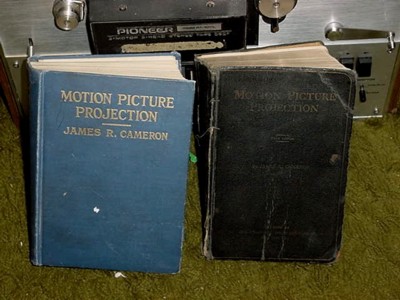
...plus also the numerous technical manuals written by a James Cameron (no relation of the director, AFAIK!) in the late '20s to early '30s for projectionists dealing with the rollout of synch sound, for a contemporary view of the standardisation process.
Here is a pict of "The Motion Picture Projector" that James R. Cameron wrote. The blue one was printed in 1943, and the black one was printed in 1922:
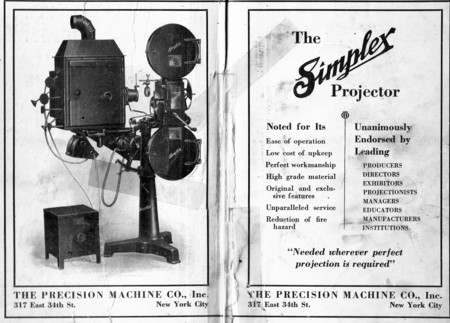
Here are some picts within the 1922 edition.
This one is of the Simplex:
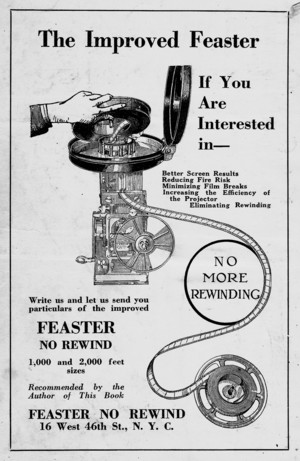
This is of a "platter" design for the sake of no-rewinding. A device that replaced the upper magazine with a center feed reel:
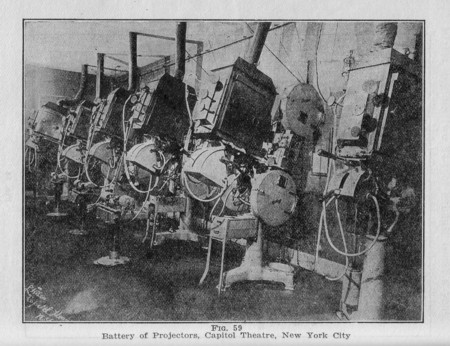
..and the booth of the Capitol Theatre in NYC .. the 'battery' of Simplexes with low-intensity arc lamphouses:
Interesting reading material contained within these two books of the art of being a projectionist and what curtails in this trade and skill.
thx-Monte
Posted by Leo Enticknap (Member # 534) on 01-07-2005, 05:06 AM:
Thanks Monte. I've got a 1927 edition of Motion Picture Projection plus Motion Pictures With Sound from 1932. The latter described pretty much every disc and optical reproducer system then on the market and must be invaluable for anyone wanting to restore some of this kit, I'd have thought.
It would be great if someone could edit a selection of chapters from the umpteen editions and republish it, complete with a contextualising introduction to each section. A more specialist publisher such as Focal Press might just bite at the idea, though to cover the whole range of technical issues Cameron deals with would mean winding up with a pretty thick book (250k words at least, I'd have thought) which would push production costs up. You'd have to find a way of pitching it at film historians more generally as well as technology buffs, or else I'd guess that the potential market would be too small.
Posted by Monte L Fullmer (Member # 2797) on 01-08-2005, 03:55 AM:
...for all those are curious about the "standards" set by the SMPE of 1922:
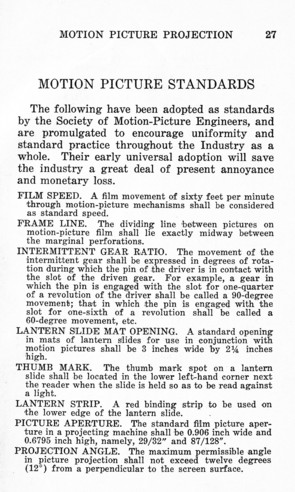
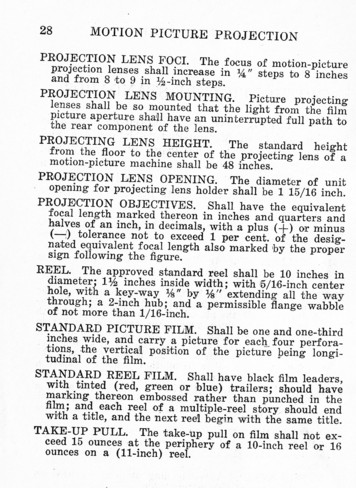
...which shows the basis of the start of this topic as for the history of the film speed.
AND.....even though I erred in my earlier statement about the shutter speed for silent,16fps film speed, I wish to correct myself: I neglected to notice that the early machines of Simplex and the Powers had three blade shutters, in which the light pulse rate, with film speed at 16fps, would be 48 interruptions of light.
So, in a logical sense, with taking out a shutter blade to make the standard two blade shutter, the film speed was sped up to the now standard of 24fps to keep the same 48 interruptions of light.
Have to learn to "do the math."
thx-Monte
thx-Monte
Posted by Michael Schaffer (Member # 1204) on 01-08-2005, 04:34 AM:
Why is there such a big gap between the lamphouse and the head? Is that a prefocusing lens such as can still be found in the Meopta MEO5XB projector? Or did somebody install the head the wrong way around?
Posted by Monte L Fullmer (Member # 2797) on 01-08-2005, 05:16 AM:
Here's a little diagram of the low-intensity lamphouse that were used in this era:
The arc rods were one size different - like 10mm positive and 8mm negative - both black, and positioned in the lamphouse at the 11 and 5 o'clock position. Low Intensity arcs were the voltage was higher than the amperage and the negative was forward a bit from the positive so the positive would burn the "bowl" needed for light emission to the condenser lenses in front of the lamphouse in that "snood" The arc burning emitted a high angle of light where the corners of the light was the same as the corners of the condenser lenses in the "snood". The condenser lenses had a long focus length where the light was concentrated to meet the aperture opening, thus why the long distance between the "snood" and the rear of the machine. These low-intensity arcs light output was so low is for the reason of such a long light angle-to try to get as much effective light to the machine as possible.
The Hi Intensity arc, both refractor (which also used the condenser lenses, like the lamphouses that Radio City Music Hall used behind those Simplex XL heads)which use a much larger condenser lens, and the reflector, which contained this angle within, thus the distance was taken up with the longer built lamphouse.
Here is a pict, with added drawings of how the Low Intensity operated behind these silent-era machines:
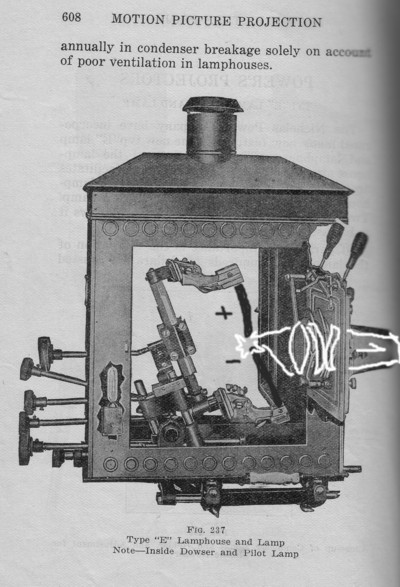
Hope this answers your question on this area.
thx-Monte
Posted by Carl Martin (Member # 1146) on 01-08-2005, 05:43 AM:
aha! time to reopen the "douser" vs. "dowser" debate! will someone post a usage of "douser" from before 1922?
carl
Posted by Leo Enticknap (Member # 534) on 01-08-2005, 05:51 AM:
Not to mention flange 'wabble'. Was James R. Cameron really Elmer Fudd in disguise?
Posted by Monte L Fullmer (Member # 2797) on 01-08-2005, 04:11 PM:
..funny, I've always seen the word "dowser" used for either the hand dowser (which I've always called "damper") on the lamphouse, or the selenoid driven dowser for the machine. Never knew of the alternative spelling, unless this is the British spelling for the word.
thx-Monte
Posted by Stephen Furley (Member # 1277) on 01-08-2005, 08:04 PM:
I usually see it spelt 'douser', I don't know if it's different in other countries. I do occasionally see it spelt 'dowser', but that's normally somebody who goes looking for water with a couple of sticks.
I've never heard 'damper' used in that context, but it has got at least two other uses, both of which might be found on a film projector; a device which damps an oscillation, like the shock absorbers on a car, I think the Zeiss Favorit 16B 16mm projector had one somewhere in its film path, but I haven't seen one for years.
A device for restricting the airflow in a flue or chimney. Most carbon arc lamphouses were fitted with these, and they had to be adjusted when the lamp was connected directly to a chimney out through the projecton room roof, rather than to an extraction system with a constant airflow, depending on the state of the wind.
Powered by Infopop Corporation
UBB.classicTM
6.3.1.2