This is topic Kinoton/Philips Dia Anbaugerät (slide attachment, I think) in forum Film Handlers' Forum at Film-Tech Forum ARCHIVE.
To visit this topic, use this URL:
https://ft-forum.com/ft/cgi-bin/ubb/ultimatebb.cgi?ubb=get_topic;f=1;t=006824
Posted by Stephen Furley (Member # 1277) on 01-03-2005, 03:45 AM:
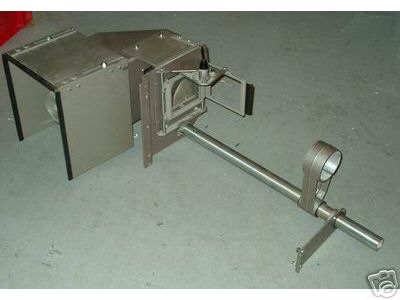
This is on Ebay at the moment, Here
From the word 'dia' in the descriptiion I think it's something to turn your Philps projector into a slde lantern, but I can't see how it is supposed to work. The thing on the right looks like a lens holder, but it's rather small, and a long way from the rest of the works, even for the sort fo focal length lkely to be needed for projecting slides. There seems to be a 45 degree mirror to reflect the light through the slide holder, and a mounting bracket on the end of the long rod; did it mount with the rod running down the front of the projector column? If so, it would seem to be projecting onto the floor. If the long rod was pointing forwards then it would would be through the front wall of the box, and into the auditorium. Any ideas?
Posted by Brad Miller (Member # 2) on 01-03-2005, 04:36 AM:
For the sake of preserving the archives...
Posted by Hugh McCullough (Member # 1542) on 01-03-2005, 06:44 AM:
I remember working with a similar device at the, now demolished, ABC cinema at Eltham, London (birthplace of Bob Hope) in the late 1960s.
It was bolted to the non operating side of a Peerless carbon arc.
A hole was cut in the arc door, and the 'slide projector' bolted on. Light from the arc was reflected by the 45 deg mirror, then through a condenser lens, and onto the slide, and then through the lens and sideways enlarged porthole.
The resulting image was rather dark especially at the edges. You can say it worked, but only just. I believe it was made by Premiere.
Posted by John Hawkinson (Member # 1135) on 01-03-2005, 07:43 AM:
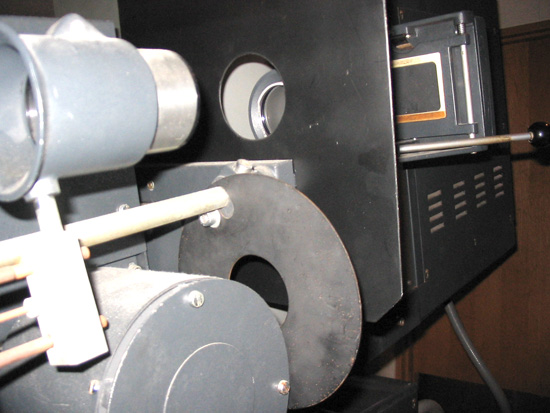
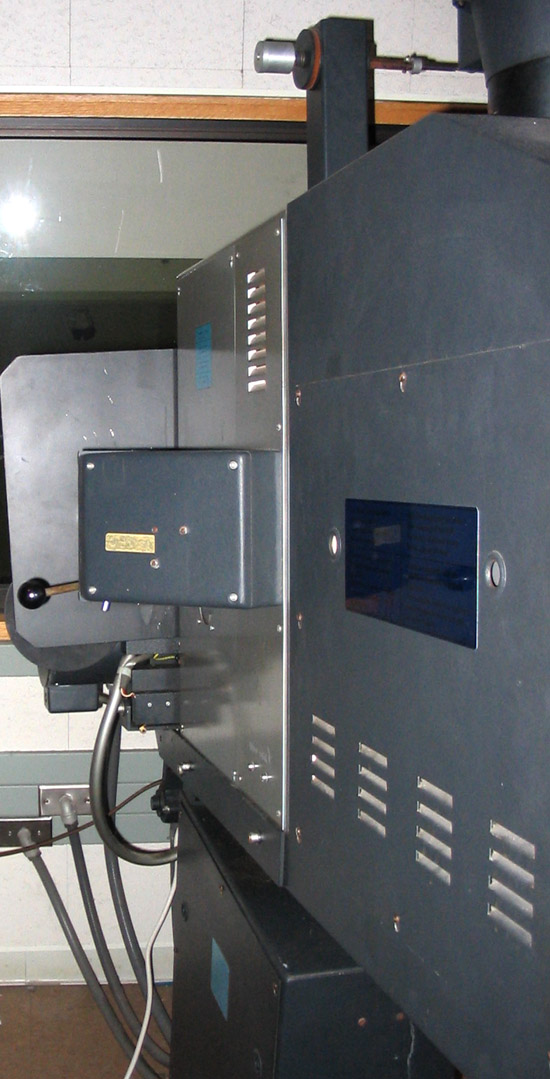
One of our Bauer U4s has such a device. It differs from Hugh's in that the lamphouse douser has a 45-degree mirror attached to the back of it, reflecting the light out to the slide attachment whenever the lamphouse douser is closed. It produces a very bright uniformly lit image and is excellent.
--jhawk
Posted by Stephen Furley (Member # 1277) on 01-03-2005, 08:20 AM:
Thanks for inserting the picture Brad; sorry, I forgot to do it.
John, any chance of posting a picture of this thing?
Hugh, given the design of the thing, the mounting position you suggest would make sense. What machines did you have there? I think ABC had got rid of most of their original Ross ones before that. I know they were installing single Philips machines with platters in the '70s, I saw Streatham after it was converted in about '73. I think they used Westars in between at some places. This thing looks the right colour to be Philips/Kinoton, but I'm not sure you could mount it on a column type machine; wouldn't the column be in the way? Did this just use stray light that found its way out of the side of the lamphouse, or did you put in a small 45 degree mirror? I think you'd need a hole in the centre for the positive to pass through to do this. If these were standard size slides, I would guess that you would probably be using a lens of about 200-250mm. That seems to be a very small lens holder.
Were you still regularly using slides at that time, or was it disused, and you just tried it out? I would have thought that there were very few ciinemas still using them then. What had been my local cinema still had a slide lantern when I first visited it in 1963, but it had been disused for many years, if not decades, even then. The News Theatre at Victoria Station used slides to announce train arrivals and departures; I think this continued after the War, but they no longer did so when I first went there. I don't remember the date, but I saw a Laurel and Hardy film, I'd never heard of them before, and it was announced in the paper that Stan Laurel had died the very next day. No doubt somebody will remember when that was. I went back there just once more, on their closing night; I asked for a visit to the projection box, but they wouldn't let anybody up until they had removed the nitrate newsreel from their opening year which they had been showing. I had to collect my mother from another station, and couldn't wait.
The last place I saw slides being used was at the State, Grays, after it closed, and the auditorium was basically used as a fire escape route from the club which operated in the foyer area. They still gave occasional organ concerts, and showed slides using the upper unit of the Brenograph. This stopped some years ago, when the club went out of business.
I really can't imagine that many of these things were ever sold.
Posted by Mark Gulbrandsen (Member # 72) on 01-03-2005, 08:30 AM:
Here is how it mounts on an FP-56.......
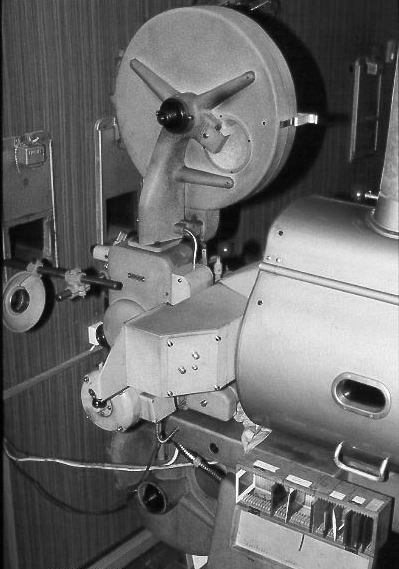
Note the box for holding the slides mounted to the pedestal.
Mark
Posted by Hugh McCullough (Member # 1542) on 01-03-2005, 11:20 AM:
Stephen. The bolt on slide machine was fitted to Peerless behind the good old Ross GC3 projector.
We only used slides for the sing along ABC Minors song on saturday morning kids shows, and for projecting car registration numbers supplied by the Police of any vehicle illigally parked, or parked without side lights turned on.
Posted by Gordon McLeod (Member # 33) on 01-03-2005, 08:20 PM:
They were also very common on the zies Ikon ernaman line
Posted by Norman J. Rabold (Member # 2236) on 01-04-2005, 08:14 PM:
In the 50's, 60's, and 70's every theater in Germany had a slide projector attached to the lamp house or a stand alone unit. On the attached units the lamp house douser had a mirror aimed at the slide attachment opening, so when the douser was closed the light went through the slides, when you opened the douser the light went through the projector aperture. After starting the movie you had to place a metal slide in the slide attachment so when you closed the douser after a changeover you didn't spill white light all over the screen.
Posted by Scott Norwood (Member # 30) on 01-04-2005, 08:35 PM:
Is there a mechanical advance mechanism, or do the slides need to be changed by hand (like on a Brenograph)? If the latter, how does one crossfade or at least black out the screen when changing slides?
Maybe I'm missing something, but I don't quite understand why anyone would want to use a $30k+ film projector to do something that a $500 slide projector probably does better. (OK, it shows medium-format slides and maybe the image is brighter with the arc lamp, but the whole concept just seems really bizarre.)
Posted by Hugh McCullough (Member # 1542) on 01-05-2005, 10:54 AM:
Scott.
The bolt on slide projector that I worked on used 3.5inch square glass slides, and these were changed by hand. The light was blacked out by a hinged flap over the lens. Very prehistoric, but it worked.
Posted by Stephen Furley (Member # 1277) on 01-05-2005, 02:28 PM:
quote: Scott Norwood
Is there a mechanical advance mechanism, or do the slides need to be changed by hand (like on a Brenograph)? If the latter, how does one crossfade or at least black out the screen when changing slides?
The Philips attachment looks like it only takes one slide. The traditional cinema slide lantern usually had a sliding holder for two slides; you slide it over to put a slide in place, then removed the previous slide from the other side of the holder, and replaced it with the next one, like an overgrown version of the Aldis Tutor 500/1000/2 slide projectors that just about all British schools had. Kershaw also made one rather similar to the Tutor 1000; any British members remember that one? It had a focusing knob, and handle in the same dark red plastic that was used on the Kalee 21, 20, 18 etc. (For those who don't know, Kershaw made the Kalee projectors).
Some cinema slide lanterns were bi-unial, you would disolve from one lantern to the other mechanically, then change the slide in the lantern you had just disolved from. Some slide lanterns had a douser like a film projector, but some didn't, and you had to either cap the lens, or just strike the arc when you wanted a slide on screen. I remember reading somewhere that in one of the railway station news theatres an old tin lid had been used to cap the lens.
Slides were used for two purposes, for announcements, like the train times I mentioned, or Hugh's car numbers. I've also heard of them being used near ports to call for a crew to return to their ship, ready to sail. I've never seen this done; I thought it finished long ago, possibly soon after WWII, which is why I was quite surprised to hear Hugh say he was still doing it in the '60s. For this purpose you would probably only want to use one slide.
The other use was for 'decorative' slides, sometimes shown on the tabs before the film, while the organist was playing; I have seen this done in recent times, but it's not very common now. For this you probably would want to show a number of slides, so a sliding holder, and/or a biunial lantern would be useful.
quote: Scott Norwood
Maybe I'm missing something, but I don't quite understand why anyone would want to use a $30k+ film projector to do something that a $500 slide projector probably does better. (OK, it shows medium-format slides and maybe the image is brighter with the arc lamp, but the whole concept just seems really bizarre.)
Are you comparing it to a modern 2" square projector, like a Carousel? If so, I think you'd get a brighter image, unless you had a xenon projector. (I once even saw a carbon arc conversion of a Kodak Carousel). I've never seen 35mm slides used in a cinema for advertising; as others here have referred to from time to time. Every cinema Where I've seen, or shown, advertising it was on 35mm film, from either Pearl & Dean, or Carlton (formally Rank Screen Advertising), never slides. I have seen 35mm slides used in cinemas to accompany lectures, a use which goes back to the days of the old travelling 'Magic Lanternist', though less used in recent years than it used to be since the advent of the Powerpoint presentation. It's still quite common though.
If you are comparing the attachment to other ways of showing the old large glass slides on a full cinema screen, or tabs, the main advantage would seem to be a saving of space, compared to installing either a normal slide lantern, or a Brenograph. Either of these machines, with space to operate it, would take almost as much space as a film projector. Being on the 'non-operating' side, if you fitted the attachment to the right hand projector it could be reached by a single projectionist, standing between the projectors; take down the slide, then turn round and start the feature on the left hand projector without having to walk to another machine. Projection boxes in early cinemas tended to be very small, some were only about 2 x 2.5m, so this attachment might be useful there, but the ones shown seem to be rather too modern for that. Some very early projectors were dual purpose, either a film, or slide, mechanism could be slid into place. The big '30s 'super cinemas' seem to have made considerable use of slide lanterns, Brenographs and spots, but they tended to have much larger projection boxes, the Lowe's Jersey is the biggest I've seen, but the Odeon Leicester Square isn't far short, and more projectionists on duty to operate everything, so an atachment would be less of an advantage there.
The attachment would probably also be cheaper than a slide lantern, and certainly much cheaper than a Brenograph. I can't remember the price, but it's listed in the Brenkert catalogue in the manuals section. It was a very expensive bit of kit in its time.
I have operated a Brenograph a couple of times; it's a great machine, very versatile, but I wouldn't choose one if all I wanted to do was project a few slides, unless I wanted to do something like have the image move across the stage. The simple lenses in the Brenograph do not produce a very good quality image, not very sharp, and tend to show colour fringing. It's more like projecting a gobo with a profile spot. Reflecting the beam off two mirrors doesn't help either, especially nowadays, with the silvering on the mirrors tending to be well past its best on most examples. The Brenograph is also simply overkill, if all you want to do is project slides. If you really insist on having singalong shows it will project the 'bouncing ball' over the song words though. ![[puke]](graemlins/puke.gif)
Posted by Michael Schaffer (Member # 1204) on 01-05-2005, 02:56 PM:
quote: Stephen Furley
I've never seen this done; I thought it finished long ago, possibly soon after WWII, which is why I was quite surprised to hear Hugh say he was still doing it in the '60s.
Maybe Hugh thought the war was still going on, like those Japanese soldiers they found on a remote island 10 years or so ago who hadn't received word of the end of the war and were still at their posts. Or maybe that is an urban legend.
Posted by Hugh McCullough (Member # 1542) on 01-05-2005, 06:24 PM:
Michael Schaffer said
quote: Michael Schaffer
Maybe Hugh thought the war was still going on
A rather tasteless statement isn't it?
No Michael, I was glad to see the end of it. I am old enough to remember, as the first four years of my life were spent during the war.
As a three year old I still remember being bombed, and seeing the dead bodies of some of my relatives.
Michael I suggest you remember the words of Basil Fawlty. "Don't mention the war".
Posted by Michael Schaffer (Member # 1204) on 01-05-2005, 10:27 PM:
No, I thought it was a really funny line. Please don't hate John Cleese for making fun of that subject. His way of dealing even with serious subjects in a relaxed way is something that you could profit from too.
Posted by Ron Yost (Member # 1850) on 01-05-2005, 11:05 PM:
It's not an urban legend, Michael. I remember seeing a couple of accounts of holdout Japanese soldiers emerging from the jungle on TV once in a while, way back when. I actually Googled it and came up with:
Japanese Holdouts Registry
Apparently the last confirmed one was found in Indonesia in 1974. I didn't read the entire page, tho.
Ron Yost .. I swear, one can find ANYTHING on the Net. ![[Big Grin]](biggrin.gif)
Posted by Michael Schaffer (Member # 1204) on 01-06-2005, 04:01 AM:
Sometimes life outruns anything you could imagine in a movie script or novel!
On the Dia-Anbaugerät thing, I remember seeing 2 or 3 of these on old projectors in Germany, but they hadn't been used for many years then.
Posted by Bernard Tonks (Member # 809) on 01-06-2005, 05:57 AM:
Further to Stephen’s last post.
I well remember cinema advertising 3.25” slides which were also common in variety theatres until the 1950’s. Most music halls had two spotlights plus a slide lantern situated in a pit at the front of the huge raked upper circle known as ‘the gods’. The slides were shown during the interval onto the safety curtain. The carbons at the old Hippodrome Theatre in Aldershot used to hiss and spit which you would put up with for the sixpence old money admission. The low intensity carbon (I assume) fumes escaping with all the cigarette smoke into the dome.
One old 1912 built cinema I worked in, the Premier slide lantern was attached to the ‘non-operating’ side of No 2 projector, it did however have its own lamp house which was power shared from the same rectifier. The twin slide carriage was vertical mounted due to restricted space and for ease of operation.
During the late 1940’s at the Regal (ABC) in Kingston-upon-Thames, there was always the traditional annual organ 15 minute plus ‘Sing-A-Long’ show for one week before the feature on the evening shows. You can imagine the atmosphere in this always packed out 2,500 seat cinema. Clifford Birchill, the resident organist was extremely artistic and wrote his own slides that included characters and drawings with colour dyes which were most professional. With the quick changes on the ‘bi-unial’ as Stephen describes, three projectionists were required, one to feed the carbons, one to feed the slides, and one to load and show the slides, which could have well exceeded 100. There were two additional projectionists for the spotlight, and for the Strand lighting board situated on the stage.
My old cinema until closure in 2002 used two slide projectors every show daily for ‘decorative’ use on the curtains and for captions and announcements. Pictures can be seen in the Warehouse under the Singles section – Regal Cinema, Cranleigh, Surrey, England.
Posted by Hugh McCullough (Member # 1542) on 01-06-2005, 07:40 AM:
Michael Schaffer said quote: Michael Schaffer
No, I thought it was a really
funny line.
Do you mean the John Cleese line or your line about
myself and the war?
I find John Cleese to be a very talanted, clever,and funny. I have
no trouble at all with his remarks about the war.
What I do object to is you making remarks about myself and the war
that were uncalled for.
As for your remark that, and I quote, "even with serious subjects
in a relaxed way is something that you could profit from too" could
be construed as a personal attack, especially as you know very
little about me.
Posted by Leo Enticknap (Member # 534) on 01-06-2005, 07:41 AM:
quote: Bernard Tonks
We only used slides for the sing along ABC Minors song on saturday morning kids shows, and for projecting car registration numbers supplied by the Police of any vehicle illigally parked, or parked without side lights turned on.
I imagine that you could have fun with that arrangement on April Fool's Day!
That reminds me of 1 April last year, doing my weekly shop in Tesco on the way home from work. There was a Tannoy announcement: 'Would the owner of a green Vauxhall Cavalier, registration no. X123 ABC, please come to the customer service desk. I'm afraid a 40-ton lorry just reversed into it in the car park and we need you to exchange insurance details.'
Posted by William Hooper (Member # 71) on 01-07-2005, 12:40 AM:
quote: Bernard Tonks
My old cinema until closure in 2002 used two slide projectors every show daily for ‘decorative’ use on the curtains and for captions and announcements. Pictures can be seen in the Warehouse under the Singles section – Regal Cinema, Cranleigh, Surrey, England.
Excellent photos & beautiful theatre. Were the curain slides animated or static?
quote: Leo Enticknap
There was a Tannoy announcement
Leo, probably only .008% of non-UK readers know what a Tannoy announcement is!
Posted by Bernard Tonks (Member # 809) on 01-07-2005, 05:45 AM:
William,
The ‘decorative’ slides were static, being 3/16 inch in thickness decorative safety plate glass as used for bathrooms, kitchens, offices etc. Cut to the American standard slide size of 4 ¼” x 3 ¼” projected through an eight section colour wheel revolving at 1 rpm. We had a good ten different designs that were very effective even with full houselights up, naming them as they looked for example, diamonds, honeycomb, bubbles, stars etc.
Leo,
Your ‘quote’ was Hugh McCullough’s, not mine you will find.
Posted by John Hawkinson (Member # 1135) on 02-12-2005, 12:56 AM:
Wow. Sorry for the abysmal delay.
Back on January 3rd, I said, "One of our Bauer U4s has such a device." and Stephen asked, "John, any chance of posting a picture of this thing?"
Here we go. Sorry the pictures are crap.
This is a view from the left side of the machine; you can see the Bauer Selekton II 16mm attachment and its upper reel arm sticking out on the left; the 35mm reel arm for the U4 is cropped out, but the bototm is visible at the top center:
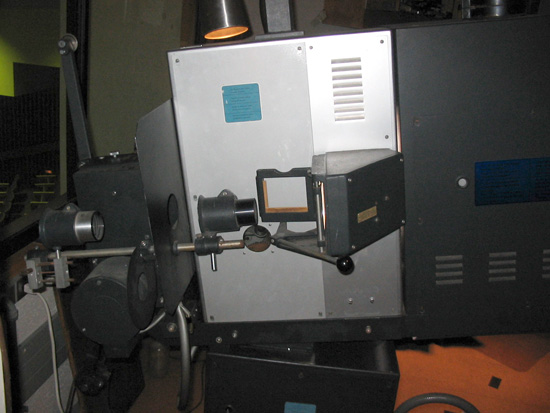
Oh, the circle underneath the lens element in the middle is a viewing window into the inside of the U4. It's not part of the slide optics. A bit more clear here, where we zoom in a bit:
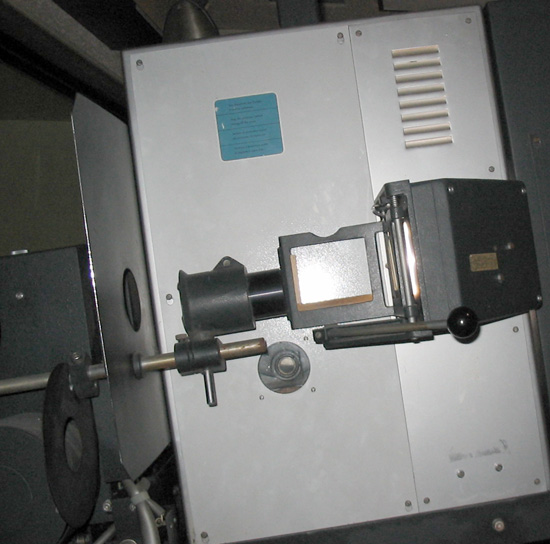
There's very little space between the front and the window glass, and I didn't want to hang in the air on the other side of the glass, so this is somewhat distorted, but it is a view from the front, looking back at the projector:
And lastly, here's a view of the apparatus from behind the projector (you can see the entire 35mm upper reel arm here):
--jhawk
Powered by Infopop Corporation
UBB.classicTM
6.3.1.2