This is topic What's the best way to determine the quality and stability of your AC power? in forum Film Handlers' Forum at Film-Tech Forum ARCHIVE.
To visit this topic, use this URL:
https://ft-forum.com/ft/cgi-bin/ubb/ultimatebb.cgi?ubb=get_topic;f=1;t=006865
Posted by Michael Schaffer (Member # 1204) on 01-13-2005, 09:04 PM:
I am not talking about measuring AC ripple in DC current. I mean the AC power lines which feed the equipment. Apart from simply looking at the waveform on the oscilloscope, what other methods would you recommend to establish how stable your AC power is? And what are the criteria for deciding if and when it is necessary to take measures such as installing filtering devices?
Posted by Steve Guttag (Member # 268) on 01-13-2005, 09:34 PM:
Power companies can place a power monitor on your line. They can plot "events" that occur on all three phases plus the neutral (significant neutral currents indicate an unbalanced panel).
That is the best way to look at it...at any one point in time you are unlikey to find significant problems that the equipment wouldn't have shown you anyway.
As far a spikes and surges...they are un predictable but will happen so it best to protect against them...series mode is preferred but MOVs will due if you realize they do degrade as they get hit.
Some protect individual equipment...while others, like Mark G. will go for protecting the full panel.
Steve
Posted by Thomas King (Member # 2745) on 01-14-2005, 07:40 AM:
We have all the sensitive stuff (dolby box, amps, lighting/masking control unit, etc) run through two power conditioners. I'd imagine there's not much point filtering the supply to the projector and rectifier.
Posted by Steve Guttag (Member # 268) on 01-15-2005, 12:08 AM:
Bzzzzt. Wrong, the rectifier is a big item to have power conditioned. The biggest cause of diode failure is noisey power in a rectifier.
Steve
Posted by Thomas King (Member # 2745) on 01-15-2005, 07:09 AM:
I imagined wrong then. Is that a fault in the rectifier, in that it provides noisy powers, or the fact that the rectifier is on an unfiltered supply?
Posted by Gordon McLeod (Member # 33) on 01-15-2005, 07:39 AM:
Rectifiers older style inductor types can and do introduce some phase warping but the diodes are still seeing noise that passes through the transformer
Switcher types are like computor switching powersupplys and like clean power
Posted by Mark Gulbrandsen (Member # 72) on 01-15-2005, 09:13 AM:
Its amazing that no one has built a rectifier with torodial trannys. Toroids are very good at filtering out power line noise and are the heart of many power limne conditioners and are also in the neighborhood of 40% higher efficiency than iron core type. Toroids are requirements in all hospital applications due to their good filtering, regulation, and efficiency characteristics. They and also allot lighter in weight... the down side is higher inruch current draw but there simple methods to control that.
Mark
Posted by Michael Schaffer (Member # 1204) on 01-15-2005, 10:43 AM:
So what is typical power line noise? Is it distortion of the 60Hz/120V waveform or addtional components superimposed on it? Up to what point is it acceptable, and when does it start to create problems?
Posted by Thomas King (Member # 2745) on 01-15-2005, 11:09 AM:
This is going to sound stupid, but what exactly is 'diode failure'? I know what diodes are/do, but what is their function in this situation, and what happens if you do get a failure?
Posted by Michael Schaffer (Member # 1204) on 01-15-2005, 11:17 AM:
Basically, diodes help making DC out of AC because they allow electrical current to flow only in one direction. That is why you normally have 6 diodes of which each one is "assigned" to let one half-phase of the three AC lines pass and block the other half-phase. If a diode is open, it doesn't allow current in either direction anymore, if it shorted, current passes uncontrolled in both directions.
Posted by Frank Angel (Member # 248) on 01-15-2005, 11:32 AM:
quote: Steve Guttag
MOVs will due if you realize they do degrade as they get hit.
Absolutely: this is a serious problem and shouldn't be taken lightly. We have power in the big theatre that ranges from 123vac to 129vac....way higher than is comfortable for many pieces of equipment. And although surge protectors will do nothing to reduce high voltage, we have them on most of our signal processing and computer equipment, as do most people, for spikes and momentary anomolies. But here is a major problem with that, at least in our environment of unusually high, steady-state voltage. As Steve says, as the MOVs get hit and as they age, their threshold for clamping down spikes gets lower and lower. When the voltage is as high as ours, we found out (the hard way) that at some point these surge protectors will simply clamp the high voltage and stay there, overheat....and then fry everything in the unit. A sudden high spike when they are in this "clamped" condition will actually cause them to flame out. I had TWO fires in as many months.
One day in our box office, there was a line spike -- big enough to see lights flicker -- and then three of the surge protectors that computers were plugged into shot fire out of the socket holes while making a nasty hissing sound. This was bad enough, but a few weeks later, one of the big UPS units that weighs about 50lbs which services our main telephone switch, same thing....some "event" on the power line make the aging MOV in it actually go on fire. I was right there to witness it so I unplugged the thing, but flames and smoke continued to pour out of it. I used the handy fire extinguisher that was in the room; while the yellow powder that the extinguish was pumping out was aimed directly at the flaming USP, the fire was quenched, but as soon as I stopped the extinguisher, the damn thing burst into flames again. So here I am, choking on the smoke which quickly filled the room and the offices as I dragged the thing by its AC cord to get it out of the building. Who knows what PCBs were spewing out of that thing along with the smoke. If I weren't in there, that thing would have cause a major fire.
BE CAREFUL surge protectors, especially those in UPSs because, whereas the little power strips will only burn up the few caps and whatnot that are inside them, the MOV that's built into UPS will cause the batteries to burn and once that starts, continue eventhough it is disconnect from any power source. That's not to say that those power strips can't be very dangerous depending where they are located when they decide to fry. If they are placed where is typical, under desks with all kinds of flammable materials pile around them and even on top of them....that little flame that shoots out of the sockets can start a fire if luck isn't on your side.
I looked into this more closely and it seems that a new UL rating has been established that requires there to now be thermal protection in surge protector circuits. Problem is, you don't know if what you are buying has the thermal protection because the old UL spec which DOESN'T have it can still be sold grandfathered. And it will still say UL on it.
Oh, and parenthetically, that fire extinguisher that the college supplied which I used in the electronic equipment closet....that yellow power that it sprayed all over everything....it is corrosive to metal. Any piece of equipment that is anywhere near that powder will be coated with it inside and out because it migrates over everything. The CAT5 patch bays, all the equipment terminals, every electrical connection in the room had to be thoroughly cleaned with solvent. A call to the extinguisher manufacturer confirmed that eventually that coating on any electrical contact surface will corrode it. Nice, huh? So I advise STRONGLY to check what kind of fire extinguishers you are being supplied with. Make sure they are CO2 and not the dry chemical type if they are going to be used anywhere in the vicinity of electrical equipment. If they are found in your projection booth, get rid of them ASAP.
Posted by Mark Gulbrandsen (Member # 72) on 01-15-2005, 11:49 AM:
quote: Michael Schaffer
So what is typical power line noise?
Put your scope on a line and have a look see. You will find different types of noise in every different location you check. There are literally hundreds of types of noise that can be on an AC line.
quote: Steve Guttag
MOVs will due if you realize they do degrade as they get hit.
This is the main reason why they require their own dedicated circuit breaker when you install them as a whole panel protection device.
Mark
Posted by Michael Schaffer (Member # 1204) on 01-15-2005, 04:27 PM:
Which of those, if any, noise patterns can seriously affect the performance of your equipment? The actual voltage in most of our locations is usually between 116-119, rarely higher, so it is within the 5% normally deemed acceptable. But I am concerned about slow degradation of the equipment by unclean power patterns, if that actually has an effect.
Do you normally install surge protection in your projects? What's the most common cause for high voltage spikes in the line?
Posted by Tony Bandiera Jr (Member # 2365) on 01-15-2005, 04:41 PM:
quote: Frank Angel
Who knows what PCBs were spewing out of that thing along with the smoke.
Actually, no PCB's (Illegal in electrical gear since the '70s) but a lot of other nasty toxic byproducts! The burning of the UPS battery probably put out heavy metal fumes. (Great name for a rock band maybe? ![[Big Grin]](biggrin.gif) )
)
quote: Mark Gulbrandsen
Put your scope on a line and have a look see. You will find different types of noise in every different location you check.
Be careful!! Many 'scopes (older) cannot handle a direct connection to the AC line! And you have to make sure you don't connect the probe's common or ground to a hot line, many scope's probe commons/grounds are connected to scope chassis.
Mark, do you have a good method to check AC line noise with a scope? So far, everyone I've talked to repeats my caution above and can't give a good answer otherwise! ![[Smile]](smile.gif)
Posted by Mark Gulbrandsen (Member # 72) on 01-15-2005, 05:27 PM:
quote: Michael Schaffer
Do you normally install surge protection in your projects? What's the most common cause for high voltage spikes in the line?
Yes, There are two ways to do this. Install a giant surge protector at the panel feeding the booth sub panels or install a smaller one at each booth sub panel. I prefer the latter method because if one largish protector blows there is not a risk of the whole place shutting down. Also another reason is that it can result in a more stabilized voltage in each operating booth.
A good example of how well they work was during the install at Thanksgiving Point Stadium 8. Right next door is the Giant Screen 15/70 3D theatre in the Dinosaur Museum. This is in Utah County and they have very poor power down there for what ever reason. During the middle of one afternoon there was a massive power bump that knocked the 15/70 off the screen and damaged one of the projectors claw mechanisms and about 200 feet of film between both the projctors.... Those Museum guys that made the decisions had decided to skimp and not install any surge protection or UPS supply to keep things running as normal...... the "Museum Guys" should have installed them though and learned the hard way. Right next door with 6 of the cinemas running we were unaware that there was any power bump at all until Stewart Anderson came over to tell us he was off screen and one projector had been damaged. All of the 6 Stadium 8 cinemas kept on running as normal because they were equipped with surge protection devices. The 15/70 theatre has since installed a whole building surge protection device and the projection system now has a sizable UPS supply that can run all the 15/70 stuff long enough to effect a safe shut down of the lamps and projetors... this all after ruining thousands of dollars of 15/70 film.
quote: Tony Bandiera Jr
Mark, do you have a good method to check AC line noise with a scope? So far, everyone I've talked to repeats my caution above and can't give a good answer otherwise!
You're right about that, its imperative that you KNOW which is hot and which is neutral. You can also use a small torodial isolation transformer on the scopes input along with a X10 probe with just about any scope. The toroid won't introduce any noticable distortion. My Tektronix 465B for what ever reason works fine for looking at AC, most likely its input grounds are floating and not connected to chassis ground....would have to take a look at its vert. amplifier schematic but I can bet thats why. Most modern scopes should be able to do this but possibly not all of them. You may still need the isolation tranny to be on the safe side though.
Mark
Posted by Michael Schaffer (Member # 1204) on 01-16-2005, 03:08 AM:
My scope is allegedly rated for up to 400VAC or DC input. Especially with an X10 probe which reduces the signal to 1/10, it should be safe. But before I try that, I will dig up the manual and see if there is a schematic of the VA though.
Posted by John Anastasio (Member # 607) on 01-16-2005, 07:18 AM:
Yeah, so's mine, but if you plug it directly into the AC mains, you'll blow the breaker because of the way it's internally connected. Be careful. We once had an enormous problem with our 50Kw FM transmitter at a station I was employed by. The darned thing went off the air every day at the same time. We had the power company put a line monitor on it and discovered that someone was using an old freight elevator in the building every day at that time and the line surge from the motor kicking in was enough to trip our breakers.
Posted by Oscar Neundorfer (Member # 458) on 01-16-2005, 07:20 AM:
I am going to STRONGLY recommend that if you don't know EXACTLY what you are doing, DON'T connect your scope to the AC line. At best, you may fry your scope, and at worst you may fry YOU.
Most scopes I have seen have the ground side of the probe connected to scope chassis ground which in turn is connected to AC ground. Accidentally connecting this to AC hot will result in lots of smoke and flames and a huge repair bill. And DON'T lift the AC ground of your scope either. You could have your scope chassis floating at 120 VAC which could hurt you bad if you got between it and ground.
Even though you may see some noises on a scope looking at the VOLTAGE waveform, it is not all that informative anyway. If, on the other hand, you can look at the current waveform through some type of AC current probe, it is amazing to see the huge spikes and distortions that occur. The source of these problems is numerous, with switching-type power supplies and industrial motor drive controllers being big culprits.
In some large buildings, three-phase transformers have burned up due to excessive currents in the neutral leg caused by too many harmonics which upset phase relationships and increased the neutral current way beyond specification.
Power companies have reaaly been looking hard at the amount of distortion and noise acceptable on power lines and are establishing standards for this. A lot of more modern power supplies are striving for a power factor approaching 1 to limit the reactive loads presented to the distribution system.
Noise, transient events, and distortion are not good for electronic equipment. But transient events such as large spikes are probably the most damaging to the equipment in your booth.
With todays microprocessor-based equipment in the booth (processors, automations, etc.) it is always good practice to install some type of line conditioner to prevent errors in the digital circuits which can result in strange and unexplainable behavior such as a processor shutting down or losing its settings or an automation doing something strange. Unfortunately, this is an extra cost item, and this is protection that many are not willing to purchase.
Surge protection such as Mark G. describes is a very good idea. Also, contact your power company too see what whole building protection might be available. It seems to me there are some non-degrading types of surge protectors available for whole building protection. I believe they are called gas-discharge types, but not sure.
Posted by Michael Schaffer (Member # 1204) on 01-16-2005, 12:46 PM:
Thanks for the tips. Figuring out which line is hot and which is neutral, apart from that, are there any other hidden dangers? Am I mistaken in assuming that an X10 probe should greatly minimize the risk?
Using an AC current probe is a very good idea. I have a Fluke clamp meter which outputs the current readings as a voltage (1A=1mV). You plug it into your multimeter and read the current as a voltage. This should be safe to hook up to the scope. Although I don't know how accurately it represents the actual wave form of the current, or if it "rounds off" the input to give a stabilized reading.
I have no desire to blow myself up. Last night I was working on a power supply and I discovered that some idiot had bypassed the breakers on the front of the console. They were not even bad, I have no idea why. I made sure that all the breakers in the distribution panel were off and tested all the lines before starting to work on the power supply. Later when I grabbed the AC lines to hook them back up to the PS, there was a puff! and a flash! which resulted in a nice burn mark on my hand. It turned out that the projectionist, who knew I was working on the console had turned the breakers back on in the meantime. ![[Eek!]](eek.gif)
It turned out that he "thought they belonged to another screen". Why he thought so even though they are clearly labeled, and why he felt the need to turn the breakers on even though all other screens were running - would they run if their breakers were off? -, he couldn't explain to me.
Posted by Mark Gulbrandsen (Member # 72) on 01-16-2005, 02:02 PM:
quote: Michael Schaffer
I have a Fluke clamp meter which outputs the current readings as a voltage (1A=1mV). You plug it into your multimeter and read the current as a voltage. This should be safe to hook up to the scope.
Yes, but may not be the same as looking at the AC directly although it will be interesting to loko at. Also, the use of a storage scope can be very helpful as it can be set up to trigger and record a large spike so it can be easily seen. As Oscar mentioned Motor drives and switchers can put alot of crud back on the AC and this definately can be seen with a scope as RF riding along on the hot lead. If in doubt buy a small isolation transformer as this will make looking at AC perfectly safe even if your scopes input is grounded. In this case the primary AC is not directly connected to either chassis or the actual input. It is the secondary of the transformer you're looking at.
Mark
Posted by Phil Hill (Member # 371) on 01-16-2005, 02:49 PM:
quote: Michael Schaffer
It turned out that he "thought they belonged to another screen". Why he thought so even though they are clearly labeled...
That's why you should ALWAYS use lock-out tags or at least put tape across the breakers and a note giving your name, location, and saying not to energize...people are working... etc.
Also, It is extremely dangerous to connect a scope directly to the AC line. Even if you make sure the neutral is on the "grounded" side of the scope input, there is a substantial risk of blowing it up anyway. There is a significant possibility of a low voltage/high current difference between the neutral and ground...especially in large distribution systems as in malls and complexes.
I once saw a guy lose a hand when his wrench disintegrated when it accidentally hit the ground bus while he was tightening a neutral connection on a disconnected "dead" 1200 Amp standing section.
DANGER! DANGER, WILL ROBINSON!
Again, I STRONGLY warn against it, but IF you *MUST* connect a scope in that way, make sure you use a ground lifting adaptor on the scope's AC plug and put the scope on an insulated surface and DO NOT touch it...or leave it unattended. Make sure the neutral side is connected to the "ground" side of the scope.
And, just because your scope is "rated" for 400vac, that really doesn't mean much as many times there are kV spikes on the line that will fry your scope.
There are plenty of commercial recorders, loggers, and chart recorders available to buy or rent made specifically for monitoring the AC line. Get one!
Posted by Mark Gulbrandsen (Member # 72) on 01-16-2005, 04:42 PM:
In actuality looking at the 120 volt AC power line should be no more dangerous that looking at the output of some very high powered amplifiers who's output can easily exceed what a 20 amp AC line can carry.
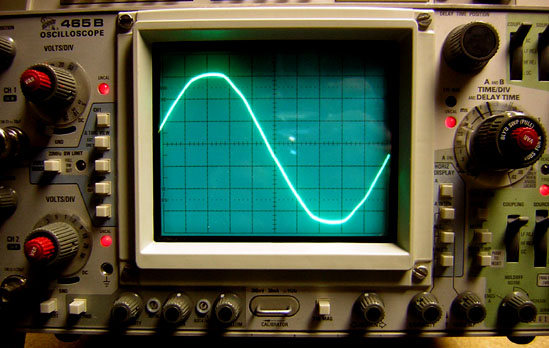
Here is a shot of the AC in my house off the screen of my TEK 465B. Pretty clean except for some distortion at the positive and negative going peaks. This distortion is typical in this area but varies somewhat from location to location. This was done with the scopes AC plug ground pin connected as normal. I never advocate the floating of any ground in any piece of AC operated equipment because its very dangerous to do. If you're unsure about your scope then get a 465B for cheap off of E-Bay. It works just fine for this purpose.
Mark
Powered by Infopop Corporation
UBB.classicTM
6.3.1.2