This is topic Uncrisp image in forum Film Handlers' Forum at Film-Tech Forum ARCHIVE.
To visit this topic, use this URL:
https://ft-forum.com/ft/cgi-bin/ubb/ultimatebb.cgi?ubb=get_topic;f=1;t=006878
Posted by Peter Mork (Member # 1336) on 01-16-2005, 09:08 PM:
A conundrum. I run two side-by-side houses, #1 and 2, that are virtual twins. Same screen size, same throw. Both have straight-gate Century C's, seemingly in good mechanical shape with steady pictures, both have the same 2000w Strong lamphouse. But the image in #2 is noticeably inferior to #1, especially apparent when running scope. It's not really a focus problem: focus is consistent across the screen in both houses, but #1 seems crisp and clean and #2 looks smeary around the highlights, like looking through a dirty window. I'm thinking it's a dirty, damaged or just plain inferior lens, but I swap lenses between the cinemas and the problem stays put, with #1 crisp and #2 muzzy. (Porthole glass in both is as clean as I can get it. Also, I've run the same print in both houses and seen a difference, so it's not like I'm comparing apples and oranges.)
Anyone got any bright ideas? I am stumped, and that NEVER happens y'know.
Posted by Paul Mayer (Member # 355) on 01-16-2005, 09:18 PM:
Shutter opened a hair too wide? Could cause just enough symmetrical travel or shutter ghost to give a slightly smeary appearance.
I'd like to see "Uncrispitude" added to the official list of SMPTE terms. ![[thumbsup]](graemlins/thumbsup.gif)
Posted by Peter Mork (Member # 1336) on 01-16-2005, 10:25 PM:
Nope, it's definitely not a travel ghost thing. The problem's more of an overall dinginess or lack of contrast.
Posted by Monte L Fullmer (Member # 2797) on 01-16-2005, 10:29 PM:
...check your mirror focus..you could have a slightly warped mirror that is throwing off the light temperature spectrum or even the focus. Strongs, with their weak air travel inside and the way the mirrors are made and shaped are good for overheating. Course, is this a Super Lume-X or a X-90 console?
thx and good luck with this. I know this can be frustrating at times - Monte
Posted by Peter Mork (Member # 1336) on 01-16-2005, 10:37 PM:
It's a Strong X-90. But I don't get how mirror focus could cause the problem. Doesn't seem to be running extraordinarily hot. I should mention I recently changed the lamp and had the same problem with the old, relatively dim bulb as the new, much brighter one.
Posted by Monte L Fullmer (Member # 2797) on 01-16-2005, 10:57 PM:
..it could be that the back part of the mirror could be just slightly warped, which one really can't see until you take that mirror out, lay it face down and place a straight edge across the rear opening, then you can see the warpage.
Usually was due to a bulb that was slightly sitting just slightly too far back and heating up the rear quarter of the mirror. Is the backside of the mirror darked by getting too hot, which could easily happen with a stack fan going out and being out for quite a while?
I should send you a pict in this area of a good warped mirror, which looks good from inside, but you should see the warpage at the back of the cone.
I had a horrible time getting some decent light out of this one, which was remedied with a mirror replacement.
thx-Monte
Posted by Peter Mork (Member # 1336) on 01-16-2005, 11:03 PM:
Hm, I shall take a look at that and report back. There were times when the fan below the mirror got clogged with dust and didn't turn for who knows how long.
Posted by Monte L Fullmer (Member # 2797) on 01-16-2005, 11:13 PM:
quote: Peter Mork
fan below the mirror got clogged
OUCH! that'll heat up a back end of a mirror for sure. That fan that cools down the bulb contacts, and with the channel that the air has to travel through to do both ends, was a poor design in my book for the end cooling practice.
There must have been some air to travel to keep the cathode's failsafe switch's "sailfin" in the "on" positition (unless the switch has been bypassed...), but still not enough to kelp cool down the rear end of the mirror.
You must have an older version of the X-90 lamphouse (the one without the muffin fan that blows on the anode of the bulb), like I have.
good luck once again. - Monte
Posted by Peter Mork (Member # 1336) on 01-17-2005, 12:19 AM:
I didn't see any obvious blackening or warping of the mirror.
My screen illumination is fairly even. I still don't understand how any lamp issue could result in the problem I described, unless perhaps it got the film so hot that it caused it to buckle in the gate, but I don't think that's happening...
Posted by Wolff King Morrow (Member # 2226) on 01-17-2005, 02:08 AM:
Is there any way you could remove your port glass just to make sure its not an impurity in the glass? Might be worth checking after close just to conclusively rule out the glass. Also, do you have UV shields? I once had a minor blurry problem that I discovered was from someone having smudged the UV shield.
Posted by Adam Martin (Member # 641) on 01-17-2005, 02:34 AM:
PLEASE EDIT YOUR ORIGINAL POST AND CHANGE THE NAME OF THIS THREAD TO SOMETHING USEFUL
Posted by John Pytlak (Member # 331) on 01-17-2005, 09:50 AM:
quote: Peter Mork
My screen illumination is fairly even. I still don't understand how any lamp issue could result in the problem I described, unless perhaps it got the film so hot that it caused it to buckle in the gate, but I don't think that's happening...
All else being equal, lamp alignment could affect optical flare. Simplistically, if the cone of light is not on the optical axis of the lens, or is overfilling the entrance pupil of the lens, you could have some light "bouncing" around inside the lens, causing an increase in flare light.
Posted by Mark J. Marshall (Member # 1409) on 01-17-2005, 10:43 AM:
I've always wondered if a sub standard (or dirty or whatever) screen could cause this.
Posted by John Pytlak (Member # 331) on 01-17-2005, 11:06 AM:
quote: Mark J. Marshall
I've always wondered if a sub standard (or dirty or whatever) screen could cause this.
Usually, a dirty or stained screen will reduce the light level, or change the color temperature of the reflected light. If the screen material (often vinyl) did not have pigments in it, it could theoretically "light pipe", which would cause a halo around light objects. Or you might be able to see a reflection of a light or shiny surface behind the screen through the perfs.
Posted by Leo Enticknap (Member # 534) on 01-17-2005, 11:16 AM:
I know it's a bit of a faff removing the lamps, replacing them and refocusing the mirrors; but swapping the mirrors would either identify or rule that out as the cause of the problem, once and for all.
Also, do you have any heat filter glass in the lamphouses?
Posted by Gordon McLeod (Member # 33) on 01-17-2005, 08:38 PM:
Since you say they are idendical twins swap the lens and see if the problem follows them
Lamphouse alignment can make terrific focus issues
Posted by Richard Hamilton (Member # 321) on 01-17-2005, 10:24 PM:
If you said that you changed lenses, prints and port hole glass, what is left? I agree with Gord. I would first check working distances. Then lamphouse alignment. Then check the light readings on each screen. If all is equal, then they should be the same. I would compare the image looking at RP-40, not changing the prints, and using the same lens.
If it is still bad, I would have to ask someone with more knowledge (than me), could one screen be a higher gain and the light levels have an affect? Maybe the good screen is a higher gain or silver screen and the bad one has a matte finish. If you are trying to match the light levels, then you could create a hot spot on the matte screen causing the film to heat up and distort in the gate?
Rick
Posted by Peter Mork (Member # 1336) on 01-17-2005, 11:18 PM:
quote: Wolff King Morrow
Is there any way you could remove your port glass just to make sure its not an impurity in the glass?
Tried it. It didn't help. quote: Richard Hamilton was the last to post
Posted by Peter Mork (Member # 1336) on 01-17-2005, 11:22 PM:
quote: Wolff King Morrow
Is there any way you could remove your port glass just to make sure its not an impurity in the glass?
Tried it. It didn't help. quote: John Pytlak
Or you might be able to see a reflection of a light or shiny surface behind the screen through the perfs.
I didn't think of that. I think the screens have similar black baffling behind them, but will check. quote: Leo Enticknap
I know it's a bit of a faff removing the lamps, replacing them and refocusing the mirrors; but swapping the mirrors would either identify or rule that out as the cause of the problem, once and for all.
Also, do you have any heat filter glass in the lamphouses?
Yes, both have filter glass. I will try swapping the mirrors when I get a chance if nothing else works. quote: Richard Hamilton
could one screen be a higher gain and the light levels have an affect?
The two screens are the same age and material, and are fairly clean.
Posted by Richard Hamilton (Member # 321) on 01-18-2005, 12:54 AM:
Peter,
Can you just remove the heat filter from the screen in question? I don't think that a 2000w bulb will damage the film if properly aligned. this would rule out the heat filter right away. Are the lenses integrated? If not, how does the prime lens look on screen if you take the anamorphic off?
Posted by Peter Mork (Member # 1336) on 01-18-2005, 01:21 AM:
Removing heat filter, another good thing to try. I'll do it this weekend.
Lens isn't integrated, so I can try the prime by itself. As I said, subjectively speaking the problem seems greater when projecting scope.
Posted by Leo Enticknap (Member # 534) on 01-18-2005, 01:53 AM:
That would seem to point to the anamorph, but as Richard points out a print can look a bit confusing - an RP40 should show any difference clearly.
Sorry - should have been a bit more explicit viz heat filter panes. I meant that before going to the hassle of swapping the mirrors it might be an idea to check those out (e.g. swap them or look for any slight difference in the mounting angle between the two).
Posted by Monte L Fullmer (Member # 2797) on 01-19-2005, 12:39 AM:
..okey, even though I made mention of this is a while back with this topic of a sharp image, here is a couple of pics of a good warped mirror toasted to oblivion - Monte
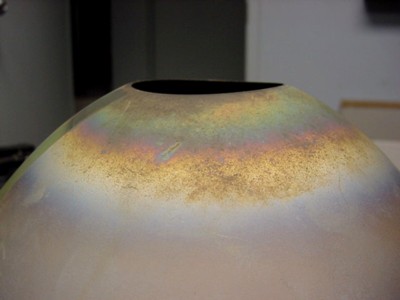
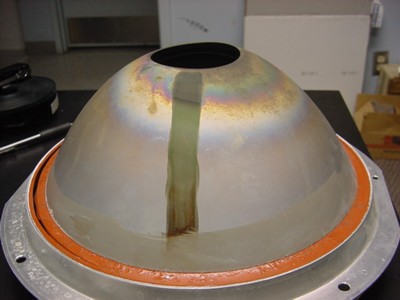
Goes to show you that unexperienced operations can exist. Light was so bad from this mirror it was a necessity for a mirror replacment.
-thx Monte
Posted by Peter Mork (Member # 1336) on 01-19-2005, 08:29 AM:
Oh boy. Well, I'm sure mine's not toasted like that.
Posted by Matt Zeiner (Member # 1914) on 01-22-2005, 10:02 AM:
Deifinitely check the heat filter - Had one yesterday that was causing a 35+% reduction in light output and very poor contrast In a Big Sky lamp. It was driving me nuts for quite a while - checked and tweaked the alignment repeatedly, still couldn't get more than 12 fl in scope with a 3k lamp and 25 foot screen. Removed the heat filter and poof! 20 fl in the center and contrast was sharp as a tack. had to back off the current a bit.
Posted by John Pytlak (Member # 331) on 01-22-2005, 11:05 AM:
You may regret removing that heat filter if you ever play a B&W print or a color print processed with a "silver retention" process. ![[Eek!]](eek.gif) Any silver in the image absorbs much more infrared energy than a dye only print.
Any silver in the image absorbs much more infrared energy than a dye only print.
Posted by Leo Enticknap (Member # 534) on 01-22-2005, 12:36 PM:
Given that both of these projectors have heat filters and only one is causing an uncrisp image, it doesn't look like the existence of a heat filter per se is the problem (unless there is any other variable between the two screens which is causing the problem in combination with the filter and which we don't know about). Agreed entirely with John - I'd be reluctant to remove it altogether, and also because the extra light might make it difficult to see if the uncrispness is still there. But swapping the filter panes between the two projectors would tell you if one of them is NFG.
I'm starting to get a gut feeling that either the heat filter or the mirror is the culprit, simply because everything else seems to have have been ruled out. Sod's law strikes again, because if it comes down to the mirror, it's a much bigger job swapping them than anything else.
Posted by Matt Zeiner (Member # 1914) on 01-22-2005, 12:45 PM:
Well sure. I believe the filter on this particular lamp was rated for 7% reduction in visible light (optiforms makes it.) Coating was burnt a bit. We installed the heat filters in the first place precisely because they are an art house and do run B&W films quite often. We will be getting a replacement.
Powered by Infopop Corporation
UBB.classicTM
6.3.1.2