This is topic BH perforations on release prints in forum Film Handlers' Forum at Film-Tech Forum ARCHIVE.
To visit this topic, use this URL:
https://ft-forum.com/ft/cgi-bin/ubb/ultimatebb.cgi?ubb=get_topic;f=1;t=006883
Posted by Dan Lyons (Member # 1454) on 01-18-2005, 11:52 AM:
How often do release prints get printed on stock with BH perforations? (the type with the rounded perf corners, like you find on PA-35 test film)
I ask because I encountered this for the first time this weekend. I ran a recent print of "Doctor Zhivago" that was on Kodak 2383, 1999 film stock. It had BH perforations. ![[Confused]](confused.gif)
Any ideas?
Mr Pytlak?
Posted by John Pytlak (Member # 331) on 01-18-2005, 12:11 PM:
Kodak VISION Color Print Film 2383 is available with BH-1866 and BH-1870 perforations, primarily for "background plate" projection applications that use pin-registered movements. Of course, 35mm release prints normally use film perforated KS-1870:
http://www.kodak.com/US/plugins/acrobat/en/motion/catalog/printfilm04.pdf
http://www.kodak.com/US/en/motion/support/h1/sizesP.shtml#perfs
quote:
Perforations
Why All the Sizes and Shapes?
In the early days of 35 mm motion pictures, film perforations were round. Because these perforations were more subject to wear, the shape was changed to that now known as the Bell & Howell (BH) or "negative" perforation (Figure 41). This modification improved positioning accuracy and was the standard for many years.
During this time, 35 mm professional motion picture cameras and optical printers were designed with registration pins that conformed to negative (BH) perforation. To this day, newly designed professional equipment incorporates registration pins conforming to the negative (BH) perforation. In 1989 Kodak introduced a stronger version of the Bell & Howell (negative) perforation. The radius of each corner was rounded by 0.005 inches. This small difference is almost imperceptible visually, but adds strength where the perforation is most vulnerable to tearing during stress periods while being transported through equipment. This is especially true during highspeed photography. This corner radius change does not necessitate any equipment change worldwide, and yet improves product performance.
Another Bell & Howell perforation performance improvement was introduced by Kodak in 1989. This is a reduction in perforation-dimension tolerance from the ANSI specifications. This tighter tolerance format is used where film registration is very critical, such as in travelling matte photography or separations. The tighter tolerance perforations are standard on all Kodak 16 mm camera films and some 35 mm films.
The high shrinkage of older films on nitrate base made the negative perforation a problem on projection films due to excessive wear and noise during projection as the sprocket teeth ticked the hold-back side of the perforations as they left the sprocket. The sharp corners also were weak points and projection life of the film was shortened. To correct this, a new perforation was designed with increased height and rounded corners to provide added strength. This perforation, commonly known as the KS or "positive" perforation, has since become the world standard for 35 mm projection print films.
During the period when the production of color prints involved the multiple printing of separation negatives onto a common print film, a third design, known as the Dubray-Howell perforation, was introduced. It had the same height as the negative (BH) perforation to maintain the necessary registration but had rounded corners to improve projection life. This perforation is still available for special applications on certain films. Because shrinkage in current films is low, the shorter perforation height poses no projection wear problems. In 1953, the introduction of Cinemascope produced a fourth type of perforation. This wide-screen projection system incorporated 35 mm film with perforations that were nearly square and smaller than the positive (KS) perforation. The design provided space on the film to carry four magnetic sound stripes for stereophonic and surround sound.
Perhaps the print you had was originally made for a pin-registered application, and they kept the print for theatrical use. ![[Cool]](cool.gif) Or someone grabbed the wrong cans of raw stock.
Or someone grabbed the wrong cans of raw stock. ![[Roll Eyes]](rolleyes.gif)
Posted by Leo Enticknap (Member # 534) on 01-18-2005, 12:27 PM:
Or, given that this was probably a single print (or at least, one of only a small run) rather than a mass release, maybe the BH stock was more readily available in 2k lengths rather than the 6k rolls which I understand are more commonly used on the high-speed printers that produce large-scale runs of prints? Just a speculation.
Posted by Dan Lyons (Member # 1454) on 01-18-2005, 12:31 PM:
quote: Leo Enticknap
maybe the BH stock was more readily available in 2k lengths rather than the 6k rolls which I understand are more commonly used on the high-speed printers that produce large-scale runs of prints? Just a speculation.
Might be the case. There were NO lab splices in any of the 12 reels ![[Smile]](smile.gif)
Posted by Tao Yue (Member # 836) on 01-18-2005, 10:11 PM:
That was a very limited release of Doctor Zhivago in 1999. As long as Warners was paying the overhead of a small print run, why not spend a bit more to ensure uninterrupted stock? After all, Sony struck dye-transfer Technicolor prints of Funny Girl, and IBTech is even more expensive for short print runs.
Too bad, I'd like to have seen Zhivago in 35. With 2383 print stock and DTS, it'd be like seeing it in 70 back in 1965, what with the improvements in color saturation, grain, steadiness, and sound.
Would be interested in seeing info about these sorts of one-off (or dozen-off) prints in Feature Info. But the print's probably out of your hands by now.
Posted by Dan Lyons (Member # 1454) on 01-18-2005, 11:22 PM:
It looked like hell, you didn't miss a thing. It had heavy grain and poor contrast. In some scenes I felt like I was watching an Eastman print, in some shots the blacks were not black, but had a brownish/red look. The color timing between shots within some scenes varied, and color timing between reels was also off.
![[puke]](graemlins/puke.gif)
Posted by Dominic Case (Member # 1830) on 01-19-2005, 12:30 AM:
quote: Dan Lyons
It had heavy grain and poor contrast. In some scenes I felt like I was watching an Eastman print, in some shots the blacks were not black, but had a brownish/red look. The color timing between shots within some scenes varied, and color timing between reels was also off.
This sounds odd for a film that was re-released in 1999 after "restoration" which ought to lead to a proerly graded print. Purely speculating, but I'm wondering if what you've been sent is an early trial print from a new, unbalanced negative or something - and the lab used the stock to use it up, not expecting it to be a saleable print???
Posted by Leo Enticknap (Member # 534) on 01-19-2005, 03:51 AM:
I suppose that might be possible if this print dated from the start of a restoration project. I guess they might have taken a print off a surviving (i.e. faded) interneg, perhaps to screen to studio bosses or funding agencies in order to make the case to fund a full scale restoration involving a set of YCM seps (i.e. serious money). That would explain the poor contrast and brownish red look.
There again, was there any 'restoration' involved at all here? I seem to remember a re-release of Dr. Zhivago a few years ago, but this could have been just new prints, not a full-scale restoration. Given Scorsese's campaign and everything we now know about dye fading (not to mention the rapidly decreasing cost of fixing it digitally, though this wouldn't have applied in 1999), it's a bit of a shame if a studio did just decide to whack out some new prints from a pink interneg, but this was quite frequently done back in the '80s and early '90s.
Posted by Tao Yue (Member # 836) on 01-19-2005, 11:07 PM:
Heavy grain is surprising considering how carefully Freddie Young lit and shot the film. Plus he has a reputation for shooting very thick negatives so that'd aid in dye preservation.
People have gotten all sorts of mistakes from the depots before, who knows? Given the BH perfs and the poor color balance, Dominic's hypothesis seems reasonable. But of course, without more firsthand information on the print, this is all just reasoned speculation.
Posted by Leo Enticknap (Member # 534) on 01-20-2005, 06:02 AM:
quote: Tao Yue
Plus he has a reputation for shooting very thick negatives so that'd aid in dye preservation.
Not if he shot on a negative stock that was susceptible to fading, it wouldn't. In fact that would probably exacerbate the fading, thereby requiring heavier correction when printing seps for preservation.
Posted by John Pytlak (Member # 331) on 01-20-2005, 12:49 PM:
I don't know the storage history of the negative and masters for "Dr. Zhivago", but there are many examples of original and duplicate elements from that era surviving quite well (e.g., the recent new prints of "Sound of Music", "Hello Dolly", "Patton", etc.). Processing (especially washing out residual chemicals like thiosulfate) and storage conditions (SMPTE Recommended Practice RP131, Standard ANSI/NAPM IT9.11) often have more to do with long term image stability than the choice of film stock.
quote: Leo Enticknap
In fact that would probably exacerbate the fading, thereby requiring heavier correction when printing seps for preservation.
Since dye fading is usually manifested as a loss of contrast or buildup of stain, a denser, "richer" negative is usually better. There's more image to begin with, and less unreacted coupler chemistry left in the film.
Posted by Leo Enticknap (Member # 534) on 01-20-2005, 04:17 PM:
Agreed entirely that some '60s and '70s elements survive pretty well but others faded badly: my assumption was that storage conditions were the main variable here - i.e. if an element has been kept cool and dry throughout its life it'll probably be less faded than one shot on the same stock and developed the same way but which has been stored in a warm and/or humid environment. We certainly hold elements of different footage on the same stock type and from the same year, but with wide variations in the extent of the fading.
quote: John Pytlak
Since dye fading is usually manifested as a loss of contrast or buildup of stain, a denser, "richer" negative is usually better. There's more image to begin with, and less unreacted coupler chemistry left in the film.
OK, but also a denser faded dye, even if it isn't fading as fast by the time duplication is attempted. Surely the denser emulsion will absorb more light in printing and therefore need greater refraction to correct the colour balance on the dupe? I'm probably being stupid and missing something; if so sorry...
Posted by John Pytlak (Member # 331) on 01-21-2005, 08:01 AM:
quote: Leo Enticknap
Surely the denser emulsion will absorb more light in printing and therefore need greater refraction to correct the colour balance on the dupe?
Yes, a denser negative requires more light to print. But as long as all the scene information is placed on the linear portion of the film's sensitometric curve, it should not compromise the ability to achieve a good color balance. If fading occurs, you have more image to work with when remedial methods (e.g., correction of contrast mismatch with separation exposures or digital restoration) are necessary.
Posted by Leo Enticknap (Member # 534) on 01-21-2005, 09:59 AM:
Many thanks.
Posted by Bill Carter (Member # 156) on 01-21-2005, 11:39 AM:
Is it possible this one was accidentally printed on some type on low-con stock intended for telecine?
Not too long ago, I had my hands on one of the 35's of Dr. Zhivago struck for the 1993 reissue (has Turner Entertainment in the end credits). Although that print was badly beaten up through mishandling, the color, contrast, and grain looked okay. Not breathtaking, but okay.
According to Dick May at Warner, original camera negative was used for those prints, with the exception of parts of reel one, and ALL of reel eleven, which had been damaged and replaced with dupe material many years before. New wet-gate interpositives and dupe negs were struck in '93 from that material.
Posted by Leo Enticknap (Member # 534) on 01-21-2005, 01:05 PM:
quote: Bill Carter
Is it possible this one was accidentally printed on some type on low-con stock intended for telecine?
2393 is projection print stock - the low-con telecine stock is 2395.
quote: Bill Carter
According to Dick May at Warner, original camera negative was used for those prints...
They contact-struck release prints straight off the cut camera negative?! ![[Eek!]](eek.gif) I've heard horror stories about how this was done in less enlightened times, shall we say, but it seems staggering that they would risk a camera negative, which for a film like Dr. Zhivago represents a multi-million dollar asset, by putting it through a printer for any more passes than was absolutely necessary.
I've heard horror stories about how this was done in less enlightened times, shall we say, but it seems staggering that they would risk a camera negative, which for a film like Dr. Zhivago represents a multi-million dollar asset, by putting it through a printer for any more passes than was absolutely necessary.
Posted by Bill Carter (Member # 156) on 01-21-2005, 02:28 PM:
Hello, Leo,
Sorry, in hastily paraphrasing Mr. May, I made that unclear. IP's were struck in '93 from the original neg, except for the portions that existed only as dupe. From the new IP, dupe negs were made.
Posted by Leo Enticknap (Member # 534) on 01-21-2005, 03:07 PM:
Hi Bill,
Good to hear from you again. I gather that Minneapolis is a bit snowier now than it was in November!
Phew! I have heard stories about o-negs being used to strike rerelease prints back in the '70s and '80s, but thank goodness this is more-or-less a thing of the past now. That having been said, there was a really scary post on the AMIA list a year or so ago. It was from a Bollywood DoP, whose o-neg had been used to strike 300 release prints of quite a recent feature - they didn't even bother with any intermediate elements at all! When the neg started to fall apart, he had it Scotchgarded. His query to the list was whether it was possible to remove the Scotchgard before (finally!) duping to an f/g interpos for preservation.
One thing struck me, though - those prints must have looked spectacular.
Posted by John Pytlak (Member # 331) on 01-21-2005, 03:13 PM:
quote: Leo Enticknap
One thing struck me, though - those prints must have looked spectacular.
At least the first dozen or so, before the wear on the negative started to show or a splice broke in the printer. One key reason direct prints look so good is that they follow the correct practice of printing a short-pitch original to a long pitch raw stock, so printer slippage is minimal. Done right, modern intermediate stocks retain almost all of the image quality of the original negative.
Posted by Dominic Case (Member # 1830) on 01-23-2005, 04:28 PM:
quote: Leo Enticknap
there was a really scary post on the AMIA list a year or so ago. It was from a Bollywood DoP, whose o-neg had been used to strike 300 release prints of quite a recent feature
Scary, yes. Unusual, no. Apparently this is the norm. 300 is a relatively large order for a Bollywood film, as the prints are worked their way around the country rather than the blanket day-and-date approach that we have become used to, which of course relies on much larger numbers of prints.
But the risk of damage to the negative (not just wear and tear after the first few runs, but the implications of a disaster on the printer) is indeed scary.
Posted by Leo Enticknap (Member # 534) on 01-24-2005, 04:17 AM:
We've had a similar problem, albeit on a much smaller scale, in the form of a collection of industrial and educational 16mm shorts from the 1950s acquired a couple of years ago. They were all shot on Kodachrome, and the release prints made by contact printing the original cut element to Kodachrome stock again for release! So you can imagine that the contrast looked horrid on the prints. The variable density track originals are also on reversal stock; but in this case some Ferrania stuff which has faded to hell, meaning that the tracks had to be re-recorded too.
They hadn't even edited the originals as A & B rolls, so job no. 1 was to take them apart and reconstruct them in A & B roll form before sending them to London to have a new preservation negative and polyester interpos struck on 7245 & 3242 (why won't any stock manufacturer make polyester negative stock? It would save archives huge amounts in making preservation elements of reversal originals or in cases where the only surviving element is a print). We could only afford to have a print made of one of the 13 titles, and the difference in contrast and saturation from the original prints is amazing.
Posted by John Hawkinson (Member # 1135) on 01-24-2005, 01:45 PM:
Leo writes, "why won't any stock manufacturer make polyester negative stock?" I'm confused. If you're making preservation elements from a reversal original, don't you want to use an intermediate film like Kodak 5242 (aka 2242/3242/7242)? It's available in acetate and polyester for both 16 and 35, and you can use it for both INs and IPs.
--jhawk
Posted by Leo Enticknap (Member # 534) on 01-24-2005, 01:53 PM:
quote: Kodak's website (my emphasis)
KODAK VISION Color Intermediate Film / 5242, 7242 and KODAK VISION Color Intermediate Film / 2242, 3242 / ESTAR Base are color intermediate films for the preparation of color master positives from color negative originals for release printing
It's not suitable for striking preservation negatives if the surviving element selected for duplication is a positive (i.e. a print or a reversal original). For that you need camera negative stock, as slow and as fine grain as possible; AFAIK, no-one manufactures anything suitable on polyester base.
Posted by John Hawkinson (Member # 1135) on 01-24-2005, 02:00 PM:
The same paragraph continues:
quote:
...for release printing, and for mastering videocassette, DVD, and digital cinema releases, and for color duplicate negatives from the master positives.
I thought the intermediate stocks had the edge up on the camera stocks because they did not need to handle such a wide variety of light levels.
--jhawk
Posted by Leo Enticknap (Member # 534) on 01-24-2005, 03:02 PM:
The explanation I've been given is that in high contrast (i.e. reversal) originals, there can be a wide variation in the light levels used for printing. Both of the labs that we regularly send colour duplication work to advise against the use of intermediate stock for striking a preservation master from a projection print or reversal original. You'd use this stuff for recombining seps, if the original is a fine grain interpos or if you're digitally outputting a preservation master from a laser or CRT film recorder.
Perhaps John and/or Dominic could come in if I'm missing or misunderstanding something, but as I say, both of the labs we use recommend that any preservation materials made from colour reversal or projection print originals be in the form of a dupe from the original on acetate camera negative stock and then a polyester interpos from that. Sometimes we can't afford both and have to rely on a new acetate negative for preservation. Admittedly this should last hundreds of years in a proper vault, but it'll still decompose sooner or later.
Posted by John Pytlak (Member # 331) on 01-24-2005, 03:09 PM:
Kodak VISION Color Intermediate Film has a printing density contrast (gamma) of 1.0, so it copies the image contrast of the original negative when making master positive, except that the image is now a color-masked positive. When making a duplicate negative from the master positive, the image contrast is again maintained, yielding a duplicate negative. Since there is usually plenty of light available in the printer or laser recorder, the film is slow so it can be very sharp and fine grained.
An internegative stock used for copying projection contrast reversal originals or prints needs to have a much lower contrast, and may even have the tone scale optimized by flashing to avoid blocking in the highlights. Either 7272 or a camera negative film are sometimes used as an internegative.
Usually camera negative stocks (gamma of about 0.6) are used for CRT recording (e.g., Solitaire recorders), mainly because you need the extra speed.
Posted by Tao Yue (Member # 836) on 01-24-2005, 11:13 PM:
The only link I could find to an ESTAR base camera negative film is EXR 100T SO-256 in 65mm (discontinued half a year ago). I assume the SO stands for "Special Order" due to lack of general demand:
http://www.kodak.com/US/plugins/acrobat/en/motion/newsletters/news/PCN081604_Q.pdf
Posted by Dominic Case (Member # 1830) on 01-25-2005, 01:23 AM:
quote: John Pytlak
Usually camera negative stocks (gamma of about 0.6) are used for CRT recording (e.g., Solitaire recorders), mainly because you need the extra speed.
But having the low gamma, they require a higher gamma in the CRT output - that is, a greater dynamic range - and this can lead to problems with image flare. Laser recorders are brighter and so can work with the slower, finer grained higher gamma intermediate stock, and therefore require less dynamic range, thereby reducing any issues of flare.
Camera negative is about the only stock that is still normally made on acetate base: the intermittent movement of a cmaera is generally thought to be too sensitive to damage if there is ever a snarl-up (and we all know what happens to projector and platter movements if estar gets jammed, don't we. But also, it doens't have to have the toughness and resistance to multiple passes that print stocks do - but it does have to be capable of being spliced cleanly and accurately and completely invisibly, which is something that still hasn't been done successfully with estar base.
Posted by Leo Enticknap (Member # 534) on 01-25-2005, 04:35 AM:
...though you don't need to splice an element duplicated for archival preservation. I guess there just isn't enough demand generated by preservation duping to justify making camera negative stocks available on poly, even on a special order basis. I can see why the business case isn't there, but just feel it's a pity that we have no choice but to create preservation masters which are storing up the same decomposition problem as with the material we're duping from. Thanks for everyone's responses.
Posted by John Pytlak (Member # 331) on 01-25-2005, 10:37 AM:
Some ESTAR base Kodak color negative films have been available on a Special Order basis. For example, 5279 is available as SO-579 for use in very high speed instrumentation cameras, and other films have been used in 65mm to shoot films in space for IMAX format films, where the thinner base and ability to withstand extremes of temperature of polyester base are a real advantage.
Posted by Richard Fowler (Member # 893) on 01-25-2005, 10:56 AM:
I produced a few projects on 16mm reversal in the 1970's and depending on the film stock, we would either "flash" ( pre-fog ) the camera or print stock to lower contrast on the final prints. I FilmGuarded these prints recently and the color and contrast still look great
Posted by Dan Lyons (Member # 1454) on 07-22-2005, 03:40 AM:
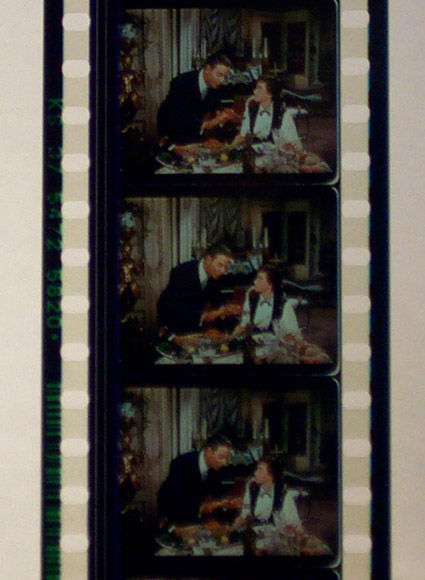
Once again I get a print with these type of perfs, "An American in Paris", new print on poly stock. Very dull colors and bluish in many of the scenes. In some scenes the colors vary from warm to bluish with each different shot. Such a shame that a Technicolor film is reduced to something so ugly.
Posted by Leo Enticknap (Member # 534) on 07-22-2005, 05:36 AM:
Sounds like a print made from a faded interneg which itself was recombined from slightly misregistered seps (possibly due to differential shrinkage).
You'd be looking at serious money to put that right, and even that would depend on the cut camera negative rolls surviving in reasonably good shape. That having been said, the good thing about Technicolor original elements is that there's no danger of several hundred release prints having been struck straight off them, as there is with a single-strip cut camera negative; so if decomposition isn't a problem and they weren't junked, they should be OK.
The NFTVA had similar problems with The Magic Box a few years ago and most of the Powell/Pressburger Technicolor films they restored in the '80s: even optically printing the lot on a Matipo, the registration wasn't perfect. It might be viable to do that by 4k scanning the originals and realigning the colour records digitally now, though I don't know if a three-strip feature has been digitally restored yet.
Posted by Tao Yue (Member # 836) on 07-22-2005, 08:48 PM:
Warner Brothers has been digitally reregistering many of their three-strip films recently, as misalignment shows up all too clearly on DVD.
Singin' in the Rain and The Adventures of Robin Hood had new 35mm prints struck from the digital files for a limited release. Some of the others, like Meet Me in St. Louis, Gone with the Wind, and The Wizard of Oz went straight to DVD.
The criticism, in fact, has been that these are too sharp compared to the original IB prints. Recombining three-strip with computer alignment onto Eastman stock avoids the registration issues inherent in dye-transfer.
Dan, I must commend your theater for running so many new prints of classic films. All too rare these days. Too bad you keep getting bad-looking prints.
Posted by Leo Enticknap (Member # 534) on 07-23-2005, 06:14 AM:
quote: Tao Yue
Recombining three-strip with computer alignment onto Eastman stock avoids the registration issues inherent in dye-transfer.
The original process was very hit-and-miss. The prints produced by the London and Hollywood labs in the '30s and '40s vary from astonishingly sharp to a fuzzy mess. In Britain during the war, when film stock rationing (there was never any film base casting plant in the UK: before the war we imported most of it from Europe; once it started it all had to come via the Atlantic convoys) dictated that the bad prints couldn't be junked, the misregistered ones were known as 'north of Watford' prints. Watford is a suburb in north London; the phrase implied that the good prints went to the high-grossing, prestige theatres in London's West End, while the misregistered ones were sent up north for the yokels!
I remember seeing original nitrate release prints of The Thief of Bagdad and The Life and Death of Colonel Blimp a few years ago, which were culled from a number of surviving release prints. The difference in definition and colour dye density between each 1,000 foot reel was astonishing.
quote:
The criticism, in fact, has been that these are too sharp compared to the original IB prints.
That criticism was made here when the P & P restorations were done in the '80s. Personally I don't have a problem if all you're doing is making all the new viewing elements to a consistent quality which is comparable with the best prints produced for the original release: and from the 5-10 Technicolor features I've seen both in original prints and restorations, my guess is that this is more-or-less what's happening.
quote: Tao Yue
Recombining three-strip with computer alignment onto Eastman stock avoids the registration issues inherent in dye-transfer.
Registration issues inherent in dye-transfer is the issue with original prints, but not with restorations or re-releases. The problem here is nitrate shrinkage, which often means that the three camera negatives (the cyan, yellow and magenta records) shrink at a slightly different rate. The analogue way of producing a new release print from there is to print them through filters onto modern colour internegative stock in three separate passes. So if one has shrunk more than the others, that gives you edge fringing and other defects. This can be offset to a large extent by using printers which are designed or modified to cope with shrunken film - the NFTVA uses a Debrie Matipo, for example. But as you point out, scanning all three separately and then using software to compensate for the shrinkage is potentially a much more easy and accurate way to do that. I'd be interested to see some 35mm prints of restorations produced that way, but as far as I'm aware none have made it here.
Posted by William Hooper (Member # 71) on 07-25-2005, 03:40 AM:
I got a new-ish, low-contrast print of Bava's (I think} "Black Sabbath" for a show from Italy which I believe was not a print for theatrical projection, but for telecine or some other purpose. Low contrast, blue-ish, to an extent that it was obviously not a theatrical print. It had colorful opaque leaders with Italian which I couldn't decipher. I had to run it, it looked awful. "Black Sabbath" is famously a saturated Technicolor eye-popper; it was a shame. Someone must have grabbed a 35mm print of the title & sent it by mistake, possibly thinking it was all the same.
On the other hand, they also sent an incredible, immaculate, probably from first-release print of the black & white "Girl Who Knew Too Much", which had a picture so gorgeous on carbon arc that you wanted to just eat the screen.
Powered by Infopop Corporation
UBB.classicTM
6.3.1.2