This is topic Should a projectionist go to college? in forum Film Handlers' Forum at Film-Tech Forum ARCHIVE.
To visit this topic, use this URL:
https://ft-forum.com/ft/cgi-bin/ubb/ultimatebb.cgi?ubb=get_topic;f=1;t=006891
Posted by James Faber (Member # 2796) on 01-20-2005, 03:18 AM:
I am at the point in my where I have to decided whether I want to go to college or not, and quite frankly, I do not. I personally don't see any need at the moment, since I have the job that I want, and would prefer, if not for my entire life, at least work there for a great while. As far as learning goes, I've never been a school person - that isn't the way I learn. I go throug about a book every two days, so I don't think I've stopped learning. So, basically what I'm asking here, is if any of you went to college did you think it was a waste of time, and if not, do you wish you did(as far as your job is concerned).
Posted by Thomas Hauerslev (Member # 566) on 01-20-2005, 03:53 AM:
Get some education and some paper to prove it. It might come in handy one day when you are tired of projecting movies. You never know what happens in 5 years time.
Cheers Thomas
www.in70mm.com
Posted by Carl Martin (Member # 1146) on 01-20-2005, 04:00 AM:
i think you answered your own question.
i went to college, didn't really have a plan, got interested in film, and here i am making $8 an hour. really using that education.
by all means, keep learning things throughout your life. if you ever do need to learn something in a structured manner, take a community college class. and if, later, you decide to go to college for real, do so, because you want to. your work experience will probably give you a leg up. and chicks will dig you.
carl
Posted by Monte L Fullmer (Member # 2797) on 01-20-2005, 05:03 AM:
quote: James Faber
So, basically what I'm asking here, is if any of you went to college did you think it was a waste of time, and if not, do you wish you did(as far as your job is concerned
That really a good one with this topic. Yet, with me, I went to college just to get out of the draft (1969-71) since my draft number was somewhat low. So I went to college to get my 2-S deferment. I didn't want to goto 'Nam. Plain and simple.
While in college though, I studied what I liked to do as a hobby and that was with music. Thus, I studed music education, being I already knew the keyboards. But the real suprise is that right after I started in college, I started working at the town's local Drive-In as a trainee for the projectionist's opening that was there. .. and so goes the rest of the story 35 yrs later...(LOL).
As for college though, I can say "yes!" It was a somewhat of a waste, yet I'm still glad I went because I learned something that I wouldn't have learned elsewhere with music. Plus,the atmosphere of a large college, with different people you have never seen or been around with when you were younger, plus, different teachers and courses that high school would never even think of offering. College is a great stepping stone in GROWING UP!
Yet,I knew that I didn't wanted to be "married" to a music career, since I was only doing music as a hobby. Course, back then, who ever heard of a PC, or MAC, the internet, online courses, et.al.?
Jobwise, well...it could be a six-of-one (aka "The Prisoner"), or half-dozen of the other. If I would have continued with music and made that a career, would I be happy? Granted, the money would be great, but still...would I be happy taking the work home, whereas I can leave it at work and come home to HOME?
While staying in the motion picture field as I have done, learned on my own for nobody "professionally" taught me the ropes about the field, I felt that I really have accomplished a bunch, even though the money income had its "hills and dales". And companies that I've worked for, in a whole, treats you as "doing them a favor" to "status as a doorman." Big thing with me is that I have never been unemployed in this business, or unemployed at all. Eventually, with my term in this field, I was making the dough where I'm now successfuly comfortable, but it took all of these years to prove and sell myself to companies who wants me and my expertise-and I still goof-up once in a while (LOL).
With the company I work for now, I'm assured a steady job as long as I want, for my job is defintely secured until this, or any company goes under for some reason or changes hands. By then, I can retire and forget about all of this and call it 'experience'..lol.
You'll find out that there is ALWAYS a tradeoff in what you want and need to do. ALWAYS that balance.
True, with the comments from the others: DO keep up with the education. For you need to have the main knowledge and knowhow to SURVIVE - to keep your head above water, and stay one step ahead of the rest of the world. And the most of all is to keep your bases covered at all times.
For the world doesn't tolerate weaklings. The world will destroy those who will not survive and defend themselves.
thx-Monte
Posted by Brad Miller (Member # 2) on 01-20-2005, 05:17 AM:
Your profile doesn't show your age, so this post is assuming you are 18-22ish???
What are you interested in, other than movies? Try to get some education in something that interests you, because taking a job that you won't enjoy will ultimately make you miserable. Also because if you don't have SOMETHING to fall back on, you could find yourself out on your ass if the studios ever end up doing something like giving away digital projectors and such.
If you don't have anything else that interests you, getting some education in business or management skills certainly won't hurt. Probably moreso up your alley would be to go to a tech school and learn how everything works. That way you can upgrade yourself to a tech down the road if that sort of thing interests you...or you end up HAVING to go that route because projectionist jobs dry up.
So even though the idea of school may seem like a vacation in hell to you, do it anyway. Once you start crunching $$$ numbers of what it will cost for you to LIVE out on your own, school starts looking better and better (not to mention SAFER - something to "fall back on"). If that isn't enough to convince you, throw in the $$$ of what happens when you find out you're going to be a daddy! ![[Eek!]](eek.gif)
Everyone always underestimates how much life really costs. I cannot stress this enough.
Posted by John Pytlak (Member # 331) on 01-20-2005, 05:58 AM:
Unfortunately, being a projectionist today is rarely a career. It IS an excellent way to work your way through college. If you like working in the film industry, your college degree (whether technical, business, or arts) will help you advance in your career, whether it's filmmaking, management, IT, engineering, etc.
I worked several jobs while getting my engineering degree, but most enjoyed my part-time work as a projectionist. My projection experience helped me get a job at Kodak. But my 35-year career at Kodak has been as an engineer, working on motion-picture projects.
Posted by Thomas King (Member # 2745) on 01-20-2005, 06:41 AM:
You might want to get a formal education, because in a few years there isn't going to be any demand for projectionists as it'll all be digital ![[evil]](graemlins/evil.gif)
Posted by Jeremy Fuentes (Member # 2135) on 01-20-2005, 07:18 AM:
quote:
throw in the $$$ of what happens when you find out you're going to be a daddy!
Take my word for it, that'll quickly change your mind about whether or not you wanna be a minimum wage projectionist or not.
Posted by Scott Norwood (Member # 30) on 01-20-2005, 07:23 AM:
If you have the time and cash (or can borrow the cash), I strongly recommend college. If you are not trying to prepare for a specific career, take courses that interest you and/or are taught by professors who are known to be especially good. Some of my favorite courses were in subjects that I didn't think would interest me or were completely unrelated to my major.
A good professor can make a huge difference, avoid the boring ones if at all possible. If nothing else, education (both formal and informal) will make you a better, more interesting person. One of my favorite classes (in which I did not get good grades, I might add) was art history; it was taught by someone who genuinely loved and cared about the subject and that made the topic fascinating to me, where otherwise I would have had little interest in it. The social experiences that you will have in college are also not to be ignored; you will meet many interesting people, many of whom will be of the opposite sex. ![[Smile]](smile.gif)
I majored in Government, which was fascinating, but I didn't really want to make a career out of being a politician or civil servant. Now, I maintain computer networks and do occasional film stuff on the side.
You can probably work at a theatre while in college and, if you choose to study mechanical or electrical engineering, you can gain the skills needed to service projection and sound systems, if you should want to do that. Even if (when) film projection goes away, someone is going to make a killing installing and maintaining ![[dlp]](graemlins/dlp.gif) machines.
machines.
If you are on a budget or don't want to commit to a four-year degree, consider taking courses at a community college, making sure that the credits are transferrable to a four-year institution if you do well in the classes and want a four-year degree someday.
Posted by William Hooper (Member # 71) on 01-20-2005, 07:58 AM:
quote:
I personally don't see any need at the moment, since I have the job that I want,
Ah c'mon, you know there's more than just one thing on this planet you'd enjoy. The tedious part may be just finding those other things.
Most colleges & universities have as part of marketing their goods for sale an office & service of some kind "interests counseling", "career selection", whatever for prospective students -- it's basically going in yet again with a #2 pencil to fill in circles on an interests inventory. They feed feed this mess ("Do you like math more than history? Would you prefer to watch a TV show about The History of Polypropylene or a TV show about Cooking with Sterno? Do you like fingerpainting? Would you rather work with pre-schoolers or nematodes?")into a computer & get statistical matches of people with similar interests in various professions, & throw back at you a list ranked in order of those which you match most, then less, then not much at all.
As you'd guess, it's not the all-knowing Ouija. The best matches come out at the top, those won't fit everybody who fills in the circles ("Yeah, I like nekkid people, but I don't want to be a mortician"), noise starts coming in with people who just go to work & are disengaged from their professions for example because they foreclosed on it )"My folks wanted me to be a factory electronic parts assembler, so I'm going to be an electronic parts board assembler"), some professions look good to certain personality types but are better suited to another (working on customizing cars is fun, until that 1st February when you open up the door for the umpteenth time & see a lot of crunched cars that have to be done in freezing temperatures), etc.
If the counselor is just a lazy git pulling a paycheck & only comes up with broad, uninteresting categories ("This says you'd enjoy being a laboratory scientist"), you'll have to press for example of what KIND of engineer (electronics? chemical? civil? working with road grades or designing bridge?) lab technician (medical? nuclear?) or research lab supervisor (marine biology? chemical?) or dig on your own to find out something more.
The best way to get through the college mess, since you're pursuing a particular standardized set of classes to get a particular degree to do a particular thing, is to find & meet with the group the school has for folks pursuing not just that degree, but that particular profession - the Cardiovascular Students Club, the MBA Knitting Circle, etc. All these structured things are usually not very useful on top, but the informal stuff answers questions about which instructors are awful, do I need to take History of Spartan Military Fashions, etc., & provide the tips & support to get through things like The Stupidity of Requiring Calculus for Degrees in Professions That Don't Need It At All.
You never know, projectionisting may get old fast; but while it's still almost recreational, it'll be a fun way to pay the bills while you work on something else you'll like maybe even more, & which will provide money for more sumptuous vacations.
Posted by Leo Enticknap (Member # 534) on 01-20-2005, 08:06 AM:
quote: John Pytlak
Unfortunately, being a projectionist today is rarely a career. It IS an excellent way to work your way through college. If you like working in the film industry, your college degree (whether technical, business, or arts) will help you advance in your career, whether it's filmmaking, management, IT, engineering, etc.
Agreed 200%. I got my first part-time projection job while still in high school. The main reason I went to university was really (being honest with myself) because my parents did and it was kind of expected. It was a combination of working as a projectionist and doing a history degree which got me interested in film archiving, and the next step from there was a postgrad qualification in film archiving (will continuing to work in the theatre business to pay for it). At the end of that there were no archive jobs around (this was 1996, Britain was only just coming out of an economic recession and the public archives were feeling the pinch), but I was offered research funding for a PhD in film history. So there then followed three more years of being a student by day and a projectionist by night and weekend, and eventually two years full-time in the business before finally getting the archivist's post I'm in now.
I'd say that both has helped each other. The research skills I learnt in various universities and colleges are something I could fall back on if the film archives here finally get into real trouble (something which, sadly, is becoming a real possibility). The projection and film handling skills kept me in a job when I needed one, and furthermore was a far nicer job to have than any of the alternatives, despite the antisocial hours. Furthermore, having the film handling experience is incredibly useful in my current post, which is a small organisation (three full-time and two part-time staff) where we all have to multi-skill to a certain extent.
As Brad says, the college education is a very important safety net to fall back on should you ever need to, or eventually want to move on. I enjoyed every minute of my time in the booth, and still project the odd show in the theatre of the university in which our archive is based every now and again, but there came a time when I knew that this wasn't all I wanted to be doing for the rest of my life.
Posted by William Hooper (Member # 71) on 01-20-2005, 08:17 AM:
quote:
It was a combination of working as a projectionist and doing a history degree which got me interested in film archiving,
Leo omits to mention that the crusty job description of "film archiving" is actually a pretty cool thing where he learns about & works with really funky, interesting old movies in funky, interesting old formats, with interesting new things coming his way frequently.
Why, I bet he didn't hesitate one second to get on the phone to call that guy in Argentina about audio restoration of movie sync sound discs!
Posted by Greg Mueller (Member # 17) on 01-20-2005, 09:03 AM:
I took a couple years of college and recommend it. But then I went to technical school, which I think is a great alternative for some people.
Posted by Chris Medley (Member # 2145) on 01-20-2005, 09:34 AM:
Take something in college. Just try something...underwater basket weaving, whatever. Many companies require some type of degree or certification in something for any job. Plus if you ever want to be a tech for theaters in your chain, you will do well to get some type of engineering or mechanical training. I loved being a projectionist and manager too, but I had to be realistic. I always say do what you love, but I know guys that love playing Halo 2...and that just doesn't pay the bills. ![[Big Grin]](biggrin.gif) I had to support a family and live on my own...that takes more money than my management position paid, or would ever pay.
I had to support a family and live on my own...that takes more money than my management position paid, or would ever pay.
Posted by Thomas Procyk (Member # 1170) on 01-20-2005, 10:30 AM:
College isn't for everybody. You have to WANT to go into academics, which I hated as long as I can remember. And now that I look back on all those people who drilled me through my pre-teen years that I HAVE to go to college and HAVE to get a career at some big corporation or I will NOT be "successful" I want to beat them up. When I approached my school guidance councelor about the prospect of opening my own business with the money I got set aside for college and she said, "You will NEVER make any MONEY with your OWN business. You need something SOLID, like an ESTABLISHED company for your career..." ![[Frown]](frown.gif)
So I went to college. And I found it to be exactly what Bob Dylan said it would be: "...an invisible circle in which no one can think without consulting someone..." College is a business, and they're not in the business of selling education. They're in the business of numbers. Because the bigger the numbers, the more funding they get and the more money the administration will make. And anyone who believes for a moment that when they raise tuition that a good percentage goes to the professors should take a gander at the recent Faculty Protest regarding that very matter that happened here two days ago.
Anyways, the stuff I learned in college that I really cherish never came from a classroom. The experience of it all, the people, the hardships, the challenges and decisions you have to make are the things I have learned about. But ask me what I learned in Anthropology and I couldn't tell you even if you held a gun to my head. In that sense, I believe college is the biggest hole you can ever throw your money into.
Throughout my "career" in college, I've had six majors. Each one had some kind of stupid requirement or prerequisite to purposely throw people for a loop so they won't pick that major. The biggest joke here is the communications department. You have to go through so many "applications" and "approvals" before they let you learn what you really want to. (Radio, TV, Film or Journalism) My problem was, despite the fact that I've touched more actual film than all the students in the program put together, that I've had a radio show ON CAMPUS for a year, that I am a published writer... all that didn't matter. Nor did my portfolio. You see, you have to have a 3.4 GPA to get in and mine was a couple point fractions lower. So the entire department is filled with book-smart hacks with no talent. YAY!
Universities are also a brilliant model to create cheap labor for corporations or cheap recruitments for the military. You see, these big corporations pour money into universities so that they can come and do a "career expo" to lure students into working for them. You see, through college you basically PAY to be TRAINED for these jobs that these companies offer. That saves them major bucks, not having to train people on their own. Then when they come to the career expo, they can fill all those lower-level positions with aspiring young college students who think they will actually climb the corporate ladder once they get their foot in the door.
That's a very important thing to remember. Don't go after a major or a job just because it makes a lot of money. You may be well-off, but you'll be dead tired and disgusted at the end of your 9-5 day that you won't want to spend any of it. Except maybe on alcohol.
So in a nutshell, the only thing you will "learn" in college is how to navigate one of the most unnecessarily complex buraucracies on the planet (which can actually be useful in this "real world" they keep telling me about) and how to live on your own for a couple years. All for only $25,000+
I wanted to open my own theater before I got to college. Could have used the money to start it up. It would have been open for four years now. Currently, the theater that had opened in that location since is making money hand over fist. There's a college lesson for you.
I should be graduating soon. But I told myself that repeatedly for the past three years. I will more than likely have a degree in Technical Writing. YAY! That's what I've ALWAYS wanted to do. More accurately, it was the only thing left that was loosely based on what I REALLY wanted to do, which the buraucracy told me I couldn't. "In college, you can be ANYTHING you want!!" Yeah, just like Santa, they lied to me about that too. But I guess you have to lie to people if you want to be rich...
=TMP=
Posted by Randy Stankey (Member # 64) on 01-20-2005, 11:05 AM:
Let's assume that you go to a private Liberal Arts school like I work at.
You will spend, on average $25,000 per year... Government financial aid notwithstanding. The average college student ends up paying about $100,000 to go to school for 4 years.
A person with a High School diploma, on average, will be able to get a job that pays $50,000 per year at most.
A person with a College degree... virtually ANY kind of degree... has the potential to enter a career that pays anywhere from $100,000 per year and higher. (Depending on the degree, the school the degree was earned at and how the person persues a career.)
That comes out to as much as a $50,000 per year differential in income! (Or, in some cases, even MORE!)
In 20 years time, on average, the person with a College degree will out-earn a person with only a High School diploma by $1,000,000!
Consider that it only cost you $100,000 to go to school in the first place, and you get a TEN-FOLD PAYBACK on your dollar!
And, this is only the AVERAGE! Some people who continue on and become doctors and lawyers, etc. can earn MUCH MORE! You'd be SILLY if you had the chance to go to college and didn't take it!
The above is a summary of the speech the President of my school makes every year to the incomming Freshman class and their parents. The man says it much more eloquantly that I can!
Posted by Jim Ziegler (Member # 86) on 01-20-2005, 04:17 PM:
Most people I know do not have jobs in the same field as their major. What counts is the experience. For the booth side of the theatre business, electrical and mechanical education will come in very handy. For the management side, courses in business and marketing, and some selected courses in theatre, psych/sociology and criminal justice will be of benefit
Posted by Chris Hipp (Member # 1788) on 01-20-2005, 04:41 PM:
A college degree wil not ensure you anything after you graduate. Degrees really don't mean as much as they did 10 or 15 years ago. Almost everyone goes to college these days so almost everyone has some type of degree. It is just like high school diplomas. 20-30 years ago it was not uncommon for kids to stop going to school after 8th grade and start working, therefore a high school diploma mean much more back then.
If you decide to go to a university, do it because you want to learn, not becasue you want to "get rich." College is not job training, it is supposed to teach you how to think and how to ask the right questions. There are planty of ways to get rich without a degree.
I forget who it was, but someone had a signature on here that said something like "Bill gates never went to college and he is worth 60 billion dollars, but think about how much more he could have made if he would have gotten that degree." I think that really sums it up.
Posted by Phil Hill (Member # 371) on 01-20-2005, 05:04 PM:
I agree 100% with Chris... he said it best. A college degree doesn't mean as much as it used to. A college degree does not necessarily ensure you a high-paying job... there are plenty of college grad taxi drivers, waiters, and clerks around. And many jobs that "require" a degree do not pay that well either.
The degree with help you IF you are smart in the 1st place. Unfortunately more and more, the college degree is more likely to tell the employer that you have been politically brainwashed by the professors with their own agenda while getting limited real world learning.
It will always be a plus to have it in anything but Liberal Arts, and it is a MUST if you plan on going into some high-tech field. Just for the wall paper if nothing else.
Posted by Mike Blakesley (Member # 26) on 01-20-2005, 08:12 PM:
quote: Chris Hipp
I forget who it was, but someone had a signature on here that said something like "Bill Gates never went to college and he is worth 60 billion dollars, but think about how much more he could have made if he would have gotten that degree." I think that really sums it up.
That was my signature. It was a quote from the comedian, Dennis Miller, from his book "I Rant, Therefore I Am." An excellent book!
Posted by James Faber (Member # 2796) on 01-20-2005, 08:15 PM:
Thank you so very much, you guys. After reading all of the posts, I'm leaning toward taking some community college classes, and if that works out, taking the next step to a larger univirsity. I would most likely end up taking film, English and history classes, and maybe a couple of management classes. If I decide I don't want to go to school anymore, I'll be out $4000 for 2 years of community college, but big deal, I'll at least have an AA, which is a little better than just a diploma.
I don't figure I'd do too well in engineering classes, since my math skills are not the greatest, however I'm fairly proficient with a computer(especially hardware) and can fix pretty much anything around the booth. Perhaps a tech school would suit me, I just don't know what kind of skills that would require. A mild amount of math is acceptable(I love physics, but I can't do problems that it feels like I'm solving for no apparent reason). A little more help, please?
Posted by Paul Mayer (Member # 355) on 01-20-2005, 09:17 PM:
Try an EET, Electronics or Electrical Engineering Technology certificate or AAS degree program. Many CCs offer EET programs with all kinds of specializations. The math in an EET program is not tough, just college-level algebra, geometry, and Boolian math. No calculus or numerical analysis. Perfect for technicians.
For example, here's CCSN's AAS EET program sequence.
Posted by Mike Heenan (Member # 392) on 01-20-2005, 09:50 PM:
To make college more exciting, go to ASU in Tempe, where the girls dont wear too much clothing in the spring and summer! ![[thumbsup]](graemlins/thumbsup.gif)
Posted by Steve Guttag (Member # 268) on 01-20-2005, 09:58 PM:
Let me tell you about a fella I know....rather well....
He came from a familiy where both parents were college grads (Chemists) and whos siblings (3-older) all went to college, one who placed out of his Freshman year (many "AP" classes in HS and had over 1400 on the SATs). Needless to say, going to college was a bit of an expectation.
However, this guy was not what one would call a "good student." He didn't really enjoy school that much.
When he turned 16, he, though a mutual friend, landed a job as a projectionist at a local theatre chain. His grades shot up substantially...from say a C-D student to an A-B student. Musta been something about the booth environment (especially in the days of singles, twins and the odd triple) that lead to better scholastic environment. He also was earning substantially more money than his friends.
As he progressed through school, so did he though the projection ranks (obtained better theatres to work, improved his skills and had more recognition from the administration). However, the theatres ment more to him than the school work. So much so, that upon graduation from HS, he, like you, didn't really want to go to college and was "tired" of school. This was certainly a disappointment for his parents though it was predictable based on his activities.
He progressed through the theatre chain to become their in-house tech, trainer, and assistant supervisor (projection). The company supported him and sent him to "Dolby-School" and such. He had a say on theatre construction for the chain as it pertained to projection/sound.
When his boss resigned, he was promoted to "Operational Supervisor" which ment that he was responsible, along with the other supervisor, for the day-to-day running of the entire chain of 70 some odd screens. This included staffing the projectionists as well as providing support/guidance for the managers. At this point, he was 22-years old, had a new Corvette (he still has it, I believe), and had seen his last promotion. It was a private company and his immediate superior was the owner.
For the year prior to his promotion, there was this ever increasing desire to go back to school (college) to learn. To be more. To not have to accept just what is provided.
So, he eventually resigned after he applied, and was accepted at his local community college. He also applied, and was hired by another independant theatre chain as a projectionist, and to help out with service and design of their theatres.
The plan of showing movies while going to college worked out very well. His grades were quite good. They would have to be. His chosen major was Electrical Engineering. At the state school he was to attend, a 3.0 GPA was a minimum to continue into one's Junior year.
He found that the profressors at the community college to be quite good and eager to teach. Most were quite eager to provide extra help and effort, if desired. The work was hard but was certainly doable in a mannor that never seemed so in High-School. Physics was the Deusy...the Professor announced on the first day of class that they have a 1 in 10 success rate of Freshman that make it through their 3rd semester of Physics (a requirement of the Engineering Sciences). Most chuckled at the statement figuring it was a scare tactic. After the first exam, noboydy was chuckling. The professor made up another exam and gave it to the class, again most people failed it. By the end of their first year only a 1/3 of the orginal Freshman were still in Physics, this guy being one of them.
At the end of his community college days, having never applied nor obtained an AA degree, he qualified and transfered over to the state school. This was a different experience all together. Whereas at the community college, the professors were interested in you doing well, not so was the case at the state school. They couldn't care less, by and large (there are always exceptions in life). Reality Bites nailed it when they pointed out that you would learn your Social Security number in college, if nothing else.
There was a system in the state school for doing everything and if you didn't know the rules, or how to work the system, you were trampled upon and left behind.
He chose to live on campus, and due to his age, was housed in the adult appartments on campus. There he met one of his life long friends that showed him the ropes of "working the system."
He roomed with people both from his country and from other countries. Learned to live with a group of strangers and make friends. He also learned how to live with people he didn't particularly like. In a large college setting, there are ALL kinds of people with all sorts of beliefs and habits. Hopefully you learn how to have freedom and how to allow others to have it too.
He became active in professional societies like the IEEE and SMPTE. Both of which he is a member to this day. He is still quite active in the SMPTE and is on one of its engineering committees. I also hear that he gave a speech in front of a bunch of video guys at a section meeting of the SMPTE.
When taking classes that had projects, he always tried to have theatres or movies as part of the project. For technical writing, he wrote a paper on restoring a theatre. For a senior Physics class with a programming language called Mathematica, he wrote a program to calculate the optimum light reflectance from a curved screen based on gain, room shape and audience area. He once took a class on "Film Appreciation" where they actually gave out grades for watching movies! His professor for the class went on to work at the Library of Congress' film archive.
While in school, he joined the local union of IATSE. He eventually was elected as an officer of the local (Financial Secretary). He helped organize and successfully turned a lockout by Cineplex to a 100% union representation for Cineplex in the area.
However, by the end of college, he once again was ready to leave school and go back to the "real world".
When he graduated with that Electrical Engineering degree, he found that times were tough in the EE field, IBM was laying off engineers for the first time in their history. The other tradional EE firms, with their cubicle lifestyle, were doing likewise.
However, he took a job with a local service company that was always the pre-eminate company for theatre and started his career off there by designing audio interfaces so allow these new-fangled digital processors to communicate with the older sound systems. He eventaully made a changeover interface for the Sony brand of digital processor, SDDS, I think it is, that sold well and was installed in just about every country around the world.
So once again, he was able to bend the professional training to work with the movie theatre environment.
He still designs hardware (or software if necessary) to allow for better projeciton/sound installations and his former film professor is now his customer!
If you pay attention to Film-Tech, you will see his posts...in fact, he is writing to you right now!
Steve
PS In the fast paced world that we live in, the above, heavily abridged story could be easily summed up to "Been there done that, got the degree" but I don't think that would help you at all. The realies are, as Thomas has pointed out, that college is NOT for everyone but what it offers, if you give it your all, is much more than academic education but an ever lasting education of people and culture. It will give your mind a workout much the same working out in the weight room can work on your muscles. My physics professor, Dr. Corely, said often, doing physics for 6-hours should feel every bit as exhausting as digging a ditch for 6-hours or working out for 6-hours.
I don't think I would have had the same experience in college if I went stright from High-School but I don't regret for a minute just about ANY of my classes that I took, major or non-major. My college days were certainly some of my favorites. Do you want to learn how to get along with different cultures? During the first Gulf war, one of my apartment mates was a Jordanian. It takes on a whole new meaning to turn on the TV and while all the Americans are reveling in their victories to notice one who is scared about what is going to happen to his country. College can provide that sort of education too.
Like everything else in life, it is what you make of it.
Posted by Sam D. Chavez (Member # 1841) on 01-20-2005, 11:54 PM:
Steve,
The only class you did not take was editing. I do agree with everything you say about going to school. It takes dedication but ultimately makes you look at the world with a wider view.
If I may turn this topic on its head, the real questions is, can a projectionist remain normal if there is nothing else in his/her life to make them grow. It is an isolating experience that often causes severe atrophy of the social skills.
I became the most anal retentive perfectionist operator anyone could hope to meet. I stayed at what at the time was a very well paying profession for 13 plus years but came to realize at the age of 35 or so that my people skills were declining and I was developing a lifer mentality. I had however, taken a string of classes to sharpen my technical skills and this prepared me to become a full time technician.
I like to say I stayed in the booth about three years too long and had the begining of an affliction, complete with showing up for 13 hour grinds in a dirty tee shirt and three day growth.
There is life after the booth.
Posted by William Hooper (Member # 71) on 01-21-2005, 02:27 AM:
I agree with Thomas Procyk (& Steve Guttag). Colleges & Universities are very high-stakes for students, unfortunately, they're also self-sustaining, closed organizations that frequently become as dangerous & dysfunctional as the Drivers License office, poplulated by the same kind of people. Folks in any profession will tell you theirs has got lots of people in it who are there for the wrong reason & shouldn't be there; teaching is no different.
There are a lot of occupations that attract people with personality problems which are essentially a need for display - law enforcement, emergency services, performing arts (non-tech), teaching, politics, health professions - because they are seen as a way to assume a position of authority, which some folks desperately need for self-esteem. The rough part is that those occupations specifically require the most results-oriented, probliem-solving, & realistic personality types. In some, like the performing arts, the result is just lack of vocational success, in others, the result is much more destructive to everyone around.
If you get a bad class/instructor, get on the outside of it mentally; view it like another nasty job like changing the oil that has to be just seen through. But if it's really bad, like a hostile instructor, one that isn't effective in teaching what his examinations cover, etc., write a complaint, go see the dean, change to another instructor. Hostile people are very fragile, & staying there after they've been disagreed with one is academic suicide. It's your money, & you're neither their target nor shrink.
I've got to disagree with the idea that now degrees (& certification) are less valuable because more people have them. In a pool with a lot of applicants & the neccessity to establish a minimum requirement, *any* degree is usually a baseline to get out of the very bottom. The top is not getting higher, the bottom's getting lower.
Also, a degree gives you room to move to something similar, if the current occupation starts going smelly. People in sales & management can always get a job somewhere else in another business doing sales or management, but being a projectionist is lmited to pretty much that alone. You can't take any experience in that as brownie points somewhere else; you're entry-level again.
When you're looking around trying to find what you want a degree in or certification for, it doesn't have to be far from what you're doing now. Technical occupations a little higher the ladder can be very satisfying. Will Kutler looks like he's going to be having fun. Get some additional training, & you'll be a more valuable (professionally & monetarily) tech.
People who like their jobs have in common that they're described as "engaged" with their jobs. It's not very useful; the engagement is described in various ways as I like to work with communicating with people & do, I like interesting machinery & work with it, etc. Some people really like routine, but in folks looking at other things, it's very uncommon. When you pursue the "engagement", it turns out that they like the *problems* presented to them in the job that they like. Like the same problems every day - likes routine. Like figuring out how to construct a method to communicate something so others will understand it - PR/teaching. Like figuring out how to make a new device to do something specific - design. With all the vagueness about the *engagement*, it basically boils down to the common satisfying sensations that performing arts people know have to go over for people on the other side of the foots that's always the same process flow: setup, suspense, payoff. The suspense is where the engagement is; people just sort of sit through the setup & you try to structure it also with little bits of setup/suspense/payoff sprinkled in there to keep it from getting too boring. If it can't be resolved (payoff) satisfactorily, there's frustration & dissatisfaction. If it's too difficult to handle (setup), same result. That's how you can read that people who like their jobs like the problems the job presents. Not awful, unsolvable, or repetitive problems. People like novelty, but novelty they can deal with.
So when you look at possible other occupations or pursuits (even if it's switching from projectionist to mercenary projection wiz-tech like Steve Guttag), the way you assess an occupation is to look at it & say "Would I like the problems?" You can get training & experience to back you up for just about anything, but to enjoy a pursuit: rock climbing, engineering, cooking, etc.; the problems have to appeal to you.
There's a sort of superficial vocational preference inventory thingy online at
http://www.careerkey.org/english/
Results you get for your interests & preferences are again going to be really broad, possibly uninteresting descriptions: most of the "engineer" things sound duller & more isolated than "librarian", but it's the actual jobs under that category that are interesting. You get the degree to pursue a particular job, or find the interesting job objective in the information you discover while you're pursuing the degree.
If the admissions folks at the school you're looking at doesn't have a service & counsellor to adminiser something like this, check out a larger nearby universtiy & do it. It's almost always free, to suck in prospective students. (Heck, you might transfer there later anyway through any turn of events, not excluding winning the Sam Chavez Scholarship For Socially Isolated Projectionists). If the counsellor can't offer any more information when asked about occupations other than the top broad listings in such results other than "well, you'll have to research that", that person is there either to prop up some personal inadequacy by sitting in a chair of presumed authority or just to get into the retirement system.
If you have to do additional research on your own, just remember that all research at the top level is tedious; it's as you start burrowing down to the specifics that things *always* become interesting.
Good luck!
Posted by Monte L Fullmer (Member # 2797) on 01-21-2005, 02:32 AM:
quote: Sam D. Chavez
If I may turn this topic on its head, the real questions is, can a projectionist remain normal if there is nothing else in his/her life to make them grow. It is an isolating experience that often causes severe atrophy of the social skills.
There is ALWAYS something else out there to make one grow and that something is ALWAYS out there - one just have to find that.
In a general sense: that's kind of a bad excuse when one's not trying to grow. (no offense intended)
For, if you don't grow, you'll destroy yourself in a heartbeat. This is always a good challenge for all who fall in this trap: go find something else to do and find something else to learn, for studying and learning won't hurt anyone.
Also...finding a girl who can really understand were you are coming from and fully understands what your profession is and that your profession make you happy and you feel successful in doing this sort of work, plus enough income to support raising a family, then get married.
This cures the isolated experience real quick, for it will make you realized whom you are "married" to.
A projectionist CAN be normal if they want to. But, I've seen some eccentric, anal retentive ones that I'd love to shoot just to get them out of their misery. -lol-
thx-Monte
Posted by Steve Guttag (Member # 268) on 01-21-2005, 07:02 AM:
Sam, needless to say, my major was not English (or any other language). But it is true, I do not proof read very much on my postings. Even if I see a mistake later, if the meaning can be inferred, I'll let it stand.
One thing I discovered upon leaving the booth as a full-time thing, is that I rarely liked spending more than a day at a time showing movies. The isolation is good, to collect ones thoughts, but too much of anything can have its negative effects.
Steve
Posted by Martin McCaffery (Member # 37) on 01-21-2005, 09:06 AM:
If you are not sure about college right now, don't go. Take a year in the "real world" and get a few clues as to what you may want to do in life (odds are you be doing something completely different 20 years from now).
After that year, unless you absolutely possitively do not want college, go.
You may have already done the year off thing and may just be looking for validation one way or the other now. We can't do that for you, but the tide towards some sort of further education is turning your way
Posted by Daniel Alt (Member # 2303) on 01-21-2005, 09:42 AM:
My two cents?
Try not to look at college as a "trade school", but rather a chance to grow. In college I majored in Astronomy and Music, took classes in economics and philosophy, had a radio show, was president of a fraternity, and spent a lot of time juggling.
I went to parties, dated, fell in love, fell out of love, made friends, lost friends, and generally had a lot of experiences that shaped who I am.
Can you do all of those things outside of college? Sure. But the academic environment provides you with unparallelled opportunities to explore a wide range of interests in a relatively compact space and span of time. It's an incubator for diverse, interesting people.
I wholeheartedly recommend it, for the overall gestalt, not just for the academics. (Plus, you learn to use words like "gestalt")
Posted by Sam D. Chavez (Member # 1841) on 01-21-2005, 11:24 AM:
No offense intended to Steve of course, and I love Monte's observations. I too have pondered putting an operator wallowing in self loathing out of his misery.
Oddly, I've never met an unbalanced female projectionist.
This has been a very revealing topic.
Posted by Joshua Waaland (Member # 287) on 01-21-2005, 12:24 PM:
I have not read all the replies yet and don't have the time but here is my two cents.
I was much like you and thought school wasn't my bag. I hated it with all my being. I was forced to go my first year to a community school by my mom or move out. I went and of course hated it. I soon quit. After a few years of work I realized that working for 8-9 dollars an hour sucks. Nobody really cares about your plight or what you think of anything when you are on the bottom of the totem pole. I decided that I was smarter than that and it would be a waste to use what I had been given on a job that would never really satisfy me. I went back to school again and this time had to pay my own way. I had to work midnights at UPS moving freight all night and go to school during the day. Needless to say my grades suffered and again I took the easy way out and quit.
A few years ago I again started feeling the pangs of frustration in my current job. By this time I was married and decided to go to school part-time and work full-time. This sucks let me tell you. You never have anytime to yourself or your family. The good thing is I had finally grown up and changed my mind set. I realized that school is all in your head (no pun intended). It just takes hard work and diligence. I kept a 4.0 for three semesters and now have a 3.8. I was the guy in high school that never did any homework. Luckily I had some very nice teahcers who liked me and passed me many times when I shouldn't have been passed. I scraped by when I graduated.
This past monday I made the leap to full-time school again and part-time work. Am I looking forward to all the hard work and studying that is in front of me? Hell no, but I keep my eyes on the prize. The fat cheddar that awaits me when I graduate with my bachelor's in engineering. The hard part is that now I am faced with juggling my job, school and my wife. Thank God I have no kids or I would probably be stuck. My wife wants kids and now I have to get through school as quick as I can. I always say my biggest mistake was not finishing school. I regret it everyday of my life. Now I will be at least 10-15 years behind everyone else. Yes, you can always go back to school, but it will be never be as easy to go as it is now.
My advice to you is go to school. You will not be able to get a decent job anymore without a degree. Union jobs are starting to get scarce and good luck getting one with all the other people competing for them. We have a GM and Ford plant in the town I grew up in and you have to know someone high up to even get in there and they are always getting laid off. Besides with cinema going digital soon, there will be no more projectionists jobs.
Josh
Posted by Monte L Fullmer (Member # 2797) on 01-21-2005, 03:34 PM:
..if you want to see a "cozy" booth, (and I've posted this pic in another thread...) this was my "home" for 12 years.
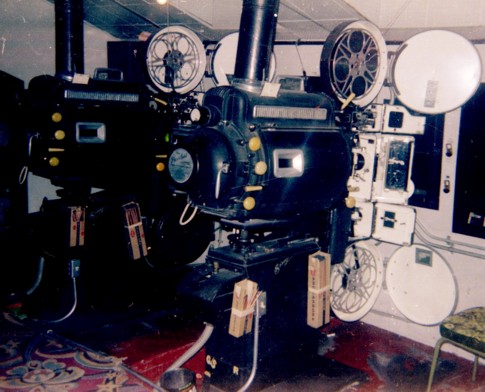
And you talk about isolated - definitely away from the outside world. Yet, within this theatre, I learned so much on how to take care of a building-from the attic to the basement, auditorium to furnaces(coal, of all things..!!). Now, the private party has this theatre, with the booth all empty, using it as a city performance center.
One can tell back then, that I wasn't thinking about furthering my education. Course, I was younger and dumber then (LOL). - Monte
Posted by Mike Pennell (Member # 1692) on 01-21-2005, 08:43 PM:
quote:
To make college more exciting, go to ASU in Tempe, where the girls dont wear too much clothing in the spring and summer!
Damn Scum Devils! Go Arizona Wildcats! ![[beer]](graemlins/beer.gif)
Posted by Thomas Procyk (Member # 1170) on 01-22-2005, 10:55 AM:
Something to ponder:
The new Appretice season started with two teams, one consisting of all members who have a college degree, and the other team consisting of people who only have a High School diploma and went straight into the job market. ("Book smarts" versus "Real world" people)
They revealed approx. how much all the members in each team make combined. The team who only had a high school diploma coupled with what they learned for 4 or whatever years in the field made THREE TIMES MORE MONEY than those with a college degree.
And the college grads are from places like Harvard... so not only do they make LESS money, but they also SPENT tons on their overpriced education, which as Will Hunting said, "...you could have gotten for a dollar fifty in late charges at the public library!"
College is overrated. Pursue your ambitions, not what the status quo tells you are your ambitions.
=TMP=
Posted by Mark Gulbrandsen (Member # 72) on 01-22-2005, 12:47 PM:
I agree with both Thomas and Sam.
quote: Thomas Procyk
College is overrated. Pursue your ambitions, not what the status quo tells you are your ambitions.
Real world experience I received over the years has been far more valualable than any college degree could ever have been to me in this field, not that college would hurt but it would have hindered my kowledge of alot of things in this field. Previous jobs involving electronics, mechanics, and optics prepared me to work in this field. I got the equivelent of a 20 year college education of things I wanted to know, learn about or was interested in, not what thise that ran a university thought I should know! If one needs more education in a certain area to expand and improve its always available to you at any time.
quote: Sam D. Chavez
If I may turn this topic on its head, the real questions is, can a projectionist remain normal if there is nothing else in his/her life to make them grow. It is an isolating experience that often causes severe atrophy of the social skills.
Sam that is an excellent thing to bring up and the best point made in this thread. I can honestly say I've been down that up and down road myself. I find that technicians are also affected this way... not just the operators. Road trips are semingly endless and some times very lonley with only your next customer on the horizon or the waitress at the next restaurant to talk to. Spending way too much shop time also affects individuals this way. In effect you become isolated! I see this in myself and is reflected in my postings here sometimes.... I also see it in my co-worlers as well. Yes, getting out and doing other things is a must for the mind and soul to be able to keep ging forword in a normal manner. Thanks for bringing that up. I think this really deserves a thread all by itself!!
Mark
Posted by Joshua Waaland (Member # 287) on 01-23-2005, 12:08 AM:
Thomas,
I would be willing to bet that most of the college grads on "The Apprentice" haven't been out of school long and able to climb the ladder. I too made more money than my wife when she got out of college, but she passed me a year later, and now makes 3 times what I make. I am sure they purposely found very successful people without degrees to prove a point on that show. Of course there are exceptions to any rule, but look up the stats. College grads make an average of $1,000,000 more in a lifetime than non-college grads.
If you don't want to go to school then don't go, you will only hurt yourself and your own future. Can you make it without a degree? Yes, but it will be much harder and less likely. I agree it is a lot of hard work and it sucks studying about things you have absolutely no interest in (economics), but the end result is worth it.
Like Sam said projection work is very isolating. Most of my jobs have been that way and I too felt my social skills(what little I had) dwindling. My lack of social skills and self-esteem was much of the reason that projection work appealed to me so much at first. I was picked on a lot in high school and was very shy. I loved the idea of being left alone for many hours to be by myself and hide from the world. But eventually I knew I had to get back on the horse and do something with my life. Better to fail and say you tried than do nothing and waste your life I guess.
This crap about school is not for everyone really boils my blood. People used to tell me that all the time. My high school guidance counselor was one. She was all to pleased to sign me off when I decided to go vocational. She had put me in the mold of not college material and figured I wasn't good enough. She was a real arrogant woman. Anyhow I let people talk me into that and I bought it for many years. Thank God for my wife who helped me to see otherwise. I thought I sucked at math too. I don't. Turns out I believed all that crap that I wasn't cut out for school and never really tried to put in any hard work to find out. If you apply yourself and get help if you need it, then you can do it. No shame in using the tutoring lab.
Bottom Line: : It takes a lot of hard work to finish school and you can do it if you really want it. You gotta want it. If you are not going to put in the effort, then save your money and start looking for something to fall back on because projection won't be around forever.
Posted by Jim Ziegler (Member # 86) on 01-23-2005, 02:02 AM:
So if Bill Gates would have finished college he would have $40,001,000,000.00 instead of the $40,000,000,000.00 he has now?
Seriously, in the theatre business there really is no degree that having will boost your career. If you go to school, study what you want, get whatever degree you want, because, if you stay in this business, it doesn't really matter what field you study.
Posted by Mark Gulbrandsen (Member # 72) on 01-23-2005, 08:01 AM:
quote: Jim Ziegler
because, if you stay in this business, it doesn't really matter what field you study.
It matters alot if you're a technical person and want to keep abreast of many new developments.
Mark
Posted by Thomas Procyk (Member # 1170) on 01-23-2005, 10:20 AM:
You want to be rich like Bill Gates?
Open a 2,000 seat Cinerama theater in Orlando, FL.
Make it an "attraction"
You'll be set for life.
Who wants to help me?
=TMP=
Posted by Dean Kollet (Member # 1789) on 01-23-2005, 12:10 PM:
yeah Tom, I'll join ya. I think having the best of both worlds makes you get a good job. If you have a college degree and the skills to talk to people on a professional level...boom there ya go. The whole world is all about marketing, and you have to market yourself.
Posted by Jim Ziegler (Member # 86) on 01-23-2005, 02:42 PM:
I agree with you there Mark, I was talking about the choice of major being largly unimportant (though, for a tech, I can see how an Electrical Engineering degree would be helpful).
If you want to be a tech, classes in electronics and engineering are a definate. If you are in management, some marketing, communication, computer and criminal justice courses are helpful as well.. Most business programs seem to lean towards middle managment cubical jobs, with only a few of their courses teaching anything that will be useful to a theatre manager. Colleges will have programs to turn you into a nurse, or a teacher, etc, but none of them have a B.S. in Projection Technology or a B.A. in Theatre management..
Posted by Will Kutler (Member # 770) on 01-23-2005, 03:31 PM:
I am really sickened by the negative attitudes of many FT members regarding college.
You don't go about selecting a college major based on the current fad or how much $$ you can make! I have known many people who have done that and who are absolutly miserable!
When selecting a college major, one should determine:
A: What do you enjoy?
B: What your aptitudes are?
C: Is A and B versitle (a base by which to branch out into various fields?
D: Can you earn a comfortable living from A, B and C.?
Anyhow, look at me, as all four of the above apply!
I already have an AAS degree in Machine Tool Technology from an accredited and well respected community college program that is an authorized HAAS learning center and also serves as part of the AZ NTMA apprenticship program.
I am currently finishing my BS degree in Manufacturing Engineering Technology at Arizona State University - East, which is also an accredited program (one of the oldest in the country) and HAAS learning center. HAAS is the largest US manufacturer of machining tools and are almost 100% US MADE!
An excellent aspect to this program is the "real world" experience of the faculty, as well as the programs emensly strong ties with major industry. SME is a major supporter (I am a student member of this major international organization), and the program is accredited by ABET. With the current comeback of the manufacturing sector, the program has seen a 100% job placement rate, along with internships...starting salaries in the $50k range. And once I graduate and obtain a cerrtain level of experience, I will be able to take the industry exams to become a Certified Manufacturing Engineer.
I wrote about some exciting new current events happening with our program in the Film-Yak forum.
So what is my degree about...well many craftsman and artisian type fields that are now falling under the engineer's realm...much of what is exciting, current state-of-the-art technology!
Classes include manual machining; multi-axis CNC programming and machining; tool, die, mould, and pattern making and actual casting; machine design, process planning, hi-tech inspection and measurement, welding, metalurgy, machine design, fluid and thermo dynamics, electronic design, statics, math, physics, chemestry, senior capstone projects, etc....
Cheers
Kutler
Posted by Jeremy Fuentes (Member # 2135) on 01-23-2005, 05:39 PM:
quote:
You don't go about selecting a college major based on .....how much $$ you can make!
quote: Will Kutler
D: Can you earn a comfortable living
So, I take it you minored in self-contradiction??
Its all about how much money you can make, Will. Otherwise, why go? For self-enrichment? I tried to pay a truck payment with self-enrichment once, it didnt work.
quote: Will Kutler
A: What do you enjoy?
I enjoy working at the theater. I wanna either be a tech or an owner, but currently dont make enough money to pay for an education, that includes many classes that I dont need anyway. Core curriculum requires you pay for classes that dont always help you with the degree you are looking for. So do I go to a tech school instead? None here in Corpus. I'm not able to move my family to an area where a tech school is, and still be able to provide for them in the mean time. So how do I stay in the theater business, since the first priority on your list is what do you enjoy?
Posted by Will Kutler (Member # 770) on 01-23-2005, 07:03 PM:
Well Jeremy
Maybe I should simperfy for you....
I have known many people who went to school to become Dr's or lawyers because thats were a lot of $$ is an/or thats what their family wanted them to do. But even though they earned $$$$, they were absolutly miserable because they could not stand those career choices.
As the old saying goes, "Money does not necessarily bring happiness!"
BTW Jeremy, not having $$ is a real lame excuse for not going to college. My tuition and expenses are covered through loans (subsidized and unsubsidized) and some university and Federal grant $$. Ya, I'm now in debt, but I am not worried. I keep up my grades, present a positive professional attitude, live honestly...so I am confident all will work out in the end.
Cheers
K
BTW, I can relate to Joshua Waaland, except that I am single. My personal experience has been that school can be exhausting and at times fraustrating, and sometimes you just can't wait until a particular class is over...but oooohhhh wat a sense of exhilarating accomplishemt when all that hard work pays off in the end!
Posted by Mark Gulbrandsen (Member # 72) on 01-23-2005, 07:08 PM:
quote: Will Kutler
I am currently finishing my BS degree
Heck Will many here have degrees in BS and they didn't have to go to college to get it. Whats taking you so long?????
![[Wink]](wink.gif)
Mark
Posted by Will Kutler (Member # 770) on 01-23-2005, 07:11 PM:
I guess there might be a sense of jealousy being displayed by those not pursuing a higher education?
Posted by Gordon McLeod (Member # 33) on 01-23-2005, 08:21 PM:
And after the degree in BS one gets an MS (more of the same) and then their PHD (Piled Higer and Deeper)
Posted by Mark Gulbrandsen (Member # 72) on 01-23-2005, 08:28 PM:
Thats hilarious Gord!
Mark
Posted by Jeremy Fuentes (Member # 2135) on 01-24-2005, 06:17 AM:
quote: Will Kutler
I guess there might be a sense of jealousy being displayed by those not pursuing a higher education?
I have no reason whatsoever to be jealous of anybody at all.
quote: Will Kutler
not having $$ is a real lame excuse
quote: Will Kutler
Ya, I'm now in debt, but I am not worried.
Maybe I am jealous after all.
quote: Will Kutler
I am single.
I'm not. I have 3 other people to worry about. I guess the only solution for me would be to get out of the theater business, since you never answered my question Will.
Posted by Rick Raskin (Member # 1561) on 01-24-2005, 05:21 PM:
quote: Jeremy Fuentes
"I guess the only solution for me would be to get out of the theater business..."
Some corporations have a tuition assistance program but I rather doubt many theatre companies do. There are also certified home study programs over the net, but beware of those degree mills; those that promise a degree with little or no effort. Look at it as a long term investment; you won't regret getting that education. And who knows, you may even get a better position in the theatre business. Best of luck.
...Rick
Posted by Jeremy Fuentes (Member # 2135) on 01-25-2005, 08:36 AM:
Thanks.
Posted by Will Kutler (Member # 770) on 01-26-2005, 12:43 AM:
One of my classes this semester is "Technical Calculus II", and our textbook is "Technical Calculus with Analytical Geometry" by John C. Peterson.
So, what's the point? Well, here is a cinema related question from the text...one just for kicks....
How far back from the screen (in a specific theatre) should you sit in order to have the best viewing angle? Hint..using the derivative of a trig. function. ![[Roll Eyes]](rolleyes.gif)
Posted by Jeremy Fuentes (Member # 2135) on 01-26-2005, 06:08 AM:
HAHA!! ![[Confused]](confused.gif)
Posted by John Pytlak (Member # 331) on 01-26-2005, 07:21 AM:
quote: Will Kutler
How far back from the screen (in a specific theatre) should you sit in order to have the best viewing angle? Hint..using the derivative of a trig. function.
Standard SMPTE 196M-2003 specifies the following:
quote:
9 Review room viewing conditions
All observers in a review room shall be located within a standard observing area which shall be:
a) within the limits of a 15° angle on either side of a perpendicular to the center of the screen, in both the
horizontal and vertical planes; and
b) at a distance of 3 picture heights ± 1 picture height from the screen.
Although those specifications are specific to "Review Rooms", since that is where the creative decisions are made on the "look" of a picture, sitting in that area of a theatre will provide the best correlation.
I personally prefer to sit on the centerline of the theatre, at a distance of 2 times the picture height, for an "immersive" experience.
Posted by Joshua Waaland (Member # 287) on 01-28-2005, 06:58 AM:
Will,
We had that same question last semester in my precalculus class. I cannot remember the answer at the moment but I remember there was specific information given to solve the problem like the angle theta of the stadium seating measured in radians.
Speaking of which those trigonometric functions kicked my butt last semester. I never made it beyond pre-algebra in high school so that was all new to me. Many of the kids in the class were straight out of high school and had already learned much of it. (Another good reason to go to college now so you don't have to go back and review. There was a couple of older guys in my class that had all this 20 years ago but had to retake it because they could not remember it. That only delays your degree and costs you more in the end.)
I am taking calculus this semester too but am really looking forward to physics since it relates so much to projection work.
Posted by Carl King (Member # 398) on 01-28-2005, 08:04 AM:
be cool go to school
Powered by Infopop Corporation
UBB.classicTM
6.3.1.2