This is topic Filmguard and Sticky Prints in forum Film Handlers' Forum at Film-Tech Forum ARCHIVE.
To visit this topic, use this URL:
https://ft-forum.com/ft/cgi-bin/ubb/ultimatebb.cgi?ubb=get_topic;f=1;t=006927
Posted by Ian Bailey (Member # 1752) on 02-03-2005, 04:00 AM:
I have used Filmguard for over a year now and I have been very happy with the results.Lately though I have had a spate of prints that have been "sticky" in places and a couple of serious brain wraps.Running the prints through the cleaner again does not resolve the problems.What could be causing the problems?Can you put too much Filmguard on a print?We normally clean a print as soon as it is made up and most prints get an extra clean at least once a week(we only have one cleaner for 3 screens).Problem prints have been sticky in places from the first run(some of the prints wre new and some used).
Posted by Leo Enticknap (Member # 534) on 02-03-2005, 04:08 AM:
Are they sticky because of polyester static cling or because of some contaminant on the film surface (e.g. projector oil from having been run through a leaky mech at a previous theatre)? If it's cling I can't see how FG would make any difference one way or the other. If there's some sort of goo on the film I've found that FG can be very effective at dissolving it, but you do need to wipe the whole lot off afterwards. Hand cleaning the affected reels on a bench with a lint-free cloth (e.g. a Selvyt) before plattering them and running them through the FG-impregnated media pads might be something to try.
Posted by Ian Bailey (Member # 1752) on 02-03-2005, 04:32 AM:
Hi Leo
It appears to be static cling,I need to get a magnifying glass so i can inspect the problem areas a lot closer(my eyes aren't that great-something to do with getting old I'm told).We have tried using part of a media pad with filmguard on it to hand clean the problem area without much success.
Posted by Dominic Espinosa (Member # 2122) on 02-03-2005, 11:29 AM:
That sounds quite strange to me...I'm sure Brad will be along with an answer soon.
It seems to me that a heavy run of FilmGuard plus edge coating the roll with FG would take care of any static or shedding problems. As well as most anything stuck to it.
Take a look and let us know what it is.
Posted by Chris Brown (Member # 2800) on 02-03-2005, 12:25 PM:
Somewhat related story I have...last January we had a sneak of "Win a Date with Tad Hamilton" that had numerous spots in the last 3 reels that were "sticky". What the substance was, I'm not sure, but it was as if the last person breaking it down was drinking soda at the same time and spilled it on the print in spots ![[thumbsdown]](graemlins/thumbsdown.gif) Somehow I didnt spot this upon bulidup.
Somehow I didnt spot this upon bulidup.
So naturally, during the sneak Friday night, its wrapping like crazy, to the point where I was sitting there babysitting the last few reels just to prevent more. Rough night, to say the least.
Anyways, my point is that we had another sneak Sunday, and my GM told me to figure out a way to fix it by then. So basicaly I broke it down slowly, and whenever I encountered a sticky spot, I used Film Guard and cleaning media to clean it off, and it worked quite well. Played through fine for the Sunday sneak. Ian your problem is obviously a bit different, though I am surprised that applying Film Guard didnt really help. I'm sure Brad or someone will be of some assistance...best of luck though!
Posted by Brent Neal Jones (Member # 1048) on 02-03-2005, 01:08 PM:
Try spraying directly on the affected area, I think you'll be suprised. Wasted Film-Guard is better than a brain wrap, I promise it works.
Next, What brand of equipment do you have? Do you have a "climate controlled booth? When did this start? Let's try to narrow this thing down...
Posted by Randy Stankey (Member # 64) on 02-03-2005, 01:58 PM:
Just guessing here:
If you apply F.G. by the regular method, it can dissolve all kinds of icky goo that finds its way onto film but it might not get completely REMOVED.
Even WITH F.G. you might have to manually clean the film with a soft cloth/pad soaked in F.G. Otherwise you might be left with patches of partially dissolved goo on the film which COULD cause wraps at inopportune moments.
Posted by Monte L Fullmer (Member # 2797) on 02-04-2005, 02:26 AM:
..wonder if a "green" print would be causing this stickiness? Just soft emulsion of sorts. - Monte
Posted by Brad Miller (Member # 2) on 02-04-2005, 02:44 AM:
It'll work magic on green prints. I've had many that were shipped literally straight from the lab and ran less than 12 hours after they were processed.
Ian, please describe your method of application. I can offer more assistance knowing the specifics of your situation.
Posted by Ian Bailey (Member # 1752) on 02-06-2005, 08:35 PM:
Hi Brad
We have one cleaning unit that we have attached to a portable MUT that we always use for making prints up.Once the print is made up we run it through the cleaner onto the platter.We also re-clean every print (1-2 times) each week by running it back onto the mut and then through the cleaner at the next showing.I do plan on making mounting plates so we can attach the cleaner to the platter trees(3 screens)so we don't have to run them back onto the MUT.The other problem I have in the projection room is too much humidity in the summer months.We live in a sub-tropical area that can average 80-100% humidity for most of the summer.I have to have some major work done on our A/C plant soon so we will be adding more ducting into the projection room to try and alleviate that part of the problem.We only have problems with the two Speco platters-very rare that we get a brain-wrap on the AW3 even with a sticky print.We seemed to have had very few problems for quite a while then it seemed every second print had to be watched due static or stickiness
Posted by Monte L Fullmer (Member # 2797) on 02-06-2005, 09:45 PM:
quote: Ian Bailey
We seemed to have had very few problems for quite a while then it seemed every second print had to be watched due static or stickiness
..wonder if it's a lab issue then - quality taking a bit of a nosedive to the ocean. - Monte
Posted by Gordon McLeod (Member # 33) on 02-07-2005, 11:16 AM:
I doubt if it is a lab issue. The specos have a painted non conductive platter deck which is shy they are more prone to static buildup
Posted by John Pytlak (Member # 331) on 02-07-2005, 03:19 PM:
If it is indeed "static cling", a good path to ground is important, even for Kodak VISION Color Print Film with it's conductive anti-static backing layer. For non-conductive platter surfaces, consider spraying the platter with a conductive anti-stat (e.g., Staticide, Static Guard, Endust for Electronics, etc.), or use a conductive "platter mat" or disk on the platter.
Posted by Ian Bailey (Member # 1752) on 02-07-2005, 06:43 PM:
Hi John
I think your comments about the platter grounding is part of our problem.We sit all our prints on Masonite sheets so we can easily move them.The print pays out off a maonite sheet and takes back up onto a masonite sheet on the take-up platter.So our prints never touch a grounded surface.My AW3 is the only platter I have with bare metal decks-my two Specos have painted decks.I prefer to use the masonite sheets as it makes print moving very easy and safe and my AW3 has fixed brains which makes it that much more difficult to add or remove prints on the platter.
Posted by Dean Kollet (Member # 1789) on 02-07-2005, 06:57 PM:
I'm not too good with the theories of electricity, but isn't the projector grounded?
Posted by Gordon McLeod (Member # 33) on 02-07-2005, 08:15 PM:
The fact that there are two different plastic film and a epoxy painted platter deck and frictional movement generate static at that point, the ground of the projector will have no effect on the area on the surface of the platter that have the static generator effect occuring
I offten take strips of sensing tape and run them back and forth across the platter surface and connect them to the bearig area to help create a ground plane on the platter deck
Posted by Randy Stankey (Member # 64) on 02-07-2005, 09:29 PM:
It doesn't matter how well the projector, itself, is grounded. The charge on the film will be grounded-out as the film goes through the projector but, once it leaves the projector and goes back to the platter, it will start charging up again.
Now, you've got a giant insulated, rotating disk and a giant band of insulating material passing over insulated rollers all gathering up electrostatic charge as they go.
What you have here is a giant Wimshurst Machine! An early form of electrostatic generator!
Yes, a Speco platter is a giant electrostatic generator, IMHO!
Spin those platters fast enough and you could probably generate a spark that could kill a man! ![[Eek!]](eek.gif)
(Well, in theory only, at least. ![[Wink]](wink.gif) )
)
quote:
From Wikipedia, the free encyclopedia.
The Wimshurst machine is a form of electrical generator developed by British inventor, James Wimshurst, in 1832. It is a historical electrostatic machine for generating high voltages. It has a distinctive appearance, with two large contra-rotating discs mounted in a vertical plane, and a spark gap formed by two metal spheres.
The machine belongs to a class of generators called influence machines. This means that they separate electric charges by electrostatic induction, or influence. Earlier machines in this class were developed by Wilhelm Holtz (1865 and 1867), Toepler (1865), and Voss (1880). They were more efficient than the earlier machines that worked by friction.
The machine is self-starting, meaning that it requires no electrical power supply to create the initial charge. It does, however, require mechanical power to turn the discs. The output of the machine is a constant current. The spark energy can be increased by adding a Leyden jar, which is an early type of capacitor suitable for high voltages.
See also
* Electrical generator
* Static electricity
* Testatika
Posted by Brad Miller (Member # 2) on 02-07-2005, 11:21 PM:
Ian, drill and tap two mounting holes as shown on this SPECO platter. High speed cleaning isn't near as effective as real time cleaning. Plus it's a whole lot less hassle. ![[Smile]](smile.gif)
Posted by John Pytlak (Member # 331) on 02-08-2005, 12:34 PM:
Instead of Masonite, could you make the platter disks out of sheet metal?
Posted by Randy Stankey (Member # 64) on 02-08-2005, 10:59 PM:
quote:
Those made by speco are honestly not worth the money. They caused to many false shutdowns and in some cases had to be weighted or tied down to prevent the false shutdowns.
OR... You could quit dickin' around and just do what I found the kids had done in one theater I got called to:
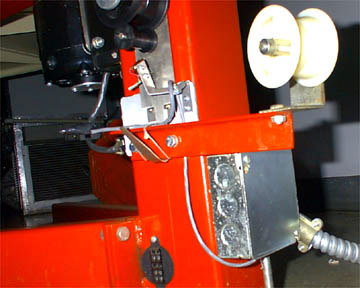
However, the best solution I have seen is to take a thin rubber band and tie them down. That way, you prevent accidental bumps and bobbles from tripping them but, if there is a real need, the rubber band will break.
Posted by Ian Bailey (Member # 1752) on 02-08-2005, 11:56 PM:
John
I have considered getting aluminium discs made up but then i would have to remove all the paint off the Speco decks and the cost could be a problem because i would need about 15 of them-we currently have 11 movies we are showing at the moment.
Brad
Thanks for the info.I have not noticed the article on the LP 280 before.I am very interested in the changes you made to the brain.The two brains I have(LP 270/LP 1003)have the same layout as the one supplied with your LP280.I'm going to have a close look at them to see how hard it would be to convert them.Just by looking at the picture of the prototype brain you would think the bottom edge of the print would drag over the pay-out arm,I suppose the height of the first roller would govern the way the print goes through the pay-out arm.Apart from you liking the AW3 is there any other reason for changing the small rollers around the outside of the brain to posts.If the print wrapped around the brain it would bind onto the pay-out arm of the prototype rather than being held off it by the small rollers-but from what I can see that rarely happens in Dallas I admit it looks a lot better with the posts,
Posted by Monte L Fullmer (Member # 2797) on 02-09-2005, 02:09 AM:
quote:
Yes, a Speco platter is a giant electrostatic generator, IMHO!
Spin those platters fast enough and you could probably generate a spark that could kill a man!
Yep..get them discs spinning fast enough (with the motor pulled back for free wheeling), grab onto any door key, hold on that key real tight, and with the other hand, hang onto a dry rag also tight when making friction contact with that spinning deck surface. Then find a good ground, and you'll pop off a good 3 inch spark between the key and the ground.
What's fun is to tag that key behind someone's ear when they're not expecting it. (lol)
-Monte
Posted by Ian Bailey (Member # 1752) on 02-09-2005, 04:07 AM:
Why do Specos have this static problem?Can it be reduced or eliminated?I know my Speco has a 220v-110v step-down transformer to power it-does this mean that earthing could be an issue?
Posted by Brad Miller (Member # 2) on 02-09-2005, 06:40 AM:
The posts help newbies remember that the film isn't supposed to be threaded around them. (Yes I see this happen in Strong-type-brain booths.) It also looks nicer and gives more room to thread. The rollers don't really do anything anyway because they are too high up off of the deck to actually have the film seat itself happily on them. Plus if the film is wrapping around the posts, you have more serious things to worry about! Rollers around the brain are stupid.
Also, you will find threading is more "drop in place" like an AW3 with that prototype brain design. It pretty much eliminates that ridiculous thread under this and around that and through this and blah, blah, blah nonsense.
Posted by John Pytlak (Member # 331) on 02-09-2005, 09:51 AM:
quote: Ian Bailey
Why do Specos have this static problem?Can it be reduced or eliminated?
The issue is one of the platter having a non-conducting surface, so there is no path to ground from the edge of the film roll. As I noted before, the surface of the platter can be treated with a conductive anti-stat like Staticide, Static Guard, Endust for Electronics, etc. --- the same type of material you might use on clothing or computer screens to minimize static buildup. Or you can use a metal disk or metallic material on the platter that is connected to the grounded frame.
I don't know about the electrical code in Australia, but most commercial electrical equipment here would have the frame connected to ground in some way, so no additional grounding of the frame would be needed.
http://www.tjk.com.au/html/antistats.htm
quote:
STATICIDE
TOPICAL ANTI-STATS
For more information on all our products and to order please contact us via email or phone us direct on (61) 02 9496 0500.
Posted by Randy Stankey (Member # 64) on 02-09-2005, 10:42 AM:
The Speco gains electrostatic charges by "influence". (AKA: Electrostatic Induction.)
Every time the film passes over (or near) a non-conductive surface a little bit more charge gets built up as the electrons get pushed around when they repel each other. Positive and negative charged areas develop on the film. Every time the film passes over a roller that charge gets multiplied. It probably pases over 8 or more rollers on its way back to the take up.
Then the film gets back to the take up where it winds itself into a big spiral... Basically forming a giant capacitor. Because the Speco platter is painted, there's no way for the charge to be "siphoned off" to ground. (Or someplace where it can be put to use.) It just sits there and builds and builds. A lot of it discharges into the air if the humidity is high enough. If you live in a dry climate or if it's winter time when indoor humidity gets low, there's not enough water in the air to bleed the charge off.
The electrostatic induction is different than the triboelectric effect. (AKA: Charging by friction.)
Just by putting your hand NEAR a moving/spinning reel of film it is possible to build up a charge powerful enough to cause a xenon lamp to light up momentarily. I did it once by accident, sitting at the rewind bench. Then I did it again to show everybody else. (The lamp was inside its clamshell.)
My first solution would be to strip the paint off the platter(s). But the problem with that is that they are made of regular steel. They would probably rust in a very short time. Making them out of heavy aluminum or stainless would probably be too expensive.
My second solution would be to make that last roller on the takeup out of metal or graphite which would conduct any charge that has built up on the film to ground.
Third, if you can find a piece of Christmas garland that has metallic fringes you can put it near the top of the takeup elevator and be sure it's conducting to ground. It doesn't have to touch the film, only pass very near. (Within a few milimeters.) It will allow some of the charge to bleed away before it gets would up into a giant capacitor.
I have tried it and it does work a little bit. I never had time to really research it, though. It was shortly after that when I decided to quit messing with it and I went out and got myself some FilmGuard.
quote:
Electrostatic induction
From Wikipedia, the free encyclopedia.
Electrostatic induction is a method by which an electrically charged object can be used to create an electrical charge in a second object, without contact between the two objects.
The effect can be demonstrated using an electroscope, which is an instrument for detecting electric charge. The electroscope is first discharged, and a charged object is then brought close to the instrument's terminal. This causes a redistribution of the charges inside the electroscope, so that the electroscope's terminal gains a net charge of opposite polarity to that of the object. At this moment, the electroscope has not acquired a net charge: the charge within it has merely been moved around. An electrical contact is then briefly made, e.g. by using the experimenter's finger, between the electroscope terminal and earth. This causes charge to flow from earth to the terminal, attracted by the local surplus of charge at the terminal. The electroscope now contains a net charge opposite in polarity, and slightly weaker than, that of the charged object. When the electrical contact to earth is broken, e.g. by lifting the finger, the extra charge that has just flowed into the electroscope cannot escape, and the instrument retains a net charge.
Numerous electrostatic generators, such as the Wimshurst machine, the Van de Graaff generator and the electrophorus, rely on this principle.
quote:
Triboelectric effect
From Wikipedia, the free encyclopedia.
The triboelectric effect is an electrical phenomenon where certain materials become electrically charged after coming into contact with another, different, material. The polarity and strength of the charges produced differ according to material and surface smoothness. Amber, for example, can acquire an electric charge by friction. This property, first recorded by Thales of Miletus, suggested the word "electricity", from the Greek word for amber, elektron. Other examples of materials that can acquire a charge when rubbed together include glass rubbed with silk, and hard rubber rubbed with fur.
Posted by John Pytlak (Member # 331) on 02-09-2005, 10:50 AM:
Conductive "tinsel" is often used to help control static charging (e.g., at the output of a copying machine to discharge the paper).
For theatre use, Kinetronics has a line of antistatic devices, including conductive "static brushes":
Kinetronics Static Brushes
quote:
Anti-Static Brushes
Cinema Platter Systems
A Static and Dust Control Product
The Kinetronics StaticWisk© SWG-625 anti-static platter brush is used to stop ‘Brain Wrap’ on cinema platter systems. The soft conductive synthetic fibers plus the conductive nature of the construction result in effective static dissipation from polyester based film. A six-foot (2m), heavy-duty, coiled grounding cord effectively drains static electric charges off the film. The SWG-625 brush is mounted magnetically to the platter tower and can be adjusted with a double ball joint for easy alignment.
Posted by Randy Stankey (Member # 64) on 02-09-2005, 01:35 PM:
I got the idea for using conductive tinsel garland to dissipate the static charge on film from looking at photocopiers and teletypes back in the 70's & 80's when I was in school. I was sitting there at the booth desk just thinking and thinking about how to stop the static when I remembered the garland thing.
The trick I found is twofold:
1) You must make sure the garland is grounded. Otherwise it will have no effect or worse... It could amplify the charge by giving it a path to move from place to place instead of going straight to ground.
2) You must place it in a location where it will be near both sides of the film or else you will only dissipate the charge off one side of the film. I simply put a wrap or two around the vertical post of the tree, just under and behind the top three rollers of the takeup accumulator. (Yo-Yo) I scraped away a bit of the paint on the tree and made sure the center wire of the garland was touching the bare spot.
If your platter isn't grounded, that idea won't work. I guess I'd get a piece of 12 Ga. wire and connect it from the platter to a known good ground.
Posted by Ian Bailey (Member # 1752) on 02-10-2005, 02:33 AM:
Randy
I checked my platter again and it does have a good earth connection which I checked with a multimeter to a known good earth at a nearby powerpoint.So it looks like poor design wins again.
John
Thanks for the information,I suppose my next question is do the anti-static devices work well enough to be worthy of purchasing?Has anybody had experience with these products?
Posted by Gordon McLeod (Member # 33) on 02-10-2005, 09:19 AM:
"So it looks like poor design wins again."
Well they had no problems until the industry demanded the change to estar film base from triacetate
Posted by Brent Neal Jones (Member # 1048) on 02-13-2005, 01:08 AM:
quote: Ian Bailey
Why do Specos have this static problem?Can it be reduced or eliminated?I know my Speco has a 220v-110v step-down transformer to power it-does this mean that earthing could be an issue?
I have not experienced any problems in our booth, other than common humidity related stuff. This an be solved by running it through again. Ours are painted with white enamel. (Appliance white)And like I said, no static cling, knock on wood...
Powered by Infopop Corporation
UBB.classicTM
6.3.1.2