This is topic CP55 Static in forum Film Handlers' Forum at Film-Tech Forum ARCHIVE.
To visit this topic, use this URL:
https://ft-forum.com/ft/cgi-bin/ubb/ultimatebb.cgi?ubb=get_topic;f=1;t=006931
Posted by Cam Jones (Member # 2684) on 02-05-2005, 02:55 AM:
Hi everybody. In one of our auditoriums there is a fairly noticable background static, it is more noticeable during talking scenes. I figured it might have been the right channel producing the static but even running mono sound has it.
The booth monitor reveals static on all channels (when volume is loud enough) from the processor and on the amps. We've checked all the connections and everything looks fine. Also we have aligned the sound head.
We run:
Ballantyne Model VII soundhead
QSC ISA 450 amps (3)
Dolby CP55 Processor
Dolby SRA5 Processor
Does anyone have any suggestions to fixing this? Perhaps some sort of calibration process?
Best Regards,
Cam
Posted by Dominic Espinosa (Member # 2122) on 02-05-2005, 03:10 AM:
And here's Dom with the obvious:
Is this something new or are you installing it?
What kind of static is it? Can you describe it in more detail?
Is there any chance it could be inteference from another device?
Sounds to me though like it's something close to the output on the processor. I'm no expert though.
Posted by Cam Jones (Member # 2684) on 02-05-2005, 03:22 AM:
The static sound just started happening, it was running fine for over a year. It's really hard to explain the static, but I'll try. When someone is talking at the end of their speech is sounds almost like they are on a radio with the slight distortion and hiss. If that makes any sense to you. I can't think of any device that could cause it since no changes were made to the sound rack or around it for awhile.
I guess tomorrow we can try to switch the cards from another processor to see if one of them is the problem.
Posted by Monte L Fullmer (Member # 2797) on 02-05-2005, 03:34 AM:
quote: Cam Jones
guess tomorrow we can try to switch the cards from another processor to see if one of them is the problem.
True, that'd be your first step - "condemning" each card to see if one could be doing this static. And, while you're pulling cards, take a pencil eraser and scrub the gold contacts on the card(s), for hidden corrosion can cause irratic contact between the cards and the sockets. This is a common thing with Dolby products, and even with Ultra-Stereo units with their cards as well.
Then, if the static is still present, check the 'momboard' for any defects as well, for 'momboards' will develop hairline cracks and will have to be replaced.
Also, this static could be caused by a power supply that is getting "tired" thus not getting enough "juice" to the system. Swap out power supplies in the process.
CP55 units are at least 12 yrs old, and those power supplies do get tired after awhile. Dolby still has those CP55 power supplies in stock.
-Monte
Posted by Brad Miller (Member # 2) on 02-05-2005, 04:31 AM:
Are you still running on exciter lamps, or did you upgrade to a red reader. If so what kind? I've seen this same problem you describe happen twice from preamps in the red readers taking a dump.
Posted by Mike Babb (Member # 1379) on 02-05-2005, 09:53 AM:
Cam, have you ruled out print damage, scratching on the analog soundtrack? I'd lean towards the reader as well but recently had what you describe because of print damage...
Posted by Gordon McLeod (Member # 33) on 02-05-2005, 11:57 AM:
What is the booth humidty level if you still have solar cells and low humidity you may be getting static discharge to the cell from the film and getting some solder braid and bonding it to the top area (the upper angled peice of the head and bringing it till it almost touches the cell face and back to a screw on the caseing will stop it
Otherwise it is probably the bypass relays either corrosion in the sockets or the contacts internally which has been a noted problem in the canadian climate
Posted by Cam Jones (Member # 2684) on 02-05-2005, 01:15 PM:
We have Ballantyne Model VII soundhead's with red light readers (sorry I don't know more then that).
I believe we have ruled out print damage as we've tested it by running trailers through with the same problem. I'm not sure of the booth humidity but I think its very low, perhaps we'll have to try turning up (or on for that matter if thier not!) the humidifiers and see if that helps too.
Thanks
Edit: Actually, I believe the reader is an RCA redlight reader, but I'd have to go in and check tonight to be sure. If it is the red light reader, will it likely have to be replaced or is it fixable?
Posted by Matt Zeiner (Member # 1914) on 02-05-2005, 02:22 PM:
We've been seeing a good number of Kelmar reverse scan units with shorted opamps lately. All of our techs have started carrying TL072 and TL074's in their parts boxes. I don't remember ever seeing this with their earlier readers...Anyone else been running into this?
Posted by Michael Schaffer (Member # 1204) on 02-05-2005, 06:24 PM:
quote: Gordon McLeod
What is the booth humidty level if you still have solar cells and low humidity you may be getting static discharge to the cell from the film and getting some solder braid and bonding it to the top area (the upper angled peice of the head and bringing it till it almost touches the cell face and back to a screw on the caseing will stop it
The poetry of Gordon McLeod! Sorry, but I read this several times and still can't understand it. What do you mean by angled piece? The front end of the bracket to which the solar cell is attached? How does bonding the cell to the upper end help fight static discharge? The bracket is plastic.
Posted by Dave Macaulay (Member # 813) on 02-05-2005, 08:23 PM:
Exactly. The bracket is nice insulating plastic and the cell is sorta conducting silicon attached to nicely conducting metal wires leading directly to the processor input. Static charge on the film can create a corona discharge to the silicon chip and a sizzling/popping problem in the audio. Gord suggests adding a bit of wire to attract this static discharge and carry it to ground without affecting the sound. However, reverse scan LED readers do not have this problem.
Posted by Cam Jones (Member # 2684) on 02-05-2005, 11:23 PM:
Thank you all for your suggestions. Turns out after all that it must be a damaged print as brand new stuff runs perfectly fine in it. Short of ordering a new print (not really an option because we are a second run theatre and the damage was likely caused by one of our operators) what can we do?
The right channel is scratched and we have been running it in mono to lessen the static but is there anything else we could do?
Thanks as always,
Cam
Posted by Monte L Fullmer (Member # 2797) on 02-06-2005, 02:23 AM:
quote: Cam Jones
The right channel is scratched and we have been running it in mono to lessen the static but is there anything else we could do?
I did one trick like this on a scratched soundtrack, and that was to take a thin piece of electrical vinyl tape, and mask out the damaged side of the soundtrack over the photocell, but this is with the exciter version. With reverse scan LED - no such luck.
With a toasted sound track - just order a new print. Be like in the days of yore when the soundtrack got sprocket run, order a new print.
And hopefully the print/booking department doesn't tag you with the bill for a new print to replace print damage, unless you can prove that the print came in damaged.
Good luck on this one, for it's a toughie to tangle with. - Monte
Posted by Michael Schaffer (Member # 1204) on 02-06-2005, 04:57 AM:
quote: Dave Macaulay
Exactly. The bracket is nice insulating plastic and the cell is sorta conducting silicon attached to nicely conducting metal wires leading directly to the processor input. Static charge on the film can create a corona discharge to the silicon chip and a sizzling/popping problem in the audio. Gord suggests adding a bit of wire to attract this static discharge and carry it to ground without affecting the sound. However, reverse scan LED readers do not have this problem.
Do you mean soldering a wire to the main plate of the solar cell and connceting it to a screw on the main cast? Why? On most projectors, the cast is painted and doesn't conduct very well. Why should this be necessary? After all, most sound drums are metal and would conduct away charges before it reaches the sound reader.
Posted by Pete Naples (Member # 761) on 02-06-2005, 07:03 AM:
Michael, for some reason static seems to prefer a sharp pointed ground rather than a nice smooth sound drum! I've seen the static problem described above many times, especially when polyester film base first appeared, before we learned about it's sensitivity to booth humidity. What I do when hit with this issue is to paint the cell bracket and the cell block (taking it as close to the tip as I dare without getting it on the cell surface) with conductive paint, taking it right back to the screws holding the bracket onto the rep set, having cleaned them with emery paper or a fibre glass pencil first. You still get the static discharge, but with the paint in place it goes to ground via the paint and not through the processor circuitry. The 'frying eggs' noise is more pronounced in theatres using Jax Lights (stands to reason, the pre-amp boosts all signals from the cell, including the unwanted).
Have any of you guys ever examined the surface of a cell that's been hit with this type of static for an extended period under a microscope? It looks like the surface of the moon, covered in pits and craters where the sparks have landed. More than once I've replaced cells damaged in this way, whilst there was no measureable difference, there is a definite audible improvement.
Posted by Mike Babb (Member # 1379) on 02-06-2005, 10:52 AM:
Cam, in the case I had it was a brain roller not turning but it would easily be a pad roller or "operator error" which covers lot of things and very often dragging the print soundtrack across the edge of something when loading.
Posted by Cam Jones (Member # 2684) on 02-07-2005, 12:02 PM:
We think it might have been a pad roller, we've lubricated it and now I think we'll run a 9' homemade test loop (from new trailers) through for about 6 minutes, which according to my calculations will be equal to running a print through for 2 weeks (four shows a day).
In the loop we've got a wide range of sound, from heavy bass to heavy treble, hopefully this will work fine!
Posted by John Pytlak (Member # 331) on 02-07-2005, 02:45 PM:
With prints made on Kodak VISION Color Print Film (that has a conductive antistat on the back side), just be sure the back side of the film runs across a grounded metal roller close to the sound pickup, to provide a path to ground.
Posted by Sam D. Chavez (Member # 1841) on 02-07-2005, 05:37 PM:
I have seen numerous instances of static discharge to the solar cells particularly in cold dry places like Montana and Canada in the winter.
Believe it, it happens. I've even seen it take out Dolby Cat. No. 117 output cards where there is no path that is obvious.
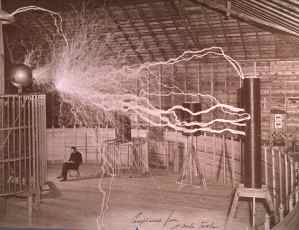
It's best not too be too logical about static and lightning as they tend to do as they please and as I'm fond of saying "the last guy who truly understood all this was Nikola Tesla".
Posted by Michael Schaffer (Member # 1204) on 02-07-2005, 08:00 PM:

Still, some people like to play with it. There is actually a guy in that suit.
Posted by Dave Macaulay (Member # 813) on 02-08-2005, 03:16 PM:
Suit? Who needs a fancy metal suit?
Here's Mr. Tesla reading his morning paper...
Powered by Infopop Corporation
UBB.classicTM
6.3.1.2