This is topic What happened to 2 reels per movie cans? in forum Film Handlers' Forum at Film-Tech Forum ARCHIVE.
To visit this topic, use this URL:
https://ft-forum.com/ft/cgi-bin/ubb/ultimatebb.cgi?ubb=get_topic;f=1;t=006952
Posted by Allison Parsons (Member # 2728) on 02-14-2005, 12:29 AM:
Sorry for the bad subject title.
If my memory serves me correctly, back in the last 90's, some movies were coming to the theater in only two giant reels in big blue cannisters. I know we only got a handful of prints in that way (I think the very first one was Selena) and I'm just curious as to why those went away.
ahhh.. those were the easy days
Posted by Aaron Sisemore (Member # 145) on 02-14-2005, 12:51 AM:
The main reason the went away: They SUCKED.
The Warner/New Line ELR was an interesting concept that was piss-poorly executed.
Do a search for 'ELR' or 'Extended Length Reel' to find more info on those wonderful reels. ![[Big Grin]](biggrin.gif)
-Aaron
Posted by Monte L Fullmer (Member # 2797) on 02-14-2005, 02:06 AM:
quote: Aaron Sisemore
The main reason the went away: They SUCKED
TRUE!
for us short people who could just barely get them damned things off the floor doing straight lifting them, let alone trying to get those containers upstairs.
Those big flanges hugging on to those 4inch cores was a trememdous joke.
Then the final straw trying to mount those full reels on MUTs with vertical spindles-trying to aim for the main spindle and dog spindle.
Even the delivery guys hated those containers -
Don't miss them at all.
WEA and NL has been smoking something to try these new things..
Hey, while on the topic of oddities: Remember when FOX came out with those plastic corregated boxes that you had to take a wrap to to close them?
These boxes were just the simple slip over boxes where you had to strap them closed with that red wrap, and the wrap was a joke in itself.
Then FOX came out with the now present plastic corregated fold-down box that almost takes a genius on how to interfold the flaps down. Then the flaps, after being folded down, still love to fly open due to the massive weight.
Still, these boxes are a pain in the ass at times, esp, with the 7 reel variety to haul up the stairs.
-Monte
Posted by James Faber (Member # 2796) on 02-14-2005, 04:00 AM:
I agree that the boxes suck, but they're much easier to carry if you just pick them up from the bottom, besides the handle. I'd personally rather carry the box than the standard film can. My girly fingers can't support that much weight!
Posted by Scott Norwood (Member # 30) on 02-14-2005, 07:58 AM:
7 reels in one box is just too heavy to lift for many people and those boxes are huge and bulky. They should have made the boxes in 3- and 4-reel sizes instead, which would be more easily manageable.
Is there _really_ any need to put the entire movie in one container? Has anyone ever received only half of a print because one can got lost?
Posted by Stephen Furley (Member # 1277) on 02-14-2005, 08:39 AM:
Scott, aver here the vast majority of films come in one container, until recently a cardboard box. A few years ago a new plastic one was tried, which took four cans I think, so two boxes were needed. In the last few months a new plastic box has come into use, which which will take at least seven cans, I had 'All About Eve' arrive that way on Friday, and I think it would take at least one, possibly two more cans. I'll take a picture of one of these next time I do a projection shift. When I first saw these, I liked them, but I've since found a problem.
Posted by Leo Enticknap (Member # 534) on 02-14-2005, 10:32 AM:
If you mean the green Rank containers, they sucked harder than an industrial strength vacuum cleaner! They were bulky plastic boxes containing three slots, each of which could take two reels. So if a film had an odd number of reels one can would be banging around in the box during transit, usually smashing the container and the core. A seven-reel film needed two boxes to ship.
I was once told - it may have been on this forum - that the boxes were designed by some health and safety loon to be deliberately impossible for one person to carry on his or her own. The handles are indeed in a very awkward position. But of course in the real world, a projectionist can't always get help carrying films up the stairs, and so will lift them anyway. I dread to think how many back injuries have been caused by those things as a result.
Whoever designed them should be taken to a cellar and introduced to The Gimp. Furthermore they were so flimsy anyway that most wore within a few months of entering circulation: they'd get cracked or the clasps would come off or whole chunks of plastic would part company from the things.
Posted by Stephen Furley (Member # 1277) on 02-14-2005, 11:08 AM:
No, not those things. I remembered that it was two cans to each slot, but I wasn't sure how many slots. I only ever saw a couple of the things.
Recently the prints have been coming in plastic cases, similar to the cardboard boxes, with the edges turned over metal rods, and the corners reinforced. The lid is attached to the box by a strong fabric strap, with a snap-in plastic buckle. You then pull the strap tight, and it's held in place across the top of the box by velcro. There's a pocket on the side for the label, which you remove and insert with the other side showing for return.
There's a large metal handle on two opposite sides, so you can either carry it in front of you with two hands, like a traditional box, or carry it vertically in one hand, like a suitcase.
The Delux Film Services ones are red, and somebody else's are blue. They're not unlike the BFI blue plastic boxes, but with carrying handles, and the permanent strap and buckle, father than being fastened with plastic strapping, which you have to cut off, and don't have the machine to replace, so you have to tie the thing up with string, or parcel tape.
The two problems I've found are that the plastic is already splitting along the edges of some of the lids, and the metal inside the edges gets bent, so the lids don't fit; a good kick usually puts that right!
The cans seem to be getting worse by the month. Some of them are not just cracked, but literally falling apart, even fairly new ones. They're obviously only designed to be used for one film, but they're not even managing that. The ones which the BFI use, we had a lovely, fairly new, polyester print of 'Sunset Boulevard' in for yesterday, seem much better made. I've still not seen any of the cans with the spigot to hold the core in place. Cans like this, made of the same material as the BFI ones, would be ideal. With nothing less than four inch cores.
I think there's also a good case for new films to be made with longer reels. I'm not sure if you could get 3000 feet in a standard can with polyester, but you could certainly get well over 2000. You can get 3000 feet in typical 2000 foot spoolboxes, for the few places which still have them. The undersized roll of polyester, in a standard size can certainly isn't a good idea.
How are 70mm prints being transported these days?
Posted by Mark Hajducki (Member # 1732) on 02-14-2005, 11:28 AM:
Moving Print Distribution use the blue boxes (identical to the DFS boxes except blue)
They sent me 9 reels in one box (the strap just closed). To me that is just asking the projectionists to kick the box down the stairs, rather than carry them.
The green Rank shipping boxes hold 6 reels (3 sets of 2) but the box weighs the equivelant of 2 reels.
Posted by Monte L Fullmer (Member # 2797) on 02-14-2005, 01:28 PM:
quote: Scott Norwood
They should have made the boxes in 3- and 4-reel sizes instead, which would be more easily manageable
..course, you know all of this was just save on shipping charges, for some airlines/couriers would charge per can instead of the whole feature. Why you saw shipping tape wrapped around the cans at times-to send two cans as one item.
Scott---still love your picts in your page! Interesting history there.
-Monte
Posted by James Faber (Member # 2796) on 02-14-2005, 02:27 PM:
I absolute HATE it when they tape 2 cans together. They're often completely encased in tape, and it takes you 10 minutes to cut all the damned stuff off.
Posted by Leo Enticknap (Member # 534) on 02-14-2005, 03:56 PM:
quote: Stephen Furley
How are 70mm prints being transported these days?
The last I saw in Darren's projection box (i.e. a fortnight or so ago), exactly the same way they always were: mounted on steel (solid hub) spools inside an individual shipping container for each reel, made of solid steel which is so thick and heavy you'd think the container was designed to withstand a direct hit from one of Ali Musab Al-Zakarwi's rocket propelled grenades, and with a handle on top for carrying vertically.
Posted by Allison Parsons (Member # 2728) on 02-14-2005, 04:43 PM:
I didn't think the 2 reel system sucked as much as everyone else does. I did think that the reels themselves were just a tad bit too flimsy for the ammount of film they carried.
i HATE HATE HATE HATE HATE those damn grey 'boxes' (I think a lot of Fox films come in that way) that are being used now a days. I can never get good balance while holding them. Now if I could just get my teleportation device to work...
Posted by Scott Norwood (Member # 30) on 02-14-2005, 05:44 PM:
Monte--I sent you mail...did you get it?
Stephen--In the US, 70mm film is still being shipped in containers like these (one reel per can):
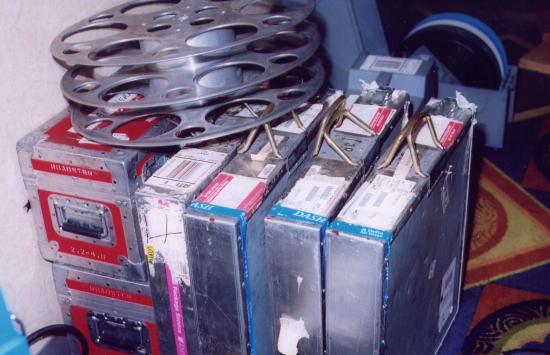
This isn't a great shot, but it's the best one I could find at the moment. The reels are standard "Hollywood Film Company" 70mm shipping reels. The shipping containers are OK, although I had one (out of about 20) that had lots of sharp bits of metal sticking out inside which made removing the reel difficult.
I know that 35mm film is often shipped on cores in the UK--is/was 70mm shipped on cores as well? It would probably save quite a bit in shipping and storage costs, but would probably also be awkward to handle at the theatre level.
Posted by Stephen Furley (Member # 1277) on 02-14-2005, 06:10 PM:
The one time I handled a 70mm print, well over twenty years ago, it came pretty much like the one in your picture. What size are those cases and spools? They look like they might me slightly smaller than the ones I've seen, but it's difficult to judge from the picture. I saw some similar ones at Bradford a few years ago.
Posted by Scott Norwood (Member # 30) on 02-14-2005, 06:16 PM:
Not sure on the footage count that those reels hold. If I remember correctly, they are 22" in diameter and hold about 25 minutes' worth of mag-striped 70mm film (don't quote me on that). Brad could probably give you a more accurate answer.
Posted by Stephen Furley (Member # 1277) on 02-14-2005, 06:20 PM:
The one time I handled a 70mm print, well over twenty years ago, it came pretty much like the one in your picture. What size are those cases and spools? They look like they might me slightly smaller than the ones I've seen, but it's difficult to judge from the picture. I saw some similar ones at Bradford a few years ago.
I've seen similar cases used for transporting 3-D and I think Cinerama, 35mm prints on large reels, but normal 35mm always comes on cores. I've seen prints come in from other countries in all sorts of odd ways, from Iran, loose rolls on cores, no cans or even bags, in a rough, dusty cardboard box and from Russia in 1000 foot rolls, several of which were in a circular can which looked like it would have been more at home holdiing a cake, for example.
Posted by Bill Gabel (Member # 1105) on 02-14-2005, 07:03 PM:
Before the platters at the GCC Avco Center Theatre in Westwood, CA. We would double-up reels when we ran 70MM in the upstairs theatres. (Victoria 8's / auto change-overs in all three houses at the time.) The main house had two Victoria 8's equipped to handle 12,000 reels for 35mm. For 70MM it ran the reels doubled up like the upstairs theatres.
Posted by Leo Enticknap (Member # 534) on 02-15-2005, 01:53 AM:
quote: Scott Norwood
I know that 35mm film is often shipped on cores in the UK--is/was 70mm shipped on cores as well?
I've only ever had one arrive that way, directly from a lab in the US for a festival screening. Indeed, 70mm cores are pretty rare: on the one occasion I ordered any, they arrived in the form of two 35mm ones superglued together. The shipping cases in Scott's picture look exactly like the ones 70mm prints are moved around in here. Agreed on the sharp edge hazard: the same goes for the edges of the spools themselves.
Posted by James Faber (Member # 2796) on 02-15-2005, 02:41 AM:
Anyone ever had to build up a print from India? I was once forced to make up a 12 reel film, ALL ON CORES. Luckily, I was able to sucker some other guy in to tearing it down.
Posted by Chase Hanson (Member # 2779) on 02-15-2005, 03:14 AM:
quote: Scott Norwood
Is there _really_ any need to put the entire movie in one container? Has anyone ever received only half of a print because one can got lost?
Yes...
Did you know that you were asking a rhetorical question?
Posted by Monte L Fullmer (Member # 2797) on 02-15-2005, 04:06 AM:
quote: Scott Norwood
If I remember correctly, they are 22" in diameter and hold about 25 minutes' worth of mag-striped 70mm
Yeppers - that's what they held - being 4k reels. Since 5/70mm runs through the machine a bit faster in footage that does 35mm - 105ft/min against the 35's 90ft/min - at the same frame rate.
Can you imagine how many 70mm cans you would have if you were running the original Camera 65 roadshow release of "BEN-HUR", in 1960? Or, the original 1964 "Cleopatra" 20th-Fox 70mm release, in it's original running time of 248 minutes?
Thx for your email reply, Scott. Still great picts. I'll have to send you some of my 'pictorial history' as well.
-Monte
Posted by Gordon McLeod (Member # 33) on 02-15-2005, 06:06 AM:
"Anyone ever had to build up a print from India? I was once forced to make up a 12 reel film, ALL ON CORES. Luckily, I was able to sucker some other guy in to tearing it down. "
what only 12 reels you must have gotten the abridged version
Posted by Allison Parsons (Member # 2728) on 02-15-2005, 10:01 AM:
quote: Gordon McLeod was the last to post
Anyone ever had to build up a print from India?
ohhh yes. Love those 3 1/2 hour movies they have. I dont remember if it was on cores or not, but I do remember that it came in a hemp lined box.
Posted by Mark J. Marshall (Member # 1409) on 02-15-2005, 10:25 AM:
If 35mm is too heavy, maybe you should try 16mm.
![[Razz]](tongue.gif)
![[Smile]](smile.gif)
Posted by Mark Hajducki (Member # 1732) on 02-15-2005, 10:37 AM:
quote: Allison Parsons
Love those 3 1/2 hour movies they have. I dont remember if it was on cores or not, but I do remember that it came in a hemp lined box.
The Indian print that I showed was on cores (like the UK domestic films) It did arrive in two boxes and was 11 reels long (although they were spiced together from 21 10 minute reels).
quote: Mark J. Marshall
If 35mm is too heavy, maybe you should try 16mm.
You could save more space by using 8 or 9.5mm instead.
Posted by Randy Stankey (Member # 64) on 02-15-2005, 03:25 PM:
quote: Scott Norwood
Is there _really_ any need to put the entire movie in one container? Has anyone ever received only half of a print because one can got lost?
I have.
I got the SECOND half of a movie but the first half got sent to Detroit. The distributor promised to have the first half sent by airline and told me that the plane landed in Erie at 6:30 PM. (8:00 showtime) I got to the airport at 6:00 PM and waited until the plane landed at 6:45. At 7:00 I still had no print. The crotchety, old clerk at the desk told me that the plane gets into the gate at the time they tell you on the computer screen but it takes another 1/2 hour to UNLOAD the cargo!
I screamed, hollered and pitched a fit until they gave my my film and I high-tailed it back to campus LITERALLY at 110 M.P.H.! (As fast as my little, blue Dodge Neon could go!) I got back to campus at 7:30 and had the film on the platter, ready to go at 7:59:59.9.
I have, on other occasions, gotten only one can but have received the film in time to get the show built and screened on time.
Yes! It happens!
Posted by Mark J. Marshall (Member # 1409) on 02-15-2005, 03:54 PM:
....but only to Randy. ![[Wink]](wink.gif)
Posted by Joseph Pandolfi (Member # 223) on 02-17-2005, 07:33 PM:
Love those prints from Eros Entertainment or otherwise know as Bollywood. We get a print a month in the neighborhood of 8 to 11 reels all cores. I got stuck breaking one down last year. Wound em on hour reels and them took them to the rewind bench to move them onto cores using split reels. Eros is good for not putting reel cue marks and overdriving their sound. Some prints come with a ton of quick movie ads that are spliced either at the beginning of the feature or during the intermission or both as in one case.
Posted by Stephen Furley (Member # 1277) on 02-28-2005, 01:49 PM:
I wrote, about the cases that prints are transported in here in the UK:
quote: Stephen Furley
I'll take a picture of one of these next time I do a projection shift.
Took some pictures last night, processed the film at about 3 a.m. just scanned a few frames.
this is one of the blue plastic cases from Moving Print Distribution:
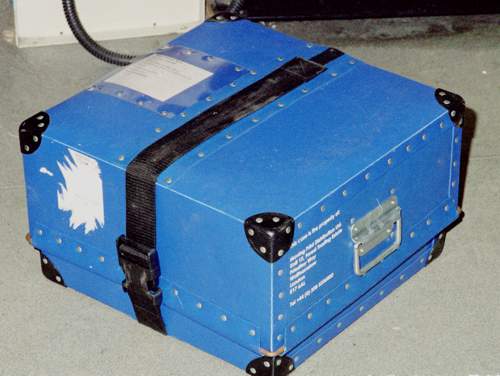
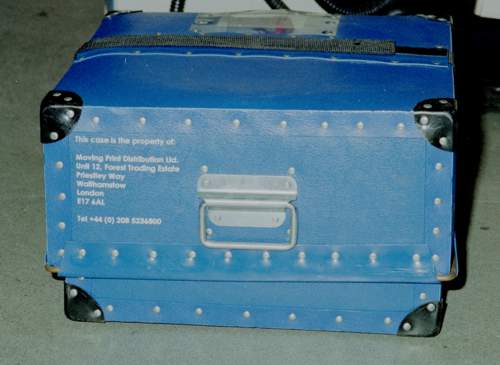
Note the plastic buckle on the strap, and the carrying handle.
Here is the same case open:
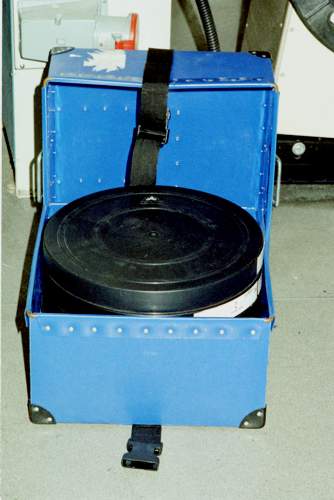
This case contains six cans of 'Finding Nemo'. As you can see, five cans is the minimum that would be held in place by the lid. The most I've had is eight cans. The thick wired (rodded?) edges can be seen better in this view, as can the two carrying handles on opposite sides.
This is the very similar red case from Delux Film Services:
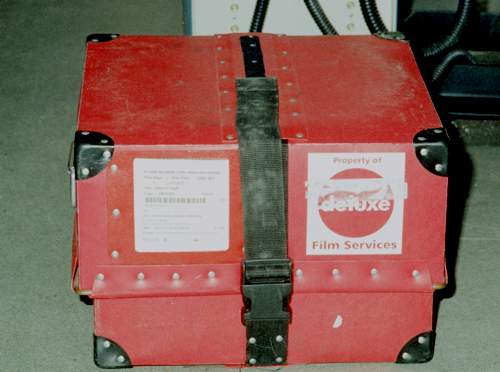
This case contains seven cans. The main difference, apart from the colour, is the pocket for the label. The MPD case has a thin plastic pocket on top, which can be seen in the first picture. It can be difficult to get the label in and out. Also, if you have a pile of cases, you can only see the label on the top one. The DFS case has a stronger holder, made from the same material as the case itself, on the side, as seen here:
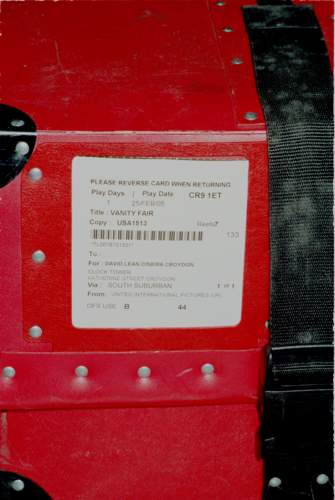
The label is reversed for return:
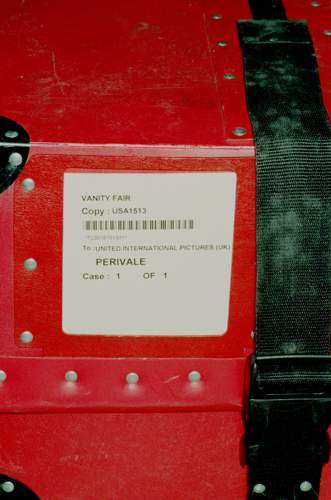
Pile them up as high as you like, and you can still read the label.
Most prints are now arriving in these cases, but the odd one still turns up in he old-style cardboard box:
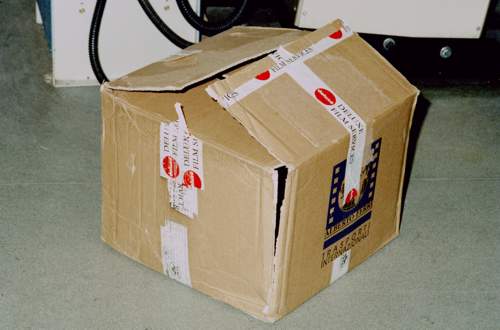
These were usually sed only once, so you got a new one each time, except when you got a print on a crossover, in which case it could be quite tatty, sometimes with more tape than box.
Most of the cans we see here are utter crap. Here is a typical example:
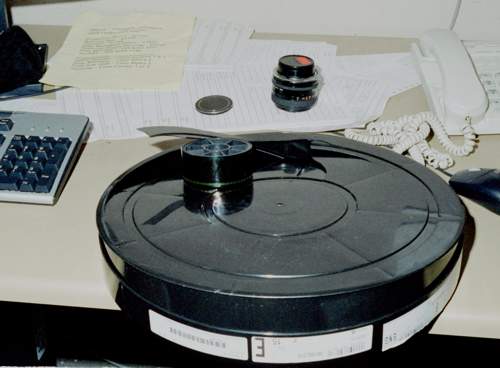
This is the bottom of a can. I didn't break it, that's the state it came in, and this is not unusual. I just inserted the core to hold the broken part up so it could be seen better. Some cans are of better quality; the ones the British Film Institute uses are amongst the better ones. The old-style metal cans are seldom used now. They tend to get dented, which makes the lid very difficult to remove.
This is the other problem with these cans:
(Image removed, because the system won't let me insert that many)
This isn't the can that this film came in; I put it in a blue one so it would show up better in the picture. The can is the same size as the one it came in. This reel is slightly less than two thousand feet, it's on a three inch core. Spot the problem. Is it any wonder that the cans get in the state they do, with the film being thrown about inside them? Of course, the problem has got worse since polyester came in. Suggestions: put a spigot in the can to hold the core in place. If you can't do that, either start using much larger cores, or put more film on each roll. I'm pretty sure you could get three thousand feet in a can.
Posted by Stephen Furley (Member # 1277) on 04-01-2005, 12:45 PM:
quote: Myself
Most of the cans we see here are utter crap.
At long last I finally saw a decent can yesterday. It had the spiggot to hold the core in place, on both the can itself and the lid, made of good strong plastic, seems to have been in circulation for a while, and still in good condition. Sadly, I didn't have a camera with me, and I forgot to make a note of the maker before taking the prints down to the loading bay. I do remember that it was made by Film <somthing> of Sun <something> California. Is anybody able to fill in the two <something>s? I think I would recognise the name if I saw it again.
Note to any British film distributeors who may read this; please dspatch your prints in this type of can, rather than the usual junk which we get, which falls apart, as in my picture earlier in this thread.
If I could get the name of the maker, I'd write to the distributors about it.
This is the picture of a typical roll of film iin a can of the type we normally see, which I wasn't able to post before. The problem is obvious.
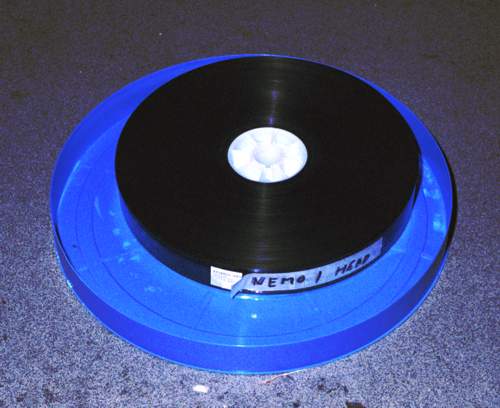
And here, as a reminder, is a picture of a typical can in the condition we often find them:
Posted by Helmut E. Dorausch (Member # 1356) on 04-04-2005, 11:48 AM:
FILMTREAT WEST CORP., in Sun Valley, Ca. 91352.
Manufacturer of 35mm Raw Stock Cans in 1000 ft and 2000 ft capacity.
(they include the core locator you referred to, and have been "personalized" for a number of Major Studios)
We opt to use a more resilient grade of "archival appropriate" plastic, in order that the cans do not CRACK. NOT a substantial cost increase to better protect the film!
We also manufacture patented 35mm 2000 ft "snap-on reels" and several million cores per year. Our manufacturing efforts are the result of being directly involved with film processing, distribution and storage for several decades.
Posted by Brad Miller (Member # 2) on 04-04-2005, 02:55 PM:
Hey Helmut!
Can you upload a picture of your plastic cans so everyone can see the concept?
Posted by Joop de Gruiter (Member # 84) on 04-04-2005, 04:25 PM:
In Sweden the big mainstream distributors uses boxes like these to transport film.
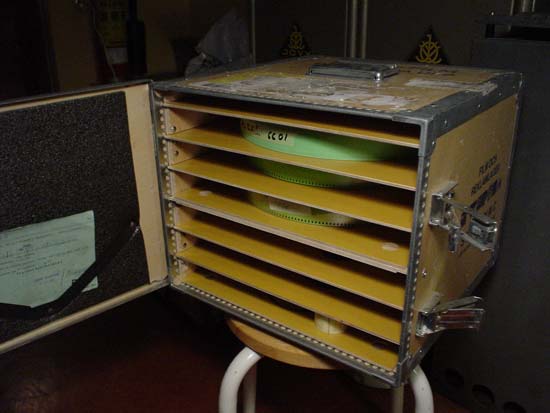
This is one of the new ones which has a shelf for dts disks and has an extra supporting shelf in the middle keeping the box together.
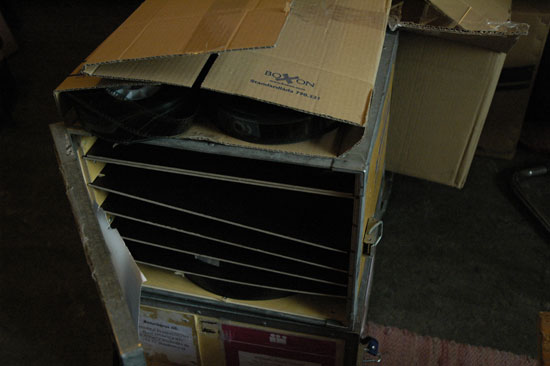
The older boxes tend to get bent which makes the shelves crash making it hard to get the stuck rolls of film out. (the film is on cores)
Some prints come in two boxes which can hold four reels (do you call it a reel if it's on a core?) each.
Joop.
Posted by Stephen Furley (Member # 1277) on 04-04-2005, 04:29 PM:
I've never seen anything like that Joop. What is that box made of?
Posted by Joop de Gruiter (Member # 84) on 04-04-2005, 04:43 PM:
I guess it's called plywood, well it's wood at least.
This is what happens far too often with the older boxes. Not the one reel arriving wrapped in cardboard! ![[Eek!]](eek.gif) But with the crashed shelves.
But with the crashed shelves.
Posted by Helmut E. Dorausch (Member # 1356) on 04-05-2005, 01:36 PM:
I will bring my camera tomorrow, in order to provide photos.
Posted by Bill Enos (Member # 440) on 04-06-2005, 12:46 AM:
That plywood box with shelves and compartments is very nice but it has to be much to heavy when filled with seven + rolls to be comfortably handled by one person. In use here, the morons at DHL would reduce it to splinters before it arrived at the first theatre.
Posted by Monte L Fullmer (Member # 2797) on 04-06-2005, 02:14 AM:
quote: Bill Enos
In use here, the morons at DHL would reduce it to splinters before it arrived at the first theatre.
..also the ETS people.
Also, the shipping charges for this much weight would be horrible. Granted, the core idea is pretty nifty on cutting down weight of sorts, but unprotected like that without being in film cans spells disaster as well. Granted, you European folks can really take care of things, where over here, unfortunately, the care gets place on the back burner at times.
-Monte
Posted by Stephen Furley (Member # 1277) on 04-06-2005, 06:28 AM:
It's surprising just how much variation there is in print packaging methods in different countries, and interesting to see photographs.
I haven't yet seen any method which seems ideal.
The American method of shipping reels in octagonal containers is heavy and bulky, but could provide good protection for the print, if the shipping reels were of decent quality, not like the junk which falls to bits which has often been shown here. Also, at least two cases are needed for most prints. The old reel bands were good, but are being phased out. The old style metal shipping reels were very heavy, and sometimes bent and rusty. In many other parts of the World most cinemas would have problems with the 5/16" spindle size.
The 70mm method is probably the best, but too heavy, bulky and expensive for general 35mm use.
The British system is lightweight and compact, but the cans and cases currently in use are not up to the job. The cores are (almost) universal, you just need a plate or split spool to fit whatever size spindles you have. I can easily carry an eight reel print, or two short ones, in one go.
The Sweedish plywood box looks nice, but must be heavy and bulky, and the fact that it seems to fall to bits would seem to negate any other advantage that it may have. Many prints would still need two cases.
The rolls of film, without cans, in a cardboard box with card board separators between is hopeless. Very little protection to the print, and the film gets covered in dust and fibres from the cardboard. It's slightly better if you put each roll into a plastic bag, but dragging the film out of the bag tends to generate static, which attracts the dust to the film.
The Russian system, using something that looks a bit like a cake tin, but about twice as high gets battered, and hard to open, and the version I saw would only take 1000 foot rolls.
India seems to use cardboard boxes, often covered in hessian sacking material. Their cans seem to be the metal, raw stock type, which get bent. I have seen some plastic ones from India, which were somewhat better than most of ours.
Iranian prints seem to arrive in any old cardboard box, of any size, some rolls in cans, some not, with a load of waste paper stuffed into the box to fill the space.
I think my choice would be for an improved version of the British system, with the film on cores, not less than 4 inch, larger would be better, in good quality plastic cans like the one I saw last week. The new plastic cases we have now are not bad, but could do with being made of slightly thicker , more rigid material, possibly with extra reinforcement on the edges.
Posted by Bill Enos (Member # 440) on 04-06-2005, 07:37 AM:
Each year after running the VCU French Film Festival, this year 13 features and 13 shprts all on cores in plastic raw stock cans in cardboard boxes, I have great appreciation for our system of reels in metal cans. Of the 77 rolls, 43 of the plastic cans were broken in some way and 4 of the 15 cardboard boxes had to be replaced before shipment. Fortunately for us the VCU French dept. handles all that.
The Indian boxes covered with burlap hold up well but don't do much to protect the flimsy plastic raw stock cans.
Posted by Joop de Gruiter (Member # 84) on 04-12-2005, 11:47 AM:
In Denmark almost all films seem to be distributed on 1800-meter (6000 feet) reels like these:
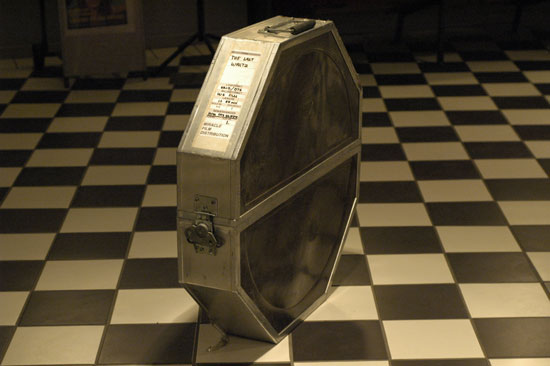
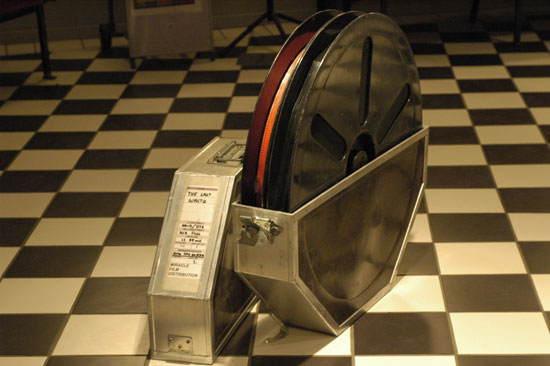
Or in a kind of "Clam"-like box, which i think is made by Cinemeccanica.
I find these "6000 feet boxes" more difficult to carry. You need two of them (one in each hand) to get any balance and they are even harder to carry up stairs (especially winding staircases). A normal box is much more compact and easier to get of the ground.
The positive sides are faster buildup time or only one change-over (on a standard length film).
Joop.
Posted by John Pytlak (Member # 331) on 04-12-2005, 12:01 PM:
The two reel shipper used in Denmark looks like "ELR Done Right".
Posted by Monte L Fullmer (Member # 2797) on 04-12-2005, 12:55 PM:
...better than those idiotic plastic jobbers that Warner and NewLine had out for that short time... - Monte
Posted by John Pytlak (Member # 331) on 04-12-2005, 01:22 PM:
Actually, the better European large reel shippers were considered as the Inter-Society Committee developed the Extended Length Reel (ELR) concept. Both Goldberg and Technicolor Entertainment Systems submitted pretty robust designs to the Committee. Bobby Pinkston was the Chairman of the working group that worked on ELR.
Posted by Leo Enticknap (Member # 534) on 04-12-2005, 05:58 PM:
The Danish ELR shipper looks good, though I take Joop's point that it must feel hideously unbalanced to be carrying one, especially up staircases. Perhaps this problem might be solved by putting some thinner cases into circulation which hold only one 6k reel? A typical print could be distributed in two of these, while a longer one (i.e. over 6 reels) could be shipped in one 'single' and one 'double' case.
Posted by Scott Norwood (Member # 30) on 04-12-2005, 06:43 PM:
Agreed with Leo. If they made those boxes so that they held one 6000' reel each, they would be ideal. I really think that 12000' of 35mm film is just too much weight to put into one container and that two containers with 4-6000' of film in each would work better. This applies regardless of whether the film is on cores or reels. It's not fun carrying a heavy box up a steep flight of stairs to the booth.
With the Danish system, I'd be curious to know what happens with films that would ship on 7 reels in the US. Do they ship a third big reel with only 2000' of film on it? What happens if theatres can't handle the big reels? Do they have to break down the print in order to show it? Do the prints have lab or depot splices every 2000', or does each reel contain one continuous piece of film?
Posted by Brad Miller (Member # 2) on 04-12-2005, 06:51 PM:
Speaking of ELRs, did anyone else see the retarded way the labs were assembling the reels? Let's take a 5 reel movie and put reels 1, 2 and 3 on the first one, then 4 and 5 on the second. Real intelligent guys! That way if a house wants to run changeover there are good odds that they just added another changeover for them just to run the trailer pack because the labs didn't put reels 3, 4 and 5 on the second reel, thus leaving enough room on the first reel for the theater to splice on their previews. ![[Roll Eyes]](rolleyes.gif)
Posted by Louis Bornwasser (Member # 3063) on 04-12-2005, 09:43 PM:
It would seem with Mylar that we have already reduced the thickness of the film. If we could do that again so that the net reduction is 50%, you would get 4000 ft on 15" reel. One large reel could hold 12000 ft instead of the 6000 we had with acetate.
I believe than any curved gate machine, properly set up, would have no trouble with that. Flat gate is another story.
This would address the issue of weight. (How oh how did anyone lift those 70MM reels every 20 minutes?)
Posted by Monte L Fullmer (Member # 2797) on 04-13-2005, 12:02 AM:
quote: Louis Bornwasser
How oh how did anyone lift those 70MM reels every 20 minutes?)
..they aren't that heavy - about 35lbs and at about the same height as a 6K arm -being a 24 inch reel and never full.
But..hunkering up a 13k, 36inch, 35mm reel full to the rim with 145 minutes of film to a spindle height of a little over 6ft is another matter..lol
-Monte
Posted by John Pytlak (Member # 331) on 04-13-2005, 05:38 AM:
quote:
I believe than any curved gate machine, properly set up, would have no trouble with that (very thin print film). Flat gate is another story.
Ah --- there's the rub! The film needs to be stiff enough to hold focus in a wide variety of projectors. The stiffness of a piece of film is roughly proportional to the cube (**3) of thickness, so even a few micrometers of thickness makes a noticeable difference. Kodak has made print film base as thin as 0.0035 inches / 90 micrometers (normal is 0.0047 inches / 120 micrometers) for special applications.
Posted by Brian Guckian (Member # 1678) on 04-18-2005, 03:06 PM:
As a matter of interest, has anyone any comments regarding the storage of ELR prints?
It would seem that long-term storage in the vertical position could lead to compression of film layers as they get closer to the hub of each reel, with all kinds of consequences...horizontal storage would seem better, but then there are handling issues in the depot or the archive in lifting the cases from a vertical to horizontal position. (This puts a cantilever-type force on the lower back if the lifting is done unaided).
One could engineer shelving where the cases are inserted vertically then rotated to lie horizontally, but that would presumably cost an arm and a leg.
Is there an easier way?
Posted by Brad Miller (Member # 2) on 04-18-2005, 05:32 PM:
If the ELRs are broken down/rewound/taken-up/whatever properly so that they are smooth and tightly wound, it shouldn't be much of an issue.
Posted by Brian Guckian (Member # 1678) on 04-19-2005, 07:27 AM:
Thanks Brad, I'd been operating out of the assumption that once made up in the labs, ELRs are left that way even after use.
Posted by Kevin Orman (Member # 3076) on 04-20-2005, 07:51 PM:
We have used two types of 6000ft plastic spool. The first type is totally useless and is the black 'brittle' plastic type made by Cinemeccanica. About 8 out 10 of ours are broken/cracked.
The second type we started using several years ago is way more successful. These are also 6000ft but are grey plastic - no NOT the brittle thin grey plastic that comes to mind - this plastic is called 'Duron' or something similar. We have 12 of these and not one of them has sustained damage and they get THE worst kind of use - mobile projection. The spools are moved in and out of a vehicle every day, up and down stairs, bashed, crushed and occasionally dropped and still they survive! You can even (and I'm not joking) stand on them squashing the flanges together and nothing happens to them (this was how they were demonstrated to me!). They are made in Italy and do not appear to be readily available outside Italy.
They would be ideal for distributing features but I agree that two separate boxes would be more sensible.
I believe there was a scheme here in the UK a few years ago to distribute on two spools, don't know why that did not happen though as it would be a major improvement in presentation due to the reduced physical handling of the print during make-up.
Personally, if I was involved in distribution (it seems as though just about everybody is here at the moment with new distributors springing-up all the time) I would distribute only on 6000ft spools. I can't believe that anybody can't handle a spool this size.
Posted by Jeremy Jorgenson (Member # 2989) on 04-23-2005, 04:38 PM:
quote: Leo Enticknap
Indeed, 70mm cores are pretty rare
The 8/70 and 15/70 prints that I've assembled have come either on cores or the entire print completely pre-assembled. Fantasia/2000 was 22 reels, Beauty and the Beast was 28 (however, on the 8/70 prints, I believe it came with three reels assembled per core). Polar Express 3D was 60 reels (30 per eye), although I was not the one assembling that print. I should note though, we'd almost always get these prints days, usually weeks, in advance of our first booked show.
I've never worked with 5/70, but when I saw Lawrence of Arabia at the Egyptian in Hollywood, I toured the booth & the cans I saw for it looked pretty much like the ones shown in the pic Scott posted back on page 1 or 2 (14 reels for LofA, I think? could be wrong as this was 5 years ago)
Posted by Rachel Gilardi (Member # 1016) on 04-23-2005, 05:07 PM:
quote:
quote: Scott Norwood
--------------------------------------------------------------------------------
Is there _really_ any need to put the entire movie in one container? Has anyone ever received only half of a print because one can got lost?
--------------------------------------------------------------------------------
Yes...
Did you know that you were asking a rhetorical question?
Me too, just two weeks ago for The Amityville Horror.
Posted by Joop de Gruiter (Member # 84) on 04-30-2005, 07:21 PM:
Stephen here is a picture of a probably similar can i guess you're referring to:
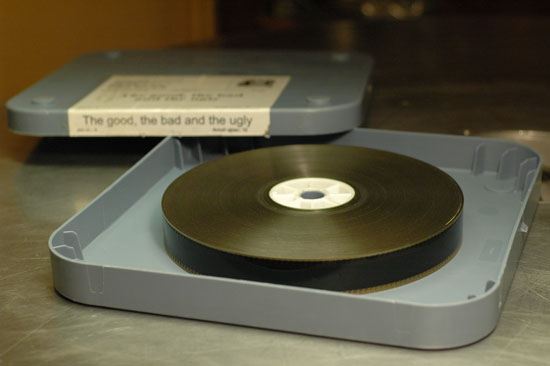
This can is made in Denmark by Dancan www.dancan.dk
It seems very sturdy. The cans were only wrapped with paper with string around it. I guess these boxes give enough protection as is. When lifting the package instead of feeling a "klonk" when all the reels shift place it was solid as a rock without being heavy as one. The bottom of each can fits into the lid of the other with round feet. Very nice solution.
Posted by Stephen Furley (Member # 1277) on 05-02-2005, 04:12 AM:
Similar idea, but the one I saw was round, and the central retainer was only half the height of the film roll; there was a similar one attached to the lid of the can.
I've only seen one of them, the rest of the print was in normal, fragile, mostly broken, cans.
There's no projection work going at the moment, and not likely to be for some time, so I don't know if any more of these cans have turned up.
Posted by Scott Norwood (Member # 30) on 05-28-2005, 03:31 PM:
Bump.
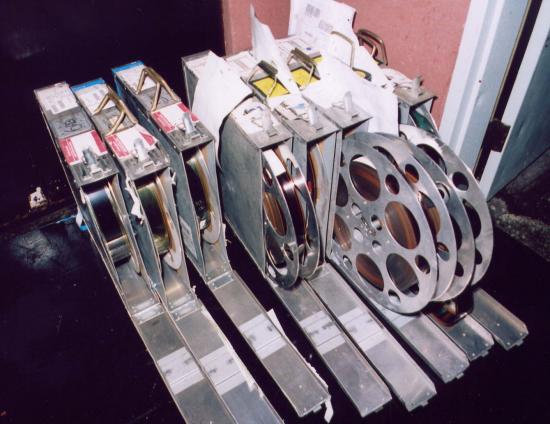
I was going through some photos today and found this one, which I took last fall. It's a better shot of a 70mm print in the typical USA shipping configuration. The film is "The Abyss."
Powered by Infopop Corporation
UBB.classicTM
6.3.1.2