Then you haven't been around, thats for sure! There's a company that builds single ended class A all mosfet amps that are phenominal. Not necessarily practical for cinemas..... but they could be used if one wanted to..... BTW: They don't sound like tubez or solid state and they only show even harmonics as a distortion by-product. As a result they are actually better sounding than the best of both worlds.
Mark
Posted by Dave Macaulay (Member # 813) on 02-23-2005, 09:35 AM:
Joshua: Reading between the lines a bit, I think you have a source for QSC1400 amps and want to know if they are OK. This is a good basic power amp. At 200W/ch they will handle your size room if you have reasonably efficient speakers. Speakers are the big question though. "Professional" cinema speakers tend to make adequate fidelity sound but lots of it and are designed to cover a fairly large area... they don't necessarily work well in a small room. Basically you can't just take any cinema speaker and get good results in a small screening room, but some models would be fine. Home stereo speakers can give very good fidelity sound but most are quite low efficiency. They also have a very wide M+HF dispersion pattern - this requires more attention to room accoustics to maintain good intelligibility and separation (theatre speaker patterns should avoid firing sound at the side walls). You'll probably find cinema surround speakers a bit large for your room and they should be fairly far from the "good" seats to give the right effect. Smaller dipole speakers are my suggestion; they give good coverage with less localization of the sound.
Since you seem to be going with digital (DTS) sound, you need decent accoustic headroom. This is where efficiency comes in. A theatre speaker will have efficiency at around 98dB spl/W @1metre; this gives you about 120dB spl at 200W ... but the amp will have the ability to provide peaks of higher power. Home thatre speakers vary widely but most I've looked into are around 89dB/W and about 111dB spl with 200W. This is a big difference. If you set the reference level correctly then the digital source will be asking for 110dB and more on the loud stuff... explosions etcetera. With inefficient speakers the amplifier will be perilously close to clipping, with efficient speakers it won't. Bi-amping helps, but 90%+ of the speaker power goes to the LF driver in normal use. Bi-amping isolates the HF driver from any clipping on the LF channel; minor clipping causes massive HF distortion effects while not really destroying the LF sound quality. Home theatre speakers may or may not be amenable to bi-amping.
Posted by Pete Lawrence (Member # 130) on 02-23-2005, 10:25 AM:
Once you have chosen your amp and speakers don't forget to include the "proper" AC line cord for optimum performance! An example is the one below from Runnng Springs Audio.
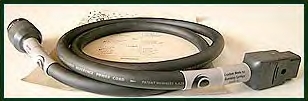
A bargin at $499.95! No kidding! (Dedicated Audio)
I'm not picking on those guys, they just happened to be the first good example with a picture that I came across. It's just one example of the ![[bs]](graemlins/bs.gif) that runs rampent through the audio market.
that runs rampent through the audio market.
The truth is most any good quality commericial amp(s) will work just fine. I happen to have Crown Com-Tech amps in my home screening room only because I was able to get them surplus at a very good price. QSC amps are pretty much the industry standard and very good. I probably would have bought QSC's if I hadn't found the Crowns. I'm sure there will be some nasty comments as to why the Crown amps were so inexpensive. ![[evil]](graemlins/evil.gif)
Remember that the folks here will pick amplifiers based on several criteria. Profit margin, repair frequency, overall quality and manufacturer support, and oh yes, how they "sound". Some may question the order of these items but that's the real world. Most good quality amps will "sound" essentialy the same, unless of course they are defective in some way. It's way to subjective to make any absolute statement that "Xyz amp is the best sounding ever made".
As Dave suggests, your choice of speakers is going to be the biggest factor, but don't neglect room equalization and and any necessary acoustic treatments. That can make or break your room. With a little care in those areas you can get a lot of improvement in performance.
Posted by Joshua Waaland (Member # 287) on 02-23-2005, 12:08 PM:
Thanks for the help guys. Any suggestions on a good intro book to help explain some of this stuff? i.e. harmonic distortion, dipole, clipping. I am not into my M.E. classes yet so a lot of this is greek to me and I doubt we will even cover anything like this. Maybe in Physics next semster though? ![[Eek!]](eek.gif)
Posted by Pete Lawrence (Member # 130) on 02-23-2005, 12:25 PM:
Take a look at the technical librarys at JBL and Rane Audio. They are good starting points and free. Lots of good stuff in there.
In particular check out the JBL Professional Sound System Design Manual and Cinema Sound System Manual: Setting up a cinema sound system. Both available in PDF on the JBL website.
[ 02-23-2005, 02:06 PM: Message edited by: Pete Lawrence ]
Posted by Samuel Hynds (Member # 2610) on 02-23-2005, 12:49 PM:
Joshua,
A QSC 1400 "restoration kit" is available from the QSC Technical Service Department. This link, http://www.qscstore.com/sg-000002-ac.html will allow you to order the kit on line for installation by a local service technician. You may also ship the amps to QSC for factory installation and calibration. With the replacement of these key components, a QSC 1400 amplifier is ready for years, or even decades, more service. The use of the restoration kit, combined with the availability of good used 1400's, offers a very cost effective way to get high quality, pro grade amplifiers for your screening room. The 1400's will have plenty of power for any screening room application that uses reasonably efficient speakers.
If you choose to use bi-amplified speakers, you will need 3 amplifiers for the Left, Center and Right channel. The surround channel can be powered by a single 1400, if you don't need surround EX. If you use EX, you will need two surround amplifiers. The subwoofer can be powered by a single 1400 in bridge mode. A single 18" sub is adequate for most screening rooms. QSC offers an extensive line of compact cinema speakers that are ideal for smaller screening rooms.
Feel free to contact me at 800-854-4079 for any assistance in designing your system with QSC amps or speakers.
Sam Hynds
Product Specialist - Cinema
Posted by System Notices (Member # 2357) on 07-05-2006, 09:27 AM:
It has been 496 days since the last post.
Posted by Joshua Waaland (Member # 287) on 07-05-2006, 09:27 AM:
So I have bought all the amps that I needed and I started to buy some speakers. Now that I have them I am re-thinking it a bit. I bought two JBL 4508 LF cabinets with two 15" speakers in each and would still need one more to complete my three front channels. Not to mention the three horns and an 18"sub that I would still need. I also bought some JBL 8330 speakers and after looking at all of these I am convinced that they are massive overkill. Not only are they huge (the 8330s look much bigger up close than they do on a wall in a theater) but I am sure I would never use all of their available power.
Can anyone recommend speakers that I could use for a 12' x 20' room? If I can even get away from having the QSC 1400 amps and using some other set-up that would be fine too. I DO however want to be able to have true digital sound with my DTS, Dolby and SDDS units. Can this still be accomplished with home theater amps and speakers?
Posted by Louis Bornwasser (Member # 3063) on 07-05-2006, 11:45 AM:
Overkill or not you'll never go wrong with quality. The speakers you have (or almost have) are now and have been the standard of the industry & will probably outlive us all. Remember each individual speaker has its own sound; large JBL's sound significantly different than small JBLs even in the same series of speakers. Louis
[ 07-05-2006, 03:23 PM: Message edited by: Louis Bornwasser ]
Posted by Mark Gulbrandsen (Member # 72) on 07-05-2006, 07:03 PM:
![[thumbsup]](graemlins/thumbsup.gif) .
.