This is topic Dancing Scratches in forum Film Handlers' Forum at Film-Tech Forum ARCHIVE.
To visit this topic, use this URL:
https://ft-forum.com/ft/cgi-bin/ubb/ultimatebb.cgi?ubb=get_topic;f=1;t=007036
Posted by Thomas Dieter (Member # 2507) on 03-18-2005, 08:01 PM:
Since the theatre that I've worked at has opened, we have been habing problems with some of our prints getting scratched. From the Projection Log, one of the other projectionists says that the scratches are Emulsion Based.
We are running Cinnemacanica V4s and Christie AW3 platters. The scratches are Vertical, and I've come to the conclusion that it's coming from the platter system somewhere, as there seems to be nothing that could cause it in the projector anywhere. We've also ruled out the possibility of misthreading on a roller, as they are inconsistant, showing here or there. I would assume that if they were threaded incorrectly, the scratches would be threw the entire film.
Mainly I direct these questions to Brad as he swears by Christie Platters, and I figured he would know the most about what would be causing this. If anyone is able and or willing to help, send me an email, and let me know your AIM or YIM id so that I can talk to you in chat while on.
Posted by Brad Miller (Member # 2) on 03-18-2005, 08:44 PM:
First YOU determine whether they are base or emulsion. Then you need to provide us with specific examples of the scratch's appearance and location. We need to know things such as if they vertical and if they dance around side to side or are perfectly steady.
Knowing the vintage AW3 platter system would help too. What year? I seriously doubt it is coming from the platter.
Posted by Thomas Dieter (Member # 2507) on 03-18-2005, 09:01 PM:
Well, I think that these platters have been here since AMC owned the theatre, and thats been a while. Must have been about 5 or more years since AMC owned this theatre. I'm going to get that the platter must have come out in the early 90s or earlier. when I go to work tomorrow, I can get their information from their plaques.
The scratches dance from side to side, just off center to the left. They are vertical like I stated before, and they come and go (meaning stop and start).
Only a few of the scratches have go so far as Green or Yellow, but 1 had gone White.
Posted by Steve Guttag (Member # 268) on 03-18-2005, 09:53 PM:
Generally when I find a Christie platter (AW3) scratching film in the middle it is from either the guide posts of the first generation AW3 or the feed fingers if the film has enough curl.
IF you have the old guide posts you would know. These are the posts that are mounted to the dust plate just prior to going into the 3-roller cluster on payout. The original posts had about as narrow a milling as one could do and claim to have undercut the middle area. Just about any curl to the flm will have the face of the film rub in the middle. The solution, get new dust plates and guide posts. The current version (since about 1982 onwards, if not 1981) have a much wider milled area.
The other one is the feed fingers themselves. However these normally are not hevey scraches and are often so fine that one needs to go down near the screen to see them. They will vary based on if the film is actually curling into the fingers (kinda following the curve of the fingers). Most operators don't see these unless you bring them down to the screen and again, it depends on the curl of the film (darker scenes where the emulsion soaks up more radiant engergy will tend to cause it more). If you find this is your source, try running your emulsion the other way so the curl doesn't face the leading finger. You can also try repositioning the fingers so get the film to not follow the hour-glass shape so much. Again, if you getting colors of scratches...this probably isn't it.
Steve
Posted by Brad Miller (Member # 2) on 03-18-2005, 11:04 PM:
Steve beat me to it. If your scratches are projecting slightly off center-left, that is dead center of the actual film (once you take into account that the soundtrack offsets the picture). If you are running soundtrack down, you asked for it, because that is putting the curled side of the film towards the left guide post (and payout arm finger) where the possibility is greatest. Still though if you have the older guide posts, you should change them. They are inexpensive. That is really the only thing on ANY vintage Christie platter that can scratch film without the system being misthreaded.
I have yet to see the actual feed arm fingers cause any damage. I would look hard at the guide posts just before the film enters the triple rollers. Also note that if you have the guide posts with the sharp 90 degree corners instead of tapered ones, it is easy to get the film jammed in there at such an angle the film is forcefully cupped to run against the inside wall of them.
Posted by Thomas Dieter (Member # 2507) on 03-19-2005, 08:52 AM:
Okay, can anyone show me a picture of the old guide posts? I don't have a digital camera to show you what I have, but if I can have a picture of what the new ones or the old ones look like, I can look into replacements if we have the old ones. Thanks Brad and Steve.
Posted by Aaron Sisemore (Member # 145) on 03-19-2005, 01:57 PM:
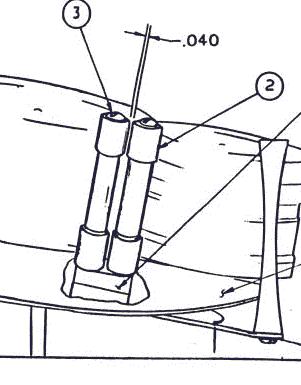
Old Guide Posts (Part #2 in the diagram: note the very thin shoulders in comparison to the body of the post):
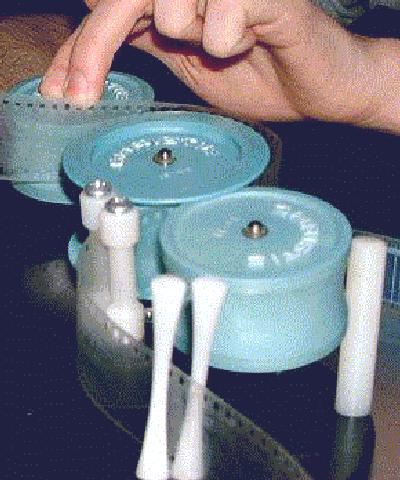
New Guide Posts (Note the much thicker shoulders with the beveled inner edges):
-Aaron
Posted by Will Kutler (Member # 770) on 03-19-2005, 05:17 PM:
I have always disliked those nylon/Delrin? guideposts. They all will eventually develope flat spots, and are somewhat difficult and time consuming to clean...especially if some knuckle-head has lubed various platter parts with Lubri-Plate, which tends to get everywhere! Furthermore, I have also occasionally seen where the tapped threads on all those plastic posts have failed.
A slightly more expensive, but by far superior solution would be to use a steel shaft with two small roler bearings seperated by spacers!
Posted by Brad Miller (Member # 2) on 03-19-2005, 05:23 PM:
That's your machinist's fantasy talking Will. I have AW3s from the 70s without any upgrades still running perfectly without ANY flat spots or wear.
Sometimes I wonder what some people do to their equipment to make it fail so quickly. ![[Roll Eyes]](rolleyes.gif)
Posted by Mike Blakesley (Member # 26) on 03-19-2005, 06:52 PM:
Same here. We have a 1980 vintage AW3, all it's ever needed is lubing and motor brushes.
EDIT: And one of the MUT's toggle switches.
Posted by Will Kutler (Member # 770) on 03-20-2005, 02:47 PM:
Brad,
Moving surface (film) rubbing against stationary bearing surface (guideposts) = erosion and flat spots! Gee whiz, I would never think that there was any erosion due to film on any projector! Never any metal erosion on sprocket shoes and gate pads! Never anything called sprocket hooking!
K
Posted by Brad Miller (Member # 2) on 03-20-2005, 04:32 PM:
It works like this Will. In the brain the reason the plastic guide posts don't get worn down anywhere near as fast as the teeth on the sprockets inside a projector is because the film is under tension against the teeth (think Century soundhead as a good example, or an intermittent sprocket). However on that Christie brain, there is virtually no pressure against the plastic parts, hence they last longer.
Make sense? ![[Big Grin]](biggrin.gif)
Powered by Infopop Corporation
UBB.classicTM
6.3.1.2