This is topic Black "film" in gear box of Simplex 35 mystery. in forum Film Handlers' Forum at Film-Tech Forum ARCHIVE.
To visit this topic, use this URL:
https://ft-forum.com/ft/cgi-bin/ubb/ultimatebb.cgi?ubb=get_topic;f=1;t=007048
Posted by Brad Allen (Member # 470) on 03-22-2005, 04:51 PM:
I've obtained said projector, it seems to be in good condition other than a black film all over the oil bath compartment.
It wipes off easily, and does not feel gritty when rubbed between my fingers. Is this simply from the previous owner not changing the oil? Sign of more serious problems?
Posted by Darryl Spicer (Member # 711) on 03-22-2005, 06:07 PM:
it can be issues with oil but at the same time I have found that it developes after the projector is ran in for a while during normal use. I have cleaned all of that stuff out before and none has come back.
Posted by Gordon McLeod (Member # 33) on 03-22-2005, 06:14 PM:
Dip a strong magnet into the oil and see if the balck migrates to it if so it is steel worn of shafts or gears
Posted by Randy Stankey (Member # 64) on 03-22-2005, 09:34 PM:
I've seen this happen once, too. Never figured out what it was.
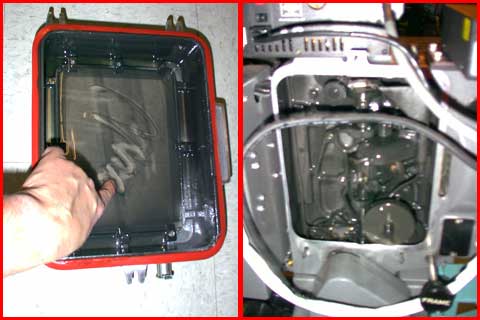
Honestly, it seems more like graphite or black grease got mixed with the oil. There is no grit in the mixture. It mixes with the oil and stays suspended, even overnight. It coats the entire inside of the projector and clings. It doesn't run down. It clings pretty well.
The first time I saw it I almost shit my pants because the glass was completely black when viewed from the outside. I thought the thing had been run without oil and all the gears & bearings were blowing their guts all over the inside.
Except for the fact that the oil was completely black, the projector seemed to be running quite normally.
I called Strong about it and they coulnd't give me an answer. They told me to change the oil, let it run for a while then change the oil again. I changed the oil twice within a two day period then changed it again a few weeks later. Most of the black was gone but you can still tell there is/was something in the oil. I don't think it will ever go away.
My hunch is that somewhere down the line, somebody put some grease into the projector and it got mixed with the oil. Could have happened at the factory. Could have been some idiot. I don't know exactly when it happened because everybody in the theater was characteristically ignorant.
To this day, I have never figured out what it was.
Posted by Brad Allen (Member # 470) on 03-22-2005, 09:52 PM:
Wow Randy, your's was much worse than this one. I wish I had taken pictures before wiping it out.
I'm going to try Gordon's magnet test, I still have the oil I drained out of it.
The oil itself is not discolored that badly.
I've wiped everything possible, going to run it with fresh oil for several hours, then drain it and see how it looks.
Posted by Mark Gulbrandsen (Member # 72) on 03-22-2005, 10:54 PM:
Any idea how many hours on that machine and on the oil? That can be caused by not changing the oil, a failing component perhaps in the compensator, or grease from the ball bearings mixing with the oil... but the latter is unlikely in this case. For some dum reason Strong does not generally remove the shields from the bearings that face the oil side....... they wouldn't want them to be lubricated too well and last indefinately...... ![[Roll Eyes]](rolleyes.gif) Actually leaving a small magnet in the oil sump is a VERY good idea as it will catch any steel particles and keep them out of the mechanism. Clean the magnet with each oil change.
Actually leaving a small magnet in the oil sump is a VERY good idea as it will catch any steel particles and keep them out of the mechanism. Clean the magnet with each oil change.
Mark
Posted by Randy Stankey (Member # 64) on 03-23-2005, 09:37 AM:
Could have been a long time before the oil was changed in that projector.
It was located at a theater known to be populated by idiots. It was the same place where they beat the shutter shaft with a ball pein hammer. (If you remember me telling that story.)
To be honest, it might never have been changed. I know it was changed three times after the fact because I did it myself. After that, I did it on every other PM visit to that site. Before then is anybody's guess.
The guy at Strong said that it might be grease from one of the bearings leaking out but he couldn't be sure unless the machine was disassembled and checked. There was no way in hell that I was going to put the house out of commission for a day just to find out so we resolved to just change the oil several times and keep an eye on it.
It never showed signs of breaking down in over a year since I found it so I left it alone, except to change the oil at more frequent intervals. Now, since I've left, I betcha' they haven't changed the oil since! (What a bunch of retards!)
I have been considering whether I should get a Cow Magnet and toss it into the back of the projector where the oil sump is. Now I am going to! ![[Smile]](smile.gif)
Posted by Brad Allen (Member # 470) on 03-23-2005, 11:41 AM:
Well as far as hours, all I can do is guess. Projector was ran regularly for 20 years. As far as how long since the last oil change, I have no way of knowing.
I will purchase a magnet today and see what I find in the drained oil.
Then leave it in the sump long term. Should be interesting.
How many hours is a good rule of thumb between oil changes normally?
Posted by Mark Gulbrandsen (Member # 72) on 03-23-2005, 07:24 PM:
I reccomend very frequent oil changes in older Simplex's with no seals on the main drive. Every month running on a platter. For those with shaft seals and greater amounts of oil then every two months runing platters. No matter how you look at it even the ones with shaft seals have miniscule amounts of oil in them and really... no filter per say at all. It gets dirty fast and breaks down quicker than you might think. Clean-fresh oil is the surest route to trouble free projectors. Another route is to use 10 weight synthetic compressor oil. Its about the best for this machine and does not break down very fast... but there is still the dirt build up problem because of the lack of any real filter. The best filtration system in any projector I've worked with is the DP-70 and Phillips FP series 35mm machines which have an actual super fine mesh filter screen with a magnet inside that and then another magnet inside the intermittent(two magnets inside the FP movements). Its the MAIN reason these projectors still run like new after 50 years! NOw Strong still hasn't included any decent oil filtration in the Apogee ![[Big Grin]](biggrin.gif) .
.
Be sure to affix that magnet so it doesn't affix itself to the steel main drive gear when its running ![[Eek!]](eek.gif) .
.
Mark
Posted by Brad Allen (Member # 470) on 03-23-2005, 07:47 PM:
Thanks Mark. Makes sense.
Ran projector for 3 hours with fresh oil.
Let it sit over night.
When oil was drained it was fairly black. Actually blacker than the oil that came out of it the first time.
You could see the black floating in the oil sort of like clouds. Even after several hours of setting.
Magnet left in oil for 4 hours. Magnet didn't pick up anything differant than the comparable piece of non-magnetized metal did that I put in the oil at the same time. Other words, just some of the black that tends to hang on anything it can.
Posted by Ian Bailey (Member # 1752) on 03-23-2005, 08:05 PM:
Hi Brad
I think you will find the black deposits is a common thing with Simplexes of that vintage.I think it is just more to do with the types of materials used in the shafts etc.What i found worked with mine is draining the oil and spraying the whole inside with a CONTACT CLEANER.This contact cleaner is a mild degreaser and leaves absolutely no residue.It is used for cleaning electronic components,relay contacts etc etc.You will see all the Black deposits drain out.Then I do a couple of oil changes over a two day period.You may have to repeat this process after a month or so then you should find it will stay clean for quitye a long time.
Ian
Posted by Gordon McLeod (Member # 33) on 03-23-2005, 08:14 PM:
If it is non magnetic it is either from the bearings, fibre or if you happen to have the old rubbber shockmounted gears it could be from that as well
Posted by Monte L Fullmer (Member # 2797) on 03-23-2005, 09:01 PM:
quote: Ian Bailey
What i found worked with mine is draining the oil and spraying the whole inside with a CONTACT CLEANER
I basically did the same thing, yet used carburetor cleaner spray. Had one machine that would, after a oil change, the oil would get all caramel colored real quick, so I figured that this machine needed a good "degreasing."
Sprayed it down with that cleaner, let it sit for a while to drain the gunk and the rest of the oil, then filled up the galley, let it run for a day.
Then changed out that oil, pulled out the pump and took off the screen filter at the end of the pump, gave that unit a good spraying down to get that filter clean, with pump out, wiped out the galley of the sludge and started over. Unit has stayed clean since.
Just like a old car-pull the pan and give it a good cleaning.
-Monte
Posted by Brad Allen (Member # 470) on 03-24-2005, 12:11 PM:
Not to doubt Monte, but isn't Carb Cleaner pretty harsh stuff?
Wouldn't it remove the paint in the oil bath area?
Posted by John Pytlak (Member # 331) on 03-24-2005, 12:52 PM:
The formulae of many carb cleaners contain the same solvents as paint removers: acetone, toluene, xylene, methanol, etc. ![[uhoh]](graemlins/uhoh.gif)
Posted by Mark Gulbrandsen (Member # 72) on 03-24-2005, 07:38 PM:
quote: Monte L Fullmer
I basically did the same thing, yet used carburetor cleaner spray.
Yes! We use alot of carb cleaner in the shop and you have to watch what kind you buy. John is definately correct in what he says and that gray paint in some of the old Simplexs may blister or wash away. We primarily use it to remove metal blue after parts are machined but its also useful at removeing other greasy messes. Just use it with care.... it also EXTREMELY flammable! So keep it away from sparks(ignitors) and heat sources.
Mark
Posted by Will Kutler (Member # 770) on 03-25-2005, 12:47 AM:
When it comes to engine cleaners and carb cleaners, I perfer Berrymans. Their products are a little more expensive, but are enviornmentally friendly and do not put out the noxious fumes as other products. And actually, I do feel that their products do an all around better job than others on the market.
Watch out for carb cleaners...they will eat paint, gaskets, etc, etc.
Mark, you have metal blueing as part of your machining processes????? Seems like incorrect machining perimeters...maybe incorrect cutters, speeds, feeds and/or chip loads???? Take a look at the Machinery Ready Reference for info about calculating Machining Optimization, which will extend tool life, etc, etc, etc.....
Cheers
K.
Posted by John Hawkinson (Member # 1135) on 03-25-2005, 01:09 AM:
I believe Mark means layout fluid.
--jhawk
Posted by Monte L Fullmer (Member # 2797) on 03-25-2005, 02:44 AM:
quote: Brad Allen
Not to doubt Monte, but isn't Carb Cleaner pretty harsh stuff?
Wouldn't it remove the paint in the oil bath area?
I agree with what you and Mark had mentioned on this and I was careful on the cleaning that I did. For I just lightly sprayed and sparingly in areas that looked like needed attention. The machine that I sprayed on was the later grey model 1050, not an actual XL with the white enamel machine side. And I wiped off the residue immediately after the spray, then immediately coated the sprayed area with oil.
I did this treatment after the close of the night to prevent any sort of fire hazard.
Next time, though, I've been thinking of using WD-40 for cleaning a dirty inside..probably would be better than the carb cleaner-being a mineral oil based content than the corrosive content of the carb cleaner.
thx-Monte
Posted by Will Kutler (Member # 770) on 03-25-2005, 03:24 AM:
If Mark meant layout dye, or Dykem, which is the most well known brand of layout dye, then acetone and either a cloth shop rag or paper towel is good enough for quick and complete removal.
Monte: You should examine the product warning/instruction label before using. Many cleaners will agressively attack and either damage or remove many types of protective coatings. And many manufacturers suggest that you test the product on a small test piece prior to full useage.
Carburator cleaner will agressively attack and ruin many a coated surface!
Cheers.
K
Posted by Monte L Fullmer (Member # 2797) on 03-25-2005, 05:24 AM:
Thx Will, for your input on the concern that you shared for me. -Monte
Posted by Mark Gulbrandsen (Member # 72) on 03-25-2005, 08:01 AM:
quote: Will Kutler
Mark, you have metal blueing as part of your machining processes????? Seems like incorrect machining perimeters...maybe incorrect cutters, speeds, feeds and/or chip loads???? Take a look at the Machinery Ready Reference for info about calculating Machining Optimization, which will extend tool life, etc, etc, etc.....
Yes, Blue Dykum... generally I use the spray on type on certain larger parts that I machine. My eyes are NOT what they used to be and its there as more of a safety thing. Since our mill does not have either DRO or dial indicators on it the blue dykum helps at times, also with the larrge number of interruptions I get it serves as a good reminder of what I was foing before I answered that theatre in distress phone call. I am also very familiar with speed and feed calculations...... learned that stuff about 30 years ago..... I get the biggest charge out of watching other employees that don't know burn up drill bits while drilling at mach 7.
Some of those DP-70 cast iron sound heads I frequently machine for reverse scans are some of the hardest to machine material I've ever encountered... much worse than some tool steels or stainless, definately age hardened stuff!
quote: Will Kutler
If Mark meant layout dye, or Dykem, which is the most well known brand of layout dye, then acetone and either a cloth shop rag or paper towel is good enough for quick and complete removal.
Actually carb cleaner just literally sprays it away. The carb cleaner I use doesn't smell much and being somewhat environmentally concience I prefer not to waste large numbers of trees just to wipe the stuff away.
Mark
Posted by Louis Bornwasser (Member # 3063) on 03-26-2005, 09:37 AM:
Greetings, Brad!
Two possibilities: 1. The oil washing grease out of the bearings. 2. I had Simplex oil tested about 20 years ago and found some concentration of varnish or tar. I only use 10 weight non detergent oil. In the years I have used 10# I have never seen this problem; Pictures don't lie, though, and, judging from the difficulty we have removing gears from shafts in rebuilds, I think it (the problem) has been around a long time.
Posted by Brad Allen (Member # 470) on 04-02-2005, 02:37 PM:
Hi Louis!
Glad to see your still a' kickin. ![[beer]](graemlins/beer.gif)
Actually, these projectors used the oil you sell for the past 10 years. After 3 oil changes, The black has almost completely disappeared.
If the grease is being washed out of the bearings, should the bearings be replaced?
Posted by Mark Gulbrandsen (Member # 72) on 04-02-2005, 03:44 PM:
Brad, No, the oil is actually better for the bearings than the tad bit if grease that put in them at the factory. With the oil bath circulating oil(and who knows what else)through the projector constantly it actually keeps the bearings flushed with clean(?) oil. ONe of the biggest mistakes the factory does is to leave the shields in place on the bearings to keep them for getting any of that oil. Many new machines have suffered pre-mature bearing failure as a result of that. The DP-70 isa good example ofa projector assembled correctly at the factory... no shields and the oil flowing through the bearings has definately contributed to the very long life of that machine.
Mark
Powered by Infopop Corporation
UBB.classicTM
6.3.1.2