This is topic Types of grease for Century gears in forum Film Handlers' Forum at Film-Tech Forum ARCHIVE.
To visit this topic, use this URL:
https://ft-forum.com/ft/cgi-bin/ubb/ultimatebb.cgi?ubb=get_topic;f=1;t=007052
Posted by Dan Lyons (Member # 1454) on 03-25-2005, 01:12 PM:
Ok, so there are a few different types of grease out there for use on Century machines.
Superlube, which Wolk sells as Century Grease.
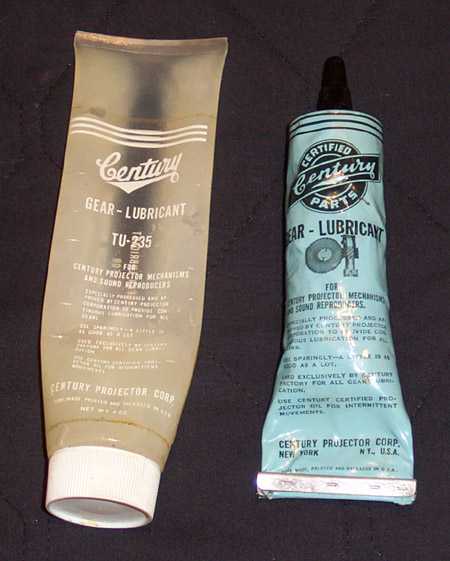
Old Century Grease, which i assume is no longer made, it was clear; I found a metal tube of it in the booth supply cabinet.
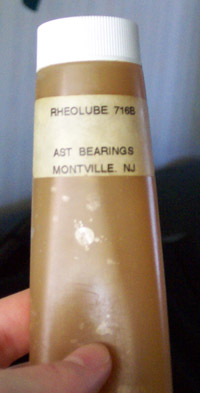
Strong Proj grease which they currently send out, when you peel the label off you find you have a tube of something called Rheolube, shown below.
I've used the Strong orange grease on my Century C's at work for some time now with no problems. Some oil separates out of it in the tube though, looks nasty.
This week I decided to try out Superlube on my Century here at home. After cleaning all the old grease off and applying the Superlube, I let the machine run for 3 minutes then turned it off and checked the gears.
The damn stuff had totally migrated off of the contact points on all my fibre gears!!! I applied more and ran for 2 mins, then looked again. SAME THING!! The contact points on my fibre gears were DRY!!! They had light orange "scuff" marks on them from running dry for a minute! ![[Mad]](mad.gif)
If I had used this stuff and then run a show, my gears would have been chewed up into red dust!! ![[puke]](graemlins/puke.gif) Why have I seen good reviews for Superlube on here, when obviously it doesn't work??
Why have I seen good reviews for Superlube on here, when obviously it doesn't work??
Should I scrape off the Superlube and use the orange stuff? Or dig out that 50 year old metal tube of Century Grease, which surprisingly has not turned to a rock.
![[Confused]](confused.gif)
Posted by Mitchell Dvoskin (Member # 751) on 03-25-2005, 01:29 PM:
Wow, I live 10 minutes from AST Bearings, and never knew they existed.
http://www.astbearings.com/p-lubes-greases.php
Posted by Monte L Fullmer (Member # 2797) on 03-25-2005, 01:47 PM:
Okey..here'sa good one: I've seen operators use Vaseline for their Century gears. Any reports on this one? - thx Monte
Posted by Mitchell Dvoskin (Member # 751) on 03-25-2005, 01:55 PM:
I've seen operators use Vaseline
I've seen that one too, on Century "C"s. I've also seen run of the mill white grease from a hardware store. The projectors did not seem to mind either, although I would be concerned about vaseline breaking down too quickly.
Posted by David Stambaugh (Member # 1102) on 03-25-2005, 02:03 PM:
Rheolube 716B Data Sheet [PDF file]
Posted by Richard May (Member # 2627) on 03-25-2005, 03:10 PM:
A lot of theaters around here use vaseline on Century projectors. I don't like it because it does break down quickly. Then it ends up in the bottom of the machine in a big puddle.
Posted by Mark Gulbrandsen (Member # 72) on 03-25-2005, 10:29 PM:
quote: Dan Lyons
Why have I seen good reviews for Superlube on here, when obviously it doesn't work??
Actually I used it for many years on all my rental machines and never had a problem with it. I also use it on all the Centurys in the field that I service as well and on my VistaVision projector and VV camera gear train. If you had alot of dust generate then you may have another problem occurng, or dry grease is flaking off,or mismatched main drive set, etc, etc, etc! A serious inspection/cleaning of your gear train may be needed to determine what is up. Also, note that I do not reccomend using synthetic grease on machines that have seen other greases with out a proper cleaning of the gear train. Synthetics may not adhere to gears that alreafy have a coating of another type or types of greases on them ![[Eek!]](eek.gif) . To properly clean the gear train involves a tear down to do correctly! Also note that Superlube contains TFE which penetrates into the weave of the phenolic and actually prevents wear....aside from the lubrication actionafforded by the grease itself.
. To properly clean the gear train involves a tear down to do correctly! Also note that Superlube contains TFE which penetrates into the weave of the phenolic and actually prevents wear....aside from the lubrication actionafforded by the grease itself.
Its interesting to note that the old C manual had you lube each gear pair with a few drops of Century oil at the start of the day and I can assure you that method also does work. From my experience the best lube for Century gears has been Super-Lube. This has been discussed many tmes in this forum. The use of Lubriplate, wheel bearing grease or anything else is the surest route to death for the gearing in this type of mechanism. The best thing about Superlube, or most synthetics is that they never dry out and are thick enough to stay on the gears for the most part and not fly off. While you're at it also use LaVezzi synthetic oil in the movement. My experience with the use of this oil has proven to double the life of the movements critical parts. Both are available from Wolk(or from foreword thinking cinema equipment dealers) under the part number TU-235 Century Gear Grease, and the LaVezzi HPO series Synthetic oils. BTW: you won't find much of anything that will stay on the main drive gear set in Centurys, especially the fine tooth direct frive gears. Very frequent lubing is necessary for the mian drive gear set to achieve maximum life span. The main drive gears which are carrying the full load of the running machine will normally get slightly warm under normal conditions of operation!!
http://www.super-lube.com/
Mark @ CLACO
Posted by Aaron Sisemore (Member # 145) on 03-25-2005, 11:58 PM:
I will also vouch for the SuperLube.
In my travels I found that I need to use less of the SL on each gear compared to the other greases.
Vaseline: I have seen it used on Centurys, it seemed to work fine, but I believe that the SuperLube and Century greases have additives that enhance lubrication quality.
White Grease should NEVER be used on projectors- I have had to chip off petrified white grease from many a gear on some projectors I have rebuilt.
'Wheel Bearing' Grease: Use for platter disc bearings ONLY. Keep it far far away from a Century gear train!! (mainly because it is SOOOO messy!) ![[Frown]](frown.gif)
-Aaron
Posted by Dan Lyons (Member # 1454) on 03-26-2005, 05:19 AM:
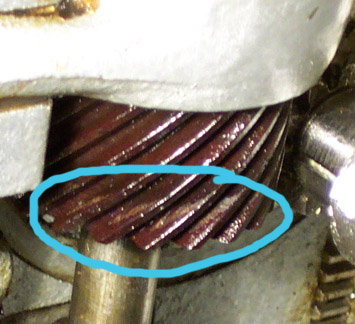
These are pics of what Superlube did to my JJ. These were taken after 60 SECONDS of running. The parts circled in blue have NO lube left on them and have started to scuff from friction.
I tried to wipe that Superlube stuff off and put some regular grease back on, but the gears won't accept it now.
How do I get Superlube off my gears? The company site doesn't say how to remove the product. I want to get this junk off so I can put some "old fashioned" grease on and have a machine that I can actually run!
(and no, nothing is mechanically the matter. This machine has run perfectly for the past 30 years; the problem only occured after i cleaned off the old grease and put Superlube on)

Posted by Mark Gulbrandsen (Member # 72) on 03-26-2005, 06:26 AM:
quote: Dan Lyons
These are pics of what Superlube did to my JJ. These were taken after 60 SECONDS of running. The parts circled in blue have NO lube left on them and have started to scuff from friction.
Dan,
You're beginning to sound like me moaning about Strong! BUT......
You have something else going on there and that scuff pattern is not something new to your gears from just 60 seconds of running with a different lube.... it appears that the Super-Lube has made the normal wear pattern on your gears very visible. This is the wear pattern one would expect to see on an old Century and is VERY visible on properly cleaned gears during a teardown before they are re-lubed. That sort of problem is not the fault of Super-Lube but a fault inherent in the design of the projector itelf! It could also be the result of having 30 years worth of old grease inpregnated into the phenolic gears.... or there may also be excessive wear on your steel gears..... not all techs replace a steel gear when they replace a fibre gear..... always replace both.
I can clearly see that some of those scuff marks are indeed covered with shiny superlube. That is clear as day and on close examination the photos speak a thousand words so to say! When the manufacturer of the gears themeslves reccomend the use of it and sell it(both LaVezzi and Wolk) its effectiveness is really not a question and my experience has confirmed that. To properly get rid of it a full tear down and cleaning is in order but I wouldn't switch to something else anyway. I've used Super-Lube on all my repaors/rebuilds for almost as long as I've been in this buisness with only positive results.
Really, you're barking up a tree in the wrong place, send Super-Lube's technical folks the photos and see what they have to say.
Mark
P.S. Also that machine is filthy and should receive a tear down and good cleaning!
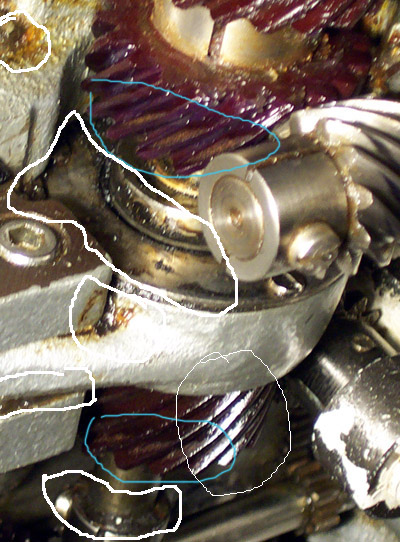
Also here is your photo re-marked to show the superlube on the gears that you say is not there. Note at bottom center circled in white the shiny teeth! I also circled the dirty parts just in that close up.....
Posted by Steve Guttag (Member # 268) on 03-26-2005, 07:29 AM:
When we switched to SuperLube we did thermal tests with previous forms of Century grease and with SuperLube. The SuperLube resulted in lower temperatures when means less friction which means less wear.
SuperLube is not the cure all for everything but it is better than other forms of TU-235 we have found for Century gears.
Posted by Louis Bornwasser (Member # 3063) on 03-26-2005, 02:04 PM:
1. Super Lube is good.
2. Factory grease is good.
3. Lubriplate, in any form, is bad (Where do people get this stuff??)
BTW: the old Century TU-235 went away under ORC. They thought they had an "excess wear poblem" which only just turned out to be metal gears that were not hardened. There is considerable customer demand for "original" TU-235.
Posted by Gordon McLeod (Member # 33) on 03-26-2005, 06:33 PM:
Original century lube was vasoline or as was stated on the data sheet white petrolium jelly
I use Moly based black greese and find it sticks well at even on hot machines
Posted by Tim Reed (Member # 137) on 03-26-2005, 08:22 PM:
LOUIS!! 'bout time you showed up here, boss. ![[thumbsup]](graemlins/thumbsup.gif) Welcome to the 21st Century!
Welcome to the 21st Century! ![[Wink]](wink.gif)
![[Big Grin]](biggrin.gif) Glad to have you with us.
Glad to have you with us.
Now, if we can only get James and Eddie on...
Posted by Mark Gulbrandsen (Member # 72) on 03-26-2005, 09:12 PM:
quote: Louis Bornwasser
3. Lubriplate, in any form, is bad (Where do people get this stuff??)
I'm pretty sure its made from dead animals...... I found a whole case of the stuff at work in the parts room and imediately put it down in the dungeon next to the pile of ole E-7's.
Gord, That black moly grease also dries up because it is animal fat based.
Mark
Posted by Dan Lyons (Member # 1454) on 03-26-2005, 09:23 PM:
Update:
This morning I put more Superlube on all gears. Ran for about 3 minutes, I observed the same spots were DRY again with orange powder on that section of the gears.
I cleaned the gears off, and applied some vintage TU 235. I ran for 3 minutes. NOt only did I observe the same orange powdery spots where the lube had been pushed off, but the metal gears were EXTREMELY HOT to the touch. Almost hot enough to burn me.
ideas?
Posted by Tim Reed (Member # 137) on 03-26-2005, 11:33 PM:
Check that the intermittent movement isn't pressing too hard against the vertical shaft. There should be just barely-perceptible back lash between those two gears.
Also, assuming the sprocket shafts have been getting oiled and are not binding... turn on the projector and carefully loosen the screws on the two vertical shaft bearing retainers, so that the shaft can align itself to the gear train. Then retighten the screws. Just be careful that you don't get the end of the screwdriver caught in a gear while you're doing this.
Posted by Aaron Sisemore (Member # 145) on 03-27-2005, 12:02 AM:
Yeah, Danny- it sounds like the gear lash is set WAY too tight on your JJ.
Follow Tim's instructions and all should be fine. There should be a teeny tiny bit of movement/play on the main, vertical, intermittent and shutter shafr gear meshes. Too little and its sloppy, too much and you get premature wear of the fiber gears as well as possible noise and vibration.
-Aaron
Posted by Dan Lyons (Member # 1454) on 03-27-2005, 03:00 AM:
A huge Thank You to Tim and Aaron. That little trick seems to have solved my problem, and the machine turns over by hand much easier now also!
Posted by Mark Gulbrandsen (Member # 72) on 03-27-2005, 08:16 AM:
quote: Tim Reed
turn on the projector and carefully loosen the screws on the two vertical shaft bearing retainers, so that the shaft can align itself to the gear train. Then retighten the screws. Just be careful that you don't get the end of the screwdriver caught in a gear while you're doing this.
Ya gotta be careful doing this!!! If the dowel pimns are in there it isn't going to hardly move at all and if its done wrong and the dowel pins are missing you can actually bend the vert shaft permanently. I remove the imtermittent and shutter shaft. Then adjust the vert. shaft by loosening the movement drive gear block and making sure that its very free to move. You will find some are locked in the carrage assy. because of excess paint or rust. Then loosen the top and bottom bearing blocks and check and set clearance in the sprocket drive gears. Keep in mind that these machines are supposed to have dowel pins that locate the top and bottom brearing blocks in place but they may have been removed by some technician that thought he could asjust it better than the factory.... remember these should have grease clearance, not oil clearance and the gears mesh should be just a tad sloppy! Anyway I prefer to have the pins in place and usually replace them if they are missing. If the dowels are in there you will not be able to move the top and bottom bearing blocks around by more than about a couple of ten thos. Once you are satisified thay are properly located or loosning them doesn't allow any movement then tighten them down snug AND THEN re-tighten the intermittent drive gear bearing block back to the intermittent carrage. Then re-insert the movement and adjust for one thickness of notebook paper clearance. Ditto with the shutter shaft and then re-run in the machine for several hours.
BTW: The main reason for loosing the intermittent bearing block is to relieve any stress that might be placed on the vert. shaft as you move the upper/lower bearing blocks around. Its really best to rely on the pins for the upper and lower blocks and replace them if missing, then tighten down the movement drive block. No stress that could reult in a permanent set on that long shaft wil happen of you do it this way. Really Danny, just takethewholedamthignapartandlearn!
Mark
Posted by Scott Norwood (Member # 30) on 03-28-2005, 08:02 AM:
Danny--your Century gear grease is in a metal tube? Every tube that I have seen is clear. I have an almost-full tube (which is probably 30 years old, but still feels fine) of the original stuff, which I expect to be a lifetime supply for home use. Is there any reason to strip this stuff off (how?) and switch to Super Lube or something else? My Centurys are fairly low mileage (probably about 1-2000 hours on each, if that) and will get relatively little use (maybe once a week) from me, in case that matters.
Posted by Dan Lyons (Member # 1454) on 03-28-2005, 02:20 PM:
Yep, here they are Scott. The one in the metal tube is REALLY old, but just as good as the other. Hasn't separated or gone bad.
Posted by Manny Knowles (Member # 1171) on 03-29-2005, 01:14 PM:
FWIW I don't think this is a lube issue at all.
If your gears are becoming too hot to handle in such a short space of time -- and so soon after a reapplication of lube -- then they are most likely binding. In which case, no amount of lube (natural/synthetic, new/old, this brand/that brand) is going to solve the problem. The projector will need a realignment.
If the SHAFTS are also too hot to touch then you may have a bent shaft. This could be the cause of the improper meshing or it could be in addition to...
Posted by Dick Prather (Member # 1136) on 03-29-2005, 01:48 PM:
The only Century's I have worked on that had dowel pins were the model C. Most A type did not have them. With that said in the many I have rebuilt I have found the gears over the years are slightly different.
I replace Century gears in pairs only due to that. Usually when a gear gets hot it is due to an improper mesh or the gears not being matched and the cut being off to each other. I always use LaVezzi gears and have not hade any problems. I agree with Manny grese is probably not the problem.
I do NOT recommemd unloosing anything on the gear side while the machine is running. Once I have a properly done vertical shaft assembly I will line it up to get proper mesh with the lower drive and the two sprocket gears. Tighten the screws on the bearing retainers. If there are dowel pins use them onlf if the proper gear mesh can be obtained. If not remove them or tap them flat so the bearing retainers can be properly adjusted. Then tighten the two screws on the intermittent gear holder. I they loosen the bearing retainers then tighten them one at a time again to let the vertical shaft set itself. Always check for hand rotation after each operation to make sure you have the proper adjustment. I then run in the machine for a bit dry untill I a slight fiber dust on the metal gear then grese the gears as normal.
I would also be happy to discuss this on the phone with you if needed.
Posted by Mark Gulbrandsen (Member # 72) on 03-29-2005, 10:59 PM:
Dick,
I have to confess that most of the A series I've worked on have had the dowel pins in them. This area is the exception where a certain tech has admitted to taking them all out over the years and I've slowly put them back in. Rarely do I have a gear mesh problem with them in and if there is a mesh problem that usually points to another problem elsewhere(mating gear, bushing etc) that also needs to be delt with. And yes there are those few incorrectly machined castings out there too! Another thing I have been doing lately is scrapping the rubber isolated intermittent drive castings and replacing them with the solid variety. The machines with the solid castings always run alot smoother... the C model, the early A model and the Cinerama/JJ's all had the solid mount casting. You should try out the new Wolk Gears on a rebuild one of these days...... very good uality, actually better than the LaVezzi fibre and they're now made on CNC gear cutters. I still use the LaVezzi steel gears though.
P.S. I agree on not working with a running machine!
Mark
Posted by Phil Hill (Member # 371) on 03-30-2005, 01:22 AM:
Danny, I don't agree with Mark, Manny, or Dick... I think you should change the lubricant to either of these:
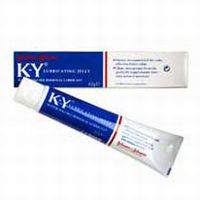
or "Elbow Grease"
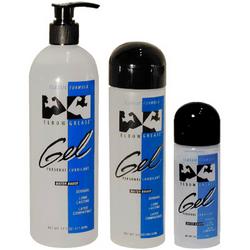
Posted by Dick Prather (Member # 1136) on 03-30-2005, 02:30 PM:
The newer machines I've been getting did not have locating pins in them. Perhaps someone did remove them but on most I could not get a proper gear mesh if the pin was still there. I have seen gear mesh problems with older Wolk and some ORC made gears.
I agree with Mark in changing the intermittent drive gear bearing bracket (BR-3). I have been doing this for several years. Also LaVezzi came out with an anealed vertical shaft and gear (C3-G-93) that does not bend or warp. A little more cost but well worth it for longer life. Century's may look simple but if they are not set up correctly with all the correct parts they wear out quickly.
Phill is right on the mark with the grease. I don't know why we didn't think of it.
Posted by Mark Gulbrandsen (Member # 72) on 03-30-2005, 07:46 PM:
quote: Dick Prather
I have seen gear mesh problems with older Wolk and some ORC made gears.
Actually when Don bought Wolk out they retired all the old gear hobbing equipment for good. NOrm alwyas told me that it wasn't the geas it was the equipment they were being made on that was bad . Now they are made for Wolk on cnc equipment. They seem to haev hit the nail dead on by doing this. As for ORC, they ruined the Century, then Stonrg bought the remains and destroyed the rest.
Mark
Posted by Michael Rourke (Member # 1142) on 03-31-2005, 02:18 PM:
Hey Dan, I thought I would give my 2 cents about grease since I had quite the ordeal trying to choose the right kind for me and my Century's.
If you like the Century Grease and it's working for you just stick with it. It was a little too thin for me, and even though our booth is air conditioned our lamp exhaust sucks meaning more heat in the gear box.
I chose the Superlube because it stays on the gears and it is available at local bearing dealers so I don't have to order it through a supply house and wait for weeks because it's back ordered. If you order the little tubes of TU 235 I think they are like 8 or 9 bucks a tube but you can go get a 5 pound bucket of Superlube for $40 bucks.
Rheolube was the best stuff ever, do they still make it? I raised a stink when I couldn't get it anymore through our distributor because it held fast to all the gears even the fiber shutter gear. It does dry up more than Superlube though.
Hope that helps with any decision you're gonna make.
Posted by Tim Reed (Member # 137) on 03-31-2005, 02:31 PM:
quote: Mark Gulbrandsen
I remove the imtermittent and shutter shaft. Then adjust
Yes, I thought about that after I'd posted, but by then, I was already out on the big road. quote:
I agree on not working with a running machine!
Well, I said you gotta be careful! It's not for the faint of heart, naturally, but you gotta figure he knows at least something about what he's doing. It's not that difficult an operation.
Posted by Mark Gulbrandsen (Member # 72) on 04-01-2005, 07:32 AM:
quote: Tim Reed
Well, I said you gotta be careful! It's not for the faint of heart, naturally, but you gotta figure he knows at least something about what he's doing. It's not that difficult an operation.
Tell that to the person whose finger was found in the chili at Wendy's .

Link To Story About The Lady That Was Stupid Enough To Eat At Wendy's In The First Place
Oh the stupid things that people sue over...... ![[Roll Eyes]](rolleyes.gif)
Mark
Posted by Gordon McLeod (Member # 33) on 04-01-2005, 08:22 AM:
I didn't relize that chilli was part of the "finger food" group
Posted by Dan Lyons (Member # 1454) on 04-01-2005, 10:19 AM:
I think everyone here knows better than to stick a finger near the gear train while a machine is on.
Then again... I recall a thread a while back where some people were talking about how they'd caught their fingers in a sprocket before while fixing a loop sizes while the machine was on.
Posted by Tim Reed (Member # 137) on 04-01-2005, 11:01 AM:
quote: Mark Gulbrandsen
Tell that to the person whose finger was found in the chili at Wendy's
BTW, the obvious question that I've heard no one ask regarding that case: just whose finger was it? You'd think someone somewhere would know which guy got his finger cut off at the plant...
Posted by David Stambaugh (Member # 1102) on 04-01-2005, 02:45 PM:
The Whole Story on the Finger in Wendy's Chili
Finger Food
Claim: A patron dining at a Wendy's fast food outlet found a human finger in her bowl of chili.
Status: True.
Origins: Claims of human body parts turning up in food products are the most horrifying of contaminated food legends, both because of our very strong societal taboo against the eating of human flesh, and because such a discovery suggests a human death, almost certainly one that was accidental rather than natural (and which conjures up images of a slow and painful death by industrial accident), or at least a painful dismemberment.
Fortunately, improved health and safety standards in food processing make such occurrences quite rare, and most reports of consumers finding body parts in food turn out to be cases of mistaken identity — something that looks like a human body part is found, upon examination by experts, to be something else entirely. (See, for example, our page about a scare involving a finger supposedly found in a can of menudo.) If recent reports are correct, however, such a grisly discovery has indeed been made.
On the evening of 22 March 2005, Anna Ayala, a 39-year-old resident of Las Vegas was dining at a San Jose outlet of the Wendy's fast food restaurant chain when she discovered what appeared to be a human finger in her bowl of chili. According to the San Jose Mercury News:
Devina Cordero, 20, was with her boyfriend at the fast food restaurant when she said the woman, who has not been identified, began gasping and ran up to her saying: "Don't eat it! Look, there's a human finger in our chili."
Cordero said the object appeared cooked and seemed to have a long fingernail at the end. All three people soon became sick.
"We went up to the counter and they told us it was a vegetable," Cordero said. "The people from Wendy's were poking it with a spoon."
[San Jose police officer Enrique] Garcia said the Santa Clara County Health Department is taking over the investigation. "It was some sort of small mass which appeared to have a fingernail. It's a small piece," Garcia said. "They collected the finger and placed it in a freezer for the health department."
A health officer described the unfortunate diner's reaction to the gruesome discovery:
"Initially she did put this object in her mouth, and did bite down on it, and wasn't sure exactly what it was," said Dr. Marty Fenstersheib, a health officer. "She's doing okay. Initially, she was a bit grossed out, as she described to me and vomited a number of times mainly because of the unpleasant experience of having this finger in her mouth."
The Wendy's restaurant temporarily closed but reopened later that evening (although they maintained they had run out of chili for the day).
The following day, Santa Clara County health officials announced at a press conference that they had confirmed the object found in the bowl of Wendy's chili was indeed a human finger, and they were planning to trace the ingredients back to the source to determine where it came from, whose it was, and how it got into the chili. The Associated Press reported that officials believe the contamination did not pose any health danger:
Officials said the fingertip was about 1-1/2 inches long and contained part of a manicured nail. The woman, who asked officials not to identify her, immediately spit it out, Santa Clara County Health Officer Martin Fenstersheib said.
"She was a bit grossed out it was described to me, and vomited a number of times," he said.
Health investigators seized all the ingredients at the restaurant and are tracing them back to their manufacturer. They believe the finger got into the chili at an earlier stage and was cooked at a high enough temperature to kill any viruses.
Investigators have ruled out the possibility that the finger formerly belonged to an employee of the San Jose Wendy's outlet:
Employees at the Wendy's store were asked to show investigators their fingers after the Tuesday night incident. All employees' digits were accounted for, officials said, adding the well-cooked finger may have come from a food-processing plant that supplies the company.
"All of our employees have ten digits," said Denny Lynch, a spokesman for Wendy's International Inc., based in Dublin, Ohio.
He said there have been no reports to the U.S. Occupational Safety and Health Administration of injuries at any supplier of chili ingredients to Wendy's.
"By law, you can't hide that sort of stuff," Lynch said.
"All of our chili suppliers report no accidents."
A medical examiner has opined that the finger portion appears to have been torn, not cut, from its base:
"The segment of skin has very irregular torn edges, it looks like its lacerated," said Joseph O'Hara, a medical examiner. "It's not incised — incised meaning it would have been with a sharp edge like a knife or something, that was not the case — it was torn, it had multiple puncture defects."
The county medical examiner said the human finger was cooked but not decomposed.
Investigators are trying to trace the finger to its origin through fingerprint matching, and determine whether the finger was introduced into the ingredients used to make chili or dropped into the finished product afterwards:
Meanwhile, the hunt for the former owner of the finger — that would be a person missing about an inch and a half of a digit — continues. Capt. Bob Dixon of the Santa Clara County coroner's office said Friday the crime lab has completed the first part of attempting to lift a usable fingerprint from it.
The idea, he said, is to run the print through a database and try to match it to its owner.
Then, one would imagine, there would be many, many questions. Such as, did you know we had your finger? Why was Wendy's serving your finger in its chili? Do you want your finger back?
Dixon also said that so far it's impossible to tell whether the finger was cooked along with the main batch of chili or somehow dropped into the serving cup afterward. The lab is going to try to determine if there's some kind of test to figure that out.
There is as yet no evidence that (as is often the case) someone intentionally put the finger in the chili in order to perpetrate a scam, but Ms. Ayala has retained a lawyer, who told the Mercury News:
"All I can say is she has suffered tremendously," Jeffrey Janoff, a San Jose attorney, said. "People are making jokes about this, but this is a really serious thing. How many people have bitten into human flesh? It's revolting."
Business at Wendy's restaurants has reportedly dropped off sharply in the days since the gruesome finger discovery, particularly at the outlet where the incident occurred and throughout Northern California.
Last updated: 26 March 2005
Posted by Brad Miller (Member # 2) on 04-01-2005, 02:53 PM:
This thread is titled "Types of grease for Century gears". This is WAY too off topic here guys! Take it into Yak.
Posted by Phil Hill (Member # 371) on 04-13-2005, 11:20 PM:
I was just wondering what was the latest on the lube/gear thingie?
Another good alternative lube to Vasoline would be Crisco... ![[beer]](graemlins/beer.gif)
![[evil]](graemlins/evil.gif)
Posted by Mark Gulbrandsen (Member # 72) on 04-14-2005, 07:14 PM:
quote: Phil Hill
Another good alternative lube to Vasoline would be Crisco...
I doubt that you could take the smell of the Crisco, after about 6 months it would become ransid !
Mark
Powered by Infopop Corporation
UBB.classicTM
6.3.1.2