This is topic SRD - Penthouse or Basement - preference? in forum Film Handlers' Forum at Film-Tech Forum ARCHIVE.
To visit this topic, use this URL:
https://ft-forum.com/ft/cgi-bin/ubb/ultimatebb.cgi?ubb=get_topic;f=1;t=007096
Posted by Frank Angel (Member # 248) on 04-11-2005, 10:55 AM:
We may have it in the budget to get SRD for our big house. We already have DTS and Mag penthouses -- I am wondering if adding yet another top reader (as well as the 6000 magazine) would make it a little unwieldy from the operator's perspective -- he might need a step-stool to load the 6000ft reels.
Assuming I can get a basement reader (Component systems?), is there any reason NOT to go basement as opposed to a penthouse? Or should I just go with a penthouse and buy a step-stool?
Posted by Gordon McLeod (Member # 33) on 04-11-2005, 11:12 AM:
what make of optical soundhead is involved
Posted by John Walsh (Member # 168) on 04-11-2005, 11:22 AM:
I've always preferred the penthouse readers. I feel they generally read better, (stay in alignment) which might help running older rep prints.
In one place I worked, they pivoted the upper reel arm way over to about the "10 o'clock" position to keep the reel from hitting the ceiling. Do you run enough mag to keep the mag head on all the time?
I wonder why no one ever made a basement DTS reader?
Posted by Steve Guttag (Member # 268) on 04-11-2005, 11:49 AM:
Frank,
There is no reason not to use a basement reader if one is available for your projector/soundhead. Those that prefer penthouse readers typically just find them easier since they are a bolt on...then again...if the penthouse goes out of alignment (LED mounts mostly) they are lost there too.
I've done basement readers on Simplex, Century and Kinoton...no problems. If you have problems with a basement reader...it isn't reading the optical sound as well as it should either. Set them up right, they are stable and reliable.
As to DTS...they can't do a basement reader since their timecode will not allow for the reader to be after the projection aperture. What I wish DTS did offer was a better reader or a version that would allow it to go in place of a 35 mag head so the film would be stable and not suffer from weave and bounce. I know Mark G has done this for Norelco where the mag head is removed and a DTS reader goes in its place...I'll wager those don't have reading problems at all unless the track is physically defective.
Posted by Sam D. Chavez (Member # 1841) on 04-11-2005, 01:12 PM:
Most people prefer penthouse readers for retrofit as it is much closer to plug and play than a basement reader.
It kind of depends on who you have for a technician and how availible he/she is for follow-up.
If this is dicey, than a penthouse is a better choice as you can get a replacement and send the broken one back to the factory without disrupting the theatre.
There might be a slight edge to using a basement reader with reel to reel as the basement reader is immune to bent reels, etc, but again, it comes down to who your tech is.
Not everyone is as talented as Guttag.
Posted by Louis Bornwasser (Member # 3063) on 04-11-2005, 06:44 PM:
I also have had good to excellent results with the "basement" readers; usually Kelmar. There are three items to consider:
1. Can you find an excellent technician who "understands?"
2. Is your soundhead Century, Simplex, RCA? (prob. Kintone also)
3. Is your booth operator actually willing to thread the penthouse every time, every day with the proper tension?
Your answers to these will lead you in the right direction for you.
Note: I have actually REMOVED digital from one theatre where the "operator" refused to thread the penthouse....We removed the digital and put it into another theatre where cooperation was assured. Note that basement readers assure digital presentation if threaded at all. With auto-digitl enabled it is a no brainer.....sometimes needed! ![[Razz]](tongue.gif)
Posted by Sam D. Chavez (Member # 1841) on 04-11-2005, 07:42 PM:
I believe Louis basically agreed and repeated what I said.
Hello Louis and welcome. You finally learned how to use a keyboard?
Older Simplex 5 Star soundheads generally have more trouble with "basement" (as in bargain, just kidding) readers as the lateral guide has trouble holding the film in the proper outward position.
Also, in a basement reader where the film is moved to achieve proper lateral position, every time you need to make an adjustment to eliminate a buzzing analog soundtrack, you also move the film in front of the digital reader as well. Here's betting the lateral guide roller never gets put back to its calibrated position.
My original intention for the basement readers is to lock down the film path and have individual lateral adjustments for analog and digital. I could not convince Component Engineering owner Bill Purdy to do it my way when I joined the company in 1994. This was only the first of many battles I lost while there.
The Apogee of course, as well as most European projectors have a fixed film path and individual adjustments.
Posted by Mike Babb (Member # 1379) on 04-11-2005, 09:24 PM:
I have used both as a projectionist and serviced both. I have no real preference as a projectionist but basement is easier for new people since they don't have to do anything different, but anyone that can't figure out a penthouse probably shouldn't be operating.
For some reason servicing penthouses seems easier but probably only because I am over 6ft, my boss prefers basements and is closer to the basement:)
In reality they both do the same thing very well so you should think about what you want to thread.
Also I tend to prefer Kelmar over CE as far as basements.
Posted by Monte L Fullmer (Member # 2797) on 04-12-2005, 02:03 AM:
Hey Sam, how are those BACP penthouse Dolby Digital readers?
Can anyone share any feedback on this one?
Only thing that I've heard is that they perform great and much cheaper than the Cat-701/2 series.
thx-Monte
Posted by Steve Guttag (Member # 268) on 04-12-2005, 08:39 AM:
Monte...as penthouse readers go, they are as good as you will find. My biggest complaint with the BACP reader and the Cat. 702 is the lack of ability to kill the LED when not in use...in some of our non-cinema applications, the equipment racks stay powered 24-hours.
Posted by Dean Kollet (Member # 1789) on 04-12-2005, 08:54 AM:
I've only used the Cat700/701s and the Kelmar Basment reader, and both worked fine. I really don't have a preference, although I agree with the Penthouse being a lot more plug and play. But, you install it once, so.....the leds are easier to replace on the Penthouse though.
Posted by Scott Norwood (Member # 30) on 04-12-2005, 09:54 AM:
From the operator's point of view, I prefer penthouse readers. They (particularly the cat. 700 and also the BACP) seem to track better than the CE basement readers (I have not seen the Kelmar) and are super-easy to install (it took me fifteen minutes to set one up in a single-machine configuration). They can also be swapped out easily if there is a problem.
For reel-to-reel use, penthouse readers are convenient because they can easily be bypassed to, for example, easily run a trailer reel in SR (select format 10 on the processor, thread the trailer reel to bypass the reader, and let the processor revert to format 05 as no digital information will be present) and then changeover to the first reel of the feature (threaded through the reader) in SRD. I realize that this isn't an issue if the installation has sound format controls next to each machine, but not every booth is set up this way.
Posted by Monte L Fullmer (Member # 2797) on 04-12-2005, 02:00 PM:
quote: Steve Guttag
to kill the LED when not in use...
...then, couldn't a A/B switch be placed in the automation circuit for the P/S line cord so that the LED could be switched off during machine rest? How would one do this with a CAT-702 with it's built-in power supply where this unit doesn't have the line cord for external power?
thx-Monte
Posted by Mark Gulbrandsen (Member # 72) on 04-12-2005, 04:07 PM:
quote: Monte L Fullmer
then, couldn't a A/B switch be placed in the automation circuit for the P/S line cord so that the LED could be switched off during machine rest? How would one do this with a CAT-702 with it's built-in power supply where this unit doesn't have the line cord for external power?
With most the readers its a VERY simple matter of hooking the readers power supply across the motor circuit. Tis way the reader is switched on and off with the motor. No wasted LED time this way. With the 702 it may not really be needed. Since this sound head uses the BACP technology which has pretty long LED life anyway. It would certinly be possible to interrupt the DC going to the reader with the exciter sitching circuit in most automations, or a relay across the motor circuit.
As for basement or penthouse.... I have no problem using the later Kelmar basement readers. They work just about as well as a penthouse reader dors... perhaps one digit higher error rate or so. For penthouse readers the BACP DSTR unit is about as good as it can get. C.E. sucks as far as basement readers go.
Mark
Posted by Monte L Fullmer (Member # 2797) on 04-12-2005, 04:34 PM:
quote: Mark Gulbrandsen
With most the readers its a VERY simple matter of hooking the readers power supply across the motor circuit. Tis way the reader is switched on and off with the motor.
...so, going further with this, one could do this same trick with ANY LED power supplies-basement,or penthouse, analog or digital? -thx Monte
Posted by Kevin Wale (Member # 1851) on 04-12-2005, 04:51 PM:
quote: Steve Guttag
What I wish DTS did offer was a better reader or a version that would allow it to go in place of a 35 mag head so the film would be stable and not suffer from weave and bounce.
Is there something about the DTS readers that causes weave and bounce? I've never heard that was a problem, or never thought of it, or something. I know if you don't get the film around both of those rollers you'll regret it. lol
Also, with that problem mentioned, do you think all DTS installations should include a film stabalizer perhaps underneath the reader?
Posted by Steve Guttag (Member # 268) on 04-12-2005, 05:53 PM:
I use CE basement readers almost exclusively...if you can't get them to track well...you aren't doing a very good job.
As to DTS...yes they do allow a bit of weave and if there is any bounce in the film, it will translate into poor tracking and some "wow" problems.
As to Cat. 702 and BACP readers...if the unit is powered 24 hours, it will kill the LED life. We have been known to put a switch in line on the LED though.
As far as LED replacement goes...CE is the easiest...they are socketed by fixed sockets (Kelmar's float). While BACP LEDs are changed as a unit...the CE is the cheapest since only the LED gets changed.
Posted by Mark Gulbrandsen (Member # 72) on 04-12-2005, 05:56 PM:
quote: Kevin Wale
Also, with that problem mentioned, do you think all DTS installations should include a film stabalizer perhaps underneath the reader?
The DTS reader is a woefully inadaquate device! How stable a DTS system behaves is purely a matter of what equipment it is working with. Yes, a stabilizer in the form of a semi-tight loop system would work wonders for it. When we adapted it to the DP-70 mag penthouse position we utilized some of the original penthouse tight loop copmponents to achieve this. These systems don't exhibit even the slightest tracking difficulties or ever even blip at all. The only real problem that exists is if the print's time code track is bad. Also the LED system in the reader is simply a joke of the largest degree. It's level drifts ALOT and costs the theatre owner about 300.00 to get a DTS R/A reader..... this much $$ to replace a 50 cent LED.
CE did improve their optics as did Kelmar but I still don't like the CE digital camera as its nhot as well protected or their ASR-40 pickup, the more expensive CE analogs are fine but the BACP has them beat there anyway.. I find the Kelmar LEDs just as easy to replace as the CE. Weather the socket floats or not is really irrelevant during LED replacement. I always take the foot loose fomr the sound reproducer to do a good clean out anyway.
Mark
Posted by Sam D. Chavez (Member # 1841) on 04-12-2005, 08:28 PM:
Monte,
One can always break the line on the LED wiring and tie it across a relay that pulls in when the projector motor is running if you feel the need.
On analog readers, you need to damp the LED inrush current or you will get a pop as the LED has no thermal lag like an exciter lamp. If you have the sound system set to optical you will definitely get a thump. A good way to damp the inrush is a 5000 uF Cap in series with a 10 Ohm or so resistor.
CE analog power supplies do have some contact points you can close or open to provide a soft start. Problem is, last time I looked they are wired backwards unless you have CE automation but they may have addressed this by now.
Posted by Richard May (Member # 2627) on 04-12-2005, 08:35 PM:
Sam, they are still wired backwards.
Posted by Frank Angel (Member # 248) on 04-13-2005, 01:01 AM:
Hey, thanks guys. I think we are going to go with the BACP DSTR-20 penthouse for ease of installation and mostly because of economics over DA-20. They weren't kidding when they put the NON in non-profit with our operation. As for projectionists who get spooked by threading a penthouse, well, he'd be out on his butt in a Brooklyn minute. Anyway, mostly it will be me running.
And John, yes we do still run mag so the mag penthouses have to stay. I love the idea though of incorporating a DTS reader in the mag penthouse! I am sure if there were a demand for it, it could be nicely designed and it would be an elegant solution to all those add-ons.
Oh, and my bad for not saying it is a Simplex XL and SH-1001 (I think).
We hardly ever run 6000ft so lifting the heavy LP reels won't be much of a problem -- 2000ft is no problem. The reason I was a little wary of the height was because I always have this image in my head of a projectionist friend of mine who was short and slight of build. He once lost his balance as he was reaching to get the 6000 ft reel on the spindle on his tip toes. He fell backwards with the reel on top of him. I swear I tried not to laugh.
Oh and we don't run commerical schedules. Strictly CinEvents. If we run more than three shows for any engagement, it is unusual. No worry about LEDs getting shortend life by our runs....I will be long retired.
Now there is talk that they also may want to do some 3D films (just like that). These are the same people who heard about our very popular outdoor movies in the park and called me and asked if we could do it on campus -- during the DAY....with VIDEO projectors.
Back to this planet -- I explained that for 3D, they will need a new screen and interlock. I have a pair of old, and presumably working selsyns, but I would like to get synchronous motors and speed controllers so that when I am not doing 3D, I'll be able to use them for better control of unconformed silent films. I am sure this stuff will be way out of their budget, but seems that some of the board member and the chairman of the film dept got the bug to do 3D. When the higher-ups want stuff, they usually miraculously find the money. (When they tell you there is no money, what they really are saying is, there is no money FOR YOU!)
Anyway, thanks again.
Posted by Monte L Fullmer (Member # 2797) on 04-13-2005, 05:19 AM:
quote: Mark Gulbrandsen
How stable a DTS system behaves is purely a matter of what equipment it is working with.
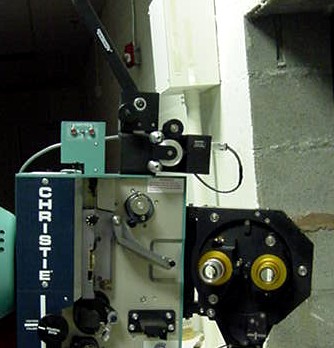
...On the comment from Mark above, here is a working layout of a DTS unit on a P35GPS machine.
Notice the black DTS guide rollers and how they are aligned to track the film through the reader. These rollers are aligned to give the tightest "S" loop though the reader assembly, thus ensuring the steadiest time code read thorugh the reader. Also, what handy with this roller layout, is that if the film hasn't any timecode information and DTS is the only digital format in that house, the film can be laced straight down to bypass the reader for optical usage.
Also, this is the main reason that AW3(r) platters are great for DTS usage - being with that three pinch roller assembly on the brain keeping the tension from platter to reader assembly constant.
Strong and other platter transports that have zero tension from platter to reader might have tendencies of DTS dropout due to the film isn't tight enough going around the scanner drum causing dropouts, or errors in timecode reads.
-thx Monte
Posted by Brad Miller (Member # 2) on 04-13-2005, 05:29 AM:
Monte, on that model Christie projector, you will find (if you don't already know) that the tightness of the belts will greatly affect the dts reader's ability to scan the track. So if you have one that is flickering and everything else checks out fine, remove the back cover of the projector and check the belt tension. ![[Wink]](wink.gif)
Posted by Monte L Fullmer (Member # 2797) on 04-13-2005, 02:05 PM:
quote: Brad Miller
remove the back cover of the projector and check the belt tension.
Boy! don't I know that one upside down, inside out, backwards and frontwards and all around the world with these P35's!
Why, we didn't use basement SRD readers with these things!
The other side of this complex, we have CAT-701's sitting on top of these P35's for the SRD playback. This side had the DTS.
When I would do the belt changes on these things, I made sure of the quarter-inch slack requirements on both belts.
I was told all about this from our chief engineer with this company and his choice of this tight "S" film path configuration, in which I have adopted completely.
He was an absolute perfectionist when it came to booth/machine setups and presentations! .... and a good teacher as well.
We'd never had any DTS dropouts with these machines.
..and I've heard that the CineX-35 machines took care of this basement SRD problem by eliminating that dbl sided belt, and using the round toothed belts.
thx, Brad. - Monte
Posted by Antonio Marcheselli (Member # 373) on 04-13-2005, 02:34 PM:
Steve
I agree with you about the need of a new and more sophisticated DTS reader!
Ok, IF the timecode is printed correctly, IF the equipment is correctly installed, IF the film path is correct and does not wow the reader works properly with NO problems at all.
In Italy sometimes we received prints that had one or more reels with timecode not correctly printed but where a little adjustment of the lateral position of the big roller completely solve the read problems (I marked the original setting!). Then there are the tension issue, with a platter can be a problem.
Mains disadvantages with DTS were
- CDROM drives reliability
- CD shipment
- Eventually Timecode reliability
First two problems seems to be addressed (the first one with XD10, the second has been fixed, at least in my country).
Why doesn't build a better reader, a reader that can track the timecode track if it is not perfectly under specs and a bit misaligned, a reader that can have a sprocket that solve ANY tension problem, that performs an auto LED gain calibration and so on? I believe that it would be easy for them to build a device like this. This could help the entire system's reliability.
Ok, you can reply that a good print with a correctly aligned system does not have problems. True. But the real world is not always perfect! ![[Smile]](smile.gif)
What do you think?
Ciao
Antonio
Posted by Mark Gulbrandsen (Member # 72) on 04-13-2005, 07:03 PM:
quote: Monte L Fullmer
..and I've heard that the CineX-35 machines took care of this basement SRD problem by eliminating that dbl sided belt, and using the round toothed belts.
Yes, the new Christie is without doubt the best bang for the buck in 35mm projectors today. They have eliminated and greatly simplified the belt system with round tooth pulleys and belts. All the flutter that used to be at the hold back sprocket on the P35GP is gone... gone...gone on the Cine-X35! Now you can use that basement reader with any problems and with very low error rates. The projectors also run much quieter than even a well tuned P35 does.
quote: Antonio Marcheselli
Why doesn't build a better reader, a reader that can track the timecode track if it is not perfectly under specs and a bit misaligned, a reader that can have a sprocket that solve ANY tension problem, that performs an auto LED gain calibration and so on? I believe that it would be easy for them to build a device like this. This could help the entire system's reliability.
Actually Antonio, I've given some serious thought to building a plate with dead rolling sprockets and tension arms that the DTS reader would mount to. This assy. would then attach to the standard DTS bracket. If I can do this for under 200.00 retail in small qualtities I may go ahead with it. The main cost though is the sprockets and tension rollers. The rest of it is really pretty trivial stuff.
Mark @ CLACO
Posted by Antonio Marcheselli (Member # 373) on 04-14-2005, 04:18 PM:
Mark
Yours is a good idea. I remember Brad posting a similar one. I wonder why DTS are not thinking about that rebuilding the reader from the basics. I cannot believe that it is too much expensive...
Bye
A
Posted by Mark Gulbrandsen (Member # 72) on 04-14-2005, 09:47 PM:
Antonio,
I believe that a reader is about 750.00 U.S. dollars right now. If they made a better reader that was even double that price I would gladly spec them in. What I hate is the constant removal of the tiny cover screws to get at the adjustment pot and tp's. There is one local chain that has drilled a hole in the front cover ov all their readers for access to this adjustment, they also installed mini phone jacks on the front to plug a meter into. Speeds things up quite a bit. On another outlook the reader could also be much worse than it is!!
Mark
Posted by Frank Angel (Member # 248) on 04-15-2005, 12:21 AM:
New development: they are now saying that because we already have Kelmar red readers and with that came the power supply that will feed a Kelmar basement digital reader as well as the analog rr, they want to know why I am not spec-ing a Kelmar basement reader to utilize the existing power supply.
Although I can't find it in a search, I am almost sure I heard some one praising the BACP basement reader units over the Kelmar. Was that just the analog reverse scanners or both the analog and the digital BACP readers that were considered superior over Kelmar? From what you guys are saying here, I shouldn't feel threatened by a basement reader, so now the question is, should I opt for the BACP unit over the Kelmar and tell them not to get their panty-hose in a knot over a $50 power supply? Will a Kelmar basement unit do good by me or is it going to come back and bite me in the ass?
Posted by Sam D. Chavez (Member # 1841) on 04-15-2005, 01:44 AM:
Frank,
BACP does not make a basement digital reader, only a penthouse SR.D reader.
There is not a thing in the world wrong with the Kelmar digital readers, it's simply a matter of the service and repair issues already discussed.
I am not clear which version of a Kelmar reader you now have. If all you need to do is add the digital reader to the soundhead, it's a snap. I believe they made a couple of versions of the analog readers, some with brackets in order to be "SR.D ready" some not.
Give my friend Tom Mohr at Kelmar a call. He's a straight shooter.
Posted by Richard Fowler (Member # 893) on 04-15-2005, 10:11 AM:
the Kelmar basement unit is very nice but we had a customer complain about the dual led bracket does not allow for individual adjustment for analog or digital pickup....so when new no problems but as the led aged, the tech would have to favor either the analog or digital reader.
Posted by Steve Guttag (Member # 268) on 04-15-2005, 03:18 PM:
That is not true...one has to set up the reader properly. The two readers are not fixed...in fact both move. It is certainly more work to set up a Kelmar, but it is also quite doable and once done no big deal. The one thing I don't like is that you kinda have to set up the analog twice...first to set the LED bracket...then you dial the digital reader in, then you go back and reset the analog...it is kinda hard to explain.
On Component Engineering...it is easy to get everything into alignment fast. They also provide for LED adjustment (independant) as well as precise alignment of the LEDs/Readers with respect the sound drum.
Posted by Richard Fowler (Member # 893) on 04-15-2005, 04:45 PM:
This was from six years ago so I may be not up to speed ![[Cool]](cool.gif)
Posted by Mark Gulbrandsen (Member # 72) on 04-15-2005, 05:28 PM:
Frank,
One thing to seriously consider is if you will be running any prints that have seen alot of previous use. You may experience alot higher error rates and print wear that may not playback with a basement reader where the penthouse reader will work just fine!
You also need to open up the Kelmar supply to see that there is really a digital power supply board in the case. On many Kelmars there is an LED for digital but nothing else in the case for it.....
MArk
Posted by Steve Guttag (Member # 268) on 04-15-2005, 11:15 PM:
I'll put my basement readers up against anyone's penthouse readers...new or old prints.
Posted by Frank Angel (Member # 248) on 04-16-2005, 12:33 AM:
I misspoke. I meant Component Engineering, not BACP. And besides, everything was pulled out from under me today as the lighting and sound department got all the money because what they are purchasing will say labor and generate money (wireless mics that we can rent our clients). Cinema remains the bastard child. But they promised me that I get first crack at the next budget go-around. So that just gives me more time to add more stuff they are gonna have to buy me....punishment/guilt for them stealing all my new toys.
Luckily for me, it seems there will be more money available in next budget and I get first crack at it. I guess I shouldn't have tweaked the ole CP50 & the system all these years making it sound so good because my boss kept saying today as I cried in his office, "But I don't understand why do you need a new processor....the sound in Whitman is better than most the theatres I go to....tell me again why we have to spend $30,000?" "Because I am playing the BACKUP tracks," says I. "If they fail, we have no backup!" Then I repeated the word DIGITAL about a thousand times. This he understood. Yah, yah, I have to hang my head in shame when I look in the mirror in the morning, but I am learning to deal with it. ![[Big Grin]](biggrin.gif)
Oh, and anyone wanna jump in on recommending a good interlock system for 3D, give it a shot. I would be nice if it also gave me the ability to run variable speed for silent and kick it up to 30fps for that one 35mm Todd-AO print they supposedly struck ten years ago. Will running the XL at 30 chew up any break-away gears or those brass gears in the soundhead transmission?
Posted by Mark Gulbrandsen (Member # 72) on 04-16-2005, 10:41 AM:
quote: Steve Guttag
I'll put my basement readers up against anyone's penthouse readers...new or old prints.
Steve,
I realize you've got to cover your butt on this ![[Eek!]](eek.gif) , and.... Basement readers have gotten ALOT better, about equal to a CAT 701 penthouse, however they still are not as good as what the DSTR, or 702 reader cranks out. You can definatley make that claim when basement readers get to utilize the technology designed for the DSTR and then also liscensed to Dolby for the 702... In 2nd run theatres I've seen prints not playback reliably with the later C.E. basement readers but play acceptably on the DSTR. There are good places for basement readers however they're still not good in a sub run situation, or with a very worn print.
, and.... Basement readers have gotten ALOT better, about equal to a CAT 701 penthouse, however they still are not as good as what the DSTR, or 702 reader cranks out. You can definatley make that claim when basement readers get to utilize the technology designed for the DSTR and then also liscensed to Dolby for the 702... In 2nd run theatres I've seen prints not playback reliably with the later C.E. basement readers but play acceptably on the DSTR. There are good places for basement readers however they're still not good in a sub run situation, or with a very worn print.
Frank,
Hang in there.... budgets are a pain in the you know what. Just be sure to ding the next budget for double what you told them it woulda been this time.....
Mark
Posted by Steve Guttag (Member # 268) on 04-16-2005, 02:56 PM:
Mark, I'm not covering my butt...I just don't have the basement reader problem you or others claim and I CATER to sub-run and Art house theatres.
I've installed basement readers back in the EPT lamp days, the 1st generation red readers and the current crop. I've done basement readers from Kelmar and Component Engineering as retrofits and Component Engineering and Kinoton as new as OEM installs...I'll put my basements up against your penthouses...they will track any film your penthouses will. In fact, I did a premier with a basement reader in a 4-star Simplex (CE basement)...to which the studio (Disney) and Dolby were nervous (1st generation LED basement)...I bet them it would track 1 point below what they go on their penthouse....I didn't loose the bet either.
If you have a problem with a basement reader from either Kelmar or Component Engineering...either it isn't set up properly or the soundhead needs repairs that it should have to run analog at its optimum.
The lenses do indeed vary among the manufacturers and models (CE uses a shorter lens for their Century basement digital reader...I believe it is the same or similar one that is used on Dolby's penthouse)...the results on best focus will vary based on that...but in terms of tracking and drop outs...nope...my basements track with anything that a penthouse can track to.
When we sell penthouses to those machines that don't support baement readers (no reader is available or the soundhead sucks for analog too) then we use the BACP penthouse...it is a winner. At the National Geographic Society in DC...we installed an LED switch to turn off the LED to conserve it... it is power 24Hours a day and only infrequently runs films.
Posted by Louis Bornwasser (Member # 3063) on 04-16-2005, 05:18 PM:
On set up of Kelmar reader: We set up the digital perfectly, disregarding analog entirely (sometimes not even connecting it yet) Then mount the analog and do 100% of the adjustment with the analog reader; first level, then pink, then cat 566, then a tweak of level. Once you begin analog, NEVER touch the machine lateral guide adjustment or the L.E.D......this has been hard for many to learn...it just "untweaks" the digital.
The down side of this is that any adjustment of the digital means that you must do the analog over from scratch. A "compromise" set up is unnecessary and incorrect.
As regards "error rate:" I can consistenly better the penthouses; with the best numbers going to Century direct drive, Century standard drive then the Simplexes. This corresponds exactly with analog flutter readings. (On SH-1000 style soundheads there is considerable wow but it is apparently slow enough for the processor to resolve it. The wow is the speed of the large gear...which is not round.)
Posted by Steve Guttag (Member # 268) on 04-16-2005, 05:58 PM:
Louis,
If you have any felt G-1985 pinch rollers laying about...try them on your 4-star soundhead...check your error readings before and after...the difference is quite amazing. The biggest problem I've encountered with Simplex soundheads is pinchroller bounce where a stiff pinch roller combined with crud will cause the roller to bouce and create a jitter. Keep em clean and no problems. I agree, the Century soundheads generally come out nicer though they sometimes have their bearing receivers a bit off from one another. A Component Engineering Century basement reader is pretty damn good.
Posted by Mike Babb (Member # 1379) on 04-16-2005, 07:45 PM:
This one is mainly for Louis or Steve but anyone else feel free to chime in. I more or less work with Louis' method of making sure digital is right before analog is done but also completely understand Steve's bouncing back and forth and do a version of it. I "center" the controls on the digital and board on analog before starting as well. My question though is if you had to adjust the lateral on the sound head, which do you prefer to nail, the digital and then bump the analog reader or analog and then bump the digital, or some combination of the two?
Posted by Steve Guttag (Member # 268) on 04-16-2005, 08:20 PM:
Are you doing a Century or Simplex, Kelmar or Component Engineering?
Posted by Mike Babb (Member # 1379) on 04-16-2005, 08:52 PM:
This would apply to Kelmar I imagine, but I'm asking generally, not for specific situation. I know with CE you can move the LED laterally.
Seems like if you center a Kelmar digital tube perfectly and the soundhead lateral guide on that, the analog might need to be bumped slightly. Or the same in reverse.
Oops sorry, Simplex 5* but I think the same q would apply to Century in this case.
Posted by Steve Guttag (Member # 268) on 04-17-2005, 12:58 AM:
In general, you should align the analog first. With CE...always analog first. The lateral adjustment of the solar cell is quite limited thus you want the film to be fixed to the analog cell. With CE you then bring the LED into alignment with that. After that is said and done...the digital can then be brought into alignment with what you have already done...again, with CE the LED can be precisely matched to what you have done in the analog alignment so both are exactly where they need to be. The CE digital reader allows for easy lateral adjustment to have it dead center. What you don't have with the CE reader is the ability to move either reader vertically BUT they reference their readers off the sound drum and then pin everything so that alignment remains true. It is rather easy and fast to bring a CE system into precise alignment.
On the Kelmar system...for Century there is way too much demolition that is needed but good results can be had. I've done several JJs with the Kelmar (they are the only ones that properly support the R-50 soundhead for 70mm to bypass through the head).
Kelmar's problem is that their LEDs do not adjust and that they have too many variables. The LED bracket is not referenced to anything and is limited to just the mounting screws. Likewise, there is nothing really referenced on the analog reader...just limited by the mounting screws. As such, you can have the LEDs skewed to the reader pick up and hence some back-and-forth alignment may be needed to get it all precise. Since laterally you are most restricted on the analog side...you really should start there but since you pretty much have to remove the analog reader to fully adjust the digital one...you kinda have to finish with the analog reader.
Century is much more of a pain system in either case...their machining has generally sucked throughout the years. You almost need the CE 30-series to properly align the older Centuries (and some of the later ones too). The film should not skew as it goes from sprocket, to drum to sprocket...as such you may need to adjust the reverse reader cell to get it to laterally center up on the film...likewise the LED may need to be shimmed (on a Kelmar) to get it to line up. I have not come across this on any Simplex but several Centurys.
Another variable in the analog alignment is how the various companies have dealt with reflections in their lens tubes....Kelmar silk screens their cells while CE hand paints them (on the outer part of the slit)...sometimes the silk screen isn't well aligned. With the analog cell you really are aiming for a bullseye. The center must be center and the edges of the modulations should not be clipped. With digital, you have a CCD that is wider than the image...you have some slop factor. This is another reason I get analog precisely aligned first, then bring digital into conformity. Note too, on the CE readers, it is pretty easy to adjust magnification on both the digital and analog readers and sometimes you are best served by checking those...too little magnification on the analog will have your cell picking up the edges of the track and finding time code or other noises.
However, regardless of which system, digital or analog, one should get their soundhead mechanically right...it all starts there.
Posted by Louis Bornwasser (Member # 3063) on 04-17-2005, 07:49 AM:
Mike: I center everything on the Kelmar, do Digital, then I find I have to "bump" the analog very slightly to make the lateral position "work." (BTW with analog at lowest current, I get Dolby level at 66% on the CP-500 bargraph, the same as I do with non-digital Kelmar red LED installations.) I NEVER touch the Digital once it is correct.
I not have much experience with the other reader companies, having started with Kelmar.
I agree that field installation of the Kelmar/Century is a bear. We usually do a frame swap with a previously machined casting from our stock. In the event that we ship a customer one of our Century "upgrades" (NOT a rebuild) we machine off the exciter mounts and precut the hole for Digital as well as clear off the slag and slot the old wiring compartment. If you don't then the LED will not always mount square and flat. If the customer only wants analog, then the old Davis bridge is reinstalled and a small piece of sheet metal covers the hole; digital later is then easy.
Posted by Mark Gulbrandsen (Member # 72) on 04-17-2005, 09:28 AM:
quote: Steve Guttag
I'll put my basements up against your penthouses...they will track any film your penthouses will.
Steve,
The main problem I have with basement stuff is that installing it in the optical soundhead will yield more inconsistent results overall because the optical soundhead itself is more likely to need regular attention to keep the digital working at its best, particuluarly 5 star and SH1000 type. Century is less maintainance generally, but the projector heads more than make up for that. As I mentioned there is a place in the buisness for basement type stuff but its not a really good thing for theatres that do not get "normal maintainance" on a regular basis or decent prints. About half the 400 or so screens we service get what I would call normal maintainance so I think you can see why I feel the way I do. In my experience even twice yearly is not enough tweeking for reliable operation of the older basement stuff. Sure they all work but there are far more critical variables having it down there. Penthouses for the most part stay working with little to no maintainance while optical soundheads don't stay working properly with out some occasionnal maintainance. Although I think you'd find yourself in a minority I'm glad that yours work out so well, but out here they just don't while the penthouses always keep on chugging along. The fact is that there are less variables that can be affected by lack of service on penthouses in general. There is alot of dust problem out west that you don't have back east and that is another contributing factor towards unreliable basement results for the most part. Many theatres here, even first run, have trouble getting decent SRD tracks on brand new prints let alone on second run and indeed many second run theatres get prints that have damage that even penthouse readers have a hard time with let alone a basement... even your basement readers would not read them and many times there are no extra prints to get. So perhaps you can understand whay we've stuck with what works reliably for us out here.
Louis,
Out of round gear..... now why don't you replace them dude? They can and will run really nice. Actually I've measured pretty low W&F specs on SH-1000s in the past. They generally average around .1 to .15% which is pretty decent and as good as many 35mm mag dubbers. Those out of round gears will certainly affect analog playback!! The Century direct drive JJ always measured higher than the 35mm Centurys, with the movement pulled it measured as good. I never saw much W&F difference between standard or direct drive except when a Bodine sync motor was used on DD, then it was consistantly higher because of hunting between poles. Three phase electronic drive always measured the lowest when set up on any Century. Also, the use of ABEC 7 bearings in any SH-100 type or Century sound head helps tremendously on the W&F specs!! The lowest W&F I ever measured on an optical repeoducer was on the Kalee 21 projector at .07% which is about the residual in the SMPTE film.
Mark
Posted by Louis Bornwasser (Member # 3063) on 04-17-2005, 10:07 AM:
Mark: Of course you are right about out-of-round gears. Several years ago we did our W&F readings and found about 9 of 10 Simplex large metal gears to be not round. At the time, there was no source to get better ones so we either filed the existing ones or, if minimal, just overlooked the problem since Digital worked OK.
On the Centurys, there are 2 main imediments to low W&F. On standard drive the projector belt idler pulley in on the wrong side of the belt which causes acceration/deceleration of the projector when the back-side lump passes it by....Simplexx 5 star got that one right! Maybe I should make an adapter..
Using direct drive JJ vs. 35mm direct drive, some significant improvement is possible by using the JJ large flywheel. It is, unfortunately, hard to permanently change this due to doors being made differently. I have considered making a special Century flywheel with the mass of the JJ, but with a profile that puts the weight on the side near the operating side. This also improves gear "bounce" and the problem with shutter oscillation.
Posted by Mark Gulbrandsen (Member # 72) on 04-17-2005, 10:19 AM:
Louis,
Have you tried any of the 3 phase solid state drive motors? These motors will yield better results and they run alot smoother too. One of these motors may just eliminate your need for that larger JJ flywheel. I've used Baldor, Reliance, and several others but prefer the Baldor. The drive is alot more user friendly than the others and the motor is heavier too.
Its also nice to take advantage of the jog feature to run the film down for those that have to do that. The jog feature is actually as easy on the gear train as turning the projector over by hand .
Wolk, LaVezzi, and others can actually manufacture gears for you that are very tight tolerance in small batches for a fairly reasopnable price. Its less expensive to have your own made than it is to get em from Strong..... that is if you don't mind keeping some on the shelf. There were a lot of 1000's that had those goofy out of round gears and when they ran they made a funny whirring noise, easy to find em.
We recently had LaVezzi run us a batch of 35mm only VKF holdback and intermittent sprockets for the DP-70. Wolk made us gate bands. So we can now maintain all the DP-70's out here for many years and for a song compared to what Kinoton wants for the parts, 480.00 alone for a 35mm intermittent sprocket. The VKF's will in all likelyhood be the last set of sprockets any of these projectors ever get.
Mark
Posted by Steve Guttag (Member # 268) on 04-17-2005, 03:51 PM:
Watch out on those cheaper motor controllers...we had a reliance controller that wasn't too accurate on its frequency output. It said 60H but the film speed was over 25fps...a fudge factor was needed!
We've had great luck with TB Woods controllers...especailly the micro-drives. The Etracs are okay and a little less.
Tell the controllers that at 60Hz your motor is turning at 2400rpm and you whola, you have an FPS read out to two decimal places.
Posted by Mike Babb (Member # 1379) on 04-17-2005, 04:28 PM:
Thanks, and I also usually align lateral to the analog with the thought that it would be less tolerant of shifting than the digital, but probably both would be within acceptable range and I can't point to any problem doing it the other way. The analog lateral is also harder to bump "after the fact". Also my test film, I believe Dolby calls it cat 530 is measured at -2 azimuth, +1.72 lateral so one would hope they have enough margin built in, knowing that a printed Dolby tone loop is off that much.
Posted by Gordon McLeod (Member # 33) on 04-17-2005, 05:04 PM:
I have had good luck with Baldor controllers
Posted by Mark Gulbrandsen (Member # 72) on 04-17-2005, 09:15 PM:
quote:
It said 60H but the film speed was over 25fps...a fudge factor was needed!
There are two reasons for that happenning.
1. Motors, even these motors will run slightly fast with small loads that are under their rated load. Remember these motors generally run at the stated speed at full load.
2. There is nothing to tell the controller how fast the motor is going. There are feedback tachometers and controlers like the Baldor will take them and give you a precise feedback control for precise speed at all loads.
I've also found that the Baldors run a wee bit off speed with out a tach controller. I prefer not to use them though and just set the speed with an optical tachometer instead. For running the DP-70's I have to set the controller to 49.11 hz instead of 50 hz. There is also still some speed drift with out a feedback loop but it is far less than a standard AC sync motor.
Mark
Posted by Steve Guttag (Member # 268) on 04-17-2005, 09:44 PM:
Actually, we were using the Relianace controller on an ELMO LX-1100 with a bodine 3-phase motor...the motor and controller were of the proper rating. It was the controller...only that controller had the problem (we didn't use it on the next machine)...we measured the frequency too...the Relianace was simply wrong but it was cheap...and again.. with a fudge factor and going down to 1/10 of a frame per second accuracy, we had a usable system. We just normally get 1/100 of a frame per second accuracy.
Steve
Posted by Mark Gulbrandsen (Member # 72) on 04-17-2005, 10:10 PM:
I only used Reliance stuff once on a pair of Dailies projectors. It was for fast forword capability but I don't remember any speed problems at 24. Have not used the Woods as its not too common around here. We have an actual Baldor stocking office about a mile from the shop so I tend to stick with them. Their controler is very user friendly and extremely versatile. With the feedback loop you could be to about 1/1000 of a frame if need be, however it is alot of extra expense for the tach as the unit does 1/100th as standard. I suspect its very similar to the Woods.
Mark
Posted by Frank Angel (Member # 248) on 04-18-2005, 11:12 AM:
This is getting WAY off topic guys & it;s my fault....so let's continue here: How to do 3D Interlock. Selsyns the way to go? It is sounding like these things are run just for speed control, but what about interlock....
Powered by Infopop Corporation
UBB.classicTM
6.3.1.2