This is topic How to thread leader, which way is correct? in forum Film Handlers' Forum at Film-Tech Forum ARCHIVE.
To visit this topic, use this URL:
https://ft-forum.com/ft/cgi-bin/ubb/ultimatebb.cgi?ubb=get_topic;f=1;t=007108
Posted by Richard Greco (Member # 2032) on 04-15-2005, 12:14 AM:
Just wanted to know if this is common practice. I thread from my payout platter, through the rollers bypassing the projector, and to the take up platter. Then I pull some slack on the film and thread my machine.
My tech today, threaded by pulling from the payout platter, going to the machine, and running about 10 feet of leader on the floor. He then threaded up and ran the small pile of film through the rollers, and to the take-up platter.
He says both ways are suitable. I fell, aside from the dirt on the floor going to the film, that it is much messier and only adds time to the thred considering that you have to straighten out the leader on the floor before you put it on the take-up.
Also, while you are reading this...
Is it normal practice to put the leader attatched on Reel 1 included in your build? My tech says that if we put clear leader, then the head of 1, then the movie, that if we thread and get the number 3 on the leader in the framing square, then the film will be in frame when the show starts. What do you think? I don't mind doing it, but I'll have to change my ways a bit.
Posted by Brad Miller (Member # 2) on 04-15-2005, 12:43 AM:
Hmmm, how to put this??? Oh, I know.
Your tech is a freakin' idiot!!!
From this point on, listen to nothing he tells you. Seriously, the guy's a moron. Tell your boss to find someone else to service your theater while you're at it. In the meantime, go to the tips section.
Posted by Richard Greco (Member # 2032) on 04-15-2005, 01:11 AM:
Ok, but how about keeping the leader from Reel 1 on the head? I don't really see any disadvantage in that.
Posted by Mike Spaeth (Member # 524) on 04-15-2005, 01:23 AM:
Unless you're not playing trailers, the idea is absolutely retarded. What do you do, detach the H1 leader and reattach it before the trailers??
Posted by Richard Greco (Member # 2032) on 04-15-2005, 01:28 AM:
No trailers here
Posted by Mike Spaeth (Member # 524) on 04-15-2005, 01:31 AM:
Do you play the attached trailer?
Posted by Richard Greco (Member # 2032) on 04-15-2005, 01:35 AM:
Yes, anything attatched, we play. So there isn't anything wrong with that IMO
Posted by Jason Whitlock (Member # 3077) on 04-15-2005, 01:36 AM:
putting the 3 in the gate?? wouldn't that leave 3 seconds of film before the picture start.. thus scratching the crap out of the beginning of the film while the flywheels are getting up to speed..
i've seen it happen before.. the first ads on prints, even greenbands on trailers on prints without preshow ads..
maybe put the 10 frame or the first frame line on the leader in the gate, but definitely not the 3.
Posted by Richard Greco (Member # 2032) on 04-15-2005, 01:42 AM:
He said either the 5 or the 3 would be fine
Posted by Cam Jones (Member # 2684) on 04-15-2005, 01:51 AM:
I really hate when people let the leader touch the floor! ![[Embarrassed]](redface.gif)
It gets dirt in the projector an ruins the presentation!
Posted by Stephen Furley (Member # 1277) on 04-15-2005, 01:58 AM:
quote: Jason Whitlock
putting the 3 in the gate?? wouldn't that leave 3 seconds of film before the picture start.
Three seconds for smpte leader, two seconds for Academy.
quote: Richard Greco
He said either the 5 or the 3 would be fine
If he thinks the 3 or the 5 are ok, why not the 4, or the 9, or any other frame you care to think of.
I agree with you that the 3 is too late, the only time I would do that would be to do a changeover from a reel with a lot of film missing from the tail, but it would be very unusual for that much to be missing, I think I've only seen it about once. Since you say you are running a platter, even this wouldn't apply in this case.
Posted by Monte L Fullmer (Member # 2797) on 04-15-2005, 03:08 AM:
quote:
I really hate when people let the leader touch the floor!
It gets dirt in the projector an ruins the presentation!
..especially at a Drive-In! Do you have platter covers at your drive-in? I would recommend it highly.
Also Richard, being at a drive-in, I would recommend knowing how to lace your machines in reverse-lacing from the bottom up. That way, leads will never touch the floor. It takes time to get the co-ordination all together since one is so used to lacing from the top down, but once you get the hang of it, it isn't that bad and one can almost be as fast lacing in reverse as it is forward.
When you lace from platter to machine back to platter, have the platter loaded, then lace the machine.
Yes, I've seen sloppy "indies" who pile the leads on the floor, then thread the projector, then finally finish up lacing up the platters. And the floor is so frikken dirty and oily, that when I used to get prints from this place, the reels went through the Kelmar pad soaked in FG BEFORE I mounted them on the platter. I managed to make a platform of such where I could mount the Kelmar between the reel spindles on a Kelmar bench and clean the prints that way.
Yep, what a -MORON and a HALF- so-called "tech" to tell you this. He should be shot and fed to the FLA crocs.
good luck-Monte
Posted by Dave Macaulay (Member # 813) on 04-15-2005, 09:36 AM:
I wonder why you would remove the R1 leader, but it doen't much matter if you have threading leaders with frame lines. I would splice the framing leader to the R1 leader (in frame!) then thread the projector on the threading leader (without dumping the film on the floor!), then run down to 6 on the R1 leader, check framing, and the system would be ready to start.
From experience I don't trust the countdown on threading leaders as I've found rather a lot of them where someone has damaged and removed a lot of film at the splice end... the countdown is then meaningless.
Posted by Matthew Peters (Member # 1495) on 04-15-2005, 09:53 AM:
I recently observed a projectionist threading up at another cinema, I was pretty impressed. He had the whole thing done in less than 30 seconds.
He threaded up the platter first, but did not go over to the projector, just payout then straight to take-up (all done very fast). He then swiftly pulled some film over to the projector and threaded it real fast. That was it. Oh he did power up the lamp and run the motor for 5 seconds…. I guess to see if it was in frame?
How common is this practice?
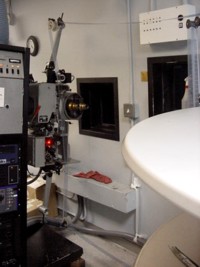
I must say though this has got to be the newest, cleanest, and most glamorous booth I’ve ever seen, I’d have taken pictures but the projectionist and manager there seemed a little suspicious of me.
Posted by Tim Reed (Member # 137) on 04-15-2005, 10:09 AM:
quote: Richard Greco
He said either the 5 or the 3 would be fine
Do you have an automation that doesn't delay 7 seconds before opening the douser or something? Otherwise, this sounds like someone who has never even been a projectionist before.
Posted by Cam Jones (Member # 2684) on 04-15-2005, 11:43 AM:
"He threaded up the platter first, but did not go over to the projector, just payout then straight to take-up (all done very fast). He then swiftly pulled some film over to the projector and threaded it real fast. That was it. Oh he did power up the lamp and run the motor for 5 seconds…. I guess to see if it was in frame?
How common is this practice?
"
Powered up the lamp eh? That's kind of strange. I'd run the motor to advance the slice to the proper location so the changeover would open at the exact right spot on the film but never run the lamp. You should be able to tell if the picture will be in frame or not without powering on the lamp!
Posted by Jannette McQueen (Member # 1885) on 04-15-2005, 12:10 PM:
quote: Cam Jones was the last to post
He threaded up the platter first, but did not go over to the projector, just payout then straight to take-up (all done very fast). He then swiftly pulled some film over to the projector and threaded it real fast. That was it. Oh he did power up the lamp and run the motor for 5 seconds…. I guess to see if it was in frame?
I knew someone who threaded like that, but it would only work well if (when you're facing the screen) the platter is on the right hand side of the projector. But never have I seen anyone fire up the lamp to check framing. That's why framing lights exist, and even if they're burnt out, you should have some kind of work light to be able to see something as obvious as framlines of a leader.
Posted by James R. Hammonds, Jr (Member # 673) on 04-15-2005, 12:13 PM:
Some people strike the lamp because they like to "warm up" the lamp before the show starts.
With good equipment, there is no need for it.
I agree that it shouldn't be necessary for checking your framing.
There should already be enough light available for that.
Did he thread without getting the film, on the floor?
If he didn't then his method is unacceptable.
I'm not really impressed with quick threading.
On the other hand, I can't stand very slow threading either.
Posted by Scott Norwood (Member # 30) on 04-15-2005, 01:45 PM:
In single-screen venues with xenon, I always strike the lamp(s) about ten minutes before the show (with the hand douser closed, of course). This allows the lamp to warm up (xenons do change color temperature over the first few minutes of operation) and also gives time to change a bulb or troubleshoot the problem if something goes wrong.
This isn't practical in a multiplex with automation, but I try to do it when running shows manually.
Does Richard have automation at his drive-in or is he running the show manually? If he is running the show manually, then there is no reason to motor the leader down ahead of time at all. That just puts unnecessary stress on the motor and gears. Advancing a few frames manually would be sufficient to verify loop sizes and platter feed/takeup.
Posted by David Graham Rose (Member # 1450) on 04-15-2005, 02:03 PM:
Greetings Richard
Was it you we saw across the pond here in the United Kingdom BBC televisual extravaganza that is 'The Office'?
David
Posted by Brad Miller (Member # 2) on 04-15-2005, 04:32 PM:
quote: Matthew Peters
Oh he did power up the lamp and run the motor for 5 seconds…. I guess to see if it was in frame?
Lemme guess, it was a Kinoton booth, right? For some reason the factory default is to burn the lamp anytime the motor is on. ![[Roll Eyes]](rolleyes.gif)
quote: Scott Norwood
If he is running the show manually, then there is no reason to motor the leader down ahead of time at all. That just puts unnecessary stress on the motor and gears. Advancing a few frames manually would be sufficient to verify loop sizes and platter feed/takeup.
Richard, listen to Scotty. Scotty knows!
Posted by Charlie Frisby (Member # 2927) on 04-15-2005, 07:33 PM:
Can i get a show of hand of who threads up backwards. I am quite curious.
Is it the professional way to do it, Brad?
We keep out carpet pretty clean but I would hate to think I am reasonable for getting film dirty.
We frame up on the six marker.
Frisby
*EDIT*
I guess i answered my own question Brad. I found this on the tips page.
- The proper way to thread-up is to thread the film through the rollers, bypassing the projector and lower magazine roller, all the way to the take-up platter. Then “thread-up” the projector literally. Start by sliding the film onto the lower magazine roller, being careful to keep back tension against the take-up platter so it will not come into contact with the floor. Then thread through the failsafe, soundhead, projector and finally any digital sound readers. One fair note of warning: learning to thread this way after years of the “old school” practices will be difficult and will take a week or two of practice. Once mastered however, will cut your threading time down by up to 50% without losing any accuracy.
[ 04-15-2005, 08:56 PM: Message edited by: Charlie Frisby ]
Posted by Matthew Peters (Member # 1495) on 04-15-2005, 11:33 PM:
quote: James R. Hammonds, Jr
Did he thread without getting the film, on the floor?
Nothing touched the floor. However the floor was literally “sparkling”. VIP ticket holders use the booth as a foyer, or depending on how you look at it, they use the VIP foyer as a booth.
As a customer I could have walked right over to the projector and done anything, - turn the volume on full blast – anything (not that I would). I asked them about that, only one incident he could recall. Someone just walked over to the projector and cut the film with a pair of scissors.
quote: Brad Miller
Lemme guess, it was a Kinoton booth, right? For some reason the factory default is to burn the lamp anytime the motor is on.
Looked like a Christie Package.
Posted by Brad Miller (Member # 2) on 04-15-2005, 11:45 PM:
Probably a Christie package with a CA21 then. The Christie breakout board couples the motor and lamp together too. Completely retarded! You have to wire around it to prevent that.
Posted by Monte L Fullmer (Member # 2797) on 04-16-2005, 02:37 AM:
quote: Charlie Frisby
Can I get a show of hand of who threads up backwards. I am quite curious.
..to be honest, I've never heard of this practice until I came here on FT and saw the "Threading Tips" in the "TIPS" section of a P35GPS shown being threaded backwards.
So, I took this curiousity of seeing if I can do this, only on a Simplex 1050/5 star layout. After a couple of tries with it and getting a system down on how much film to be had in the projector area to make the lower loop the right size on the first wack, it really isn't that hard to do-might be slower than lacing forward, but it still works.
Then, I showed the other MO's on this and see if they can lace a machine backwards, and some of them really had no probs with it, even on the first wack, where others say "No Way, Josay - too confusing".
But have to admit, it can tax the brain a bit in having to think backwards in doing things when you've done forwards for 35 yrs.
If I ever go back as a booth presentation manager at a huge megascreen complex, I just might make this policy for the booth operations of that complex. Right now at a discount house where I just work to keep a job and really have not that much say what goes on, I'm not going to change things around-just leave it alone. But I still, on occasion, lace backwards to keep in practice.
-Monte
Posted by Charlie Frisby (Member # 2927) on 04-16-2005, 12:19 PM:
Well last night after I posted, I threaded "up" our simplexs and damn. The first few caused a headach, and I somhow threaded it soundtrack in, but cought myself half way through. By number 8 I was knocken 'em down pretty quick, but no where near as fast as "cheating".
Maybe after a few weeks I'll be much better and our commercials much cleaner.
I really wish I had learned this way.
Posted by Manny Knowles (Member # 1171) on 04-16-2005, 12:47 PM:
I'm not criticizing anyone who threads backwards (i.e. bottom-to-top) but I tried it for something like a week and just could not get into it. Sure, I can do it but it doesn't feel right and -- what can I say? -- I approach projection with a certain amount of emotion and sensitivity.
So I simply have to start at the gate. Then I thread anything above the gate, followed by everything below it.
But, then again, I know how much film to pull so that I don't have a pile of "slack" on the ground. Once in a while a frame or two would "bounce" down and touch the floor while I was working but I also had really long threading leaders with nearly 60 feet between the threading segment and the first frame of picture.
Oh, yeah! The clothespin tip is a good one.
...That was when I worked in multiplexes with platters. These days I've been having lots of fun running changeovers and the leader never touches the floor. I use a technique that Scott Norwood showed me when I was in Boston.
(I'm sure he thought I was just looking at his ass the whole time but that wasn't the case. I was paying attention to what he was showing me. Thanks, Scott!)
Not that the leaders on these used prints are in mint condition -- hardly! -- but two "wrongs" do not make a "right." There is no sense in being a contributor to the demise of previously abused leaders.
But I digress! Getting back to threading practices...
Up or down, it doesn't matter to me -- as long as you're not damaging film. I'm sure we have some members here who are PERFECT LIKE ME and thread the "old" way without causing harm and then I'm absolutely certain there are those who do it Brad's way and still somehow manage to wreak havoc with their prints.
Posted by Charlie Frisby (Member # 2927) on 04-16-2005, 01:43 PM:
quote: Manny Knowles
I'm sure we have some members here who are PERFECT LIKE ME and thread the "old" way without causing harm and then I'm absolutely certain there are those who do it Brad's way and still somehow manage to wreak havoc with their prints.
So you are saying... dirty leaders do not damage flim...but dirty projectionist.
Hehe
Posted by Monte L Fullmer (Member # 2797) on 04-16-2005, 04:22 PM:
Course, the trick about lacing backwards, is to have the platter completely laced with the film forming a "square" from platter to upper guidance roller, then straight down to the bottom guidance roller then onto the platter's bottom roller.
Then, start from the bottom up, pulling the film from the payout platter, hooking the film across the lowest sprocket before the failsafe assembly, and the film going across the two bottom rollers never move and never touching the floor.
It's a twister for sure..lol
-Monte
Posted by Gordon McLeod (Member # 33) on 04-16-2005, 04:39 PM:
charlie said "So you are saying... dirty leaders do not damage flim...but dirty projectionist'
no it should read Dirty Minded Projectionists
Posted by Charlie Frisby (Member # 2927) on 04-16-2005, 04:46 PM:
EWWWW!
the possibilities *cough* PHIL *cough* *cough*, are endless.
Posted by Phil Blake (Member # 2012) on 04-19-2005, 07:04 AM:
I still thread up the same way I dis during the change over days.
Thread with 10 in the aperture , wind the film through the machine by hand to 7 and the automation starts it from there.
This ensures the film is sitting correctly in the path before the machine starts and leave enough film behind the gate to get everything up and running before the picture on cue happens.
Posted by Brad Miller (Member # 2) on 04-19-2005, 07:23 AM:
Phil, you might want to read the thread before responding because your response looks like you are replying after reading only the title of the thread, not the content. ![[Wink]](wink.gif)
Posted by Kevin Wale (Member # 1851) on 04-20-2005, 05:55 PM:
Lacing the projector has a bit to do with what projector it is too. Especially the sound head. 5 stars are great for threading bottom to top because if you have the intermittent in the propper position, and you have the swing arm in the center with the sound trap closed, you'll thread through the film trap perfectly every time. The older simplex soundheads don't work out quite that well. With those, I thread from intermittant out. Either way, I always engage the takeup deck with the film clamped in the bottom roller before I thread up, down, or otherwise around. lol. At that point, I start at the 9 and manually roll to the 8 except in the smaller 3 houses that are seemingly set at about 6 and a half seconds instead of 8. The less you have to crank the rack when you start up, the better the loops will stay thier propper size.
The biggest problem at our booth is the carpet. Even clean carpet is filthy in terms of particle on the film.
When you get used to at least latching that bottom sprocket Frisbie, you'll notice that the film cleaner will last longer, as will the media pads because they are not having to clean the leader dirt off every time they make thier way back to a print.
Wish I could be to see how you like it but alas, I'm victim of the ol cost cutting bug for the first time in my career.
Posted by Charlie Frisby (Member # 2927) on 04-21-2005, 02:49 PM:
It is a pain at times, but after a few runs (with FG) i noticed less dirt on the b/w american express comercial.
Posted by Kevin Orman (Member # 3076) on 04-24-2005, 07:54 AM:
Ha! Believe it or not I was actually 'taught' to lace up in this way - piles of spacing/leader on the floor. I was also 'taught' that the easiest way of untangling a leader to re-attach it when packing-off was to literally throw the leader across the room so that the leader straightened itself out across the floor and you then wound it onto the MUT dragging all the dust from the floor with it! I really was shown that way!
Okay, relax, I very soon realised through reading film presentation manuals (oh and common sense) that this was a poor idea. This was back in the 80's before FT!
My policy since then has been that nothing touches the floor - intentionally at least.
The procedure I used with a colleague with a Vic 4 and Christie AW3 was the same as described in FT tips. The variation we had though was that we used a large 'Bulldog' clip (one of those large sprung paper clips used on noticeboards etc). This clip was screwed onto the bottom roller bracket on the Vic 4 where the film makes it's return run to the platter.
Lace-up was:
From feed platter to take-up platter first.
A 'loop' of spacing was then taken towards the projector and the bottom run of film was then clipped preventing any slack film from reaching the floor.
Enough film was then pulled from the feed to lace-up the machine.
When lacing was complete the film was 'un-clipped' from the holder and pulled enough to activate the take-up platter until all excess was taken up. Nothing on the floor and no slck film to worry about.
Posted by Monte L Fullmer (Member # 2797) on 04-24-2005, 06:47 PM:
That's a good one on how to prevent film contact on the floor. I remember seeing in those Kodak bulletins of some users having boxes or trash cans lined with new trash can liners and positioned between the platter and projector, especially where the platter was MILES away from the machine (never could figure out why some booths have the platter this far apart from the machine even when the platter can be much closer...go figure...).
Yet, I still know of some operations that still pile the leads on the floor, then take the lead to the platter after lacing up the machine.
I agree: back in the early 80's, I've seen this practice done as a common practice-piling up the leads on the floor, lace the machine then finishing up to the platter (and another common practice then was using white opaque tape and "baby powdering" these splices to get rid of the stickiness..who ever heard of using clear to join reels..????..another "go figure" thing).
-Monte
Posted by Mike Blakesley (Member # 26) on 04-24-2005, 10:49 PM:
We do the wastebasket-with-clean-liner thing. Although I am also capable of holding all the leader in one hand while I'm threading and keeping it all off the floor. I've tried the threading "up" routine a few times and can't get the hang of it. I guess I've been doing it the other way too long to change. As far as I'm concerned, keeping the film off the floor (and in frame) is the prime important thing no matter how you thread.
Posted by Monte L Fullmer (Member # 2797) on 04-25-2005, 04:06 AM:
quote: Mike Blakesley
I've tried the threading "up" routine a few times and can't get the hang of it....
Hey Mike, you've got the same machinery that I have, except I have the 1050's were you have the 1014("XL" head) with the 5 star below.
..and these are the same machines that I "reverse" thread with. Trick is to lock the film over the sprocket in the soundhead, then think backwards...not that all hard.
-thx Monte
Posted by Kevin Orman (Member # 3076) on 04-26-2005, 09:30 AM:
Over this last weekend I had to show an occasional projectionist (for the film club that uses our equipment) how to thread-up the recently installed Vic 5. He was about to do the pile-of-film-on-the-floor method when I (as politely as I could!) stopped him and said "I always go from spool to spool first to avoid film touching the floor" (this is with a long-play tower with 12,000ft spools). He was thought that was a great idea and it had never occurred to him before!
It just shows really the importance of sites like Film-Tech in helping people to find better ways of doing things by sharing knowledge.
By the way he is a terrible projectionist and should never be let near film in my opinion but that's another story! Actually, maybe he is only a terrible projectionist because nobody has ever shown him the 'correct' way of doing things.
Posted by Randy Stankey (Member # 64) on 04-26-2005, 01:15 PM:
quote: Kevin Orman
Over this last weekend I had to show an occasional projectionist (for the film club that uses our equipment) how to thread-up the recently installed Vic 5.
You let OTHER PEOPLE use your equipment?! ![[Eek!]](eek.gif)
Our policy is that the ONLY people to operate our equipment are me and my designates. My work studies are perfectly capable of operating the projector without damaging film. If they have questions, troubles or find them in a situation where they are not 100% sure of what to do they call me on my cellular.
If somebody has a question about security or how film gets handled they are welcome to send a representative to the booth. That person will take up a position on a stool in the corner of the booth, somewhere and KEEP HIS HANDS IN HIS POCKETS!
If that person wants the film handled (or not handled) in a certain way I will listen to them insomuch as their directions don't cause damage to the equipment.
When it comes right down to it, if somebody wants access to the projector/booth they have to go through ME. If they don't like that they can go pound salt!
Posted by Brent Burkett (Member # 3120) on 04-26-2005, 02:44 PM:
quote: Monte L Fullmer
That's a good one on how to prevent film contact on the floor. I remember seeing in those Kodak bulletins of some users having boxes or trash cans lined with new trash can liners and positioned between the platter and projector, especially where the platter was MILES away from the machine (never could figure out why some booths have the platter this far apart from the machine even when the platter can be much closer...go figure...).
Yet, I still know of some operations that still pile the leads on the floor, then take the lead to the platter after lacing up the machine.
I agree: back in the early 80's, I've seen this practice done as a common practice-piling up the leads on the floor, lace the machine then finishing up to the platter (and another common practice then was using white opaque tape and "baby powdering" these splices to get rid of the stickiness..who ever heard of using clear to join reels..????..another "go figure" thing).
-Monte
I started working for a theatre here in SC in 1998. When I was trained in Proj later that year, the only method they taught was to thread to proj, pile into floor, then to rewind/take up.
I always wondered how much crap go onto the film, but some of our projectors have the platters on the wrong side to just be able to bring the loop around to the proj after threading platter to platter. Those proj's have flex conduit running to the wall that prevent you from threading that way unless the platter is on the right side of the proj.
Posted by Monte L Fullmer (Member # 2797) on 04-26-2005, 03:05 PM:
Here's one thing to think about of operators who pile leads on the floor then to the platter: If one knows a bit of physical science, especially the science of capillary action. It's like putting a drop of water on a flat surface and laying a piece of tissue paper on that drop of water. We notice how the water spreads across and through that tissue-to be almost ten times the size, in diameter, of that drop of water.
Now, we take that leader that has been laying on the floor, which is dusty and maybe oily from being soaked to death from Simplex machinery (why I like Christies....) and operators who doesn't "clean up after their messes", take that leader, lace it through the machinery and then around the ring to the takeup deck. That oil/dust that is covering the leader, being wound tight around that ring, will actually SPREAD into the film due to the same capillary action mentioned above.
You do this practice for a few weeks on the same movie, and I'll almost guarantee that the first part of that print will be oily, machinery will be slightly worn down due to the extra contaminants on that leader acting as 35mm 200 grit sandpaper...and your floors will be much cleaner up by "mopping" the floor with that leader.
...something to think about. - Monte
Posted by Brent Burkett (Member # 3120) on 04-27-2005, 12:45 PM:
Oh, I completely agree. But as I forementioned, some of the projectors at our theatres where installed with the platters on the left of the projector (century projectors) And there are flex conduits or dts/EX readers on top with cables going straight forward to the wall, making it IMPOSSIBLE to just move the loop from platter to platter to the other side of the projector. I guess you could thread the head of the leader to the top of the projector, move to the other side, thread straight down to the bottom projector roller, then move back to the rear and finish threading to the platter. Then you could thread the projector. These machines where just installed with poor planning when you get right down to it. Five of our eight projectors have the platters on the back/left side/gear side of them. Is this really uncommon? Or was the poor design of the cables/conduit the downfall? Two of the five share a Five tier potts platter system with another projector, though, so moving those to the other side of the projector isn't an option.
Posted by Manny Knowles (Member # 1171) on 04-28-2005, 02:43 AM:
Instead of hauling wads of leader back-n-forth, I simply pull the leader through the payout head carry it over to the projector, back to the platter.
Posted by Monte L Fullmer (Member # 2797) on 04-28-2005, 03:14 AM:
Platter transport to the left of the machine/console is called "gear side" platters, and the opposite is called "operator, or driver's side" platters.
Lot of theatres uses the "gear side" for the sake of having a open path from machine to operator so the operator isn't going to get himself all tangled up in the film coming overhead and down by his feet.
The obvious advantage of the "drivers side" platter is that if there is a mis-start or have to make a sudden shutdown, one can spin around and immediately grab the platter deck before the film wants to do nasty things and make your life miserable for the rest of the day..(unless that platter is 'miles' away from the machine...then you're seriously screwed in any case...lol..)
If you have such a messy wiring configuration at that theatre, and with "gear side" platters, take your leads over the top guidance roller, then feed the leads down across the front of the machine and reach under, when you see the end of the lead and grab the head of the lead then pull it back to the platter. This, what I call, a "square" threading configuration - being the thread path is in the square shape.
I use, what I call, the "triangle" load being that I don't go down to the lower guidance roller but grab the lead and bring it straight down to the lower roller on the platter tower.
Now, if you're going to reverse thread, one must do the "square" load so to keep the leads hitting the floor.
thx-Monte
Posted by John Hawkinson (Member # 1135) on 04-28-2005, 04:15 AM:
![[uhoh]](graemlins/uhoh.gif) The side opposite the operator's/operating side is known as the "driving side" or the "drive side," because thats where the gears that drive the projector are. I don't think it's advisable to use the term "driver's side" -- its too confusing.
The side opposite the operator's/operating side is known as the "driving side" or the "drive side," because thats where the gears that drive the projector are. I don't think it's advisable to use the term "driver's side" -- its too confusing.
(See, for instance, the Century C manual, for examples of this terminology).
--jhawk
Posted by Monte L Fullmer (Member # 2797) on 04-30-2005, 02:05 AM:
Where "driver's side" came from was from one of my operator's where I was projection manager.
...aren't we "driving",or operating a projector?
-Monte
Posted by Brad Miller (Member # 2) on 04-30-2005, 02:21 AM:
I fail to see why "operator side" and "non-operator side" isn't easier and less confusing.
Posted by Monte L Fullmer (Member # 2797) on 04-30-2005, 02:44 AM:
..maybe less syllables to speak...using a simple visual term (gear, and operator's side), easier words to use (for the high school trainees and the MO's..) and still want to get the message across..
..just personal preference that I've used and trained with.
-thx Monte
Posted by Manny Knowles (Member # 1171) on 04-30-2005, 05:32 AM:
I usually say "gear side" and "operating side."
Posted by Richard Greco (Member # 2032) on 05-01-2005, 02:30 AM:
My tech told me last week that in the Chicago Union houses, changeovers btw, that they would thread the leader from the top reel, to the floor, thread the projector, and then take up whats on the floor on the bottom reel.
He also says that it doesn't matter if leader gets dirty or not. It won't go on the film.......HE says. Not me. Anyways, thought you'd like to know.
Posted by Monte L Fullmer (Member # 2797) on 05-01-2005, 02:35 AM:
...Going back to "reverse threading" - This time for the owners of the Simplex/5-Star configuration:
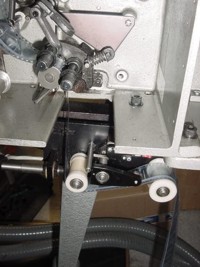
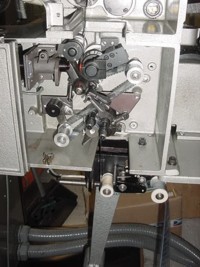
I took the liberty of taking some pictures at the theatre that I work at and share with those who seems to have the 'all thumbs' syndrome in figuring out how to lace one of these monsters up backwards.
1 - lace the film as such from platter to machine and back to platter through both upper and lower guidance rollers. This example is with the "operator (driver's) side" system layout, and do the same for the "gear side" system layout as well.
2 - lace the film through the failsafe, then around the lower holdback sprocket and close the pad roller assembly.
3 - lace the film around the snub roller, the front roller, around the scanner drum, lock the pressure roller, then around the middle constant speed sprocket and lock down the pad roller assembly.
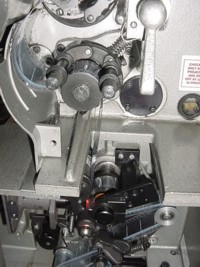
4 - with the intermittent sprocket locked, lace the trap. If the sprocket is locked and when you frame in the trap, the lower loop is automatically set to size, so no adjusting is needed.
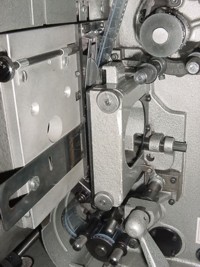
5 - With trap closed, then make your upper loop, close the pad roller assembly and finish off with the digital readers, if applicable.
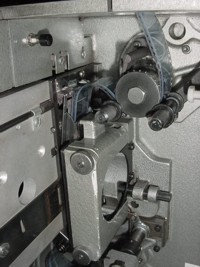
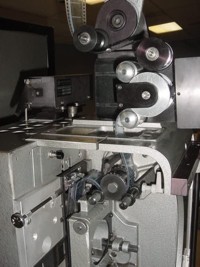
Give this a whirl. Granted, this can be confusing at the first, but with a few more tries, one can almost make this practice as second nature.
thx-Monte
Posted by Brad Miller (Member # 2) on 05-01-2005, 04:30 PM:
One correction there Monte...
quote: Monte L Fullmer
1 - lace the film as such from platter to machine and back to platter through both upper and lower guidance rollers. This example is with the "operator (driver's) side" system layout, and do the same for the "gear side" system layout as well.
No, do not do this. Make a triangle out of the film when threading the platter by BYPASSING the lower guidance roller. When you run through that roller, you almost always end up bouncing the film across the floor. The film should be put in that lower roller only right as you are threading the failsafe/clamping the film to the holdback sprocket. Watch as someone threads like that and you will see what I mean...the leader almost always hits the floor when that lower roller is used.
quote:
My tech also says that it doesn't matter if leader gets dirty or not. It won't go on the film.
Richard, you might as well stop bothering to quote your tech. It's painfully obvious to everyone reading these forums that he is a certified F'ing moron with those kind of instructions and attitude towards quality presentations.
Posted by Monte L Fullmer (Member # 2797) on 05-01-2005, 07:50 PM:
quote: Brad Miller
Make a triangle out of the film when threading the platter by BYPASSING the lower guidance roller
That'll work as well. Thx for the help.
Thx-Monte
Posted by Scott Norwood (Member # 30) on 05-01-2005, 08:16 PM:
quote: Richard Greco
My tech told me last week that in the Chicago Union houses, changeovers btw, that they would thread the leader from the top reel, to the floor, thread the projector, and then take up whats on the floor on the bottom reel.
He also says that it doesn't matter if leader gets dirty or not. It won't go on the film.......HE says. Not me. Anyways, thought you'd like to know.
Remind me not to go see movies in Chicago. Is it really that much trouble to hook the film into the takeup reel and wind the first bit of leader onto it (or loop excess leader on the lamphouse douser handle) before threading? Not only does it get the leader dirtier, but it also means threading the outermost (=dirtiest) part of the leader through the projector, thus getting more dirt than necessary inside it. ![[Mad]](mad.gif)
I've never seen or heard of anyone doing something this dumb in any type of booth.
Posted by Monte L Fullmer (Member # 2797) on 05-01-2005, 08:47 PM:
quote: Scott Norwood
I've never seen or heard of anyone doing something this dumb in any type of booth.
...True as always. Yet, when I started in this projecting field back in '69, I was taught this way-to let the film pile on the floor, lace the machine up then secure the end to the takeup reel.
During this time, I began to visit other booths of small single screeners and noticed the operators doing the same as above-piling the leads on the floor.
It wasn't shortly afterwards that I began this trait of after pulling the lead from the supply reel, secure the end to the takeup reel and have enough leader to lace the machine up, thus keeping the lead off the floor.
Then I went to work in a union house where the operators would actually take the lead, pull down the lead and gather the rest of the lead in hand. Then while holding onto this handful of leader while lacing up the machine, then he would secure the end to the takeup reel. Another way to prevent leads of being on the floor. Course, when I operated, I did the secure the end first on the takeup reel then finished the lace as mentioned above.
If this tech that is working on Richard's drive-in, has any credentials of sorts, I wonder what the rest of the theatres that he services are like (but be a nightmare to witness though...)
Posted by Mike Blakesley (Member # 26) on 05-01-2005, 09:49 PM:
quote: Monte L Fullmer
when I started in this projecting field back in '69, I was taught this way-to let the film pile on the floor, lace the machine up then secure the end to the takeup reel.
Same here. I originally learned from two different guys (at the indoor and at the drive in) and they both did it the same way. Both of those guys are now out of the business.
Film-on-the-floor... That's one bad habit I'm happy to say I ditched even before I found Film-Tech.
Posted by Phil Hill (Member # 371) on 05-01-2005, 09:55 PM:
quote: Manny Knowles
I usually say "gear side" and "operating side."
Ya know Manny...that's the stupidest thing I have EVER heard! How do yous refer to a Christie or a Ballantyne or a Kinoton? I totally agree with Brad and the other professionals:
quote: Brad Miller
I fail to see why "operator side" and "non-operator side" isn't easier and less confusing.
Posted by Monte L Fullmer (Member # 2797) on 05-01-2005, 10:18 PM:
quote: Phil Hill
How do yous refer to a Christie or a Ballantyne or a Kinoton?
..I can see your point, Phil and Brad.
But, of course, belts, enclosed mechanisms and chains are actually newcomers to the world of the gear driven machines of Powers, Brenkhert, Motiograph, Century and finally Simplex. (whoops, forgot about those chain driven DeVrys..lol)
Being raised with some of these old "fellers," comes the 'gear side' and 'operating side' terminology that I've been accustomed with.
thx-Monte
Posted by Phil Hill (Member # 371) on 05-01-2005, 10:52 PM:
That's all well and good. But ya gotta drop the old, living-in-the-past stuff and get with modern times.
The young, up and coming kids deserve to know all the correct terms (and procedures) to know how to address and ask the proper questions so as to learn the craft from us old farts.
Posted by Monte L Fullmer (Member # 2797) on 05-01-2005, 11:08 PM:
I agree very well also, Phil.
Yet, I've been chastized for my "old fart" style in this new fandangled team oriented world we're heading into. Chastized from the management that my styles doesn't parlay into this form of operation-the "kids" need to be told what to do on a continual basis and that's it.
Be a baby-sitter.... ![[Shrug]](graemlins/shrug.gif)
Yet..... it be kinda fun to show these "kids" how to work a changeover booth with the old equipment and carbon arcs-learn how to read cue dots to do changeovers correctly, clean out a lamphouse, do bench inspections, wet splicing..being "cooped" up in a small booth with no air conditioning throughout the entire 6hr shift, et.al.
They wouldn't forget about this at all.
thx-Monte
Posted by Alan Dallas (Member # 2537) on 05-02-2005, 03:50 AM:
Kinoton Heads - Easiest to lace "up". Seriously. I do the "Triangle" like mentioned in the Tips here. A triangle as in the leader thats tree'd up looks like a triangle if you step back and look at it. Actually I was trained by the previous lead booth manager to do it that way who was trained by our assigned Tech. before reading it here.
Our GM on the other hand still can't get the hang of threading from bottom to top and still traps the film in the gate first after running to and from the AW3. Kinda comical really. I can generally thread 3 out of the 14 we have every 5mins. Takes him a bit longer. We also have "No Leader/FILM on the floor!!" policy.
"Mr. Dallas! Number 8 starts in 2 mins and it's not threaded!" "Ya so whats your point?" ![[Big Grin]](biggrin.gif)
Posted by Monte L Fullmer (Member # 2797) on 05-02-2005, 04:00 AM:
Actually, I do the "triangle" as well, but with my pict tutorial, I went to the "square" load for simplicity's sake. Even with either one, leads don't hit the floor-especially with the Simplex "oilers".
When I started at EDWARDS, I had to forget the "square" since they showed me that the "triangle" was a better loading format-and that was with all of the 21 machines having "gear side" platters.
-Monte
Posted by Manny Knowles (Member # 1171) on 05-03-2005, 10:30 PM:
quote: Brad Miller
Richard, you might as well stop bothering to quote your tech. It's painfully obvious to everyone reading these forums that he is a certified F'ing moron with those kind of instructions and attitude towards quality presentations.
[prick mode]
Brad,
I think you're coming down awfully hard on someone after hearing only one side of the story...and from someone you really don't know.
Richard mentioned in another thread that his current tech used to be my tech in The Bahamas. I can assure you that my tech was not a moron.
After reading Richard's recent posts about his tech, I decided to give my former tech a call to find out if they were indeed one and the same. Yes, my former tech is now the tech at the drive-in where Richard works. He and I spoke about this situation and, of course, I got the story from a markedly different perspective.
Call me a moron, but I would agree that it's pointless to worry about whether the threading leader touches the floor when there is the bigger problem of having a drive-in booth with no port windows. It seems pointless to fuss over the leader when dust from the unpaved lot and rain are coming through the port hole and ruining actual prints. I would also agree that it might be a worthwhile endeavor to sweep and mop the booth floor once in a while so that *if* the leader *did* happen to touch ground that it wouldn't be the end of the world.
And what's the point of worrying about the floor when the gates are a filthy mess?
Perhaps I will add this theatre to my inspection survey. I hear they're really getting the hang of threading in frame, now that they've had some training.
[/prick mode]
Posted by Brad Miller (Member # 2) on 05-04-2005, 12:30 AM:
[prick mode]
Manny,
If Richard is directly quoting something his tech said, then that is PATHETIC! If Richard is mis-quoting something his tech said, then his tech should get it straightened out.
I don't know this guy, and Richard has never mentioned a name. While I do agree with you that if everything in the booth sucks (such as filthy projectors) the leader on the floor doesn't matter much, however the point here is that anyone giving such intentionally shitty training ("it doesn't matter") deserves to be outed as a certified moron.
[/prick mode]
Posted by Richard Greco (Member # 2032) on 05-04-2005, 12:36 AM:
I should tell you Manny, the gates have gotten MUCH better recently. But you are right, I'm not thinking from his POV. In his eyes, it doesn't matter much because of the poorly built booth (e.g. portholes, dirt on the field, etc)
Posted by Brad Miller (Member # 2) on 05-04-2005, 12:38 AM:
Do everyone a favor Richard. The next time you see him ask him if his reasoning behind the leader on the floor was a general opinion, or because you are apparently working in lousy booth conditions. His answer will help calm Manny's nerves and possibly something you should edit into your quotes. Don't assume.
Posted by Manny Knowles (Member # 1171) on 05-04-2005, 01:09 AM:
quote: Brad Miller
the point here is that anyone giving such intentionally shitty training ("it doesn't matter") deserves to be outed as a certified moron.
I'm told that those booth operators can now thread in frame, thanks to the "shitty training." Reportedly, nobody at that location knew about clearing the intermittent before threading.
My point being that people in glass houses should not throw stones.
I can't wait to be in Florida again. Summer vacation is so close, I can taste it.
Posted by Brad Miller (Member # 2) on 05-04-2005, 01:28 AM:
Anyone training people that it doesn't matter if the leader is permitted to touch the floor IS providing shitty training. Sorry Manny, but it doesn't matter if the guy is a friend of yours or not. By telling Richard that it is perfectly acceptable to practice poor film handling skills without stipulating something along the lines of "because this booth is such a dump, etc" is doing a shitty job.
You should know the difference.
Posted by Monte L Fullmer (Member # 2797) on 05-04-2005, 02:08 AM:
quote: Brad Miller
".....that it is perfectly acceptable to practice poor film handling skills without stipulating something along the lines of "because this booth is such a dump, etc"...."
..and that's really a poor excuse that one has ever heard. Blaming something/someone for the results.
...and unfortunately, this happens almost everywhere, for I've seen very sloppy booth procedures, even though the manager of that cinema KNOWS of the proper procedures, but doesn't CARE if he practices them or not. Just that the machinery/theatre is OLD and somewhat outdated.
...and if the manager doesn't care, the "domino effect" is in practice: He doesn't care, so why should others under that manager doesn't care as well....
Then the machines are a mess, the booth looks horrible, I fight to get this all straighten up and it's like fighting against the current of a raging river, especially when the ones responsible doesn't care....
I can really see the side of that tech's response of telling Richard his thoughts on booth operations. He's possibly seen what I mentioned above and has probably quit fighting against the stream in this area, plus it's not his booth..so why should he care....
Yet with Manny's explanation of this fellow, he IS probably that tech that Manny has mentioned and Manny acknowledges his attributes as a tech to the letter.
Yet, the tech did a big no-no in mentioning these sort of things (like piling the film on the floor, et.al.) and say "either way was okey": for people like Richard (no offense) who is basically a newcomer of sorts to the business could easily take these comments and quotes as gospel for legal practice. (blind leading the blind, so to say...)
Plus, comments by the tech that IS practiced by the staff operators at any complex is also a big no-no, for it causes conflict with the management of that complex with his training procedures.
He is just the "sound guy" - find the problem. Do the fix. Make sure the fix is good and done. Get the FRIK out of there after the bill is collected.
The tech, no matter who he is, private or corporate, NEEDS to set the example of a professional serviceman-a serviceman who knows how things are to be conducted in a professional manner-so others can follow his example.
For if he sets an example, as the case above, in a certain way, either he'll be praised, or condemned for his actions.
Yet, Richard knows more as times goes on.
-Monte
Posted by John Pytlak (Member # 331) on 05-04-2005, 05:50 AM:
quote: Brad Miller
By telling Richard that it is perfectly acceptable to practice poor film handling skills without stipulating something along the lines of "because this booth is such a dump, etc" is doing a shitty job.
You should ALWAYS keep film and leader off the floor, whether the floor is spotless or filthy. Films with conductive antistats like Kodak VISION Color Print Film no longer attract dirt from a distance with static charge, but if they touch the floor or a dirty work surface, they can get dirty.
Film handling technique is probably the most important aspect of "Film Done Right".
Posted by Manny Knowles (Member # 1171) on 05-04-2005, 12:48 PM:
You guys astound me. Bash the tech and defend the projectionist who can't thread reliably, leaves a brand new splicer on a platter and lets it spin off onto the floor so it doesn't work anymore and doesn't sweep or mop his booth floor. But his leader doesn't touch the ground. Film done right.
I get it.
Carry on.
Posted by John Pytlak (Member # 331) on 05-04-2005, 12:59 PM:
No one here is defending bad film handling or bad maintenance or bad operators. The bottom line is that you need to do all that is within your power and responsibilities to "Do Film Right". Keeping the film off a dirty floor is a good start, but only a start in what seems to be a bad situation. The important thing here is to fix what is wrong, and keep improving.
Posted by Richard Greco (Member # 2032) on 05-04-2005, 01:00 PM:
First off Manny, My tech doesn't know diddly squat about what happened to that splicer and it pisses me off that he still doesn't believe that I didn't put the splicer on the platter. I had it on the MUT during teardown and it fell from there. It was an accident. Also, it is swept every other day, he doesn't know that. Also I clean my machines daily, he doesn't know that. I also check my oil daily.There are things he doesn't know and tells my higher ups about and they only believe him.
Also, I CAN thread reliably. I have never had a problem threading there.
Did he tell you that, no! My other idiot projectionist can't thread right. I am always in frame. I RARELY have a show go down (only when a machine breaks down, not from a film error.
Posted by Rachel Gilardi (Member # 1016) on 05-04-2005, 01:05 PM:
I have been reading this thread from the beginning and you guys ALL astound me.
This thread started out as a question of common and correct practice. Why does anyone, projectionist or tech, have to be bashed? It is obvious that someone or multiple someones in this situation are not correct but no one is perfect, I know I do my best to keep my booth clean but as Scott N. can attest to, its not even close to perfect. The floor needs to be mopped, we need new equiptment (horribly bad), and it would be nice if my projectionists listened to me and just brushed down the projector when threading up as normal practice, etc. My point is, no one is perfect.
At least Richard has the common sense to ask people for help, why is he being bashed for it? And as for the tech, like Manny said, he isn't here to tell his side of the story, who knows if Richards account of what the tech said is actually correct? Why not just answer the question and quit the bashing? Let's just put it this way, someone is incorrect and we'll do our best to try and fix it.
Well, thats my thought anyway.
Posted by Jeremy Fuentes (Member # 2135) on 05-04-2005, 01:28 PM:
Maybe Richard or Manny can tell the tech in question to come to Film-Tech and tell his side of the story, and we can get this cleared up. Or the owner can come and explain why there is no cover on the port window. Its really not fair to bash someone who isnt here to defend themselves. Trust me, I've made that mistake here, I felt like an idiot later on for doing it.
Posted by Monte L Fullmer (Member # 2797) on 05-04-2005, 01:46 PM:
quote: Richard Greco
"....There are things he doesn't know and tells my higher ups about and they only believe him...."
... called "shit rolls downhill" ... and if you're in the path, you get rolled over in it as well.
Been there and done that and it ain't fun being "stunk" upon.
-Monte
Posted by Manny Knowles (Member # 1171) on 05-04-2005, 02:34 PM:
Well stated, Rachel.
Jeremy, I have suggested that many times over the past few years since I've known him but, for whatever reason(s), he chooses not to post.
I lurked a long time before posting because I didn't trust the internet. I also remember being very nervous about having my photograph on the site. Meeting fellow Film-Techers at the Dolby training was weird and I remember having a small panic attack the first time I went to Dallas to meet Brad and the gang.
But under these current circumstances -- Brad called him a moron who needs to be "outed" and almost everyone else is siding with Richard -- I would not blame my friend for staying away. He'd be walking into an ambush situation.
Posted by Scott Norwood (Member # 30) on 05-04-2005, 03:28 PM:
Is it possible that the guy is an electronics wizard and a great technician, but a lousy film handler? That's not necessarily a problem, since he's not a regular operator.
Rachel--bug me sometime when you aren't busy and I'll show you at least one booth where you could (literally) eat off the floor. I'll also show you some others where you couldn't! ![[Smile]](smile.gif)
Posted by Rachel Gilardi (Member # 1016) on 05-04-2005, 04:11 PM:
Scott,
I've already shown you 3 booths where you wouldn't want to eat off the floor... but you could in my lobby! I just can't seem to get the guys upstairs to do what I ask...Sad but upstairs isn't my specialty, I know it.
Posted by Manny Knowles (Member # 1171) on 05-04-2005, 07:46 PM:
Scott, he's not a lousy projectionist. Let's not be so quick to pass judgement before we have all the facts.
My "idiot tech" began his film career at White Sands missle range in the early 60's working on high-speed instrumentation photography (something insane like 50,000 fps). Finished out with some work on the SR-71 before beginning a career in Chicago where he made thousands of service calls for a host of theaters throughout the midwest and directed/supervised film chain maintainence for WLS-TV7 and WMAQ-TV5 Chicago. Maintainence lead for 90 camera security system for Federal Reserve Bank Chicago. Designed and built the first FM stereo transmitter for a drive-in in West Chicago Illinois, called the "Cascade DI" in 1976. Installed mulitplex theaters in dozens of foreign countries. Designed and installed 35mm special venue automated projection systems for the US government from Alaska to Maryland to Kanahoe Bay Hawaii. His contractors include, The United Arab Emerits, Peoples Republic of Korea, US Air Force, Marine Corps and Navy. He is also THX certified for installation and recertification and has had dinner with George Lucas in his residence.
Like any of us, I'm sure he has his faults.
I'm really disappointed that several of the people who post here are so quick to point fingers and call names when I have personally witnessed these self-appointed experts having film "walk out" of their projectors, missed changeovers and, let's not forget the cleaning of moving intermittents with toothbrushes and setting of moveable masking with pure white light.
I wonder how many of us could run a print of "Star Wars" (for instance) for over a year without needing replacement reels, like my friend did. In all honesty, I'm not sure I could. (Actually, I did pretty good job keeping my "Titanic" print in great shape for nearly a year and I'm sure this will instigate posts about how everyone has returned a print in excellent condition after some insanely long run.)
The point is that a person has to do a whole lot more than let leader touch floor before they enter the realm of what I would consider a "lousy" projectionist.
Finally, whether that splicer was flung off a platter or fell off a MUT is irrelevant. Splicers don't just fall to the floor by themselves. This "accident" was borne out of carelessness. As far as I know, they don't have earthquakes in Florida...
(Fired.)
Never mind that...my REAL question is this:
Why would a competent projectionist need to take employment at one of Florida's crappiest drive-in theatres?
Posted by Monte L Fullmer (Member # 2797) on 05-04-2005, 07:54 PM:
..with all of these replies pertaining to the subject that Richard has opened this topic with, with all of the yay's and nay's of operating procedures, in which all is right from all parties, it's just how one want's to operate their booth.
Big thing that really stuck out on this is from the first comments that Richard made when he saw that tech thread the system which was different that what Richard knows and how to do.
Okey, the tech did and said things different than what we know and do. Okey, THAT should have stayed there in that theatre and that was that-not to be "broadcasted" out to this forum and "stirring up the pot" so to say with statements.
One thing about these forums is that there is a definite level of standards that the majority of these members are achieving and have set these goals as high standards of operations. Which is also great and fine.
Thus, when a member enters into this forum a comment, that member should be careful on what to present, for if a comment or topic is presented in a level below these standards that is acertained here, that member should expect some sort of rebuttal on that topic - like the huge blowup on the usage of opaque tape that went way overboard a few months back-even though the individual that presented this topic was presenting a simple discussion (and I'm sure that the individual that presented this topic is still using opaque tape..for example's sake).
If the topic, which is once again below these standards, is in a question form where there is room for improvement and gaining knowledge, then absolutely no problem with this, for that's what we are here for-to help ones to acertain these standards. Just don't drag in someone else's sub-standard procedures into that question-leave them out completely. That doesn't help things out at all when topics include what the other person does.
Thus, for a recommendation to Richard: If you see anything out of the ordinary, and like Brad has mentioned.."to edit and not assume.." be more careful and present topics that doesn't demer other individual's operating procedures, from the manager to that technician. Present factual information that one need's help on or has a question on. Not, just "well, this is what he did/does," sort of thing.
For all it causes is rile statements from members of this forum against that/those individual(s) and it can make Richard look kinda foolish as a "troublemaker", or "is he's rocking the boat?" especially if his higher up management people knows about FT, read his posts and thus could jepardize his occupation at that drive-in.
thx-Monte
Posted by Phil Hill (Member # 371) on 05-04-2005, 08:10 PM:
Ya know Monte, your posts are the best example of gobbledegook I have ever read!
Yours in Christ,
>>> Phil
Posted by Manny Knowles (Member # 1171) on 05-04-2005, 08:15 PM:
What? You didn't get the secret decoder ring? ![[Razz]](tongue.gif)
Posted by Monte L Fullmer (Member # 2797) on 05-04-2005, 08:19 PM:
(LOL)Thx for your vote of confidence, Phil.
It's just that I fell into the same situation that Richard did and almost lost my job when I was younger.
-Monte
Posted by Jeremy Fuentes (Member # 2135) on 05-04-2005, 08:29 PM:
quote: Manny Knowles
several of the people who post here are so quick to point fingers and call names
Manny, you do realize you are one of these people dont you? I've never seen your technicians work, but I have to agree that leader on the floor is sloppy for anyone, especially a tech. You've never seen Richard's presentation, but you assume he's a careless operator because of an accident involving a splicer. Someone accidentally dropped a splicer, your tech(who seems like an experienced tech) purposely lets leader touch the floor. I'm not taking sides here, I mean I dont drop splicers or let the leader touch the floor, but I've threaded out of frame before. Damn, I guess I'm sloppy.
Posted by Scott Norwood (Member # 30) on 05-04-2005, 09:06 PM:
Manny--I'm not perfect. I do run the motor when cleaning the machines and I have also been known to set masking while running white light on the screen for a minute or so. Neither of these habits would meet with Brad's approval, but they work for me and they /don't damage film or equipment/. I'm not sure about your other points, but I assume that they don't apply to me, as I didn't miss changeovers when you visited, nor were there any mishaps.
If you really think I suck, that is too bad. There are plenty of people (both on and off this forum) who think that I am perfectly capable of handling film without damaging it or the equipment. In any case, this is a hobby for me anyway, not a full-time career.
The points that I attempted to make were a) all other things being equal, film will stay in better condition if it does not touch the floor and if the outermost (=dirtiest) part of the leader is not run through the projector and that b) it's perfectly understandable for a full-time technician to not be as good a film handler as a full-time projectionist.
Obviously, I haven't met Richard or this other guy, nor am I familiar with the particular circumstances in question. I don't really care, either. I do think that the point being made in this thread ("keep film off the floor") is valid, however.
Posted by Manny Knowles (Member # 1171) on 05-04-2005, 09:11 PM:
1. Jeremy, you're wrong and you should admit it. I used specific examples without resorting to name-calling. In all of this my point has always been that we should not be so hasty to judge a person or situation. I brought up the point about other people's mistakes as a reminder/illustration that none of us here is perfect.
2. I don't think you suck, Scott. I'm grateful for some of the tips you gave me -- one of which happened to be how to keep leader off the floor when threading changeovers. Now that I'm running changeovers, I'm glad I got to meet you and learn from you. My point there was simply that we *all* have faults. If those flaws don't automatically make *us* morons, idiots or lousy then why should they make someone else a total write-off?
(White light can screw up a lens in less than a minute.)
Posted by Jeremy Fuentes (Member # 2135) on 05-04-2005, 09:37 PM:
Well Manny, you didnt exactly say his name, but you linked to a post that he started. Your link read "fired" and Richard was fired. You also asked why would a competent projectionist need to take employment at one of the crappiest theaters in Florida? Richard took employment in Florida..also, is it crappy because of the projectionists, or because of the tech(your tech) that trained the projectionists? So, since you didnt exactly say his name, I wasnt exactly wrong. I have no problem admitting when I'm wrong, I just dont think I am in this case.
Posted by Manny Knowles (Member # 1171) on 05-04-2005, 09:41 PM:
Jeremy, I was referring to a different sort of name-calling. I'm not talking about literally calling a person's name.
I think the theatre sounds like a crappy place based on the descriptions of how it was built.
Posted by Phil Hill (Member # 371) on 05-04-2005, 09:44 PM:
Scott, why are you getting your panties all tied up in a knot? I didn't see anything that Manny mentioned that supposedly pointed to you... but if the shoe fits, wear it!
One thing though, why on earth would you clean a machine with it running? Wouldn't that be in danger damaging the machine OR yourself IF something would get caught in the mechanism like a toothbrush or a finger?
quote: Scott Norwood
I have also been known to set masking while running white light on the screen for a minute or so.
Projecting white light without any film is a sure way to crack a lens... bad practice!
quote: Jeremy Fuentes
Manny, you do realize you are one of these people dont you?
Gosh Jeremy, that's the kettle calling the pot black! You are doing the same thing. I never saw Manny demean anyone, but just post the "facts".
Which ***IF*** you go back and look through Richards prior posts, it appears that wherever Richard goes, trouble follows... jobs, equipment skills, and people problems.
Posted by Mike Spaeth (Member # 524) on 05-04-2005, 09:59 PM:
Here is a perfect example of someone being "hung out to dry" simply because they asked a question about whether a practice he was shown is correct ... no one mentioned the tech's name ... I wouldn't have the slightest idea going through a list of techs eliminating him (and potentially causing him business) simply because he's a tech at some drive-in and Florida ... and ... oh my freaking God ... he was Manny's old tech in the Bahamas. Yet, you are publicly chastising someone on this forum for simply asking a question. This thread is getting ridiculous. I'm certainly not a buddy of Richard's (in fact I've publicly disagreed with the way he handled a customer problem) ... but I'm certainly not out to prove that he's such a horrible person as a result. In my opinion ... the little allude to <fired> was a completely uncalled for little addition to this conversation.
Posted by Monte L Fullmer (Member # 2797) on 05-04-2005, 11:04 PM:
quote: Manny Knowles
(White light can screw up a lens in less than a minute.)
..especially when light from a 6k bulb is going through...POOF! Goodbye rear elements.
-Monte
Posted by Brad Miller (Member # 2) on 05-04-2005, 11:15 PM:
The core facts here --
-- Leader that is permitted to touch the floor when threading is one of many potential bad film handling practices.
-- Manny's tech friend told Richard (for whatever reason) that it was fine to let the film touch the floor when threading.
-- Richard's booth has some pretty bad conditions to work in.
-- The condition of a particular booth, or whether the tech is a friend of Manny's or not, is in no way a valid reason to INTENTIONALLY practice bad film handling.
-- Regardless of whether Richard is the world's worst projectionist or not...at least the guy is TRYING to improve things! Sheeeeesh people, cut the guy a little slack. The real issue here is that his tech is TELLING him to practice film done wrong.
Enough is enough. Someone will surely cry soon if this continues, so...THREAD CLOSED
Powered by Infopop Corporation
UBB.classicTM
6.3.1.2