This is topic How is zebra tabe to be applied? in forum Film Handlers' Forum at Film-Tech Forum ARCHIVE.
To visit this topic, use this URL:
https://ft-forum.com/ft/cgi-bin/ubb/ultimatebb.cgi?ubb=get_topic;f=1;t=007109
Posted by Richard Greco (Member # 2032) on 04-15-2005, 12:19 AM:
Ok, I'm very confused on this one. On my yellow zebra tape(Please no discussion of zebra vs opaque vs clear)There are two edges and a yellow dotted line in the center. My question, is the dotted line supposed to go in the center of the splice? Or should I go forward and have the clear section with the two lines on the top and bottom edge on the film?
Posted by Brad Miller (Member # 2) on 04-15-2005, 12:46 AM:
The way it was designed to be used was that the dotted line should go across the frameline at reel joins. The theory in the design being that emergency repairs (obviously any splice not at a reel join) would be spliced at the other alternating interval where the line did not go across the film. Neat idea, but retarded as you WILL see that line flash on screen at the splices on scope films, and it can also disrupt the soundtrack.
If you simply MUST use zebra tape, use the alternating pattern that discardes the yellow line, such that only the two edges of the film have the yellow across the sprockets. And if you lose the battle to use clear tape (the choice of professionals), at least buy Jack Roe brand T-Stripe tape...as the yellow lines are precisely measured so as not to interfere with anything other than SDDS playback.
Posted by Jason Whitlock (Member # 3077) on 04-15-2005, 01:21 AM:
another question is, do you line up the two lines to cover the sprocket holes (and the SRD track), or do you line up the one line so it covers the analog track. 3 of the 4 projectionists(including myself) at the theatre i work at cover the sprocket holes, while our head projectionist covers the analog track. We use the Neumade splicing tape that has the solid frame line instead of the dotted frame line.
Posted by Darryl Spicer (Member # 711) on 04-15-2005, 03:53 AM:
Neither way....If your splicer is cutting correctly or set up like Brad suggest there is no need to cover the analog track. If you are using Dolby Digital covering those four or more sprocket spaces can cause dropouts to occur. Put it on the SDDS track area. If you use SDDS put it on the Dolby digital track. If you use both SDDS and Dolby Digital in the same house Turn off the SDDS and use Dolby Digital. If you have a mixture of both type systems but not in the same house pick one solution and go with it. If you have all digital houses it may not matter with the analog track unless you have to play it.
Posted by Monte L Fullmer (Member # 2797) on 04-15-2005, 05:09 AM:
Then, there is the slick stuff called "SpliceMark" tape. This stuff is only comes in either the 3/4inch, or the inch widths. Stuff has corresponding thin and thick splice marking lines that goes across only one way across digital film. Thin line side on the SRD side and the thick line side opposite of soundtrack. The tape is especially printed for double side splicing.
Get it in either red or yellow markings.
I've heard the same augruments on "Zebra" tape - dotted on the framelines and clear to pull across, or yellow edge only and the dotted to pull across the splicer. Just an operator's preference on this one.
One can use dotted on flat features and edge on scope features-so no one can see the "dots" on the horizontal edge of the screen of a scope movie.
....I use clear-saves headaches.
(lol)
-Monte
Posted by Mike Blakesley (Member # 26) on 04-15-2005, 12:54 PM:
I still don't understand why there has to be a line going across the frame. You've already cut the film, and even a blind person could tell there's a splice there, so why have a line going across...dotted or otherwise? Why not just have the horizontal lines to mark the edges?
Posted by Peter Kerchinsky (Member # 1098) on 04-15-2005, 01:24 PM:
If memory serves, zebra tape came about to replace the solid white or yellow tape for platter use. I believe it was felt projectionists would not be able to "see" the splice coming when taking the print down. Like Mike stated, a blind person can feel the splice so I have no problem doing that. In Portland, OR. rule of thumb with the circuits there was use clear tape and shoepolish a foot on either side of the reel change splice. Yuk. Makes on shudder. And I hope I haven't given an ideas to newbies out there!
Posted by Mike Blakesley (Member # 26) on 04-15-2005, 06:38 PM:
When we got our platter (in 1980) the install guy actually gave me a container of shoepolish and showed me how to mark the film. Since I'd seen plenty of shoepolished prints over the years, I went ahead and did it -- but always tried to go easy on the polish and not get any on the soundtrack. It turned into a habit -- but eventually the proverbial lightbulb came on and I realized it isn't necessary to mark the film at all.
That particular install tech is dead now and hopefully paying the price for recommending shoepolish to newbies! ![[evil]](graemlins/evil.gif)
![[Big Grin]](biggrin.gif)
Posted by Randy Stankey (Member # 64) on 04-15-2005, 10:47 PM:
How to use zebra tape?! Easy!
First you don't clean your projector for about two weeks until it's so caked up that the aperture plate won't slide the way it's supposed to, then you use the zebra tape to hold it in place while you wait for your tech to get there and repair (Read: CLEAN) the projector!
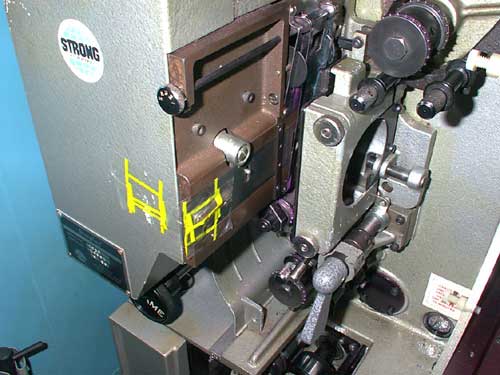
Other good ways to use zebra tape:
- Uhers use it to hold incorrectly assembled standees together.
- Cashiers use it to tape signs and movie posters to the box office windows.
Posted by Charlie Frisby (Member # 2927) on 04-15-2005, 10:50 PM:
Waka waka waka!
Posted by Brian Michael Weidemann (Member # 2243) on 04-16-2005, 02:56 AM:
When it comes to using splicing tape on something other than film, I've NEVER had luck! It just never holds, never sticks to anything. Granted, it's not supposed to be used for anything else, but I'm sure we've all tried at one point or another.
A low adhesive masking tape is the best for a booth's non-film taping needs.
As for the zebra tape, we are explictly to use the zebra tape ONLY on reel-to-reel splices, and with the dotted line portion being the discarded bit. The yellow that does show is to go over the SDDS (and/or the non-soundbar-side sprockets), not the analog or SRD. ALL OTHER splices must be clear tape. Duh. And clear tape is not for reel-to-reel. This is a very sensible arrangement. (And easier, considering we have three (maybe four?) splicers on the premises, ready to go with either zebra or clear.)
Posted by Monte L Fullmer (Member # 2797) on 04-16-2005, 03:45 AM:
quote:
First you don't clean your projector for about two weeks until it's so caked up that the aperture plate won't slide the way it's supposed to,
..take that aperture plate out and give it a teeny bend to bow it in the middle, then place it back in and it'll stay where you want it to be. Did that many-a-times with those 1050's with that jogger assembly doing the push/pull on those apertures. Noticed, that 1050 had the later model (one piece) of trap assembly-not the two piece version of the earlier models.
-Monte
Posted by Mike Babb (Member # 1379) on 04-16-2005, 07:54 PM:
I think we were originally told the dotted line went across the frame line in frames like flat pix where the image wouldn't be covered and for scope films and others with a full frame image use the alternate section with no dotted line. Also it was supposed to be used for reel splice only, not repairs and used to make it easier to spot splices when breaking down. Yeah yeah, I know...
Oh and all this was before digital I think.
Powered by Infopop Corporation
UBB.classicTM
6.3.1.2