This is topic Christie bulb spacer question in forum Film Handlers' Forum at Film-Tech Forum ARCHIVE.
To visit this topic, use this URL:
https://ft-forum.com/ft/cgi-bin/ubb/ultimatebb.cgi?ubb=get_topic;f=1;t=007177
Posted by Frank Dubrois (Member # 3042) on 05-10-2005, 04:36 PM:
We were contemplating getting these in order to rotate our bulbs (yep, it hasnt been done to this point) because we have the screw in type bulbs. I'm sure spacers or washers could be gotten at a local hardware store, but I cant find any specs on the "official" Christie spacers. Anyone know size? curcumfrance diameter etc. Also, would there be a problem with heat? I dont want them to melt or burn. Thanks!!
Posted by Gordon McLeod (Member # 33) on 05-10-2005, 04:37 PM:
The lamps normaly come with the washer on the lamp which is removed to rotate the lamp I am assuming that the lamp in question is the 1000 or 1600HSC
Posted by Mark Gulbrandsen (Member # 72) on 05-10-2005, 05:00 PM:
Frank,
Then best thing is NOT to rotate your lamps, just keep them and the reflector spotless. if you leave em alone and they will more than likely last longer. We have customers that typically get 12,000 hours from 2kw Christie lamps, note that they do have good lamp exhaust!. Not that running them to 12k hours is a good thing to do but none of these lamps ever get rotated and none have ever exploded either.
Rotating lamps was necessary before the advent of the getter that is now inside of all xenon lamps manufactured since about 8 or 9 years ago. This getter attracts the vaporized tungsten so it does not deposit on the inside wall of the lamp and darken it. The quarter life(or half life) rotation was to allow the vaporized tungsten to deposit evenly on the inside wall so even illumination and heat dissipation through the quartz could be achieved. Thsi eliminated uneven stress on the envelope and reduced the number of lamp explosions.
With very large lamps 4kw plus you might push a few extra hours out of em by rotating them. Some feel that this helps to keep the very heavy electrodes centered in the lamp so they don't end up sagging.
All in all with todays lamps many techs including myself do not reccomend rotating lamps. The amount of life that can be gotten out of them without rotation and the inclusion of the getter speaks for itself.
You definately need to get to a booth training seminar... As useful as F-T is this is not a training place. Those of us assisting with answers are sticking our necks out a bit in the liability department when we provide anssistence. You should also limit your liability at work until you become adaquately trained. Should someone be injured, or a film become damaged because of something you repaired you could be held liable... althougtn at your place it sounds as though they would just replace the dead person anyway ![[Big Grin]](biggrin.gif) .
.
Perhaps the Kodak booth seminar would be the best one for you to attend since it is the most complete one going. You should also do the Dolby seminar around the same time. John P., can you provide Frank with some info on this.....
Mark @ CLACO
Posted by Bevan Wright (Member # 1884) on 05-10-2005, 07:52 PM:
Definitely agree with Mark, don't rotate them. Chances of creating problems (flicker, heat, focus, etc) is far greater than any benefit you will ever get.
Posted by John Walsh (Member # 168) on 05-10-2005, 08:12 PM:
Not that I'm an expert in xenon bulbs, but I agree with not rotating them. You can see there's very little blacking at the top of bulbs today, so why bother?
Posted by Brad Miller (Member # 2) on 05-10-2005, 08:34 PM:
Not that it matters at this point in the thread, but chalk up another one in the "don't rotate" department. Overkill rooftop exhaust and Christie brand lamps is the real magic in getting phenomenal performance in a bulb anyway.
Posted by Frank Dubrois (Member # 3042) on 05-10-2005, 11:23 PM:
The packing materials on the bulb packaging itself says "for maximum performance, rotate bulb at half-life"
I dunno...just following instructions. Our bulbs typically start to dim (noticably) or flicker around 2000 hour mark. I didnt expect a miracle, but a little bit longer life would be nice if possible.
Oh well..Thanks
Posted by Mark Gulbrandsen (Member # 72) on 05-11-2005, 12:34 AM:
What lamps, lamphouses, and rectifiers, or consoles do you have there? Probably not enough from the blower either... The problem out here is that stupid HVAC techs don't take our 5000 foot elevation into account when specing them. It takes alot larger blower at this altitude to equal one at your altitude. I also find many of them running backwards.
As for rotating..... Of course thay want you to go in and mess with the bulb... thats how they sell more new bulbs!
Following "Lifes Instructions", not the manufacturers instructions, generally pays off in the booth........
Mark
Posted by Monte L Fullmer (Member # 2797) on 05-11-2005, 12:38 AM:
I remember when I used to work at EDW's and playing with 4K plus bulbs in our Christie Reference consoles that there used to be a spacer washer included in the box mentioning for the 180 degree rotation at half life - but never did any rotation due to the comments that Mark has mentioned (but had a parts bin full of these washers which came in handy for other uses).
Later on, the washers were omitted in shipping bulbs with the recommendation for not doing any rotation.
I've noticed that Osram and some other still recommend rotation at half life-guess an old habit is hard to break.
-Monte
Posted by Gordon McLeod (Member # 33) on 05-11-2005, 08:18 AM:
my experience has been that rotating them improves the overall life span of the lamp as long as one does increase the current immediately after rotation I haven't had issues with flicker or the likes
Also blackening is far more even
Posted by Mark Gulbrandsen (Member # 72) on 05-11-2005, 08:42 AM:
quote: Gordon McLeod
Also blackening is far more even
I don't think any of us here see any lamp blackening at all any more on any manufacturers lamps.... literally none after 12k hours down here on Christies. What lamps are you using that blacken?
Mark
Posted by Brad Allen (Member # 470) on 05-11-2005, 02:49 PM:
My Osrams blacken, always have. But I don't rotate. I found it caused problems. I may have to try a Christie. I'm lucky to get 2200hrs out of 2000w Osrams.
Posted by Brad Miller (Member # 2) on 05-11-2005, 03:05 PM:
Brad, what kind of lamphouse are you using? The lamphouse itself, the exhaust and of course lamp brand plays a huge role. People just don't understand that even though certain combinations of equipment and lamps cost a little more initially, the extra expenditure pays for itself within the first year or two and then becomes noticeably less expensive to operate for the remainder of the cinema's life.
You cannot beat the combination of a Christie SLC lamphouse, burning Christie bulbs and an overkill exhaust system. While any one of those three important items will improve a system's performance, I've yet to find any combination that beats the magic from using those three items together. (Sadly though I continually see Strong packages installed with all sorts of random bulbs and piss poor exhaust everywhere I look, which makes for a fairly lousy performance. ![[Roll Eyes]](rolleyes.gif) )
)
Posted by Brad Allen (Member # 470) on 05-11-2005, 03:14 PM:
Ancient Kneisley Kni-tron Xenex Mod L2000.
I've always suspected that the roof ventilation wasn't where it should be, but never could come up with anyone that could accurately check it.
Once upon a time, I would get easily 5-6000hrs out of bulbs, but no more.
Brad do you feel the same about the SLH lamphouse?
Posted by Monte L Fullmer (Member # 2797) on 05-11-2005, 05:22 PM:
quote: Brad Miller
(Sadly though I continually see Strong packages installed with all sorts of random bulbs and piss poor exhaust everywhere I look, which makes for a fairly lousy performance
..any information on how much CFM's is required on exhaust to get life out of any bulb and also maintain excellent presentations?
SLH consoles, isn't that the "Reference" consoles? If it is, that is one SWEET console.
thx-Monte
Posted by Brad Allen (Member # 470) on 05-11-2005, 06:38 PM:
Monte, The SLH is the lamphouse (two piece) version of the SLC console according to Christies web site.
Yeah, me too, how many CFM's would be considered an overkill exhaust system?
Posted by Mark Gulbrandsen (Member # 72) on 05-11-2005, 07:53 PM:
Brad,
For one 2 to 3kw lamphouse I spec in a Grainger blower # 7C038, direct drive blower. I've been using these for years. you can buy the motors and blower seperate! but the pisser is that in the last year Grainger has discontinued their ball bearing motor that fit that unit. Now all thats available is the standard sleeve bearing motor and they need to be oiled twice a year. Emerson does make a ball bearing motor that will fit it but they are hard to find........ You will have less trouble with the ball bearing motors over the life of the blower unit.
7C038 Blower
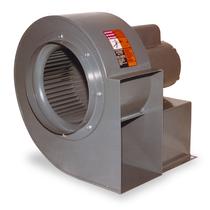
With a 6" duct which is typical in a 2 to 3 kw lamphouse we typically shoot for the 765 cfm figure but in your area which is lower altitude the air movement will just be greater than it is out here. If your lamphouse is set for 8" duct then by all means use that! If you use these be sure to check the rotation of the thing after assembly..... they are always set to run backwards.... the rotation direction difference effects air movement by about 6 fold.
Check the local codes about installation! There are equivelent roof top "mushroom" blowers that have similar ratings and these are required in some areas.
Mark
Posted by Bevan Wright (Member # 1884) on 05-11-2005, 10:44 PM:
I've always been a believer in the 'Cat Test' rule for roof extraction. If you can suck a small cat up your roof exhaust it is about right. ![[Wink]](wink.gif)
Posted by Mark Gulbrandsen (Member # 72) on 05-11-2005, 11:41 PM:
Yea Bevan..... that blower I posted above will then grind that cat into dog food ![[thumbsup]](graemlins/thumbsup.gif) !
!
Posted by Brad Allen (Member # 470) on 05-12-2005, 01:57 PM:
So, I'm assuming that this blower would be suitable to use on my Ancient Kneisley Kni-tron Xenex Mod L2000's?
I remember now having experience elsewhere with this blower. What I have now is not even close to amount of air flow that blower provides.
Posted by John Pytlak (Member # 331) on 05-12-2005, 02:21 PM:
Air flow meters:
Air Flow Meter
quote:
The CFM Master II provides simultaneous display of air velocity and temperature in an easy-to-read LCD screen. It provides minimum and maximum values and measurement of up to eight multi-point readings. The data hold function is ideal for transient readings, and the auto power off function conserves battery life.
Air velocity readings are displayed in any of the common scales in use: FPM, MPH, KPM, Knots, MPS and CFM. Temperature scale switches between °F and °C.
Other Meters
Contracting Guidelines
Measuring Air Movement
quote:
Measuring Air Movement (October 1999)
Providing the right amount of air to ensure occupant comfort requires a thorough knowledge of the instruments used to measure air volume and velocity in duct systems. It's information engineers should know.
Posted by Gordon McLeod (Member # 33) on 05-12-2005, 11:04 PM:
just rememebr it is possible to over cool a xenon lamp
Posted by Fabrice Dubourg (Member # 1635) on 05-13-2005, 04:12 PM:
no,no, : do not over cool a lamp!!!! ![[Eek!]](eek.gif)
Posted by Dustin Mitchell (Member # 372) on 05-14-2005, 10:19 AM:
To answer your question (sort of question I guess) about who could look at your blower for you, if you are unwilling or unable to do it yourself your local HVAC service can look at it for you, that's who we have do maintenance on our rooftop exhaust systems.
Posted by Louis Bornwasser (Member # 3063) on 05-14-2005, 08:06 PM:
We use the blower Mark suggests. In my experience it is not possible to overcool. (BTW hold onto the cleaning rag with both hands!)
Posted by Brad Miller (Member # 2) on 05-14-2005, 08:37 PM:
Agreed here with Louis, I have yet to find a situation where I can overcool a bulb. I've got 900CFM exhaust on a 2K lamp, but BOY OH BOY is it stable and lasts FOREVER!!! I wouldn't consider anything less than 900CFM on a 3k though as bare minimum. Best to hit 1200CFM for that and 1500CFM for a 4k, etc. ![[Cool]](cool.gif)
Posted by Gordon McLeod (Member # 33) on 05-14-2005, 08:48 PM:
hmm 1500cfm through a 6" round duct
I think the linear air speed and static pressure would make that almost impossible
Posted by Brad Miller (Member # 2) on 05-15-2005, 01:36 AM:
SLCs have 8" openings, the duct is much larger to the roof, so it is pretty much maximizing the possible airflow.
Posted by Gordon McLeod (Member # 33) on 05-15-2005, 09:57 AM:
Based on a 8' diameter opening with a static pressure of 203" water for the use of a flexible duct connecting to the lamphouse to get 1500cfm of air the linear speed is 4299 feet per minute
hmm that would draw up a small dog not just a cat
One could have a 1500 cfm fan on the roof but with the effect of the flex and smallest opening I doubt it is actually drawing more than 750-800 cubic feet per minute through the lamphouse vent
Posted by Steve Guttag (Member # 268) on 05-15-2005, 10:14 AM:
Gordon,
I have measured in excess of 1200cfm on 8" ducts. However it is true that with smaller ducts it gets progressively much harder to attain higher cfm ratings. Typically the ducting system is 10" or larger than transitioning to 8" just above the projector with a flexible duct to allow for projector positioning. It is best to have a rigid duct attached directly to the lamphouse/console and a small section (3-feet or so) of flexible duct (I prefer insulated) to attached to rigid duct above the projector.
Posted by Gordon McLeod (Member # 33) on 05-15-2005, 10:29 AM:
I usually mount the blower right on the top of the lamphouse so that its suction is direcly coupled to the lamphouse and then a vent pipe to the central exhaust
also that should have been 2.03" static not 203 i missed the decimal when I typed which is the static on 10' of 8" diameter aluminum flex duct
Posted by Brad Allen (Member # 470) on 05-15-2005, 11:23 AM:
Gordon, what blower do you use to mount directly to the lamphouse?
Posted by Gordon McLeod (Member # 33) on 05-15-2005, 11:38 AM:
Up here we use Delhi blowers and I usually put a 800cfm direct drive on the lamphouse top and then box it in with a 8" round outlet to connect to the exhaust system
Posted by Brad Allen (Member # 470) on 05-15-2005, 12:14 PM:
Thanks, been unable to find those blowers. But I assume it is an inline duct blower?
In my situation, it would be very difficult to install the suggested Dayton blower in such a way as to easily get to it to maintain it....I'm looking at other options.
Posted by Gordon McLeod (Member # 33) on 05-15-2005, 12:21 PM:
The blower in question looks much like the one pictured by mark
I usually mount it just behind the exhaust opening and then box it in with sheet metal and orient the vent out the top to a flex to a main flue
Posted by Brad Allen (Member # 470) on 05-15-2005, 12:56 PM:
Thanks Gordon, duh, I was making it too complicated.
Posted by Gordon McLeod (Member # 33) on 05-15-2005, 01:30 PM:
look at the pictures of the rainbow woodbine 8 in the warehouse
Posted by Brad Allen (Member # 470) on 05-15-2005, 02:22 PM:
Thanks.
Do you mount the blower in rubber grommets to prevent vibration showing up in the picture?
Posted by Gordon McLeod (Member # 33) on 05-15-2005, 02:32 PM:
The blower is on rubber isolators
Posted by Brad Allen (Member # 470) on 05-17-2005, 12:20 PM:
I've ordered Marks Grainger blowers. A question, the blower has an 8" input, the lamphouse's have 6" vents. Will this reduce the air flow too much? As in overload the blower motor?
Thanks
Posted by Alan Roehr (Member # 2892) on 05-18-2005, 11:03 PM:
Someone can correct me if I am wrong, but I think that the motor is under less load if the airflow is restricted and the blower is moving less air. So you shouldn't have to worry about overloading the motor, at least not because of the 6" duct.
Also check the rotation as Mark said above. I just found that our blower was running the wrong direction - 5 years after it was installed. I reversed the rotation and now there is airflow! One thing I did notice is that there doesn't seem to be very many openings to let air into the lamphouse (old Christie CH-20). I think that limits the amount of air that can be moved through the lamphouse. The air that is sucked out of the stack has to enter somewhere.
Posted by John Walsh (Member # 168) on 05-19-2005, 07:51 AM:
A suggestion is to use the largest vent you can. Like resistance in wire, going to a larger size wil reduce the effort needed by the motor. For example, even if the top of the lamphouse has only a 6 inch diameter vent, install larger ducting with an adapter (if you can.) Avoid bends where possible. Square ducting passes more air than the same size round duct. So, you might be able to go 'round' from the lamphouse to the ceiling, then square or rectangle the rest of the way.
The manual for the lamphouse should state the required airflow. The next time a guy comes to work on the HVAC system, ask him to measure it for you.
I went from an 8 inch to a 12 inch round up to the ceiling, then 18 square to the roof exhaust. Clear plastic venting allows the operators to see that the lamp is on, although plastic venting isn't always allowed in some local codes.
Powered by Infopop Corporation
UBB.classicTM
6.3.1.2