This is topic Gate Type Soundheads in forum Film Handlers' Forum at Film-Tech Forum ARCHIVE.
To visit this topic, use this URL:
https://ft-forum.com/ft/cgi-bin/ubb/ultimatebb.cgi?ubb=get_topic;f=1;t=007216
Posted by Paul Trimboli (Member # 1509) on 05-22-2005, 04:33 AM:
Does anyone know what sort of wow/flutter figures you get on a gate type soundhead, such as some of the Western Electric? How do they compare to rotary stabaliser sound heads? What is the sound like out of a gate type soundhead? I don't own one but know of a couple of places still running them and have often wondered.
Posted by Mark Gulbrandsen (Member # 72) on 05-22-2005, 08:00 AM:
Even though the Western Electric 1A and derivatives were gate type they had a large flywheel on the sprocket shaft and inside that flywheel there are a number of dashpots for filtering sprocket flutter. I've had one open but its been a long time and can't remember if it was three or six dashpots in there. Seems they were definately aware that they had to get rid of as much flutter as they could. I don't remember these things sounding bad by any means but I never made any measurements on one.
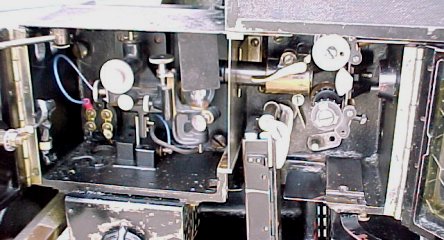
This one has the curved gate, earlier versions had a straight gate.
Mark
Posted by Louis Bornwasser (Member # 3063) on 05-22-2005, 10:21 AM:
So much for the "origin of the curved gate!"
Sprocket flutter they were aware of. Unfortunately, they were not yet aware of "scrape flutter" which this thing (W. E. 1A) had boatloads of. In the 1970's I measured all parameters of this sound system and found it actually to be no worse than anything else EXCEPT for the scrape flutter.
It makes you appreciate the invention of the sound drum that we use today; another W.E. innovation.
Posted by Mark Gulbrandsen (Member # 72) on 05-22-2005, 11:53 AM:
Lou,
I believe that the top rotating roller at the scanning gate was indeed an early form of scrape flutter filter roller. The thing is that scrape flutter was probably so high that even that roller did not help all that much.
Mark
Posted by Alan Gouger (Member # 543) on 05-22-2005, 12:40 PM:
Forgive my newbie question, Im still working through the learning curve. Ive never seen a gated sound head but I use to have an old Holmes projector laying around and the film passed through two plates or a gate where the sound was concerned, is that the same thing?
Posted by Dick Prather (Member # 1136) on 05-22-2005, 03:15 PM:
Most all the "sound gate" types had something to damp the film before it went into the gate. RCA in some of it's heads used a cork roller as in the PS-8. Later RCA heads used a 4" set of bands with a loose loop. I ran WE 206B's with the curved gate attachment installed as showned in Mark's reply. Mark's picture shows the 1A soundhead but the sound gate was the same. Most WE soundheads had the flat type and were converted in the field to curved. I believe the WE 208 was the first to come from the factory with it. Other soundheads used a tight loop from the lower feed sprocket to a spring loaded roller above the gate. Weber soundheads used this method with Power's projectors. I am sure there were others.
I ran WE 206B's in a grind house, running 12+ hours a day, and had no problems with wow or flutter as long as the loop going into the 206 was OK. We still used the original sound system and speaker. Theatre was closed in the 70's
The sound drum or rotery stabilizer was develped by a German company called Tri-Arigon who sued RCA for using it. RCA settled out of court in the 30's. RCA with their PS-24 was the first American soundhead to use a sound drum in 1932. WE had their WE 7400 in 1934 or 35 and called it a Kinetic Scanner.
Paul, What type of soundheads do you have?
Dick
Posted by Monte L Fullmer (Member # 2797) on 05-22-2005, 06:14 PM:
Hey, Mark - I can't remember this too well, but is this a WE 206 soundhead?
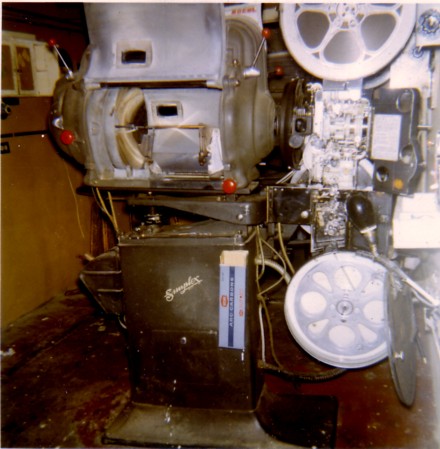
This pict is from a theatre I used to work at in my early days. The next year, your boss, Clayton yanked these soundhead units out and put in one of the first 5 star units built and automated this booth (6k reel changeover with 1.6k ORC lamphouses, and I got the boot since I wasn't needed anymore). Then the building burnt down 3 yrs later.
-Monte
Posted by Mark Gulbrandsen (Member # 72) on 05-22-2005, 08:22 PM:
Lokos like it Monte...What theatre is that?
Mark
Posted by Monte L Fullmer (Member # 2797) on 05-22-2005, 08:54 PM:
..It was the Royal Theatre in Rigby, Idaho. This was my first indoor house that I worked at..in the fall of 1971 until Clayton put in those 5 star units and the ORCS.
When I went up to this booth, after meeting with the owner who needed help bad, I saw this E-7/Strong Mogul setup and saw these 'ancient' soundheads. Having that 40lb dual cord belt driven flywheel on the backside (where you can barely see the flywheel in the pict), I was a bit amazed of this style, since that fall, when the drive-in shut down and used to Ballantyne Model 6 sound heads (which were about the same as the 4-star and the RCA's), then seeing a gate version of a sound head that uses the pulldown sprocket as the scanner drum. I had to reverse this sprocket on this right machine since the sprocket was hooking badly.
One time, Clayton came up to do a sound check and a oblique gear replacement, (which eventually I found out how horrible they can be to work on down the road, and which this place actually had Motiograph stereo magnetic sound-for there were the three Altec/Lansings "Voice of the Theatre" speakers behind screen, booth had 4 Motiograph amplifiers, I found the two Motiograph Penthouses in storage) and he was impressed on how these things sounded being the gate-type sound system (he also mentioned that the old Rialto in downtown SLC, which is still there on the 200 block of Main street with a different name, had these 206's also) and how there was very little flutter coming from these old heads.
Here's the pict after Clayton did the 5-star install (sorry on the fuzzy shoots-couldn't hold a instamatic worth beans..lol):
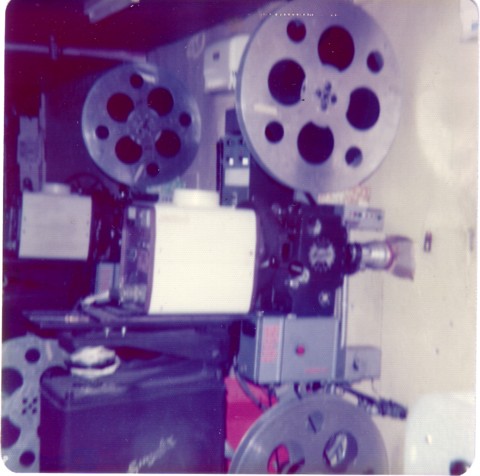
After I left this theatre, business started to plummet due to sloppy operations, health conditions and overall poor situations there. Finally, the theatre went up in a blazing fire. Some said that the coal furnace in the basement let go, and the auditorium, with wood floors soaked with syrup and popcorn grease added to the destruction, but others figured out that it was ARSON to get the insurance money due to lack of business and massive debt that had piled up.
I went there after the fire and saw a huge glob of aluminum-figured this what was left of the machinery. Nothing was readilly recoginizable. That fire definitely consumed almost everything-nothing but the ajoining walls were left.
Lotsa fun I had in my early years handling film. That was a very dirty booth when I first started. I must have spent a good 3 months cleaning it up to where it was quite liveable up there.
thx-Monte
Posted by Mark Gulbrandsen (Member # 72) on 05-22-2005, 09:04 PM:
I call those the Simplex "No Stars". They were the worst sound head ever devised. The Rialto is still here but is now a comedy club. I worked on a "Touched By An Angel" Episode there.
Mark
Posted by Jeffry L. Johnson (Member # 453) on 05-24-2005, 10:44 AM:
quote: Dick Prather
Tri-Arigon
Tri-Ergon?
Film Sound History: 20's quote:
Tri Ergon
Three German inventors, Josef Engl, Hans Vogt, and Josef Engl patented the "Tri Ergon" process. In 1922, Tri-Ergon announced the development of a glow lamp light modulator for variable density recording of sound. The Tri Ergon Process uses a technology known as variable density, which differed from a later process known as variable area. The Tri Ergon process had a pattented flywheel mechanism on a sprocket which prevented variations in film speed. This flywheel helped prevent distortion of the audio. Tri Ergon relied on the use of a photo-electric cell to transduce mechanical sound vibrations into electrical waveforms and then convert the electrical waveforms into light waves. These light waves could then be optically recorded onto the edge of the film through a photographic process. Another photo-electric cell could then be used to tranduce the waveform on the film into an electrical waveform during projection. This waveform could then be amplified and played to the audience in the Theater. The Fox Film Corporation acquired the rights to the Tri Ergon technology in 1927.
Posted by Richard Fowler (Member # 893) on 05-24-2005, 11:43 AM:
Fox aquired the German patents since the recording aspects where the same as the rights from Theodore Case which where folded in to the Fox-Case corporation. Fox-Case introduced and promoted the Movietone system. RCA tried to get around the sound drum aspect of the German system by a different design ( no sprocket teeth on drum ) but the end concept was not radical enough to side step the existing patents. I saw one of the German sound projectors of the late 1920's at the Munich Technical Museum; the unit had a sound drum of around 3 inches (75mm)and was sprocketed on one side to drive the drum.
Posted by Monte L Fullmer (Member # 2797) on 05-24-2005, 01:24 PM:
I liked that site that those three put together, but a small flaw in the Tood-AO page: they didn't mention of the film speed of 30fps for Todd-AO presentations.
Posted by Ben Wales (Member # 92) on 05-24-2005, 03:49 PM:
Here in the UK we had the GB 'N' Portable 35mm projector.
I had one myself a few years ago, as I recall it was based on a BAF pull through sound head.
These projectors were designed in the late 1930's and films could be played as "Back Projection" sound the sound gate could pick up on both sides of the film.
Posted by Mark Gulbrandsen (Member # 72) on 05-24-2005, 05:27 PM:
Actually RCA also made sound reproducers with gate type scanners. I want to say the PS-1, and 2 were gate type reproducers. Perhaps Dick Prather can confirm that one.
Mark
Posted by Dick Prather (Member # 1136) on 05-25-2005, 12:59 AM:
Most RCA gate type soundheads used bands like the curved gates in projectors today only smaller in length. The first American stablizer head was the RCA PS-24. RCA models from PS-1 through PS-22 and a PS-26 had a gate or band type scan system.
Posted by Paul Trimboli (Member # 1509) on 04-14-2006, 06:16 AM:
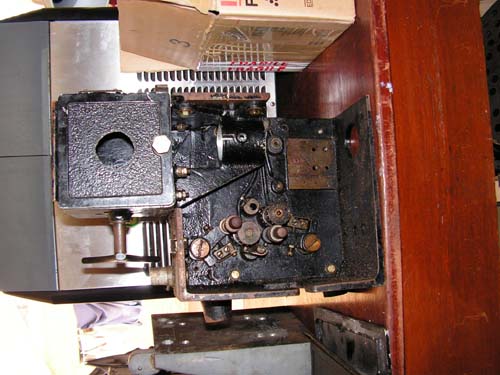
I have just got an RCA PS 1, I belive it is a PS 1 anyway. How is it driven? What gear is needed to drive a Simplex Standard? Does anyone have a manual on this thing? I have found the users manual at the widescreen museum site, under the 1930 RCA projection handbook. I will take some photos tommorow and post them.
Posted by Stan Gunn (Member # 554) on 04-14-2006, 07:15 AM:
I have a pair of 208B WEs in my open air cinema,converted to stereo with a cp50, I have tested my system with a kalee wow and flutter meter, cant remember the readings but they were quite low I have never been able to hear any wow or flutter.
that is except when my bum gets caught up in the flywheel of the No2 machine when threading up No1 ![[Eek!]](eek.gif)
Posted by John Eickhof (Member # 323) on 04-14-2006, 10:34 AM:
Of course don't forget the neat little hole in the flywheel for oiling the cup behind it...many an operator lost or mamed the end of a finger when sticking it in that hole to help 'spin-up' the incoming machine! The old woven cloth belts were known to stretch snd slip!!
Posted by Paul Trimboli (Member # 1509) on 04-16-2006, 03:51 AM:
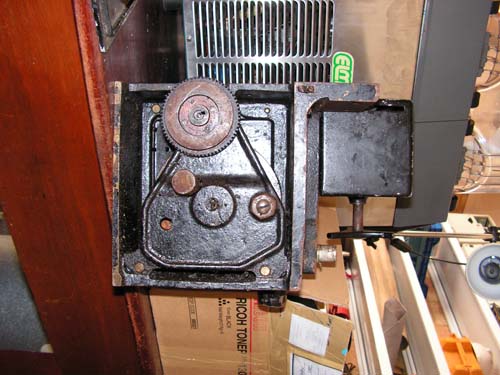
Here are the photos of the soundhead I have. It is complete but as you can see the slit lens, soundgate, photocell housing and door are not installed. Is this defiantly a PS 1? Does anyone know the answers to my questions above?
Posted by Bruce McGee (Member # 131) on 04-16-2006, 08:52 PM:
In an answer to the question about the Holmes sound system. Yes, it uses the gate-type system.
Bruce
Got 4 Holmes 35's up and running in my spare time during recovery. #4 has no sound, yet...
Posted by Dick Prather (Member # 1136) on 04-17-2006, 05:45 PM:
Paul,
Both the RCA PS-1 & PS-8 look quite simular. Both were set for Simplex projectors. I did look closely at both and yours looks like it is a PS-1 by the way the exciter lamp cover and door is made missing the parts you mention.
e-mail me with your address and I will try to send you some manual pages.
Dick
Powered by Infopop Corporation
UBB.classicTM
6.3.1.2