![[Mad]](mad.gif)
quote: Brad MillerYes a Weak Company for sure......
..."never buy anything from Wrong International".
quote: Dennis UdovichI think you meant to say "Knock On Strong".....Water circulator it is but cool the water it does not. The water gets hotter and hotter it does.
I have a Strong water circulator for a Simplex Millennium projector with a 4K lamp that has been in use for five years with no problems. (Knock on wood).
![[Big Grin]](biggrin.gif)
quote: Thomas JonssonIt's for environmental reasons. Using continuously running tap water is a monumental waste of a natural resource and in most municipalities such use is illegal. We used to have air conditioning units that used tap water to carry heat away from the compressor instead of exhausting to the outside in situations where outside access is not possible. This type of air conditioner was very practical in terms of being able to easily cool rooms that had no outside access, but they were obscenely wasteful of our water supply. Laws were passed about 15yrs ago that made using these units illegal.
Lots of theaters seems to use circulation systems. Is this for practical reasons instead of connecting to the house water pipes?
quote: Frank AngelWhile the sale of new ones are regulated (and many import the higher flow ones), I was not aware of any law requiring the removal of the old toilets for the new ones. Personally, I feel before any politician makes such a law, THEY should have to live with their new regulation first (in their homes and work place). The new toilets, especially when they first came out didn't save water, they wasted it...it took several flushes.
Everyone had to replace their toilet bowls with high effiency units that use about 1/3rd the amount of water as the older ones.
quote: Frank AngelBrainwashing though that sort of statement may be...short of shooting it off into space...it actually is pretty unlimited and renewable. It may need to be cleaned or desalinated and such but even in space they have learned to filter urine to reclaim the water rather than rely only on "fresh" water. Maybe not a pleasnt thought to some but a smart way of reusing (aka recycling).
Water is not an unlimited resource; we need to stop thinking of it as such.
![[Wink]](wink.gif) What is a water circulator used for on a projector? I have never seen or heard of it. It's obviously used for cooling, but cooling what exactly and what types of projectors require them?
What is a water circulator used for on a projector? I have never seen or heard of it. It's obviously used for cooling, but cooling what exactly and what types of projectors require them?
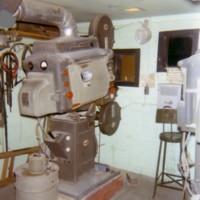
quote: R. Andrew DiercksThe water is used to cool the film trap and/or the aperture when running high-wattage bulbs.
It's obviously used for cooling, but cooling what exactly and what types of projectors require them?
quote: Aaron SisemoreChristie is the only projector out there that is not available in a water cooled model. Alot of theatres regularly run lamps as high as 7kw through them with just the small muffin fan assist that they normally come with. Those runing higher wattage lamps will generally replace the shutter belt twice as often.
Any projector running 4000W or higher bulbs should have some type of cooling in place, be it water or forced air (some Simplex models had a forced-air cooled gate)
quote: John Pytlak(..gonna drift a little off-topic here on the subject of the cyan tracks) -> If this process is so great and cost effective, then why haven't ALL of the labs converted over to cyan by now? Does it take special processing, or special equipment to do cyan processing?
Over 10 BILLION feet of print film is processed annually. That's why reducing water use in processing by about 50% with cyan dye tracks is so important.
quote: Monte L FullmerSame film, simpler processing (no need for soundtrack redeveloper application and water wash-off).
If this process is so great and cost effective, then why haven't ALL of the labs converted over to cyan by now? Does it take special processing, or special equipment to do cyan processing?
quote: Frank AngelOh, but it is. Even when you flush the toilet, the water doesn't just disappear.
Water is not an unlimited resource
![[Razz]](tongue.gif) There are methods of recycling, even wastewater recovery. And let's not forget about the biggest water recycling system: rainstorms.
There are methods of recycling, even wastewater recovery. And let's not forget about the biggest water recycling system: rainstorms.
quote: John PytlakAll (!) Austrian cinemas were committed to have LED readers installed (Were cinemas in other countries also committed?). We had 2 ordinary sound readers from "Siemens Klangfilm" installed on Philips FP6 projectors. The cinema leader had to pay a lot of money to have these units installed.
Some also want to wait until less developed areas of the world have a higher percentage of red LED readers, as prints may be recycled into those territories.
![[beer]](graemlins/beer.gif)
quote: Dieter DepypereThe National Association of Theatre Owners (NATO) made a committment:
All (!) Austrian cinemas were committed to have LED readers installed (Were cinemas in other countries also committed?).
quote:http://www.dyetracks.org
Mary Ann Grasso, Vice-President and Executive Director of NATO confimed that at the recent Spring Board and Committee meeting held in Washington, D.C May 8-10, 2002 the NATO Technology Committee expressed continued support for the conversion to cyan dye track. The Committee suggested to the Board that NATO select a firm date by which NATO member theatres' would be fully equipped with red readers. The NATO Board of Directors recommended by unanimous approval that all theatres be properly equipped with red light readers by July 3rd, 2003.
![[Shrug]](graemlins/shrug.gif)
quote: Alan DallasThats why its standard for use in extremely high power transmitters. No deposits or crud and most of those high power Klystrons actually get returned to the factury and rebuilt for use again.... you can't leave any deposits in them or you won't get any credit for the dud, just another bill for about $30,0000 for a unusable dud!
Oh and about de-ionoized water. It has the best thermal properties and doesn't leave desposits. I
![[Eek!]](eek.gif) When I buy water and it just says Distilled Water, how can I tell if it is the kind that is gonna eat away my projectors?
When I buy water and it just says Distilled Water, how can I tell if it is the kind that is gonna eat away my projectors?
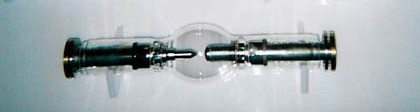
quote: Gordon McLeodDonno Gord, but if your cars cooling system exhibits more than about a volt or two of current leakage(measured fomr ground to the center of the fluid under the radiator cap with a dmm) any alumnium components in that cooling system will desintegrate pretty quiclky, so antifreeze in general has to be pretty void of that problem. The Klystrons water jacket was alot differnt from todays 15k lamps and was also all copper. Copper was used because conducts heat the best......
all the additives I know of do create some leakage current
quote:http://www.jp.horiba.com/story_e/conductivity/conductivity_03.htm
Familiar tap water or river water contains various substances. So, it is not actually pure water (). Of course, tap water is fine for household use. For scientific research or industrial engineering, however, we sometimes need highly pure water.
As we try to make pure water by gradually removing electrolytes, its conductivity gradually decreases. So, if all electrolytes are removed, will its conductivity become zero? No. Why? Because an infinitesimal part of the molecules of water--only about one in 500 million--is ionized as hydrogen ions () and hydroxide ions (). Theoretically, at this point, the conductivity becomes 0.0548 µS/cm at 25 °C.
The conductivity of water used in the production of VLSIs in the semiconductor industry is below 0.06 µS/cm-- that's water of very high purity indeed. Such water is referred to as ultrapure water. Without going to such an ultrapure level, conductivity of water can be lowered to below 1 µS/cm through a process of deionization. Such water is called ion-exchanged water or deionized water. When we talk about pure water, we refer to water of this level of purity. When water comes in contact with air, carbon dioxide is dissolved in water, causing its conductivity to rise by about 1 µS/cm. This does affect the conductivity of pure water.
quote:
Thus, resistivity becomes an index of difficulty of flow of electric current. And the reciprocal of resistivity (1/resistivity) is conductivity. So, conductivity becomes an index of ease of flow of electric current. Its unit is written S/cm, meaning siemens per centimeter. Also, 1/1000 S/cm is a called millisiemens per centimeter, and 1/1000 of a millisiemens per centimeter is a microsiemens per centimeter.
quote:You might be able to have it properly recycled by your local automobile service shop:
This request was posed in order in the context of a spent antifreeze recycling program, wherein
spent antifreeze generated from radiator flushes done at automobile service centers (specifically,
Valvoline Instant Oil Change stores) is collected, stored and sent for recycling at Union Carbide’s
Glycol Recovery Unit in Institute, West Virginia. The specific questions you raised relate to the
practical difficulties of generating and characterizing spent antifreeze, where one radiator flush may be
hazardous and the next flush nonhazardous...
quote:http://www.colorado-recycles.org/referencelibrary/recyclingtips/anitfreeze.html
Disposing of antifreeze is also a problem. Antifreeze contains ethylene glycol which is poisonous to fish, wildlife and people. Many cats and dogs have died after drinking the sweet tasting puddles of antifreeze left on driveways. Do not dispose of antifreeze down storm drains, instead ask you local service station to add the liquid to their used anti-freeze storage drum. If your household is connected to a central sewer system, call your wastewater utility for specific guidance in disposing of anti-freeze.
quote:
A Wonderful, But Hazardous, Product
Antifreeze is hazardous. Ethylene glycol is a toxic chemical that requires proper handling, storage and disposal to avoid harming humans, animals and the environment. One of the properties of ethylene glycol is that it is a sweet-tasting liquid which makes it attractive to animals and small children. Unfortunately, it is very poisonous and each year thousands of dogs, cats and other animals die from lapping up pools of antifreeze that have accumulated on streets and in parking areas. There have been many cases of human poisonings and deaths over the years, predominantly among small children. The Centers for Diseases Control and Prevention provides a considerable amount of useful information about poisonings and poisoning prevention on its website at http://www.cdc.gov/ncipc/factsheets/poisoning.htm .
As a broad generalization, orange colored antifreeze is an indication that the antifreeze is manufactured for more extended uses, and has a longer service life than does green antifreeze. However, under no circumstances should green and orange antifreezes be mixed together because the enhanced properties of the orange antifreeze will be diminished.
Used antifreeze may also contain levels of dissolved heavy metals that can be toxic to animal life and may contaminate soils, water and sediments. If ethylene glycol biodegrades in large quantities, it can deplete the levels of dissolved oxygen in surface waters, killing aquatic organisms. Antifreeze picks up many contaminants from engine operation in addition to some heavy metals. It will also pick up toxins such as benzene. That is why antifreeze must be tested to determine whether or not it falls under the classification as being a hazardous waste.
It has been 519 days since the last post.
quote: Jeffry WildeYou will eventually!
I have never had a problem with one.