This is topic Xenon Bulb blowup damage the truth the myth? in forum Film Handlers' Forum at Film-Tech Forum ARCHIVE.
To visit this topic, use this URL:
https://ft-forum.com/ft/cgi-bin/ubb/ultimatebb.cgi?ubb=get_topic;f=1;t=007260
Posted by Paul J. Neuhaus (Member # 3205) on 06-14-2005, 12:24 AM:
Hey everybody. What's the worst damage you've ever witnessed a Xenon Bulb do? The worst I've ever seen was a scored reflector that we replaced. I've heard stories about lamphouse doors being blown off their hinges and shards of glass sticking in block walls. Any Truth to the Matter?? Can they really be that dangerous?
Posted by Leo Enticknap (Member # 534) on 06-14-2005, 01:42 AM:
I once had a 2k bulb one blow up on me while I was removing it from a lamphouse (thanks to a faulty ammeter causing us to run it at way over its rated current, the anode lead had burnt out and the lamp had failed). The explosion was more of a dull thud than the big bang I'd been told it would be, but the force with which the envelope disintegrated was impressive. Several fragments were deeply embedded in my face mask, protective jacket and gloves. We were sweeping and hoovering bits of bulb up from all over the booth for days afterwards.
If I hadn't been wearing the full protective kit, there's no doubt in my mind that I'd have been seriously injured or even worse. Another decision I made from that point on was that no-one in that theatre was going to be handling bulbs on their own. This incident happened after the last shows had finished and I was the only person left in the building. If, for example, the face mask had shattered... well, I think I used up one of my nine lives that night. In retrospect I wish I'd taken some pictures of the aftermath, but was too shocked to do anything mucn except clean up, switch everything off, go home and have a very stiff drink!
Before that incident another bulb had blown in the same lamphouse. This happened immediately (i.e. within a couple of minutes) after the lamp had been struck for the first time after the theatre had been closed for three weeks due to flooding in the building's basement. The whole place was very damp, so I suspect that condensation on the envelope was probably the straw that broke the camel's back. In this case the lamphouse contained the blast: if I remember correctly, there were a few abrasions on the mirror (so much so that we retired it to a cupboard for use as an emergency backup, but it was still usable - just) and one or two minor components in the strike unit needed changing, but that was the limit of the damage. That having been said, the lamphouse was one of those huge 1970s Cinemeccanica things which was built like a tank and designed to hold a much larger bulb than we were running in it. In terms of damage caused, I guess that a lot would depend on how sturdily the lamphouse was built in relation to the size of the bulb. I imagine that a lamphouse made of flimsy sheet metal would not look pretty after an 8k bulb exploded in it.
Posted by Ferdinando Innocenti (Member # 2477) on 06-14-2005, 02:21 AM:
Well, this is (was?) a Prevost P93 just after a blowup of a 4000W lamp. Everything in the lamphouse was broken, except for the igniter. The wires from the rectifier were damaged too. Two blowers, IR filter, reflector, spring for the mirror, capacitor, photoled, wires, everything.
But there was no problem outside of the lamphouse. If a lamphouse is good, there's no chance to destroy it with a blowup.

Posted by Frank Angel (Member # 248) on 06-14-2005, 02:24 AM:
Not to go off subject, but the protective gear that I found in one of the booths consisted of gloves, face protection helmet and tyvec jacket. The gloves and the face mask/helmet seem like they would help, but I really question the tyvec jacket. Does anyone know if this flimsey stuff will protect from flying quartz projectiles of an exploded bulb? I'd hate to find out after the fact that they go through this stuff like a knife through butter. What do you guys use for body protection?
Posted by Robert John Jeromson (Member # 2559) on 06-14-2005, 04:50 AM:
I have had three go in my carrer, two 5k's and one 7k, all made one hell of a mess, destroying the reflector and fusing reflector fragments to the surface of the anode. The coated heat filters survived (the 7k bang cracked it however) but the first 5k I had go dropped molten glass onto the floor burning small holes in the lino.
Posted by John Pytlak (Member # 331) on 06-14-2005, 05:49 AM:
quote: Frank Angel
What do you guys use for body protection?
For the screening rooms in our building at Kodak, we use a one-piece KEVLAR jumpsuit with long sleeves and pant legs, and a high neckline that fastens around most of the neck. It's hot, heavy, and uncomfortable, but IMHO the safety is worth it. (To test its effectiveness, I tried piercing it with a sharp screwdriver.)
We wear double eye protection: safety glasses with side shields, and then a full face visor. For the hands, we use chain mail meat-cutters gloves.
I agree with Leo that you should not work alone when handling xenon lamps -- a "buddy system" is a good idea in case of injury.
Again: If you don't wear the proper safety equipment to handle xenon lamps, an exploding lamp is likely the last thing you will ever see! ![[Eek!]](eek.gif)
Posted by Mark J. Marshall (Member # 1409) on 06-14-2005, 01:45 PM:
I'll second that.
A good friend of mine had one blow up in his face right after he disconnected the ground lead. Luckily he had a face shield on, but no other protective clothing. He had bloody arms and a neck, and he said his ears were ringing for about an hour. To this day he still has quartz shrapnel embedded in his arms and upper chest and neck. They even show up on an MRI.
Posted by Scott Manley (Member # 867) on 06-14-2005, 05:05 PM:
I had a 2K CHristie bulb once blew and little more than doubled the opening in the reflector
Posted by Phil Hill (Member # 371) on 06-15-2005, 01:28 AM:
At my former job "position" I was known as "Mr. destructo"... I have blown up more 7k, 10k, and 15k bulbs than I can count. ALL for good reason! It's ALL about cooling AND current!
NEVER trust the published/manual specs for air flow for a lamphouse! While it is very important to cool a lamp properly (the envelope as well as the seals) it's equally important NOT to over-cool the lamp!
BTW: Putting aside the better "optics" of glass reflectors... the metal reflectors provide much better protection to ALL the lamphouse components with a catastrophic bulb failure. I'll take metal over glass ANYDAY! ![[Smile]](smile.gif)
And YES! I agree with all yous about wearing protection.. and I don't mean condoms unless we're talking sex here.. ![[Wink]](wink.gif)
Posted by Monte L Fullmer (Member # 2797) on 06-15-2005, 02:22 AM:
..what's interesting is how black the anode end and the cable is when that 4k took off in that Prevost lamphouse. Not enough cooling, and the front seal let go?
That's one big "Ka-Boom!"
-Monte
Posted by Stephen Furley (Member # 1277) on 06-15-2005, 04:58 AM:
Xenons worry me (maybe that's where my hair went). I 've never had to handle anything bigger than a 2k, but I don't like doing it; I feel much safer handling a box of carbons. I've only ever known one to explode, it was and old three electrode thing many years ago, and thankfully I was in the auditorium, not up in the box.
Posted by Darren Briggs (Member # 1071) on 06-15-2005, 05:12 AM:
After the incident that Leo decibed above where the lamp went after it had been on for a few minutes, the lamphouse looked like a steam train as shards of minute glass were blown out and everywhere.
As the cinema was closed and we were all in the room, (One next to the Projector mech, I was behind the lamphouse and Leo at the desk) we all decided that the dust was not good for us and went for a Guiness i believe at the pub next door. It was a very loud bang indeed. Lamphouse still in use today, new miror and a meter that matched its shunt! (After calculations we were giving the 2k lamp 95amps, but the meter read 65, great picture for 500 hours though!)
Darren
Posted by Leo Enticknap (Member # 534) on 06-15-2005, 03:25 PM:
quote: Phil Hill
...and I don't mean condoms unless we're talking sex here.
I once saw my boss leave the 'condom' (i.e. the protective plastic sleeve in which a xenon bulb is shipped) on a bulb after fitting it and striking up (the xenon, that is!). For a second or two, he wondered why the picture looked dull; then there was a funny smell; then a couple of blobs of molten plastic dribbled out of the grille in the bottom of the lamphouse... and then the penny dropped. The bulb was obviously ruined - the quartz envelope would have been delaminated, for one thing - but it didn't blow.
Posted by Aaron Garman (Member # 1653) on 06-16-2005, 02:34 AM:
I've got some darn thick gloves, a mask, but nothing for my body. Any ideas on what I could get on a modest budget? All these stories start to make me nervous, along with the fact that my work clothes consists of a short sleeve shirt!
AJG
Posted by Leo Enticknap (Member # 534) on 06-16-2005, 03:30 AM:
Someone I once worked with used an old leather motorcycle jacket (I think he fancied himelf as Dennis Hopper in Easy Rider, though the fact that he was totally bald sort of undermined that image!), insisting that it would provide better blast protection than the xenon jacket we had in the booth. Thankfully, that theory never had to be put to the test.
Posted by Monte L Fullmer (Member # 2797) on 06-16-2005, 03:44 AM:
Yes, it can be nerve wracking when handling a bulb -from a pencil 1k type to a good size 6k bulb. For you just don't know if the thing is going to go with just holding it or what.
I remember when I changed my first bulb and that was in a Cine 1600 vertical lamphouse. Bulb had 8700 hrs on it and dark as pitch. I've heard nasty stories of the dangers of bulb explosions, so dressed up with the protective garb (hotter'n hell in that thing as sweat running from the heat and with the nerves going full tilt...). Got the allens out to loosen up the connections, got the cover over that bulb, took it outside and threw it in the driveway to bust..and the danged thing didn't even pop...just shattered from age. I was disappointed on that one....lol.
One time when I was changing out a 2k in a X-90 "Wrong" unit, I bumped the envelope pretty good on the edge of the mirror as I was pulling it out (wasn't paying attention that time), but no "pop!" - just woke me quite suddenly on paying attention to what I'm doing when extracting a bulb from a small lamphouse area. For I was still used to CHR-SLC consoles with all the room those things had when changing bulbs...and no cables to worry about with those SLC(E) consoles...
I've only had one bulb (2k Osram) explode on me, and that was during a run in an Xetron-35 console back in 1980. The anode spider that supports the front end got tweaked solid somehow and when the bulb was getting hot, exploded when it couldn't expand.
That was a noisy one-the whole cinema heard that one go off.
Many bulbs that I've changed, from the first one that took almost a half hour to do, to where I can do one in 5 minutes..yet I still get nervous on what can happen....
-Monte
Posted by Bernard Tonks (Member # 809) on 06-16-2005, 05:36 AM:
From 03-04-2002 Topic: So What Do You Do When A Bulb Explodes?
My worst explosion was with a 2k Osram during a show which shattered the mirror into a million pieces and bent the fan axis beyond further use. The noise of the bang and plume of black smoke was unbelievable and I did in fact suffer from shock until I was able to move the programme to continue on No 2 projector. I sent the remains, the anode and cathode being green in colour to Osram although the bulb had clocked just 700 hours, they did send a free replacement. Our last bulb just died in silence and intact, average lamp life here is 2,500 hours.
quote:
Darren Briggs.
(After calculations we were giving the 2k lamp 95amps, but the meter read 65, great picture for 500 hours though!)
Projection rooms should hold a clamp-on AC/DC meter to check rectifiers. I found one very useful when I first changed to xenon being supplied from old Westinghouse rectifiers, which originally were made for 3 electrode bulbs. I later updated to T & R rectifiers but still kept a check on the current.
Posted by Wolff King Morrow (Member # 2226) on 06-16-2005, 05:58 AM:
Thats some pretty low lamp life you have there for OSRAMS. I take my 2ks out after 3500 hours and they look nearly crystal-clear, with only very slight darkening in a few spots on the glass. Maybe because I have plenty of airflow and I enforce a strict policy of letting the machines cool down for 15 mins before turning them off each night. Anyway, my 4ks I take out when they reach 3000 hours. I've only had one bulb that had to be removed prematurely at 2600 hours, which was because the anode deformed to the point of causing arc flicker.
The only "incident" I've had was when I installed a new 4k bulb that failed to work when I turned it on. It made all sorts of sparks inside the envelope, so I quickly turned it off (and was later correctly told the bulb was a "leaker" here on the forums). I got a strange reaction from the rep on the phone when they asked how many hours were logged on it. I said "10 seconds" and they couldnt believe it.
Anyway, bulb changes scare the hell out of me every time I do one. I feel like I'm in a bomb squad, only the pay rate isnt the same.
Posted by Marc Hansen (Member # 705) on 06-16-2005, 07:41 AM:
quote: Aaron Garman
I've got some darn thick gloves, a mask, but nothing for my body. Any ideas on what I could get on a modest budget?
Leather welding jackets are pretty cheap. Any welding supply shop will have them.
Posted by Frank Angel (Member # 248) on 06-16-2005, 10:28 AM:
Pirate Phil sez: quote:
NEVER trust the published/manual specs for air flow for a lamphouse! While it is very important to cool a lamp properly (the envelope as well as the seals) it's equally important NOT to over-cool the lamp!
Which, I gotta tell ya, isn't the most comforting thing I've ever heard. I mean, first I was worried about everything getting too hot because this is an outdoor venue and typically the ambient temp in that booth is like 95-100 degrees on a hot August night. I stuck this Granger fan that is built into a 8" stove pipe on top of the ORC lamphouse (4500K bulb) as an extra bit of cooling "just in case." I figured sucking out more heat from the lamphouse can only be a good thing. But here's this over-cooling issue to give me more heartburn. Do I really have to worry about this too?
Welp, nothing has exploded yet, and the bulbs are in no way distorted -- I am assuming that if the additional cooling were adversly affecting the bulb (uneven temps on the envelope?), there would be some signs of it....or an explosion, or both, whichever comes first as they say. I've seen a bulb from a lamphouse that had faulty exhaust and it had a buldge in the envelope. Nothing like that so far.
And while we are at it, bulbs that I have seen in one of the theatres were all encased in a hard plastic hinged case. The Osram bulbs that we have are only wrapped in this kind of Seran wrap thing with shoe laces attached to hold it in place. To be honest, that looks pretty flimsy to me. Can that soft plastic wrap really be any help if the bulb decideds to become a grenade? The hard plastic case looks a lot more substantial. And further, that damn plastic wrap sticks like glue to the bulb, and me being the wimp that I am, I put the bulp in the lamphouse, wrap and all. The idea being, that I want to make that time the bulb and me are together without the added barrier as short as possible. Then, once it is in place in the lamphouse, I TRY to pull the wrap off, but it's not easy -- you have to pull and tug at it because it sticks like glue to the bulb, which, as I said, being the wimp I am, is pretty damn nerve-racking.
Posted by Leo Enticknap (Member # 534) on 06-16-2005, 11:20 AM:
quote: Frank Angel
Can that soft plastic wrap really be any help if the bulb decideds to become a grenade?
I guess there's an easy way to find out: simply drop a worn-out bulb inside its 'condom' onto a hard surface (e.g. a car park) from a great height (e.g. the roof of a theatre), after first having cleared the drop zone of humans. If the bulb remains intact, then the plastic shell is so tough there's no need to worry anyway. If it explodes and the debris is contained then the shell held. If it explodes and the shell fails to contain the debris, then Osram needs to go back to the drawing board.
Posted by Monte L Fullmer (Member # 2797) on 06-16-2005, 01:24 PM:
quote: Leo Enticknap
I guess there's an easy way to find out: simply drop a worn-out bulb inside its 'condom' onto a hard surface
Did that with an ORC (Perkin Elmer) bulb and that's quite dangerous since the ends go flying everywhere and the quartz shards fly through the wrapped ends as well. Very poor protective quality...and this was done in an empty trash dumpster.
Posted by Aaron Sisemore (Member # 145) on 06-16-2005, 03:22 PM:
I have dropped an ORC/PE in the plastic wrap and it did contain the explosion, though it ripped holes into the wrapping and the ends shot out from it a few feet. Better than a bare bulb exploding, I guess.
-Aaron
Posted by Randy Stankey (Member # 64) on 06-16-2005, 04:43 PM:
quote: Aaron Garman
I've got some darn thick gloves, a mask, but nothing for my body. Any ideas on what I could get on a modest budget?
I wear a heavy Carhartt work/hunting jacket.

But I live in Pennsylvania. Practically all male children born in Pennsylvania are issued one at birth.
Posted by Dennis J. Losco (Member # 1374) on 06-17-2005, 08:42 AM:
Superior uses the vinyl wrap on lamps all of the way up to our 32,000 watt lamps. This wrap has been approved by the US military and will protect the user. Although I can not vouch for other manufacturers wraps. Obviously the thickness of the vinyl is important. We went with the wrap so you can keep it on the lamp while installing. Also todays market has become very competitive and the hard plastic cases are expensive and hard to dispose of.
Posted by Scott Norwood (Member # 30) on 06-17-2005, 09:06 AM:
Are you supposed to leave the "condom" on the bulb when installing it? I never have, but I can see how it might be a good idea for safety reasons. I can also see how removing it after the bulb is installed might lead to reflector damage (to say nothing of _not_ removing it prior to striking the bulb!).
I don't doubt that the vinyl "condoms" that SQP is using are sufficient to contain a bulb explosion, but I still feel better with the plastic shells that Osram uses.
I've changed bulbs ranging from 350w to 3kw and have operated lamphouses up to 5kw. I've had one explosion (a 2kw LTI which exploded mid-show at ~1200 hours). It sounded like a large plate-glass window breaking and shards of quartz ended up in the shutter guard housing of the projector and all throughout the lamphouse and on the floor around it.
Posted by John Pytlak (Member # 331) on 06-17-2005, 09:44 AM:
quote: Dennis J. Losco
Superior uses the vinyl wrap on lamps all of the way up to our 32,000 watt lamps. This wrap has been approved by the US military and will protect the user.
Speaking of the government and military (who use lamps for searchlights and solar simulation), here is the Xenon Safety Manual used by NASA at the Glenn Research Center:
http://smad-ext.grc.nasa.gov/gso/manual/chapter_26.pdf
Posted by Dennis J. Losco (Member # 1374) on 06-17-2005, 09:58 AM:
We have had suggestions to go to a plastic tube that slides over the lamp, which would be more economical. The plastic cases are nice but the molds are really expensive to get started. Speaking of the vinyl wrap..we have had customers that left it on the bulb, ran it, and then called us to see if it was ok to peel it off and reuse the lamp??? Here's your sign.
NASA Glen is a good customer of ours. It is amazing what they do with these lamps. You think a 7kw bulb is bright ..how about 37each 32,000 watt lamps focusing down to one mirror..thats at JPL in California.
Posted by Darren Briggs (Member # 1071) on 06-17-2005, 03:16 PM:
I Like the SQ wraps, as you can just about put the lamp in any lamphouse and then get it off.
The plastic caddy's are not suitable to be left on in all lamphouses. Cant use them on Cinemeccanica CX16/20/21 Zenith 4000H etc and Chirstie CP2000.
Posted by Ferdinando Innocenti (Member # 2477) on 06-17-2005, 03:49 PM:
quote: Monte L Fullmer
what's interesting is how black the anode end and the cable is when that 4k took off in that Prevost lamphouse. Not enough cooling, and the front seal let go?
No, Monte, the blower was right; in Prevost lamphouse, there is a board which controls blowers.
Posted by Randy Stankey (Member # 64) on 06-17-2005, 04:15 PM:
I just kinda' figured that plastic condoms on xenon lamps worked because of our friend, Isaac Newton's laws.
i.e.: If the pieces of glass are contained before they gain momentum AND if the force is spread out over a larger area, it takes a much less substantial piece of material to stop them.
Thus, I never really spent much thought about the fact that a plastic wrapper APPEARS flimsier than a hard "clamshell".
Furthermore, in my booth, if the xenon lamp isn't in its box, with all its packing materials and wrapped in its plastic cover (whatever form it takes) and placed securely on the shelf behind closed doors it will be actually INSIDE the lamphouse in operating configuration. Other than the actual process of replacing a a lamp, there IS NO in-between.
I have seen a few xenon lamps break and have seen what they can do. No, they are NOT like hand grenades waiting to go off but shards of glass flying toward your face at supersonic speed is not a fun thing to think about, much less have happen to you.
Just give them the respect they deserve.
Posted by Aaron Mehocic (Member # 15) on 06-17-2005, 04:42 PM:
In 14 years I've only had two bulbs explode that I've installed, but neither went during my shifts. The worst explosion I've personally encountered was a ORC 2K that blew while I was removing it. Had I not been wearing my prescription eyeglass I think things would have been a lot worse. There were shards of glass from the bulb in my eyelashes. I've worn protective equipment during every bulb change since that night, and would you believe a former co-worker actually poked fun at me when I did. He went to another theatre and was eventually fired.
Posted by Andy Muirhead (Member # 712) on 06-17-2005, 06:44 PM:
Never actually been there when one went, in fact in 10 years I only had one explode, but it took out the mirror.
quote:
I can also see how removing it after the bulb is installed might lead to reflector damage (to say nothing of _not_ removing it prior to striking the bulb!).
A long time ago, my chief at the time accidentally left the protective cover on after changing over a bulb, naturally enough killing it on striking! He said it was my fault as I should have noticed! He was joking (I think!). Funny now, and actually funny at the time, despite the fact it was £500 down the tube. A great man.
Posted by Frank Angel (Member # 248) on 06-18-2005, 12:58 AM:
OK, I feel better about the saran wrap condom thing -- and yes, if it does hold, then great, I get that much more protection because it's between me and the bulb all the way into the lamphouse. I like that. I just have to get used to tugging at the show strings and having to peal the wrap off the bulb. Today I got the wrap unstuck before I got it into the lamphouse and it made it a bit easier.
So now what about that extra fan on the exhaust? Could I be over-cooling it? I am thinking, no because nothing untoward has happened so far and they have been running for about 24 hours of film runtime and they the bulbs look fine. These bulbs have to come out and go back in to the lamphouse every summer when the projectors are installed and then taken town from the projection tower, so there is a lot of handling (hence my nervous concern as it is me who always has to do it.)
Someone tell me I can stop worring about too much cooling.
Posted by Bernard Tonks (Member # 809) on 06-18-2005, 04:30 AM:
Frank,
As an extra precaution you could always make use of Christopher Duvall’s outfit. I think the visor would even fit over the helmet. Running magnetic could be a problem though, and you might have to visit a hospital first to get degaussed! ![[Big Grin]](biggrin.gif) Just a thought.
Just a thought.
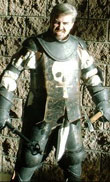
A cinema I know well that runs with 2k xenon's, by overcooling reduced lamp life. Some Osram bulbs were only doing a few hundred hours until the problem was solved.
Posted by Jack Ondracek (Member # 1466) on 06-18-2005, 04:16 PM:
quote: Frank Angel
Someone tell me I can stop worring about too much cooling.
I never thought that cooling was that lamphouse's biggest problem.
In any case... there were two models. One had a taller shroud on top, and a bigger squirrel-cage blower up there, which might be something to consider.
Do you know what the cfm rating is on that stack blower you have? I rather doubt you could overcool an ORC lamp with anything you could insert in the stack.
Posted by Louis Bornwasser (Member # 3063) on 06-18-2005, 04:49 PM:
My take on "overcooling" is that it is urban legend. I have seen so much cooling that turbulence is created near the bulb which is "unsuccessful" in bulb cooling.
In any event, you must turn off the booth exhaust blower when you clean to keep the cleaning towel from being sucked from your hand in the theatres I equip and bulb life is very good (almost too good.)
Louis
Louis
Posted by Robert Harrison (Member # 3202) on 06-19-2005, 03:14 PM:
I used to be so afraid of a bulb exploding that I had a tech do the bulb changes. He never used any protection, by the way. Perhaps because of that, I finally got comfortable with it, using only a face mask. Now, I'm thinking of getting a space suit because it's bulb changing time again!
I must pass this on. I heard a story about a guy who decided he wanted to keep the ends of a bulb and proceeded to remove them with a HACKSAW! Yes, it blew up in his face. How badly he was hurt, I don't know. Also, one of techs from years back had one blow up on him when he wasn't using protection. He had some scars on his face.
Posted by Louis Bornwasser (Member # 3063) on 06-19-2005, 08:34 PM:
I don't typically use protection either....this is a bad example. I am EXTREMELY careful not to put any stress on any part of the bulb.
Obviously a hot bulb is more potent than a cold one. One war story: XBO-2500w/hs was thrown 75 feet against a block wall at a drive in; it did not break. I was afraid to disturb it so I hurled concrete blocks at it from a distance. When it finally blew, I was running away, and had gained some distance, maybe 45 feet. A large piece of quartz passed me by, still gaining altitude at 6 feet above the ground. Luckily it clearly missed me by AT LEAST 2-3 feet.
louis
Posted by John Walsh (Member # 168) on 06-19-2005, 09:28 PM:
You would have to be completely, totally, and absolutely crazy to not at least wear a face shield while changing a bulb. It makes no difference at all whether the bulb is hot or cold, new or old. Part of the problem with bulbs is that they are pretty good at not blowing up .. lulling people into a false sense of safety. I saw a guy once trying to get an adaptor off the anode end by twisting the whole thing, like you would to get a cork out of a bottle.
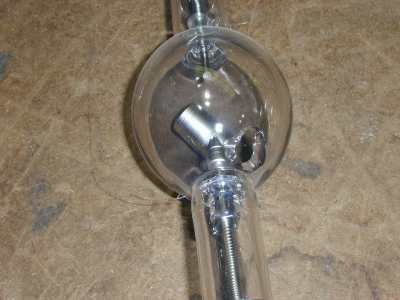
A problem I've been seeing more often is where the heavy anode falls off the end. In the photo below, I think the anode actually wedged itself onto the "hole" it created when it fell off. This may have prevented the air from rushing out, and the bulb exploding.
Posted by Sam D. Chavez (Member # 1841) on 06-20-2005, 12:15 AM:
The thought of Louis running is pretty funny in itself.
Posted by Monte L Fullmer (Member # 2797) on 06-20-2005, 12:35 AM:
quote: Louis Bornwasser
Obviously a hot bulb is more potent than a cold one
Yessir, they is. Especially when you bust a rather warm 6k that died during a soldout performance, even with letting the ends cool down for changeout. Put that bulb in it's clamshell protector and tossed it down the booth stairs to destroy. What a "Ka-BOOM" that big bulb made, plus the concussion shockwave coming from that explosion wasn't bad either.
-Monte
Posted by Tommie Evans (Member # 2674) on 09-17-2005, 01:17 PM:
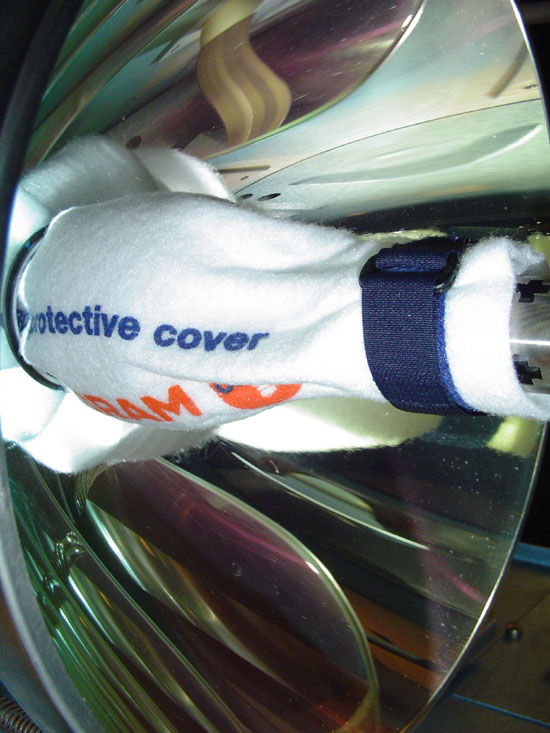
Here is Osram's new blast jacket covering a 4Kw lamp. It is strapped to the lamp by two velcro belts at each end. The jacket can be kept on during the whole changing process and gently removed once the bulb has been installing and both connections tightened. Due to the lack of space the jacket fills it will slide into most of the smallest reflector openings.
During a training seminar the spokesperson dropped a used lamp from waist height - it made a pop similar to a paper drinks carton being stamped on (come on! everyones heard one as a kid ![[Razz]](tongue.gif) ) but nothing got though the jacket. However, the bang it did make sure made me concentrate a lot harder the next time I changed one.
) but nothing got though the jacket. However, the bang it did make sure made me concentrate a lot harder the next time I changed one.
Posted by Marin Zorica (Member # 1716) on 09-17-2005, 02:01 PM:
Did you get that cover with new bulb or you get from osram??
Posted by Monte L Fullmer (Member # 2797) on 09-17-2005, 04:06 PM:
Wonder if that OSRAM cover has a Kelvar inner coating of sorts...especially, for a 4K bulb since they can be a bit nasty when they go. - Monte
Posted by Aaron Mehocic (Member # 15) on 09-17-2005, 04:20 PM:
Edited for clarity below
Posted by Aaron Mehocic (Member # 15) on 09-17-2005, 04:24 PM:
quote: Monte L Fullmer
Wonder if that OSRAM cover has a Kelvar inner coating of sorts...especially, for a 4K bulb since they can be a bit nasty when they go.
Did a 3K about two hours ago in which the new cover didn't seem to have anything extra protective about it. Just a very thick, very dense weave of man-made cloth. I like it. A welcome change given what was said on the previous page. ![[thumbsup]](graemlins/thumbsup.gif)
Posted by Mark Gulbrandsen (Member # 72) on 09-17-2005, 04:32 PM:
quote: Louis Bornwasser
I don't typically use protection either....this is a bad example. I am EXTREMELY careful not to put any stress on any part of the bulb.
I am pretty much in the same boat there Louis!! I only wear my glasses as protection but am also VERY careful when handling and turning any connection. In 25 yers I've yet to have a lamp crack, explode or otherwise explode when I was handling, removing or installing it. I respect xenon lamps much like I respected that 18kv high voltahge line at the TV transmitter ![[evil]](graemlins/evil.gif) !! Now I will usually wear a face shield when I remove very high hour lamps but I've never had one of them go either. The funny thing that I do which is really the correct thing that I should ALSO be doing for myself is to make the customer that is watching me change his/her lamp wear the face shield, gloves, and bullit proof vest is one is available. I've gotten funny comments about why they are so dressed in protection when I'm not...... I always tell em its an insurance liability precaution and they seem to buy that. Heck in 25 yers I've only had two lamps explode both were new and it happened right at ignition... both oddly were Christie Lamps but this has not happened to me now in over 14 years..
!! Now I will usually wear a face shield when I remove very high hour lamps but I've never had one of them go either. The funny thing that I do which is really the correct thing that I should ALSO be doing for myself is to make the customer that is watching me change his/her lamp wear the face shield, gloves, and bullit proof vest is one is available. I've gotten funny comments about why they are so dressed in protection when I'm not...... I always tell em its an insurance liability precaution and they seem to buy that. Heck in 25 yers I've only had two lamps explode both were new and it happened right at ignition... both oddly were Christie Lamps but this has not happened to me now in over 14 years..
Mark
Posted by Alexander Smith (Member # 1769) on 09-17-2005, 06:35 PM:
The fibre-jacket is also being used on Osram 3kW lamps.
We received one last week, in an all-new box which seems
to consist entirely of spongy foam.
Coming from the school-of-thought of always having new
Xenons being supplied in blast shields, it's a bit of a
culture shock. It can only be beneficial. If Osram say the
fibre sheath will contain the force of any lamp explosion
then who am I to say it won't?
The apparent flimsy-ness of the sheath further reinforces
my respect for Xenons.
Alex.
Posted by Daryl C. W. O'Shea (Member # 1303) on 09-17-2005, 07:40 PM:
With no space for the quartz to accelerate you're pretty safe. The same principle is behind why you should put heavy things in your trunk right up against the rear seat backs.
SQP has been using something similar, a rubber peel-off coating, since around the start of the year.
Posted by Wolff King Morrow (Member # 2226) on 09-18-2005, 02:44 AM:
I started getting the new packaged 4ks last month. It was a bit of a shock for me, having been so used to the plastic shell. When I got the fabric sheath guys in, I said "WTF is this crap? Oh well, if it works, it works."
Posted by David Graham Rose (Member # 1450) on 09-18-2005, 01:56 PM:
Gretings All From Cambridge
When I worked at the ABC Nesquick House, a former colleague of mine used to enjoy the pleasures of the ladies who worked in the oldest profession, who worked from the neighbouring flat. Apparently, he used to take used 2K Xenons that the Chief had disposed of and use them in the antics for which he paid them. I always remember the famous time when he was due to report for a shift and his wife rang up to tell us he was in hospital after (quote) 'a nasty fall in the garden whilst repairing his greenhouse'. Needless to say he had only been seen an hour before being carried out of the den of iniquity 3 hours before on a stretcher!. How we laughed!
The Chief always made sure from that day to the day he retired (with a hernia) due to ill health, that said person was always the one who would be on duty when a lamp was changed.
Ah the heady days on single screen ABC's - can't beat them!
From a stormy Cambridge, I bid you all Goodnight
David
Posted by Tommie Evans (Member # 2674) on 09-19-2005, 10:10 AM:
Hmmm, don't xenon give of a white light, not red?
Posted by Frank Dubrois (Member # 3042) on 09-23-2005, 10:10 AM:
After reading all this, I'm scared. I've been changing bulbs for years and never had an incident until about 2 weeks ago. I changed a 4k bulb (no protective gear as only a face mask is offered in the booth) and the bulb seemed to install fine with no complications. I left. The projectionist came in and ran the projector and said with in a minute of ignition, it blew. He mentioned something about this bulb being cracked. I assumed if the bulb was cracked (small crack at the + end) the bulb would have or should have blown immediately or possibly on installation when the crack formed. First of all, how far from disaster was I when I installed it, and, if only a face mask is available in the booth, should I even bother to change these anymore? We are instructed to get roughly 50% over manufacturers recommended hours out of bulb...does that put us (and out equiptment) at a substantial risk? I plan on printing out these responses and turning them into the corporate office in hopes to get protective gear. Because of money concerns, I dont think anything will be done about the the extra hours on the bulb, but so far, operational wise, we havent had any issues. I am concerned about uninstalling a weakend bulb now. Should the plastic wrap that came with the bulb be wrapped around an old bulb before trying to take it out?
Thanks
Posted by John Walsh (Member # 168) on 09-23-2005, 11:37 AM:
Almost every bulb manufacturer has documentation listing safety procedures. I would suggest: goggles, (protects the eyes-little bits of glass will fly up under a face shield) face shield, (protects your face) gloves, flax jacket with sleeves (protects upper body).
To borrow and twist a phrase from motorcyclists, 'If your safety isn't worth anything to you, then don't wear any safety equipment.'
Posted by John Pytlak (Member # 331) on 09-26-2005, 07:12 AM:
Frank: The NASA Glenn Research Center in Cleveland uses xenon lamps for solar radiation simulation and other uses. They have an excellent safety manual that details all the procedures that should be used:
http://smad-ext.grc.nasa.gov/gso/manual/chapter_26.pdf
quote:
Glenn Research Center Glenn Safety Manual – Chapter 26 High Pressure Arc Lamps (Xenon)
BMS Document: GRC-M8300.001
Revision Date: 10/04 – Biannual Review
CHAPTER 26 - HIGH PRESSURE ARC LAMPS (XENON) Table of Contents 26.1 Scope 26.2 Applicability 26.3 Authority 26.4 General Precautions for Handling All High Pressure Lamps 26.5 Regulations Applicable To Use of High Pressure Lamps 26.5.1 Lamp Enclosures (Shielding) 26.5.2 Lamp Installation 26.5.3 Lamp Operation 26.6 Hazards of High Pressure Lamps 26.6.1 Skin Injury 26.6.2 Eye Injury 26.6.3 Ozone 26.7 Storage of High Pressure Lamps 26.8 Procurement of High Pressure Lamps 26.8.1 Purchase 26.8.2 Shipping 26.9 Disposal of High Pressure Lamps 26.10 Training 26.11 References
Posted by Frank Angel (Member # 248) on 09-26-2005, 07:45 AM:
quote:
I am pretty much in the same boat there Louis!! I only wear my glasses as protection but am also VERY careful when handling and turning any connection. In 25 yers I've yet to have a lamp crack, explode or otherwise explode when I was handling, removing or installing it. I respect xenon lamps much like I respected that 18kv high voltahge line at the TV transmitter !!
Mark, I am really surprised that you are less than enthusiastic about observing known proper safety precautions. I mean, the fact that you have not been sliced and diced by an exploding bulb in upteen years doesn't lessen the threat of an exploding bulb, the risk of which remains constant no matter how how many times good luck has been on your side. It is as illogical as the motorcyclist who says he hasn't taken a fall in 25 years of biking, so what's the point of wearing safety gear?
You know very well that mishandling a bulb is probably on the bottom of the list of what causes bulbs to explode. The top reason is that there is a defect either in manufacturing or one precipitated by the environment it is placed in; you can't tell when this is going to happen. Explosions happen no matter how carefully a bulb is handled. And as for only wearing face protection, you know how small a shard of quarts has to be to sever important nerves in your hands and wrists that could severely and permanently limit your dexterity? To say nothing about arteries in the neck that can kill you if they are cut? Then there are those other most excellent favorite parts of the body that guys want to protect at any cost. Hey, gimme the coat that goes down to my knee caps!
So come on brother Mark, cover up EVERYTHING....we don't want you to be one of the guys who has a horror story that you can post on the "What's the worst accident you ever had in the booth while handling a xenon bulb?" thread. We love ya, man.
Posted by Frank Dubrois (Member # 3042) on 09-27-2005, 10:20 AM:
Perhaps I misread, but are there documented cases where a bulb explodes when its being removed even though it wasnt dropped or knicked? If all power is disconnected, and you take the leads off, can it just blow?? Thats scarey as hell. Does the fact that we go sometimes more than 50% past the manufacturers recommended life span? I'd hate to think that the company is putting us at risk just to save a few bucks.
Posted by John Pytlak (Member # 331) on 09-27-2005, 10:28 AM:
Any handling of a lamp may accidently put it under enough stress to cause explosion, for example a twist as you tighten the anode lead, or accidently bumping the lamp on the base of the reflector. Lamps run too hot or well beyond their warranteed life may have weakened seals or(vitrified)quartz. Without proper safety protection, an exploding lamp may be the last thing you will ever see.
Posted by Paul Mayer (Member # 355) on 09-27-2005, 12:04 PM:
Here's a recent 'documented' failure for you (firsthand account). My buddy Dave is getting ready to install a new 5k. We have our face shields on and Dave is just starting to lift the cover off the bulb's box when we both hear a muffled "pop." He pulls the lid off, and there in the box are the shattered remains of a brand new bulb in its plastic safety housing. First time I've seen one go like that.
So yeah, occasionally these lamps can just 'go' even when there's no obvious stress being applied. But I think these cases are pretty rare. Catastrophic failure of the quartz seems to happen most often while the bulb is operating, when the internal pressure is much higher than it is when the bulb is at room temperature. But even at room temperature they are still pressurized and thus need to be treated with respect.
Powered by Infopop Corporation
UBB.classicTM
6.3.1.2