This is topic Who has had a fire somewhere in their projector? -> OT: Voltage around the world in forum Film Handlers' Forum at Film-Tech Forum ARCHIVE.
To visit this topic, use this URL:
https://ft-forum.com/ft/cgi-bin/ubb/ultimatebb.cgi?ubb=get_topic;f=1;t=007295
Posted by Olivia Coleman (Member # 3193) on 06-30-2005, 09:56 AM:
![[Embarrassed]](redface.gif)
Last week I had a bulb that for some reason wouldn't ignite. For an hour I spent troubleshooting it, on and off the phone with the tech. Till the manual button was turned on and I leaned against the backdoor, it struck. Problem though, was there was an extremely bad flicker. It was running at almost 30 amps less then is should. So the tech informed me I will have to change out the diodes in the rectifier...
So I went in the next morning (a little later than I wanted to as I closed the night before) to change them out before our first show... Kiddie film: "Shrek 2," which I knew they would not sit through that bad flicker. So the tech informed me the night before there is a small arrow somewhere near the threads of the diodes.... Now apparently these are foriegn made as the 'arrow' did not look like the typical arrow. I couldn't figure it out so I ended up putting some in the wrong way only to find an electrical smell when trying to get the lamp to strike. Shut the projector down again, and put them in the correct direction. This time I neglected to see one wire that was to be connected to the bottom set of diodes where the other two didn't have but the two currents connecting. Small fire started when trying to get the lamp to strike. Shut the projector off again. Attached the wire. Lamp struck. Thought all was good til another manager arrive to assist me. He was the one who found a burnt wire, which was not the one I had forgotten to connect. He then attempted to fix that. Another fire started... This one was a little fun as we shut everything down and opened the back door to it still on fire!
So we ended up taking that piece out of another projector to get that one working. Of course this was our largest house! There was no way we could salvage the part due to the fire melting the tiny board the wires were attached to. The next day the part arrived so we could get the other projector up and running. When the tech called to find out if it had arrived, he asked if I put it in yet. I told him I didn't want to end up causing another fire and destroying that part, again. He chuckled and told another projectionist, who is a friend of mine, I didn't want to start another fire...
We have everything working properly now.
I was just curious how many other projectionists out there have had small fires somewhere in their projectors??? ![[Roll Eyes]](rolleyes.gif)
[ 07-14-2005, 11:32 PM: Message edited by: Adam Martin ]
Posted by Ken Layton (Member # 133) on 06-30-2005, 10:37 AM:
For something like this why didn't your tech come out in the first place to troubleshoot & confirm bad diodes? If there was a bad diode(s) then then tech should change them.
Posted by Mark Gulbrandsen (Member # 72) on 06-30-2005, 08:01 PM:
I have to wonder after reading that story if there is even a tech in her area......
Ken is right about having a qualified tech change out the diodes. Not only can they be over tightened(at both ends!) but most that are not familiar with the procedure seem to ignore correct application of heat sink compound.
Mark
Posted by Rick Long Jr (Member # 541) on 06-30-2005, 08:36 PM:
I have read this a couple of times, and am not sure what to think now. A big part of me wants to think that it's a joke. Sureley no one would attempt this without knowing what they're doing, would they?
THE FACT THAT YOU KNOW WHICH END OF A SCREWDRIVER TO HOLD DOES NOT MEAN YOU ARE QUALIFIED TO USE IT!
If this is not a joke, and IF the tech didn't know Olivia personally, they should have been at least able to feel out the technical abilities of the operator here and determined that this is obviously the WRONG person for the job.
I may not be the right person to say this but, given what you've posted Olivia, its obvious that you were in over your head, and have cost your theatre much more money in repairs than was probably necessary. IF you got it to light with the diodes in wrong, you've probably taken hours off the bulbs life, if not screwed it completely.
I don't want to seem like a hardass, but unfortunately I see this all the time. People with a little knowledge doing dumb things and blowing stuff up. I do acknowledge that I have no idea of your projection or technical skills - I'm sure you're a very competent operator, but if you don't know what you're doing DON'T TOUCH IT!!!!
You could really hurt yourself. Not to mention the equipment.
As to the topic, yes, In my 20 years as a tech, I've seen all kinds of things catch fire in the booth. Crown amps... Ashly amps... Strong switching rectifiers... Kinoton ignitors...Cinemeccanica ignitors...Speco platters...etc.
Posted by David Stambaugh (Member # 1102) on 06-30-2005, 08:37 PM:
Olivia, Do you work at a Regal? Where does your service tech work out of? I'm gonna guess Portland.
It's great to be enthusiastic and willing to go the extra mile. But this whole story sounds like the setup for a costly disaster.
Posted by Olivia Coleman (Member # 3193) on 06-30-2005, 09:28 PM:
I am qualified to do diodes (level four) and the tech is out of Salem. Yes, David, I am from a Regal. The tech was in Portland opening the Bridgeport when this happened and was the one who instructed me to do the diodes. I just have never done them before as I have only been certified level four for a few months and before we didn't have any go out.
As to you, Rick, I am rather offended you assume a lot of ![[bs]](graemlins/bs.gif) about me. Don't you remember when you first were learning, you didn't know everything either, did you? I learned what I did wrong and it won't happen again. My tech wasn't even upset about the fire as happens! Oh, and the bulb struck after I had corrected the direction of the diodes, FYI!
about me. Don't you remember when you first were learning, you didn't know everything either, did you? I learned what I did wrong and it won't happen again. My tech wasn't even upset about the fire as happens! Oh, and the bulb struck after I had corrected the direction of the diodes, FYI!
Posted by Rick Long Jr (Member # 541) on 06-30-2005, 09:56 PM:
I did in fact NOT assume a lot of about you.
The wording of your post did indicate that you are obviously inexperienced, and I felt compelled to post. It is frustrating to hear of this happening. I will be the first to admit that shit does happen. A lot. But I was concerned that perhaps someone who hasn't been trained on the proper troubleshooting and repair of xenon powersupplies was doing so.
You say you are "qualified to do diodes (level four)". Well, good. Not sure what this means. Did you have a multimeter to check the diodes? Have you had any formal electrical theory training?
I'm sorry if I've offended you in any way. As I said, I'm sure you're a fine operator, but I see this far too much. but if you've done any lurking on this site at all, you'll learn that people in this industry can be very passionate about their profession.
Posted by David Stambaugh (Member # 1102) on 06-30-2005, 10:59 PM:
I don't think anyone was trying to pick on you Olivia. It was more an honest concern for your own safety. ![[Big Grin]](biggrin.gif)
Is this the same tech that services Eugene? He's doing a pretty good job keeping Cinema World 8 going. ![[thumbsup]](graemlins/thumbsup.gif)
Posted by Michael Schaffer (Member # 1204) on 06-30-2005, 11:49 PM:
I think Olivia should be applauded for the honesty with which she tells the story.
It is not really her fault that she is expected to perform this kind of operation with minimal training and apparently not the right equipment.
I never expect or allow any of our people to work inside the power supply. Just the regular phone troubleshooting stuff - "triplecheck the breakers", "is the green light on", "are the fans running", "does it click in the bottom of the console", etc. When it becomes apparent that some work on the actual power supply is necessary, I always do it myself or call in an outside technician.
On the other hand, after step 1, she should have left the thing alone and waited for the technician, even though it did work in the end. When stuff starts smelling bad or burning, it is usually time for more in-depth anaylsis. That there was not more damage in this case is mostly luck.
Posted by Mark Gulbrandsen (Member # 72) on 06-30-2005, 11:58 PM:
quote: David Stambaugh
I don't think anyone was trying to pick on you Olivia. It was more an honest concern for your own safety.
That statement is very true and exactly what I was thinking. Chains seem to have little to no concern for an employees safety, or their customers by allowing employees with little to no training to do repairs of that type. No matter what "Level" you are at 3 phase can still kill you, single phase too for that matter. One of the chains we service does not have "Levels" so apparently they realize that anyone can be killed ![[Wink]](wink.gif) . They don't change diodes... they call us.... and every once in a while I get to visit Lake Powell as a result
. They don't change diodes... they call us.... and every once in a while I get to visit Lake Powell as a result ![[Smile]](smile.gif) .
.
Be Careful and live long!
Mark @ CLACO
P.S. In 25 years of doing this I have had very FEW things catch on fire on a booth. One Kneisley rectifier, one QSC amp, and many Essanay changover coils.... the latter being one of the more dangerous things in a booth IMHO, thats about it!
[ 07-01-2005, 12:04 AM: Message edited by: Mark Gulbrandsen ]
Posted by Josh Jones (Member # 447) on 07-01-2005, 12:56 AM:
We had a diode lead smoke and melt down, merely because the diode shorted. we upgraded the diodes and havent had a problem since
JJ
Posted by Olivia Coleman (Member # 3193) on 07-01-2005, 01:05 AM:
I AM young and inexperienced in some areas but I am not stupid. I did know, when I started the work, to have the current going in the correct direction. I blame impatientness and not a lot of sleep: only 3-4 hours! I will admit I didn't first inspect the diodes close enough and that is how I messed up. I do learn from my mistakes--isn't that what educates us?!
If I had more motivation when I was younger, I probably would have gone to ITT Tech. Oh well.
I too have passion for my work. Too many times I want to strangle a few people. I take it too personally when a print gets scratched. We had a really good record for a long time then we had some people *uck up royally!!!
David, yes, our tech is the same for Eugene. He is the tech for Idaho as well, and Alaska.
He [the tech] did instructed me on how to do the diodes. I just didn't pay close enough attention when actually working on them. Our cordless phone sucks near the projectors.
Posted by Michael Schaffer (Member # 1204) on 07-01-2005, 01:15 AM:
Do you have a multimeter in the location? I don't pay much attention to what it says on the diodes about the direction, I always test them. Yes, I have seen mislabelled ones.
It is never too late to go back to school if you desire to improve your knowledge and skills.
Posted by Emma Tomiak (Member # 1862) on 07-01-2005, 01:58 AM:
Just curious; is it unusual for day to day operators to do things like change diodes? Do large chains (and even independent theatres) usually call a technician to do this?
Posted by Olivia Coleman (Member # 3193) on 07-01-2005, 02:16 AM:
quote: Emma Tomiak
it unusual for day to day operators to do things like change diodes? Do large chains (and even independent theatres) usually call a technician to do this?
Yes, it depends on who the operator is. I am the booth manager's right hand and she had just gotten back in town from being at other theatres, with a cold. So I did not want to disturb her. If I wasn't there I would have probably been called about it any ways to try to fix it. Most managers there are either not qualified or do not do that sort of work. There is only 3 of us there that do, out of twelve managers.
Posted by Phil Hill (Member # 371) on 07-01-2005, 02:26 AM:
I agree 100% with Rick... By your own statements, its apparent you were over-your-head and should have called in a qualified maintenance tech to do the repair.
Not only did you endanger yourself, but you also put at risk the facility, the patrons, and cost the company $$$ cuz of your inexperience.
Sorry to be so blunt, but one of my pet peeves is those that think they know what they are doing but in reality do not.
The fact that you were unsure of the diode polarity and your lack of using a VOM to verify the correct polarity points to your inexperience.
Please note all yous: Calm your feathers as I'm NOT "Picking" on anyone... Just stating the fact that there are many people that attempt to "fix" things that they REALLY have not the expertise for the job.
I sincerely give Olivia credit for her post and hopefully ALL will learn from this as to when to call in more experienced people when the problem is beyond them.
Posted by Monte L Fullmer (Member # 2797) on 07-01-2005, 02:56 AM:
Good ol' Mr.Lane, Olivia's tech. He's actually an excellent tech to have for her district being under Mr.Hector, her operational D.M. But REG keeps their techs busy and sometimes, they have to be assigned to other districts on a temporary basis to help out whereever they are needed.
Yes, if Olivia is level 4 qualified, she has been trained well. For this level is the highest level to gain for use for in-house technical applications, and it takes quite a bit of learning, studying, determination and training to gain level 4 with REG.
Granted, I even get turned around with diodes for the Christie recifier bank at times for not paying attention to the diode symbol for current direction, but it's unfortunate that the ones installed in her diode bank got switched around, but give her massive credit for finding out the problem and correcting it herself.
Course, putting diodes in those Strong 61000 reactance recifiers is quite the pain to do, and that's just a simple, single phase bridge diode setup.
Olivia's tech is a very good friend of mine, and we have quite the conversations about techinical topics-almost like brothers sharing the same topics pertaining to the technical world.
If I stayed with REG when the EDW/UA takeover took place in 2002, I would have been that tech that she would have called. But family health situations kept me closer to home thus had to make the sacrifice and leave REG and seek other companies to work for that was closer to home.
-Monte
[ 07-01-2005, 03:42 PM: Message edited by: Monte L Fullmer ]
Posted by Adam Martin (Member # 641) on 07-01-2005, 03:13 AM:
I have never changed a diode. ![[Razz]](tongue.gif)
Posted by Phil Hill (Member # 371) on 07-01-2005, 03:15 AM:
I can help you with that, Adam...
Posted by Brad Miller (Member # 2) on 07-01-2005, 04:46 AM:
Adam, I thought you once worked for Cinemark? That's impossible, as it is (or at least was) mandatory training before you could run the booth on your own.
Posted by Stephen Furley (Member # 1277) on 07-01-2005, 04:58 AM:
I've had my fair share of fires, though not in projectors.
Mother set fire to kitchen (twice), chip pan cuaght fire, ceiling had polystyrene tiles; not a good idea, the smoke is incredible.
Third fire was in a corridor at work; somebody set fire to a plastic dustbin, again loads of thick black smoke.
The last one was a girl in a chemistry lab where I had been sent to take some photographs. She spilt a beaker full of solvent on her clothes, and then as she jumped back, put her sleeve into a Bunsen burner flame. Fortunately we managed to put the flames out very quickly, and it was only the solvent that was burning, and not her.
All of this was in just a few years in the early '80s. Thankfully I've had no more fires to deal with since then.
Posted by Mark Gulbrandsen (Member # 72) on 07-01-2005, 07:52 AM:
quote: Emma Tomiak
Just curious; is it unusual for day to day operators to do things like change diodes? Do large chains (and even independent theatres) usually call a technician to do this?
Emma, Of course they call a tech.....at least out here they do. Chains like Regal having employees do this and having just one tech cover that large an area... no matter how good he is..... has played a big part in the downfall of quality in modern cinema. If its an emergency thats far away I will also talk somene through it over the phone with them acting as my hands. But the theatre MUST have a VOM available ... if they don't then they wait till we arrive. Overall I've yet to be impressed by any Regal location... or AMC, carmike(the worst!), Cineplex, and so on and this is NOT a reflection on Olivia or her talents.... goes right back to the top. There is always very little of any quality to be found behind the glitz of the lights in large national chain. Independents in large citys are always the better place to go see a film as they put forth alot of extra effort to compete with the nationals, indeed some do alot better at the B.O. as a result.
Mark
Adam, Call me and you can be my "hands" ![[evil]](graemlins/evil.gif) for a diode change out.
for a diode change out.
MArk
Posted by Scott Norwood (Member # 30) on 07-01-2005, 08:15 AM:
I've never changed a diode, either, though I'd have no problem changing Sil-Tubes on old-style rectifiers (they screw in like lightbulbs and are near-impossible to install improperly). No one has shown me how to work on rectifiers and the ones that I have used with are reliable enough that it hasn't been a problem (and most booths don't have spare diodes, anyway). I would only work on this stuff if I had a technician I trusted on the phone to talk me through it. I'd like to learn how to do rectifier work safely, but, so far, haven't had the opportunity.
As for equipment catching fire: I've never had it happen personally (save for a threading lamp cord with deteriorating insulation), but I've heard of instances where smoke came from the following items: AW3 platter transformer, Christie rectifier, Strong rectifier, Simplex threading lamp transformer, and maybe other stuff.
Posted by Jason Burroughs (Member # 68) on 07-01-2005, 10:06 AM:
At Cinemark locations, particularly those with CFS consoles, its not uncommon for us lowly humble operator scum to change diodes.
BTW, its not that difficult to change diodes, and there's no reason that theater staff shouldn't be trained and be able to change diodes. Its not that difficult. The need for "formal eletrical theory training" is complete BS.
Olivia made a mistake, and has owned up to it. Those that hold firm to the idea that she shouldn't have changed it, and waited for her tech, need to get their heads out of their collective asses.
Posted by Rick Long Jr (Member # 541) on 07-01-2005, 10:21 AM:
As I indicated Olivia, it was not my intention to offend you in any way, but if you've been trained as you say you have, you must know that there can be some pretty hazardous stuff in the booth. I've been doing this for a while now, and even if I was sure the power was off, wouldn't think of sticking my hands into a rectifier without confirming there was no power with a meter. I've seen broken bleed resistors on the capacitors, which mean that there is still the chance of getting zapped even if the unit has been off overnight!
And as Michael said, you can't always rely on the symbols on the diodes. I have seen at least two batches of IR 70HF60 diodes mislabeled from the factory over the years. Always use a meter.
You said yourself that you spent an hour troubleshooting it, and I simply don't see how you, or anyone for that matter, could troubleshoot a powersupply without a meter and the knowledge on how to use it.
Again, sorry if I offended you, but I've seen far too many times where someone who has had some "training" cause more trouble than you could imagine. I have no idea what "level four" means - things are different here - for all I know you could be more qualified than me! But I feel that the training for changing diodes should involve more than simply knowing HOW to change them.
The main thing is, of course, that you learned from this.
![[beer]](graemlins/beer.gif)
Posted by Louis Bornwasser (Member # 3063) on 07-01-2005, 11:24 AM:
I get emergency calls via phone from a wide variety of people. My concern for you is the same as with my own customers:
1. Can I be certain that this person will be POSITIVELY get ALL OF the power off.
2. Is this a rectifier design that allows EASY access to the diodes?
3. Is a customer repair likely to be permanent? Of am I going to have to go anyway?
Of course this requires a bit of judgement on my behalf.
In other words: Can I be certain that the customer will be safe and sure? That is the final test.
Louis
Posted by Randy Stankey (Member # 64) on 07-01-2005, 12:10 PM:
Yes, it is quite easy to catch a projector on fire (and a few other nasty things) if you mess up changing the diodes. I have seen the results.
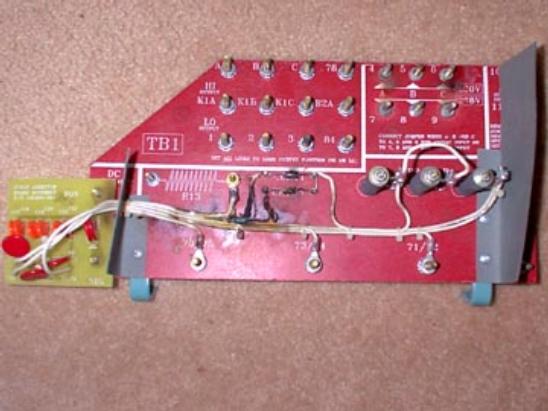
I've seen a CFS lamphouse blow its guts when somebody frigged up the diodes, too.
The answer is very simple: If you haven't been SPECIFICALLY SHOWN how to change diodes, DON'T DO IT!!
Not only can you catch a projector on fire, blow up a lamp and/or damage a projector beyond repair, but you can GET KILLED if you don't take certain safety precautions! (e.g.: Discharge capacitors! The jolt is enough to potentially stop your heart!)
If somebody in the know (i.e.: Your technician.) teaches you how, then signs off to give you permission, go ahead and change the diodes.
If not... Don't F*** with it!!
Posted by Leo Enticknap (Member # 534) on 07-01-2005, 04:23 PM:
Just as an aside, I can't help thinking that the title of this thread would have got some rather different responses if it had been written before 1950.
Thankfully, the only fires of that sort I've ever experienced have been ones I've started myself, involving elements which have decomposed well beyond the point at which they can be viewed or printed. They've all been out in the car park with no other combustible material within at least 20 yards. My excuse for starting them is that once nitrate has started to go sticky, it's probably so volatile that the sooner it has been destroyed the better.
On the experience issue, I think it's worth pointing out that the only way someone goes from being inexperienced to experienced is by doing the job and thereby getting the experience. And no-one I've ever known, me included, has ever got experience of anything without making the odd mistake.
Posted by Mark Gulbrandsen (Member # 72) on 07-01-2005, 06:54 PM:
quote:
I've seen broken bleed resistors on the capacitors, which mean that there is still the chance of getting zapped even if the unit has been off overnight!
Rick,
Excellent point! An example of that happened to me just this week.....
In the old 6280005R switching rectifiers from Strong which I repair quite a few of there is a 12K 25 watt bleeder resistor located right next to the two large blue capacitors to discharge them over about a 10 minuite time period. HOWEVER..... When the main 16A euro type fuse blows there is a bank of smaller capacitors located on the main PCB that are essentially disconnected from the one and only bleeder. This is an extremely dangerous situation whose voltage, AS HIGH AS 350 VOLTS DC is present at the outer contact of the fuse holder... remains there a VERY LONG TIME, ALMOST INDEFINATELY and easily touchable by anyone. There is quite possibly ENOUGH ENERGY STORED TO STOP SOMEONES HEART . THOSE CAPS ON THE BOARD DID NOT DISCHARGE EVEN AFTER A WEEKS TIME .... so one can wait the stated 20 minuites or a week before inserting a new fuse only to have that new fuse also blow at a loss of 8 bucks. I talked to Stong about this today and the response was "I'm not surprised there isn't a bleeder". Yes, this is a version one or two rectifier from 1990 and I can't really complain about that comment... its difficult for a manufacturer to remember that far back about every trivial little thing and they mentioned "that I can install one".
So what I did was to install a 100K 20 watt bleeder resistor for the bank of caps on the main board, located it right next to the main bleeder for convenience. This cost me about 2 bucks and 15 min of time to accomplish(not counting removing the 1 pound of hardware securing the main cover). This way both sets of caps are discharged well within the 20 minuite time it says to wait before removing-installing a fuse. A new fuse can then be safely installed with it blowing.
Just thought I'd pass this one along......
Mark
Posted by Alexander Smith (Member # 1769) on 07-01-2005, 07:08 PM:
While I've never had any need or desire to change diodes
on rectifiers, I have had to extinguish a small fire in the
base of a Strong Highlight II console where the rectifier
sits. I doubt we'll ever know the real cause of the problem
but it's likely one of clamps for the the high current leads
to the lamp became loose, resistance increases, gets hotter
and sets the cable insulation on fire.
Result is the need to replace that cable, which only comes
as a complete ass'y to the anode connection stud. This was
last year and we're still waiting for the part.
Our technician made the best job he could of cutting back
the cable, until he had reached a (relatively) undamaged
section to clamp in to the replacement PSU.
It has become a running joke with myself and the UK agent
we use to buy Strong parts from about this cable... :-)
Alex.
Posted by Mark Gulbrandsen (Member # 72) on 07-01-2005, 07:20 PM:
Really that cable should not need to come from Strong. It could easily be made up from cable obtained locally. Either you need to cable your agent in regards to getting it locally or he needs to cable the tech back to get the cable locally. At any rate someone needs a good cabling!
Mark
Posted by Phil Hill (Member # 371) on 07-01-2005, 07:49 PM:
Mark, you're absolutely right about the poor engineering and the deadly hazard of the piss-poor design of that power supply. I found that out many moons ago as you did while replacing that fuse in a power supply that sat for 2 weeks and then make a gigantic arc when attempting to replace the fuse. Scared the hell out of me... good that I was wearing my Depends!
It's another sad commentary on the engineering at Strong. I wish I could say things have improved there, but (In my personal experience) their electrical engineering is just as bad as their mechanical engineering.
I wish the F*CK the powers there would oust whoever is in charge of engineering/QC/etc and get some qualified person that would kick some ass and ***FORCE THEM*** to make quality products!
(Gosh, when will hell freeze over?)
They are not only damaging themselves, but the whole industry.
Posted by Richard Hamilton (Member # 321) on 07-01-2005, 08:09 PM:
Phil,
I laughed my ass off reading your post, I wont comment, but i will go to sleep tonight with a smile on my face!
Thanks,Rick
Posted by Mike Spaeth (Member # 524) on 07-01-2005, 08:10 PM:
I had the cone on a Christie igniter burn up once.
Posted by Mark Gulbrandsen (Member # 72) on 07-01-2005, 08:54 PM:
quote: Mike Spaeth
I had the cone on a Christie igniter burn up once.
Now what the hell does that have to do with the fact that Phil was wearing his Depends during the arc over..... ![[Eek!]](eek.gif) ?
?
At least there is a simple fix so the new fuse doesn't blow but I have to wonder how many hundreds of people have blown NEW 8.00 fuses thinking the rectifier was bad and then sent it in for repair..... ![[eyes]](graemlins/eyes.gif)
Mark
Posted by Randy Stankey (Member # 64) on 07-01-2005, 11:27 PM:
quote: Alexander Smith
...I have had to extinguish a small fire in the
base of a Strong Highlight II console where the rectifier
sits.
While I'm sure that you, Alexander, know how to put out a fire I think that newbies should be reminded how (or how NOT) to put out an electrical fire.
Obviously one shouldn't use water but relatively few people know that, although standard dry-chem fire extinguishers are safe to put out electrical fires with, they are NOT good to use in the projection booth. The powder that comes out of them will spread over a seemingly HUGE area and damage any film or equipment that it comes in contact with! Some types of dry-chem powder are corrosive to electronic devices!
So, what happens is, there is a small, teensy-weensy, little fire and somebody panicks. They get a dry-chem extinguisher and spray it all over the booth. Sure, they put the fire out but they put their whole operation out of commission until the mess can be cleaned up and equipment/film can be inspected for damage and replaced if necessary!
It would be prudent for new people in the booth to check what type of fire extinguishers there are and how to (or how NOT to) use them. If you have a dry-chem extinguisher that you aren't sure is safe for electronics try to use it only as a last resort. If you have a gas-type extinguisher (CO2, Halon or similar) that would be the optimum thing to use. I know it's hard to think clearly when a fire breaks out but a minute's worth of forethought and a second's worth of quick thinking could save you and your company THOUSANDS of dollars!
Honestly I tell people NOT to try to fight fires unless they have to.
When that Christie in the picture, above, caught on fire they called me when it was still burning. The kid on the other end of the line wanted to get an extinguisher but I told him not to.
The first thing you should do when a projector catches fire is to shut off the breakers... ALL OF THEM... including the ones on the wall panel. The next thing you should do is to see how bad the fire is. If it's a little one like mine, maybe all you have to do is let it burn itself out. (It IS inside a metal enclosure, for cripes sakes!)
If the fire seems too big or if you think it will get outside the metal projector enclosure the best thing you can do is to HEAD FOR THE FIRE EXIT and pull the alarm on your way out! Let the professionals deal with the fire! I'd rather inconvenience a few customers than have somebody get killed because he thought he could play fireman!
Once I get to know a person better and I can judge their ability, only THEN would I teach them how to put out fires.
Posted by Mark Gulbrandsen (Member # 72) on 07-02-2005, 09:32 AM:
Halon equipment should be installed in all booths and is the only non-damaging extinguisher in existance. Its unfortunately the most expensive.
Mark
Posted by Pete Naples (Member # 761) on 07-02-2005, 02:19 PM:
Mark, IIRC Halon as a fire extinguishing agent is illegal in the UK and probably Europe as a whole, it's to do with the damage it does to the atmosphere, and it's nasty habit of extinguishing human life with the fire, too many people died as a result of using it in confined spaces. Unfortunately as you rightly said, it's about the best thing there is for dealing electrical fires.
Alex, are we talking about the machine I repaired years ago, or has another one burnt up a cable? Either way it shouldn't be a problem for the workshop guys to make you the appropriate cable/stud etc., if getting the bits out of Strong is proving difficult.
Posted by Phil Hill (Member # 371) on 07-02-2005, 03:07 PM:
Pete is absolutely correct as to the restrictions and dangers of using halon for fire suppression. Halon is a non-toxic, colorless and odorless gas. It is now known to be environmentally damaging and it's production is being phased out and being replaced by more practical systems.
At a Midwest US 1570 dome installation I did many moons ago, the owners insisted on using ridiculous levels of security to gain access to the booth. Bulletproof glass walls, palm-readers to open the doors, and a halon "sprinkler" system.
Since the fire is extinguished by displacing/removing the oxygen in the area, all personal were required to have their own personal life-support air tanks and full face mask within easy reach at all times while in the booth in case of the system was activated.
Just an additional thought: There were NO life-support tanks for us installation "guests". I guess we would have to club to death the operator and use his mask.
Posted by Randy Stankey (Member # 64) on 07-02-2005, 10:41 PM:
I thought that installed Halon systems had to have a pre-signal alarm before the gas was released so that people would know to leave the area.
One of the main computer rooms at the school I went to in Boston had an installed Halon system. There were horns and flashing lights that went off for something like 30 seconds before the gas was released. All the doors had one-way locks with electronic strikers so that, once the system was tripped, you could open the doors to get out of the room but you couldn't get back in. The computer room was walled-off into sections so that Halon could be released in one area but not in the others. That way people only had to run for about 25 feet to get to an exit. Then, once the airtight door closed behind them they could exit the rest of the building in a mostly normal way without having to worry about being asphyxiated by the gas.
There were signs with big letters on all the entrances: "Halon gas. -- If this alarm sounds leave the room immediately!"
I'm sure it was all re-freakin-diculously expensive!
Posted by Monte L Fullmer (Member # 2797) on 07-03-2005, 03:11 AM:
Shoot, I remember seeing bottles filled with Carbon Tet hang in booths mounted in a lead hammer spring device, so when it got hot in the booth, the lead let go and the hammer slammed in the Tet bottle to extinguish the fire. Course, this was about 30 plus years ago when I last saw this.
Posted by Alexander Smith (Member # 1769) on 07-03-2005, 05:58 AM:
Peter; I don't remember which machine you repaired. It was
screen 4 which was on fire. I used CO2 because it's the only
kind of fire extinguisher in the booth.
FWIW the engineer wants to have the complete cable ass'y due
to the soldering technique used to attach the cable to the
lamp connection stud. The only kind of soldering I'm competent
at is with standard tin/copper solder (which has replaced lead
alloy) for small electronics. Therefore I'm not in a position
to argue the case for replacing the cable ourselves.
Alex.
Posted by Phil Blake (Member # 2012) on 07-03-2005, 11:29 AM:
My most memorable fire was in the works of a BTH carbon arc lamphouse at the drive in , on one night in 1977 , the opening night of Star wars , and we had the state manager of 20th century fox on the premises that night for the grand opening. By the time he came into the box with his hamburger we had it fixed . (phil handles soldering iron like a light sabre).
My number 2 projectionist just recently informed me of his holiday overseas where a kind friend let him stay at his town house in Berlin Germany . He repayed his friend by accidentally burning the house to then ground ! (another chip fryer- ,low wood ceiling ordeal)
He remarked , the sirens were very loud as he was crossing over the border check point.
Posted by Leo Enticknap (Member # 534) on 07-03-2005, 12:39 PM:
Halon was outlawed by an EU directive at the end of 2002. I think the reason was more that it is a greenhouse gas than for personal safety reasons. This was obviously a big issue for archives: as we knew about the directive when we were designing a new vault store, the fire suppressant system was spec-ed for Inergen from the outset.
Halon itself wasn't massively expensive, but Inergen (a non-greenhouse alternative which will absorb enough oxygen from the atmosphere to kill most fires, but not enough to kill humans) sure is. Our system has a 30-second 'phase 1', during which the discharge can be cancelled. If it does discharge unnecessarily, the cost of replacing the gas would be in the region of £10k for each of our four vault compartments.
I know of many archives in Britain which haven't been able to afford converting their Halon systems to use Inergen, and therefore have had to revert to water. Not good, especially for paper-based collections.
Posted by Olivia Coleman (Member # 3193) on 07-03-2005, 10:31 PM:
Thank you Monte and Jason. (By the way, our tech is Mr. Frazuer.)
quote: Rick Long Jr
You said yourself that you spent an hour troubleshooting it, and I simply don't see how you, or anyone for that matter, could troubleshoot a powersupply without a meter and the knowledge on how to use it.
The troubleshooting was actually the night before when the bulb wouldn't strike. (I did specify this in my original post! I did in fact ask if I should use the meter and my tech said not to worry about it, to just change all of the diodes.)
Posted by Brad Miller (Member # 2) on 07-03-2005, 11:02 PM:
I have only had/seen fires in Strong Highlight consoles. All of them were UA installations that had ran for several years before deciding to LITERALLY GO UP IN FLAMES! No warning, nothing was acting up, just flames shooting out the cracks of the console doors in the middle of a show. ![[Mad]](mad.gif)
I wish I would've saved some of those tap boards and taken pictures of some of the units afterwards. Char-grilled was hardly the word.
----
On the topic of diodes, I agree if the person has been properly trained there is no reason why that manager/projectionist/"usher-b" cannot change diodes. The key here is one-on-one training though. I don't think I would trust someone who took a "class" on how to do it though, as people don't learn quite as well from classes.
I think the reason Cinemark gets away with the usher kiddies changing the diodes all the time is because it is LITERALLY all the time on those crappy CFS consoles they have in most of their locations. When you get weekly practice at it, you get pretty darned good. I know I could change all 6 of them out in under 5 minutes easily and get the show back on, but again that's what happens when you work a Cinemark booth.
Posted by William T. Parr (Member # 677) on 07-05-2005, 08:47 AM:
quote: Brad Miller
but again that's what happens when you work a Cinemark booth.
I was fortunate, that I did not have the Chicken Fried Steak consoles at my Cinemark. I may not have been so lucky in other areas in that I had the ORC Optimax consoles with Century SATA projectors and R3 sound heads. The ORC consoles, although had thier share of problems, Diodes were not one of them so I never had the chance to replace them before I was unceremoniously booted from Cinemark. On the other hand, The 16 screen Tinseltown that opened up in 1997 in Corpus with CFS consoles has been completely re equiped with the Christie SLC and Reference Consoles now. So it seems instead of speanding money building new sites at he present, there re habing old places with newer, better equipment now.
Posted by Steve Guttag (Member # 268) on 07-09-2005, 07:20 PM:
I have thought long and hard about posting on this one...and to the regret of some, I've decided to do so.
Should a manager or projectionist being the business of changing diodes in rectifiers...my position is ABSOLUTELY NOT.
This is the equivalent to working in the breaker panel. I wouldn't be surprised if this sort of thing is covered by electrical codes. This is high-power equipment and can easily end ones life without them ever knowing why.
quote: Jason Burroughs
BTW, its not that difficult to change diodes, and there's no reason that theater staff shouldn't be trained and be able to change diodes. Its not that difficult. The need for "formal eletrical theory training" is complete BS.
The fist line of this quote is quite right....in most rectifiers, it doesn't take a highly trained genius to physically change diodes. The rest of it is dead wrong. One should have some electrical knowledge to know what they are working with and how it should work. We are not talking about an EE degree (most of them wouldn't know what a DO-5 diode looks like anyway, trust me) or even an AA degree...but they should have more than "remove the nut, change, tighten the nut."
Most dangerous things in life are not that hard. It isn't hard to prescribe medicine...but as a society we relegate that to doctors in order to do it properly and safely. It isn't hard to do most electrical jobs but the consequences of doing it wrong can bring great harm to life and property.
I've talked to many a "handy man" that never understood the difference between the neutral and ground wire...after all they both go to "ground" don't they?
The rectifier poses many hazards. There are often multiple power sources (incoming and switch leg), there are stored charges in capacitors and some rectifiers DO NOT HAVE BLEEDER RESISTORS. I've come across many a contactor or local breaker in the console where a "leg went bad" and they just wired around it...thus an off breaker does not mean it is safe. Heck, older Christie equipment used 2-pole contactors on their 3-phase equipment! I'm serious! Thus, even with the lamp off...there is still one hot leg.
Olivia's description is a perfect example of why unqualified people have no business in the rectifier. A fire started? To casually connect up a device that can have 1000s of watts of power in a manner that can and did cause a fire is irresponsible. Who qualified Regal to say you are qualified? I'm not saying that Regal didn't expect you to peform this task but they are wrong for making that a requirement. Even if they have good trainers...before someone "solos" on such a task...they should be supervised and be proven to know what they are doing...not merely sit through some sort of training. What if you succeeded in getting confused and placed the forward diodes where the reverses should go and vice-versa? What do you think that simple mistake would do? If you thinking the lamp might be damaged...you are wrong that would be the least of your worries.
If Regal doesn't supervise their people on such tasks to ensure one knows what they are doing with confidence, they are just plain wrong and dangerous.
But what the heck...I've never been too impressed by managers that change their own lamps either...while this is certainly not universal...but most I've seen don't align them well and have left too many loose connections and don't seem to clean the reflector.
Posted by Olivia Coleman (Member # 3193) on 07-09-2005, 07:33 PM:
Steve, I do agree with you on a lot of points. I would have like to have someone there who knew how to do it properly to avoid what did happen. Because of this, I will help implement this with our training for level four, at least at my theatre. I agree one should understand electrial currents and such. I would not want someone who doesn't know the difference between a ground wire or neutral do be doing this sort of work.
Fortunately this is not something every manager in theatre can do or is required to. But waiting for a tech to drive 3 hours is a bit much! I apperciate your comments, thank you.
Posted by Steve Guttag (Member # 268) on 07-09-2005, 07:35 PM:
Olivia,
Again, this isn't something that I was directing at you persay...but at a system that would make that a requirement. As for waiting 3-hours for a tech...so be it. In terms of safety, that shouldn't be an issue.
Just curious...what would have happened if the forward and reverse diodes were swapped?
Posted by David Stambaugh (Member # 1102) on 07-09-2005, 07:45 PM:
Presumably the rectifier diodes are mounted on a board that could be swapped as a module. Why don't they just keep a known-good spare board in stock? At least then there's no chance of a rushed repair job resulting in reversed diodes.
[I was gonna take a stab at Steve's diode question, but I think his intention is for Olivia to answer it. ]
Posted by Steve Guttag (Member # 268) on 07-09-2005, 08:41 PM:
David,
Different rectifier manuafacturers handle their diodes differently. Most of them do not have them all mounted on a board. Normally you are changing them out individually.
There are those that have two plates (one positive, one negative) and often these are not something that you want to change out as a unit.
IREM used to mount all their diodes to one plate and they are all reverse diodes since they wire their system in a "star" configuration. Newer ones now have indiviual diode mounting on their own PCB with surge supression.
Strong's older rectifiers had their diodes that were mounted in a "stack" that was dipped. We tend to do these in the shop if at all possible and carry "repair exchange" stacks. This is true for their single phase and 3-phase stacks. Current Strong rectifiers are based on the LP Associates rectifier design and use massive 135-150A diodes with leads.
In any even, David, the diodes used in cinema rectifiers always have a lead that is to be connected to the diode or a lead from the diode that must be connected to the transformer. There is little to be gained by have a pre-done assembly except in the case of the older Strong stacks since they are a bit cramped and dipped.
Posted by Jim Ziegler (Member # 86) on 07-09-2005, 10:28 PM:
I have to agree with Steve here.. Don't play with high voltage unless you know what you are doing.. So what if you lose a show? Better than getting killed...
Posted by Gordon McLeod (Member # 33) on 07-10-2005, 09:58 AM:
If someone had been injured the Liability issues would have been imense
Posted by Kris Brunton (Member # 432) on 07-11-2005, 12:42 AM:
quote: Steve Guttag
Heck, older Christie equipment used 2-pole contactors on their 3-phase equipment! I'm serious! Thus, even with the lamp off...there is still one hot leg.
I was informed a little while ago that one of the HVAC contractors I used to work with was killed because the particular peice of equipment he was repairing (I believe a traine RTU) utilized the same switching method of only switching 2 phases out and keeping one live. I stress this man was very knowledable and well trained to service the equipment he was working on. Personally I was very saddened to hear this story as we had worked together on a couple of projects in his area. Reason I tell this story is that even people with great experience in their field can have a bad day and cause themselves to be in danger.
Personally I have always been careful to double check and question myself prior to opening/working in any type of electrical enclosure. But as Steve mentioned as well multiple power sources are common in any projection booth and imporoper lockout or testing procedures can result in a dangerous situation.
Especially in a console where typically you can turn the rectifier off but still have power feeding breakers for the projector or changeovers.
In the past I have requested theater owners call in an electrician and over the phone it is typically easy to walk through the steps of troubleshooting/changing components.
I agree with Gordon that the Liability is too much worth the risk of having an accident.
Posted by Monte L Fullmer (Member # 2797) on 07-11-2005, 03:00 AM:
..and it's not fun being bitten by one of those caps that haven't fully been discharged - especially with one of those big caps in Christie console rectifiers.
Yes, it's quite interesting that REG will garnish a level 4 to their managers who be able to change diodes, change bulbs, do CP-500 format settings, et.al. (anyone who hasn't been certified to this high level are forbidden to perform these points..) .. (and they are something to do in those old Strong 61000 reactance rectifiers - and I think that what's Olivia has at her location there in Bend. Please correct me if any different) and not take serious heed in liability issues of safety matters.
I can see level 4 with everything else mentioned above, but doing electrician's/technician's work especially pertaining to the rectifier just doesn't add up in safety's sake - like "tickling the dragon's tail."
But, if one can do diode changeout in any form and do it well, well "congratulations" will come from me.
Like with me, if something mechanical/electrical that is out of my range, I get someone who is professionally qualified to do the job needed. I just won't touch it no matter how much the head office whines on me to get it fixed myself just to save them money.
My life is far more important than any job's requirements that pertains to some sort of danger.
-Monte
Posted by Leo Enticknap (Member # 534) on 07-11-2005, 04:50 AM:
quote: Steve Guttag
As for waiting 3-hours for a tech...so be it. In terms of safety, that shouldn't be an issue.
And there may be ways round that, too. One theatre I worked at had a portable single-phase rectifier on castors that could easily be attached to any lamphouse in the place if one of the three-phase rectifiers failed. Admittedly all the lamps there were only 1.6k, and something which plugs into a bogstandard 230v/50hz single phase supply probably couldn't power anything much bigger than that. But for smaller houses this might be a possible design solution to ensure that properly trained and experienced staff don't find themselves having to change diodes. The cost of one of these things is probably less than a day of lost shows waiting for an engineer would cost.
Posted by Steve Guttag (Member # 268) on 07-11-2005, 05:02 AM:
Leo,
We have one customer that has spare rectifiers on wheels...we use M-S connectors rated for the current (in excess of 150A in some cases). These are not cheap and the company has an electrican check the connections (within the connector) at least once per year to ensure all is working properly.
This is not cheap but it does ensure that a simple diode or contactor failure can not drop multiple shows.
Posted by Louis Bornwasser (Member # 3063) on 07-11-2005, 10:20 AM:
In terms of EFFICIENCY, dying or being injured is the least possible efficient way to go. The 3 hour wait for the tech looks like a good deal to me. This has the side benefit that the diode will be properly torqued and proper heat compound will be applied; this helps PREVENT future failures.
This is based on a "dead" rectifier from one of our customers who had multiple failures of diodes changed by the manager. This rectifier has now worked 3 years with no failures. All we did was "normalize" the 4 diodes.
Posted by Olivia Coleman (Member # 3193) on 07-12-2005, 09:26 AM:
quote: Steve Guttag
Just curious...what would have happened if the forward and reverse diodes were swapped?
In fact, I did have some going the wrong way.
On the note of the tech taking 3 hours, that is just the drive time. There is the fact that he was on his way home, at 1 am, and that was an hour drive for him. So the actual time to have him there would have been a lot longer....
For the record, the company is not upset that I cost them a little extra money. Besides, the small part that I did destroy, we didn't have any replacements for. SO, I cause us to get some back ups...
I have stated many times now, I screwed up! I know what I did wrong and it won't happen again. The next time someone is going to do diodes that doesn't know, will not do them alone and will have much better training than myself!
Is everyone done being pissy about the way my company works...??? I can't control that, I'm sorry that you all feel frustrated about this situation but I did learn from my mistake! I do understand the passion everyone has but the way some have directed it in their posts was off which made me very defensive.
Thank you all for your comments on my situation... Now onto the subject of the topic: Who has had a fire somewhere in their projector?
Posted by Ken Layton (Member # 133) on 07-12-2005, 09:58 AM:
I know several people (all old Union guys) that had fires in the projectors. These were nitrate fires in the projector heads back in the late 1940's.
Posted by Bob Koch (Member # 1062) on 07-12-2005, 12:39 PM:
Many years ago in the Paramount Theatre in Provo Utah the projectionist was killed in a film fire because there was no door from the adjacent generator room to the auditorium. This certainly got peoples attention and many doors were cut so the projection "suite" had doors at both ends.
Posted by Steve Guttag (Member # 268) on 07-12-2005, 01:20 PM:
I guess I wasn't clear in my question...if all of the diodes were swapped (I read in your post where a couple were). The question goes more to the electronics aspect of the whole thing and why a decent working knowledge of how a rectifier works is important to working inside it...including changing diodes.
I think you will find that most were disapproving of the company's policy and method more than you doing what the company expected you (a level-4) to do.
BTW...no fires in the equipment in my career thus far. I do recall being paged back in my K-B days because smoke was pouring out of the pedestal. Turns out the framing lamp circuit got a short in a Simplex and the transformer was burning up...that is about it.
Posted by Mark Gulbrandsen (Member # 72) on 07-12-2005, 05:48 PM:
quote: Bob Koch
Many years ago in the Paramount Theatre in Provo Utah the projectionist was killed in a film fire because there was no door from the adjacent generator room to the auditorium. This certainly got peoples attention and many doors were cut so the projection "suite" had doors at both ends.
Bob,
i wish you'd pop in more often with interesting info like this.... I was not aware of that occcurance at the Paramount.... which is gone now anyway. Do you have any time frame on this? There are still too many booths in existance with just one way in/out. I've been in at least four in the lkast severala days in Montana.
Mark
Posted by Andy Summers (Member # 3207) on 07-12-2005, 10:43 PM:
I’ve done PCB assembly work not in the cinema but for a small security company around 20 years ago, that would make me old, hehehe, anyway Olivia, you did good there’s no shame and we do learn from mistakes, I remember the cake plate and that motor mechanism under the arm, will as I was taking the feeder out or “the brain” as “UCI” called it the dame thing got stuck at a 45º angle and knackered the feeder arm up big time, and I was only a young trainee projectionist at the time this was around 16 years ago £180 pounds worth the chief projectionist was screaming, I saw it as a few pounds it was just one part of a whole, that needed a Phillips screwdriver and a few minutes, but oh no he wasn’t having this and the next following week he laid me off totally unfair and I was picking things up, anyway I’ve had a few dead end jobs around and the last time was in the field was with Warner Village cinemas UK at the Bristol site Cribbs causeway, something like that, and add to jack it in due to accommodation needs, gutted totally mega gutted.
So don’t let anyone tell you your no good for this profession, you did the good, keep it up this is just not a man’s field as well, all should be given equal opportunities.
Posted by John Hegel (Member # 628) on 07-13-2005, 12:04 AM:
Is there such a thing as a 480 volt rectifer, or is everything in the normal projection booth 208?
Posted by Monte L Fullmer (Member # 2797) on 07-13-2005, 01:59 AM:
Yes Mark, I do remember hearing about the fire up at the Paramount in Provo (and with the Unita next door-which wasn't touched by this..) and killing the operator due to a "suicide booth" situation-one entrance only booth.
The worst "suicide" booth was the old UTAH III (Studio) on Main St in SLC. One had to go through a side door in the lobby, walk down a narrow hallway, up a "LADDER", and at the top of the landing was a walkway back to the booth - a solid concrete shell of a booth. Film was hauled up to the booth by a dumbwaiter with an entrance door out front.
Place had Enarcs with Brenkhert Model 80 doubleshutters and 6k reels. And was it HOT up there only with a small window that was over the marquee...(guess that was the 'escape' hatch...)
I heard about all of this back in the mid 70's when I was getting ready to join the IA when I was living down in SLC at the time.
-Monte
Posted by Will Kutler (Member # 770) on 07-13-2005, 03:25 AM:
Hi Olivia
I am unfamiliar with your company or its training program, but after reading through this thread, I do think that you are unqualified to perform this type of work. But I do commend your willingness to learn, and your maturity regarding your willingness to discuss your experience. I know many people who would have preferred to "cover-up" such an incident to protect their egos and avoid embarrassment.
Anyhow, everyone has discussed replacing diodes and confirming polarity, but no one has realyy discussed...INSPECTION....
Inspection (visual) comes from both education and experience. So, besides replacing a diode, do you know how to visually look over a system for any suspicious/potential problem areas?
For example, I will repeat a story that happened to me, that I wrote about in another thread:
A theatre at which I was a projectionist had a Christie rectifier crap out. Two "upper level booth managers", both with zero electircal knowledge, attempted to repair said rectifier by swapping out numerous igniter boxes with no improved result.
I put my nose into the situation, preformed a quick visual inspection, and found that the contactor relay fried, taking a lot of wiring with it.
Now, despite the fact that these two yahoos were my immediate superiors, I am much older than them, with quite a bit of experience behind me. So I did preceed to give them a parental chewing out, with the intent of getting the message across that randomly playing with electricity can be dangerous to ones health!
Believe it or not, these two yahoos had no clue as to what a contactor relay is, and were unaware that there was a spare in the parts cabinet.
Well, I conducted the needed repairs, including making up new wires and inspecting all the diodes.
But there was this one wire that tested good via the multi-meter, but my gut instinct said that it was bad. But I ignored my gut instinct.
About a week later, the rectifier started acting up again, and these two yahoos tried to snicker at "know-it-all Kutler". Well, this time I listned to my instinct and replaced the suspicious wire during intermission. The problem was solved.
This is just one kind of example where experience and electircal knowledge comes into play.
And speaking of potential fires, I know of one major cinema chain that does not have any fire extinguishers or first aid equipment in their booths.
K.
Posted by Leo Enticknap (Member # 534) on 07-13-2005, 05:46 AM:
quote: Will Kutler
I know of one major cinema chain that does not have any fire extinguishers or first aid equipment in their booths.
That's surely just asking for a lawsuit if someone gets hurt in an accident.
That having been said, there are some situations in which it's just as dangerous to administer first aid if you haven't been trained to do so as it is frig around with electricity. Doing the wrong thing can make some situations a lot worse (for example, continuing to perform CPR on someone who has started to breathe again could kill them).
Posted by Phil Hill (Member # 371) on 07-13-2005, 05:58 AM:
quote: Will Kutler
I know of one major cinema chain that does not have any fire extinguishers or first aid equipment in their booths.
I cannot imagine ANY place in the US where the local building department would signoff a "Certificate Of Occupancy" without ALL the safety and fire emergency requirements met and operational. Even with payoffs to inspectors to "overlook" minor non-compliant things, safety was NEVER compromised in ALL the installations I did worldwide. All were VERY strict about that.
Posted by James Bjarnason (Member # 3237) on 07-13-2005, 05:59 AM:
To think that a major chain somewhere has no fire extinguishers in their booths! In British Columbia we have to have one every 75ft, unless there are sprinklers.
At my theatre, the local fire department's suppression crew comes by at least once every 1 - 2 months to check things out. This is on top of the Fire Inspector's visit about every 6 - 8 months. They make sure all of our extinguishers have been checked and certified. All of the exit lights are working. They even check to make sure we have a 'Fire Plan' in place for our staff. Usually the only things that come up from these inspections is to make sure both light bulbs in an exit sign are working. I don't mind it at all.
Posted by Scott Norwood (Member # 30) on 07-13-2005, 07:31 AM:
In the Commonwealth of Massachusetts, the fire extinguisher is supposed to be located _outside_ the door to the booth. I don't know why that is or if the law makes it illegal to also have an extinguisher inside the booth, but that's one of the questions on the projectionist license test.
Some towns have additional fire-safety codes (e.g. one might require that a "fire exit" trailer be shown before the film).
I assume that any requirements for first-aid equipment would come from OSHA (a well-intentioned but overbearing federal agency) and not local fire laws.
Posted by Monte L Fullmer (Member # 2797) on 07-13-2005, 01:47 PM:
quote: Will Kutler
"....Two "upper level booth managers", both with zero electircal knowledge, attempted to repair said rectifier by swapping out numerous igniter boxes with no improved result. .."
Like when I work at a 21 complex, two "floor managers" had to change out a igniter (the good ol' CHR IGM-15-B) ,but wasn't paying attention to the wire configuration on top of the igniter. They didn't pay attention to the last two wires to the right that cross. They uncrossed them when they attached the wires to the terminals. This is like keeping the "start" button in and keeping the igniter on at all times. SMOKED that igniter real good.
Luckilly, when I came on shift, replaced that igniter with another one and found out what they did, they got a nice huge heinie ripping from the main manager for doing something that they weren't qualified to do.
KEEP IDIOTS out of my booth!
-monte
Posted by Gordon McLeod (Member # 33) on 07-13-2005, 10:31 PM:
"Is there such a thing as a 480 volt rectifer, or is everything in the normal projection booth 208?"
Yes in Europe and any other country that the pahse to neutal is 240 the phase to phase is in the 480 range depending on other factors
Posted by John Hegel (Member # 628) on 07-13-2005, 11:54 PM:
I was wondering if the "level 4" people are also allowed to work on equipment that has a 277/480 volt service. If that is the case OSHA should be all over those people.
110/208 stuff is bad enough, but if they are telling people to stick there hands into 480 volt stuff without the proper personal protective equipment (and a license) that company is asking for trouble.
I hate to disagree Gordon, but all of America is 220 single phase, 208 three phase, 480 three phase... I don't remember the next couple of steps from there since i mostly only work with 208 and 480 volt stuff.
Posted by Phil Hill (Member # 371) on 07-14-2005, 12:58 AM:
quote: Gordon McLeod
Yes in Europe and any other country that the pahse to neutal is 240 the phase to phase is in the 480 range depending on other factors
Shame, shame, SHAME on you Gordie!
Line-to-neutral on a 60 Hz, 480 volt, 3-phase system is 277 vac.
The most common European 50Hz system standard is 380 volts line-to-line with 220 volts line-to-neutral. Although 415/240 is working it's way into the norm.
While I have seen many 380 and 415 volt rectifiers, I've never seen any 480-volt ones.
All the 60 Hz ones I've dealt with were 208-volt 3-phase or 240-volt single phase.
There are the weird exceptions like in certain places in Japan where it's 180 volt 3-phase with 105-volt single phase.
[ 07-14-2005, 05:43 AM: Message edited by: Phil Hill ]
Posted by Dick Vaughan (Member # 540) on 07-14-2005, 02:13 AM:
quote: John Hegel
I hate to disagree Gordon, but all of America is 220 single phase, 208 three phase
Surely it's 110V single phase
Posted by John Hegel (Member # 628) on 07-14-2005, 02:56 AM:
You are correct 110 to neutral 220 phase to phase.
Posted by Phil Hill (Member # 371) on 07-14-2005, 04:15 AM:
It's acually 120/240 volt single phase. 208/120 volt "wye" 3-phase. Industrial applications are sometimes 230 volt 3-phase delta.
110 volt and 115 volt went out in the 1950s, '60s, and '70s.
(Corrected typo)
[ 07-14-2005, 05:37 AM: Message edited by: Phil Hill ]
Posted by Stephen Furley (Member # 1277) on 07-14-2005, 05:38 AM:
quote: Gordon McLeod
"Is there such a thing as a 480 volt rectifer, or is everything in the normal projection booth 208?"
Yes in Europe and any other country that the pahse to neutal is 240 the phase to phase is in the 480 range depending on other factors
Gordon, three phase in Europe is always Star (wye). There is no normal 480V supply, until a few years ago the nominal voltages were 220/380 in most countries except Britain, where it was 240/415. As part of the European harmonisation thing this was changed to 230/400 throughout the continent. This change was just in the declared Voltage, the allowed tolerances were changed to bring both of the previous Voltages within the allowed range. Here in Britain it used to be 240/415 +/- 6%, this was changed to 230/400 +10/-6%. I think there may have been another small change in tolerance since then, but I'm not certain. Nothing has really changed, my home Voltage is usually about 239V, and is pretty stable. Three phase at home is unusual, but not unknown. All distribution is however three phase, all three phases are taken down each street, usually underground, but sometimes on poles in rural areas, and houses are connected to each phase in turn. We don't normally have small transformers up a pole feeding one, or a few houses, except for isolatted buildings in remote areas, but large substation transformers feeding at least several streets. This has the disadvantage that there is a greater Voltage drop to buildings furthest from the substation, but the Voltage tends to be more stable; we don't see lights dimming if we switch on a washing machine, or something similar. Just about all industrial, and most commercial buildings have three phase.
We do not normally (with one exception) use a centre-tapped supply as is done in the US and, I think, Canada. Our single phase supply consists of one live (hot) wire and one neutral, which should be at, or very close to, earth (ground) potential unless something is seriously wrong. The live conductor is 230V from earth whichever phase it is on, there is no 'high leg' as there is with a delta system with one phase centre tapped. Between any two live conductors on different phases there is 400V. The one exception which I mentioned is in certain industrial situations, e.g. building sites, where small portable power tools have to be rated at 110V, and are operated from a small local isolating transformer with a 110V centre-tapped secondary, giving 55-0-55V. This has to be used as 110V across the whole of the secondary, the use of 55V from one sive is not allowed. The transformer is contained in a small yellow box, close to where the tool is being used.
We also do not have the odd Voltages, 277, 480 etc. that America does. Unless you are operating something very large, like a steelworks, electric railway or power station, you will be supplied with 230/400V, 50Hz. If a customer needs some other sort of supply then they install there own conversion equipment to provide it from the standard supply.
Our single phase sockets are rated at 13A, and are wired in a ring main, which is protected by a 30A fuse of breaker. This is the reason why British plugs have to be fitted with an internal fuse, usually rated at 3 or 13A; connecting something like a table lamp, with a thin flex to a circuit protected by a 30A fuse would not be a good idea. The standard for these plugs is BS1363, and they were introduced in 1947. The sockets are required to have a shutter which is opened when the correct plug is inserted, and the part of the live and neutral pins closest to the plug body has for some years now, had to be shrouded to prevent them being touched when the plus is partly inserted in a socket.
There are various other types of plugs for industrial use; but by far the most common are what used to be known as the BS4343 range, now BS EN 60309 and also known as IEC 60309, CEE 17 ceeform and various other names, which are available for various Voltages, in 3,4 and 5 pin versions and in 16,32,63 and 125A ratings. The same things in the US are rated at 20, 30, 50 and 100A for some reason.
Posted by Mark Gulbrandsen (Member # 72) on 07-14-2005, 09:51 AM:
Phil,
There are still many towns in the mountain states that have not upgraded their power distribution and still have just an added high leg third phase (making it delta) to the original single phase distribution lines. This high leg can be anywhere from 177 to 204 volts when measaured in the buildings and depending on what town you're in.
Mark
Posted by John Hawkinson (Member # 1135) on 07-14-2005, 01:33 PM:
In the US, 277/480V is used for heavy machinery, like huge air conditioners in reasonably-sized buildings, etc. That's 277V phase-to-neutral and 480V phase-to-phase.
It's hard for me to believe that the UK doesn't use higher voltages for applications that draw a lot of power -- the goal is to avoid loss over longer distances. EDIT: Mostly because I wasn't paying attention to the fact there was 400V power. Sure, 400V seems a reasonable analog to 480V in the US.
While 277/480V exists all over the US, and probably exists for, say, HVAC equipment in large multiplexes, it is not at all common for rectifiers. This is not to say that 277/480V rectifiers don't exist, but I think few projectionists would have the opportunity to get killed by them.
(Also, as a point of trivia, many buildings on our campus run their fluorescent lighting ballasts off of 277V phase-to-neutral).
And while it's a rare US residence that has 120/208V Wye 3-phase, it's pretty-much a nonexistant residence that has 277/480V. I suppose a large apartment building with central air might.
--jhawk
[ 07-14-2005, 07:12 PM: Message edited by: John Hawkinson ]
Posted by Stephen Furley (Member # 1277) on 07-14-2005, 03:47 PM:
quote: John Hawkinson
It's hard for me to believe that the UK doesn't use higher voltages for applications that draw a lot of power -- the goal is to avoid loss over longer distances.
Large buildings, factories, office blocks and the College where I work for example, would have their own substation, stepping down from a medium Voltage, usually 11 kV, though I think my college is 6.6 kV, which is not common. The substation equipment belongs to the electricity company; the customer is supplied at 400/230V. Even large equipment operates on 400V. It's not until you get to the realy big stuff, usually thousands of kW, that you tend to find motors running on higher Voltages, then it's typically a few kV. Examples which I've seen include a large steel rolling mill, and the primary air fans and condenser cooling water circulating pumps in a large (2000 MW) coal-fired power station.
For residental supply the distance from the substation can be considerable, typically hundreds of metres, but the current is fairly small.
For industrial use the current is large, but the distance from the substation is small. In my College the substation is in the basement of the main building, and I believe it is rated at 12,000A per phase. It's overloaded at peak times, and we have a 500 kW generator in the car park at the moment feeding some large extraction/air conditioning plant serving some additinal new-build added last Summer, and two wings of the bulding which were refurbished at the same time, until the substation can be upgraded. Given that the current substation installation dates from the '50s, it must have been way over spec'ed when it was put in. Most of the building is not air conditioned. All of this, and other heavy loads, the boiler house plant and lift motors for example, runs on 400V three phase 50Hz.
Transmission Voltages here are 132, 275 and 400kV. Distribution usually at 11, 33 and 66 kV, though 6.6 and 22kV can also be found. Supply is almost always 400/230V.
What's the smallest size of motor over there that you would normally find running on anything greater than 240V?
Posted by Mark Gulbrandsen (Member # 72) on 07-14-2005, 06:56 PM:
There was one theatre south of Chicago that actually had 480 volts in the building for the air conditioning systems. The only one I've ever encountered.
Mark
Posted by Gordon McLeod (Member # 33) on 07-14-2005, 09:42 PM:
In canada if it isn't 110/208 it is in the 550-600 volt range depending where you set the taps on the incoming grid transformer
Posted by John Hegel (Member # 628) on 07-15-2005, 12:13 AM:
quote: Stephen Furley
What's the smallest size of motor over there that you would normally find running on anything greater than 240V?
I had to think about that for a while. We use 480 on just about everything. I think our smallest 480 motors are 1/3 horse.
Powered by Infopop Corporation
UBB.classicTM
6.3.1.2