This is topic ORC rectifier goes on fire in forum Film Handlers' Forum at Film-Tech Forum ARCHIVE.
To visit this topic, use this URL:
https://ft-forum.com/ft/cgi-bin/ubb/ultimatebb.cgi?ubb=get_topic;f=1;t=007349
Posted by Frank Angel (Member # 248) on 07-23-2005, 09:28 PM:
Well, it's an ORC lamphouse so I am assuming the manufacturer of the big reactance rectifiers is ORC's as well. We are running 4.5k bulbs. During a routine show, with both lamps buring, all of a sudden I hear the crew on the bottom level of the control tower saying the "ballast" as they call it, is on fire -- the booth is on the top floor, lighting and sound on the two lower levels, rectifiers at the bottom, but we are in communication with clearcom.
I still had light in both lamphouses, but the amp meter in projector 2 was reading half amperage. I climb down the tower and find the #2 unit does indeed have a small flame and sparks visible threw the grill top grill of the unit behind the power adjustment wheel. I instruct the house electrician to pull the power, which he does, killing they entire booth, communications, amphitheatre pole lights, plunging everything into darkness, except the for the fire in the rectifier. There is an audience of 4000, many sitting close enough to the tower and the fire to see it an to smell the smoke. I used a fire extinguisher to douce the flames which are now showing no signs of going out on their own, but burning more intensely. It did extinguish the flames.
We played the rest of the show on one projector making five reel changes (PHANTOM OF THE OPERA with the Alloy Orchestra who played brilliantly across each reel change).
Here's the question: could only some control components have failed on this unit that would make it easily repaired or with flames going on, do you think this is pretty much a done deal as far as tossing it on the junk pile? And if we need a new one, any recommendations for a switching power supply to replace it? Are those much smaller switching supplies as reliable as the monster transformer units that we are using?
We were very lucky that no one in this audience called the fire department, which, quite frankly, I was sure was going to happen what with all the smoke and visible flames, plus the proliferation now of cell phones. If that had happened, the show would have been shut down completely, I am sure. As it turned out, it went very well after we got back on the screen.
After the applause for Alloy, someone yelled out "Let's hear it for the projectionist," and I got enthusiastic applause. Very embarrassing.
We've got to get a replacement before next week's enagement of THE SOUND OF MUSIC. Any manufacturer better than the rest?
Posted by Jason Burroughs (Member # 68) on 07-23-2005, 10:46 PM:
The wheel you describe makes it sound like an IREM rectifier. Probably not too many salvageable parts in there, as many parts are plastic, or contain plastics which would have melted in the fire (also what was possibly producing the flames). The transfomer core itself may be salvageable if not too heavily damaged by fire or extinguisher.
Posted by Tim Reed (Member # 137) on 07-24-2005, 01:52 AM:
I'm with Jason. "Wheel" sounds like an IREM. Blue panels?
Lessee.. flame. Low output current. Sounds like a diode shorted during operation. You were probably too far away to note if it was making a loud noise along with the fire?
It probably would have burned itself open (electrically) in a few more seconds and you would've seen the light strobing on the screen.
Posted by Mark Gulbrandsen (Member # 72) on 07-24-2005, 09:01 AM:
I've got to say double check your breaker size when you install the new one.
Mark
Posted by Gordon McLeod (Member # 33) on 07-24-2005, 10:29 AM:
Check the nameplate on the rectifier
If it is an IREM another possibility that has happened in the past it is the connections on the contactor have come loose and burned
If so the wires if not too badly burned can be shortend
If it is an ORC it might be the old Miller welder conversions and they had aluminum wireing in them and are hard to repair
Posted by Tim Reed (Member # 137) on 07-24-2005, 12:00 PM:
Of course! Forgot all about the contactor connections, Gord. That would've made a better fire.
I was gonna mention the aluminum-to-copper splices in the old ORC rectifiers, but since he said, through the top grill of the unit, behind the power adjustment wheel that leads me to believe it's an IREM, since the ORC's adjustment was on the front panel.
![[Smile]](smile.gif)
Posted by Gordon McLeod (Member # 33) on 07-24-2005, 12:12 PM:
I thought the same except we had some of them with a 6K oRC and the pannel was on the top so I thought I better cover all bases
THe nameplat info is wtill what is needed
Posted by Frank Angel (Member # 248) on 07-25-2005, 02:26 AM:
I'll get the information when I get back to the site this week, but it probably is an IREM -- blue and gray with a sloped top with the adjusting wheel. BTW, I turned that wheel and whereas it usually has quite a bit of resistance to it, now it turns freely as if not connected to anything -- controls burned away perhaps?
Right now the main issue is to get a rental from one of the cinema supply houses so we can run two machines on Friday for THE SOUND OF MUSIC. The producers can later decide whatever is cost effective to repair the unit or simply get a new one. Personally I would like to see them go with a new one of the lighter, more compact switching units types since these monsters need to be fork lifted into place each year. The lighter units would have a distinct advantage.
Posted by Louis Bornwasser (Member # 3063) on 07-25-2005, 08:47 PM:
Switchers tend to be unreliable....not just the Strong ones. The IREM, if that is correct, has a "nut & bolt" arrangement just beneath the cover under the wheel. This is easily replaced if that is bad. This is responsible for moving the core up/down in the "variable saturable core " transformer. It may be heavy, but reliable it is also. Repair would seem likely. From a geography standpoint, Bid Sky in New Jersey would seem a likely place to start...they keep the parts.
Louis
Posted by Mark Gulbrandsen (Member # 72) on 07-25-2005, 09:25 PM:
quote: Louis Bornwasser
Switchers tend to be unreliable
I don't quite buy that Louis, Strong has done a pretty darn good job on their switchers. We have a bunch of Strong switchers running out here and have less trouble with them than with Christies blowing diodes!! The trick is to be sure to surge protect the booth feeds or each individual booth panel... hopefully you are doing that anyway though. I worked on a 3kw switcher that shut down thermally a few weeks ago in Idaho.... but the booth was amost 110 degrees and both heat sinks in it were found clogged with a large amount of dust bunnies.... that on top of the high booth temp tripped the clixons. A good clean out and this Strong switcher that was dated inside at 12/27/90 is running just fine today. BTW: The theatre personel switched out this rectifier with a spare one in less than 30 min.... was set up with quick disconnects. Thats alot safer repair than having cinema personel atempt to change bad diodes around three phase power!!
Mark
Posted by Gordon McLeod (Member # 33) on 07-25-2005, 10:09 PM:
I have greater faith in the IREM than in a switcher any day
Posted by Dick Vaughan (Member # 540) on 07-26-2005, 07:09 AM:
quote: Gordon McLeod
I have greater faith in the IREM than in a switcher any day
Hear hear! ![[beer]](graemlins/beer.gif)
Now if we could only persuade IMAX to use IREM's at least for 7kw lamps instead of Miller welding supplies!
Posted by Brad Allen (Member # 470) on 07-26-2005, 01:37 PM:
Mark, what surge protectors do you use on booth panels?
Brand, model?
Posted by Phil Hill (Member # 371) on 07-26-2005, 06:59 PM:
So Louis, Gordon, and Dick... WTF are yous smokin'? I'd take a switcher (Especially the new Strong series) over an IREM N3 ANY DAY!
The IREMS' HUM, BUZZ, VIBRATE and have terrible DC ripple that ya HAVE to have the auxially DC choke to keep the lamp from flickering and failing! That's just their good points. I have had more of those fail than ANY other rectifier including swithchers.
As far as surge/lightning protection on the mains... Ummmmm, A good cinema/electrical engineer would spec that in the "Facility Requirements" specification for the electrical contractor to install.
Square D and Siemens make some great ones.
Posted by Mark Gulbrandsen (Member # 72) on 07-26-2005, 07:30 PM:
Most of the theatres that we spec'd them into have Square-D. There is one problem with them though and that is that they don't have any protection between the three legs and ground, just the three legs and neutral. It has not been any problem though but I'd perefer the extra protection if the contractor is going to bother placing them into the systems. There is another surge protector that we will be spec'ing in on upcomming jobs that protects between both ground and neutral and the three legs, its a bit more expensive but the added protection is certainly worth the small increase in price. I will try to look up the data sheets tommrrow and get back here.
I completely agree with Phil on the Irem issue. I won't sell em but I will sell a Christie as the DC has about half or less the amount of ripple, inrush is about the same on both as long as the relay card in the Irem is functioning. I an one of the very few techs that happens to own an ORC inrush/rupple meter kit and you'd all be amazed at the high ripple that comes out of an Irem.... about 10 to 12% usually. Check Osrams specs on theor lamps and you find they only allow about 5 to 6% ripple. the ripple fomr a switcher is at shuch a high frequency that its basically invisible to the lamp. The lowest ripple spec out there is from any Kneisley unit, the single phase units are the lowest at 3 to 4% max.
BTW: Gord, you can't JUST add extra capacitance to an Irem to lower the ripple, doing so drastically increases the inrush current and then you have to compensate for that somehow too. For some reason the inrush seems to increase to the square of the old spec if the capacitance is merely doubled. So one could jump from say 300 aps to more than triple that inrush just by adding a second bank of the same type cap. Perhaps Phil can explain this........
Mark
Posted by Louis Bornwasser (Member # 3063) on 07-26-2005, 07:45 PM:
I have no IREM's that make any form of noise.
Yes, ripple is high on IREMs. So is bulb life. Therefore ripple is good??? Seems not to matter. I, too, have the ORC ripple meter. FWIW, I have never changed an IREM capacitor...they must last forever...some from the 1960's. Changed many onKneisleys and Christies, though. Also note the power draw IREM vs Christie for a given wattage.
Louis
Posted by Steve Guttag (Member # 268) on 07-26-2005, 08:30 PM:
Another controversy...
As to switchers...I only use them when I have wattage below 1600-watts or there is no choice (it is in the specification that I can't change).
I've watched switchers (current ones) die within 5-minutes of installation and no surge supressor was going to save it. Think that is bad...got a replacement...same thing happened.
Most failed rectifier based on brand/model...for us switchers...any generation. They are like ticking time-bombs with all their clocks set differently.
The big kicker is that they are not servicable. I require that if a switcher is to be in the specification, they must have a spare, just like the lamp.
As to IREMs...I've never been the big fan of them. They have that Italian elegance to them though. They cut their wires way too short and specify their components marginally. Their wire gauge and contactor choices seem to be based on the 380 voltage without any concern that more current is going to flow in countries that have 208 (nominal). The contactors that are in them now...the A16 for under 3K is only a 16A contactor and is marginal. The A30 is a 30-amp contactor and is marginal for the larger currents. We generally replace them with A26s and A40s and have cut those problems to non-existance. Likewise, on diodes, we go to 85A/1600 PIV.
IREM does charge extra for their "AFU" (aka choke) on the smaller rectifiers but it is standard on the N3-150 and up. It should be standard on all of them since they can be rough on lamps.
I have had IREMS that just sit there and do the job and those that HUM and Buzz wildly. Those that hum and buzz...it seems that even when you adjust the hum-out screws...it will just come back in a bit.
To their credit, the current adjustment just can't be beat. We have one theatre that has been chewing through diodes on the IREMs...installing surge supression has effectively arrested the problem.
I have had good and bad lamp life out of IREMS. The one location mentioned above has routinely attained greater than 5000-hours on their Christie lamps...in fact, I just changed one with 9000 hours on it! A tribute to the lamp but if the retifier was horrible, it would not have lasted either.
As to Christie rectifiers...for whatever reason, they have yielded the longest life lamps on average though they seem to be the most plagued with diode failure. Like the IREMs, upon surge supressing the power...the diode problems have gone away.
Kneisley is a rectifier that has routinely provided me with the worst lamp life so I don't know what to say about Mark's measurements...the lamps don't agree, regardless of lamp brand.
Strong's high reactance rectifiers seems to be somewhere in the middle. They do okay without much complaint. However the current version Strong decided to omit the output choke...that just can't be as good for the lamps so I expect to see shorter life spans due to lack of filtration and increased diode failure from lack of protection from the igniter coming back down the line.
MIT is the new kid on the block and they seem to have a promising rectifier. It uses SCRs instead of straight diodes. This lets them be contactorless and their troubleshooting circuit has LEDs to let the tech know which device has failed. Current is adjusted with a lever external to the unit and has 5 or so positions. I am curious about anyone that has used it and what kind of lamp life they are getting.
Posted by Mark Gulbrandsen (Member # 72) on 07-26-2005, 09:13 PM:
quote: Steve Guttag
As to Christie rectifiers...for whatever reason, they have yielded the longest life lamps on average though they seem to be the most plagued with diode failure.
Steve,
The single biggest problem with Christie rectifiers is the lack of sufficient heat sinking. Do the math, I know you can. The real joke is that the sinks they provide are super innefficient, have low dissipation ability! You'll find that at an average power setting for a given model that only have 1/5th of the amount they really should have. You have to keep device temperature within a reasonable 30 to 40 deg. C. limiit that semis like that can stand over long periods of time. Indeed the majority of failed diodes in Christies that I replace are mechanical junction failures from repeated thermal cycling. Thank god they got smart and added a fan, but I also seem to replace ALOT of those. A smallish squirrel cage blower as was used on the old ORC rectifiers would have baan a better choice.
quote: Steve Guttag
The big kicker is that they are not servicable.
Wrong on that one, they are usually VERY easy to repair. Believe me Strong makes a pile of $$ on repairs. Shorted switching transistors account for the majority of problems with them. Unless the traces of the boards are seriously burnt off repair is simple although not as easy or as fast as working on say a Christie but it is really quite basic electronic repair. I like to think of them as huge Class D power amplifiers. The majority of time I've spent repairing them involves removing and replacing the two pounds of screws holding them together. The other thing that one must do is match the switching transistors for a VGS of about .01 volts so that all share the same amount of current. Doing so is VERY simple and the
devices are also dirt cheap... far less expensive than replacing all the diodes in a Christie rectifier. Only some of the very old Strong larger power switchers cannot be repaired because of semiconductor obsolescence.
I have quite a number of locations that get great lamp life with the Kneisleys... sold a boat load of them back in the Midwest area and customers report excellent lamp life. Might be more attributable to the hurricane blowers I always spec in on the lamphouses. I suspect that perhaps your problem may be with dirty power.
quote: Louis Bornwasser
I have no IREM's that make any form of noise.
Louis,
I just tightened up a buzzing Irem this past Saturday. I've had my share of buzzing units, especially the contactors in humid areas like yours. In all fairness ditto for Kneisley and loose cores!
As for the MIT units, its definately NOT a new idea but it does get around the expensive high current tap switch but who knows if the company will be around in a couple of years, they are a watch and wait type of thing for us. I hate selling equipment, no matter how good it is, from conpanies that then disappear in a short amount of time. Changing from diodes to SCR's is also something that can be done to just about any rectifier. All you need is a simple circuit to properly fire the gates. Many very high tech welding supplies have used scr rectification for years. Before SCR's they used Thyrister vacuum tubes.
Mark
Posted by Monte L Fullmer (Member # 2797) on 07-27-2005, 12:12 AM:
Okey..let's get a bit "ancient" here and have to ask this one as well: How did the old "Tungar bulb" rectifiers work and how reliable were these old monsters compared to generators and then, the newer diode rectifiers?
-Monte
Posted by Phil Hill (Member # 371) on 07-27-2005, 02:30 AM:
When I was a mere teen, I *REALLY* liked watching the Motor-Generators. They gave me a hard-on just watching them with their sparking brushes. The 866 Mercury Vapor rectifiers used in broadcast transmitters did the same thing for me...Hubba Hubba!
OBTW: It's "Okay" or "OK", NOT "Okey"! JEEEZUS!
Posted by Gordon McLeod (Member # 33) on 07-27-2005, 07:46 AM:
Kniesley rectifier I have had almost always poor bulb life
Sanrex has been using SCR's for years in several models of there rectifier
Posted by Steve Guttag (Member # 268) on 07-27-2005, 07:56 AM:
Mark,
The VAST majority of diodes I've changed in Christie's and IREMs have not died in a thermal fashion. It is true that the inner plate does get warmer and those that died thermally tend to be the inner plate diodes.
As to Strong's switchers...just how much are your trasistor devices costing you? I know that 85A diodes are not THAT exepensive. As to matching the Vgs...is that a thing with the devices themselves? As in matched transistors? How many devices is Strong using (I have not even looked)...how many devices must you have in order to always have a matched set? However, it is quite understandable why one would want as closely matched devices as possible.
Posted by Mike Babb (Member # 1379) on 07-27-2005, 06:56 PM:
Some of the most interesting conversations happen in topics after the initial problem is addressed...
Those Strongs should have more comfortable handles on them, it would make it easier to carry them in and out which I tend to do more often than I should have to. They kind of dig into your fingers.
On the other hand, I do carry one in my van and it has saved a show several times.
Posted by Mark Gulbrandsen (Member # 72) on 07-27-2005, 07:13 PM:
quote: Steve Guttag
As to Strong's switchers...just how much are your trasistor devices costing you?
Steve,
Well under 3.00 each in 100 quantity. There are very few left over after matching to .01 volts as long as you get devices from the same code lot. Actually .05 volts is probably also close enough but I have a habit of matching to .01 from building alot of Class A power amps. It takes about 4 to 5 hours to match up 100 devices, its very easy but boring. The MOSFET devices in the switchers are indeed very similar to but not the same ones I use in the power amps, IRFP240. The amount and type of devices depends on the model number. There are only several models of them that I will repair, and quite frankly I don't get to work on them very often. I've never had to repair the newer compact model at all.
I also do mods to the older ones so that BOTH internal banks of caps drain down in the 20 minuite time period so one can install a new fuse and not have it blow. There was something I posted about doing this mod in a thread about this a while back.
I would say that at least 70% of the diodes in Christie and Strong that I have changed have failed mechanically from thermal cycling. The rest are shorted or open devices. I can usually wiggle the stem of the diode quite easily as the epoxy eventyually contracts around the stem and allow the device to fail. Christie and most others use pretty crappy diodes. They are epoxy encapsulated instead of the higher quality glass type seal that rarely ever fails from thermal cycling. I once met a semicontictor engneer that was near my shop when I was back in Elgin. He got took a look at some samples I sent him of the diodes that the manufacturers were using and told me about the higher quality glass sealed diodes. He sold me a couple hundred of foreword and reverse 85 amp diodes at a very resonable price, I think less than 5 bucks each. He said it would be the last diodes any rectifier got and he was absolutley right. I've never had to replace one of those.
I will take photos and post them here of the next switcher I get in and do a repair to or do the mod to. They are really very simple once you understand them.
Steve,
There are many parameters to matching transistors but in heavy current devices VGS is the most important matching criteria. This is done so all the devices share equal amounts of operating current. Or so one device isn't handling alot more current than the other devices. This would lead to premature failure of that device since its douing the brunt of the work. There are also plus and minus sides to the switcher amplifier just like in a power amp. Its not that important that both sides be matched to each other but that all the drvices on one side be matched and sharing the load equally on that side.
Mark
Posted by Tim Reed (Member # 137) on 07-27-2005, 11:18 PM:
quote:
The 866 Mercury Vapor rectifiers used in broadcast transmitters did the same thing for me...Hubba Hubba!
Oooh, yes! Altec 287-W amplifiers had those, too (at least, I think they were 866's, if not, then similar HV rectifiers). That's one of the first things that caught my eye in drive-ins! ![[Cool]](cool.gif)
Posted by Mark Gulbrandsen (Member # 72) on 07-28-2005, 05:24 AM:
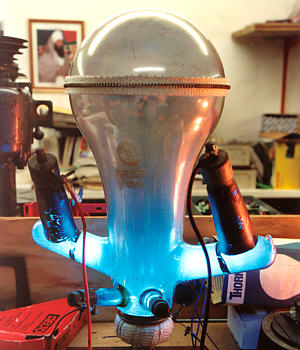
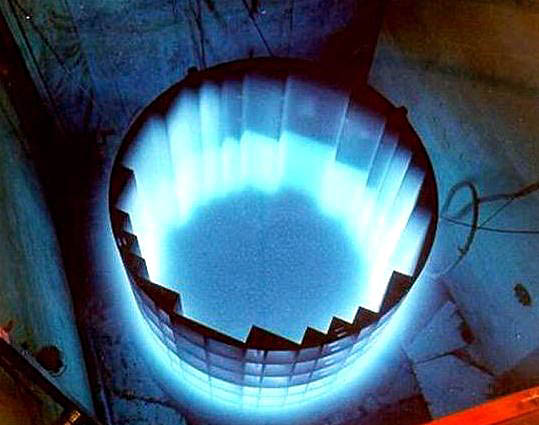
There must be some close relationship between these two types of glows?
A large Mercury vapor rectifier tube.......
Maine Yankee de-comissioned reactor core lining.......
Posted by Stephen Furley (Member # 1277) on 07-28-2005, 10:11 AM:
quote: Mark Gulbrandsen
A large Mercury vapor rectifier tube.......
Mark, that's not large, that's tiny. A little two anode single phase job. You can get a rough idea of the size from the light bulb package behind, even if that's a large light bulb. I've seen glass bulb rectifiers over a metre high, and 12 anode steel tank ones about two metres high, and 2.5 metres across.
The modern technology just isn't as interesting ![[Frown]](frown.gif)
There used to be a substation on the London Underground that had rows of very large glass bulb rectifiers. At night you could see this wierd blue glow from ventilatation openings high up in the building. All long-gone now, just a few trays of solid state diodes replaced it all.
Where is that by the way? It looks like it's working, but it doesn't seem to be in the usual cabinet, with the cooling fan underneath. And what's that picture on the wall behind, it looks like Bin Laden!
Posted by Mark Gulbrandsen (Member # 72) on 07-28-2005, 10:46 AM:
Actually that rectifier tube is available from that place in the UK that I posted the link too that sells the steam engines. So its not all that far from you Stephen. If you want one go for it..... I doubt that the steam engine dudes are much interested in Bin Laden...... except to hang him bvy his b#lls! The New York Subways also used banks of those larger tubes up till the mid 80's. I suppose they last a very long time but knowing this government they made them pull them because they have mercury in them.
Mark
Mark
Powered by Infopop Corporation
UBB.classicTM
6.3.1.2