This is topic All our change-overs going to hell. in forum Film Handlers' Forum at Film-Tech Forum ARCHIVE.
To visit this topic, use this URL:
https://ft-forum.com/ft/cgi-bin/ubb/ultimatebb.cgi?ubb=get_topic;f=1;t=007392
Posted by Frank Dubrois (Member # 3042) on 08-13-2005, 07:07 PM:
1 out of 7 of our change overs still functions correctly. The problem is, they dont open when the cue goes through the cue detector. I have re-cued the current films on the projectors being VERY careful to place the cues where they need to be. I can only blame the automation or changeover itself. We are using the Strong G7927 changeover with MIT M4A automation. Most of the time when I start the units, I dont hear a buzz from changeover, so it doesnt seem like it even WANTS to open. One one projector, I heard a buzz like it was trying to open up, but couldnt. Whats going on here?? These are roughly 1 year old...I checked the wiring...all wiring is attached and run correctly. I opened one of the changeovers to make sure the springs werent too tight..they arent. The switches will open and close the changeover fine. When the film is over, the changeovers all close properly...its just opening that seems to be the problem. Anyone hear of this? All of em going to hell like this?
Thanks
Posted by Mark Gulbrandsen (Member # 72) on 08-13-2005, 09:40 PM:
Frank,
Who ever spec'd and installed your booth should be shot! I don't think I've heard of a booth with relatively new equipment that has as much trouble as you do with your stuff.....
Mark
Posted by Frank Dubrois (Member # 3042) on 08-13-2005, 09:56 PM:
You get the gun, I'll get the bullets and we can hunt him down together. Can this really be installation though? Sounds more like a mechanical problem.
Posted by Mark Gulbrandsen (Member # 72) on 08-13-2005, 10:28 PM:
I was really referring to the boat load of crappy equipment that you were sold. Poor installation can also take its toll on new equpment as well.
Its hard to say exactly what is wrong without being there but it could be either an automation or a C/O problem.
Mark
Posted by Richard Hamilton (Member # 321) on 08-13-2005, 10:35 PM:
Frank,
Take the top cover off of the changeover and check the allen screws that are holding the linkage in place. I have had problems before on newer equipment where these have loosened considerably and causes things to bind up.
Rick
Posted by Frank Dubrois (Member # 3042) on 08-14-2005, 12:27 AM:
I did that....the only thing is, it doesnt sound like its even TRYING to open. No buzz, no click...no sound at all. Sounds electrical to me.
Posted by Richard Hamilton (Member # 321) on 08-14-2005, 02:38 AM:
Sorry,
I just reread your post and saw that the manual switches work it just fine. Does the changeover open function really take a cue? I would think this is from the start button. I am not familiar with the MIT automation.
If they work with the manual switches, then it is a problem with your automation systems, not mechanical or electrical on the changeover end.
Rick
Posted by Mark Gulbrandsen (Member # 72) on 08-14-2005, 08:35 AM:
I don't know where Strong went wrong building their C/O but this doesn't happen to Kelmars.....
Mark
Posted by Frank Dubrois (Member # 3042) on 08-14-2005, 04:14 PM:
Well, the changeover doesnt open until the first que goes through. Otherwise it would open immediately...correct?
Posted by Mark Gulbrandsen (Member # 72) on 08-14-2005, 04:46 PM:
It sounds like you are running in "Intermission mode", or possibly some sort of "Interlock mode" and not "Normal mode"... if this automation even has that capability..... Most automation will open the dowser after 7 seconds or a preset time or a time that would be adjusted in the supervisory mode of an all digital type automation.
Just took a look at the manual and it does require a cue to open the C/O...... This is definately cheap stuff, actually sorta says that in the manual! We should go back to my 1st post of who on earth spec'd in this stuff to begin with and so on and so forth....... I'll bring the bullets ![[Eek!]](eek.gif) .
.
Mark
Posted by Heath Dutton (Member # 3265) on 08-14-2005, 07:18 PM:
One thing I've noticed about these changeovers is that the clevis pin that holds the two seluloid shafts to the actuator shaft will often break.
Worse, some times the dangly part of the clip will rub against one of the wires each time the changeover opens/closes. This will eventually cause one of the wires to be eaten through till the circuit grounds itself out. I've had this happen on two of the changeovers, and it isn't pretty. At first it seems like they aren't working propperly, but then sooner or later it will shoot sparks at you.
BUT, if you say you don't hear any buzzing at all, and you have looked under the lid and see nothing amiss, then I would do as the good man just mentioned and check that you aren't in intermission, or interlock mode. Double check all the automation programs.
Posted by Frank Dubrois (Member # 3042) on 08-14-2005, 07:27 PM:
I know there isnt a preset time before the changeover opens, its definately que activated. I have opened the changeovers and looked at the wiring to make sure nothing has come loose or been cut, all is well there. I would normally blame the que detector for something like this, but our first que also dims the house lights...so if its dimming the house lights, the que is being read just fine. Its gotta be automation or the changeover itself. Would voltage have anything to do with it? I know the changeover needs a certain amount of juice to open up....does it take less voltage to close? Because, as I said, they all close at the end of the show just fine.
Posted by Mark Gulbrandsen (Member # 72) on 08-14-2005, 07:43 PM:
quote: Heath Dutton
One thing I've noticed about these changeovers is that the clevis pin that holds the two seluloid shafts to the actuator shaft will often break.
Seems to only happen on the Strong version...... I don't see this happenning on the Kelmars.....
quote: Frank Dubrois
Its gotta be automation or the changeover itself. Would voltage have anything to do with it?
If the C/O works from the manual switch then the C/O is ok and getting the correct voltage. There is a relay(K-10) across the C/O switch for the open pulse that is run by the automation. Be sure that this relay is being pulsed when the cue is read. If it is being pulsed at the start cue then the relay contacts, or pcb trace itself may have failed..... You can swap the close(K-11) and open(K-10) relays around to confirm if its the relay or not..... Beyond that you need to call a COMPETANT tech in to have a look.
BTW: If you have to hold the manual open button down for more that 1-2 seconds to open the C/O then there may also be C/O problem...... This C/O should snap open with a good 1 second pulse.
Mark
Posted by Frank Dubrois (Member # 3042) on 08-14-2005, 10:02 PM:
They definately open within a second of hitting the swutch. I will try the relay trick tomorrow.
Thanks for your help.
Posted by Richard Hamilton (Member # 321) on 08-15-2005, 06:49 PM:
quote: Frank Dubrois
1 out of 7 of our change overs still functions correctly
I have a hard time believing 6 relays failing in a year, but I guess anything is possible ![[Smile]](smile.gif)
We have ruled out the C/O being the problem, so it sounds like a call to MiT is the next step. I would think those guys would be willing to help you troubleshoot. Or, as Mark says, get a competant tech there to fix it!
If it is a design flaw, they probably need to know about it. If it is operator error, they will probably shoot you instead of the tech ![[Big Grin]](biggrin.gif)
Rick
Posted by Frank Dubrois (Member # 3042) on 08-15-2005, 07:18 PM:
I dont see how it could be an operator error. All we have to do is push the start button. All the other ques work...right down to the last one that shuts the changeover. If corporate was ok with paying a tech to fix it, it would be fixed by now. Unless I can figure it out, we will be foomed to manually opening the changeover with the switch.
Posted by Mark Gulbrandsen (Member # 72) on 08-15-2005, 07:37 PM:
quote: Richard Hamilton
have a hard time believing 6 relays failing in a year, but I guess anything is possible
Rick,
With that many failing my finger is pointing to a design flaw. I've seen way too many manufacturers route AC through too small and too light of traces on pcb's that its almost beginning to be the first thing I look for when there is a multiple problem like this one. IMHO its a pretty stupid idea to build an automation that relys solely on cues.....
Mark
Posted by Richard Hamilton (Member # 321) on 08-15-2005, 07:53 PM:
Mark,
I think so also. If it is the traces, then I guess they have heavier traces for the close side? At any rate, Frank should call MiT and get their input and let them be aware of the problem.
Frank,
Who is "corporate"? They don't want to fix potential presentation problems? Start handing out passes and refunds because the projectionist forgot to manually open th C/O.
I am sure there are competant techs in the Cleveland area. Spend a hundred bucks and let them troubleshoot 1 out of the 6 bad ones. If it is a design flaw, then charge MiT for the service calls to have them fixed!
Rick
Posted by Mark Gulbrandsen (Member # 72) on 08-15-2005, 09:21 PM:
quote: Richard Hamilton
If it is the traces, then I guess they have heavier traces for the close side?
Wouldn't surprise me if the opposite side was heavier. Have done alot of PCB design work myself and calculating how much current a trace will pass without vaporizing is not all that difficult and some PCB design programs will calculate it for you during the design phase so you know how wide a trace to spec for a given thickness of copper. Boards can be made up with standard .5, 1, 2, and up to 100 oz copper traces that are capable of carrying massive amounts of current.
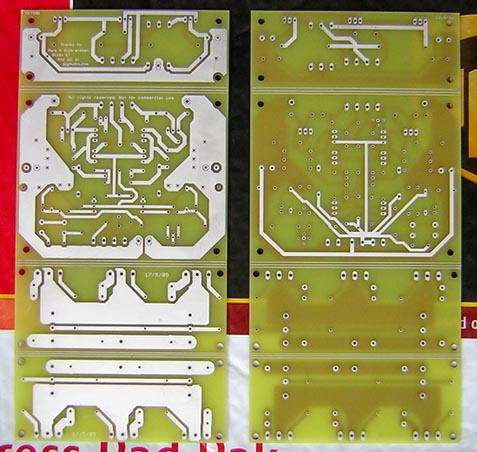
Attached is a photo of a PCB design prototype board for a DIY Krell Class A power amp that I am presently involved with. Some minor changes were made for the mounting hole/foil spacing and a number of holes adjusted for larger wire size. The production boards are now being made with 3 oz copper traces as the amplifier's idle current is over 4 amps. Standard traces are usually just 1/2 oz.
The production board is scored and snaps apart into 4 seperate PCB's to make up one channel of the power amp. Both sides of the board are shown.
Mark
Posted by Bevan Wright (Member # 1884) on 08-15-2005, 09:37 PM:
Frank,
Give me a call or e-mail. I'm sure it is something simple.
Bevan
714 751-7998
bevan.wright@movingimagetech.com
Powered by Infopop Corporation
UBB.classicTM
6.3.1.2