This is topic Visible negative cue markers with 2.39:1 in forum Film Handlers' Forum at Film-Tech Forum ARCHIVE.
To visit this topic, use this URL:
https://ft-forum.com/ft/cgi-bin/ubb/ultimatebb.cgi?ubb=get_topic;f=1;t=007465
Posted by Oliver Pasch (Member # 1335) on 09-23-2005, 08:19 AM:
Hi everybody,
i'd like to discuss the growing problem of visible negative cues within 2,39:1-filmframes, you know bright "flashs" beeing on screen with every cut that can not be turned into the masking. Here are some recent examples, scans from German release prints:
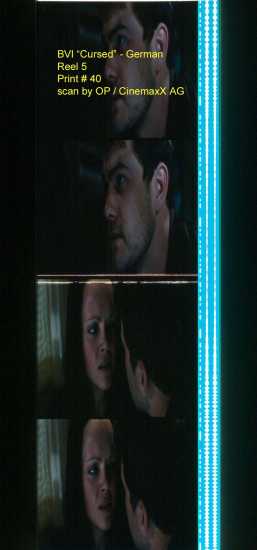
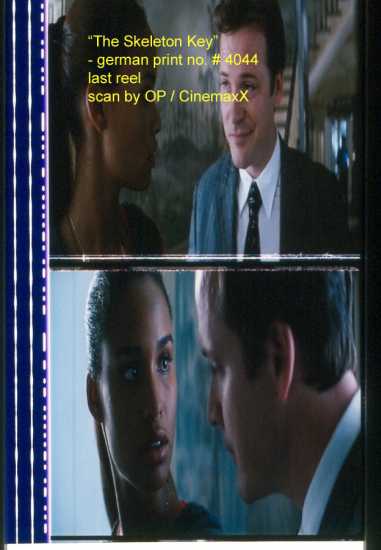
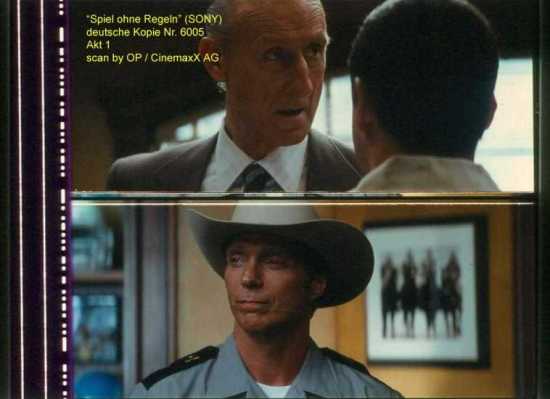
Scans are from "Cursed" (BVI), "The Skeleton Key" (UIP) and "The longest yard" (Paramount, in Germany distributed through SONY - i've de-sequeezed this scan to see what it looks like on screen, it's not 70mm... ![[Razz]](tongue.gif) ).
).
Other examples would include "xXx", "The interpreter", "Peter Pan" and "Bad Santa", so we're not talking about a specific distributor or studio here.
So what is this all about? Why do some pictures have these markers within the negative frame of - correct me if i'm wrong 825 x 690 inches - and some don't? Not talking about films where the negative has been cut "digitally" such as "Stealth".
Is it "just" sloppy negative cutting? Who makes the mistake? May i assume, that these markers should be visible on every release print around the world of a particular film, as it comes from the very same negative?
Starting to complain about this at German distributors mostly provides two results: 1.) It's - as always - supposed to be only me and my company complainig (but i know that's not true, having talk to my dear colleagues at other exhibitors AND being quite sure that picture formats in my theatres are according to the standards); 2.) When complaints are forwarded to the European offices, it's - as always - supposed to be only Germany complaining... ![[Frown]](frown.gif)
Best regards
Oliver
Posted by Darryl Spicer (Member # 711) on 09-23-2005, 09:37 AM:
It is related to the use of anamorphic lenses being used during the filming process of a movie, You do not see them when the movie has been optically processed from the Super 35 process that does not use anamorphic lenses during filming.
Topic discused here and other places.
Negative Splice flash
Posted by Brad Miller (Member # 2) on 09-23-2005, 10:56 AM:
Bad Santa was flat, so it wouldn't have mattered just how thick those negative splice lines were. It would never have projected.
Essentially, other than Passion of the Christ, if you are seeing these and cannot frame them out, you are projecting too much visual information and need to adjust your masking or replace your lenses.
Posted by John Walsh (Member # 168) on 09-23-2005, 11:28 AM:
I agree with Brad; every time I've seen that 'flash' of frameline go by, I always could get rid of it by adjusting the framing knob.
But is it possible the framing standards for optical printers are different in Germany? Or, no allowance is being made for reversing printers where the image is shifted just a little?
Posted by Sam D. Chavez (Member # 1841) on 09-23-2005, 01:04 PM:
This topic may have been covered before, but the original aperture vertical size was .715. This came down as a practical matter to .700 to avoid flashes. Eventually everyone I know uses .690 to avoid seeing these. It would be good to know if the problem is getting worse yet again. He should run some RP 40 and determine the aperture size.
Posted by Tommie Evans (Member # 2674) on 09-23-2005, 02:33 PM:
If you look closely at the scanned pictures you can see that the negative splice overlaps the bottom of one frame and the top of the next frame.
Surely if the aperture is cut incorrectly (to big) you would get the flashes appearing at both the top and bottom of the projected image (if the film is framed dead center.) If you only get the flashes at the top OR bottom then the framing is out. Some people have observed that the flashes migrate to either the top or bottom during the run of the print, this can either be a mis-registered print or most likely poor splicing. If your splices do not overlap (presuming you overlap) equally on adjoining reels then you are adding or taking away film and frame height at every join.
I have noticed this occur quite often on Bollywood films were the negative has been built with splicing tape!
Posted by Louis Bornwasser (Member # 3063) on 09-24-2005, 09:48 AM:
Adding to Sam's post: In addition, when auto turrets are used it is becoming common proactice to cut the vertical to .690 MAXIMUM. This makes framing the scope less critical in typically "unattended" booths. Naturally splices as indicated are never seen unless system is grossly mis-framed. Louis
Posted by Gordon McLeod (Member # 33) on 09-24-2005, 09:50 AM:
I doubt Bollywood films would use tatpe to splice the negatives as the added thickness would lift the negative away from the print stock on the printing sprocket and cause a focus shift as well as a jump neither of which are artifacts I have ever noticed in any of the Bollywood films I have run Usually the lab work is very good
Posted by Bruce McGee (Member # 131) on 09-24-2005, 03:03 PM:
I just finished a run of The Skeleton Key. I had to be very careful with framing on my print, or the audience would see the edits. Had to keep it low in the frame.
I love this business.
Posted by Dominic Case (Member # 1830) on 09-25-2005, 07:20 PM:
The official frame height in scope was 0.700" but was reduced some years ago again to 0.690" (see SMPTE standard 195). That leaves a frameline of 0.056" for the splice. Normal 35mm negative splices are 0.049" SMPTE RP-111. A Cinemascope splicer is normally used for anamorphic original negs, with a width of 0.030" (cement at the edges makes the image of the splice a little wider than this, so there is very little tolerance left for the rest of the process: registration during printing, or errors in the projector mask or racking for example.
A thinner overlap splice still would help, but is much weaker unless the Hammann "cleaver" is used, which makes a mitred join. (For comparison, the old standard for cement splices on acetate prints was around 0.150", five times as wide.
Splices are often visible for these reasons: but before pursuing any more complaints, it's worth checking your own projector aperture plates with a SMPTE RP40 test film to be sure that you aren't showing too much of the frame. Many projectors (and projectionists) still follow the 0.700" standard.
Posted by John Pytlak (Member # 331) on 09-26-2005, 07:31 AM:
I agree. Use the SMPTE 35-PA (RP40) Projector Alignment film to be sure you are projecting the correct (0.825 x 0.690 inch) area for "scope" prints specified by standard SMPTE 195.
Unfortunately, a few negative cutters are using splicers that produces a wider overlap than specified by SMPTE 111-1999, or have poor technique that lets splicing cement get into the image area. It's usually not a lab issue, as the cut negative is delivered to the lab already spliced.
SMPTE RP 111 says: "To minimize projection of splices, the width of the laboratory splice should be no greater than 0.040 in (1.02 mm)", so if you measure a greater overlap, you have a legitimate complaint to the distributor.
Powered by Infopop Corporation
UBB.classicTM
6.3.1.2