This is topic How the West Was Won in Cinerama in forum Film Handlers' Forum at Film-Tech Forum ARCHIVE.
To visit this topic, use this URL:
https://ft-forum.com/ft/cgi-bin/ubb/ultimatebb.cgi?ubb=get_topic;f=1;t=007472
Posted by Paul Linfesty (Member # 214) on 09-26-2005, 12:44 PM:
For those interested, this film returns to the Cinerama Dome (Arclight Cinemas) in Hollywood for a one-week engagement beginning October 28, daily shows at 1:30pm and 7:30pm. Reserved seats go on sale October 6 through their online site. Arclight Cinemas
Posted by Floyd Justin Newton (Member # 1316) on 09-26-2005, 12:55 PM:
Paul--
Will this be 3-strip, or 70MM?
Posted by John Pytlak (Member # 331) on 09-26-2005, 02:38 PM:
Most likely 3-strip, using the new prints that were made by Crest Laboratories:
http://www.in70mm.com/news/2002/htwww_screening/dome_screening.htm
quote:
How does "How the West Was Won" look and sound after all these years? Incredible! As all the original Cinerama prints had been made dye transfer by Technicolor and all the subsequent 35mm, 16mm, and video versions from inter negatives, the original had had little use, has been well stored, and the 5251 negative it was shot on has so far proven to have very good dye stability. I thought the print looked as good as a Technicolor IB without being so contrasty (IB freaks will vehemently disagree of course) and the timers and engineers at Crest Laboratories are to be congratulated for their work on all the Cinerama titles, perhaps deserving of a Sci-Tech or honorary Oscar?)
http://www.findarticles.com/p/articles/mi_m1346/is_10_47/ai_92042075
quote:
Warner Bros., which now owns How the West Was Won, had retained Henry to restore it. The movie was the last spectacular filmed in Cinerama, the grandiose, unwieldy film format that is celebrating its 50th anniversary this month. With its seven-track surround sound, Cinerama was grandfather to THX and Dolby; with its three-projector, 126-foot-wide screen, it was great-uncle to IMAX. Introduced in 1952, it was prone to so many logistical difficulties and cost overruns that it lasted only ten years--vanquished by 65- and 70-millimeter wide-screen, its saner if less spectacular competitors.
Today only two commercial theaters in the world can exhibit Cinerama. Refurbished as the centerpiece of the new Arclight Theater complex in Hollywood, the 1963 geodesic Cinerama Dome was designed for Cinerama but never took delivery of the proper cameras for the declining format, and so never in its history did it screen a Cinerama film. Only recently did the Dome salvage a set of projectors from a defunct Cinerama palace in Hawaii. The Dome will begin its first Cinerama program this month, in time for the anniversary The other venue is Seattle's Cinerama Theater, owned by Microsoft cofounder Paul Allen (who funded the West restoration).
Posted by Stephen Furley (Member # 1277) on 09-26-2005, 05:02 PM:
quote:
Today only two commercial theaters in the world can exhibit Cinerama...
...The other venue is Seattle's Cinerama Theater
Have they forgotten Bradford, or is that not considered a commercial theater? I suppose that would depend on how you define the term.
Has anyone here been to all three of the 'new' Cinerama venues? How do they compare to each other, and to the originals? How about the temporary one in Dayton? I went to one of the three original ones in London, but I was very young, and I don't really remember anything about it.
Posted by Louis Bornwasser (Member # 3063) on 09-26-2005, 07:03 PM:
I don't know what happened to the equipment in Dayton, Ohio, now that John Harvey is sick. (I sold John the complete St Louis Cinerama booth, less projector heads. I then found 2 heads for him from Indianapolis.) Louis
Posted by Dick Vaughan (Member # 540) on 09-27-2005, 09:55 AM:
I believe John's equipment went to a private buyer in Columbus, Ohio
Posted by Roger Manning Jr (Member # 1560) on 11-07-2005, 08:31 PM:
Well I went on nov. 2 over all it was a good show, picture was great but the sound was not.
There was static coming from the left side for 90% of the show other than that it was ok.
I'd give it a 5 out of ten.
Roger
Posted by Paul Linfesty (Member # 214) on 11-08-2005, 12:35 AM:
Yeah, I saw it on the Saturday show. The left-center speaker definitely distorted (cackled) on loud passages. The center panel also had vertical scratches running down the right hand side of the frame (were not there when i saw this print two years ago). Just how many times and places could this print have showed?
Posted by Dick Vaughan (Member # 540) on 11-08-2005, 02:59 AM:
Not here in Bradford that's for sure!
Posted by Monte L Fullmer (Member # 2797) on 11-08-2005, 04:12 AM:
...on a side topic of Cinerama: Here's the soundtrack LP of "Windjammer" - Filmed in Cinerama's long-lost cousin called Cinemiracle ...
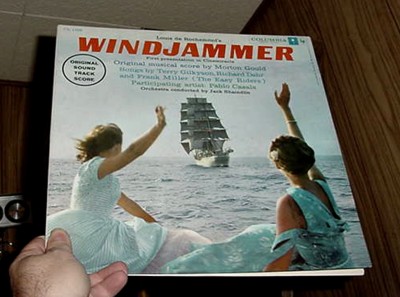
-Monte
Posted by Roger Manning Jr (Member # 1560) on 11-08-2005, 09:01 AM:
The static I heard was constant even in the soft passages, It got louder as the film went on. Then at the start of the 2nd half it was gone then it started again and got louder as the film went on.
Roger
Posted by Greg Mueller (Member # 17) on 11-08-2005, 09:50 AM:
I've been to the Seattle and LA Cineramas and saw HTWWW 2 years ago in LA. It was perfect then. I think I like the LA theater better. Seemed a little plusher. I sure like the reserved seating
Posted by Sean Weitzel (Member # 244) on 11-08-2005, 10:55 AM:
quote: Dick Vaughan
I believe John's equipment went to a private buyer in Columbus, Ohio
If it's the same person I'm thinking of, he's been slowly selling off all of John's equipment and films on ebay for the past year. A prologue for Seven Wonders of the World and the breakdown reel for This is Cinerama just sold for over $900 each last week.
Posted by Bill Gabel (Member # 1105) on 11-08-2005, 11:01 AM:
Those two pieces went to a buyer in Germany. There is a Cinerama projector sync box and part of a three channel fader box now.
Posted by Mark J. Marshall (Member # 1409) on 11-08-2005, 10:29 PM:
Paul,
Those scratches were there when I saw it two years ago. Must have been scratched between the time you saw it and the time I saw it. It's a real shame too. It's hard enough to try and ignore the seam lines. ![[Frown]](frown.gif)
Posted by Paul Linfesty (Member # 214) on 11-09-2005, 11:09 AM:
quote: Mark J. Marshall
Must have been scratched between the time you saw it and the time I saw it
That kind of confirms my suspicions about this theatre. I saw LOA in 2002 (?) there. Brand new 70mm print. The Saturday I saw it (the day after it opened), vertical scratches ran thtroughout the film in both the inner left and inner right of the frame. I saw Spiderman on the first Sunday. Same thing.
Posted by Richard Fowler (Member # 893) on 11-09-2005, 11:16 AM:
Hmm, the dome has separate projection systems for 35/70 and Cinerama....and they are having print damage?...platters?
Posted by David Kilderry (Member # 142) on 11-11-2005, 06:11 PM:
There is also a complete Cinerama set-up in Sydney, Australia. It is not commercially operated at this point, but hopefully it will one day. Prints exist here too.
Posted by Frank Angel (Member # 248) on 11-12-2005, 02:33 PM:
Do they need special printers for Cinerama release prints, or can they be printed the same way ordinary 4/35 prints are struck? With today's better color emulsions and color timing accuracy, can they get away with striking only one panel if it get's damaged or would they have to strike three together?
Posted by Gordon McLeod (Member # 33) on 11-13-2005, 10:48 AM:
Contact printers could print any frame size step printers cannot
Posted by Mark Gulbrandsen (Member # 72) on 11-13-2005, 02:14 PM:
Cinerama prints have to be step printed otherwise any printer bounce would show up as movement between panels and could be pretty annoying. In the Cinerama cameras the movement was also part of the magazine. Sorry for that sucker that was the film loader! To make the new 3-panel prints they absconded with a Cinerama camera magazine and used its movement to build a step printer. Works ok. There was a link someplace on the Crest Labs site as to how that was actually done... so in a sense they built a new 6 perf step printer to make these prints. They should be able to process a new print just for that panel that was scratched. In this day and age if they can't conrtol printing and processing to that fine a degree then I will welcome digital with open arms. The only drawback I can think of is having to have film stock all made from the same batch lot... but tests can also be done on any lot and the filter pack changed slightly to match color balance to the original print.
Mark
Posted by Brad Miller (Member # 2) on 11-13-2005, 03:03 PM:
quote: Mark Gulbrandsen
In this day and age if they can't conrtol printing and processing to that fine a degree then I will welcome digital with open arms.
Uh oh, I've read Mark's various posts on sloppy lab work. Looks like he is about to jump on the digital bandwagon! ![[Wink]](wink.gif)
Posted by Mark Gulbrandsen (Member # 72) on 11-13-2005, 05:00 PM:
Well, I am against sloppy lab work and bad digital systems and presentations that die or drop out half way though. I don't think we'll ever see the quality of lab work that was once happenning in years gone by because of the high speed world we live in today. But it should certainly be possible to pull it off if need be once in a while. There are still people out there that care.....
Mark
Posted by Louis Bornwasser (Member # 3063) on 11-13-2005, 07:03 PM:
Mark: some years ago I was on a "field trip" to CFI (I know it was sold.) I can assure you that there are serious craftsmen who work(ed) there. In addition, Technicolor London seems to do an excellent job compared to US. Louis
Posted by Monte L Fullmer (Member # 2797) on 11-13-2005, 07:29 PM:
quote: Louis Bornwasser
seems to do an excellent job compared to US.
It seems that the Brits have always done a better job in about anything they can touch. Them folks do have a sense of caring.
..in the US, it goes back to the "supply and demand" foundation where quality takes the second seat to mass production.
-Monte
Posted by Mark Gulbrandsen (Member # 72) on 11-13-2005, 08:10 PM:
Louis,
I agree they can do good work when required of them but its mainly now all done by the smallish labs that thrive on that sort of work. I have friends that work in that field and there is no real steady work any longer like there was back as late as the mid 70's. So finding really knowledgable people is also hard because they scatter about the differnet labs doing work where there is work to be done and a living to be made The only steady work one might find is running a processing line or a panel printer... or a chemists position, those jobs are the more common jobs today in the typical lab but sometimes don't hold the best people that industry has to offer.
Up to the time frame that I moved to SLC I delt with the output of all the major labs and many small ones too on a fairly regular basis. This occured all on Dailies jobs for many large motion pictures. Of all the large labs Technicolor West Coast had the most consistant dailies product while East Coast Technicolor literally sucked bug time. In fact a friend that worked at BPI in Chicago for quite a few years confirmed for me when I was on a major film in DC having image steadiness problems that Technicolor East Coast in fact got all the throw out eqipment from the West Coast lab and that they also rarely if ever did any required routine maintainance as per the BPI manuals to their BPI printers, mainly only if they went down! This of course showed up in dailies one day... the projectors were the first to be blamed but as you know Century's can indeed put out dead steady images.... and this set was not to be blamed as I aptly demonstrated for the producers of the film by running an original camera steadiness test negative. The problem turned out to be Technicolor east Coasts worn out printers. This was confirmed with the help of Color Lab which is a super top notch lab in Maryland. We had both Technicolor and Color Lab print a 200'length from the same double exposure camera steadiness test and in the Technicolor print the unsteadines came right through, the film was in scope as well so this made the lateral unsteadiness even worse... while the Color Lab print was darn near as steady as running the original camera negative, and I do mean close! After that day Technicolor printed stuff on a differnet printer with better results but still not as good as what I saw come out of their West Coast lab. Over the years I had small problems with other labs but none like the problem with the East Coast Technicolor stuff I experineced on that film.
Monte,
Technicolor in England used differnet dyes than we did over here for I.B. printing. These dyes are somewhat explained in the book Colour Cinematography. I think it had to do with the British Government requiring at least some of the raw materials that went in to I.B. Technicolor material printed over there to be of British origin... Not a bad rule in my opinion and the results sure were good. I also think you will find the Brits turn out higher quality work today than we do over here. The thing about them is that there is still a hint of decency, care, and honor in what they do overall. It certainly shows in the posts they make on this site. That has pretty much disappeared over here were all folks seem to do is go in to work to collect their pay checks.
Mark
Powered by Infopop Corporation
UBB.classicTM
6.3.1.2