This is topic Looking for tips on keeping a clean Simplex XL in forum Film Handlers' Forum at Film-Tech Forum ARCHIVE.
To visit this topic, use this URL:
https://ft-forum.com/ft/cgi-bin/ubb/ultimatebb.cgi?ubb=get_topic;f=1;t=007505
Posted by Dan Chilton (Member # 2288) on 10-05-2005, 08:39 PM:
When I used to work at a theater, in my teens, I wasn't concerned with learning the ins and outs of being a projectionist. I worked at a multiplex, for minimum wage, and they taught me just enough to thread the platter and projector in less than a minute... other than that, they didn't bother teaching us much. Now that I run my own theater, I'm maniacal about keeping everything clean - popper, projector, booth, etc.. I lurk around Film-Tech and glean what I can from all the experts.
What I can't seem to find, however, is a good thorough guide for cleaning a projector and soundhead. I have a Simplex XL and a Simplex soundhead. The tips section has a few pointers, but nothing for my specific projector (as common as it is). I glanced through the 1960 printing of the XL manual, but it doesn't say much about cleaning the machine. Is there any good reference that you guys would recommend? Beyond vacuuming all the film dust and keeping the intermittents clean, I'm not really sure how to clean things like the film gate, optical pick-up, etc..
I definitely don't want to screw things up. So if you don't mind suffering a newbie, any suggestions would be greatly appreciated.
![[uhoh]](graemlins/uhoh.gif)
Posted by Brad Miller (Member # 2) on 10-05-2005, 09:28 PM:
Suggestion #1 - change the title of this thread.
Your post will be quickly locked and/or deleted if you continue to ignore the posted policies. ![[Wink]](wink.gif)
Posted by Dan Chilton (Member # 2288) on 10-05-2005, 09:39 PM:
Sorry Brad. Done and done.
Posted by Monte L Fullmer (Member # 2797) on 10-06-2005, 01:16 AM:
First question is: do you know how to disassemble some of the areas of the XL. Since you have a 1960 manual there, study that thing carefully on how to take things apart and put them back together by looking at the parts section of the manual. This is actually how I learned to work on an XL by studying the parts manual on how things come apart and go back together.
Toothbrush and a can of "air-off", or better yet a regular air compressor with an air nozzle does, wonders on blowing out the crud from within the deep bowels of that machine.
But, actually, simple common sense is to wipe up any oil that is visible, keep the sprockets clean with that toothbrush (with motor off - turn the machine over by hand to scrub teeth..), clean the lenses with lens cleaner and lens tissue, if you know how to take the gate off to clean the rails and know how to remove the trap to clean the runners (if a flat trap assembly), or the bands (being the curved trap assembly), the areas around the lateral guide rollers - just all sorts of cleaning can be done on an XL.
Soundhead -cue tip and lens cleaner to clean the lens of the camera if have reverse scan LED devices. Otherwise, the same for the slit lens-back and front after removing the exciter lamp. (you should have reverse scan by now being all of these cyan prints out there..)
Big thing - keep that oil level where it's supposed to be at -either on the glass tube out in front, or the round glass inside. You run that thing dry, goodbye intermittent assembly since it needs that spray to lubricate that assembly. Intermitent units are not a sealed unit, they crave the outside oil to operate.
If the oil is dark yellowish, change that oil with the proper oil (and not automotive motor oil...). Is the spray in the back really spraying good out of the tube, or it is just dripping. If dripping, the filter screen needs to come off and cleaned for the pump to work good.
..just some starters to go for. - Monte
Posted by Joshua Waaland (Member # 287) on 10-06-2005, 09:43 AM:
Be careful if you use compressed air to clean out the picture head. If you have too much pressure and it is aimed at the tension bands in the film gate you could possibly damage them. We actually had this happen once.
We used a q-tip with rubbing alcohol on it to clean the film gate parts where it touched the film. Then we would apply Xecote (I believe this was what we used) to the same area.
Another good idea is to keep a soft bristled tooth brush nearby and a soft paint brush to get into deeper areas. *Caution: Do this at your own risk* We used to manually start the motor and then hold the toothbrush against the sprockets to clean them while slowly going back and forth to get in between them. This can be a dangerous practice though because there is no safety if you get caught in the machine. I got careless once and got my finger caught in the top sprocket. I had perforations all through my finger not to mention the pressure of the sprocket on one side with the roller pad on the other side. It was over before I could even pull my finger out! ![[Frown]](frown.gif) So moral of the story I guess would be to do this with the projector off although I still prefer to do it with the projector on. Old habits die hard I guess.
So moral of the story I guess would be to do this with the projector off although I still prefer to do it with the projector on. Old habits die hard I guess.
There are two thumbscrews on the shutter blade housing that you can unscrew to remove it. It slides right off and then you can get into there to clean out all the film dust.
Monte already posted most of the other good ideas. ![[thumbsup]](graemlins/thumbsup.gif)
Posted by John Pytlak (Member # 331) on 10-06-2005, 12:22 PM:
It's much too easy to damage the gear train or yourself if you try to clean a machine while it is running. ![[Eek!]](eek.gif)
Posted by Randy Stankey (Member # 64) on 10-06-2005, 10:23 PM:
90% of the time, all I do is clean out the projector with a shop towel. But then, again, I use FilmGuard and I clean my projector every time it's threaded.
Simply remove the two fasteners that hold the film shoe in place and slide it out of the machine. Then take a shop towel and wipe down every surface that you can reach with your hands.
If you need to get into the nooks and crannies, a 1" paint brush does the trick. If you need to get into the really tight spots, a Q-Tip will work nicely.
Rarely, if ever, will I use a liquid cleaner inside the projector. Most of the time, when I do use liquid, it is to get some baked on crud off the film bands that won't come off with other means. That happens, MAYBE, once or twice per year.
When I worked at the megaplexes I told people to carry a shop towel around in their back pocket. Sometimes they would have a shelf next to each projector where a clean rag was kept. No matter what method you use, it takes a TRIVIAL amount of time to clean a projector before you thread... TRIVIAL!!
If you keep your projector clean in the first place you will hardly ever need to use anything more than a rag and a brush.
If you want to be totally anal retentive you can do what I call a "Take-Apart Cleaning". Take the trap, shoe and shutter covers off. Go at it with a vacuum cleaner hose, a brush, a rag, a Q-Tip or whatever you deem necessary.
I do a "Take-Apart Cleaning" twice per year. Once at around Christmas break and again before summer break. (College theater.)
So, the short answer is, "Common sense and elbow grease."
That's probably why the old, 1960's vintage manuals don't have much in the way of cleaning instructions. They assumed the user had common sense and wasn't afraid to use a little elbow grease. After all, back then, 90% of all projectionists were tradesmen.
Posted by Dan Chilton (Member # 2288) on 10-07-2005, 01:34 AM:
Thanks for the advice, guys. I'll try all of the tips mentioned above, and hopefully one day I'll be able to contribute my own two cents to this wonderful community.
Posted by Josh Jones (Member # 447) on 10-12-2005, 01:22 PM:
NEVER use a toothbrush in film handling equipment. The bristles can detach from the plastic body of the brush and get caught in various parts of the machine causing very misterious scratching issues. Compressed air is also a bad idea as it can force dirt into bearings causing premature failure and the like. It also creates a cloud of dust that will just settle on something else minutes later. I did a stint at a 10 plex where all I used was a rag to mop up the oil and dust as well as any film shedding. I used a plastic movie pass card to remove hard deposits from the gate, although when cleaned on a daily basis, there are no deposits. Online wet film cleaning will usually eliminate this inconvenience all together.
JJ
Posted by John Pytlak (Member # 331) on 10-12-2005, 02:10 PM:
I've never had bristles detach from a toothbrush used for cleaning gates, rollers, and sprockets. Probably depends on using a high quality brush.
(I've also never had a tooth brush bristle come off while brushing my teeth).
Posted by Joshua Waaland (Member # 287) on 10-12-2005, 02:28 PM:
quote: Josh Jones
Compressed air is also a bad idea as it can force dirt into bearings causing premature failure and the like.
How so? I can't think of any bearings on the XL head that are open to the film side. I am not at home right now so I can't look but I am sure they are all sealed off. I would agree that the dust will settle somewhere else, but then again how do you get the clumps of film dirt out of some of those back places without a serious teardown of the head? My hands are pretty big (see picture) so if a brush can't reach it, compressed air is the only other option besides disassembly.
Posted by Monte L Fullmer (Member # 2797) on 10-12-2005, 02:29 PM:
...XL sprocket shaft bearings are sleeve bearings..nutting can get through those. Only one that is roller bearing is the 5-star lower constant speed sprocket shaft, and that bearing is of the sealed variety
Shoot, I use a brass bristle welder's brush to clean my sprockets.
True, all the years (36 of them) that I've ran projectors, never once have I ever had bristles come out of the head of the brush.
Also, if one IS careful with a compressor, you CAN direct the airstream (and NOT use 100lbs coming out of the nozzle as I've seen some booth clowns do..) with small bursts, instead of one continual blast of air, and still do a cleaning and not make such a mess. (Of course, you can cover your prints before the compressor usage... ![[Smile]](smile.gif) )
)
Practically all of the booths in large and small circuits that I've seen is the mandantory air compressor to blow out the machines nightly on a daily basis
Posted by John Pytlak (Member # 331) on 10-12-2005, 02:44 PM:
Compressed air does just move the dirt around, and makes it airborne to land on something else. Whenever possible, do most of your cleaning with a brush, cloth, vacuum, and "elbow grease".
Posted by Dan Lyons (Member # 1454) on 10-12-2005, 03:27 PM:
quote: Monte L Fullmer
Shoot, I use a brass bristle welder's brush to clean my sprockets.
You kidding? All that will do is scratch up your sprockets and create metal dust in the film path.
Posted by Monte L Fullmer (Member # 2797) on 10-12-2005, 03:53 PM:
Hey, don't you know anything about your Moh's (mineral hardness) factor? Brass is tons softer than forged steel sprockets.
"Metal dust".. that'sa good one..LOL (SORRY! I've never had this happen to me in all my years using brass brushes..Yes, if you really bear down on that brush on extremely dry metal<like a file> that is massively abrasive, then you might get the dust as mentioned, but who's gonna kill their sprockets with this treatment..maybe "booth clowns" who doesn't know any better, or is shown in a horrible manner...)
-Monte
Posted by Steve Scott (Member # 630) on 10-12-2005, 05:32 PM:
My experience running XL's over the summer has been this: there's nowhere you can't get with a toothbrush in that machine that can't be reached with a paper towel. If your XLs bleed oil like mine do, most of the dirt in the head will mix with the oil and clump up. There's a lot of flat space in the casting furthest inside the operator side. Keep this space, and the ridge in the casting beneath the intermittent clean. These areas will collect debris too. Depending on whether or not your projector head has its original shutter cover, which on earlier models should mate with little space between cover and head, you should clean the space that may be present in this gap, coincidently right around the intermittent as well.
My experience with the 5-star soundhead has taught me not to ignore any black surface in that soundhead! If you experience any shedding, it may not reflect itself into sight unless you shine a light directly on it. Clean this, and the corners of the soundhead's casting well. That pinch roller is nothing but trouble.
For what its worth, the four star soundheads have worked great for me, bleeding far less than its representative projector. Still dirt collects around ridges in the casting, and I equally hate the pinch roller and the mount for the motor, but its decent, and cleaner than the 5-stars.
Just keep cleaning, every show, no matter how behind you already are. Any dirt in your machine is a threat to the longevity of any print.
Posted by Mark Gulbrandsen (Member # 72) on 10-14-2005, 06:23 PM:
One thing I will add that is a NOT TO DO is to use any type of bottled spray CRC brand cleaner of any sort. This flushes out any oil that had been applied to needy areas in order for them to work properly. Just yesterday over in Wyoming a customer had been using CRC electronic cleaner as a short cut to clean the lateral guide roller assemblies in his Simplex sound heads. This flushed out needed oil from the lateral guide roller parts and from the pivot point in the "knuckle" of the assy. In fact the shaft in the "Knuckle" had rusted and welded itself to the alumnium casting and this makes me a bit suspicous of the cleaner being a tad bit acidic. So this is a big no-no!!
In the photo you can see how the pivot shaft rusted.... This cleaning method is no short cut by any means and resulted in a refunded house and a service call because of garbled sound.
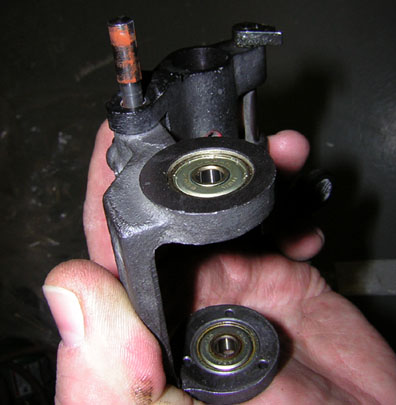
Mark
Posted by Joshua Waaland (Member # 287) on 10-17-2005, 11:51 AM:
quote: Steve Scott
My experience running XL's over the summer has been this: there's nowhere you can't get with a toothbrush in that machine that can't be reached with a paper towel.
Sorry but I have to disagree with you on this one Steve. I am in the middle of rebuilding two XL heads and I have been finding clumps of film dust in places you can't even see into. The only way to get to it is by tearing the head down or if you are lucky with compressed air.
I have used XL's for years and the best way to keep them clean is wipe down the inside after every run and do a general cleaning once a week. Also a good idea to do a major cleaning every few months or so.
Powered by Infopop Corporation
UBB.classicTM
6.3.1.2