This is topic Sandpaper strips on Christie platters in forum Film Handlers' Forum at Film-Tech Forum ARCHIVE.
To visit this topic, use this URL:
https://ft-forum.com/ft/cgi-bin/ubb/ultimatebb.cgi?ubb=get_topic;f=1;t=007542
Posted by Keith Rightmyer (Member # 3403) on 10-17-2005, 10:42 PM:
Hello folks! I'm new to the drive-in projection biz but I'll spare you my story for now. I've run projector for the last three weekends and have had a different experience with the platters every weekend. Each of our platters have four (4) strips of what seems to be sandpaper at angles.
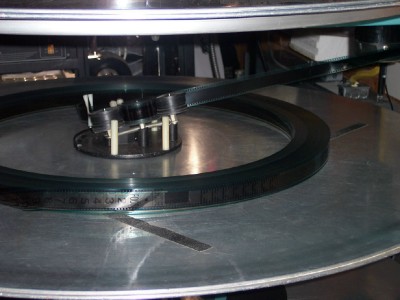
I've already trimmed the edges on two of the platters as needed but one strip on platter 3 was scraping the bottom edge of the film practically the strips' entire length.
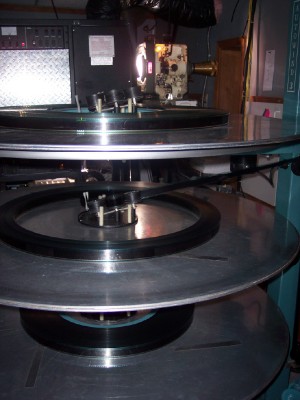
A kind gentleman on another forum said he had never seen ![[Eek!]](eek.gif) this before so I thought I would share with you guys and seek ideas or suggestions.
this before so I thought I would share with you guys and seek ideas or suggestions. ![[Roll Eyes]](rolleyes.gif) Thanks in advance!
Thanks in advance!
Keith
Posted by John Pytlak (Member # 331) on 10-17-2005, 10:48 PM:
I think someone put those strips on the platter in an attempt to keep laps from sticking together from "static cling", or to prevent the roll from sliding on a mistimed platter. The attempts I've seen used a rubbery no-slip surface, and NOT "sandpaper".
Since the advent of Kodak VISION Color Print Film with its proprietary conductive antistatic coating, static cling is much less of an issue today.
If those rough strips are indeed scuffing the film edge, they should be removed. Be sure to clean the platter surface of any residual adhesive.
Posted by Steve Scott (Member # 630) on 10-17-2005, 10:53 PM:
Yep, this looks like a misguided homebrew solution to a common booth problem. Sandpaper could have been used to increase the friction holding a print onto an overspinning platter. What's the track record of these platters Keith? And what do you know as to the permanence of these strips on the decks?
Posted by Jon Miller (Member # 163) on 10-17-2005, 11:20 PM:
The strips could be of anti-slip material (such as these 3M products linked here) used for stairsteps and bathtubs. I would not use that stuff due to the potential for film damage as John P. suggests. I would much rather buff the platter deck as described in the Chirstie AW3 tips (click on the Tips button to the left).
Posted by Tim Reed (Member # 137) on 10-18-2005, 05:38 AM:
At the description, I thought you might have an ELF platter, but from the photos, it's as everyone says. Someone put the friction strips there. Properly adjusted, you don't need them on a Christie.
BTW, I attempted to re-open that theatre in 1989, but it turned out my partner - who was supposed to have the money - didn't.
I did, however, succeed in my intermission trailer venture. You should have a new intermission clock (and other drive-in-specific trailers) at your theatre, to sell your concessions right...
Screen Attractions
Posted by Keith Rightmyer (Member # 3403) on 10-18-2005, 11:00 AM:
Thanks for the responses guys!
The entire system was installed on September 22 after the last operators split town with their equipment. So I don't the history before that but the strips haven't stopped static cling or one BAD head wrap on a second night.
Steve, the strips aren't hard to cut but it'll take some work to remove them. The residual glue shouldn't be a problem with...alcohol?
Jon, I printed those tips out this morning and plan to review them with the owner.
Tim, wish you could have re-opened the place in '89. This area needed a good drive-in and that's what we are trying for now. I'm looking into the concession trailers for next year. Not much $$ coming in right now though WE ARE OPEN!! Tell your friends and family!!
I look forward to more info from you guys.
Oh, the previous ops left two boxes of cheap dryer sheets. What is the proper use for them...applied to platter or film or both?
Posted by John Pytlak (Member # 331) on 10-18-2005, 11:10 AM:
The dryer sheets contain a topical conductive antistat (quaternary ammonium salt). They can be used to treat non-conductive (plastic) rollers and surfaces to minimize static buildup. Even though the film has a conductive antistatic layer, the static does need a "path to ground" through conductive platter surfaces and rollers. Liquid antistatic treatments include Static Guard, Neutrostat, Endust for Electronics, and Staticide.
Adhesive can usually be removed by using FilmGuard, mineral spirits, isopropyl alcohol, naphtha, "Goo-Gone", or other mild solvent compatible with the platter materials. Be sure to be careful with exposure to the solvent/vapors, and any flammability.
Definitely check the leveling and timing of that platter.
Posted by Louis Bornwasser (Member # 3063) on 10-18-2005, 11:48 AM:
I have seen platter decks that were heavily WAXED. The aftermath is that they were so slick that film would almost vibrate off the deck.
The short term solution was to use duct (duck) tape to support the film and provide friction.
Maybe that is what the previous owner did.
(Also, the previous owner of that drive in ordered the equipment, we arranged to install it , but he never showed up with the paperwork (money.) We were not hurt, but there is an entire drive in of equipment on our loading dock. Louis
Posted by Brad Miller (Member # 2) on 10-18-2005, 02:14 PM:
Keith, please see Christie Platter Tweeking in the TIPS section of this website. Once you get all of that crap off of the decks I can virtually guarantee that if you don't buff the decks you will throw film from all of the residual crap left behind. It's not that easy to do and it is all explained on that page (among other tips).
Posted by Monte L Fullmer (Member # 2797) on 10-18-2005, 02:21 PM:
quote: Louis Bornwasser
I have seen platter decks that were heavily WAXED. The aftermath is that they were so slick that film would almost vibrate off the deck.
... like some goons would do with their AW2 formica topped platter decks, and even those chromed domed ORC platters - using PLEDGE furniture polish to shine up these surfaces (lol).
Threw prints like crazy.
-Monte
Powered by Infopop Corporation
UBB.classicTM
6.3.1.2