This is topic CAP-printed copy numbers on leaders? in forum Film Handlers' Forum at Film-Tech Forum ARCHIVE.
To visit this topic, use this URL:
https://ft-forum.com/ft/cgi-bin/ubb/ultimatebb.cgi?ubb=get_topic;f=1;t=007560
Posted by John Hawkinson (Member # 1135) on 10-23-2005, 10:08 PM:
I haven't seen this before, but our print of Wedding Crashers showed up with CAP codes on reel 3, and with the copy number of the reel printed from 12'2f to 12'4f on the head leader.
Have I just not been paying attention, or is this new?
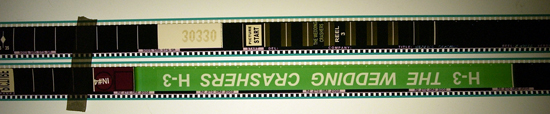
and zooming in:
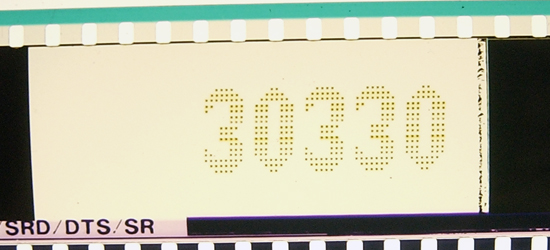
--jhawk
[ 10-24-2005, 09:43 AM: Message edited by: John Hawkinson ]
Posted by John Pytlak (Member # 331) on 10-23-2005, 10:25 PM:
Unlike the original Kodak-developed CAP Code, each lab now has a proprietary system. You would need to ask them about any details.
Man-readable tracking numbers were an optional part of the Kodak system that I helped develop, usually printed along the edge of the film.
Posted by Mark J. Marshall (Member # 1409) on 10-23-2005, 10:37 PM:
For what it's worth, I've seen that a couple of times over the last year or so, but I'm not sure when it started.
Posted by Bruce McGee (Member # 131) on 10-24-2005, 07:15 AM:
I'm noticing CAP codes. At first, I thought they were finger prints.
Posted by Scott Norwood (Member # 30) on 10-24-2005, 08:34 AM:
If I remember correctly, I first saw this on "Rabbit Proof Fence," which means that it goes back at least to 2002. It's been around for a while, at least.
Posted by Bruce Hansen (Member # 281) on 10-25-2005, 05:36 PM:
I've seen this on a number of films as well. The number will be on the reel with CAP code. The other reels will have nothing printed in that "clear" box on their leaders.
Posted by Frank Angel (Member # 248) on 02-08-2006, 08:50 AM:
Question about the CRAP codes. Why is it necessary to place them in the MIDDLE of the damn frame? Since all those pirates with camcorders that that Hollywood thinks are lurking at every screening in ever cinema in every city in every country in the world aims his camera at the full screen, you would think placing the code somewhere OTHER than smack dab in the center of the frame would work just as well. Also, my guess is that with the sophistocated technology available it must take to generate these things, they could use some sort of light intensity sensing that would know NOT put the codes in bright scenes with big expanses of sky like I just saw in BROKEBACK MOUNTAIN. I mean, it couldn't have been in a worse scene and in a worse place. And why repetatively in three different places in the same reel? Isn't once enough? Do they think marring the image THREE times is more secure than once? Big brown blotches in the middle of an azure sky....nice going Technicolor and Focus Features. Maybe if they spent as much energy getting a sharp, focused image as they did sticking in Crap Codes, the film would have been better served.
I would love the industry to produce some HARD FACTS about how many "pirates" have actually been caught as a direct result of these codes, given the millions of honest, paying customers who have been subjected to inferior presentations because of them.
Loveya John P., but Cap Codes are an abomination.
Posted by Jesse Skeen (Member # 586) on 02-09-2006, 03:02 AM:
They're STILL doing this?? (Sorry, I haven't seen a regular movie since Revenge Of The Shit, and didn't notice it there.) As if there wasn't enough other stuff to support all the bad press about business being down.
Posted by Mike Blakesley (Member # 26) on 02-09-2006, 01:26 PM:
John P. keeps saying that "it works," but I don't think I've ever heard any actual numbers or anyone actually being caught directly related to the CAP code or its similar cousins.
I too would like to see some iron-clad proof that it's really helpful to the industry for them to screw up our presentations on purpose.
Posted by David Stambaugh (Member # 1102) on 02-09-2006, 02:15 PM:
John has pointed out before that the original CAP code was designed to be a lot less intrusive than the egregious examples we see now on some movies.
Posted by Andy Muirhead (Member # 712) on 02-09-2006, 06:50 PM:
quote: Mike Blakesley
John P. keeps saying that "it works," but I don't think I've ever heard any actual numbers or anyone actually being caught directly related to the CAP code or its similar cousins.
I too would like to see some iron-clad proof that it's really helpful to the industry for them to screw up our presentations on purpose.
Well said and I agree. Or is it not actually working?
Posted by Daryl C. W. O'Shea (Member # 1303) on 02-09-2006, 07:01 PM:
quote: Frank Angel
Why is it necessary to place them in the MIDDLE of the damn frame? Since all those pirates with camcorders that that Hollywood thinks are lurking at every screening in ever cinema in every city in every country in the world aims his camera at the full screen, you would think placing the code somewhere OTHER than smack dab in the center of the frame would work just as well.
That's just it, they often don't get the whole screen (and crappy theatres that let people pirate stuff probably have crappy screens that are cropped to hell too).
Anyway, the coding really covers about the middle 2/3rds of the frame, not just "the middle". Spreading them out any more would decrease the chance of enough of the code being captured thus requiring the code to appear more often.
quote: Frank Angel
Also, my guess is that with the sophistocated technology available it must take to generate these things, they could use some sort of light intensity sensing that would know NOT put the codes in bright scenes with big expanses of sky like I just saw in BROKEBACK MOUNTAIN. I mean, it couldn't have been in a worse scene and in a worse place.
Why that's the best place for them to show up in a crappy video recorded copy.
quote: Frank Angel
And why repetatively in three different places in the same reel? Isn't once enough?
To increase the odds of recovering the code.
quote: Frank Angel
Do they think marring the image THREE times is more secure than once?
Encoding isn't about security. That's what the platsic zip ties are for.
Posted by John Pytlak (Member # 331) on 02-12-2006, 10:37 PM:
The CAP Code originally developed by Kodak had very tiny dots, but was repeated up to several hundred times per reel. It was used since 1982, and few people ever noticed it (except for a famous director or two when the distributor had the lab print it on their release prints ![[Wink]](wink.gif) ).
).
The larger dots of the newer codes are more likely to survive poor duplication and Internet transmission with compression. But they are more visible on the screen. Fortunately, there are reportedly some new and better ways of concealing the code compared to a few years ago.
Quite a few articles were written in the trade pubs and even Time Magazine, reporting the success of the original CAP Code in tracing piracy to the source.
Posted by Frank Angel (Member # 248) on 02-13-2006, 11:38 PM:
It almost seems to be one of those "Protected by Ace Security Systems" signs you can buy for $1.50 at Home Depot. You stick them on your windows and it's supposed to scare off robbers. Seems to me the industry puts these huge blobs on prints in the hopes that it will be a deterrent for would-be in-theatre camcorder pirates. It is in the industry's interest to keep the hype out there that they've got security mechanisms in place that will catch anyone trying to copy their stuff, so you can't really believe the hype that comes from the people who have a vested interest in maintaining a particular perception. As for Time Mag, they listen to whoever is talking to them (read BAD journalism). Go back and read what they and the other news media who went ga-ga over Lucas's pronouncements said about Deeee-cinema in 1999. They talked to Texas Instruments and Lucas and pronounced as if it were fact that film would be replaced as the way we see movies in five years. So just because Time Mag says CAP codes are working doesn't convince me that they are.
Besides, the industry itself had that study done (was it AOL or American Express? some unlikely company as I recall) and they found that really GOOD copies of films -- the ones that the industry REALLY has to be worried about -- didn't come from off-the-screen shenanigans but from Academy members' Screeners and stuff right out of the labs.
LOTS of people who work on a movie have copies, some even before prints are even struck. I personally have seen a major blockbuster just a month ago on the laptop of someone who was involved in post-production. That report is what caused the furor about not giving out screener copies to Academy members, which the studios finally backed down on....the wusses. They would rather not offend their cronies but instead, mar the presentation of millons of the honest, movie-going people who pay to see a film.
To put those codes on every release print is, again, IMHO, a disservice to the movie-goer, not to mention the directors, cinematographers and all the craftspeople who work on a film.
So let me ask this: Say I do that idotic camcorder-off-the-screen copy, with its lousy image quality to say nothing of the sound....resulting in the lowest of the low type of end quality (it would akin to making a CD copy by putting a microphone in front of a BoomBox's loudspeakers and recording that sound, along with whatever ambient room noise the mic happens to pick up). So now I have this camcorder copy, now I dump it to my computer so I can burn my DVDs. Assuming I have enough technical skills to do any kind of manipulation in the computer to prep it for burning burning, what's to prevent me from editing out those few frames of CAP code? Surely I wouldn't be that quality conscious as to worry about loosing those few frames in every reel? And I am sure my anti-discerning end- user of my shit isn't going to bothered by a few missing frames either. So no matter how big the lab winds up making the dame things, unless they repeat them over and over in each reel (don't put it past them), how do the codes stop bootleggers if they can just edit them out?
The only REAL codes that make any sense would be a system that the bootlegger CAN'T see....not ones that are so huge that they almost shout "EDIT HERE".
If a system were designed so that the bootleger couldn't detect it, THAT would be worth persuing. But the fact is, it's all for naught because streetside vendors selling crap copies isn't what hurts the film companies. It's their own people leaking out master quality stuff.
[ 02-14-2006, 09:30 PM: Message edited by: Frank Angel ]
Posted by Dominic Case (Member # 1830) on 02-15-2006, 08:27 PM:
quote: Frank Angel
Maybe if they spent as much energy getting a sharp, focused image as they did sticking in Crap Codes, the film would have been better served.
Well if you have a concern about focus, you would need to talk to the cinematographer (or possibly the projectionist). Nothing in the lab process (contact printing) affects focus.
Labs put the antipiracy coding onto prints because the distributors insist on it. As John has pointed out, the earlier system was more subtle, but that was its downfall when digital cameras, compression and the internet came in. The dots need to be clearly visible in order to be detectable in pirated copies.
And, by the way, they are detected in pirated copies. So while there are some good quality clean pirate copies going out, there are still suckers who don't bother to remove the incriminating evidence, however easy it might be to delete a few frames.
Sure, copyright is also stolen by other means as discussed: but if the ship is leaking you don't just plug one hole, you plug as many as you can, as effectively as you can.
quote: Frank Angel
To put those codes on every release print is, again, IMHO, a disservice to the movie-goer, not to mention the directors, cinematographers and all the craftspeople who work on a film.
It's surely a greater disservice to the filmmakers to stand by and allow their work to be shown in cruddy quality via a stolen image camcordered from the back of the auditorium, without trying to prevent it.
Posted by Aaron Sisemore (Member # 145) on 02-15-2006, 09:07 PM:
quote: Dominic Case
Labs put the antipiracy coding onto prints because the distributors insist on it.
OK, distributors:
Why not just go whole-hog and put the fucking CRAP code onto the DVD release as well? I bet the public REALLY goes bananas with all those hideous splotches and dots littering the image, and maybe you'd re-think doing it on film prints as well.
![[fu]](graemlins/fu.gif)
![[Mad]](mad.gif)
-Aaron
Posted by Scott Norwood (Member # 30) on 02-15-2006, 09:20 PM:
quote: Dominic Case
Well if you have a concern about focus, you would need to talk to the cinematographer (or possibly the projectionist). Nothing in the lab process (contact printing) affects focus.
Interesting. So why are some prints consistently sharp and others consistently soft? Is this only an issue with prints which are made with an optical stage (e.g. scope prints from super-35 original)? This isn't a case of specific scenes being shot out of focus, but rather of an entire print not being sharp.
As a specific example, consider the US prints of "Brokeback Mountain." I've shown three different prints of this (in two different theatres) and seen a fourth at a third theatre. All were soft. Contrast this with something like "The Squid and the Whale" which (despite being a super-16 blowup) is razor sharp (have shown two different prints in two different theatres). If anything, I'd have expected that the blowup would look worse due to the optical work involved.
Posted by Brad Miller (Member # 2) on 02-15-2006, 09:54 PM:
Some venues NEED anti-piracy prints, while others don't.
Think about drive-ins. That is the most effortless place to "camcorder" a movie. The pirate has the privacy of his car, the ability to set up a tripod and a direct connection to the stereo FM sound broadcast. To make matters worse, most driveins are horribly underlit, which means that anti-piracy code has to be really obnoxious for it to translate to a videotape, and then later post-compression to an internet file.
Now think about special movie premieres with all of the goons running around strip searching everyone and watching the audience with their nightvision glasses. PUHLEEEEZE! Nobody is going to pull a camera out during one of those movies and get away with it.
I also dare anyone to TRY and bootleg a movie at a movie grill. With waitstaff constantly watching from the back of the auditorium for the red lights (to indicate "service needed") and doing sweeps of the auditorium, no way in hell could anyone pull it off.
Posted by Dominic Case (Member # 1830) on 02-16-2006, 09:21 PM:
quote: Dominic Case
Nothing in the lab process (contact printing) affects focus.
Sorry - this was a bit of a simplification. I should have said "Nothing in the release printing process in the lab affects focus". Focus is an attribute of lenses. They aren't used in printers. However . . .
quote: Scott Norwood
As a specific example, consider the US prints of "Brokeback Mountain."
I haven't seen any US print of this show, so I can't be sure. But I read the following in American Cinematographer - quoting the DoP (Rodrigo Prieto ASC) :'"Ang originally wanted to use Cooke Panchros because he wanted a softer image" recalls Prieto'. They finished up with S4 lenses - '. . a tiny bit less harsh . .' and 'if we needed a little extra softness, we used diffusion'.
Brokeback Mountain went through an entirely traditional lab process - so the focus that you saw was the focus that was on the original negative.
Posted by Scott Norwood (Member # 30) on 02-17-2006, 10:19 AM:
That explains it--thanks!
Posted by Tao Yue (Member # 836) on 02-17-2006, 07:50 PM:
Aaron Sisemore wrote:
quote: Aaron Sisemore
Why not just go whole-hog and put the fucking CRAP code onto the DVD release as well? I bet the public REALLY goes bananas with all those hideous splotches and dots littering the image, and maybe you'd re-think doing it on film prints as well.
How would this help to track down a pirate? They're going to go out to some random store and buy some random copy. (Or go to some random warehouse and bribe someone to get a random copy before the DVD release date.) Unlike theaters, where knowing about a favorite camcorder spot is actually somewhat useful, knowing where the DVD source originated is practically useless.
Posted by Dominic Case (Member # 1830) on 02-20-2006, 04:23 PM:
quote: Aaron Sisemore
Why not just go whole-hog and put the fucking CRAP code onto the DVD release as well? I bet the public REALLY goes bananas with all those hideous splotches and dots littering the image, and maybe you'd re-think doing it on film prints as well.
Maybe you've hit on a great idea, Aaron. IF the public is as upset about the visible coding as you say, then putting it on the DVD release instead of on 35mm prints will drive them all back into the cinemas. ![[Big Grin]](biggrin.gif)
Seriously, I've spoken to a number of members of "the public" recently. (Yes, really). I've tried to find out what they think of the coding. Almost no-one has noticed it. Those that have, are mildly curious about why it's there. They don't seem bothered by it - absolutely no sign of bananas in their attitude.
Actually, it's not really "the public". Many of them were keen film-goers, festival audiences, and non-technical industry people. The sort who _do_ know that it's projected film they are watching (probably the minority of most audiences).
Really, the coding doesn't seem to be an issue.
Can anyone on this list report any punters asking for their money back because heir viewing experience has been ruined?
Posted by Carl Martin (Member # 1146) on 02-21-2006, 03:53 AM:
but of course that's no way to gauge their effect. people are often unaware of the factors that make for a good or bad experience.
i can easily "forgive" things like dirt in the image when i'm watching a film. i didn't think it impacted the experience too much... until i saw a perfectly clean presentation (filmguard). it was a new thrill that had been denied me before. the crap code is similar to dirt.
nobody complains about muddy looking prints, yet they're so much worse than ek prints. most people won't notice that a show is (somewhat) out of frame, yet that can crop elements out of the frame and make compositions awkward. and so on.
most people don't complain even when they do notice. i've seen some shows with the most fantastically godawful sound, and the customers will just grumble to each other about it, and maybe not come back.
please, let's lose the craps. and the lab cues, for that matter.
carl
Posted by John Pytlak (Member # 331) on 02-22-2006, 07:20 AM:
quote: Carl Martin
please, let's lose the craps. and the lab cues, for that matter.
As mentioned before, some new technology has allowed labs to do a better job of concealing the anti-piracy codes, yet still allowing the code to be read from poor video copies. Of late, I usually find the codes much less obvious on screen, even when I am looking for them.
There are still thousands of theatres that still use changeovers. Eliminating the lab cue marks will just force them to use "homemade" cues, which may not be done well.
Posted by Carl Martin (Member # 1146) on 02-22-2006, 02:14 PM:
and i don't mean to trivialize those theaters. but they really should find a better way to mark cues than scribing them into the emulsion. certainly there are ways of making temporary or invisble cues.
carl
Powered by Infopop Corporation
UBB.classicTM
6.3.1.2