This is topic What would cause this kind of damage to a film? (pictures) in forum Film Handlers' Forum at Film-Tech Forum ARCHIVE.
To visit this topic, use this URL:
https://ft-forum.com/ft/cgi-bin/ubb/ultimatebb.cgi?ubb=get_topic;f=1;t=007566
Posted by Dan Chilton (Member # 2288) on 10-25-2005, 04:49 PM:
I just received our copy of THE ARISTOCRATS from Technicolor this afternoon. Upon screening the film, I noticed that it looked, and sounded, like utter crap. There was noticable damage on the non-soundtrack side of the frame, and persistent lines that would last for several minutes at a time. Also, although it's not present in the included pictures, there is considerable damage next to the soundtrack that translates to crackling during projection.
What did the last projectionist do to cause this kind of damage? Should I request a new print from Technicolor? I've yet to have a print in this condition, so I haven't had to do that yet. Any suggestions?
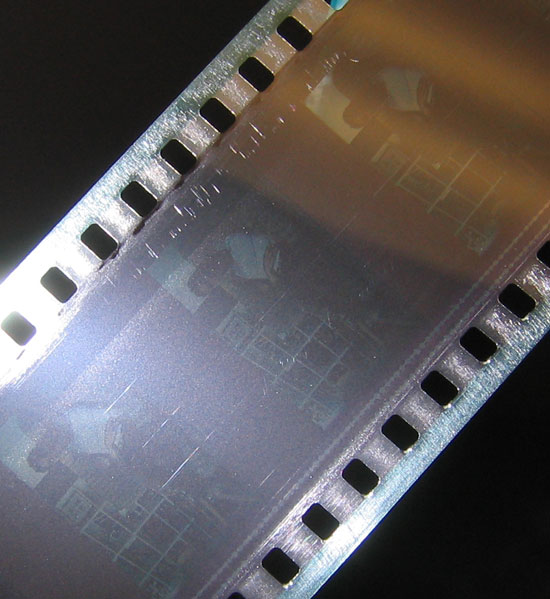
This picture shows a lot of the damage on the non-soundtrack side of the frame. This is persistent throughout.
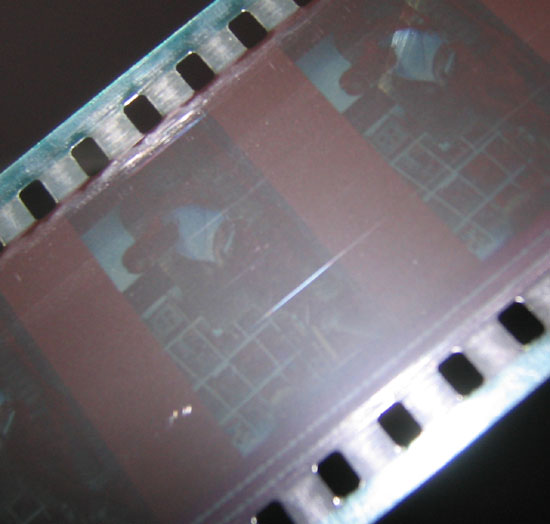
Here's a good shot of the lines that keep appearing and moving around. They don't dance around the frame, instead they stay perfectly static and then disappear as quickly as they appeared.
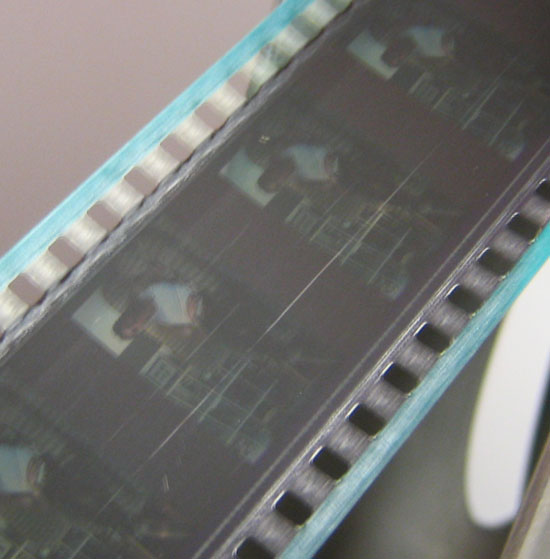
I tried to get a shot of the soundtrack damage, but it didn't turn out. However, you can see a good bit of additional scratching along the opposite edge.
Posted by Richard May (Member # 2627) on 10-25-2005, 05:05 PM:
The small horizontal scratches just inside the sprockets look familiar. I had the same problem one time, although it was on both edges. It turned out to be the intermittent shoe from a simplex projector. It would shake back and forth and give those short horizontal scratches. The rest just looks like it was mauled.
Posted by Dan Chilton (Member # 2288) on 10-25-2005, 05:20 PM:
I just called Technicolor and requested a new print, although I doubt it will get here by our first showing (tomorrow night at 7:00). I forgot to ask the customer rep who had the print last. Will they even disclose that information? Is there any other way to tell who had it before me?
Posted by Darryl Spicer (Member # 711) on 10-25-2005, 07:34 PM:
I would suspect that it last ran on a Simplex with a bad sound gate assembly. The Nothing in that sound gate was probably turning correctly do to bad lubrication and bad bearings. It's also possible that all the pad rollers are set incorrectly and the intermittent shoe is probably loose as mentioned above in another post.
quote: Dan Chilton
Is there any other way to tell who had it before me?
Maybe, get the tracking number off of the cans and go to DHL's web site and run the tracking number. If it was shipped directly from that theatre it might show up.
Posted by Dan Chilton (Member # 2288) on 10-25-2005, 08:14 PM:
Thanks for the tip, Darryl, but no luck... the print came directly from Technicolor in Ohio.
Posted by Brad Miller (Member # 2) on 10-25-2005, 09:42 PM:
FIRST PICTURE
The marks on the edges can be caused by many things, of which the most common is the last roller on the platter being too low to the edge of the takeup deck and it having a burr on it that puts a scrape with every rotation. After a number of runs, you have something that looks like that. However in your case that doesn't make sense, as that is the emulsion side of the film, so it couldn't have happened there unless the film was consistently threaded "against the grain" as it traveled onto the deck. I've also seen it from keeper rollers with a burr on it that was touching (and spinning) with the film, so without seeing the film in person, that's my best guess.
It is very important to look CLOSER at this first pic! This print was CLEARLY run on one of those stupid shitty Simplex/RCA type soundheads. See the embedded dirt pattern that was left behind? That DOES translate to the screen on properly lit screens and IS film damage. I'm glad someone was finally able to capture this damage clearly in a photograph. Maybe more people will listen and heed my advice running 5 Star models to do the pinch roller modification to prevent this. Older RCA type soundheads will forever be a shitty soundhead though, as there is nothing that can be done to it's design to fix it.
PICTURE 2
This is absolutely pad roller scratches, where the clearance was too tight. The pad rollers should be able to spin freely with 2 layers of film clamped onto the sprockets, but be snug with 3 layers.
PICTURE 3
Without seeing more of this scratching I can't be certain, but my initial guess is a misthread where the film jumped a roller and was scraping over a bar (such as can happen on a SPECO or STRONG platter).
Posted by Dan Chilton (Member # 2288) on 10-25-2005, 10:08 PM:
Wow! Thanks for the detailed explaination, Brad. I really need to buy some Film Guard, to repay your generous advice... and to help me never leave a print in this kind of condition. Here's hoping that the second print doesn't end up worse than this one!
Posted by Monte L Fullmer (Member # 2797) on 10-26-2005, 12:01 AM:
..and the third one is usually caused by someone who had "shouldered" rollers in the pad arm assembly that surrounds the middle constant speed sprocket (Simplex) after the film leaves the intermittent assembly-usually with the lower loops being too small.
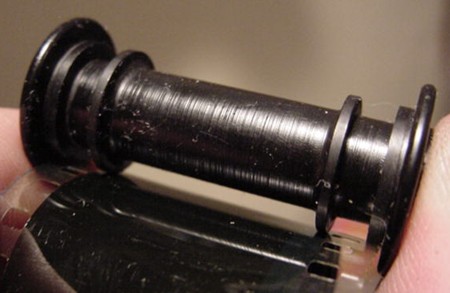
Shouldered rollers causes this linear scratching on the base(cyan) side of the print as the film is entering the sprocket and the inner shoulders of the roller are rubbing against the print on each side.
..and on the first one, you can see the "tiretread" of the lateral guide pressure pad as it presses on the emulsion (magenta) side of the film as it goes around the scanner drum. A common Simplex trademark for a print that was being used for quite a few weeks in these machines.
-Monte
Posted by Leo Enticknap (Member # 534) on 10-26-2005, 01:20 AM:
Also, look at the bottom right corner of each perforation on the soundtrack side. A worn sprocket, I'd guess.
Posted by Monte L Fullmer (Member # 2797) on 10-26-2005, 01:35 AM:
quote: Leo Enticknap
A worn sprocket, I'd guess.
..like a sprocket that had the sides worn off due to an off-aligned outer shoe...
..or an intermittent sprocket not fully aligned to the shoes - a good sign of a recent intermittent assembly replacement and the sprocket wasn't aligned with the gate shoes after the reinstall.
-Monte
Posted by Wolff King Morrow (Member # 2226) on 10-26-2005, 03:24 AM:
Brad, can you give me a link to your instructions on modifying the pinch roller on a 5 Star sound head? Mine are clean and I haven't found that kind of damage happening, but I'd like to see what I can do to prevent it if it does come up.
BTW guys another way rookies can scratch the middle of the film with random lines is by incorrectly threading the cue detector. If the film is threaded on the inside of the first roller of the cue detector, it then rubs again the metal edge of the device, causing random virtical scratches. It boggled my mind that rookies can pull this off, because its actually harder to thread the leader inside that first roller.
Posted by Brad Miller (Member # 2) on 10-26-2005, 03:36 AM:
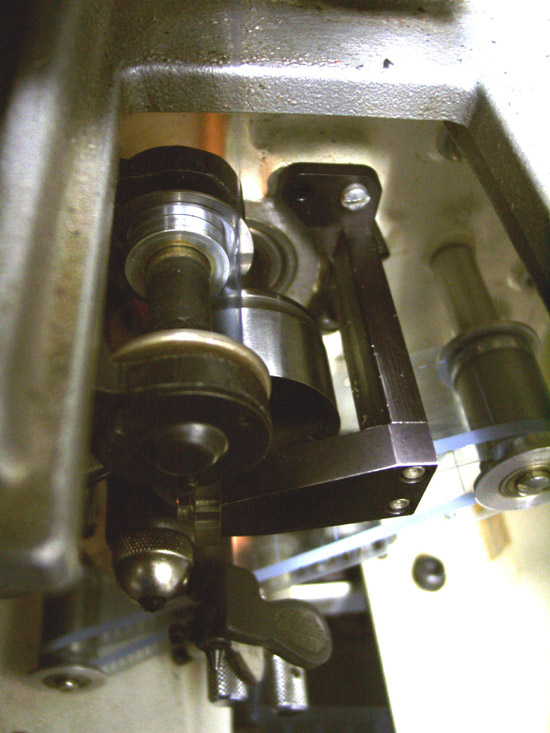
It's very easy, provided you have a buzz track loop and some rubber inserts from Kelmar that are sold to go on the takeup shafts of their film cleaning machines. Simply disassemble the soundhead "gate" and remove the rubber pinch roller and replace it with a rubber insert for a film cleaner. Note you DO need to trim the rubber insert to just BARELY wider than the pinch roller that you are removing, but past that run your buzz track and adjust lateral guide position and you're done...FOREVER! You don't even need to screw with opening the gates up at night either, because it is not IMPOSSIBLE for them to develop a flat spot or wear out.
Posted by Dan Lyons (Member # 1454) on 10-26-2005, 03:49 AM:
Just note that you don't want to thread on the countdown leader if you perform that modifiction on the machine or you will end up scratching the first few feet of the picture; unless you have a fancy motor that can be slowly brought up to speed. ![[Smile]](smile.gif)
The photo above was my previous machine. If I recall correctly, I measured the amount of footage for the sound drum to come up to speed at approx. 15 feet. That was with a resistor on the motor to slow the jack rabbit start-up. Definately more footage with the motor wired normally.
Posted by Brad Miller (Member # 2) on 10-26-2005, 04:14 AM:
I know what you are saying Dan about how the sound drum itself will take a few extra seconds to get up to full speed, but those machines ran for years on 7 second start ups with that modification and the first image to hit the screen was never scratched.
Posted by Monte L Fullmer (Member # 2797) on 10-26-2005, 02:13 PM:
quote: Wolff King Morrow
lines is by incorrectly threading the cue detector.
...and by checking the ball bearings on those rollers on those drop arms. Seen many rollers dried up and not turning.
Kinda why the FP-350 really has it made without using any drop arms to actuate the system.
Thought of other reasons of that base line scratching is of the bearings for the scanner drum shaft-get grumbly bearings and the scanner drum is actually dragging some to cause the film to actually pulling the drum around to rotate.
..or, the lower snub roller arm isn't being drawn inbetween the two stops and the film is actually sliding across the scanner drum.
AND...why I wish that STRONG would have never got rid of the fluid filled flywheel that was on the old 4-star units so the scanner drum wouldn't have to be ramped up to speed with the rest of the system as it is now.
But, unfortunately, we are in an era of amateur operators where paying for professionalism is such an evil omen for the masses.
-Monte
Posted by Brad Allen (Member # 470) on 10-26-2005, 02:43 PM:
Brad, so do I understand this right, what this accomplishes is that the kelmar rubber doesn't touch the film? That's what it appears in the pic.
Posted by Monte L Fullmer (Member # 2797) on 10-26-2005, 03:47 PM:
What it kinda looks like converting over to a "Cinemeccania-type" unit to where the lateral guide roller flanges are the only thing contacting the film,in as well as pressing down on these edges of the film to keep the film tension over the scanner drum, thus eliminating any roller contact("treadmarks") in the picture (emulsion) area.
Course, the next question would be on this conversion is that if a print that was FG'd, would the print want to slip around the drum since there is no pressure to keep the print in contact with the drum with the removal of the larger rubber roller?
I bet that one could go down to an auto part store, buy some gas line neopene hose to do this conversion with.
How close am I?
-thx Monte
[ 10-26-2005, 06:13 PM: Message edited by: Monte L Fullmer ]
Posted by Brad Miller (Member # 2) on 10-26-2005, 09:40 PM:
Both of the above posts are on the money. This way the pinch roller simply becomes a spacer and tension is maintained by the roller just before the holdback sprocket.
And yes it works just fine and dandy with FG'd prints.
Posted by Monte L Fullmer (Member # 2797) on 10-27-2005, 01:20 AM:
Thus, the viscous dampened snub roller behind the lower pulldown sprocket is keeping things snug around the drum to maintain the tension. Once again, a "Cinemeccanica wannabe" trick...-pretty slick.
Now, next question: we know how "5-star" heads, when they start, the film gets a little crazy (wanders back and forth some) until the scanner drum spins up to speed to even things out. With this conversion, does this "craziness" gets eliminated?
Going back to the 3rd picture: With my mentioning of the "shouldered" roller, here is a roller pulled from that middle constant speed sprocket pad roller assembly. As you can see, where the sprocket teeth passes through, are these two shoulders - the inner one and the outer shoulder which is part of the outer flange. This shouldered roller was located in the front part of the assembly (which was removed to be replaced with a non-shouldered roller).
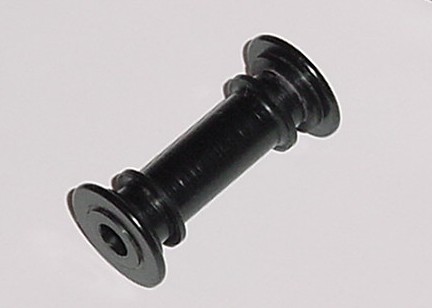
The picture below is what happens durng film travel between sprocket and roller (with me making the loop and resting the roller over the loop), and you can see how the inner shoulders are making contact with the film (base out) as if the film was passing over a sprocket and under the shoulders.
thx-Monte
Posted by Brad Miller (Member # 2) on 10-27-2005, 03:10 AM:
Nice pictoral explanation Monte. ![[thumbsup]](graemlins/thumbsup.gif) Anyone running those kind of pad rollers really needs to replace them with the type that doesn't have that inner flange.
Anyone running those kind of pad rollers really needs to replace them with the type that doesn't have that inner flange.
Monte, I found that post-modification ALL of the issues went away, including warble from an idler roller with a flat spot on it.
Posted by Gordon McLeod (Member # 33) on 10-27-2005, 08:13 AM:
I have had more grief from the pad rollers without the inner flange allowing buckling and scratching than with those
the important point is the 2 fim thickness clearance
Posted by Monte L Fullmer (Member # 2797) on 10-27-2005, 01:03 PM:
True, there is the two film thickness with the arm rollers, but this roller is from the front of the arm when receiving the loop from the intermittent sprocket. Thus, if the loop is a bit too small, the loop is touching the roller first (and the shoulders) before being pulled down by the sprocket.
Why the front roller should be the non-inner shouldered variety on this one arm. Others are okey and I can see the potiental problem(s) as mentioned with the non-shouldered rollers.
-thx Monte
Posted by Louis Bornwasser (Member # 3063) on 10-28-2005, 09:22 AM:
1, The inner flanges cannot be adjusted not to scratch; should either be turned down or discarded.
2. Brad's modification may work well enough on a 5 star. However, even though the same parts are in use, this will not work on a SH-1000, XL or RCA soundhead. My concern for any modification of this kind is that the wow & flutter content is affected. On a Simplex, which has no Davis loop, w/f is already more than discernable. Worse is unacceptable. Louis
Posted by Monte L Fullmer (Member # 2797) on 10-28-2005, 01:14 PM:
quote: Louis Bornwasser
this will not work on a SH-1000, XL or RCA soundhead....
... since you don't have a tension roller to keep things snug being that the lower roller is designed as a snub roller than with these earlier models being that they have no other form of snubbing the film outside of the pressure roller doing the job of snubbing the film.
You'd have W/F like nobody's business without any form of snubbing.
-Monte
Posted by Brad Miller (Member # 2) on 10-28-2005, 01:40 PM:
Odd, who was it that said this??? quote: Brad Miller
Maybe more people will listen and heed my advice running 5 Star models to do the pinch roller modification to prevent this. Older RCA type soundheads will forever be a shitty soundhead though, as there is nothing that can be done to it's design to fix it.
Just giving you boys a little crap. ![[Razz]](tongue.gif)
Louis, in every instance I've done this I have achieved a better result, but then again I have not tried comparing it to a brand new pinch roller. It's possible it may be slightly higher, but even so, it sounded great on the machines I converted and when comparing it to the film damage that occurs when running film on these machines, it was a no-brainer.
The question is would it work with 5 Star SRD basement readers? Maybe Louis could have one of his guys do the mod and report back since he has a perfect facility and staff to do this? ![[Wink]](wink.gif)
Posted by Monte L Fullmer (Member # 2797) on 10-28-2005, 03:34 PM:
quote: Brad Miller
The question is would it work with 5 Star SRD basement readers? Maybe Louis could have one of his guys do the mod and report back since he has a perfect facility and staff to do this?
I could give this a try since I do have a Component Engineering basement reader mounted in my 5-star head at my theatre and make the report to all.
-Monte
Posted by Jon Miller (Member # 163) on 10-28-2005, 07:50 PM:
quote: Monte L Fullmer
You'd have W/F like nobody's business without any form of snubbing.
I performed the modification on the SH-1007 X-L soundhead on my home setup and on an RCA 9030 which preceded the X-L head. As long as I thread up with just one sprocket hole of slack, the lateral guidance assembly provides a little snubbing action and I hear very little flutter, if any. Allow more slack and the sound turns a fluttery mess and I can feel the lateral guidance assembly shake. Odd.
Posted by Gordon McLeod (Member # 33) on 10-28-2005, 09:19 PM:
the principal of the slack loop design is that there is 3 perfs of slack so the double flywheel can damp out both the wow and the flutter components
Powered by Infopop Corporation
UBB.classicTM
6.3.1.2