This is topic Carbon Arc (Cinema carbons Vs Gouging electrodes) in forum Film Handlers' Forum at Film-Tech Forum ARCHIVE.
To visit this topic, use this URL:
https://ft-forum.com/ft/cgi-bin/ubb/ultimatebb.cgi?ubb=get_topic;f=1;t=007578
Posted by Henry Titchen (Member # 3141) on 11-01-2005, 05:52 AM:
Hi,
I recently came across a metal working workshop where Carbon arc electrodes were used for a process called "gouging". The copper coated carbon electrodes look identical to cinema carbons. Upon enquiry I found that the price is very cheap. (Around $15 for 100 electrodes). Does anyone here know the difference between the two types of electrodes? Can gouging electrodes be used in projection gear safely?
Thanks From,
Henry.
Posted by Mark Gulbrandsen (Member # 72) on 11-01-2005, 08:24 AM:
Yes have heard of it before but I don't know of any shops using it around here. There is also what is called EDM (Electrical Metal Disentegration) that is a very precise machine capable of very high tolerances..... as close as 1 micron. I think you will find that water jet custing is replacing what you saw. Water jet uses 60,000 psi water jet to cut metal up to 6" thick. We just had a batch of Christie negative lamp supports roughed out this way then I just finish drilled and tapped the required holes. These negative lamp supports for the older CH series lamps are NLA from Christie and our cost per unit was about 1/3 of our old cost of the factory part from Christie. Because of the odd shape of this part it coldn't really be done by hand on a mill.
As for using them in projection I would doubt that the core of the carbons is treated with the correct rare earth elements and they would more than likely not burn very consistantly.
Mark
Posted by Stephen Furley (Member # 1277) on 11-01-2005, 08:42 AM:
quote: Mark Gulbrandsen
As for using them in projection I would doubt that the core of the carbons is treated with the correct rare earth elements and they would more than likely not burn very consistantly.
I tried it once; I found that the arc was unstable, and the spectural composition of the light was wrong, and not as bright. You might just get away with using them as negatives in a H.I. arc, but not as positives. Sadly, I think the end really is here for projection arcs.
Posted by Joshua Waaland (Member # 287) on 11-01-2005, 08:27 PM:
quote: Mark Gulbrandsen
I think you will find that water jet custing is replacing what you saw.
Actually Mark, gouging rods are mainly used to back gouge a weld on steel plates. It removes metal and creates a valley that can be re-welded. The company I work for makes carbon gouging rods and I think I brought this topic up before though I can't find the old thread.....must have been on the other forum I guess. Anyhow, the ones we make are hollow which is supposed to cut down on smoke and give a better gouge.
Henry, we have a branch of our company down in Queensland Australia and I am sure that he would send you some samples if you request them. His name is Brian. Below is the info. Anyone stateside who wants to try these can e-mail me and I can send them some samples and you can enlighten us all on their performance in a lamphouse. Hope this helps. ![[thumbsup]](graemlins/thumbsup.gif)
Phone: 61 (0) 7 5496-9555 (9599)
[ 03-13-2009, 07:53 PM: Message edited by: Joshua Waaland ]
Posted by Mark Gulbrandsen (Member # 72) on 11-01-2005, 10:33 PM:
So Josh,
Is this company you work for in the old National Carbon building or anywhere near it? I was aware of gouging but have never seen it done. I probably don't have things welded that are so thick as to require that.
Mark
Posted by Gordon McLeod (Member # 33) on 11-02-2005, 01:09 AM:
I doubt your powersupply will be able to regulate them as the voltge drop across the arc vs the current is very different
Also if you were familiar with how a re carbon arc works the light is from the sublimation of the rare earths in the core being volitzed in the positive crater none of which are found in welding carbons
Posted by Stephen Furley (Member # 1277) on 11-02-2005, 03:47 AM:
My experience was that a very shallow, irregular, crater formed in the positive; a stable arc would burn for a few seconds once this formed, but would then wander around the tip of the positive at random for a while, before briefly stabilising again. Even when the arc was stable, light output was very poor. The carbons did have some sort of core, but goodness knows what was in them; certainly not like projection carbons, which I think use Cerium salts in the core of the positive.
I believe that welding, brazing, gouging etc. arcs normally run on a.c., and use a pair of similar carbons. I didn't try using one of these carbons as a negative, with a proper positive; I suspect this might have a greater chance of working, but I don't know for sure. They are hopeless as positives. They might possibly work in the old low intensity, vertical, arcs, like the ones used in Brenographs, and some old spots, but I haven't tried it, and I think it's highly unlikely that anybody is still projecting film with those type of lamps today. The only film projectors I've seen with them have been hand-cranked silent machines, in museums.
Posted by Joshua Waaland (Member # 287) on 11-02-2005, 09:50 PM:
Mark,
quote: Mark Gulbrandsen
Is this company you work for in the old National Carbon building or anywhere near it?
No, we are in a small strip building. All of our stuff is made at our headquarters in Newmarket Ontario in Canada, except the carbons and ceramic weld backing which are made at our location in China.
quote: Mark Gulbrandsen
I was aware of gouging but have never seen it done. I probably don't have things welded that are so thick as to require that.
I have only seen it done once or twice myself. It is obnoxiously loud and dirty. Once the arc from the carbon turns the steel molten, the gouging machine blows compressed air into the puddle which then sprays the molten steel in all directions. It leaves a very nice valley though once it is done. I once got to go on a equipment demonstration with my boss to a local company that made huge (20' diameter) steel fans for ventilation. There was a guy that was back gouging and I went over to watch him.
I can send you a video of our equipment with a back gouger attached to it that we recorded in our warehouse. It is on our cd catalog but I don't have one here. I will e-mail it from work tomorrow if it's not too large. That goes for anyone who wants to see it.
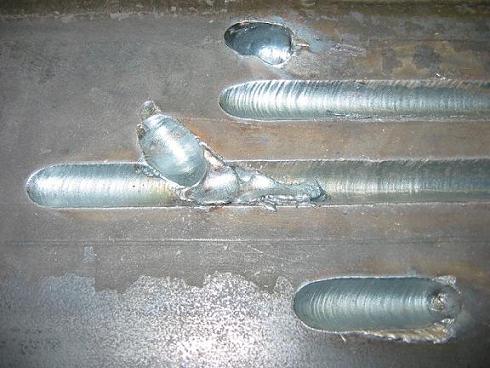
I will also try to post a picture of a plate we back-gouged on here.
[ 11-03-2005, 01:37 PM: Message edited by: Joshua Waaland ]
Posted by Joshua Waaland (Member # 287) on 11-03-2005, 08:20 AM:
Here is a picture of a sample plate that we did some gouging tests on.
Posted by Jim Spohn (Member # 1547) on 11-03-2005, 09:14 AM:
Our theatre is a Carbon Arc exclusively house. We tried the gouging rods in several applications and found them to be 100% wrong for projection. The arc is not steady, uniform or of the correct Kelvin temperature. If you don't stand next to the lamp and baby-sit the arc will go out. Nice try but no cigar. Jim
Posted by Marin Zorica (Member # 1716) on 11-03-2005, 09:31 AM:
Nice to hear that someone still uses carbon arc! Indeed i still have couple of boxes in mine desk, maybee someone will need them someday!
Many projectionicst don't have experiance with carbon arc.
Well i do some projection with carbon arc couple years ago, one of that cinema is closed now :-( ![[Frown]](frown.gif) and other I repaired to xenon lamp.
and other I repaired to xenon lamp.
Is there any carbon arc still producting??
I remember here were used germans carbon arc's i don't remember producters name but i'm sure that where markings positiv on + electrode and nunega on - electrode.
Before couple of years when couple of cinemas used them what i know is been so hard to find it and price was very high because they be out of produce for long time now.
Funny thing was that some projectionics do hear like mine father is that after show arc's where small, but not small do not do one changeover for about 30-40minutes, and there was some holders so you can use whole electode, because normal you can't use last 10cm of lectode on some carbon arc houses.
But i know that some people used carbon arcs for gouging.
Posted by Scott Norwood (Member # 30) on 11-03-2005, 12:06 PM:
Carbons are still available. Some company in India ("Schultz Carbon Electrodes"?) is manufacturing carbons under the National brand. Marble in Japan is producing much better carbons under the Eagle brand. There may be other manufacturers as well.
For those who need lamphouse parts and such, I know that Lenny Miller of Eastern Cinema Supply has a reasonable stock of assorted parts. There may be other sources as well.
Posted by Joshua Waaland (Member # 287) on 11-03-2005, 01:39 PM:
I found a company on the internet a while back that still makes them. I have the link saved on my computer at home. Will edit this post later with it as long as the link still works.
Posted by Henry Titchen (Member # 3141) on 11-04-2005, 04:03 AM:
Thanks for all the useful info about gouging carbons. I guess it would have been too good to be true if they were to work as well as a genuine "cinema carbon".
Can anyone recommend a source of carbon rods in Australia?
Thanks From,
Henry.
Posted by Marin Zorica (Member # 1716) on 11-04-2005, 06:12 AM:
There's some link of one carbon arcs producter :
http://www.lithcoproducts.com/prods/carbon_arcs.htm
It says that are high intesivity carbon arc's, so this can do well on projection, what do you think?
Posted by Kenneth Wuepper (Member # 1174) on 11-04-2005, 06:38 AM:
From the link above.."you get the optimum plate image for longer runs."
These carbons are made for the printing industry and are used to image the surface of offset printing plates. The most useful light for this application is in the UV (Ultra Violet) spectrum.
I have been around shops that used these as a light source and they are only burned for a few minutes at a time. KEN ![[Cool]](cool.gif)
Posted by Lindsay Morris (Member # 1430) on 11-04-2005, 09:45 PM:
Henry,
A good source of carbons for Australian consumers is Carbon Imports in Christchurch NZ.
They supply the Sunny Carbon brand and when I was using carbons (2 seasons ago) I was using a mix of both Sunny and Double Eagle and there was no noticeable difference between either.
If anything the Suuny's burnt a fraction longer but others on this site had found that the Sunny's they were using burnt with a yellow flame and were unstable????
I still use 6 + 7mm carbons in the slide arc and have a good screen light and for a slide arc which requires a spot some 80mm in diam to send a 3 1/4 sq glass slide up onto a 10m wide screen is pushing the boundries a bit.
Contact Mark Strong on Email strongy@xtra.co.nz or phone NZ 3354 3948 or Fax 3354 3968.
He posts them back and they travel well via that method... no breakages so far.
If you only bring in small quantities most likely they will not get slugged GST by Customs.
Mark had and I believe still has good stocks of 6mm Negs + 7mm Pos as well as 7 + 8mm ones.
12 months ago I met with him in Christchurch and he was still selling plenty as there are many small shows in NZ still running carbons.
A mate of mine over here with a mobile 35mm show has just restocked his supply of 7 + 8mm carbons from Mark.
Some NZ places are running 7 + 8mm setups on a 6/7 style rectifier and get very long run times out of them.. the arc might not be as stable as I would like it but it looked fine on the screen. 40amps on a 7/8 setup is a bit dodgy.
Recently I visited a small (22 seater) cinema at Tinone in NSW and there he was running the entire show on carbons on one machine with a double MUTT using 7/8 carbons at about 50 amps.. light was good and arc was stable in the Westrex 14" arc lamp.
Lindsay
Posted by Stephen Furley (Member # 1277) on 11-05-2005, 04:18 AM:
quote: Marin Zorica
It says that are high intesivity carbon arc's, so this can do well on projection, what do you think?
I don't think so. Platemaking arcs are not like projection ones. The ones I've seen use much thicker carbons, maybe 12mm, though I saw a very large one once used for exposing photostencil film, and direct screen emulsions, for screen printing large posters, which used ones of about 25mm.
I've not seen a platemaking arc which used coppered carbons like the ones shown in your link, I'm not sure what type of equipment these are designed to be used in. These would be too short for film projection, and I suspect that the composition of the core would also be wrong. Notice that these carbons are not specified as being 'positive' or 'negative'; in H.I. projection arcs the two carbons are quite different to each other. Carbons do not work well in the wrong polarity, even if you can get the right combination of sizes.
I've got away with using a size larger carbons when the correct ones were unavailable, and under-running them, burning time was longer, but the light output not quite as good. I don't think you are going to get acceptable results which are 'incorrect' in any other way.
Posted by Jon Miller (Member # 163) on 11-05-2005, 09:46 AM:
On this side of the pond, Stephen, the well-known "nuArc" line of platemakers and lamps used copper-coated AC carbons. For example, this portable nuArc platemaking lamp I got for the heck of it uses a 8mm x 8" copper-coated trim (National HI Photo 88, to be precise). I think the nuArc "Flip-Top" platemaker, common in the graphic arts industry in its day as Peerless Magnarcs were in movie theatres, used the same trim, give or take a millimeter.
With a static image, a DC arc was not necessary for platemakers.
Posted by Stephen Furley (Member # 1277) on 11-05-2005, 11:09 AM:
Sounds like the sort of thing that the carbons in the picture are intended for. Probably more modern than the sort of platemaking arcs that I've seen. I used to do quite a bit of small offset work myself in a previous job, but that was with mercury lamps. Carbon intended for operation on a.c. are unlikely to work satisfactorily in projection lamps.
Nu-Arc equipment was/is quite common here as well, but I haven't seen any using coppered carbons.
Posted by Joshua Waaland (Member # 287) on 02-09-2006, 07:08 AM:
I found out that the company that we got the gouging rods from is actually a projector carbon company. Their info is below. We still have some in stock but we are no longer going to carry them.
ChangZheng Projector Carbon Co. Ltd.
NanXun 318 National Highway
HuZhou City
ZheJiang Prov., China 313009
Tel: 0086-572-3912367
Fax: 0086-572-3011768
E-mail: czcarbon@yahoo.com.cn
Contact: Mr. Ling Bing, General Manager
Posted by Frank Angel (Member # 248) on 02-09-2006, 03:16 PM:
Maybe someone can explain this. When I was in HS, in Physics, when we were touching on electricity, it so happened that to illustrate the concept of postitive and negative electrons, they happened to show a diagram of carbon arc and a battery. However, the diagram showed the rod with the crater as being the NEGATIVE and the rod with the tip as being the POSITIVE. I was very surprised to find that it was just the opposite terminology when I got to my first booth.
Why would there a totally opposite way of looking at it? Isn't positive and negative universally understood?
Posted by Will Kutler (Member # 770) on 02-09-2006, 08:46 PM:
Josh....
Some VERY nice looking beads! Are they robitic or manual and what kind of metal was being tested?
Mark...
EDM...correct title for EDM is Electrical Discharge Machining. EDM has many, many uses! Two types of EDM: sinker type uses electrodes, which can be a variety of materials (including carbon) and are machined to shape..then there is the wire type EDM. Anyhow, as soon as our new sinker EDM at school is set up, I want to use it for a portion of that model engine I am currently building. I want to do a small Ace of Spades brass decorative inlay, the base piece being stainless steel and the inlay being brass. I'll probably machine the electrode on our HAAS CNC VF-2, as doing it on a manual mill/rotary table would be a real time consuming pain!
Posted by Lindsay Morris (Member # 1430) on 02-10-2006, 02:56 AM:
Frank,
Easily explained... it is just a hangover from the days of "current flow" where the accepted direction of current was positive to negative.. hence you get a theoretical hole in the neg carbon.
I grew up in the time of transisition from current flow to electron flow but even then there were many contradictions such as the left hand and right hand rules for generators and motors and then you started dealing with valves and it all went the other way. Neg to Pos.
If you have a copy of Richardsons Blue Book of Projection you will see what I mean.
I was always confused when I started out doing my projection training and looking at the carbons and wondering why the Pos one got the crater if the current really went Positive to Negative. But at that stage I had more valve theory under my belt than I did projection theory so I just applied the electron valve theory and I was happy until I got to the Motor and gene rules ![[Confused]](confused.gif)
Now we all know it goes neg to pos and nobody thinks otherwise.. well not the younger ones anyway
Lindsay
Posted by Joshua Waaland (Member # 287) on 02-10-2006, 09:07 AM:
Will,
Those are actually craters in the metal that were made by the gouging rods. They appear as welds in the picture because of the way the light is hitting them. The material is mild carbon steel. We make a machine that runs on track and automates welding processes. The gouging machine is made by another company and it mounts on our carriage. It isn't as high tech as a robot but it is also 1/10th of the price of a robot and does a good job as you can see.
Posted by Tim Reed (Member # 137) on 02-10-2006, 01:18 PM:
quote: Frank Angel
to illustrate the concept of postitive and negative electrons
Electrons are always negative, regardless of which theory a person ascribes to. Movement of valence electrons create positive "holes" in the conducting atom(s), which can be said to be moving in the opposite direction. That's current theory.
The best way I came up with to illustrate "hole current" is to envision a theatre marquee (what else?) with lights running in a traveller fashion. The areas of lit bulbs (like flowing electrons) run in a certain direction, and are easily seen with your eyes. However, if you look at the groups of bulbs that are OFF at any given instant, between the lit ones, and you train your eye on them long enough, you will see the dark areas (holes) travelling in the opposite direction.
Simple, huh?
Posted by Frank Angel (Member # 248) on 02-11-2006, 08:24 AM:
Yah, I get it....thanks you guys. It's like one of those optical illusions where you look at it and you see a perfect picture....but you keep looking at it and all of a sudden a few extra cells or something in your brain snap together and you see a completely different but perfectly formed picture and the first one is just gone. It's all perspective.
But actually, I am really more interested in that metaphysical moment....the precise still point of the turning world where the mind changes from one to the other and you haven't done anything at all to make it morph....it happens involuntarily. Now THAT'S the interesting thing! Some one explain THAT and I buy you a round! ![[beer]](graemlins/beer.gif)
Hmmmm, I was up doing an all nighter.....I guess it shows? ![[uhoh]](graemlins/uhoh.gif)
Posted by Joseph A Sierra (Member # 3625) on 02-14-2006, 01:50 PM:
change the film reader for the one that should use, the cat 702 and check the proyector speed(pulleys,belts,etc)if proyector speed is fluttering probably it will happen
Powered by Infopop Corporation
UBB.classicTM
6.3.1.2