This is topic Difference Between DTS-6 and DTS-6D in forum Film Handlers' Forum at Film-Tech Forum ARCHIVE.
To visit this topic, use this URL:
https://ft-forum.com/ft/cgi-bin/ubb/ultimatebb.cgi?ubb=get_topic;f=1;t=007581
Posted by Joshua Waaland (Member # 287) on 11-03-2005, 06:51 PM:
What is the difference between a DTS-6 and a DTS-6D besides two cd drives? I have a DTS-6 and I already have the latest chip installed. I thought if I bought a face plate and the upgrade kit, that I would esentially have a DTS-6D. Am I smoking crack or is this feasible? Thanks.
Josh
Posted by Daryl C. W. O'Shea (Member # 1303) on 11-03-2005, 07:30 PM:
I always thought you injected crack.
Functionally there's not much difference between the two players. The 6 has a better output stage than the 6D. You can add a third drive to the 6 if you have drive envy. Either three slimline drives in the existing two bays, or one externally.
Posted by Joshua Waaland (Member # 287) on 11-03-2005, 07:53 PM:
Actually I think you can do crack both ways can't you?
I looked at the back of my unit and at the drawing in the DTS-6D manual I have, and I did notice that the outputs and inputs were different. The DTS-6 doesn't have a automation connection for one thing.
Do any films have three discs or is the third drive just for a trailers disc?
Posted by Mark Gulbrandsen (Member # 72) on 11-03-2005, 08:08 PM:
Josh,
The automation connections are through that large connector on the back. The original DTS ribbon cable had three breakouts, 2 are genereally used unless its set up on a CP-200... 1 b.o. for audio, and 1 b.o. for automation. I believe the dts 6 manual is in the manuals section. The 6 uses Jensen output transformers!! These are about the best transformeres in the buisness. The 6D uses fairly high end Burr Brown op amps for its output stage and an independent +/- 12 volt switching supply(that was failure prone at one time)just for the analog stages.
Mark
Posted by Daryl C. W. O'Shea (Member # 1303) on 11-03-2005, 09:46 PM:
I've been meaning to look into it for years. You always hear about people smoking crack, but never hear people saying that they must be injecting crack.
Yeah, the third drive is normally for the trailer disc. 99.5% of features are two disc only. 99.5% of the main stream three disc features can be made to fit on two 700MB CD-Rs. So, if you don't need the trailer disc you'd be fine with a two disc player.
Posted by Brad Miller (Member # 2) on 11-03-2005, 10:06 PM:
Adding a 3rd drive to a dts6
Reauthoring 3 disc movies onto 2 CDR discs
Posted by Monte L Fullmer (Member # 2797) on 11-04-2005, 04:31 AM:
When "Gone With the Wind" re-release by NewLine (the catastrophic, anamorphiced IB release) came out in 1998, there were 3discs for this release-being the release was 224 minutes.
Only thing that I noticed between the "6" and the "6D" were the useage of the 2 spin caddy drives (which were built like a tank), a 386SX20 momboard, then the upgradable firmware chip. "6D" units went to the 486SX25 processor with the 16 spin Toshibas and more memory, but still had the "AT" board in both of them.
-Monte
Posted by Joshua Waaland (Member # 287) on 11-04-2005, 06:05 AM:
So I guess I was "injecting" crack then Daryl.
There are many more differences than I thought. Monte brought up a good point in that the DTS-6 was a 386 and the DTS-6D was a 486. I believe I remember Brad saying one time that the DTS-6 had a better sound to it than the DTS-6D. Is that true Brad? Is this due to the differences in output that Mark pointed out?
Posted by Stephen Frazza (Member # 2320) on 11-04-2005, 12:33 PM:
Crack is made to be smoked. In its normal state it is not water soluble. You need something acidic to break it down to be able to inject it. Lemon juice or vinegar is most often used. Although some needle exchanges do pass out bags of ascorbic acid to make it safer.
Hope that helps Daryl
Posted by Monte L Fullmer (Member # 2797) on 11-04-2005, 01:47 PM:
quote: Joshua Waaland
DTS-6 had a better sound to it than the DTS-6D.
The slower 2 spin speed of the caddy drives could transfer data almost on a "real time" basis with the "6" units than with the 16 and 32 spin drives for the "6D".
Thus, the data transfer from the higher spin drives had to be slowed down considerably along with the newer SCSI cards that had to go with these faster spin drives, thus probably going through the "lossy" data loss of the stored data in the cache.
With the faster drives, came the faster processor for the DOS based units.
-Monte
Posted by Gordon McLeod (Member # 33) on 11-04-2005, 02:28 PM:
the major sonic difference was the high quality jensen output tranformers on the dts6
Posted by John Hawkinson (Member # 1135) on 11-04-2005, 03:33 PM:
Monte wrote, "Thus, the data transfer from the higher spin drives had to be slowed down considerably along with the newer SCSI cards that had to go with these faster spin drives, thus probably going through the "lossy" data loss of the stored data in the cache."
Huh? ![[Confused]](confused.gif)
Data stored in a cache is not "lossy." When we speak of something as being "lossy," we mean it actually loses information. Examples for laymen:
- An image compression algorithm that compresses an image by saying, "99% of the image is black, so just treat the whole thing as black, humans won't know the difference." This is "lossy." You cannot recover the 1%.
- An image compression algorithm that replaces each run of black pixels with a count (aka "run-length encoding"). i.e. "The next 2000 pixels are black." This is non-lossy. You can recover the exact original image.
Lossy compression is frequently more space-efficient.
What word did you mean to use?
--jhawk
Posted by Monte L Fullmer (Member # 2797) on 11-04-2005, 04:51 PM:
quote: John Hawkinson
What word did you mean to use?
..a word that could possibly meaning in an area of where data stream is going so fast (from the faster spin drives) and has to be slowed down for the data to be accessed in sync.
Course, where I mentioned the word "probably", it mentions that the information is not an accurate term, but in a suggestive (or guessing) tense.
That's were outside help comes into play.
thx-Monte
Posted by Gordon McLeod (Member # 33) on 11-04-2005, 04:58 PM:
monte said "..a word that could possibly meaning in an area of where data stream is going so fast (from the faster spin drives) and has to be slowed down for the data to be accessed in sync."
buffering of data should not introduce any loss of data it is just a queing up process
Posted by Bobby Henderson (Member # 840) on 11-04-2005, 06:25 PM:
This subject reminds me of all those "jitter" topics, where people would describe a CD player or DVD player as if it were behaving in terms of an analog device.
The data either gets through or it doesn't. Data packets and memory buffers certainly see to that. If things like jitter were corrupting digital audio sound quality then by that logic it would be completely impossible to read or write computer data from CDs or DVDs with any reliability at all.
Also, if a DTS-6 player were sounding better than a DTS-6D unit the difference in audio quality could only be happening from aspects in the players after the audio has been converted into analog form.
Posted by Bruce Hansen (Member # 281) on 11-04-2005, 06:39 PM:
The only film I know of that uses three DTS discs (other than GWTW) is "Gods and Generals".
Posted by Joshua Waaland (Member # 287) on 11-04-2005, 09:41 PM:
quote: Bobby Henderson
Also, if a DTS-6 player were sounding better than a DTS-6D unit the difference in audio quality could only be happening from aspects in the players after the audio has been converted into analog form.
Good point Bobby.
Posted by Monte L Fullmer (Member # 2797) on 11-05-2005, 02:03 AM:
Yea, I forgot about "G&G" since I only ran that movie in an optical house for one week, thus leaving the discs in those two big boxes.
Posted by Chris Trainor (Member # 9) on 11-06-2005, 12:25 PM:
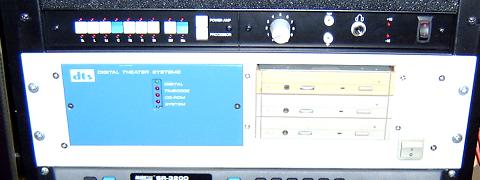
I just slapped 3 drives in my DTS-6. I used 3 of the Toshiba 2x drives. Just removed the spacers (since they are slimline drives) and put 3 in there. Works well. I've got a pile of these drives from old Sun/SGI workstation upgrades.
--Chris
Posted by Joshua Waaland (Member # 287) on 02-22-2006, 10:56 PM:
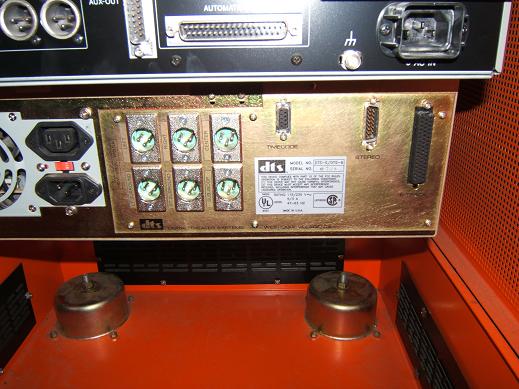
I looked through the manuals for the dts-6 and the dts-6d and could not find any connections like the ones I have on the back of mine. I am referring to the 6 connections on the left of the picture. Can anyone help me? These look like the type of connections on a microphone. Thanks.
Posted by Monte L Fullmer (Member # 2797) on 02-22-2006, 11:00 PM:
Looks like that this DTS-6 unit has been "modded" with those "XLR" male connections on the back. This is not a stock DTS-6 unit out of the factory.
Someone added those "XLR" connections for discrete channel hookup instead of using the breakout connection on the right. With these XLR hookups, someone wanted real clean, balanced analog output running directly to the power amps that would have the XLR connection to receive these signals.
-Monte
Posted by Joshua Waaland (Member # 287) on 02-23-2006, 06:30 AM:
This unit was in a special venue ride. It was a Showscan installation. The XLR connections look factory. I wonder if Showscan had DTS install those connectors for them. Maybe Karen Hultgren can verify this?
Posted by Gordon McLeod (Member # 33) on 02-23-2006, 12:31 PM:
many of the special venue ones have xlr connectors
Posted by Mike B. Smith (Member # 2829) on 02-23-2006, 04:00 PM:
This modification was done by DTS for Showscan. To the best of my knowledge these are the only ones with XLR outputs.
Powered by Infopop Corporation
UBB.classicTM
6.3.1.2