This is topic Help identify these intermittent parts in forum Film Handlers' Forum at Film-Tech Forum ARCHIVE.
To visit this topic, use this URL:
https://ft-forum.com/ft/cgi-bin/ubb/ultimatebb.cgi?ubb=get_topic;f=1;t=007643
Posted by Marc Hansen (Member # 705) on 11-27-2005, 10:08 AM:
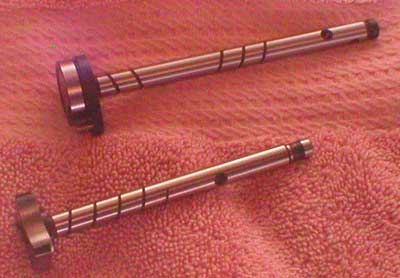
The boxes they were in just says Simplex
Aprox Dimensions
Cam
Shaft Diameter .312
Shaft Length 4.360
Overall Length 4.765
Cam Diameter .932
Pin Diameter .100
Star
Shaft Diameter .312
Shaft Length 3.750
Overall Length 4.067
Thanks
Posted by Monte L Fullmer (Member # 2797) on 11-27-2005, 12:12 PM:
Interesting. Don't really understand your question unless you're trying to find which machine this cam and starwheel belong to.
Looks like they belong to the "XL" family of Simplex.
-Monte
Posted by Marc Hansen (Member # 705) on 11-27-2005, 12:26 PM:
That's exactly what I am trying to find out. I got them with some other stuff I bought at an auction and I can't sell them if I don't know what they fit. When I know I'll put them in the wanted/for sale forum.
thanks
BTW: These are Brand New
Posted by Bob Koch (Member # 1062) on 11-27-2005, 01:18 PM:
I`ll go with Monte. If they are,indeed,Simplex they would have to be XL.Supers and E7 had a flywheel gear that drove the cam so the cam shaft would be much shorter
Posted by Monte L Fullmer (Member # 2797) on 11-27-2005, 04:51 PM:
The Starwheel has the indentation on the end of the shaft for the lock collar and the Cam has the double threaded holes to mount the geared flywheel.
These clues which drew my conclusion on which assembly needed these parts - since I've rebuilt a good 5 of the intermittents.
-thx Monte
Posted by Gordon McLeod (Member # 33) on 11-27-2005, 05:46 PM:
Also the sprocket attaches with a nut and bolt the Super and E7 were typically a pair of taper pins
Posted by Will Kutler (Member # 770) on 11-27-2005, 06:17 PM:
Gord
I have seen Supers and E-7's equipped with bolt-on sprockets. And one of mine had a VKF on it.
Cheers
K
Posted by Marc Hansen (Member # 705) on 11-27-2005, 06:45 PM:
The holes in the cam are threaded, looks like 8-32. The hole in the star is straight and approx .153.
Marc
Posted by Mark Gulbrandsen (Member # 72) on 11-27-2005, 08:36 PM:
I'll second, third and forth what everyone else has said... Definately X-L star and cam... value if unused is about 500.00 US for both pieces.... In other words don't give em away. Those are also much better quality than whats being made today...
Mark
Posted by Will Kutler (Member # 770) on 11-27-2005, 11:51 PM:
Hi Mark
As a machinist, I fail to see what is sooooo difficult about making a star and cam. I would say that the biggest challenge is having a jig-grinder to grind the star. Actually, it is some pretty straigt-forward machining. Yes, making a one-off pair would be very time consuming, but with a mass production set-up, not necessarily CNC, production could be relatively quick. What are the part tolorances?: +/- 0.0002 in? Pretty standard for grinding ops.
Posted by Monte L Fullmer (Member # 2797) on 11-28-2005, 12:57 AM:
Hmmmm..pretty close tolerances, fine tooth balancing of the cam, with these two picts of the pin of the cam entering the starwheel, and the clearance of cam and starwheel...I would say...Mark can fill in the blank spaces of actual tolerance measurements.
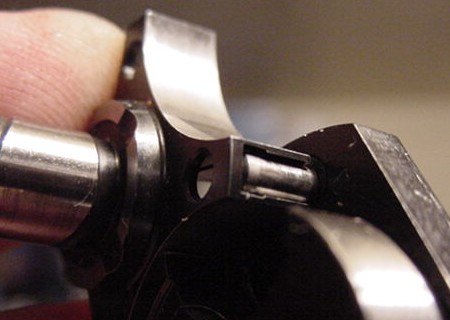
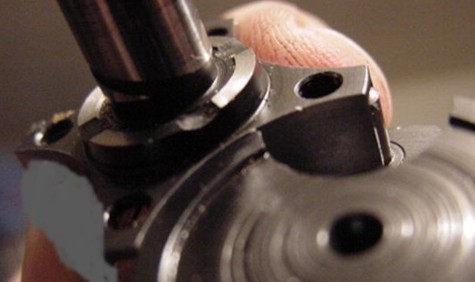
This, below, is what happens when units aren't getting the continual proper oil feed to the intermittent assembly and the starwheel shaft decides to sieze inside the nose cover:
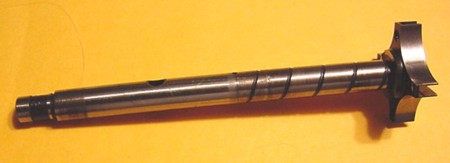
one can see the "ring of steel" that was cut between the first and second spiral that the iron from the cover piece decided to cut when the iron got a bit hot from no lubrication.
Definitely constituted a new cover,gasket cam, starwheel and three fibre gears that were stripped when the unit seized.
..twas a bit messy to clean up all of that shredded gears inside the geartrain, which practically taking out the vertical shaft assembly, cleaning out the sump and replacing those gears that where shredded from their metal counterparts.
After all was cleaned up and unit rebuilt, that black case "XL" sounded better and quieter than before this all happened.
.......................................................
The first time I did an intermittent rebuild was on a Super with those taper pins. Had to replace the sprocket-inner workings were fine. Sprocket's teeth were shot and sprocket was already reversed so I couldn't use the back side of the teeth. It was just a bit of a trick to figure out which side of the sprocket's shaft holes are smaller so the pins could be entered in on the reverse (larger hole) side. Then, to make sure that the pins are seated equally before reassembling and setting the starwheel with the cam so the pin of the cam was entering into the starwheel at an exact moment-not before or afterwards.
Afterwards, that Super ran pretty smooth-real good for a 20 year old kid that didn't have the foggiest on what he was doing except by reading the parts manual on how stuff was put together.
-Monte
Posted by Robert Throop (Member # 61) on 11-28-2005, 03:19 AM:
[QUOTE]Also the sprocket attaches with a nut and bolt the Super and E7 were typically a pair of taper pins
E7's always used a nut and bolt to fasten the sprocket.
Bob
Posted by Mark Gulbrandsen (Member # 72) on 11-28-2005, 08:39 AM:
quote: Will Kutler
As a machinist, I fail to see what is sooooo difficult about making a star and cam. I would say that the biggest challenge is having a jig-grinder to grind the star. Actually, it is some pretty straigt-forward machining.
Actually that is a good question for Don Markus at Wolk! When Don bought Wolk one of the first things he wanted to do was make stars and cams. Didn't work out and I don't know the exact reasons although he siad there were too many reject parts... so You should call and talk to him about it. Tolerances on stars and cams are typically better than .0001 and Phillips kept tolerances to 1 micron on their stars and cams. If you think you can make them I'm sure that LaVezzi would hire you one the spot, but then there are only just a few people working there(for a very long time) that can make these parts without there being alot of reject parts...... Its hardly what I would call a normal grinding operation......
quote: Monte L Fullmer
Definitely constituted a new cover,gasket cam, starwheel and three fibre gears that were stripped when the unit seized.
Monte,
Not necessarily.... The cover is rarely a loss as it can be lapped out clean. Even stars that have seized can be polished and saved and a few more years gotten out of them, have done that many times.... its the most common place for an X-L star to seize up. Polishing the star is on a one by one case as long as none of the radius's are bent.
Its simply a matter of dealing with a supply dealer that knows what he is doing vs. one that doesn't or thinks he does...... false economy is for the fools.
Mark
Posted by Will Kutler (Member # 770) on 11-28-2005, 01:23 PM:
Monte
+/- 0.0002 is a pretty standandard grinding tolorance....nothing special about that. Keeping in mind that the tighter the tolorance the more $$ the part.
Now if stars and cams are ground to the 0.00000 (fifth decimal place) we can start having problems. Those problems can include tolorance change due to the material used as well as due to the operating enviornment.
As far as "balancing" the star and cam, on those I have seen at least, there was no indication of any special balancing, like what is done with material removal on the intermittent flywheel.
[ 11-28-2005, 07:09 PM: Message edited by: Will Kutler ]
Posted by Monte L Fullmer (Member # 2797) on 11-28-2005, 02:08 PM:
quote: Mark Gulbrandsen
Polishing the star is on a one by one case as long as none of the radius's are bent
Yes, and I agree totally with this. But unfortunately where I don't have the equipment available to test and redo such measures, it was just the obvious route for replacement and get this XL machine up and running.
Owner didn't care about expences - just for me to get the machine fixed pronto since revenue was being lost with that house down.
thx-Monte
Posted by Mark Gulbrandsen (Member # 72) on 11-28-2005, 07:02 PM:
quote: Will Kutler
there was no indication of any special balancing, such as material removal on the intermittent flywheel
Actually many of the older projectors had balanced flywheels. Motiograph comes to mind. when machining fomr solid stock balances are not as prone to be way off like machining from a casting.
BTW: One Micron = One micron = 1/25,000 of an inch or 1/1000 of a millimeter. This is the reason I hold the Phillips equipment in such high regard.... anyone working to 1 micron tolerances and that can hold that tolerance part after part really knows his stuff. I'd like to see a high volume place hold tolerances like that today... it would be VERY spotty and costly.
quote: Monte L Fullmer
Yes, and I agree totally with this. But unfortunately where I don't have the equipment available to test and redo such measures, it was just the obvious route for replacement and get this XL machine up and running.
Monte,
Thats why dealers have loaner movements on their shelves.... Instant repair so to say.... sometimes the same day if a Greyhound bus heads your way(which it does). I'd be willing to bet that that movement woulda run fine with new gears and some "clean up" work.
Mark
Posted by Will Kutler (Member # 770) on 11-28-2005, 07:07 PM:
Hi Mark
I did not write clearly. Yes, the flywheels themselves are balanced, and is noticable on various projectors - and those flywheels are seperate parts. But I have not seen an actual star or cam balanced themselves through machining.
Posted by Louis Bornwasser (Member # 3063) on 11-28-2005, 07:08 PM:
Andy Marglin says he saw stars & cams made on "12 foot tooling" at the old Long Island Century facility.(outgrowth of Western Electric.) Definately not high tech back then and the work, though tedious, was really excellent. (Early "C's" and Supers had rock steady pictures, too.) Louis
Posted by Mark Gulbrandsen (Member # 72) on 11-28-2005, 07:33 PM:
Agreed Louis.... Its not necessarily the machines that are being used its the people running them and their amount of experience that matters far more. Those old C stars and cams also far outlast todays stuff....
Mark
Posted by Monte L Fullmer (Member # 2797) on 11-28-2005, 11:13 PM:
quote: Mark Gulbrandsen
Thats why dealers have loaner movements on their shelves....
Yes, and with you showing me where you work at and the loaner parts located at your occupation, I keep forgetting about this.
Just something to remember next time a drop of any sort that causes a downed screen (if I get the clearance to do a loaner procedure..if you know what I mean..LOL).
-thx Monte
Posted by Louis Bornwasser (Member # 3063) on 11-29-2005, 08:55 AM:
Part of the blame is EPA. LaVezzi started having some problems about the time that old style hardening procedures were declared off limits. Now most parts threoughtout the world are "surface hardened." Louis
Posted by Will Kutler (Member # 770) on 11-29-2005, 06:35 PM:
Louis
Please explain EPA limits on heat-treating materials? Where did you get this info?
One of my current engineering classes is Applied Materials Science. Conducting heat-treat,hardness and microstructure analysis on a variety of metals including: A2 Tool Steel, 17-4 stainless steel, 1020 carbon steel, copper berylium, yellow brass alloy, 6-4 Titanium, Waspaloy and Inconel 718. Also a Jominy test on 4140 Steel.
Regarding Surface Hardening Treatment (Case Hardening) "Many applications require high hardness or strength primarily at the surface, and complex service streses frequently require not only a hard, wear-resistant surface, but also core strength and toughness to withstand impact stresses" Machinery's Handbook.
But case hardening can also be a method to reduce heat treat time and costs by not requiring a full "soak" at temp.
Not sure what you mean by "old style" methods of heat treatment? Each alloy has its own "reciepe(s)" for heat treatment depending on what needs to be accomplished. Its all about metalurgy.
Posted by Mark Gulbrandsen (Member # 72) on 11-29-2005, 07:37 PM:
Louis,
I guarantee you that hardening exccuse is a crock of you know what!! As Will mentioned its possible to harden to the core... just takes longer... I once had a batch of shutter shafts made up to go with the hardened verticle shaft... makes a Century virtually indestructable... The hardening process for them took just over 4 days. They were hardened to about an RC-62 which is even harder than the LaVezzi verticle shaft,then ground their length by Boston Centerless too a .0001" tolerance. You could pound a nail inn with onone of these shafts.. they wouldn't bend nor would there be any dings in it.... I gave a few away to visiting friends and other dealers and used the rest in rebuilds.
Get your self a nice used Rockwell harness tester and check parts both new and old... you'll find out in short order how crappy the metals and the projector parts in use today are. I think that alot of the quality in older parts stems from the steel just being alot better back then and the care that went into making them!
quote: Will Kutler
microstructure analysis on a variety of metals including: A2 Tool Steel, 17-4 stainless steel, 1020 carbon steel, copper berylium, yellow brass alloy, 6-4 Titanium, Waspaloy and Inconel 718. Also a Jominy test on 4140 Steel
Will, don't leave the tuballoy out of that list..... ![[Big Grin]](biggrin.gif)
Mark
Posted by Monte L Fullmer (Member # 2797) on 11-29-2005, 11:49 PM:
quote:
I think that alot of the quality in older parts stems from the steel just being a lot better back then and the care that went into making them!
Seems like this is the trend in any manufacturing policy and procedure nowdays.....forgetting about quality.
Like the the "M" steel that Henry Ford used to use for his Model "T"' frames: cut a piece out of that frame and you have a nifty portable anvil. Who can do that now...
-Monte
Powered by Infopop Corporation
UBB.classicTM
6.3.1.2