This is topic THX amps? in forum Film Handlers' Forum at Film-Tech Forum ARCHIVE.
To visit this topic, use this URL:
https://ft-forum.com/ft/cgi-bin/ubb/ultimatebb.cgi?ubb=get_topic;f=1;t=007649
Posted by Amanda Mundin (Member # 3386) on 11-30-2005, 12:15 PM:
Does anyone know how amps and speakers are judged to be upto THX spec? and in what way are the THX models better than the non-THX models?
Posted by Pete Naples (Member # 761) on 11-30-2005, 01:03 PM:
They aren't necessarily better in any way, they just bear the badge ![[Wink]](wink.gif)
THX means next to nothing in the UK now, none of the major chains are bothering with it. A well designed, specified and insatlled theatre and projection/sound system can easily match or exceed THX.
Posted by Louis Bornwasser (Member # 3063) on 11-30-2005, 02:23 PM:
This was not true when Tom Holman set up the program; but it is true now.
To answer your question; I have found by experience that the very best amplifiers have one thing in common: they are RATED into a 2 ohm load. Louis
Posted by Gordon McLeod (Member # 33) on 11-30-2005, 10:32 PM:
Typically a THX approved device will do what the spec sheet claims it will how it is then used is upto the system design engineer
Posted by Jonathan Worthing (Member # 803) on 12-01-2005, 10:35 AM:
quote: Pete Naples
They aren't necessarily better in any way, they just bear the badge
And what a price for a ![[bs]](graemlins/bs.gif) badge
badge ![[Big Grin]](biggrin.gif)
Posted by Ben Wales (Member # 92) on 12-01-2005, 05:56 PM:
THX means next to nothing in the UK now.........
I wonder what Andy Summers will have to say about that!
Posted by Phil Hill (Member # 371) on 12-01-2005, 06:15 PM:
Yeah Ben, I wonder what Andy would have to say about it too...especially since I totally agree with Pete and Jonathan. THX certification is just another horseshit marketing thing that really has NO advantage that 99% of the theatre-going masses can recognize...BUTT! Think they can! OBTW: Don't forget to use "Monster Cable" for EVERYTHING! ![[thumbsup]](graemlins/thumbsup.gif)
It's just ANOTHER hype for the theatre owners to pay the $$$ so they can have the "privilege" to screw the patrons outta more $$$.
HERE is the "official" approved equipment list. (pdf)
(Which just goes to show that shit equip is "approved" right along with the "good" stuff!)
Posted by Daryl C. W. O'Shea (Member # 1303) on 12-01-2005, 11:01 PM:
Don't you be knockin' Monster Cable. I just rewired a 2000 car space drive-in's AM system with Monster Cable and it definitely rocks. Well worth the $6,000,000 it cost.
Posted by Phil Hill (Member # 371) on 12-02-2005, 02:59 AM:
OK, OK, OK, Daryl! I'll endorse Monster Cable for the AM transmitter interconnects for drive-ins with a capacity of 1500 or more cars.
BTW: Was that cost in US or Canadian dollars?
Posted by Daryl C. W. O'Shea (Member # 1303) on 12-02-2005, 05:25 AM:
Canadian of course. Didn't you hear that American money isn't worth anything anymore?
Posted by John Walsh (Member # 168) on 12-02-2005, 08:50 AM:
Given two similar pieces of equipment, I'd buy the THX rated one. It probably doesn't cost any significant amount extra anyway.
I agree that the "THX approved" nameplate doesn't mean much today, but I'd like to point out Louis's remark. 20 years ago, few products had as much hyperbole as audio equipment. Manufacturers routinely fudged specifications, ratings, etc. in almost any way possible to make their product look better (anyone remember the stupid IHF ratings?) RTA's, wow and flutter meters, good filters, etc. were expensive in the late 1970's, so it was somewhat difficult for the average person to see for themselves the real specs of a piece of equipment. This was the state of the industry when THX started rating equipment. As Gordon said, with a THX rating, at least the equipment will do what the spec sheet says.
So if you want to say THX rated equipment doesn't mean much today, well, OK. But to say it's a waste is like saying mag striping on release prints was a waste; you are using modern eyes to judge an old problem. THX raised the bar for motion picture audio and just about everyone has benefited. It too bad George just bailed on the whole idea 'quality' for theaters.
Posted by Louis Bornwasser (Member # 3063) on 12-02-2005, 12:28 PM:
John: the words you want to say are "SOLD OUT!" I was one of the very first of the TAP engineers; back in-the-day. The others included Bill Purdy. All were the best at that time. Over the years deals were made until THX literally meant nothing. I personally heard 5 movies at the same time in one large chain auditorium that was "self certified." Other chains were not allowed to self certify and sometimes were held to a much higher tolerance.
The outcome for me is that we built all auditoriums to THX specs, used the same equipment (except crossover) and no one could tell the difference between certified or not. Untimately that chain removed the THX since no one could tell the difference; and, since it was not on all screens, they could not reliably promote THX to the public. (need any "like new" dbx card frames?) Louis
Posted by Frank Dubrois (Member # 3042) on 12-02-2005, 04:39 PM:
quote: Gordon McLeod
Typically a THX approved device will do what the spec sheet claims it will how it is then used is upto the system design engineer
Exactly.....but thats not worth anything??? C'mon people. I think THX really started quality control in the theater / home theater business. Perhaps a lot of manufacturers are stepping up to the plate and making good equiptment now BECAUSE THX was so popular. I'd bet a lot of theaters / equiptment manufacturers used or still use THX specs to build their equipment..possibly take it even further and exceed THX standards. It pisses me off when people say THX is because its not. It may not be the ULTIMATE standard that it once was...but its not . I'd pay more for a THX certified AMP or speakers because I know its going to sound great and DO exactly what its supposed to. THX is good.
Posted by Richard Hamilton (Member # 321) on 12-02-2005, 07:01 PM:
quote: Gordon McLeod
Typically a THX approved device will do what the spec sheet claims it will how it is then used is upto the system design engineer
Exactly, as are all similar devices. About 10 years ago, I installed an 8 plex using Hafler amps, Smart ModIV's and JBLs, a single mic and a Goldline. THX was called in by a sub that was responsible for the sound insulation between the auditoriums. The THX tech set up his R2 to analyze everything, and asked me who set up the sound system because it was right on.
I agree alot has to do with the equipment, but the design and install play a major factor in the whole outcome. Who really cares about the name brand?
Does the average paying customer think about THX? I think they worry more about if the concession has Coke or Pepsi, or coconut or canola oil! Oh, and free refills!!
The fact is a well designed theater can get just as good results as a theater that has all THX approved equipment. In my opinion THX did not set any standards, the new technology and the competition between theaters has made the experience what it is today.
my 2 cents, Rick
Posted by Mark Gulbrandsen (Member # 72) on 12-03-2005, 11:07 AM:
quote: Louis Bornwasser
To answer your question; I have found by experience that the very best amplifiers have one thing in common: they are RATED into a 2 ohm load.
That may be partially true of the more reliable amplifiers but, and this is a big BUT, The most important contribution to sound quality that an amplifier should posess is very low odd harmonic distortion levels..... The human ear is far more sensitive to odd harmonics than it is even harmonics.....
The next most important thing is having a large....no, huge power supply reserve, sometimes refered to as head room but its not just headroom that matters here.... the power supply capacity(large power cord, transformer, bridge rectifier(high speed rectifiers or just the 10 cent variety), and filter capacitors.... have alot to do with the reliability AND the overall sound of an amplifier. Just about 95% of the amplifiers we all install in cinemas are WAY underbuilt in the power supply department, thats how the manufacturers are able to afford all those lavish full page ads in national magazines!
There are other factors that weigh in with other things that really matter a great deal as what type of output devices are used right down to brand and type... some sound way better than others, are the emitter resistors inductive or non-inductive... inductive=cheap and they sound bad, this is what 95% of the commercial amps have, Mode of operation... class B, Class AB, or Class A, Is there an indictor in series at the output of each channel(really bad!), etc.
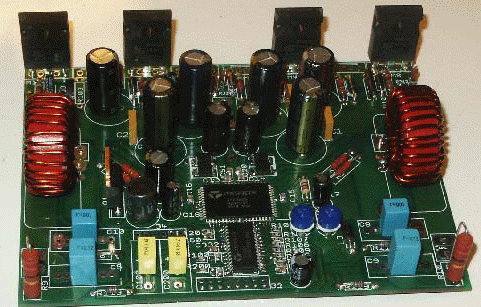
Personally, even though I dislike all digital cinema processors I do look forword to the new breed of Class D Digital power amps comming to use in cinemas in the near future. You can attain huge power levels.... easily 2-350 RMS into 8 ohms easily in a 12 pound package with little to no heat sinking! They typically run at 90+% efficiency. Many of the "consumer versions" of these amps sound phenominal and the radiated RF energy from them is now well under control. Reliability is as good or better than a standard power amp because of sophisticated byult in protection circuitry... parts count per channel is also way less.
Complete 2 chan 300 watt RMS @ 8 ohms Class D power amp less power supply. Power supply is +/- 60 vdc.
Mark
Posted by Amanda Mundin (Member # 3386) on 12-04-2005, 06:12 AM:
Can't find anything about odd & even harmonic distortion levels in QSC specs for their amps, is that something that they would list?
Also regarding amplifier class, I read an article saying Class A are the highest fidelity amps, Class AB has less fidelity, and Class B & C has low fidelity, if this is correct just wondering why QSC who seem to be recognised as one of the better amp manufacturers only seem to make Class AB & Class H amps (assuming Class H is just a variation on Class AB) and don't make any Class A amps?
Also Mark what would you consider large/huge reserve?
Posted by Gordon McLeod (Member # 33) on 12-04-2005, 06:21 AM:
Class A amps are also very inefficient which makes them good booth space heaters and I would not use on in a booth
I don't think there are any class A "commercial power amps" made that would be rack mountable
I usually spec the amp size so that the max required power is 80% of the amps rateing
Posted by Mark Gulbrandsen (Member # 72) on 12-04-2005, 10:08 AM:
Actually there are many Pass Labs amps that serve commercial service, most in the recording and music industry.... Their X series has class AB output stages but is also properly designed... no holds barred so to say, while the XA series is pure class A. All of Sony Music's studios and all their other important facilities are probably the largest users of the XA Series amps as are most of the more important CD mastering facilities in the U.S.
Except for the sheer cost I couldn't think of a reason not to use them in a critical cinema situation with proper ventalation. Its extremely easy to ventillate a rack as a lamphouse is done on any given screen. The main downfall is the sheer cost of the amps.
You're right.... not many manufacturers make mention of which harmonics their amps generate and I'd bet that very few have even looked to see whats there. I've seen some really ugly distortion content from some really well regarded(on these forums) power amps!! Its a very easy test you can do by feeding the output of a high quality distortion analyzer into extended range audio spectrum analyzer such as the old H-P 3580 or its later variants. Some amps bias level can also be adjusted to at least minimize these harmomnics but you have to be careful not to get the amp biased too high, so sometimes its a compromise on the setting. None of the QSC's, Crowns or BGWs that I have repaired and tested fall in the low odd harmonic catagory, these are the three amp brands amps that I see most to repair. Some amps that use Mosfet outputs fall in this catagory, the older Hafler 220's are one that does but not all MOSFET amps are well designed and some may also exhibit odd harmonic dstortion as a result, I have not tested many MOSFET amps excepting some of the Pass Labs stuff so I can't really name them for you. The funny thing about even harmonic distortion is that it has to approach high levels before it becomes really objectionable while a little odd harmonic can give an amp an undesirable effect..
Because I build and modify alot of power amps and I have found most of whats in this article on power supplies to be true so just read this for power supply info...... Article .
Mark
Posted by Gordon McLeod (Member # 33) on 12-04-2005, 08:58 PM:
According to there web site their largest "class A" amp is only 200 watts so that is a bit small for a comercial cinema
Posted by Mark Gulbrandsen (Member # 72) on 12-04-2005, 10:09 PM:
Gord,
I don't think you're familiar with how Class A power amps perform, not at all like the normal power amp does.... ditto for the equivelent tube power amp. Its a whole differnt thing. The power rating belies what they can do, especially in the single ended type of amp like the Pass stuff. Personally I would use the X-600 and X-1000's were I ever do do something like that. Somewhat less heat, Class A to about 1/3 power and then high bias class AB to clipping, sound almost as good as the XA stuff.
Then there are the Class A amps that basically keep doubling output power each time the impedance is halved... all the way down to 1 ohm..... Great for driving speakers that have really wierd impedance curves. The KSA-50's that I have been building can do that. 50 watts RMS pure class A into 8 ohms, keeps doubling power output as impedance is halved all the way down to 1 ohm. Behaves more like a 200 wpc amp. The current and voltage some of these amps amps can swing is amazing! Others have gotten the same amp to do 500 watts at 8 ohms by upping the rail voltage and adding more output devices..... I won't even get into discussing the P.O. into lower impedances nor the huge toroids they used.... nor the water cooled sinks..... ![[evil]](graemlins/evil.gif) .
.
Did I mention that none of these amps have any sort of current limiting or protection circuits... they just don't need them and failures are extremely rare.
Mark
Posted by Phil Hill (Member # 371) on 12-04-2005, 10:31 PM:
Yous guys are pissing in the wind. Class A amps are great if you want to heat the room and have the mega $$$ for them ***AND*** can tell the difference in performance...go for it! MOST people can NOT! OH! Did I mention WHO THE FUCK CARES? Get off the dope!
Yous are equating big-time ***HIGH-END*** audio nerds with the commercial theatre market... get a life for Christ's sake and stop J/O'ing on the Class A stuff!
BUTT! To be realistic from a cost/performance commercial aspect, most amps for commercial movie theatre applications are now class H like QSC. That is the BEST choice for most ALL commercial installations!
OBTW: Just in case yous didn't know, Class AB1 and AB2 while cool, have NO PLACE in a modern theatre.
(Butt! I still LUV my McIntosh 240 for my home stereo!) HA!
Posted by Mark Gulbrandsen (Member # 72) on 12-05-2005, 07:10 AM:
Phil,
So we drift around a bit in discussion **BFD*** however it ***IS*** a viable discussion and a proven fact that odd harmonics cause more listener fatigue than do even generated harmonics. The reason you like your Crapintosh 240 so much is because of its even harmonic content, very typical of toobe equipment. Of course not **all** class A power amps sound great nor is one necessarily "better" than the next one... there are however a few that are quite exceptional in what they do and amplifier expense was not a consideration in this discussion.
The Class H stuff you mention generates more odd harmonics than I would like to see. They are reliable, sound ok, but if you ever spent time repairing/rebuilding them you'd also know that they do alot of things wrong....
Mark
Posted by Gordon McLeod (Member # 33) on 12-05-2005, 08:28 AM:
Mark power is power and even though if over driven it will still be limited as even excessive even harmonics in excess are bad
Posted by Phil Hill (Member # 371) on 12-05-2005, 06:56 PM:
Earth calling Mark...come down. Summing up what I said since you seemed to have missed it: Class A amps are NOT economically reasonable or practical for a commercial theatre. While they are OK for the high-end high $$$$ crowd. JFC!
OBTW: I NEVER said anything about going off-topic or about harmonics. It's EXPECTED on FT.
Oh, and I really don't give a rat's ass about theatre amp harmonics ...odd OR even...nor do ANY theatre patrons OR owners. To 99.44% of the owners, it's the initial bottom-line hardware/installation cost and the long-term equipment maintenance track-history cost that drives what is installed.
Posted by Scott Jentsch (Member # 1681) on 12-07-2005, 01:49 PM:
quote: Richard Hamilton
I agree alot has to do with the equipment, but the design and install play a major factor in the whole outcome. Who really cares about the name brand?
Does the average paying customer think about THX? I think they worry more about if the concession has Coke or Pepsi, or coconut or canola oil! Oh, and free refills!!
The fact is a well designed theater can get just as good results as a theater that has all THX approved equipment. In my opinion THX did not set any standards, the new technology and the competition between theaters has made the experience what it is today.
I think it's interesting to read comments about THX that go along the lines of "if you design to THX specs and use equipment that is just as good as THX specifies, it can sound just as good or better."
My response to that would be "of course!" If you design an auditorium to THX specs, but don't pay for the certification, you've already gone through the work, but with no third-party verification and no ability to apply a known marketing device to publicize your efforts and the money you spent.
Maybe self-certification was abused, and someone at THX was asleep at the wheel. Even if I cede these points, that doesn't mean that the design concepts behind the THX approach are wrong/useless and that the quality of THX equipment is sub-par, right?
From my experience and research on the topic, THX certification was never meant to be the best attainable level of quality/performance. Rather, it was meant to be a bar that was set for minimum performance standards in order to deliver a quality presentation.
Can theaters exceed those minimum specs? I would imagine that quite a few do. Can a non-THX certified theater outperform a certified theater? If it was designed, equipped, and operated well, sure. There's no monopoly on intelligence on the part of the THX engineers when it comes to those things.
But it comes down to: how do you know? How do your customers know?
A theater owner building a new location can either follow published guidelines (THX) or do the leg work him/herself to figure out what makes for good design and equipment choices. Then, a responsible owner would make sure that the equipment is always maintained and calibrated on a regular basis to assure a consistently good quality presentation. He/she can hire good people to do that in-house, and/or hire a calibration service (THX) to come in and do it.
OK, so as a theater owner, you've done this all yourself in-house. You found great people that know everything that there is to know about theater design, calibration, and proper maintenance and operation. You pay good money to make sure that your equipment is maintained properly and end-of-life equipment is traded out for new on a regular basis.
So, how does the paying customer know that you've done this? When looking at the newspaper ads or showtime listings on web sites or (gasp) calling a phone recording, how can a paying customer differentiate between your first-class theater and the run-of-the-mill stockyard multiplex down the road?
What recognizable mark of quality can they look at to know that you've done all these really great things in your theater?
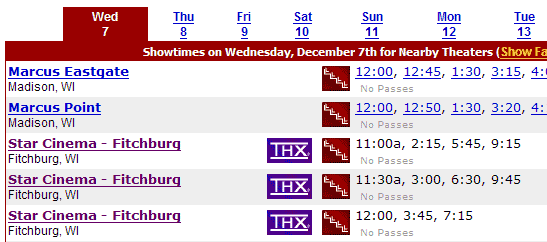
Please tell me how having a THX label next to your showtimes won't matter and that it's just a waste of money.
If it's nothing else, it's a marketing device to differentiate your theater from a competitor's theater. Since I haven't been there in a while, I checked out THX's web site to see if there has been any recent research done lately.
This is what they have:
http://www.thx.com/nato/
- Across all three surveys, more than 82% of participants had heard of THX
- The hypothesis that THX is a valuable differentiator and assists in driving preference and theatre loyalty was shown to be true in the BASELINE study – before the marketing campaign even started
- Across all three studies, between 69% - 75% of participants stated they were loyal to the theatre. THX Certification is one of the reasons stated for their loyalty
- All else being equal – same time & same movie selection – 66% to 69% prefer to go to a THX Certified Cinema
- When educated about THX, 80% said they would become more discerning when selecting a movie theatre
THX certification must be really expensive or really hard to get for theaters to say that attracting more customers is a bad thing...
But back on the point of the original question, I wasn't able to find any baseline specifications for amplifiers to be THX-worthy. You may want to research some of the amps listed on their THX Approved Equipment List. Perhaps some of those manufacturers expound on that aspect of their products. You could always contact the people at THX and see if they can shed some light on your question as well. It's too bad their web site doesn't do more to inform than it does.
THX always seems to be a flashpoint for some people, and all you end up getting is vitriol as a result. Fortunately, people like Mark and others are willing to rise above that and get to the heart of the matter.
Posted by Mark Gulbrandsen (Member # 72) on 12-07-2005, 02:38 PM:
Scott,
Those are well known points and your post is very meaningful. My reason for "abandoning" THX installations was the fact that it IS way too expensive for the average small to medium chain to endure even the re-certs every year let alone the additional installation costs. Indeed THX is really just too greedy at 10K per year with a miniscule downward sliding scale decline for multiple screens at the same site. It IS just flat out too expensive. This especially where a theatre owner either hads that area locked up or is the only ganme in town.... there it just doesn't matter.
The other but bigger problem that came forth from installing one or two THX screens at a site was the patrons would come in to buy a ticket... but first ask if the film they want to see was in the THX house. If it was all was fine but if their choosen film was in "run of the mill" house #7 they often would turn around and leave or state that they would be back to see it when it was playing in one of the THX house's. This was a big problem at one site that is now a Marcus location and now not THX at all... this site previously was owned by an independent. So with not many theatre owners willing to pay upwards of 70 to 100 grand a year for recerts I abandoned pushing any more THX systems to my customers. We do indeed continue to design systems based on the THX philosophy.
Mark
Posted by Louis Bornwasser (Member # 3063) on 12-08-2005, 07:24 AM:
Mark's post covers all points well.
I guess I will just have to start promoting my THY sound system concept. ("Everything else is just Grandpa's sound system." Louis
Posted by Scott Jentsch (Member # 1681) on 12-08-2005, 11:41 AM:
Mark,
When I met you when you were doing the Johnson Creek calibration, I was very impressed with the amount of effort going into the THX screens they had there, and I was also impressed with the courtesy you extended to me in explaining what you were doing. As a result, your opinion carries a lot of weight with me.
In a market where a theater is the only game in town, I can see where it would be difficult for a theater owner to justify the expense of THX certification at $10,000 per screen. However, I would hope that any self-respecting theater owner is still investing time and resources into calibrating and maintaining their equipment so that high quality presentations are maintained. This is on top of the assumption that the installation (building and equipment) was done right in the first place.
Your account of a location which had just a few of their screens THX-certified is a scenario I've heard before. The theater with that situation is a victim of their own decisions, in that they made a good decision to go the extra mile in certifying some of the screens, but then the success of the THX marketing device got the best of them because not all their screens were certified.
With restaurants, consumers have food critics to help them find the good places to visit. With hotels, AAA provides information and rates them according to quality and other characteristics. With movie theaters, consumers have none of those types of sources to consult. THX is a recognizable mark that means something to a lot of people, and even though it's not perfect, it's a way for someone wanting to see a movie to identify theaters which should be doing it right.
I've never heard what the prices were for the recertification, so that can be the only rationale I can see for dropping it. I would hope that each theater making such a decision looks at the numbers hard and does a cost-per-sale calculation as opposed to just looking at the total bill and freaking out.
I ran some quick numbers using lots of assumptions, but it didn't seem to take much of an increase in customer volume (10-15%) to justify the expense, even if it was considered purely as a marketing expense without considering other factors which would reduce the effective cost.
It's unfortunate that an alternative to THX has not cropped up, so that good theaters would have a way of distinguishing themselves from the mediocre or just plain bad ones out there. If it's prohibitively expensive and of dubious worth in the minds of theaters, I'm surprised that an alternative has not arisen to challenge them. My guess is that the effort and cost to do so would result in similar fees, which would negate the viability of an alternative service.
My post was a reaction to a comment that always provokes me, which is that customers don't care, or worse, that they care more about mundane things like soda flavors. Sure, some outspoken cranks may stand out in a manager's memory as being far too concerned about the ice in their cup than the presentation, but I fervently believe that the audience as a whole cares about the movie-going experience.
If a customer is provided with a high quality experience, and especially if they are educated as to what makes a high quality experience (because such things are often hard for many to identify or quantify, but it's part of their overall impression nonetheless), they will respond.
I've had a hell of a time getting theaters to differentiate themselves by making sure that their THX shows are flagged, that the proper digital sound format (or at least the generic digital sound flag) is indicated, and other items that will differentiate themselves from the other shows out there. People can't be expected to know the difference or care about the difference unless the people doing film right take the time to help their customers see what makes their presentations better.
I've gone and stood on this soapbox again and probably overstayed my welcome, but it's frustrating to see such things, especially looking at it from the customer's perspective. Since I'm also trying to serve theaters and help to increase their business, the lost opportunity that is present frustrates me to no end.
Posted by Louis Bornwasser (Member # 3063) on 12-08-2005, 01:37 PM:
Scott: I share your frustration with providing the correct level of excitement in cinema marketing. I think "the daily grind" and to some extent, pay levels, are at the heart of the problem. I have mentioned "the banker syndrome" before; where profit is made only by cutting expenses. It is disheartening to work under those circumstances.
Promotion; the magic of showmanship, needs to be widely embraced before it dies completely.
My hat is off to you for doing your part.
Yes, a very large amount of money is being left on the table. I know of 20 plexes where only 10-15% of the audience attempts to buy concessions. They had "staff reductions" mandated by HQ. Louis
Posted by Phil Hill (Member # 371) on 12-09-2005, 12:07 AM:
Yawn...
Posted by Mark Gulbrandsen (Member # 72) on 12-09-2005, 08:18 AM:
Scott,
Well.... Johnson Creek and most of AGT's locations are a big exception, not many indies build cinemas like they do and that area of the country is very lucky to have them..... They could blow Larry Millers theatres off the globe if they came out here and tried. I really do wish they'd come out here, build some nice plex's and kick some butt because unfortunately there are NO really good (hi-tech) plex's here in Salt Lake City!!
With the exception of SLC proper just about all of our customers are in areas that THEY have locked up so to say. There are one or two exceptions to that but only a couple. In those couple of cases having THX might help out since they compete directly with Carmike(if you call that competition), Carmike od really a joke. Fortunately at least 95% of our customers do care that they get quality equipment and that its installed properly there is always going to be that 5% that no one knows why the heck they are there.
As for the cost of THX and their re-certs.... its still out of line with the return it generates... none in some cases and a little on others... and most theatre owners I know are way too greedy to spend the bucks on something like that... heck they could buy a nice summer cabin or new fleet of Hummers instead. Even Larry Miller's theatres have just a few THX screens and Larry could EASILY buy THX of he wanted to... for now his THX systems remain just another toy for him. The only all THX location around here is the Century 16 and overall it's SLC's buisiest location. I personally don't enjoy going to locations that I have to fight the crowds just to hear a film on a THX system.
Mark
Powered by Infopop Corporation
UBB.classicTM
6.3.1.2