This is topic Emulsion peeling problem. in forum Film Handlers' Forum at Film-Tech Forum ARCHIVE.
To visit this topic, use this URL:
https://ft-forum.com/ft/cgi-bin/ubb/ultimatebb.cgi?ubb=get_topic;f=1;t=007698
Posted by Stephen Furley (Member # 1277) on 12-18-2005, 11:35 AM:
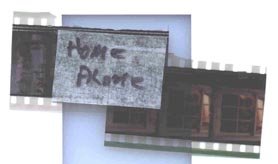
Have a print of 'It's a Wonderful Life' in at the moment. On the ends of the reels and leaders, where the splicing tape has been peeled off, the emulsion has come away with it, sometimes in quite large areas, as can be seen here:

The emulsion has come off the base quite cleanly, the dark marks in the picture are just sticky muck from the tape. I have never seen anything like this before; does anybody know what is causing it? Most of the emulsion was missing before the old tape which I removed was applied, so I don't know what type of tape removed it.
The print is on Kodak stock, with a triacetate base. I don't know the date of the stock, but think the print probably dates from the 50th anniversary release.
[ 12-18-2005, 02:11 PM: Message edited by: Stephen Furley ]
Posted by Peter Mork (Member # 1336) on 12-18-2005, 01:13 PM:
I used to see this happen with a lot of black and white prints in the 90s - I haven't run one for a while, but I believe I read somewhere that the problem was noted and had been dealt with. Your print may well be from the problem era. It may also shed a lot of emulsion, which caused real headaches. Films like Ed Wood and Schindler's List got covered with specks in no time, and wouldn't hold focus 'cause the gate would get gunked up. Bad news for you.
Posted by Monte L Fullmer (Member # 2797) on 12-18-2005, 01:41 PM:
I've seen some B/W safety prints do the same thing after with age - the emulsion separating from the base.
"Wonderful Life" was released in 1947 and prob at that time was on nitrate positive stock. Look at the edge of the print that you run now and if there is wording "nitrate", or lateral hash marks that run on the soundtrack edge of the print, meaning a nitrate negative was used to print the safety positives.
Posted by Dan Lyons (Member # 1454) on 12-18-2005, 01:50 PM:
Is the rest of the film as dirty and scratchy as that one frame?
Posted by Stephen Furley (Member # 1277) on 12-18-2005, 02:06 PM:
Monte, I don't know what this what negative this print was struck from, though I doubt that it was an original one. I don't think there are any negative edge markings on the print, though I didn't look that closely at it. However, the negative used couldn't possibly cause emulsion peeling on the print film. I've never seen this sort of thing on any film stock, black and white or colour, negative or positive, any gauge, any age, nitrate, diacetate, triacetate, or polyester. About the nearest thing I've seen is around the edges of glass plates, I think caused by mis-handling while wet. I've never seen dry emulsion peel away from the base in large areas like this.
quote: Dan Lyons
Is the rest of the film as dirty and scratchy as that one frame?
The print is generally very good, apart from a couple of slight scratches, which don't last very long. I removed this frame from the end of a reel when making up the print; I don't like doing that, but I don't really think I had much choice in this case. I brought the frame home to scan, but I don't have any suitable solvent handy to remove the muck that several generations of splicing tape have left behind.
Posted by Stewart Anderson (Member # 1809) on 12-18-2005, 06:54 PM:
We use to run classic movies. We even devoted one of our small theatres to our "Classic Cinema" program. I couldn't believe how awful those prints were. They were printed on that old acetate film, they always had scratches every where, they were always breaking, and after doing the Thursday night build up and screening of a few of them I could tell that these prints have had a hard life and should probably not be in service anymore. 'It's a Wonderful Life' was one of those prints. Emulsion peeling near splices was near the least of our problems we had with those old films. We dropped the Classic Cinema program about two years ago. You must have been very lucky to find a print of 'It's a Wonderful Life' that actually looks presentable.
Posted by Monte L Fullmer (Member # 2797) on 12-18-2005, 07:53 PM:
..and what's sad is that if FG was invented back then, these old prints would be a whole lot better off. I did my father's old 8mm reels with FG and it seems to bring back some life in these old films.
-Monte
Posted by Brad Miller (Member # 2) on 12-18-2005, 08:12 PM:
Stewart, did you not do full inspections before you played those movies? Either you didn't do that properly, or your equipment needs some immediate attention. I handle older acetate prints all the time and never have such problems.
Paramount has struck some new prints of Wonderful Life. They have some pretty nice condition acetate prints circulating from the Library of Congress master (along with some horrible ones), but this year you should start seeing some brand new prints getting into circulation.
Posted by Stewart Anderson (Member # 1809) on 12-18-2005, 09:08 PM:
It wasn't an equpment problem (of ours). This was just how they came. It was obvious not only in the Thursday night dry run but also just building it up. Sometime we were lucky enough to get a print that wasn't thrashed. The only two that come to mind right now is Beetle Juice, and Jurassic Park. I'm sure there were others. The point is a lot of them sucked. The worst ones that I can remember was one of the Indiana Jones movies (I can't remember which), and Mr Smith Goes to Washington. This may be different now, as I said we stopped our Classic Cinema program about two years ago, and maybe we just had a lot of horrible luck with the prints we received.
Posted by Monte L Fullmer (Member # 2797) on 12-18-2005, 09:54 PM:
quote: Stewart Anderson
maybe we just had a lot of horrible luck with the prints we received.
..reminds me of my carbon arc days with Kid Shows that we would get that were in horrible condition: having to go through each reel and taking about an hour each per reel to check and to "wet" splice what was needed for repair so the print can run the 2 or 3 days without any problems.
Big time inspection was needed on these prints and that was AFTER the depot had already inspected that same print (back in the old days when NFS would inspect prints before they shipped them out..), and oh yes once again, when I would pull a taped splice on an old B/W print, the emulsion would peel off from the base-being so dry and brittle.
"Old School" was that every print arrived in that theatre, especially the old ones, were severely inspected for any flaw that would prevent any problems during the scheduled run of that print on the rewind table or reel bench-long before the print went through the machine the first time.
It seems now that this practice isn't even heard of and almost extinct as with the dodo bird ..
-thx Monte
Posted by Mark Gulbrandsen (Member # 72) on 12-18-2005, 09:57 PM:
Unfortunately LHM theatres did not/do not use Filmguard while the projectors are running... its just applied on the MUT on an as needed basis... This is not necessarily the best way for Filmgard to be able to do its thing..... sometimes it takes repeated Filmguarding of an old print to get it to look and run decent again.
Monte... The Dodo is not extinct we have plenty of them down here..... ![[Big Grin]](biggrin.gif)
Mark
Posted by Brad Miller (Member # 2) on 12-18-2005, 10:46 PM:
Stewart, while in this day and age of brand new polyester prints *can* be ran without inspecting them and 99% of the time there is no problem, ANY used print and ESPECIALLLY anything on acetate film stocks absolutely MUST have a full hand inspection on the bench before even considering loading to a platter or running through a projector.
This sounds like a training issue.
Posted by Monte L Fullmer (Member # 2797) on 12-18-2005, 11:34 PM:
quote: Mark Gulbrandsen
The Dodo is not extinct we have plenty of them down here
..LOL - like around up here?
Yea, the other 1% are usually the crummy lab splices.
Posted by Stewart Anderson (Member # 1809) on 12-19-2005, 12:37 AM:
Mark - we did and do FilmGuard, ESPECIALLY when we were running the classics
Brad - We inspect films while building them and then we do a dry run. This is part of the reason those films left this building in much better condition then when they arrived. Training issue? Please explain...
Posted by Brad Miller (Member # 2) on 12-19-2005, 01:39 AM:
quote: Stewart Anderson
They were printed on that old acetate film, they always had scratches every where, they were always breaking
There's your answer
Posted by William Hooper (Member # 71) on 12-19-2005, 03:03 AM:
quote: Monte L Fullmer
I've seen some B/W safety prints do the same thing after with age - the emulsion separating from the base.
And after not too long - I think I was the 3rd person to run a nice new-ish print of Audrey Hepburn & Gregory Peck in Rome whatever-it-is: It had been plattered, when the splices at the leaders & tails were pulled off, the emulsion stripped back for a foot in places. The 2nd guy obviously was trying to save what he could, sticking subsequent peels back down with tape, coloring in spots with black marker, etc. It was probably acetate, but could have been polyester.
I've seen it on color acetate too, but B/W reprints have had it the worst.
Posted by Stewart Anderson (Member # 1809) on 12-19-2005, 09:00 AM:
Brad - I guess if the film breaks where our fault that would make sence to me. Not only were the acetate films old and brittle, but a lot of them had broken perfs. One of our prints of Indiana Jones had multiple broken perfs every foot. So unless your arguing it was our fault for not basically laminating the whole print with clear splicing tape I still don't see your point.
If your arguing the scratches were our fault, keep in mind that you could count on one hand how many prints have been mildly scratched by us since we opened about six years ago. I find it hard to believe that we would scratch only the classics. Not only that, this would also mean we did it only while building them up and never while running a show.
As I said before we returned those prints in BETTER condition then received. ![[Smile]](smile.gif) Why is it so hard to belive that an old used print could be in bad condition?
Why is it so hard to belive that an old used print could be in bad condition? ![[Confused]](confused.gif)
Posted by Richard Hamilton (Member # 321) on 12-19-2005, 09:25 AM:
quote: Stewart Anderson
One of our prints of Indiana Jones had multiple broken perfs every foot.
And you still ran it? You even had multiple prints?
quote: Stewart Anderson
you could count on one hand how many prints have been mildly scratched by us since we opened about six years ago
You shouldn't be able to count on one finger the number of scratches. Unless you were involved in a horrible accident where you lost all of your fingers, this is unacceptable! Even if "mild" whatever that means. A scratch is a scratch
Posted by Stewart Anderson (Member # 1809) on 12-19-2005, 09:30 AM:
The scratches that were barely visible on the LESS the five prints that have been scratched at the Commons IN THE LAST SIX YEARS were cause by film cleaners that are no longer in service here. These scratches were barely visible black scratches that disappear for most of the movie. I guess you find this no different from a nice thick green one. I'm including scratches that most projectionists might not see and probably wouldn't count as a "scratch". And I'm not sure if you were aware but they did more then one Indiana Jones movie: Last Crusade, Temple of Doom, and Raders of the Lost Arc. FYI: we did stop running that one print early.
Why is it that in almost every thead I post in at least one person decides to attack me?
Posted by Richard Hamilton (Member # 321) on 12-19-2005, 09:49 AM:
Stewart, Nothing personal, I just read the posts and reply. My response would be the same no matter who I am replying to.
And for the record, yes I know there are different Indiana Jones movies. I was born and raised in Indiana!! The way you said it quote: Stewart Anderson
One of our prints of Indiana Jones
sounds like you have multiple prints! Yes I am a smartass most of the time!
P.S. What happened to the film cleaners?
Rick
Posted by Stewart Anderson (Member # 1809) on 12-19-2005, 09:51 AM:
Not sure, they just disappeared over time. I'm not sure who made those (they used brushes, a fan and some sort of static feild whatever that I didn't understand). The name Kinetronics sounds familiar. We still use the Kelmar w/ FilmGaurd.
Posted by Brad Miller (Member # 2) on 12-19-2005, 10:35 AM:
I guess the bold wasn't clear enough.
quote: Stewart Anderson
I guess if the film breaks where our fault that would make sence to me. Not only were the acetate films old and brittle, but a lot of them had broken perfs.
To clarify, if the films were brittle, you should've lubricated them coupled with a full inspection before running. I will agree that broken perfs are broken perfs. If it was every foot, you should've called the booker and said the print was "unplayable" and put it back in the cans. If there was only occasional perf damage, you should have caught that on your inspections and repaired them. Hence, if you have film breaks, your staff is probably doing something wrong. Make sense?
Posted by Stewart Anderson (Member # 1809) on 12-19-2005, 10:40 AM:
Belive me, if we could have got another print to run for the shows that have already been sold we would have. Again, I guess we just had a lot of bad luck with our classics if you guys are getting almost all good/old acetate films.
Posted by Mark J. Marshall (Member # 1409) on 12-19-2005, 12:20 PM:
[back on topic]
I've seen the dye come off of IB like that. I assumed it was just the base stock starting to shrink as there was also a slight vinegar smell.
[/back on topic]
Posted by Richard Hamilton (Member # 321) on 12-19-2005, 12:27 PM:
I'm guessing that the Kinetronics was only on the 8/70 platter. Hard to believe that cleaner caused scratches. IF it did, then it was most likely operator error. It should have been caught also, because that cleaner is mounted in the film path before the film hits the projector.
Posted by Stewart Anderson (Member # 1809) on 12-19-2005, 12:43 PM:
Richard - Yep, we had it in the 70, but we also had them on some of the 35s. And that is what I was talking about. These were very rare, very fine, and barely visible black scratches that a lot of the time will completely disappear for a long time and that sometimes made it hard to catch. I remember starting #14 and noticed a fine black scratch in the green band of the first trailer. I removed the cleaner, triple checked everything and the scratch never came back. This was a long time ago, because we stopped using those a long time ago.
Mark - I remember a lot of those prints smelling like vinegar, I never knew exactly what that was.
Posted by Monte L Fullmer (Member # 2797) on 12-19-2005, 01:21 PM:
"vinegar syndrome" is when the acetate is breaking down back to a liquid state which emits the acetic acid.
Prints weren't kept in a controlled atmosphere.
Posted by John Pytlak (Member # 331) on 12-19-2005, 03:35 PM:
Vinegar Syndrome:
http://www.kodak.com/US/en/motion/support/storage.jhtml?id=0.1.4.11.12&lc=en
quote:
"Vinegar Syndrome" is a term used to describe the chemical reaction that goes on during the deterioration of cellulose triacetate film support. When cellulose triacetate begins to decompose, "deacetylation" occurs and the acetate ion reacts with moisture to form acetic acid producing a vinegar odor when a can is opened. Once the reaction is started, it cannot be stopped. —Information extracted from a paper that was presented at the 1992 AMIA Conference on December 10, 1992, by Dr. Tulsi Ram.
quote:
Molecular Sieve Acid Scavenger
Molecular Sieve is a promising new technology developed by Eastman Kodak Company that has the ability to retard the vinegar syndrome reaction. Simply stated, the inclusion of Molecular Sieve with processed motion picture film in a sealed container has the ability to extend the life of the dye images and film support beyond that which is currently considered normal.
In simple terms, the best advice is to store film cool, dry and vented. If film is in sealed containers, use Molecular Sieves to provide a low humidity "microclimate" and adsorb any acid vapors.
Unfortunately, in the past, many film exchanges were not temperature or humidity controlled, and film was stored in film cases or cans that trapped acid vapors. Sitting in a hot warehouse at 70% to 90% summer humidity is not good for optimum life of the film base or dyes.
Posted by Brian Guckian (Member # 1678) on 12-21-2005, 05:49 AM:
John, what are your thoughts on what Stephen is describing at the top of this thread? What are the conditions under which the binder will start to break down, and is it related to Vinegar Syndrome in any way (e.g. perhaps a precursor)?
I had exactly the same problem as Stephen with a print of "Man of Aran" (1930s, B/W) a couple of years ago. The emulsion layer was very fragile. I didn't know the age of the stock. I wrote to the BFI about it (it was their print) but sadly never got a response.
Posted by Leo Enticknap (Member # 534) on 12-21-2005, 07:07 AM:
I had the same experience with new b/w poly prints during my time in the booth in the late '90s - when unpicking splicing tape, it would often take a chunk of emulsion with it. This didn't seem to affect elements which had been printed in the '80s or earlier, or any acetate prints as far as I can remember.
quote: Brian Guckian
I had exactly the same problem as Stephen with a print of "Man of Aran" (1930s, B/W) a couple of years ago. The emulsion layer was very fragile. I didn't know the age of the stock. I wrote to the BFI about it (it was their print) but sadly never got a response.
If there are any theatres in Ireland which are equipped and certified to run nitrate, do try and show the BFI's nitrate print of Man of Aran. I saw it at the NFT many years ago, and can't remember any other 35mm b/w print that comes anywhere near it for sharpness and tonal range.
Posted by Stephen Furley (Member # 1277) on 12-21-2005, 07:57 AM:
quote: Leo Enticknap
I had the same experience with new b/w poly prints during my time in the booth in the late '90s - when unpicking splicing tape, it would often take a chunk of emulsion with it. This didn't seem to affect elements which had been printed in the '80s or earlier, or any acetate prints as far as I can remember.
Only with b/w prints? This print was definately triacetate, not polyester, and there was no hint of vinegar. I'm certain about that because the first thing I do when I get a print of a film this old is to make absolutely certain that we haven't been sent a nitrate print in error. It's very unlikely, but I always check. If it was indeed a 50th anniversary print, then that would tie in with what others have said about problems with '90s prints. I suppose that I haven't had many b/w prints of that vintage through my hands; plenty of older ones, and, recently, several newish ones on polyester.
I remember that there was speculation that there might be problems with emulsion peeling from polyester, but, from the 1960s, Prinz and Ferrania Super-8 films were on a polyester base, as was Fuji Single-8 film. I've got a few reels of each of these, and while they show more fading than the Triacetate Kodachrome from the same period, I've had no problems with the emulsion peeling.
quote: Leo Enticknap
If there are any theatres in Ireland which are equipped and certified to run nitrate, do try and show the BFI's nitrate print of Man of Aran. I saw it at the NFT many years ago, and can't remember any other 35mm b/w print that comes anywhere near it for sharpness and tonal range.
I doubt if you'll find anywhere that's still got a nitrate licence, but even if you could, would the BFI let a nitrate print out to a cinema? Also, how much would it cost to transport the thing, and how much paperwork would be required? I've seen some very good nitrate prints in the past, but it's just about impossible to see them today.
Posted by Leo Enticknap (Member # 534) on 12-21-2005, 08:01 AM:
TNT will ship nitrate for the same price as other films; but delivery can take a very long time, because they leave your consignment in a depot until such time as a refrigerated lorry or van is going where you want it taken. 3-4 weeks from Middlesbrough to London is not unusual. If there's no hurry, fine; if there is, I'll stick the films in a carrier bag and hop on the Easyjet with them (only joking - I'd actually drive).
Posted by Kenneth Wuepper (Member # 1174) on 12-21-2005, 02:07 PM:
Here is the edge damage which is not repairable by "Perf-Fix" machine.
You will note that the sound track is damaged and the right channel would be very noisy if played back. Also the film will not be centered on the scanner since there is no reference edge.
The perf fix will repair the missing sprocket holes but the film still is unplayable as mentioned. Simplex XL and SH-1000 sound reader w/Kelmar red conversion.
KEN
[ 12-21-2005, 09:12 PM: Message edited by: Kenneth Wuepper ]
Posted by Dan Lyons (Member # 1454) on 12-21-2005, 03:20 PM:
You still have one good side of perfs left! No problem! I've run lots of films with one sided perf damage through Century C's and JJ, and a Pro 35. ![[thumbsup]](graemlins/thumbsup.gif)
Posted by Brian Guckian (Member # 1678) on 12-21-2005, 05:43 PM:
quote: Leo Enticknap
If there are any theatres in Ireland which are equipped and certified to run nitrate, do try and show the BFI's nitrate print of Man of Aran.
Sorry Leo, but unfortunately there are no such equipped cinemas here. Nice thought though, and I'd love to see the nitrate version myself. It is a great documentary classic.
Posted by Mathew Molloy (Member # 666) on 12-24-2005, 08:17 PM:
Kenneth - a Norelco AAII would run that film without any problems - tho' I'd still keep an eye on it!
Film with major perf damage should run okay through Norelcos and Century C - from my own experience.
Powered by Infopop Corporation
UBB.classicTM
6.3.1.2