This is topic Adding trailers to platter (photo) in forum Film Handlers' Forum at Film-Tech Forum ARCHIVE.
To visit this topic, use this URL:
https://ft-forum.com/ft/cgi-bin/ubb/ultimatebb.cgi?ubb=get_topic;f=1;t=007700
Posted by John Walsh (Member # 168) on 12-19-2005, 02:20 PM:
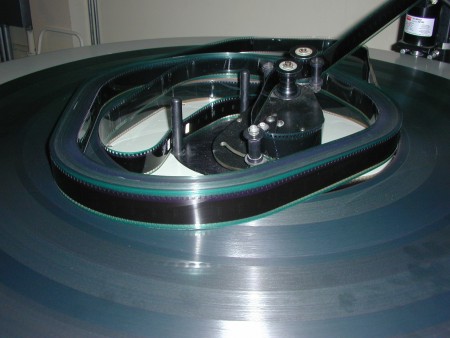
What do you think of adding trailers as shown in this picture:
Posted by Dieter Depypere (Member # 3184) on 12-19-2005, 02:22 PM:
"Creative" idea. Really. Never thought of that. Does that really work? ![[Confused]](confused.gif)
Posted by Floyd Justin Newton (Member # 1316) on 12-19-2005, 02:36 PM:
John--
Twenty-five years ago I did the same thing where the trailer pack was a little too big for a "drop-in". Instead just "drop-
on" and let 'er rip. If it can be thought of, it can be done.
Posted by Wolff King Morrow (Member # 2226) on 12-19-2005, 03:04 PM:
Of course if you know in advance you need them, you can get a 19-inch center ring and already have plenty of room to drop trailers in. I know strong sells them at least.
Posted by James R. Hammonds, Jr (Member # 673) on 12-19-2005, 03:33 PM:
I used to do that all the time, but that loop in the back there doesn't look good.
I would try to keep that wound up against the rest of the roll.
It looks like it may be getting creased on the right there.
Posted by John Pytlak (Member # 331) on 12-19-2005, 03:42 PM:
You know the obvious risks. If you can do it without damaging film or having the film jam or fly, it has been done. ![[Roll Eyes]](rolleyes.gif) But I agree the better and preferred way would be to wind the film on a larger hub on the previous show, so you have room to insert a smaller diameter "trailer pack" inside.
But I agree the better and preferred way would be to wind the film on a larger hub on the previous show, so you have room to insert a smaller diameter "trailer pack" inside. ![[thumbsup]](graemlins/thumbsup.gif)
Posted by Louis Bornwasser (Member # 3063) on 12-19-2005, 03:43 PM:
Sometimes the loop unthreads from between the feed out fingers. You will find a soda straw from McDonalds can be inverted and forced over the fingers to "capture" the film; at least until the top layer is gone. Louis
Posted by Mike Blakesley (Member # 26) on 12-19-2005, 03:45 PM:
As Cheech & Chong would say, "I've done that, man."
Posted by Monte L Fullmer (Member # 2797) on 12-19-2005, 05:06 PM:
I'd at least lay one end of that "trailer pak" into the filmroll so the loop of "trailer pak" doesn't want to slip out since the platter rotation doesn't want to fling that loop off the rest of the filmroll.
Posted by Scott Norwood (Member # 30) on 12-19-2005, 05:40 PM:
That method works fine on Christie platters and I do it regularly. It gets really fun when there are 3-4 "layers" of film on each of six screens. If done carefully, it's easy and there's no risk of film damage.
Supposedly Christie makes a larger center ring, but I've never seen one, and most theatre owners would be too cheap to buy it, anyway.
I wouldn't want to try this on a Speco or Super Platter, however.
Posted by Brad Miller (Member # 2) on 12-19-2005, 05:40 PM:
Fully agreed with Monte. So long as you do that, such a trailer drop is perfectly fine.
Posted by Andy Muirhead (Member # 712) on 12-19-2005, 06:44 PM:
Works well, been doing it for years. I agree with Brad and Monte though.
About the large centre rings, you can make your own cheap enough from wood. At least you can for CFS platters, I'm not too familiar with other platter makes to know if the design would work with the other makes. Originally built as backup platter rings (same diameter) and then built a few larger versions for trailer pack drops. Been using them for about 10 years. We call them 'woodys'
Posted by Richard Hamilton (Member # 321) on 12-19-2005, 08:02 PM:
Why would you do this? Maybe I dont fully understand the operations side. Do you have to suddenly show 3 or 4 trailers before a certain show? or do you make up a print and then decide you must add trailers? The way you show it, looks like more work and possible problems just waiting to happen. Never been there or done that.
Rick
Posted by Monte L Fullmer (Member # 2797) on 12-19-2005, 08:06 PM:
quote: Scott Norwood
I wouldn't want to try this on a Speco or Super Platter, however.
I've done this trick with almost all kinds of platters - Specos, CFS "StupidPlatters", STRONG, Christe, ORC's - et.al. with large or small ring openings.
The trick is the laying the trailer pak on one side inside of the filmroll and starting your threading procedures slow instead of being in a hurry and watching all of this pay through the brain since no matter what kind of platter you have, they can be your "best friend", or your "worst enemy" if not treated correctly.
-Monte
Posted by Ryan Navaroli (Member # 3477) on 12-19-2005, 08:23 PM:
I wonder the same thing as Richard, when does this situation occur.
Posted by Steve Scott (Member # 630) on 12-19-2005, 08:31 PM:
I'd be afraid to attempt that on any platter except a Christie.
Posted by Richard Hamilton (Member # 321) on 12-19-2005, 09:08 PM:
I have re-read this post a couple of times. I guess I am stupid because I don't understand, yet everyone is agreeing about this procedure! What is the reason for adding trailers this way? Why wouldn't you make up the trailers,wind them on the platter and just splice the existing feature onto them, available for the next show?
Posted by Brian Michael Weidemann (Member # 2243) on 12-19-2005, 09:19 PM:
I used to do this all the time, when I had control of programming, swapping out, and adding trailers. As long as I kept an eye on it and, yes, had at least PART of the roll down and level with the rest of the feature, it works great.
The reason I personally wouldn't have just spliced the feature to the trailer roll would be I'd have to wait a whole show before screening the trailers. At the second-run 8-plex I started at, I don't think we had the luxury of time. I'd rather screen them NOW, while I have time, than in two hours, when I may be swamped and not available to sit around for 10-15 minutes double-checking something I could have already done. (Plus, they were almost ALWAYS for new trailers we just received, and everyone wanted to watch them immediately. We still programmed first-run trailers.)
Most of the time, though, I didn't have to add a whole 4-5 trailer pack to a feature; I added one or two at the most, or I was removing one or two and adding something their place ... which, if you do it right, you don't even need to rest anything on TOP of the rest of the print.
Ah, I remember the days of trailer swapping (flawlessly, every time) in 5 minute turnarounds. It's THAT kind of stuff that makes the craft of booth operations fun!
Now, it's just too bad that you can't add trailers to IMAX prints with a QTRU feed head in that fashion! It would sure save a load of time.
Posted by Paul Mayer (Member # 355) on 12-19-2005, 09:39 PM:
Been there done that. Got the hat and t-shirt too. Big Sky platters handle such drop-ins just fine.
Posted by Mike Blakesley (Member # 26) on 12-19-2005, 09:40 PM:
Well I don't know why anyone else does this procedure, but my reason is usually to add trailer(s) that arrive after I've built the film. It only happens rarely....only if I feel the new trailers absolutely MUST play on the next show. Normally I would run a spacer into the film after the trailers, lift them out and add/subtract what I need to.
Posted by Richard Hamilton (Member # 321) on 12-19-2005, 09:59 PM:
quote: Brian Michael Weidemann
I'd rather screen them NOW, while I have time, than in two hours, when I may be swamped and not available to sit around for 10-15 minutes double-checking something I could have already done. (Plus, they were almost ALWAYS for new trailers we just received, and everyone wanted to watch them immediately. We still programmed first-run trailers.)
Doesn't make sense. You have an extra 15 minutes during the first show to watch trailers that everyone wants to see immediately? If you do what I see in the original picture, then you have to stay and watch the film run through. If you don't, then you are asking for trouble. Again, I just don't understand this logic.
Posted by Brian Michael Weidemann (Member # 2243) on 12-19-2005, 10:18 PM:
Yes, of course I had to stay to watch the film run through. I always screened them from the booth, anyway.
Extra 15 minutes? Not really. Fellow employees would just say, "Hey, these came in, can you add them to something starting in the next 20 minutes?"
If I built trailers and added them with, say, a bad splice, I'd catch it when I started that first run, while watching to make sure it feeds properly. If I ran the movie through bypassing those trailers on the first pass, I'd go to start its subsequent run and not think twice about leaving once on screen, to start threading another auditorium or something. Eight auditoriums, every one of them doubled up, you've got a lot of prints to keep track of (and this was early in my "career") so I wouldn't have put it past myself to have an oversight.
Either I'm just not a patient person, or I just like completing the task I start because I don't trust I'll finish if I put off the last steps.
I don't know. There's no real LOGIC here. You just do what you have to do, with whatever circumstances, to get something on screen.
Posted by Richard Hamilton (Member # 321) on 12-19-2005, 10:38 PM:
not to be a smartass, but I still don't comprehend! A "fellow employee" can hand you some previews, ask you to run them on a print that starts in 20 minutes, and this is better? This means you make them up on a ring with attached leader, then take them off the ring, lay them on top of the feature, splice them, thread them, start them, and then watch them?
Posted by Steve Scott (Member # 630) on 12-19-2005, 10:42 PM:
With an ever-growing number of megaplexes, fewer booth staff to help out, and the contiuned demand of many owners for more work in fewer work hours, solutions like this one are a necessity, if they can be successfully accomplished.
Posted by Brian Michael Weidemann (Member # 2243) on 12-19-2005, 10:53 PM:
Sure, that's the quickest way to add the trailer. I'd take out the ring of the feature, removing the leader with it. I'd splice in however many trailers to that leader, and then splice that pack back to the print. THEN remove the ring, with the bulk of the new trailers somewhat like the picture, and it's ready to go. Thread the leader as normal. The new trailer is first, and once it's run through, it's all good, as if it were always there.
Posted by Brad Miller (Member # 2) on 12-20-2005, 12:33 AM:
Richard, center dropping trailers inside the film roll before any show...regardless of whether you took up the previous show on a large center ring (or with a bunch of large cores around the ring to "create" a larger ring)...this is a far better solution for the film than having the trailers on the takeup ring and making the splice there. It's less unnecessary handling of the film. It also permits every show to have a full trailer pack presented to the audience, which is absolutely the professional way to operate. Does that answer your question?
Posted by Monte L Fullmer (Member # 2797) on 12-20-2005, 01:03 AM:
..or just make a new trailer pak mounted on a ring, mount that ring the deck and splice the feature to the end of the pak and run that feature without trailers for that showing - the actual easy way if you need to make a new trailer pak for that current feature...if one gets a little anal on our method of trailer inserts.
Posted by Brad Miller (Member # 2) on 12-20-2005, 02:00 AM:
Monte, that's what I just described as the unprofessional way to change trailers! Not only is there unnecessary film handling involved that can put tiny marks around your splice, but it does not give the complete presentation to the audience for that performance.
Any projectionist of mine that does trailer changes in this manner finds he is working elsewhere the next week.
Posted by Monte L Fullmer (Member # 2797) on 12-20-2005, 03:02 AM:
Yea, I knew that even though I don't do that practice anymore.
(Gee, would help for me to read through some posts before making comments..instead of "jumping the gun" and replying)
Posted by Richard Hamilton (Member # 321) on 12-20-2005, 06:40 AM:
I am only asking why this way is better. I can see both sides to do this. Everyone has their preferences and reasons, I just saw this and thought to myself "WTF?". Another question kind of on topic, what happens when you MUST take a trailer off that happens to be in the middle of your "trailer pack"?
Posted by Mike Spaeth (Member # 524) on 12-20-2005, 06:45 AM:
Umm ... you're showing a trailer for a movie that's already open.
Posted by Scott Norwood (Member # 30) on 12-20-2005, 07:49 AM:
Richard -- I guess you've never dealt with an art-house situation where bookings change frequently and where the policy (rightly, I believe) is to only show trailers for films which are booked and where the trailers should be shown in reverse release-date order (i.e. the trailer for the next film to open shows last). There's no other way to manage trailer changes in that sort of environment.
Posted by Brad Miller (Member # 2) on 12-20-2005, 07:51 AM:
Richard, let's say you are going to remove the 3rd trailer. You remove the leader and the first two trailers as one loop of film and set aside. You then remove the 3rd trailer and discard. If there is another trailer to go in it's place, you can lay the loop of film on an empty deck and load up the replacement trailer, then lay the loop back in the center and splice.
Posted by John Walsh (Member # 168) on 12-20-2005, 08:54 AM:
I tried to keep my own opinion neutral when I posted that picture. Myself, I don't like adding trailers this way, but I can't 'fault' it. I think Steve summed it up best when he noted; "...[with] fewer booth staff to help out, and the continued demand of many owners for more work in fewer work hours, solutions like this one are a necessity ..."
Trailers change every week, and even the order the ads are shown sometimes change. Trailers added like this can be inspected (for misframes or even being on backwards) right away on prints that remain for next week. It needs to be known *now* if they are right, because the operator is required to go home (or downstairs) as soon as possible, but can fix it next show if needed. No one will put in a large takeup ring because that takes planning, and there's no time to plan ahead. There's so little time devoted to the booth that the trailers are added immediately when they come in, whenever that is.
Anyway, I thought more people would disapprove, but it's turning out that most approve, however grudgingly.
Posted by Wolff King Morrow (Member # 2226) on 12-20-2005, 10:40 AM:
Taking a trailer off the middle of a pack is actually quite easy. The gap it leaves behind allows plenty of room to splice the two sections back together. Naturally I put any new trailers at the beginning using a center-dropper.
Posted by Brad Miller (Member # 2) on 12-20-2005, 11:28 AM:
At some theaters that had crazy people in charge of trailer programming, they would insist A trailer be removed from X feature and put on Z feature in spot #3, and B trailer be removed from Y feature and put on Z feature in spot #2, etc. What I would do is simply pull the trailers out of the center of the roll and carry them to the print it needed to go on and lay them into the pack doing multiple center drops on top of each other. Always worked like a charm and NEVER a hint of film damage. The Christie platters handle multiple drops at the same time magnificently and in 20 years of handling trailers in this manner, I have never had anything go wrong.
I couldn't do that when I was working with other platters such as Strong and SPECO that did not have the raised brain. (Examples of platters with a "raised brain" for lack of a better term would be the Christie, Neumade and MiT). They aren't too happy with the film not laying on the deck, so whenever a larger loop of film would be put into the pack, I would install it with an "S" twist to it. The "S" twist created a bulge toward the brain, but so long as the threading was smooth and relatively slow, actual payout was fine.
Posted by Olivia Coleman (Member # 3193) on 12-20-2005, 10:10 PM:
We will also be forced to do this when a trailer arrives the next day and we don't know when... I do prefer using cores. We use the trailer cores to mark trailers. We have some taped together to make larger gaps when we add trailers. Makes it very easy and no film on top on film! ![[Smile]](smile.gif)
Posted by Mathew Molloy (Member # 666) on 12-20-2005, 10:53 PM:
On the subject of large center rings: The quick trick I was taught to make a home-made large center ring was to wrap some tape around the center ring sticky-side out. Place 2" cores side-by-side around the ring and then tape those cores together.
Posted by Mike Baer (Member # 1519) on 12-21-2005, 04:12 AM:
Normally when i change trailers,there is an intermission after the preshow,so i have time to tear the splice between preshow and feature.Then i take a greater ring and resume the show,taking up the feature onto the greater ring.Then i have to change the trailers and after the show put it back in before the feature.
But sometimes,when there is only the first trailer to change it would be a waste of time to do as described.
Then i take the first trailer (with leader) out and put a new trailer (with a new leader) in.When the new trailer is shorter,then it will be no problem to fit,otherwise it will overlap like in the picture.
Powered by Infopop Corporation
UBB.classicTM
6.3.1.2