This is topic White Christmas - is this a "t.v. print"? in forum Film Handlers' Forum at Film-Tech Forum ARCHIVE.


To visit this topic, use this URL:
https://ft-forum.com/ft/cgi-bin/ubb/ultimatebb.cgi?ubb=get_topic;f=1;t=007714

Posted by Mathew Molloy (Member # 666) on 12-26-2005, 08:15 PM:
 
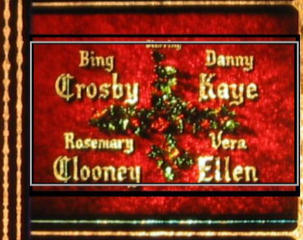
We're showing a print of White Christmas from Paramount here and it's in great shape - however two things have been bugging me about it. 1) Focus is way too soft and 2) we're having to show this 1.66:1 to avoid cutting off heads/feet and credits. Being a Vistavision film it should be good up to 2:1 correct? So I took a few scans and take a look at this: (sorry for the poor scans.)

Here's a capture from the opening title sequence:
 -

And here's a scan of the frame with a black box as the 1.66 mask and a grey box as the 1.85 mask.
 -

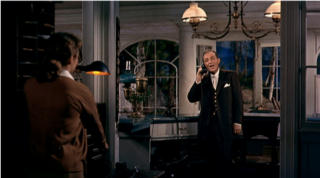
Now here's a dvd capture from the first bit of reel 4:
 -

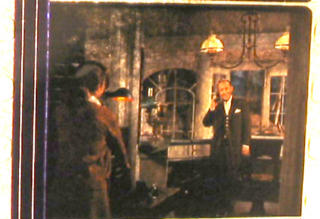
And here's a scan of that 35mm frame:
 -

Notice in both cases how much is missing from the sides. So is this a t.v. print or did someone not know how to correctly transfer a Vistavision print?

[ 12-26-2005, 09:49 PM: Message edited by: Mathew Molloy ]
 
Posted by Monte L Fullmer (Member # 2797) on 12-27-2005, 12:25 AM:
 
Print looks like a "rectified" print for full screen viewing-with the side information being cut off. Then shooting it through a 1.66/1 or 1.85/1 aperture is really destroying the original presentation of "VV".
 
Posted by Carl Martin (Member # 1146) on 12-27-2005, 02:23 AM:
 
to go o.t. a little...

imdb lists this as mono or perspecta, yet your print has a true stereo track.

what's the deal with that?
 
Posted by Mathew Molloy (Member # 666) on 12-27-2005, 02:48 AM:
 
It's a fairly new print. Reel 1 listed as SR, 2-7 as Dolby. See the comments in Feature Info. & Trailer Attachments.
 
Posted by Mark Gulbrandsen (Member # 72) on 12-27-2005, 03:50 AM:
 
There is very definately something screwy with that print!! Its was either printed from the wrong elements or it is very definately a TV print. The contrast looks to be considerably washed out.... another sign of a TV print. VV prints are never full frame like that one is and always have a wide frame line. As for the tracks its definately sva and it might have been generated by decoding the perspecta track and re-recording it to sva. Modern equipment does exist for decoding Perspecta tracks!!

Mark
 
Posted by Fred Georges (Member # 505) on 12-27-2005, 06:44 AM:
 
Your a victum of the Roach bucket prints that were struck at the behest of Films inc. when they handled Paramount for Rep bookings. The Music Box theatre in Chicago was the first theatre to run that P.O.S re-print in the Mid eighties & I asked myself the same questions. From info I got from a fellow at films inc our print (& it seems all subsequent prints) were struck from a 1:33 negative that had been prepped for TV years ago. I could barely run it 1:66 without trimming heads & finally gave up and ran it 1:37. Such a shame. It was the first VistaVision release & these crap prints are all thats available in 35mm. [puke]
 
Posted by Frank Angel (Member # 248) on 12-27-2005, 07:41 AM:
 
Why in hell would Film's Inc want a 1.37 conversion for Rep houses? Unless they had no choice because Paramount only had the TV crap dupe negatives available to strike new prints. Makes no sense at all, and for Paramount to only have these versions available for distribution is a crime (not that this is a particularly favorite film of mine). I guess they think if an image comes on the screen and sound comes out of the speakers, that's good enuf. Ah yes, I forget, digital should fix all of this.

As for the sound....this is a real mystery because if this is merely a Perspecta sound conversion to Dolby, and since Perspecta sound is simply a mono track that was panned left and right via Perspecta trigger tones, then there shouldn't be the kind of variation between the two waveforms as we see there is in the scan. Making either of the two channels louder than the other, then you only get that track with more modulation, but the waveform will stay identical. Out of phase stuff that they want to come out of the surrounds would look identical, just offset slightly. In the scan, the waveform of the two channels look quite different which points to some remixing in of sound effects or other elements that were not in the original mix. Who knows what these people do when then decide they can make some extra cash on a classic. Seems they can't just let the movie stand on it's own merits, they don't seem to get it that the reason a classic is a classic, is because it's great just the way it was made and doesn't need to be messed around with.
 
Posted by Mark Gulbrandsen (Member # 72) on 12-27-2005, 08:01 AM:
 
Frank,

Perspecta could do more than just pan it's single channel.... the control tones could also be phase modulated during encoding creating a pseido stereo effect that was quite impressive. White Christmas was done this way. I've seen - heard reel-1 in true Perspecta decoded through an original tube unit that was restored by an engineer at Tektronix. The opening VV logo score in Perspecta was incredible!

There is/was a card available from Great Britian that would plug in place of the cat 150 in Dolby processirs that could decode Perspecta tones properly.... Last I heard it was about $600.00 U.S.

Mark
 
Posted by Stephen Furley (Member # 1277) on 12-27-2005, 09:23 AM:
 
quote:
Perspecta could do more than just pan it's single channel.... the control tones could also be phase modulated during encoding creating a pseido stereo effect that was quite impressive. White Christmas was done this way. I've seen - heard reel-1 in true Perspecta decoded through an original tube unit that was restored by an engineer at Tektronix. The opening VV logo score in Perspecta was incredible!
Something like fifteen years ago I heard that there was a t least one print in circulation in this country, which still had the perspecta track on it. I don't know if thisis still the case, and, of course, at that time just about nowhere would have had working equipment to decode it. I've never heard 'White Christmas' in perspecta; I'd like to, but I've never heard of it being played that way in recent times. I have heard 'forbidden Planet' on an original Fairchild Integrator at the loew's Jersey in 2002, and the first few minutes of it, before I had to leave to catch my train to London at Bradford in 2004. This was with one of the modern cards in a CP-200. I've also heard various cartoons and a couple of clips, from what I'm not sure, through one of the cards, and a few other shorts and clips through the original Integrator at the Loew's. Many years ago I heard a few minutes of something, I can't remember what it was through an original Integrator in London, howevr, that unit was in poor condition, with lots of hum, and I think the filters may have been off, as well.

From the limited amount of material which I've been able to hear, my impression is that, at it's best, Perspecta could sound quite good, better than I expected, but not as good as a true 4-channel magnetic stereo system. One problem seems to be that a lot of what was produced was badly done, sounds like it was done cheaply and quickly, and it was also used on films for which it was not suitable; particularly cartoons with music.

When Perspecta died out it wasn't because it was replaced by something better; most films, in most cinemas were in simple Academy mono optical for another twenty years. Perspecta wasn't cheap to install, I seem to remember a price of something like $1000 for the Integrator and it's power supply, then there was the cost of the extra amplifiers, speakers, cabling etc. Of course, the prints wre much cheaper than 4-track mag ones.

quote: Mark Gulbrandsen
There is/was a card available from Great Britian that would plug in place of the cat 150 in Dolby processirs that could decode Perspecta tones properly.... Last I heard it was about $600.00 U.S.
I believe there were two cards available; one I know nothing about, other than it could be used in a Dolby processor, with an adapter. I have one of the other cards; it was produced by Dion Hanson, previously with Dolby, now as far as I know on his own, and trading as 'Cineman'.

My main reason for buying this card was to listen to various samples of Perspecta film that I managed to borrow from various places. It has also been used once, with an actual audience, for a short demonstration. I wanted to use it another time, about two years ago, at an event at a London cinema, but was unable to do so, do to availablity of a print, but complications with rights, whith could not be sorted out in time.

The card replaces the Dolby Cat. 150 decoder, and can be used in any processor which takes that card; I've used it in a CP-65 and a CP-200.

Last year I lent the card to Peter Apruzzese, Director of Film Programming at the Layfatte Theatre in Suffern, NY. Peter wanted to use the card in a CP-50, with 'Forbidden Planet', but was not able to do so due to a technical problem which could not be resolved in time; I can't remember the details now, but it was very odd. Whether the card has developed a fault since I last used it, when it was fine (pun not intended), or whether it was due to an incompatibility with his CP-50, which he said had been heavily modified, I don't know.

I do not intend to use this card again in the foreseeable future; if anybody has access to any Perspecta film, and would like to try it, I could ask Peter to send it to them. Mark, when I bought the card the price was 300 pounds, so your figure of $600 isn't far out. It's a very well made card, and considering the very small quantity which must have been produced, I think that's very reasonable. Dion uses one of these cards himself at his 'Fantastic Formats' lecture, which he has given at various venues. I understand that one was also bought by somebody who was producing a DVD of a Japanese film which had a Perspecta track.

I don't know if this card is still avable. There have been suggestions of doing this by custom programming of the CP-650, but I haven't heard of anybody actually doing it.
 
Posted by Jeff Taylor (Member # 443) on 12-27-2005, 01:27 PM:
 
If that track was from the '80's TV/FI reprinting it's hard to explain the stereo track, but the new DVD releases of WC do have a true stereo track, at least for the musical numbers where they went back to the multi-track masters. I assume the dialog is still mono--at least it sounds that way. One thing that's always interested me is that even on the 16mm TV prints (obviously 1:33) of WC, the sound changed dramatically during the musical numbers, becoming considerably richer and then reverting back for the dialog sections. I'm not used to that kind of mix even on comparable early mag-period musicals of the period
 
Posted by Mitchell Dvoskin (Member # 751) on 12-27-2005, 01:42 PM:
 
Original White Christmas prints were intended to be projected 1.66, as were most VistaVision Titles.

Original VistaVision prints has a symbol at the start of each reel in the upper right corner, a cross between an "F" and a "t", which indicated were to frame the top of the picture depending upon whether you were projecting it 2:1, 1.85, or 1.66. While most VV title can be framed 1.85, it is a usually a little tight.
 
Posted by Bill Carter (Member # 156) on 12-27-2005, 03:07 PM:
 
That print was just here at the Heights Theater in Minneapolis. Direct comparison with some clips from an original Technicolor VV print prove that it is (rather severely) cropped, apparently from a TV element created on CRI stock. The print is grainy, with somewhat muted color. Not at all what you would expect from a Vista Vision neg.

It does carry a modern stereo track, which doesn't sound like a Perspecta conversion. It sounds like they merely "expanded" the mono sound by adding some muddy reverb/delay. Either that, or they re-recorded it in the bathroom. Same difference.

It appears to be true that this is the only print in "official" circulation (there may or may not be more than one, but they are all from this same printing), though Tech prints (with Perspecta) do survive in private hands.

It ran at The Heights in 1.66, though even that is a little too tight at times.

And, by the way, it was a 410-seat sellout, with people turned away.
 
Posted by Mathew Molloy (Member # 666) on 12-27-2005, 03:37 PM:
 
I've received a reply from Paramount that this new print has played six theatres and nobody's complained but they're looking inot it. Bill, could you let Paramount (or the folks at your theatre who deal with Paramount) know that you noticed these problems as well? Amy probably thinks I'm crazy. Well, she might be right but that's beside the point. We've had complaints and walk-outs due to the soft focus on this print.
 
Posted by Dick Prather (Member # 1136) on 12-27-2005, 04:44 PM:
 
It is a real shame your print is that way. I have seen the original IB print and listened to the Perspecta tracks. The focus was extremly sharp as most VV prints were and the Perspecta track was superb.

The little marks at the start of each reel were for framing at which ever aspect ratio you were using as several ratios could be used.

I have a Fairchild tube Perspecta unit and the card type for Dolby processors from Dion Hanson. Both work great.
Dick
 
Posted by Scott Jentsch (Member # 1681) on 12-28-2005, 01:27 PM:
 
quote: Bill Carter
And, by the way, it was a 410-seat sellout, with people turned away.
It's great to hear that a 51-year-old movie was able to draw that kind of crowd! That movie has been available on DVD for years, and gets lots of play on TV, so it would seem to refute the notion that it's impossible to get people to go to the theater once a movie is available for home viewing.

With some of the holiday-themed stinkers that have been released in the past couple of years, I wonder if it wouldn't be a good idea for theaters to run prints of old holiday movies.

I would much rather see a (well-done) showing of "White Christmas" than so many of the supposed holiday films that have been released. Besides, right now, there are no movies playing that could be considered in the same ballpark as "White Christmas" or the other holiday classics. The Times Cinema here in Milwaukee was playing "It's a Wonderful Life" but that run ended on Monday, and I wasn't able to organize a family outing before then.

Sure, something like "White Christmas" probably wouldn't be able to maintain high attendance, but I can't imagine that a series of the holiday classics would do any worse than "The Ringer" or other garbage that gets pushed onto celluloid once in a while.

Is there an online source of which movies are available for theatrical showings? I'd be curious to see which are available and how much it would cost to run them.
 
Posted by Mathew Molloy (Member # 666) on 12-28-2005, 02:41 PM:
 
quote: Scott Jentsch
Is there an online source of which movies are available for theatrical showings? I'd be curious to see which are available and how much it would cost to run them.
Paramount and Sony both have exhibiter websites listing their available classics titles. Others, such as Warners and Universal, need to be contacted directly. The standard rental for classics is in the $250-$350 range vs/35%. We've had a pretty good month with the Christmas classics. A Christmas Story, Nightmare Before Christmas, White Christmas and Wonderful Life over Thanksgiving holiday. For White Christmas, we should be hitting the 400+ attendance figure Bill had but over the course of an 8 day run.
 
Posted by Robert Harrison (Member # 3202) on 12-28-2005, 11:24 PM:
 
I ran a print of "White Christmas" last year for two days. I figured it would run fine at 1.85 only to find that heads and feet were missing from dance numbers. The next night, I ran it 1.37 which was better except for one sequence on a train that was hard matted at 1.85 . Did you notice this sequence by any chance?

Damned if I do, damned if I don't! I looked up VistaVision in the book "Wide Screen Movies," and it stated that in those early days of widescreen films, some 1.37 prints were made for theatres which hadn't converted (for CinemaScope or any other widescreen process).

For further reading on the soundtrack, see The Afterlife and a thread titled "Stereophonic re-mixes of mono soundtracks."
 
Posted by Brad Miller (Member # 2) on 12-28-2005, 11:30 PM:
 
You might want to check out Wide Screen Movies Corrections v2 Apparently it's not the most accurate book ever written. [Big Grin]
 
Posted by Christian Appelt (Member # 1067) on 12-29-2005, 11:13 AM:
 
Technicolor seems to be a special problem.
I just had a 35mm print of GENTLEMEN PREFER BLONDES for a christmas show, and it looked very soft, had low contrast and extreme color changes, some scenes with a yellow or greenish look, and more grain than I am used to from vintage Tech-IB prints.
The dupe neg was created from color separations, many shots were misaligned with almost anaglyphic green and red contour lines.

The studios do strike new prints sometimes, but mostly from inferior dupe negatives made in the 1970s or 1980s, which is a pity because modern audiences believe "that's the way these films looked back then".

The worst examples of new prints from large format that come to my mind are NORTH BY NORTHWEST (Vistavision) and BEN HUR (Ultra Panavision, currently rereleases over her in really awful 35mm prints from some garbage negative).

If the music business was run like the film industry, we would hear Elvis and Sinatra on wax cylinders today... [Frown]
 
Posted by Mathew Molloy (Member # 666) on 12-29-2005, 03:42 PM:
 
quote: Christian Appelt
The worst examples of new prints from large format that come to my mind are NORTH BY NORTHWEST (Vistavision)
We recently ran a new print of North By Northwest and it was real nice. There was the odd, imperfect moment here and there but on the whole, excellent.
 
Posted by Christian Appelt (Member # 1067) on 12-29-2005, 04:14 PM:
 
A small distributor rereleased NORTH BY NORTHWEST some years ago in germany, and they got prints from a grainy, out of focus dupe negative with many neg scratches, splices and spots. Looked like a improperly processed 16mm print and had terrible colors, like 1970s Super-8 releases. [puke]

But you can get lucky, too: Just checked a SOME LIKE IT HOT print today for our Dec. 31 show, and it was the best print I ever saw of that title, made in 1999 and sparkling black&white. [thumbsup]
 
Posted by David Stambaugh (Member # 1102) on 12-29-2005, 04:15 PM:
 
quote: Brad Miller
You might want to check out Wide Screen Movies Corrections v2 Apparently it's not the most accurate book ever written.
[beer] 60 pages of corrections! lol.
 
Posted by Robert Harrison (Member # 3202) on 12-29-2005, 09:50 PM:
 
Yes, well, on top of that, I misquoted the book. What it actually said was, "The first engagements were presented in anamorphic format, with regular 35mm prints offered for second-run playdates in theatres without (or that didn't want) 'scope."

No actual aspect ratio was mentioned. I took "regular 35mm prints" to mean 1.37. Or, I picked up this tidbit from the Internet from a website that I can't remember. (It wasn't the American Widescreen Museum.) OR, I'm being my usual "Mr. Short-Term Memory."

I still want to know why that one sequence was hard-matted at 1.85 if it was a TV print.
 
Posted by Mathew Molloy (Member # 666) on 12-29-2005, 11:48 PM:
 
Hey Robert, I just checked the 'train scene' you mentioned and it's not hard-matted on this print...although I thought the grain was more noticeable.
 
Posted by Leo Enticknap (Member # 534) on 12-30-2005, 05:50 AM:
 
quote: Brad Miller
Apparently it's [Carr & Hayes, Wide Screen Movies] not the most accurate book ever written.
...and it was published by McFarland. What a surprise!
 
Posted by Robert Harrison (Member # 3202) on 12-30-2005, 09:40 PM:
 
quote: Mathew Molloy
Hey Robert, I just checked the 'train scene' you mentioned and it's not hard-matted on this print...although I thought the grain was more noticeable.

Well, doggone it. Now I'm 0 for 2! Everybody's gonna think I'm on that I-30 stuff!

Did you run it in stereo? Was there crosstalk in the surrounds?
 
Posted by Mathew Molloy (Member # 666) on 12-31-2005, 12:31 PM:
 
We did run this in Dolby A with surrounds and yeah, there was some crosstalk - not so much during the dialogue though. I did a test run with the first reel without the surrounds on and it was lacking . Running it in Mono was just mushy. Heck, this was nothing compared to that nightmare re-release of Gone With The Wind!

Besides, you know how it is when running a movie without surrounds these days- "know-it-alls" come out to tell you the speakers aren't working. (And 90% of what we run is Mono!) [Roll Eyes]
 
Posted by Scott Jentsch (Member # 1681) on 12-31-2005, 01:23 PM:
 
quote: Mathew Molloy
Paramount and Sony both have exhibiter websites listing their available classics titles. Others, such as Warners and Universal, need to be contacted directly. The standard rental for classics is in the $250-$350 range vs/35%. We've had a pretty good month with the Christmas classics. A Christmas Story, Nightmare Before Christmas, White Christmas and Wonderful Life over Thanksgiving holiday. For White Christmas, we should be hitting the 400+ attendance figure Bill had but over the course of an 8 day run.
I'm not an exhibitor, so I don't have access to those sites, but thanks for the information.

Are the rental figures per show or for a certain time-span, like a week?

I'm thinking that it would be cool to run a series of movies, one per week from Thanksgiving to New Years. These would be likely candidates:

Going My Way (1944)
The Bells of St. Marys (1945)
White Christmas (1954)
It's a Wonderful Life (1946)
Holiday Inn (1942)
Scrooged (1988)
The Family Man (2000)
While You Were Sleeping (1995)
The Santa Clause (1994)

Are the TV shows like A Charlie Brown Christmas, and Frosty the Snowman able to be shown theatrically? I think that a showing of the shorts could be very appealing to parents looking to take their kids out to a theater and not be concerned about how "PG" a G-rated movie might be.

Besides being a lot of fun, I would think that theaters could make up the rental costs in concession sales alone!

I have a 5 year old, and maybe I'm just being protective, but there was nothing in theaters this entire Christmas season that I could have taken her to. That's a shame, and a lost opportunity for theaters.
 
Posted by Robert Harrison (Member # 3202) on 12-31-2005, 04:26 PM:
 
quote: Mathew Molloy
Besides, you know how it is when running a movie without surrounds these days- "know-it-alls" come out to tell you the speakers aren't working.
Yeah, I know what you're talking about, as I'm sure most people on this forum do. Especially the customers that believe that dialogue should come out of the surrounds!
 
Posted by Sean R. Custer (Member # 3531) on 12-31-2005, 07:53 PM:
 
Matthew:

Aren't you proud of your new relationship with Paramount? They have a differnent definition of "Archival". I think Paramount and Fox were the among the first to prepare prints for T.V., and as soon as the new dupe was struck, they usually destroyed or abandoned the nitrate-stock originals, which I imagine was the case with that "Wonderful Life..." print I was griping about. Less likely they did this with Vista Vision prints, but I can only guess at what they did do... There's a good chance that your print of "White Christmas" is a dupe of a dupe of a shoddy trasfer to begin with. Did you happen to notice any pan & scan employment on your print? Was it all on polyester or was some of it triacetate? In any case, sorry to hear it gave you trouble.
Great scans, incedentally.
-SRC
 
Posted by Mathew Molloy (Member # 666) on 01-01-2006, 11:52 PM:
 
Sean, I didn't notice any pan & scan and the print was all polyester. The photo of the 35mm frame is backed by a piece of lens tissue so it looks like crap but apart from the focus problem, the colors were pretty good - it didn't look as dupey as say, some 16mm or Super8 prints.

We had a great Wonderful Life print from Paramount in November but we're now running Raiders Of The Lost Ark. It's not complete junk but it is by far, the worst non-Criterion print - and the worst color film we've played this past year (about 75 revival films total). Quite a few scratches both base-side and emulsion. We wanted to play this sooner but were told their 'good' print wasn't available until now. I'd hate to see their bad prints!

As this is only our third film from Paramount we've got our fingers crossed our upcoming prints will be better off.
 
Posted by John Eickhof (Member # 323) on 01-06-2006, 10:50 AM:
 
Don't forget, the trigger tones on perspecta also raised and lowered the gain on each channel. I have heard the sound through Dick's system, it is unbeleivable for its age and design!!
 
Posted by Tao Yue (Member # 836) on 01-18-2006, 08:20 PM:
 
Matthew -- was the Raiders print in digital sound? Sometimes there are bad prints which are indistinguishable in the database since not enough metadata is kept.
 
Posted by Mathew Molloy (Member # 666) on 01-18-2006, 08:39 PM:
 
Tao - the Raiders print was listed as "Dolby" on reels 1 & 2 and "SR" on 3-6. No digital. We ran the film Dolby A and the theatre owner felt that sounded best. This print was from 2004 and Paramount was not happy to hear it hadn't fared too well.
 
Posted by Mark Gulbrandsen (Member # 72) on 01-18-2006, 08:57 PM:
 
quote: John Eickhof
Don't forget, the trigger tones on perspecta also raised and lowered the gain on each channel.
And they could also be modulated to give a reverberant effect with fast cross modulating between tones that created a pseudo stereo effect. A correct working Perspecta system is mighty impressive.... in a way far more impressive than SDDS, SRD, and DTS combined.

Mark
 
Posted by Paul Linfesty (Member # 214) on 01-18-2006, 09:04 PM:
 
quote: Mark Gulbrandsen
A correct working Perspecta system is mighty impressive.... in a way far more impressive than SDDS, SRD, and DTS combined.

Oh, pleeze!
 
Posted by Mark Gulbrandsen (Member # 72) on 01-18-2006, 09:54 PM:
 
Oh Paul... come on... that was meant as a set up for Brad...... now you've ruined it [Razz]

But I will stick to the mighty impressive part.....

Mark
 
Posted by System Notices (Member # 2357) on 12-26-2007, 02:28 AM:
 

It has been 706 days since the last post.


Posted by Carl Martin (Member # 1146) on 12-26-2007, 02:28 AM:
 
these lousy w.c. prints are still in circulation... saw one 3 days ago in el cerrito.
 
Posted by Adam Holland (Member # 4539) on 12-26-2007, 09:24 PM:
 
We showed this movie, at the Fiske in Oak Grove, La. (Pop 2,687) as well, on December 1 and 2, but we rented the DVD from Swank Motion Pictures, as at this stage it is all we can show until we get some newer 35mm equipment.

The movie drew a good crowd considering we only were showing it a 2 p.m. On the Saturday after the parade we prolly had 150 and on the Sunday showing around 100.

Though this crowd looks empty in a 750 seat theatre we were pleased with the turn out.
 
Posted by Ron Funderburg (Member # 4561) on 12-26-2007, 10:33 PM:
 
The film was turned sideways on VistaVision when run on a VistaVision projector you had a picture that was 8 sprockets wide so the picture was somewhere between 85/1 and 2/1 it was photographed at the 2/1 ratio but the cameras were marked inside so they tried to hold action inside the standard picture sizes of the day (what a shame wider is better) so that when they printed it on a standard 35MM it could be shown in aspect format from from 1.33/1 through 1.66/1, 1.85/1 up to 2/1. According to Paramount the standard 35MM plays best in ratios close to 1.85/1.

I have seen a couple of pictures (way back when I was a kid) that were actually shown in VistaVision it had a really sharp picture if my itty bitty mind worked well then. Oh well!
 
Posted by Frank Angel (Member # 248) on 12-28-2007, 01:46 AM:
 
quote: Ron Funderburg
According to Paramount the standard 35MM plays best in ratios close to 1.85/1.

That's just some jerk at Paramount not wanting to have to admit that they've got prints that look better at 1.66 but hardly any theatres have the proper lensing and plates for 1.66 so they just say it looks better at 1.85 because that's how commercial theatres are going to project it. Happens all the time. Miramax would make deals to distribute foreign films here in the US and these films no question were shot 1.66 and meant to be projected at 1.66 (Europe retains that as the preferred AR over 1.85); they would scribe subtitles at 1.85 and call it a 1.85 film. And then you wonder why when you project it at exactly 1.85, you either cut off part of someone's head or cut off part of the subtitles.

I know VistaVision was a great format -- great resolution and a much more elegant format than CinemaScope which was its intended competition. Only trouble was, IMHO, it was sheer stupidity to take that great width and crowd everything so it would play, not at 1.85 or even 1.66, but at freakin 1.37. This idea trying to make a format work for everything is just idiocy and something I bet the suits thought up and not the cinematographers and the R& D guys who came up with the film running horizontally thing.

Paramount had the right stuff when they said CinemaScope just look too much like three day old vomit to shoot their product on so they came up with the brilliant idea of turning 35mm film on its side -- hey, IMAX thought it so good they did it with 70mm. And that turned out not too shabby. Then Paramount converted to assholeism and laid it all to waste by trying to make it all things to all exhibitors. "You want 2:1? -- fine, we got that; you want 1.85 or 1.66? -- hell, we got that too. What did you say? You are still running Academy 1.37? No problem....no problem....we got ya damn 1.37 too!!"

That one-size-fits-all was WORSE than what happened when cinematographers were forced to started shooting Panavision but keeping everything safe for godawful cable and television....it's the aesthetic equivalent of a rhino turd.

A film CAN'T be composed for BOTH 2:1 AND 1.37, I don't care how many reticles there are in the camera viewfined and if the cameraman has got a dozen voodoo trinkets hanging from his nose.
 
Posted by Stephen Furley (Member # 1277) on 12-28-2007, 03:37 AM:
 
quote: Frank Angel
so they came up with the brilliant idea of turning 35mm film on its side
Like most things it wasn't a new idea; it had previously been done by Alberini (sp?) about thirty years previously; he actually used a 10-perf frame for his system, and since it had no track the full width between perforations was used, giving an aspect ratio of something like 1.66. There were horizontal systems before this, but I don't know of any that used 35mm film.

Wide film, multiple films, anamorphic lenses, horizontally-running film, masking down a standard frame, and using a two-perf camera pull-down had all been used long before they were "re-invented" in the '50s. There's almost nothing new in this world.
 
Posted by Jack Theakston (Member # 4484) on 12-28-2007, 03:41 PM:
 
And it didn't matter anyway. 99.999999999999% of prints were going to be standard 35mm. That was the point of VV-- finer grained 35mm prints, not large format.

Right off the bat, you can't run VV at 1.37. The film is hard-matted to 1.5:1 or so.

The first year of VistaVision, most of the titles were composed at 1.66:1, with loose headroom on medium shots to accommodate running at 1.85:1. This was dropped not long after when most theaters in the US standardized to 1.85.

The idea of making the system applicable for multiple ratios was to be flexible for exhibitors that were installing wide screens under various circumstances. I've got Paramount's documentation in regards to "if your theater has a steep rake from the projection booth... run VistaVision films at 1.85:1" etc, etc.

By the way, I don't recommend reproducing the Perspecta tracks on anything but an original integrator. The new cards for decoding the system are poorly designed, and often lack the gain control that was half of the system.
 
Posted by Mark Gulbrandsen (Member # 72) on 12-28-2007, 04:09 PM:
 
All the VistaVision cameras from the first Stein conversion prototype that was used to film White Xmas used Leica camera lenses which to this day are still some of the very best lenses ever made.

Mark
 
Posted by Ron Funderburg (Member # 4561) on 12-28-2007, 04:28 PM:
 
Actually the VistaVision camera's were used for a long time to film SF for minutures, the last picture is see listed for this is The Dark Knight next year. Of course when they do this they only use the middle of the film in a 2.35 to 1 ratio (unless it is Disney and they have been claiming that scope is 2.4 to 1 for some time). The bigger negative is the reason of course I sure wish they would actually bring back 70 MM I miss it, it had nice sharp pictures at 27 feet high and 60 feet high!

I watched Ice Station Zebra last night it claims to be filmed in both cinaram and super panavision I think that means in 70mm I saw that one at Cooper in Colorado Springs the first time!!! Smaller theaters after that I miss those big curved screens of the Cinarama type!
 
Posted by Ron Curran (Member # 3631) on 12-29-2007, 10:36 PM:
 
The first time I read about VistaVision was in a popular magazine. It claimed that this new process would be projected on a screen that was as wide as CinemaScope but HIGHER as well! The author contended that this would be more suitable to most theatres where the proscenium was originally designed for 1.37.

I think that Sydney’s Prince Edward theatre showed it that way. Most cinemas presented it as normal flat 1.85. some showed it standard with black top and bottom. I never had the misfortune to see it at 2.0 to 1.
 
Posted by Gordon McLeod (Member # 33) on 12-30-2007, 01:26 PM:
 
Ron said "The film was turned sideways on VistaVision when run on a VistaVision projector you had a picture that was 8 sprockets wide so the picture was somewhere between 85/1 and 2/1 it was photographed at the 2/1 ratio but the cameras were marked inside so they tried to hold action inside the standard picture sizes of the day (what a shame wider is better) so that when they printed it on a standard 35MM it could be shown in aspect format from from 1.33/1 through 1.66/1, 1.85/1 up to 2/1. According to Paramount the standard 35MM plays best in ratios close to 1.85/1."

The camera apperture was 1.472x .997 which is a aspect ratio of ~1.47:1

Interesting to note was during the restoration of WIlliamsburg the story of a patriot that the prints were mag striped covering part of the original image
 
Posted by Martin Brooks (Member # 1269) on 01-01-2008, 03:04 PM:
 
quote: Ron Funderburg
unless it is Disney and they have been claiming that scope is 2.4 to 1 for some time)
The current SMPTE standard for projecting anamorphic 35mm is .825 x .690 which unsqueezed works out to 2.391:1 (essentially 2.4:1). This is the aspect ratio in the SMPTE RP-40-1995 test film. The height was reduced in the standard some years ago because lab splices were visible when projected at full height.

Older films were intended for slightly different apertures, according to the standards of the day:
The 1986 (6th edition) American Cinematorgraphers Manual documents Panavision, Super Panavision 35, Todd AO 35 and Super Techniscope at .838 x .7 (2.394) projection. In the 1973 ACM, this was expressed as .839 x .7 (2.397). I don't know why the width was reduced in the standard by .001.

The 1969 (3rd edition) of the American Cinematographers Manual had Panavision 35 at .839 x .715 (2.347) with a note that projecting at a .715 height would reveal splices. Superscope and Techniscope had the same specs.

I can understand reducing the height, but I don't know why the width was dropped from .839 to the current .825. .839 x .690 would have worked out to 2.432. Maybe some people thought that was too wide.

Vistavision: The ACM 3rd edition quoted the negative area as 1.485 x.991 (8 perf horizontal), which works out to 1.498 AR. The nominal dimensions for a VV print were 1.418 x .722 for a 1.964 AR which was designed for use in houses that normally projected anywhere from a 1.85 to 2.0 AR, not that Vistavision was ever really projected horizontally, aside from a few special venues like Radio City Music Hall. Regular (vertical) 35mm prints came in two flavors: .825 x .446 (1.85) and .825 x .497 (1.66).
 
Posted by Stephen Furley (Member # 1277) on 01-01-2008, 03:21 PM:
 
quote: Martin Brooks
not that Vistavision was ever really projected horizontally, aside from a few special venues like Radio City Music Hall.
Something that I've never been able to work out is how widely horizontal projection was intended to be used. Obviously, more than it actually was, and obviously only a minority of theatres, but was it only intended to be in a handful of theatres, or more widespread, as 70mm became?
 
Posted by Frank Angel (Member # 248) on 01-01-2008, 06:32 PM:
 
I have never seen VV film projected in horizontal VistaVision. It must have been very disconcerting seeing scratch lines traveling sideways!
 
Posted by Jeff Taylor (Member # 443) on 01-02-2008, 01:32 PM:
 
You're not alone in that, Frank. From what I recall actual horizontal projection was really only used for the road show venues for White Christmas and Strategic Air Command. I believe they switched to standard prints after that.
 
Posted by Stephen Furley (Member # 1277) on 01-02-2008, 02:31 PM:
 
'Battle of the River Plate' was shown in this format, and I've seen an odd reel of the original print projected. It looked impressive, despite being badly faded. There was a track on the print, but no soundhead on the projector, so I don't know if the double speed optical track would have sounded much better than a normal one.
 
Posted by Lionel Fouillen (Member # 1475) on 01-02-2008, 03:47 PM:
 
The FORUM in Liège, Belgium, was also equipped to show genuine horizontal VV in the ratio of 1.85 projected on a screen surface as wide as scope but higher. This theater went widescreen in the late fifties, having not only VV but also scope (2.35) and flat 1.66 for conventional 35mm. It never had magnetic sound. Sound was mono for scope and 1.66, and Perspecta stereo for VV.

As my father reminds me (he saw The Ten Commandments and a few other films in VV there), sound was awful because of the theater architecture and accoustics (3000 seats across the stalls and the three balconies turning around the auditorium on the side walls much like old Italian-style theaters). For this reason they didn't bother to try installing Dolby Stereo later.

As one of you pointed out, VV had an interesting aspect ratio which better suited the stage of most older theaters. In the late seventies or early eighties, the FORUM had a re-run of The Ten Commandments in conventional 35mm (1.66). My father, who went to see it, was extremely disappointed by the image that filled about just the half of the screen surface of the earlier VV projection...

Since the mid-eighties, the FORUM does not show films anymore. It is exclusively used for concerts and theater plays.
 
Posted by Hillary Charles (Member # 769) on 01-02-2008, 03:55 PM:
 
Wasn't "The Story of A Patriot" originally presented in the horizontal VV format in Williamsburg, VA? I thought I read that when they reprinted it for conventional 35mm.
 
Posted by Gordon McLeod (Member # 33) on 01-02-2008, 09:20 PM:
 
Here is a link to the widescreen museum site article from SMPTE on Story of a Patriot
http://www.widescreenmuseum.com/widescreen/colonial_williamsburg2.htm

Also there was an excllent article in a old American Cinematorgrapher on the restoration of the film to standard 5 perf 70mm

This is a link to the development of the prototype VV lazy eight projector
http://www.widescreenmuseum.com/widescreen/vvproj.htm

There were 2 of them installed at the Imperial theatre in Toronto and there were two of the GK kalle machines at the Odeon Carlton in Toronto
The imperial machines went to Lucas Film The Kalee machines I don't know
 
Posted by Carl Martin (Member # 1146) on 01-05-2008, 02:46 AM:
 
quote:
It must have been very disconcerting seeing scratch lines traveling sideways!
that scuzzy print of white christmas did have a printed-in horizontal scratch on one shot.


Powered by Infopop Corporation
UBB.classicTM 6.3.1.2