This is topic Super Simplex / RCA 1040 / Peerless Magnarc Restoration in forum Film Handlers' Forum at Film-Tech Forum ARCHIVE.
To visit this topic, use this URL:
https://ft-forum.com/ft/cgi-bin/ubb/ultimatebb.cgi?ubb=get_topic;f=1;t=007761
Posted by Tim Hull (Member # 2875) on 01-16-2006, 02:00 PM:
Hello,
I am in the process of restoring 2 Super Simplex projectors. I plan to document the entire process on my web site at:
http://www.timhull.com
Currently, there are only 2 galleries available, but it should give a good idea of the their current condition. The pages for the entire restoration project are currently being designed.
I am looking to get in contact with anyone that has good resources or information that can help out on this project. I will give credits and links to your web site or contact info in exchange.
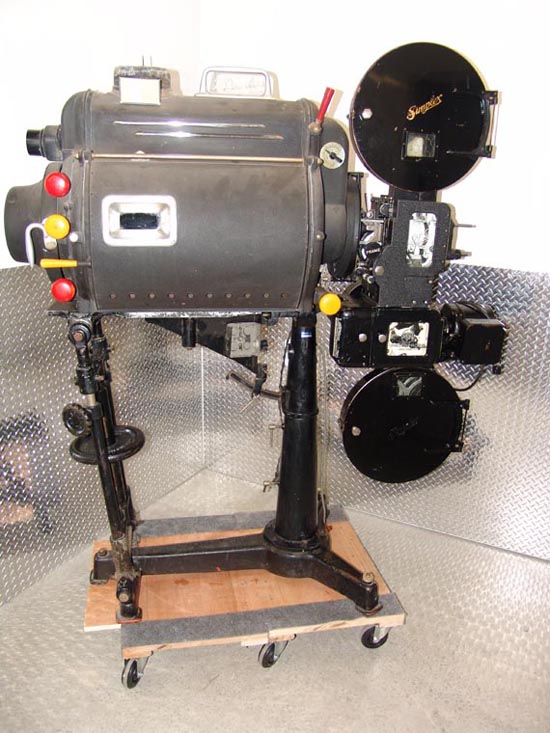
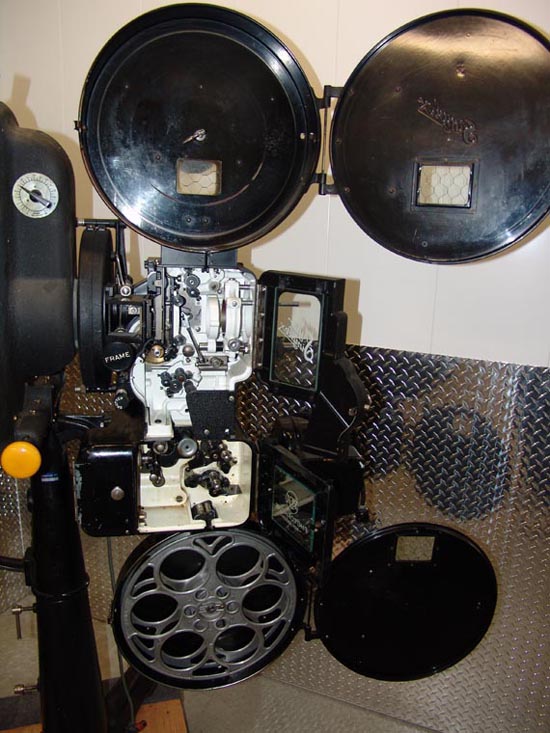
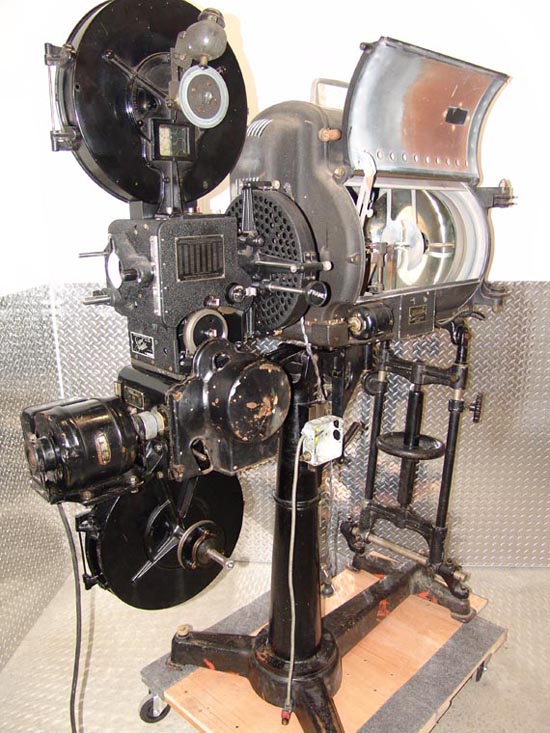
Thanks!
Tim Hull
[ 01-16-2006, 04:08 PM: Message edited by: Tim Hull ]
Posted by Louis Bornwasser (Member # 3063) on 01-16-2006, 05:51 PM:
Are you going to put the photoelectric cell and yellow knobs (Magnarc) back? Just joshing you. Louis
Posted by Monte L Fullmer (Member # 2797) on 01-16-2006, 06:02 PM:
yea..looks like somebody stole some Ashcraft knobs and plopped them on the back end of that McNauley Peerless ..(lol)
These Supers were fun to play with...dropping oil in those inlet tubes in the gear side of the head per each showing. Plus, doing an intermittent sprocket replacement on this things being the taper pin variety.
-Monte
Posted by Mark Gulbrandsen (Member # 72) on 01-16-2006, 06:16 PM:
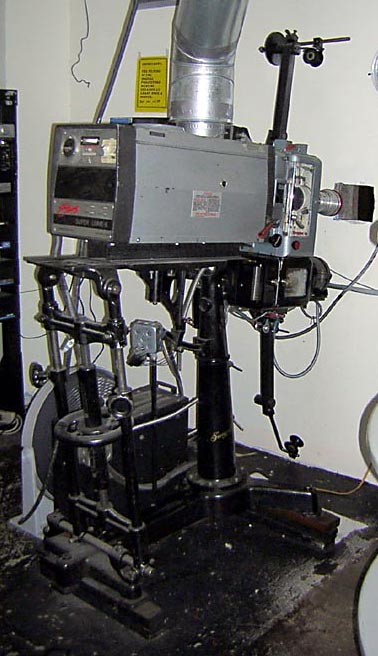
Hopefully you'll open a theatre with them and run it the old fashioned way! There is a base and 1050 RCA just like that still in daily use at the Teton Theatre.
Posted by Tim Hull (Member # 2875) on 01-16-2006, 09:20 PM:
Thanks for the replys!
I have had these Supers for just over a year and I'm finally getting to the point that they are complete enough to begin restoring. I found the bases, picture heads and sounds on ebay and I really want to bring these projectors up to operational condition.
At this point any information you think might be helpful would be greatly appreciated. I know from reading other threads that there is a ton of experience here at the film-tech forum and I hope to lean on it a bit to get these babys humming again.
Mark - thanks for the picture! I have looked all over the web trying to find a picture of this Simplex base. It's really cool to see one in use today - specially with the RCA soundhead. (by the way...i would love to open a theater and with these!)
I will post more pics as they are reconditioned.
Tim
Posted by Monte L Fullmer (Member # 2797) on 01-16-2006, 10:28 PM:
..and we forgot to mention about that oddball reel end alarm (a mechanical version) on the back end of the upper spindle...which was fully discussed in an earlier post in this forum of both versions - electrical and mechanical versions. I ran a booth that had the electrical version which an Edison light bulb socket was mounted on the wall and the light would flash on and off when the reel was coming close to an end, which was about a minute and a half.
-Monte
Posted by Mark Gulbrandsen (Member # 72) on 01-16-2006, 10:46 PM:
Monte's thinking of this post I made last summer......
Mark
Posted by Will Kutler (Member # 770) on 01-16-2006, 11:23 PM:
On the Supers, take a look at the manuals Forum on FT.
Pay attention to what gears you have, straight bevel or spiral.
Also look at gear wear.
Keep in mind that these Simplexs used hardened steel shafts against a softer cast iron bearing surface. Sometimes dirt, lack of maintenance and just wear will cause lots of scoring. But even if they are scored, a deburr-cleanup will often be enough to get them running again, so long as there is not too much slop between bearing surfaces.
Mark can chime in, but if memory serves me right, shafts could be ordered with different diameters as a corrective remedy. Or, a machine shop might be able to overbore the casting and press in oil-lite bushings...which would also do a lot to decrease the amount of daily oiling. I'v forgotton, but the oil-lite thing might be iffy due to a lack of "meat" around critical areas?
Also pay attention to the shims behing the shutter shaft casting, and if you do remove it, be careful so as to not crack it.
Also, be careful of the nickel plated parts. Those are actually nickel plated brass, and overbuffing will remove the plating.
Posted by Mark Gulbrandsen (Member # 72) on 01-17-2006, 08:16 AM:
quote: Will Kutler
Mark can chime in, but if memory serves me right, shafts could be ordered with different diameters as a corrective remedy.
This used to be true but Super and 1049 parts are NLA even from Wolk. They have a few parts that are commonly used. The shafts used to be available in several oversize increments but not any longer. LaVezzi also used to make a stationary shaft that went into the main casting and then the gear turned on the shaft. Supers with these shft setups were the best of the lot and had the lonfest life. If you need parts you'll have to scrounge around at different sealers to find what you need. Supers are basically a dead issue now..... but there are still exactly 24 of them running in the Mountain States.
P.S. What ever ya do don't turn the thing over by turning the shutter shaft..... doing so can strip the GR87(I think) double bevel gear in there which is now made from unobtanium.
Mark
Posted by Tony Bandiera Jr (Member # 2365) on 01-17-2006, 05:52 PM:
Tim:
Send me an email, I still have some Super and RCA parts floating around and can assist you in the restoration. I'm local to you...sort of.
Posted by Will Kutler (Member # 770) on 01-17-2006, 06:31 PM:
Hi Mark
Seeing as you have lathe experience, you could make some shafts...a little time consuming, but not too difficult.
The oil gallies that run along the shaft would be done with a radiused cutting tool. I forgot what direction the grooves twist, but it would basically be done by using layout dye and either a very course feed rate/threading rate or Acme thread. Old trick is to put tool upside down with the compound on the backside of the work and feed from the spindle towards the tailstock. Old toolmaker's method of threading if undercutting at end of threads not used and there is a shoulder and the thread needs to be a specific toloranced length.
Shafts would be turned between centers, and those centers would also be used for o.d. grinding.
That hard black coating that is often seen in the oil grooves is a result of heat treating.
Cheers
K
Posted by John Eickhof (Member # 323) on 01-18-2006, 10:20 AM:
Ahhh yes the feeble old 'can't scratch' reel end alarm...brings back memories of hearing it go off then checking the #2 machine only to find out I had forgotten to thread up the next reel!!!!
Good old Supers!! They run like clocks when they are well maintaned! I didn't see any 4 tube rectum-friars?? I have a couple pallets of them...also the Simplex 'L' 5 point pedistal was probably the most common and most copied base! The optional tilt mechanism was actually made by CS Ashcraft for use to steady the pedistal when using large arc lamps. Simplex did make they type 'S' and 'R' pedistals ( A very heavy duty 5 point base approx 250 lbs!)late in the 1940s but very few exist today, in fact I am looking for the pivot bracket for one if anyone out there may have it??? By the way, the RED knobs were used on the last of the Magnarcs that were made by Strong after aquisition of the Mc Auley company. They also used some SILVER metal knobs for a while after the stock of the old 'egg yolk' knobs ran out! I use the old "egg yolk' knobs for shift knobs on my vintage Power Wagon trucks! They always get comments!
Posted by Mark Gulbrandsen (Member # 72) on 01-18-2006, 07:21 PM:
quote: Will Kutler
Seeing as you have lathe experience, you could make some shafts...a little time consuming, but not too difficult.
Actually I don't make any of the custom shafts I had on hand, there just are not enough hours in the day to make everything and certain aspects are really quite specialized anyway. I have a good friend down in Sedona, AZ who is a knife maker by trade produce them for me. He has an almost brand new Hardinge HLV that he uses for roughing them out to just slightly oversize. They are generally made from S-12 steel, a special high shock load steel that is designed to take high loads without twisting or distorting. He also does the hardening(to about 60C)as well. Then they go to Boston Centerless Grinding(on Baston) to be ground to size +/-.001 over the length. For the Century shutter shafts I have over 20 bucks in them per shaft but they will never fail.
Mark
Posted by Robert E. Allen (Member # 1351) on 01-19-2006, 03:58 AM:
In good condition Tim, I'd put those Supers up against any machine on the market today for great picture quality.
Posted by Louis Bornwasser (Member # 3063) on 01-19-2006, 09:55 AM:
Me, too. My reference projector is a straight gated Super Simplex. It is amazing to me how many "modern" projectors are suffering in some way compared to that: darker, jumpier, out-of-focus. Nothing with a straight gate is better. That leaves Simplex/Century and most curved gate projectors as a Possibility.
Even the old RCA soundhead is not that far back in design principles. Short of the Davis-bridge in a Century, it is right there=OK> Louis
Posted by Mark Gulbrandsen (Member # 72) on 01-19-2006, 10:18 PM:
quote: Louis Bornwasser
Me, too. My reference projector is a straight gated Super Simplex.
There is one better Super Simplex out there... add a set of LaVezzi Posi-Trol sprockets to one and you will become stunned by the incredible steadiness! Imagine a Super with absolutly no side weave at all, even on worn prints!
Most of your customers still running them plan on keeping them as long as they can.
Mark
Posted by Tim Hull (Member # 2875) on 01-20-2006, 02:51 PM:
Would anyone know of a theater in southern california (los angeles area hopefully) where they are still operating super simplex projectors?
I would really like to see them in operation.
Thanks!
Tim
Posted by John Eickhof (Member # 323) on 01-20-2006, 03:24 PM:
Loius, I can't agree with you more! My favorite projector still has the be a nice quiet gloss black Super! And a pleasure to repair too! Good maching back in those days!!
Tim, Last time I was downtown ( 1995 or so) the Los Angeles was running Supers with Peerless HyCandescent lamps! Also there were a couple more large spanish houses on Broadway running Supes The Warner theatre in Port Hueneme also has a pair in operation, plus some houses in the Santa Ana area. (spanish)Its been too many years since I worked in that neck of the woods..
Posted by Sean Weitzel (Member # 244) on 01-20-2006, 07:08 PM:
Last time I was at the Bridge Theater in San Francisco, they were running a pair of Supers. One was paired with an AW3 for the feature and one was running the house trailers reel to reel.
Posted by Will Kutler (Member # 770) on 01-20-2006, 07:19 PM:
I was always tought that Supers and E-7s were not designed for continuous (platter) operation due to the type of construction (bearing surfaces and gears). Can Mark G. or John E. please elorborate?
Cheers
K
Posted by Robert E. Allen (Member # 1351) on 01-20-2006, 08:02 PM:
Tim:
The Fox Theatre in Pomona ran supers until the day it closed. The city has bought the theatre to restore it. I don't know if the job is done and opened. The machines there were equipped to run a two film system (seperate sound and picture for previews).
Posted by Dave Macaulay (Member # 813) on 01-20-2006, 10:04 PM:
The SS or E7 would be a poor choice for a booth with platters if you have the "booth usher" operators of today.
Both machines managed to put in many years of service in changeover houses though, and there really isn't any difference between running a half hour vs 2 hours at a time; you just get half the total hours per machine with a c/o setup.
If you have a Projectionist who does the proper maintenance and keeps them lubricated they'll run off platters fine. Try and find someone who will do that work for minimum wage though...
I'm not suggesting anyone try and use these antiques for a real working theatre, but for a screening room or occasional use venue they're fine - until something unobtainable breaks.
Posted by Paul Trimboli (Member # 1509) on 01-20-2006, 10:56 PM:
Tim I have just restored a Simplex Standard head and RCA 1050, see if you can find yourself the 1050 motors with flywheels as it makes for a much smoother startup. The mounting bracket is also different, I only had a 1040 motor mounting bracket so I had to modify the motor cradle to get it to fit.
If you were to put these into operation just make sure you stock up on the heads so if you ever need a spare you can just take it from a wreck.
If you plan on upgrading the soundheads to stereo you will need to find a new style slit lens. I have actually had one of these slit lens to peices and wonder if its possible to just have a new slit apature made?
Posted by Mark Gulbrandsen (Member # 72) on 01-20-2006, 11:06 PM:
quote: Dave Macaulay
The SS or E7 would be a poor choice for a booth with platters if you have the "booth usher" operators of today.
I couldn't disagree more. We have at least 2 dozen Supers located all over the place running in all sorts of situation on platters, double muts, and reels, and a couple of E-7's as well. I never have to service any of them except for normal cleaning. Oil them once a day and they last for ever! For some reason the age of these machines creates an aura in these booths that speak "oil me regularly". They are basically zero trouble.
Paul is dead on about the flywheel equipped motor!
Mark
Posted by Monte L Fullmer (Member # 2797) on 01-21-2006, 01:35 AM:
Mark, on the E-7's: The oblique gear-heard that this is why the E-7 isn't the correct machine to use with platter systems due to the gear is only designed for 20 minute operation - as with the reel changeover operation.
Heard that Supers aren't made for Drive-in operation due to that the casting can't withstand the excessive heat from the large lamps...
..but could be in err on both accounts..
-Monte
Posted by Paul Trimboli (Member # 1509) on 01-21-2006, 03:11 AM:
I know here in Western Australia Simplex Standards were common in drive-ins, fitted with water cooling. Mine has the water cooling plate that screws into the back of the gate assy. There was a local guy called Bernard Hartland that made heavy duty fronts and rear shutter for the Standards, he also made a large range of other projection equipment.
Posted by Bob Koch (Member # 1062) on 01-21-2006, 01:25 PM:
Monte is correct on the E7. Had a very good intermittent[ no taper pins], first one with a cam end play adj; Supers could be modified for it; but the oblique drive setup for the shutter;[ remember this originally had front and rear shutters] was an absolute disaster. I dont know about their engineering dept designing anything for thirty minute operation. You could prolong the life somewhat, by running the framing carriage in a different position but who in todays world could be entrusted to do that. Later IPC came out with a vertical shaft mod to eliminate the oblique mistake but they werent all that great either.
Posted by Mark Gulbrandsen (Member # 72) on 01-21-2006, 02:32 PM:
quote: Monte L Fullmer
The oblique gear-heard that this is why the E-7 isn't the correct machine to use with platter systems due to the gear is only designed for 20 minute operation - as with the reel changeover operation.
It all comes down to proper lubrication. There are not many oblique machines around, most were vconverted to the verticle shaft type mechanism a long long time age but a few have survived. There is an Oblique E-7 feeding from an LP-270 in Big Timber Montana that runs like it was new.
There were also many Supers in Drive Inns but most have been removed to gain more light efficiency with conical shutter machines. The Super is not the best in that department. I never encountered one that couldn't take the heat, at least for running hour reels.
Mark
Posted by Monte L Fullmer (Member # 2797) on 01-21-2006, 03:01 PM:
quote: Bob Koch
You could prolong the life somewhat, by running the framing carriage in a different position but who in todays world could be entrusted to do that.
On a side topic of this: This is exactly what I do with any projector - is to have the frame carriage in the middle of the rotation or travel. I tell the "booth clowns" this so if they get caught with and out-of-frame start (and it's apparent that they don't like to listen to what I teach them on how to set the intermittent to avoid such poor starts...) to have the assembly in the middle of the travel.
Also, I tell them, since we're running the "XL" chassis machines (PR-1050's) that the intermittent assembly receives the best oiling with the assembly in the middle of the rotation.
I agree as well with the oblique E-7's: I've ran a few for quite a while and really had no problems with that setup as long the lubrication is always present on those two small fibre gears. I bet that the one unit that Mark mentioned - the operator/manager is hitting the pump lever one shot each hour to keep that assembly wet.
-Monte
Posted by John Eickhof (Member # 323) on 01-23-2006, 12:54 PM:
Hi Mark, thanks for the compliment! I overhauled the Big Timber E7 about 7 years ago! The supers seem to run great on platters as well as the E-7. The problem with the obique E-7 is that in the good old days with a competent projectionist, the framing knob was seldomly used, thus the sliding steel gear ( G-358?) on the shutter compensator would eventually wear out in one spot and so would the 'acorn' gear ( G-297 )thus when framing was needed the worn 'acorn' would tread against the fresh teeth as the steel gear was moved while framing and pow! It would shave the teeth off the acorn gear! Thus the biggest problem when running platters is the fact that both gears wear and people who would 'repair' or 'rebuild' the heads never replaced the steel gear and it would wear out the acorn gear like mad! Or if the steel gear WAS replaced, the proper shim packs were not installed on the obilque shaft to correctly align the acorn gear, and the backlash would be adjusted by the movement vertically of the acorn gear. ( which is NOT the way to do it!) If you compare the oblique shaft E-7 (with nice gears) to a brand new Vertical shaft conversion the gear backlash from the intermittent to the shutter is way less on the oblique. Otherwise like Mark said, if you oil 'em and keep 'em clean, these old machines will outlast anything of late and with a smoother and steadier picture too!
Monte: All enclosed intermittents that rotate on axis when filled to the indicator lines with oil will lubricate equally no matter the relation to level. The oil gallies and rifling of shafts ensures proper lubrication regardless of rotational position as long as the oil level is correct. As for the XL, the oil drips in between the G-1836 gear and the flywheel gear and they act as an 'oil pump' to force feed oil into the intermittent case, thus it too will be eqaully lubricated no matter what position it is in as long as there is oil feeding into it, plus the XL case has a reservoir that holds enough oil in it even if the flow stops. I had an XL I bought blind from S. Carolina years ago,that NEVER HAD PROJECTOR OIL PUT IN IT! The guy was used to Century projectors and left the rear cover off and lubricated the gears with vasoline and dripped a few drops of oil into the intermittent along the G-1836 shaft and it ran fine for over 12 years untill the pin on the star became so flat it was banging like a jack-ass in a tin barn! And the picture became jumpy (so he replaced it with anew machine!) Anyway, it shows how much abuse a machine can take !! The only other problem with that head was the galded oil pump! It was still spinning though! Needless to say after I cleaned it and replaced bearings, oil pump parts and rebuilt the intermittent, it was perhaps the quietest "Jerry Lewis' vintage XL (Early PR-1014 hammertone blue) I have ever seen!
Posted by Will Kutler (Member # 770) on 01-23-2006, 02:55 PM:
An E-7 question for both Mark G. and John E.
I wonder about a potential problem with the Bijur Oiling System. Did you guys ever do occasional disassembly/testing to ensure that the oiler is working properly and that the check valves are working ok and that their is no gunk in the lines preventing oil from getting to the gears and shafts?
Cheers
K
Posted by Monte L Fullmer (Member # 2797) on 01-23-2006, 03:08 PM:
Please excuse me for "butting" in with this one question, but I used to work at an old "mom and pop" theatre in my early days of being a projectionist where this theatre had a pair of E-7s with Strong Moguls with WE-206 soundheads. The left machine would run pretty quiet, but the other was a bit on the rattly side. Found out that the oiler was indeed had plugged lines running to the geartrain for that one machine.
One night after work, I took off that oiler, and cleaned out the lines to ensure full feed of oil to the geartrain. Quieted the machine down since then and suprisingly, the acorn gear on the oblique was still in good condition.
Figured that I did pretty good since I've never done this task before - just figured on how it worked by looking at the parts manual of this machine - the way on how I learned on being a machine mechanic.
-Monte
Posted by Mark Gulbrandsen (Member # 72) on 01-23-2006, 07:56 PM:
quote: Will Kutler
I wonder about a potential problem with the Bijur Oiling System. Did you guys ever do occasional disassembly/testing to ensure that the oiler is working properly and that the check valves are working ok and that their is no gunk in the lines preventing oil from getting to the gears and shafts?
Will, Thats somehting I check on every visit. Although at present there is just one E-7 on my service route. Using a small flachlight its easy to watch for oil outflowing from each bushings. Generally they only get clogged up from standing unused as the oil evaporates and dries in the lines. Pumping through some solvent usually clears up a clogged line easily.
Mark
Posted by John Eickhof (Member # 323) on 01-24-2006, 12:10 PM:
Like Mark, I too would check oil flow on every service call plus I would lightly oil the fibre gears. On rebuild, the entire system would be dis-assembled and lines cleaned and the flow regulators (of several different drip amounts per gear) would be cleaned and the leather cup in the BiJur pump would be replaced. Never had any oiling troubles with the E-7s unless when on a severe down angle the drip tube for the oblique (or vert gear) was not adjusted to drip onto the gear mesh point.
[ 01-26-2006, 05:06 PM: Message edited by: John Eickhof ]
Posted by Bob Koch (Member # 1062) on 01-24-2006, 12:47 PM:
According to the ancient guru`s from IPC read 1938, the tube in the oiling system over the oblique gear was only intended as a "trace" for the entire oiling system. How long is a couple of drops of projector oil going to stay on these gears? These gears should be lubricated with an oil that will cling i.e. Houghton Sta-Put or the old ERPI Alaska oil. Seems to me Motiograph came out with a gear lubricant for their million gear AA also.
Posted by John Eickhof (Member # 323) on 01-24-2006, 12:56 PM:
Hi Bob! Good point except that fibre gears inherently absorb oil and when saturated they will retain the oil for very long periods of time, thus the gears used in most of the older machines were fibre. ( You seldom had to oil the gear faces on a super ! ) However, the later replacements, mainly century that used the nylon / plastic type gears, the saturation is impossible and surface lubricants are required!! Remember how they used to get hot and scorched?? A real poor application of plastic in my book!! I remember Larry Little (once worked for Sam Kaplan..founder of the Century projector corp.) Always told me to apply a few drops of projector oil to the fibre gears in the century and NEVER use vasoline or Century gear lube!! and absolutely no 'Lubri-plate'! And Most of the century machines I ever dealt with that were equipped with fibre gears actually ran very nice and quiet! And they stayed a lot cleaner on the gear side!!
Posted by Monte L Fullmer (Member # 2797) on 01-24-2006, 01:44 PM:
quote:
Always told me to apply a few drops of projector oil to the fibre gears in the century and NEVER use vasoline or Century gear lube!!
...and how many Centurys in our time have been gooped up with Vasoline or Lubriplate?
Would it be safe then to get all of this goop off and do the oil trick then on these fibre gears?
thx-Monte
Posted by Louis Bornwasser (Member # 3063) on 01-24-2006, 02:33 PM:
FYI: Century gear lubricant came out in 1962, along with the nylon gears. Previously gears were lubricated just as John indicated with regular projection oil on the surface. Louis
Posted by Mark Gulbrandsen (Member # 72) on 01-24-2006, 07:10 PM:
quote:
and absolutely no 'Lubri-plate'!
Absolutely! Anyone on these threads using that crap should be chained to the machine they applied it to and made to chisle it off each gear tooth. Once they are done they should be done permanently and be banned from these threads.
Bob,
We still have some umopened cans of that Motiograph gear oil in the stock room.... I think I'm afraid to open one though..... ![[Eek!]](eek.gif) .
.
Mark
Posted by Phil Hill (Member # 371) on 01-24-2006, 07:52 PM:
This is sooo exciting I can hardly contain myself....... ![[sleep]](graemlins/sleep.gif)
Posted by Bob Koch (Member # 1062) on 01-24-2006, 08:09 PM:
Phil:
I knew you would liove this.
Posted by Phil Hill (Member # 371) on 01-24-2006, 08:12 PM:
Hahahahaha...thanks, Bob! I was just making a point for Mark and his unenlightened post in another thread... 
![[Razz]](tongue.gif)
![[evil]](graemlins/evil.gif)
Posted by Mark Gulbrandsen (Member # 72) on 01-24-2006, 08:56 PM:
quote:
Hahahahaha...thanks, Bob!
Bla bla bla bla bla bla.
Posted by Monte L Fullmer (Member # 2797) on 01-25-2006, 12:24 AM:
LOL..sorry Mark, EDWARDS gave me a bunch of tubes of Lubriplate to slick up those roller bearing on the AW3r platters..but I never used the stuff on the P35's themselves.
Monte
Posted by Will Kutler (Member # 770) on 01-25-2006, 03:38 AM:
Monte is hereby ELECTED to CLEAN EVERY AW-3 roller AND payout head lubed with Lubriplate throughtout the US! ![[Big Grin]](biggrin.gif)
Posted by Monte L Fullmer (Member # 2797) on 01-25-2006, 04:25 AM:
LOL!
Posted by Louis Bornwasser (Member # 3063) on 01-25-2006, 01:12 PM:
The AW-3 is the ONLY place in this industry where the FACTORY suggests & sells Lubriplate. (I don't think we can blame this on Bevan!) Louis
[ 01-25-2006, 03:06 PM: Message edited by: Louis Bornwasser ]
Posted by Dave Macaulay (Member # 813) on 01-25-2006, 02:25 PM:
"Oil them once a day and they last for ever!"
I agree, like I said there's no reason a machine that lasts 30 years running c/o can't manage a platter show.
You must have a better grade of "booth usher" than we get up here. I hate to think what might happen if they got an oilcan... for these folk, oil is what goes in the kettle before the popcorn.
Posted by Louis Bornwasser (Member # 3063) on 01-25-2006, 03:08 PM:
Actually had multiple Century intermittent failures because the theatre owner wouldn't buy projector oil. Booth usher put popcorn oil in the projector. Louis
Posted by Monte L Fullmer (Member # 2797) on 01-25-2006, 06:27 PM:
..really makes one wonder what really goes on up in these owners minds when operating a threatre business and not give a hoot about certain things..just mind-boggling.
Popcorn oil in the assemblies....'bout as bad as adding water in the oil fill of a car. Ultimate stupidity.
Posted by John Eickhof (Member # 323) on 01-26-2006, 05:14 PM:
Of course there was the disgruntled employee of a customer of mine in California years ago that decided to get back at the owner by urinating in the Century intermittents! ( 4 of them!) They ran for about a year before they either galded or the pins wore out! It was a nasty smell when I opened the cases!! And quite rusty too!! He always figured he knew who did it but was never able to prove it! Of course DNA testing was non existant too..I figure they ran so long untill the acidic nature of the urine finally got rid of the oil coating on the parts! They all went down within two months!!
Posted by John Eickhof (Member # 323) on 01-26-2006, 05:14 PM:
Of course there was the disgruntled employee of a customer of mine in California years ago that decided to get back at the owner by urinating in the Century intermittents! ( 4 of them!) They ran for about a year before they either galded or the pins wore out! It was a nasty smell when I opened the cases!! And quite rusty too!! He always figured he knew who did it but was never able to prove it! Of course DNA testing was non existant too..I figure they ran so long untill the acidic nature of the urine finally got rid of the oil coating on the parts! They all went down within two months!!
Posted by Louis Bornwasser (Member # 3063) on 01-27-2006, 12:02 PM:
John; amplifying your comment on urine. An ex-projectionist I know decided that he could not actually put urine into the projector when he left. He put it into the oil can instead. That way, he felt satisfied that the unfair owner was actually putting the urine in himself. Louis
Posted by Tim Hull (Member # 2875) on 03-29-2006, 07:26 PM:
UPDATE -
Well, the base has been powder coated and picture and soundhead are being rebuilt.
Also, the lamphouse is being powder coated with a dull matte black wrinkle finish. All parts have been chrome plated. I was told that if I ever wanted to have the nickle finish, I could just strip off the chrome plate. I prefer the chrome because I think it has more visual impact and it doesn't tarnish like nickle.
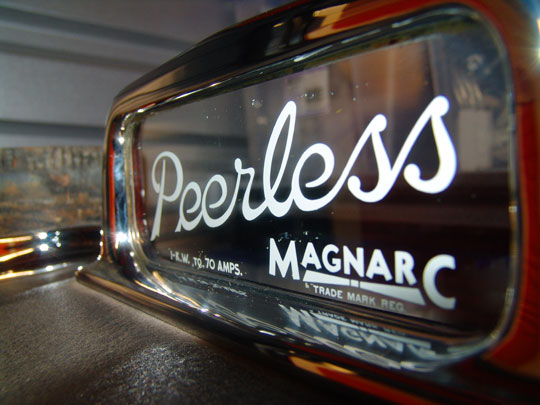
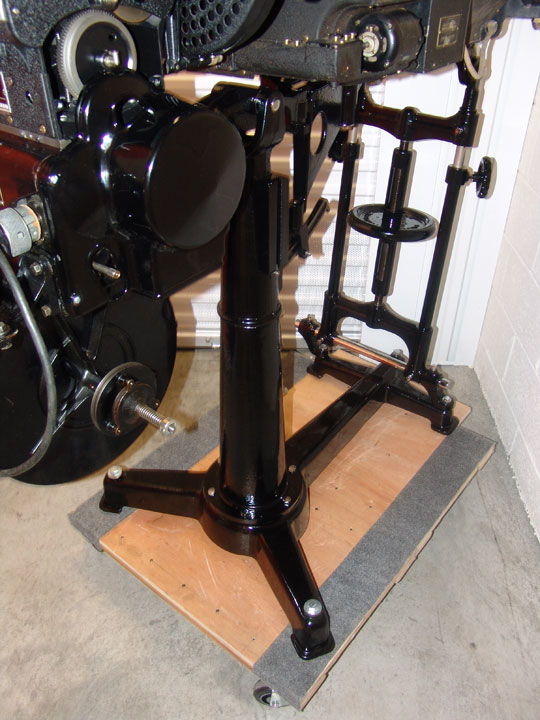
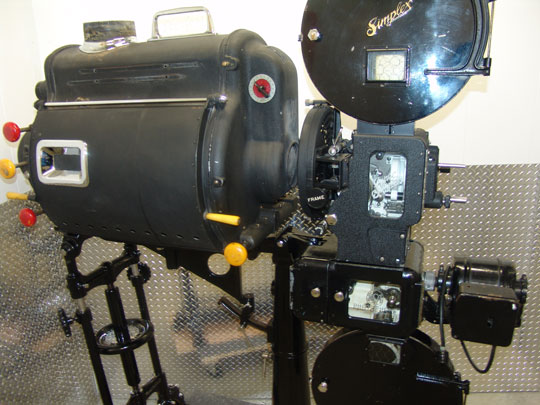
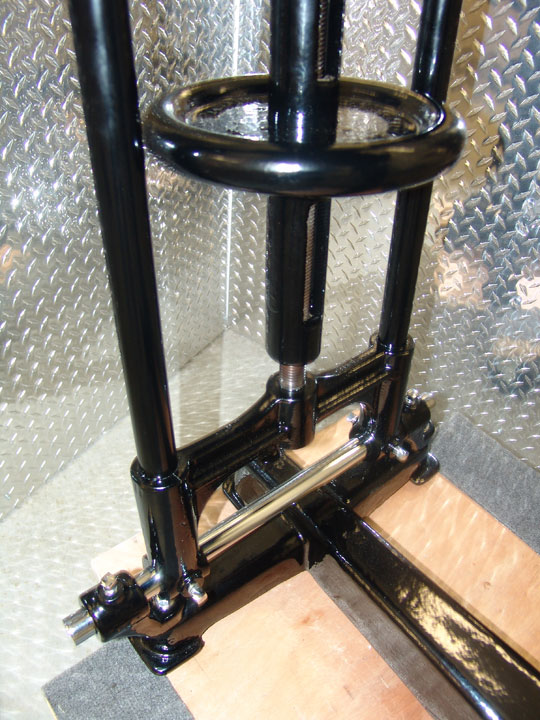
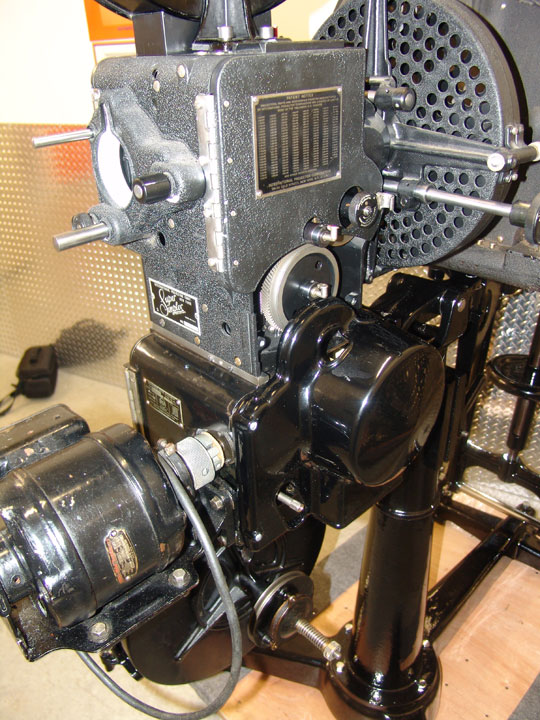
I'm glad I went with the powder coat! It is tough as nails!
Tim
Posted by Paul Trimboli (Member # 1509) on 03-30-2006, 04:00 AM:
That looks really nice Tim! Did you have much trouble getting the lamphouse table off? Do the gears on that Simplex rotate on the shafts? The reason I ask is because there is an oil pot on the intermediate gear, I have never seen that before. Your main page of your website looks great, like the look of the link to the restoration, great picture of a front shutter standard on a WE soundhead!
Posted by Monte L Fullmer (Member # 2797) on 03-30-2006, 04:41 AM:
You open up the back compartment door of that Super and you'll see oil ports all over inside..and these had to be oiled on a daily basis. Actually, the front of the main frame above the motor has small drain holes for the oil, which travels to the bottom of the frame to drain out (there should be a drain lip plate that is between the head and the soundhead to help drain the used oil into a collective device as it leaves the front of the machine..)
That big intermediate gear with the oil cup on the outside of that stationary shaft, has an smaller gear attached on the other end of the intermediate gear's shaft to run the mechanism inside. The oil cup is on the end of that stationary shaft (both of them) since the gears that are associated with those shafts just rotate around, and the shafts have minute holes for the oil to lubricate the bronze sleevings of the gears..
Posted by Paul Trimboli (Member # 1509) on 03-30-2006, 04:54 AM:
Were the stationary shafts a standard thing on the Supers? I have a few Simplex Standards, one I have just restored so am very familar with the machines. Super Simplexs are not something I have come across in Western Australia, just lots of Standards. I really like these machines, I have one from 1923 with no slop in the bearings! What a great peice of engineering. One thing I always thought was that aren't they a bit over engineered for silent use or did the designers design them for expansion, maybe they knew sound would be something that was going to come out?
Posted by Louis Bornwasser (Member # 3063) on 03-30-2006, 09:24 AM:
All of these date well before sound. My understanding is that the Singer Sewing machine guy was instrumental in the engineering of these machines. Singer & Simplex were really well built for their era; almost indestructable.
This is the hand-crank era. Motors came later. Louis
Posted by Tim Hull (Member # 2875) on 03-30-2006, 04:14 PM:
Thanks Paul! Yeah, it has been a lot of work, but the projectors are so well made that just a simple coat of new paint makes them look like they are brand new.
I have been collecting and working on these for almost 2 years. I have always been amazed by the quality of the engineering. I'm not used to seeing things so well built. Although, I can see how it doesn't make much business sense when you sell an item that lasts forever! I specially like the style of the Peerless lamphouse, as it really dates the projector to the 1930's.
The lamphouse table was no problem to remove. There were just a few large bolts.
Yes, the oil pot on the gear is rather strange. Actually, the gear door that belongs there does not fit because of it. This projector head was rebuilt by Al Moffa, who spent a great deal of his life rebuilding these.
Thanks for the compliment on the website start. It has been tough to find the time to work on it between working 3 jobs and restoring my Super...
Hey, since you are into the Standard, this will probably break your heart like it did mine...
http://cgi.ebay.com/SIMPLEX-35MM-MOVIE-PROJECTORS-AND-EQUIPMENT-NO-RESERVE_W0QQitemZ7604649762QQcategoryZ4791QQssPageNameZWDVWQQrdZ1QQcmdZViewItem
Well, I'm going to be documenting the rebuild on the projector head and soundhead next on the website. The Super projector (a '37) has already been torn down to the frame and is being powder coated now.
I will post a pic of all the Super heads that I have... you were right about having spares!
-Tim
Posted by Paul Trimboli (Member # 1509) on 03-31-2006, 03:43 AM:
Tim have you thought how you are going to make the Simplex logo on the spool box doors gold again? I have been thinking of scanning them and getting them printed somehow so they can be transfered. The pedestal also should have a Simplex logo if you look at the one that Mark posted a picture of.
My rca has no door glass so I copied a friends, put it into photoshop to make a good black and white image. I took it to a print and etch place and for $20 they sandblasted it on the glass, not as good as etching but MUCH cheaper for a one off thing.
Powered by Infopop Corporation
UBB.classicTM
6.3.1.2