This is topic DTS timecode drop out/TCR LED switching in forum Film Handlers' Forum at Film-Tech Forum ARCHIVE.
To visit this topic, use this URL:
https://ft-forum.com/ft/cgi-bin/ubb/ultimatebb.cgi?ubb=get_topic;f=1;t=007765
Posted by Dominic Espinosa (Member # 2122) on 01-19-2006, 04:44 AM:
Greetings all.
Did a quick search but couldn't turn anything relevant up.
I'm having an issue with our DTS house not reliably detecting timecode on all prints. It started being an intermittent problem about a month ago but I figured it an abberation. I cleaned the print, checked the LED voltage and put it back in spec, no problem.
Now it's on every other print the timecode just will not read reliably.
I've made sure all the rollers in the film path from the center feed to the first sprocket in the projector are properly aligned and the film motion is smooth and steady.
The film is hitting the rollers on the reader dead on.
Adding the film cleaner to add tension to the film doesn't seem to affect it either.
What should I try next?
Posted by Steve Guttag (Member # 268) on 01-19-2006, 04:52 AM:
Put a scope on the readers output and verify that the signal is actually a good clean signal. There is a DTS technical bulletin on this and I think that bulletin shows up in some of the manuals (don't have it handy at the moment). If the signal is clean, it is your player that has the issue. Remember, the green LED on the reader is actually activated by the DTS player, not the reader (pin 9 on the DB9 connector on the reader).
Steve
Posted by Gordon McLeod (Member # 33) on 01-19-2006, 08:24 AM:
also check the version of the TCfirmware as it will affect the reading of certain prints
Posted by Mark Gulbrandsen (Member # 72) on 01-19-2006, 08:27 AM:
But first..... while you have the readers cover off and before you check the signal quality with a scope(or use the scope on DC setting) set the pot in there for 4 volts dc across the test points. If this voltage is too low... below about 2.8 volts it is not a high enough signal to run the player reliably. This adjustment is done without film in the reader! If you can't get it to at least 4 volts then the LED needs to be replaced, typically they can adjust up to at least about 4.8 or 5 volts in level, but the factory setting is 4 volts.
Also, lately I've had a rash of time code readers that have drums that are worn too wide allowing the film to weave back and forth as its being scanned and causing the time code level to go high and then low and so on. Its easy to find these bad drums... just place a piece of LaVezzi Stainless steel film around the drum and look at the side clearance, or use a caliper with long measurement tangs. There should not be any clearance at all on a good drum with the steel film in there. Out here we have the unfortunate situation of inheriting a bunch of locations that were installed by a now defunct equipment dealer... and he either did not align them at all or did a very poor "eyeball" alignment on them when they were originally installed...... They need to be carefully aligned due to the bare alumnium scanning drum which is relatively soft material....
Posted by Frank Dubrois (Member # 3042) on 01-19-2006, 07:56 PM:
I was told WE cant replace the LED in the DTS readers, but rather the entire unit has to be sent in to DTS to repair. Is this true? or is this extortion? They mentioned something about very fine and precise adjustments that need to be made.
Posted by Daryl C. W. O'Shea (Member # 1303) on 01-19-2006, 08:01 PM:
quote: Frank Dubrois
I was told WE cant replace the LED in the DTS readers
That all depends on your definition of we. ![[Wink]](wink.gif)
Posted by Gordon McLeod (Member # 33) on 01-19-2006, 09:43 PM:
The LED is replaceable if you a
have a source for them
have the shop to do it and align the reader
Posted by Mark Gulbrandsen (Member # 72) on 01-19-2006, 10:00 PM:
Both gord and I do LED replacements. The 250 plus dollar cost of a R/A'd time code reader from DTS is absolutely rediclous for the sake of an LED!
quote: Frank Dubrois
Is this true? or is this extortion?
Frank,
Its very close to extortion! In fact the actual reader is pretty close to that itself even when brand new. Nice CNC machining quality but EXTREMELY poor choice of materials for a piece that gets that much daily use. It certainly guarantees DTS perpetual repairs for as ling as film is around... or at least for as long as that TC reader is around.
Mark
Posted by Dominic Espinosa (Member # 2122) on 01-20-2006, 04:43 AM:
After some much due fidling today I got it to run in digital throughout my test pack of trailers, some as old as 4 years with the timecode light staying fairly solid.
It's still not perfect however.
As I don't have the experience nor an oscilloscope I won't be able to do much else on my own.
I am however curious about the procedure mentioned above.
Am I correct in assuming that you would be monitoring the signal pin from the TCR's input on the processor? Or am I totally off base?
Posted by Mark Gulbrandsen (Member # 72) on 01-20-2006, 09:12 AM:
No, Remove the cover on the time code reader. You must have a simple inexpensive digital volt meter around there... if not they cost a whole 20 bucks so go get one...... You will see two small test points. The blue one TP-1 is minus and the black one TP-2 is positive...if memory serves me correctly but if I'm backwards just reverse your leads.
Set the small white potentiometer R-16 so you read 4 volts DC across those test points WITH NO FILM IN THE READER! This is as basic an adjustment as it gets.....
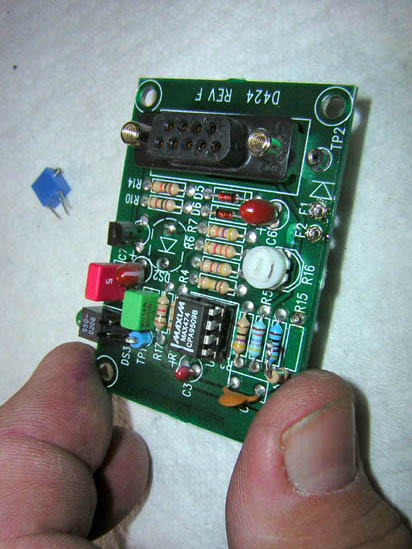
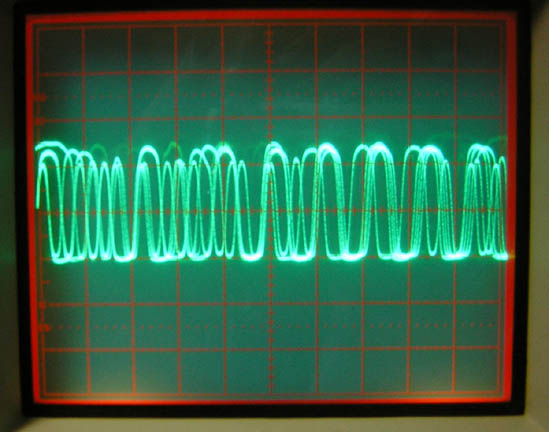
You would also connect the scope to those same test points and see this signal which is what good time code looks like.....
Posted by Daryl C. W. O'Shea (Member # 1303) on 01-20-2006, 12:33 PM:
Mark...
quote: Dominic Espinosa
I cleaned the print, checked the LED voltage and put it back in spec, no problem.
Posted by Benjamin J. Kepner (Member # 1241) on 01-20-2006, 03:44 PM:
Anyone happen to have specs on a proper replacement LED for these?
Anyone tried installing a different color LED? Just because red is so ![[fu]](graemlins/fu.gif) depressing of an LED color.
depressing of an LED color.
Or possibly just a slightly brighter LED just so that you could adjust it down and get a bit more life out of it (LED should nearly last forever anyway, don't know why these crap out as much as they do).
Posted by Mark Gulbrandsen (Member # 72) on 01-20-2006, 05:16 PM:
The LED's that Gord and I are using are ALOT brighter than the DTS LED's. They also have a much longrer life span than DTS's LED does. So yes, I have to adjust them down in brightness which means an even longer life span than the LED manufacturers specs. Getting these higher quality LED's entailed Gord and I ordering a rather large batch of them which we split. The only other thing I can tell you is that I charge 100.00 flat to replace it... far more reasonable than what DTS charges.
Mark
Posted by Frank Dubrois (Member # 3042) on 01-20-2006, 07:01 PM:
Whats the process of replacing the LED? Is it a simple unsolder/resolder job? For $100, I would suspect there was more to it, but taking on the liability of potentially ruining the reader must be built into that cost as well.
Posted by Brad Allen (Member # 470) on 01-20-2006, 07:12 PM:
And the cost of having money tied up in a large stock of the LEDs.
Posted by Frank Dubrois (Member # 3042) on 01-20-2006, 08:26 PM:
I guess my question is, if I know how to solder, would I be able to buy the LEDS from you and solder it in myself? Or are there scopes and other devices that need to be hooked up in order to "calibrate" or adjust the LED in anyway?
Posted by Mark Gulbrandsen (Member # 72) on 01-20-2006, 10:59 PM:
I will only do them in house because of the equipment needed to align them. Also we inspect other aspects of the scanner such as drum width wear and bearings. If your reader has to be sent back to DTS due to the drum width being excessive then you can do it through us or we will be happy to return it to you and you can have your own dealer handle it for you.
Mark
Posted by Frank Dubrois (Member # 3042) on 01-20-2006, 11:59 PM:
Thats quite a savings if we send it to you instead of DTS, the only problem we have then is we dont have an extra reader during the time that we send it off to you. Doesnt DTS send us the reader, then we just send ours in as a core?
Posted by Mark Gulbrandsen (Member # 72) on 01-21-2006, 12:13 PM:
Yes, they do. However for the savings you get I can't justify sending out loaner readers. It shouldn't be a problem running analog for a few days unless you have really really bad analog......
Mark
Posted by Monte L Fullmer (Member # 2797) on 01-21-2006, 01:33 PM:
..speaking of which...as some of us do the optical/CAT-701 LED power supply tied in with the motor start so the LED is off during machine rest, is there a way to do to the same with the DTS timecode reader's LED - outside of having the entire unit switched with the motor start to keep this LED off during machine rest.
Or, is this too complicated of a trick to do on DTS units?
thx-Monte
Posted by Tony Bandiera Jr (Member # 2365) on 01-21-2006, 02:15 PM:
Monte:
It would be relatively simple to do what you propose. You would only need to interrupt pin 5 of the 9-pin connector to the reader (the +5v supply) in order to shut off the reader. Use a relay off the motor power and let that relay's contacts open up pin 5 when the motor is off.
Anyone interested in how can contact me for a diagram, or if they would like me to build a breakout connector for the TCR cable.
edited to finish contacts sentence.
Posted by Jason Miller (Member # 2341) on 01-21-2006, 07:29 PM:
I kinda want to hear Karen or someone from DTS input on this.
Posted by Frank Dubrois (Member # 3042) on 01-21-2006, 08:27 PM:
I remember speaking to hear about it once before. Basically its a "No user servicable parts inside, you need to send it back" type answer. I guess for the normal person, thats true though. I don't think I'd dink around with one, especially with the replacement cost being so high.
Posted by Mark Gulbrandsen (Member # 72) on 01-21-2006, 09:26 PM:
I agree with Tony. Its an easy thing to do and quite logical.
Mark
Posted by Monte L Fullmer (Member # 2797) on 01-22-2006, 02:53 AM:
Yea, now to think about it, it would be an easy adaptation to do: pop open the cover, goto the DB-9 timecode reader socket, find Pin #5 for the +5vdc (which would be the red lead coming from the AT powersupply), snip the red lead and plop a relay inbetween the snip. If a small relay is used, then a stepdown transformer would be needed to drop the 120v down to the relay's winding voltage to do the trick. One can easily parallel the 120v leads for the transformer into the input lines for the AT power supply.
This all could be done inside the unit being there is so much room inside the case itself. Just have to bolt down the transformer some what to the case.
How close am I with this assumption?
thx-monte
Posted by Steve Guttag (Member # 268) on 01-22-2006, 09:31 AM:
Monte...a bit drastic and warranty voiding solution.
How about...put a 120V relay on the motor for the projector or use the "exciter" relay in an automation if the contacts are available...or have a relay that is triggered based on what format your sound processor is in...ie if in Non-Sync, no DTS LED...nixes potential multiple reversions at the end of show and the premature jump to DTS at the beginning too....the possibilities are endless.
Then make a special DTS reader cable that breaks out the +5 line to the relay contacts. Are you comfortable making up Dsub connectors? Believe it or not, most of the 9 pins in the DTS reader cable are not used. +5, Ground/Reference, TC1 (and TC2 for changeovers) and Reader status LED (the green one on the reader).
Depending on how you want to monitor when the reader LED should be lit, break the +5 line at that end and route it as necessary with some 2-conductor cable.
Steve
Posted by Monte L Fullmer (Member # 2797) on 01-22-2006, 01:55 PM:
Thx Steve for these ideas. I can then work with these suggested routes then.
-Monte
Posted by Mark Gulbrandsen (Member # 72) on 01-22-2006, 03:07 PM:
quote: Monte L Fullmer
I can then work with these suggested routes then.
What ever route you do take be sure to do it with the power off..... ![[Big Grin]](biggrin.gif) .
.
Mark
Posted by Monte L Fullmer (Member # 2797) on 01-22-2006, 05:16 PM:
lol..duh! ...just like working on a computer... ![[Razz]](tongue.gif)
..have no problems working with Dsub connections. Used to work in a wire assembly plant where hand soldering was a mandatory part of the operation and working with all sorts of connectors, switches PC boards, et.al. ...
Posted by Michael Schaffer (Member # 1204) on 01-23-2006, 05:19 PM:
quote: Steve Guttag
Depending on how you want to monitor when the reader LED should be lit, break the +5 line at that end and route it as necessary with some 2-conductor cable.
Why 2-conductor? Which cable do you recommend?
Posted by Steve Guttag (Member # 268) on 01-23-2006, 09:49 PM:
Michael,
Because you are only breaking the +5 line. Two conductors are all that are necessary to send the +5 line to a relay and have it return "switched."
If you need a cable number..how about Belden 8442...2-conductor 22awg.
Posted by Michael Schaffer (Member # 1204) on 01-24-2006, 01:42 AM:
I meant why two conductors instead of just one, but that was actually a stupid question because it obviously makes more sense to have one single cable go to and return from the relay than to have a single one go there and another single one return. I didnt really think. But here is a (only slightly) more intelligent idea: instead of making a whole new cable, how about simply opening the old one and bring the two new ends together at a terminal strip where the cable going to the relay could also be landed? Easier, quicker, cheaper (well, the cable and the connectors aren't that expenisve, but, as I like to say, it all adds up).
Posted by Steve Guttag (Member # 268) on 01-24-2006, 05:22 AM:
Michael, I didn't mean to imply that a new cable need be run between the reader and the DTS processor on existing installations...one can certainly make this sort of "splice" within the 9pin hood.
Note, we generally run our own cable on new installations and make the Dsub ends anyway. We generally don't have exposed cable for any longer than necessary so most times there is just a short piece showing near the DTS reader. Thus, the potential to break out the 5V line is there upon putting on the 9pin end. Mind you, we can generally put on a Dsub connector faster than most can install "breakout" boards. BTW...the same goes for Dolby Digital cables...we generally pull in raw cable and put the ends on during the installation. Since many if not most of our installations are 2-projector...one machine is almost always further than the standard 10m cables...thus we got proficient at making Dsubs or Molex KK (the reader end of a Dolby Digial cable). We should probably sell off some of our pile of stock 10m cables someday. When possible we omit the cables on new readers.
But what ever works for you. For us, switching off the DTS reader has not been an issue but I can see how it can be for some and with the replacement cost of the LED and/or down time...I can see the value of extending the time between needed service.
Posted by Dominic Espinosa (Member # 2122) on 01-24-2006, 12:36 PM:
Well, the reader seems to have settled and is running just fine in digital again. Very strange I think.
When I get the tech down to fix our SDDS I might see if he'll put his scope on it and check it.
I changed the topic of the thread for the purpose of including the discussion of switching the LED in case somebody's looking for it later.
Thanks for the help, fellas.
Posted by Matt Close (Member # 996) on 01-24-2006, 11:32 PM:
This is Mark G or anyone else who works on DTS timecode readers....
I have a reader that has failed. For the first 20 minutes or so of running, it works fine.... but then it start to produces intermittantly noisy timecode. Turn it off for a half hour or so, and it is good for another 20 minute run....
I replaced the LED on the off chance that the noise was being introduced through having the gain wound pretty much flat out, and something wierd was going on in the amp stage.... but no, the problem is still there. I looked at the transistor, the tants, caps etc.... all seems ok. The only thing left then is the photo diode..... but of course DTS does not want to help me in that regard. Karen kindly told me the photo diodes do fail and cause faults like this, but from there on it's the "you can send it back for a repair exchange" answer..... I don't really want to fork out the crazy price they ask though, for what I am sure will be a fairly cheap repair. Have any of you guys struck this fault? ... And can you offer any advice? I have been unable to find reference to the diodes' part number on the internet.
Posted by Mark Gulbrandsen (Member # 72) on 01-25-2006, 08:09 AM:
No, I have not had that happen yet MAtt. You may just want to watch E-Bay for a used TCR. Thats the kind of problem that just replacing all the parts on the entore board justifies.... What would they cost... perhaps 20 dollars AUS. total? Then if its noisy you need to find yourself a good photodiode.
Mark
Posted by Frank Dubrois (Member # 3042) on 01-25-2006, 06:37 PM:
As I read that post about the reader starting out good, then slowly deteriorating, it made me think about a dolby read we have. A Cat 701 reader starts with an error rating of about 4. to 5., but by about 30 mins into the film, its close to 7 or failure. What could be causing this? We have a new led, and the CP500 shows 32 green solid lights...where to look next?
Powered by Infopop Corporation
UBB.classicTM
6.3.1.2