This is topic Unusual old-style film leader in forum Film Handlers' Forum at Film-Tech Forum ARCHIVE.
To visit this topic, use this URL:
https://ft-forum.com/ft/cgi-bin/ubb/ultimatebb.cgi?ubb=get_topic;f=1;t=007810
Posted by Stephen Furley (Member # 1277) on 02-12-2006, 11:24 AM:
The print of 'To Have and Have Not' that I wrote about in the 'Hey you, you suck' thread had a rather unusual leader. Firstly, there was the following message to the projectionist, that I have never seen before:
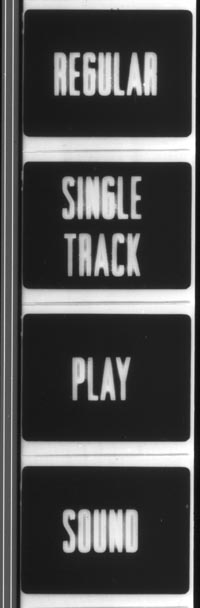
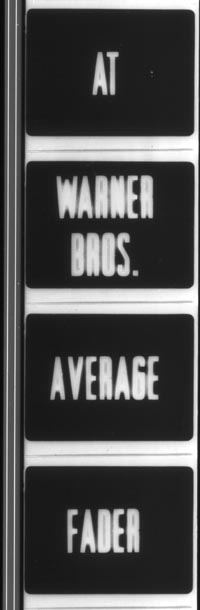
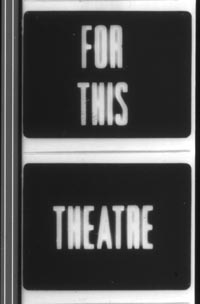
This seems to suggest that the idea of standardising sound levels between theatres by calibrating a standard setting for each theatre was something that long pre-dated the Dolby era, which I wasn't aware of.
Secondly, what did they mean by 'REGULAR SINGLE TRACK'? Films didn't have multiple tracks, as in different languages etc, and stereo tracks at that time were limited to Fantasound and a few experimental systems, so it seems unlikely that they meant that it wasn't in stereo. The only other possible meaning I can think of is that they were saying that it wasn't a push-pull track, but how likely would that have been anyway? I've never seen a push-pull track on a release print, though I did once see a pair of ancient projectors that were still fitted with the split photocells. Were Warners producing release prints with push-pull tracks at this time, except possibly on anything other than a very limited, more or less experimental, basis? Could it be that the print has a duo-bilateral track, which were then relatively new, and it was thought that this might be mistaken for a push-pull track? The difference is pretty obvious to look at. Any other ideas?
Thirdly, the leader has several different 'START' frames, including this one:
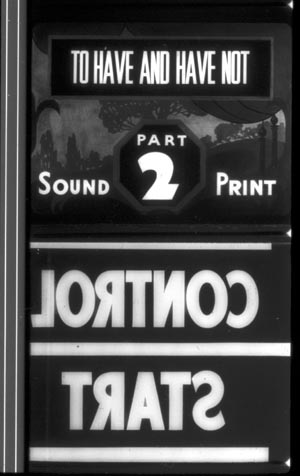
Any suggestions as to what a 'Control start' might be? The fact that the wording is reversed suggests that it was intended to be read on the negative, and therefore used in the lab, rather than the projection room.
Lastly, I rather like the 'artistic' title frame.
Edit to correct punctuation error.
[ 02-12-2006, 05:11 PM: Message edited by: Stephen Furley ]
Posted by Leo Enticknap (Member # 534) on 02-12-2006, 01:15 PM:
Most of the final mix track negs produced by Warners in those days were RCA duplex (single bilateral VA), so that might account for the 'single track'.
Posted by Scott Norwood (Member # 30) on 02-12-2006, 04:57 PM:
Aren't these pretty much standard Warner Bros. leaders for older titles? I've seen similar title frames on many prints. I know that they lasted at least through the late 1960s, as they're on "Bonnie and Clyde" and maybe even some later titles.
I've also seen "play at standard fader setting for Columbia Pictures" leaders, which is sort of ironic today, since all of those prints seem to require different settings (probably because the tracks were re-recorded).
Posted by Stephen Furley (Member # 1277) on 02-12-2006, 05:05 PM:
I've seen similar title frames before, but the sound instructions, and the 'Control Start' frame are new to me.
Many of the older films I see have had new leaders when they were re-printed, so they're not that common. Note the British spelling of 'Theatre', too. Did they actually go to the trouble of making up different versions of the leader for different countries?
Posted by Leo Enticknap (Member # 534) on 02-13-2006, 01:33 AM:
Wasn't there another thread here on the spelling of theatre/theater in relation to places which showed films? My impression is that both are used in the US interchangeably, but please correct me if I'm wrong on this.
Thinking about it, the 'please play at your usual volume' instruction might be because the level on RCA duplex VA tracks was more consistent than the VD tracks which some of Warners' competitors used on release prints. VD was highly sensitive to slight variations of densitometry in the lab, with the result that playback levels differed considerably from print to print, and sometimes between reels in a print. The trade press from the '30s and '40s is full of letters and comments complaining about this. A selling point of the RCA variable area system was that the levels on release prints were more consistent, so maybe the instruction on the leader was really a way of advertising this?
Posted by Wayne Keyser (Member # 2420) on 02-13-2006, 10:05 PM:
Unless my eyes (and a quick software negative reversal of the scan) deceive me, the "artistic" title frame is simply a negative image of an incredibly dirty interchangeable title setup.
Posted by Bernard Tonks (Member # 809) on 02-14-2006, 05:10 AM:
The title of the film was always included with the beginning and end of reel numbers for many years. I remember seeing on academy leaders ‘Play Sound at Average Theatre Setting’. Technicolor leaders also included before the reel indent, printed horizontal one letter per frame was, PROJECTIONIST PLEASE FOCUS.
If it is the same film, “To Have and Have Not” was released by Warner Bros. in 1944. The RCA variable area soundtrack is noted.
Internet Movie database.
For the UK 1953 release of the Coronation feature film “A Queen Is Crowned”, Technicolor also printed on the leaders, GIVE IT THE WORKS MR PROJECTIONIST. This referred to the soundtrack cue sheet enclosed in the can of reel 1. I was 16 years of age when I showed this film. We were fortunate to have our own copy for the week, nearly every cinema had to share a print, which must have been a bit of a nightmare moving reels about with 4-5 showing daily.
Posted by Leo Enticknap (Member # 534) on 02-14-2006, 06:30 AM:
The Technicolor IB leaders also had three consecutive frames with the letters 'Y', 'C' and 'M' printed in their respective colours, presumably to give the lab technicians a quick and easy way of checking that all three matrices had been transferred to each print correctly.
Posted by John Eickhof (Member # 323) on 02-14-2006, 12:25 PM:
The indication of 'single track' was for release prints because WB and others used the RCA system they had a dual track 'push-pull' system where the two variable area tracks were printed 180 degrees out of phase thus while editing the splice line would cancell each phase and become silent. This was before magnetic media was introduced and was the best way to make noiseless splices on the release prints.
Posted by Tim Reed (Member # 137) on 02-18-2006, 12:07 PM:
John, that's an excellent description. I never knew that was the intended use of push/pull tracks.
(Btw, you still drivin' a truck?)
Powered by Infopop Corporation
UBB.classicTM
6.3.1.2