This is topic The "perfect" threading procedure in forum Film Handlers' Forum at Film-Tech Forum ARCHIVE.
To visit this topic, use this URL:
https://ft-forum.com/ft/cgi-bin/ubb/ultimatebb.cgi?ubb=get_topic;f=1;t=007823
Posted by Monte L Fullmer (Member # 2797) on 02-19-2006, 02:35 AM:
Okey - time for another "show and tell" and this is is simply for what its worth:
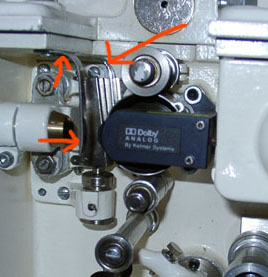
We all know (or supposed to know) that distance between picture and sound is 21 frames with the sound ahead of the picture.
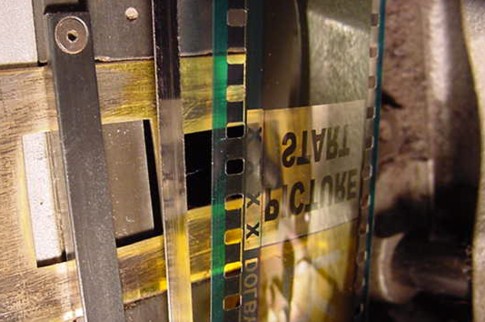
..and the sound blip almost straight across from the LED assembly:
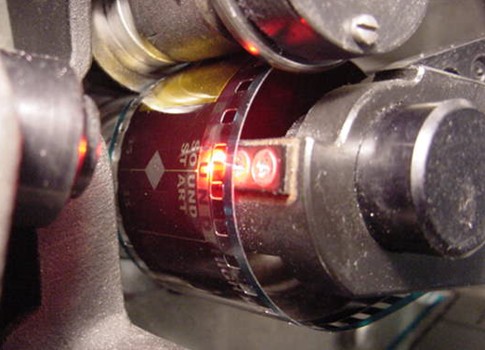
With these frames in their correct position, this becomes the "perfect" loop size for every machine that is out there.
Now, this is just for the well-known SIMPLEX XL/35 beauty that we either love or hate to death. In any case, we're stuck with this machine that has been with us since 1950. So, we'd better make the best of it.
When the frames mentioned above are in their right places, the loops become the 'perfect' size, as thus:
The Upper Loop -
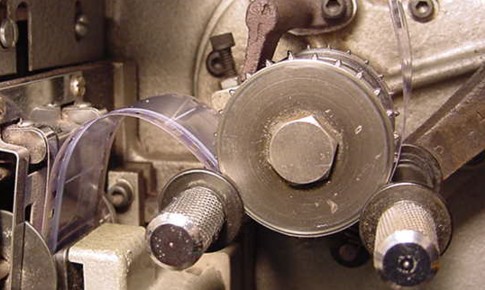
Now, I'm going to stop right here and explain something to you locations that have the curved gate variety:
1- Notice that the loop is entering the trap and gate assembly in FRONT of the band - not above the band.
With the film entering like this, the film, being made of our favorite abrasive material called 'polyester', there is less wear on the band since the film is parallel with the band on entry. If the loop is too big, the loop of film is ABOVE the band and contacting that upper round corner of the band. When the loop is like this, this oversized loop is putting massive wear on the top corner of the band wearing it down like nobody's business (anyone here had a band snap during a performance due to this...it ain't fun.. ![[Smile]](smile.gif) )
)
The Lower Loop:
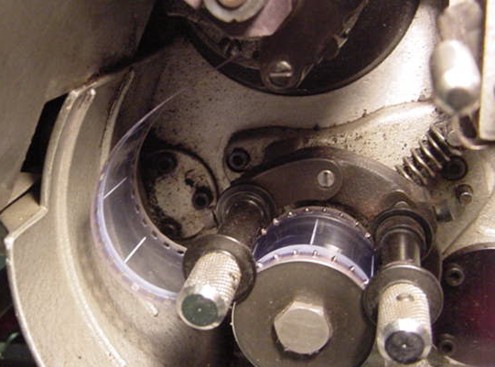
Now, heres's were I'm going to get some argument from quite a few here: I'm sure that a great deal of us have been trained that the lower loop is to be where the back side of the loop is a finger's width from the film to the back compartment.
Really, nothing wrong with that, but...how many of us love sports, especially the individual sports like golf, tennis, racquetball - anything that we have to it a ball with a device. Now, we know that with this form of sport, that if the ball is hit in a certain area of the device, the ball is hit true and the player doesn't even feel the hit after the followthrough...this is commonly called "the sweet spot"
..projectors have "sweet spots" as well and that is the 'correct loop size'. You make the loop size just right, the machine will run so much quieter to the point of the platter will be the one that one hears more than the machine. If one can hear the platter over the projector, then the lace job was a good one.
Thus, with the loop size only being a quarter-inch from the back wall, the film is leaving the intermittent sprocket in a straight line-not bending down and being a bit stressed as well.
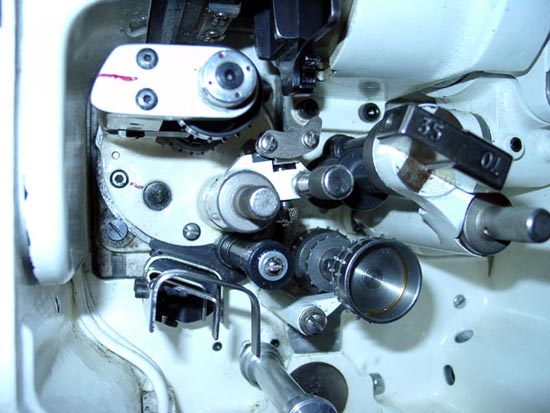
In the picture above, there is a trick to do this every time one laces a machine: Notice where the frame line over the middle constant sprocket compared to the loop size. The frame line is almost at the 12:00 o' clock position. (I use that metal dowel spot, which is inbetween the two pad rollers on the pad arm assembly as my center point for the lower loop set) How we achieve this position of frame line and loop is to set the intermittent sprocket JUST AS THE SPROCKET has FINISHED TURNING.
We all know, when the intermittent sprocket has finished turning, the lower loop is at its largest size. The same with the upper loop - loop at the smallest size, AND the trick to this upper loop size is just the opposite in the pict below:
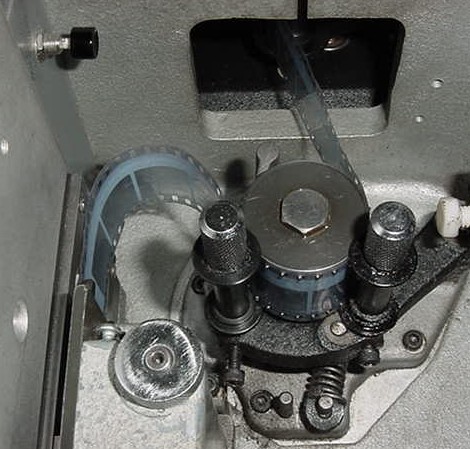
You notice that the frameline is at the 6:00 o' clock position. AND ... this pict is from the flat gate variety.
Important thing about flat gate Simplexes: that upper loop had better be as big as what's shown in the pict due to the fact that the rail top ends that stick up in the gate assembly DO NOT like small loops. You build a small loop, the splices will pop and snap as they head down into the trap assembly. These assemblies love to bust splices, especially weak ones if the loop is too small. AND, if the loop collapses, it will shear off the teeth from that driven fibre gear due to the sprocket will suddenly be pulled foward by the film when the loop is either too small or collapses. And those rail ends act like a fulcrum for the film to pull suddenly when the loop is too small and jerk on the sprocket, and shredding the teeth off that gear.
Thus, the trick is to have the loop tall enough so the film is heading straight down, after leaving the loop, into the trap without any bending or looping whatsoever. One could build the loop to where it about a quarter inch taller than the sprocket with the frame line at the 6:00 position - with the intermittent sprocket being stopped right after it gets into the locked position.
In short, if you would like to have a much quieter booth, try this out for size. It's amazing that the 6 plex that I work at, the machinery runs so smooth and with a steady 'purr' from these 1050's if laced up this way.
Anywho....for what it's worth to all.
And I'm sure that this technique is for all brands of machinery, for this is the only brand that I have available to demostrate this technique.
thx - Monte
Posted by Thomas Dieter (Member # 2507) on 02-19-2006, 02:56 AM:
WOW!!!!! This is Good Stuff Monte! I have to thank you for this information. Maybe I can not officially find the sweet spot. Thing is attempting to adapt this to the V-4s I use when it comes to the top loop.
You learn something new every day.
--Tom
Posted by Stephen Furley (Member # 1277) on 02-19-2006, 04:51 AM:
The sound of a projector, or other mechanical device, is certainly a good indication that everything is ok. In a previous job we had three inter-connected rooms, with the doors between them left open during the day. In the room at one end was a small offset press, and I was in the room at the other. I called to the operator to tell her that she was getting too much ink on the rollers. She was amazed, as I couldn't possibly have seen the machine from where I was; but I could hear it. I had much more experience on the machine han she had at the time, and the difference in sound was obvious to me, but she hadn't noticed it.
Remember that it will be necessary to adjust the lower loop size in very large auditoria. A well-designed projector will be able to accomodate this variation in loop size.
Posted by Thomas Jonsson (Member # 1902) on 02-19-2006, 05:23 AM:
On my Vic 5 I can hear no difference if the loops are large or
small. I have the curved gates with the "pushers" above the gate
removed. This way I have reduced two extra bends of the film to
one. If the upper loop is large (not too large!) I need less
tension on the bands, and the wear on the rounded part of the bands
is a little less. I also use velvet bands, which makes the machine
run smoother. The curved gate gives a better image than the
straight one, but I dislike it dearly.
Thomas
Posted by Mark Gulbrandsen (Member # 72) on 02-19-2006, 09:03 AM:
Dr. Monte.... Excellent post! And great job explaining it all....
quote: Stephen Furley
A well-designed projector will be able to accomodate this variation in loop size.
Of course it is important to properly thread any projector but in some ways I absolutely agree more with that statement!
Some machines are very unforgiving of loop size and will either cause undue wear to the bands or damage to the print.... many Strong versions of the Smplex are this way as is the Someplex 35/70... the latter HAS to be excact or it will damage the print. The JJ running 70mm is also this way to a large extent but ifs more forgiving than the Simplex is. Strong has come out with way too many gate/trap variations and the moving of the sprocket upwards to accomodate the lens turrett was another blunder on theor part as there is not really a correct upper loop size for this version of the Simplex that does not induce extra wear to the bands and still allow the full range of framing...... The many reasons why I never liked the Pot Metal X-L are merely reinforced by the poor gate/trap designs of Strong.
Mark
Posted by Scott Norwood (Member # 30) on 02-19-2006, 09:08 AM:
Nice pictures, but that lower loop is definitely too big, unless you have a screening room or tiny theatre. My method for threading Simplexes (X-L/PR-1014) is to make the upper loop such that it is even with the top of the upper feed sprocket when it is at is largest size (right before pulldown). I usually make the lower loops a few perfs smaller than the one pictured, depending upon the size of the theatre. For soundheads with two sprockets (RCA-1040/9030/9050 and SH-1000), I like to make the loop in the soundhead fairly large.
Mark--I've noticed that too--when threading the Simplex TU-2000 (recent turret model) as above, the upper loop is much higher in relation to the bands than it would be on the PR-1014/X-L. Should one compensate by making the loop smaller?
So who is going to start the debate about threading over or under the black plastic roller below the intermittent on a JJ, and whether it is to be threaded the same way for both 35mm and 70mm? (I've seen different Century manuals which specify different approaches to this.)
Posted by Frank Angel (Member # 248) on 02-19-2006, 10:54 AM:
I've seen lots of guys making that top loop huge. Never could figure out what the penchant for that was. Evidently they are too young to have ever worked a Super Simplex with that upper loop sensor from hell that would slam down the fire shutter if the loop hit it. You learned fast enough that the loop had better not be oversized.
And Scott is right, the loop out of the gate really is determined 100% by the size of the theatre. I've got a 2500 seater to contend with and setting that sound blip at zero off-set or "absolute sync" will make lip-sync go into the toilet for most seats in the house. Sound sync for large houses has to precede the image rather than be at zero off-set. The general rule-of-thumb is that you need to set lip-sync to happen at about 1/3rd back from the screen, not AT the screen.
I always wondered how they picked the 21 frame off-set which gives very little wiggle room for the large theartres. I can't imagine how small that loop has to be at Radio City Music Hall. And in the day, when there were lots of single screens with very large rooms -- 3000-4000 seaters -- the need to have sound sync precede image was real. I guess with the proliferation of much smaller rooms, many smaller than screening rooms, it's a moot point. Although there are those exceptions. Our outdoor venue (6000+ seats/spaces) needs a super short loop. Boy would I love to have a longer sound off-set.
And then there is that issue of sound and image NOT exactly at that proper offset distance. I have seen quit a few prints where it is obvious just by looking at the soundtrack start point and the image picture start frame that they are not printed together correctly, sometimes off by two or three sprocket holes. John P. says that matching the negs is quite difficult in the darkroom.
Posted by Mark Gulbrandsen (Member # 72) on 02-19-2006, 11:17 AM:
quote: Frank Angel
I always wondered how they picked the 21 frame off-set which gives very little wiggle room for the large theartres. I can't imagine how small that loop has to be at Radio City Music Hall. And in the day, when there were lots of single screens with very large rooms -- 3000-4000 seaters -- the need to have sound sync precede image was real.
Frank,
Didn't you know that back in those days those booths were equipped with Western Electric DSP based Digital Sound Advancers...... ![[Big Grin]](biggrin.gif) .
.
Mark
Posted by Brad Miller (Member # 2) on 02-19-2006, 01:17 PM:
Scott, I've been playing with the JJ roller on threading over vs. under. I've found that acetate film seems happier threading under and polyester film seems happier threading over. Due to the natural curve of these films, following that practice also guarantees that if you are running an overly curled print that the roller cannot come into contact with the picture area.
For 70mm of either base, I always thread under.
One thing that irks me about this is there are many variations in spacing on this roller from machine to machine. Also the slap guard rails (not very common) are located in different places too. ![[Roll Eyes]](rolleyes.gif)
Posted by Monte L Fullmer (Member # 2797) on 02-19-2006, 01:38 PM:
Scott, I know that you disagree, at least, give it a try with my bottom loop size...you might just be suprised. If you don't like it, it's your choice, of course. quote: Scott Norwood
Should one compensate by making the loop smaller?
..the Milleniums, with this raised upper sprocket, has the huge disadvange of wearing off the tops of the bands, when the loop was made the "normal" size, very horribly since that sprocket, being raised wasn't moved forward in the same distance as well so the loop size could be kept at the same ratio.
Thus, I do my best to maintain a much shorter loop so the film still woundn't be wearing on that corner of the band.. and it can be done with no qualms about having a upper loop too short.
Remember even with the machine running that the loops are only going up and down in a quarter inch span (with the simplex.. - as for other machines, in which I would love to try this out on century's and the P-35 Christies, in which I made those lower loops one sprocket after they touch that roller on that middle sprocket assembly...) so there really isn't that much worry of scratching unless one builds gigantic loops for some dumb reason.
Granted, the 21 frame count is at the speaker on stage. I believe that a one to two frame advance shouldn't affect the diagrams above due to the slack that is already there below the projector...and since this variable of film length to the soundhead is AFTER the middle sprocket, thus the above demostration that I posted can still be used.
Yes, the Supers and the E-7's - get that loop up there since these machines had that 'shute' assembly under the sprocket to make sure that the upper loop was tall enough, but not to hit the firetrap sensor, especially if an out of frame was encountered..
Thomas - on your V4e - there can be a simple way to figure this out and that is: take a leader with these markings, put the "picture start" in the trap, and go ahead and lace up the machine WITHOUT making your loop after the intermittent sprocket. Thread the machine as normal and when just before securing the film over that last sprocket, back the film up til the sound blip is in the designated area. I bet that the frameline will be at the 12:00 position on that last sprocket. Lock the roller down and then see if your lower loop, when pulling the film back is the correct size.
Then, for the upper loop, do the same with the frameline at the 6:00 position. See how this turns out, for this is the way I always threaded any Cine V(x) machine - where the 4E's and the majority of the V5's were the flat trap variety.
-thx a bunch, all ... - Monte
Posted by Mark Gulbrandsen (Member # 72) on 02-19-2006, 02:47 PM:
quote: Brad Miller
Also the slap guard rails
The slap guard rails on a JJ are actually a very good addition. They were originally put on Showscam JJ's to help with loop slap which gets VERY violent at 60 fps! I used the 35mm section of one of those rails on my VistaVision projector to eliminate the same problem and those slap rails are one of the main reasons why my VV is very easy on film and runs quiet. I've run loops through it literally thousands of times without damange. Not many other VV machines can claim that feat.
Mark
Posted by Steve Guttag (Member # 268) on 02-19-2006, 05:25 PM:
The actual lip sync s supposed to be 21 frames...however, the leaders always put the sound start a mere 20 frames in advance so you have a 1-frame built in. This is about 42msec of difference from dead sync. Using "Kitchen Physics" let sound travel at 1msec/foot (it actually depends on the humidity and such...generally 1130ft/sec is the nominal speed though). That makes for 42 feet of pre-compensation built in (or 47-feet to be more precise.
One thing else to consider is the psychoacoustics of the problem. The human brain can deal with sound lagging behind the picture...it deals with that all the time when dealing with people talking at a distance...it can not deal with sound LEADING the picture...that will always appear to be out of sync long before sound lagging the picture. The DCinema people found this out pretty fast...the latency (time it takes to process the picture) in a typical DCinema projector is approximately 85msec or 2-frames. The brain will immediately say that is out of sync. We have had to install audio delays on video sources that can ensure that the sound will be in sync. Dolby's DMA-8 has a "Global Audio Delay" to also deal with this.
So back to the problem. When all of this 20 versus 21 frame business came out, the theatre sizes were much longer, for the most part and the 47-foot pre compensation worked pretty well. Shifting a couple of perfs either way will get you half that time in shift so you have between 70-feet and 23.5-feet. So the system works the bulk of all theatres constructed. Again, when in doubt, make the lower loop larger to ensure you don't have the sound preceed the picture for the bulk of your audience.
Note too, the "Academy" leader has that diamond throughout...you can thread up on just about any number and look for the frame with the diamond to see where you are.
Posted by Monte L Fullmer (Member # 2797) on 02-19-2006, 07:49 PM:
..were slap rails a default install on new Century's? We're they on just the "JJ" models, or on all models?
For I've never seen these before.
(this is what happens when you don't work with all of the models out there and get stuck with just a few in your lifetime as projectionist...one doesn't know all - a big disadvantage when wanting to help out others...)
thx-Monte
Posted by Steve Scott (Member # 630) on 02-19-2006, 08:18 PM:
I've only seen them on JJ diagrams. Thanks for the tip Monte, it really reduced the noise bleed from the booth behind our big house when I tried it tonight.
Posted by Steve Guttag (Member # 268) on 02-19-2006, 09:43 PM:
The JJ Slap rails came out under the ORC era of Century projectors...I know they were on all new machines by 1987 (and probably a year or two prior at the most). They were part of the demise of the R50 soundhead. With the slap rails came the slot in the front of the projector for the 70mm film to exit and then go around the outside of the optical soundhead (R3) wich is 35mm only.
Posted by Darryl Spicer (Member # 711) on 02-20-2006, 12:09 AM:
I see what looks like a crack developing in the rubber damping roller in the sound gate. Time to get that replaced.
Posted by Carl Martin (Member # 1146) on 02-20-2006, 12:13 AM:
hmmm, our jj doesn't have that black roller under the intermittent either. when was that introduced (and why)? or has it been removed from our machine? i'll have to have a closer look at it.
carl
Posted by Monte L Fullmer (Member # 2797) on 02-20-2006, 12:20 AM:
Thx Darryl..got a few of them on order for replacment - just waiting for them to arrive, plus some other parts to keep these 1050's tickin' away.. -Monte
Posted by Steve Guttag (Member # 268) on 02-20-2006, 06:52 AM:
The Black stabilizing roller has been a feature of every JJ I've come across...even really old ones. If there ever was a machine without it, it would be a very early version.
It is used to sabilize the lower loop so it doesn't flap about wildly.
Posted by Phil Blake (Member # 2012) on 02-20-2006, 09:00 AM:
I find you never stop learning in this game. Someone is always making new discoveries even with old machines.
However I am still amazed that thousands of projectors can be made all exactly the same in every way , yet some perform better than others.
Like Monte I have threaded up as per the book and as per how I think it looks and sounds better , but out of 3 identical machines (vic 5) all threaded up exactly the same all exactly the same age with same hours one purrs like a cat the other 2 clatter like a wheat harvester.
I have studied them all with a microscope and I can not explain why the good one is good and the others are not .
Posted by Demetris Thoupis (Member # 833) on 02-20-2006, 09:34 AM:
Intermittent assemply and shutter assemply. The big issue with the V5 babies is that if you don't keep the intermittent assemply oiled to the required level, it's going to start clicking and cracking like a devil! Also the grease inside the shutter assemply is good to check out (try and use the Cinemeccanica oils and grease, they DO make a difference!). Have you tried the projectors without a film running? Do they sound reasonably the same? If yes then that means your gate assemplies might need reconditioning. If they sound the same, try changing the gate assemply with one of the louder machines and see if it performs better.
D
Posted by Mark Gulbrandsen (Member # 72) on 02-20-2006, 10:56 AM:
quote: Steve Guttag
With the slap rails came the slot in the front of the projector for the 70mm film to exit and then go around the outside of the optical soundhead (R3) wich is 35mm only.
Neither the route through the soundhead or around the outside was very good. The route around the outside involved some spharp curves for tape splices to find toeir way around... not sucessfully sometimes! The route through was the better if the tech removed all the 35mm crap before running 70mm.
Because of some platters inability to have steady and even wind torque many a 70mm print was ruined in Chicago(and suburban) booths and others because of the optical stuff being left in place as well as loops being made too large on both the upper and lower loops... the typical black base scratches on the upper left and right corners and black scratches from the tip of the slit lens were all to common.
Mark
Posted by Steve Guttag (Member # 268) on 02-20-2006, 12:04 PM:
Mark,
I must admit, I was able to get the two machines at the Uptown to not scratch any film, 35 or 70mm without removing the other's parts...with the exception of the upper pad roller in the projector head...those were double 70mm for 70mm runs.
The 70mm skate in the R50 sound head often had to be properly adjusted if not machined a little bit to have the 70mm avoid hitting things, including the middle of the skate itself.
For those that run 35mm film OVER the RO-207 stabilizing roller, be warned, if it has worn at all, and you are in a high-humidity climate, the film WILL curl into the middle of the roller since the raised portion of the roller is very small for 35mm. When it doubt, change the roller to a fresh one. If the middle of the roller ever looks like it is "polished" then you have been rubbing the film on it and are abraiding the image.
Personally, I prefer the R50 with the 70mm film slipping through the soundhead. Kelmar makes a suitable basement reader too that allows for the 70mm to slip through still.
Posted by Brad Miller (Member # 2) on 02-20-2006, 12:36 PM:
Agreed, I've never had any scratching problem not removing the 35mm parts. About the only place that requires an exacting loop size is the upper loop if the 35mm pad roller isn't removed, but I do normally remove just that one piece. Everything else, the 70mm glides on past without damage.
BTW the R50 skate is no longer available! I need one. Anyone have one laying around?
Posted by Louis Bornwasser (Member # 3063) on 02-20-2006, 02:48 PM:
I have never seen 70mm damage in a CENTURY soundhead; however, the Cinecitta (India) did have this problem. We just removed the three screws that held the comnplete dancer assembly in and stored the complete dancer assembly until 70mm was past.. This means that alignment was not not required when going back to 35mm. The end of the sound lens slightly touched the 70mm film. Louis
Posted by Mark Gulbrandsen (Member # 72) on 02-20-2006, 03:25 PM:
quote: Steve Guttag
I must admit, I was able to get the two machines at the Uptown to not scratch any film, 35 or 70mm without removing the other's parts.
Guys... of course it can work if operated properly! You are professionals... how many of those are out there....really? There were just a few out of over 400 members in Local 110 back in those days. Most were just button pushers... folks with other realife "daytime jobs" most were not technically minded, most NEVER cleaned out the machines they ran!
Mark
Posted by Sean R. Custer (Member # 3531) on 02-20-2006, 04:34 PM:
I'm glad someone has corroborated this phenomenon. In a booth with 14 Simplex 1050's I could alaways make a b-line for a signigicant misthread from across the booth as soon as I entered the door. And for a while there were a couple of us who could tell who had threaded the set that was running just by the sound of the machines...
The straight-gate xl's though, are really subjective. More difficult to get that humm and guiet splice... And it's not hard to hear our platters over the projectors, they're AW-2's. But even they are pretty smooth. (starts 2:30pm show) oops, spoke too soon, there goes a drive motor bearing.
Happy to be found to be demonstrably less paranoid-schizophrenic,
SRC
Posted by Carl Martin (Member # 1146) on 02-21-2006, 03:32 AM:
quote: Steve Guttag
The Black stabilizing roller has been a feature of every JJ I've come across...even really old ones. If there ever was a machine without it, it would be a very early version.
on further inspection, it's apparent our jj used to have this, but not any more. we tend to make the lower loop quite small though. i could see it being useful with a larger loop.
carl
Posted by Eric Robinson (Member # 2966) on 04-23-2006, 01:18 AM:
I have learned a lot from this topic. If possible I am interested in learning more about the following two issues:
1) What technique or equipment can you use to satisfy the following requirement?
quote: Frank Angel
The general rule-of-thumb is that you need to set lip-sync to happen at about 1/3rd back from the screen, not AT the screen.
2) I have seen the diamonds on academy leader but am not sure of the purpose. Could I hear a brief explanation.
quote: Steve Guttag
Note too, the "Academy" leader has that diamond throughout...you can thread up on just about any number and look for the frame with the diamond to see where you are.
ERIC
Posted by Monte L Fullmer (Member # 2797) on 04-23-2006, 02:38 AM:
quote:
I am interested in learning more about the following two issues:
1- no equipment..just take a frame away from your threading procedure to where you're 20 frame count from aperture to soundhead. Sound travels a lot slower than light, thus you want to advance the sound to picture sync to this..
2- diamond marking - see my second pict..see where the diamond is straight across the reader assembly. this is the actual 21 frame count from picture start in the aperture to sound start. You frame on any number on that academy leader in the aperture, and that diamond should be straight across the reader - if you threaded correctly. Screening rooms, with such small viewing venues probably threaded the 21 frame count procedure since the delay wasn't necessary..
This was set up back in the mid 30's as the Academy Standard Leader that began with each reel ..
..since back then, there were actual projectionists in the booth running changeover machines and we would make the BEST changeovers that could be had.
Posted by Carl Martin (Member # 1146) on 04-23-2006, 02:51 AM:
1. no, that's backwards. subtract a frame so you're at a 20 frame... ok, never mind, monte just edited his post.
2. our threading leaders have the diamond at 20 frames, not 21. maybe it's different for leaders that come on prints?
Posted by Chad M Calpito (Member # 3736) on 04-23-2006, 03:00 AM:
Thanks for the input and pics, Monte. I, too, use the Simplex 35 models. Personally, I like the Simplex 35 projectors. Anyway, I thread them just like you do, except for maybe a minor variation, but, my threading is the same.
I've also tried the Christie Projectors, but, could not stand them. Well, I better not get off topic. Anyway, thanks for the pics and tips, Monte. I learn something new everyday.
Posted by Steve Guttag (Member # 268) on 04-23-2006, 05:30 PM:
The diamond is indeed at 20-frames not 21 to inherently have one have a 1/2-1 frame advance on the sound.
Posted by Nathan Fettes (Member # 3545) on 04-23-2006, 09:33 PM:
It is kind of sweet that this comes up the same time my theater is trying to convert all of us to the thread down up procedure. We have all strong equipment and the old people thread gate first then around that. The new people thread bottom up as required by our “policy.” Then we get an email that we all have to thread bottom up. All of us that thread gate first do the same thing. First, we thread entire platter (all Strong equipment.) Then we pull film so the tension mechanism on the platter keeps tension. Then we thread the gate first.. Before threading, the intermittent is turned so it has just advanced and the same length of loops will always be consistent. This will insure the leader never touches the ground due to the platter tension. Is this wrong to thread middle out? I have been condemned from my corporate office because they made the “my way or the highway” point of view. We train our entire new projectionist staff the bottom up (strong system) threading. The fact is, our chain has many different projectors and they use the bottom up technique as the only way regardless of the projectors. If we get caught doing other, I can get written up. I have always threaded gate first and now I can get fired for this only because it is the “policy.” The gate first technique I use never lets the leader touch the ground and it is faster for me but I can not get it unless I try to grandfather clause it in. Should I just learn a new technique that will double or triple my threading time or is this just as good as the way they recommend, bottom up. We have all strong equipment, platters and projector heads.
The way I thread is as follows:
1. Thread entire platter, ignoring projector, besides top and bottom rollers
2. Turn the motor so the intermittent just turns
3. Pull the film so the film has tension from the platter
4. Thread the gate, then the top loop and DTS unit.
5. I put my finger to the base of the projector for the bottom loop and when I close the pad, it moves so the film is not hitting the wall or putting tension on the pad.
6. Then I thread the five star sound head and failsafe.
Just interested if this is acceptable. This will insure the frame distance of the sound head where as other techniques can very by a frame or so. Just wondering,
Nathan
Posted by Brad Miller (Member # 2) on 04-23-2006, 09:36 PM:
Look at the Threading 101 page in the tips section. Yes it will take longer AT FIRST, but once you master the bottom up threading, you will be able to do it faster and with more accuracy than starting at the gate or "threading down". It is the professional way to thread the projector.
Posted by Monte L Fullmer (Member # 2797) on 04-23-2006, 11:16 PM:
quote:
2. Turn the motor so the intermittent just turns
..just turns??? I though you supposed to turn the motor's flywheel to where the sprocket just stops turning - you're locking up the intermittent sprocket.
Lacing up a Simplex, reverse style, is quite easy. Here are some picts to do it below:
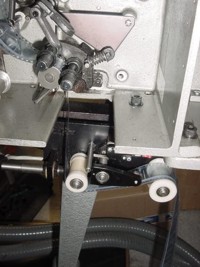
1-You bring up the film to the lower sprocket and lock the pad roller.
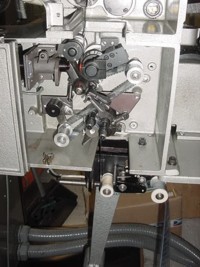 2-Then, the film over the scanner drum and lock down the lateral guide roller.
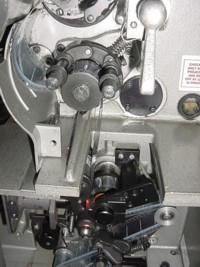 3-Then, you lock the film over the middle constant speed sprocket with the frameline at the "12:00 position"
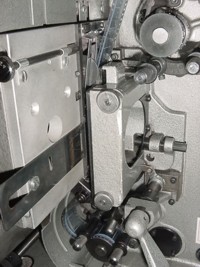
Then, you make your frame set in the aperture and with this, the lower loop is automatically set.
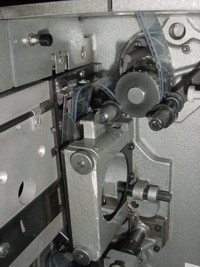 Then, do your upper loop and you're all done.
-Monte
Posted by Nathan Fettes (Member # 3545) on 04-24-2006, 12:06 AM:
Sorry, when I say just turns I mean turn the motor flywheel until the intermittent is just done turning like you said.
I will try the 12 o' clock position at the sprocket like you have suggested. Will this set up insure the tension roller for the sound head is at the correct position or is this able to be varied as long as there is tension for the scanner drum? I still do not see how it is not better or worse to thread the gate first. It is the only part that moves at the intermittent bases. I can thread the entire projector in less the 20 seconds with my way and the film (leader) NEVER touches the ground. This is due to the tension applied from the platter. I know both methods use the same film placing on the sprockets but I do not see how it is any different to thread bottom or mid first. To be honest I am very bullheaded and I can't see a reason to change my threading pattern because I still keep the film from touching the ground and the loops are always the right size. The intermittent is the only part that moves at a 1 - 4 basis and I think it should be threaded first because of this. The other parts are at a constant motor basis and as long as the film NEVER touches the floor it should be fine. I am not trying to prove it is better just that it is a legitimate threading technique. But if you guys say it is better I had better start practicing. It is just my techs give the only reason as, "It is how we do it so you have to." I like to have a reason for things other then my way or the highway. I want to try to grandfather clause this into our theater but they are as bull headed as me. As long as the leader never touches the floor and the projector is threaded correctly I don't see a problem. Regardless, I will work on the suggestion you mentioned for the next few shifts.
Posted by Brad Miller (Member # 2) on 04-24-2006, 02:01 AM:
Monte has the right idea, but no two projector models (and even often vintages) are exactly the same. Just thread one machine up with perfect loops, no matter what it takes to achieve threading it this one time. Now slowly advance the motor until the intermittent has just finished it's pulldown. NOW note where the framelines are on the last two sprockets...voila, there's your guidelines for threading bottom up at your theater.
20 seconds? Bah! Seriously, I have witnesses that can attest to me threading a machine in less than 5 flawlessly every time. The only way to achieve that kind of speed with accuracy is bottom up though.
Posted by Monte L Fullmer (Member # 2797) on 04-24-2006, 04:18 AM:
There really shouldn't be a race in lacing (granted, we had "lace races" in the past to see who's fastest and the most accurate - just for fun..) but, if one is running a 20 googooplex plus of an operation, the operator should be paying attention to the showdrop times so that the operator can get right over to that house that drops and lace with time and accuracy.
-Monte
Posted by Chad M Calpito (Member # 3736) on 04-24-2006, 11:03 AM:
When I worked at an 18-plex theatre with two different booths on two levels, there were times I had to thread and start all 18 projectors by myself, literally. Accuracy was (and, of course, still is important, though I had to work quickly. Going between the two booths via an elevator is no easy task when I have movies that start at the same time between both of the booths.
In essence, I think it is better to be accuracte. But, I will say this, I used to do threading races before as well, but, I don't prefer to do it anymore.
Posted by Brad Miller (Member # 2) on 04-24-2006, 11:29 AM:
This thread is going nowhere.
Chad, stop being stubborn and just learn how to thread bottom up. It is the professional way to thread and is what your employer is requiring of you.
Also, nowhere in this thread has anyone suggested that accuracy should be substituted for speed. Speed however IS important in it's own aspect, as there are days when one person may have to run a complex by himself, and deal with print buildups and deal with equipment breakdowns as well as other unexpected issues (print toss/brain wrap/etc).
Posted by Louis Bornwasser (Member # 3063) on 04-24-2006, 11:33 AM:
Whatever method you use that does not damage film or make it dirty is good. You are working for people who obviously have a lot of time on their hands. (Remember the leader....header....never goes through a projector; in fact we once used non sprocketed film for that purpose.) Louis
Posted by Steve Guttag (Member # 268) on 04-24-2006, 11:49 AM:
Yes Louis but that leader does come into contact with the film that does go through the projector. The dirt will ALWAYS migrate back.
Posted by Chad M Calpito (Member # 3736) on 04-24-2006, 04:53 PM:
Sorry if I sounded Stubbourn, Brad. It may not seem like it, but, I'm keeping an open mind. Anyway, I've honestly never heard of threading bottom up before. I do agree that speed is important since I do have to operate 10 film projectors per shift. Please understand that this is the first time I've heard of threading bottom up in this Forum.
Posted by Eric Robinson (Member # 2966) on 04-26-2006, 12:26 AM:
quote: Louis Bornwasser
(Remember the leader....header....never goes through a projector; in fact we once used non sprocketed film for that purpose.)
I thought I knew what I was doing until I read the above quote.
Our standard method of practice is to provide enough leader which can run through the projector during startup so that the automation is capable of triggering the electronic changeover. At that point in time, we look at the film running through the projector (house and stage lights are at half down), as soon as we see Green Band at the aperture, we open the manual dowser. We then continue, (not thread related), to watch as patrons come into the theatre. If its a low traffic film, we hit lights down after no more patrons are entering. If its high traffic, we wait until the THX trailer, at the latest, to hit light down. We keep this step purposefully manual to keep the projectionists attentive.
Anyway, now that I'm completey off track...it sounds as if we are not supposed to have any leader running through the machine. If this were true; however, this would imply that the beginning of the green band for the first trailer would have its head located at the basement sound head lower feed sprocket??? ![[puke]](graemlins/puke.gif)
Gotta throw in the puke icon ![[thumbsup]](graemlins/thumbsup.gif)
Posted by Monte L Fullmer (Member # 2797) on 04-26-2006, 03:39 AM:
quote: Eric Robinson
Anyway, now that I'm completey off track...it sounds as if we are not supposed to have any leader running through the machine. If this were true; however, this would imply that the beginning of the green band for the first trailer would have its head located at the basement sound head lower feed sprocket???
Eric - just keep on doing as what you're doing now...nobody can tell you different.
All of us do presentations in our own different way.
Some liked my post here on the Simplex threading, and some didn't like it for the fear of scratching film due to the loop sizes.
I posted this info as a potiental 'training' guide - but not to be taken as gospel-the same with Brad's "Threading 101". That is the final say with that operator..or booth supervisor if any outside threading guide is to be accepted or not.
I'd probably get shot and booted off of this forum in a heartbeat if any member of this forum saw what I do when getting the movie on the screen - and it's simply different what the next theatre does..and how they have been taught.
Nobody's going to get grumpy on you on what you do, and if they do...they'll have two choices: either to either put up with it or leave, but they'd better not say anything when they do leave.
What Brad's trying to do with this site is to help the newcomers with tremendous info on the field of presentations and with technical information so that they can be more self sufficent in taking care of their locations with more understanding on "how stuff works".
Some of us have been in this field WAY TOO LONG (lol) to where we actually see a lot of this stuff posted as 'old hat' stuff, and where others see a lot of this as massive 'learning candy.'
Why some of us 'oldsters' are on here - to put some input on all of this due to our experiences we've had.
-Monte
Posted by Kacie MacLagan (Member # 3637) on 04-26-2006, 09:38 PM:
quote: Eric Robinson
Anyway, now that I'm completey off track...it sounds as if we are not supposed to have any leader running through the machine. If this were true; however, this would imply that the beginning of the green band for the first trailer would have its head located at the basement sound head lower feed sprocket???
I can say that at our chain, it is sugguested that you have the actual movie (or trailer/ad/whatever) start when the change-over kicks in. With our equipment when the automation opens the change-over it also activates the lights and sound processor. The reason behind this is because if you have the leader goes through after the processor has switched the sound to SR/SA/DTS/etc, it will/could leave a slight buzz or humm in the theater speakers.
That is of course the general idea, and what I have been told (and I have heard it first hand) it should be done. Your theater maybe different, and it may not be the same for all equipment/sound processors/automations. I only know what happens with the equipment we have in our chain.
Hope this helps. If any.
Posted by Eric Robinson (Member # 2966) on 04-28-2006, 12:17 AM:
Sounds like the best thing to do is to stick with my current method, keeping in mind to avoid having the processor switch to analog before a valid soundtrack is in the basement. I am familiar with the odd and undesired sounds which eminate from leader and other parts of film which should not be broadcasted through the audio system.
Thanks Monte...I always enjoy hearing your comments. I think this topic, (created by you), is an excellent documentation of film threading. I also appreciate your helpful disposition.
Cheers... ![[Wink]](wink.gif)
Posted by Monte L Fullmer (Member # 2797) on 04-29-2006, 01:33 PM:
quote: Eric Robinson
I am familiar with the odd and undesired sounds which eminate from leader and other parts of film which should not be broadcasted through the audio system.
Eric, you're welcome as always and glad to be of service to you.
What you CAN do is to buy some solid black leader with the white framelines so that you can add a good 10 ft section of this black at the end of the threading leader. Thus, when the dowser opens, it opens in the black of the leader - you have no unwanted sound and the screen is black until the green of the rating tag for the trailer hits the screen.
Lot of operators do this if they have units with timed dowser openings. This is what great with the 3Q system with Christie having a cued dowser opening - dowser opens when you want it to.
-monte
Powered by Infopop Corporation
UBB.classicTM
6.3.1.2