This is topic Improve 35mm in forum Film Handlers' Forum at Film-Tech Forum ARCHIVE.
To visit this topic, use this URL:
https://ft-forum.com/ft/cgi-bin/ubb/ultimatebb.cgi?ubb=get_topic;f=1;t=007833
Posted by Ron Curran (Member # 3631) on 02-24-2006, 07:09 PM:
We’re all rooting for the return of 65mm but for we mere mortals who hope for the future of small independents there is a case for improving 35mm. Let’s keep the 70vsDC string for 70vsDC and look at ways to keep 35mm alive.
Did I imagine it or did those 35mm reduction VistaVision prints sparkle on the screens of our local picture palaces? Frankly, I don’t recall anamorphic prints of 65mm or 55mm features having any quality issues before they went pink.
So, if 65mm photography gets up, we can look forward to some beautiful 35mm reduction prints as well. Bonus! With today’s superb film stocks (and more to come) they will look even better than Mike Todd would have imagined.
If some of you are right, that the studios are reluctant to spend the extra pocket money on film stock then we could do worse than optimising 35mm photography as well.
There are wizards on this forum who could re-build a Simplex from its oil droppings so it shouldn’t be too hard to come up with ideas that would work, not new inventions that require radical departures.
I have been too long away from the blunt end of a movie camera to be dogmatic about certain technical aspects so I am certain of being corrected.
Flat 1.85 4/35 was a compromise in the fifties and is a wasteful anachronism now.
Here are some idea starters: 3/35 camera stocks using full width between CS perfs to expose 40 square mm more than Super 35 for Scope. 5/35 anamorphic using full width between standard perfs could expose a frame 18% bigger than 4/35. If CS perfs could handle it we would gain 24%. Reduction prints from these for regular projection should look impressive on screens up to 40 foot wide. Larger screens do need 70mm prints, not just for light but also for focal length. Even the best lenses have trouble resolving 35mm images on huge screens. If 65mm photography can’t get up, 5/35CS would enlarge to 70 much better than today’s Super 35.
Some systems promote higher frame rates (at higher cost) for smoother images but a variable shutter like my Nikon Super 8 camera could do the trick.
Where did 55mm camera film come from? Would it work as an alternative to 65mm?
Posted by Floyd Justin Newton (Member # 1316) on 02-24-2006, 07:25 PM:
The guy above (Ron) is making GOOD sense. ![[thumbsup]](graemlins/thumbsup.gif)
Posted by Bobby Henderson (Member # 840) on 02-24-2006, 10:29 PM:
I would be all in favor of bringing back VistaVision style 35mm photography. 8/35 production would be great for standard 1.85:1 shows and "Technirama" style anamorphic photography would deliver better looking 'scope movies.
But there's not much in the way of new cameras and lens systems to do 8/35 motion picture photography. The magazine loads sideways. Has anyone ever built a VistaVision camera that could mount atop a Steadicam and not require a professional body builder's strength to wield it?
55mm production is an even longer shot. First, CinemaScope55 never really got its legs under it. I mean, how many movies were shot in the format? Carosel and The King and I were about it, right? Actual CinemaScope55 camera gear, lenses, reduction printers, etc. have got to be very rare. On top of that, is it really necessary to revive that 55mm format when the 8-perf 65mm/70mm format is far more established?
The other incremental ways to improve 35mm production are all valid to use in making movies. But the 35mm method for showing movies is going to quickly turn into an endangered species.
I figured 35mm projection would be around for a long time, but that was until Carmike Cinemas issued their recent announcement they would install 2K Christie digital projection systems circuit-wide by the end of 2007. That's over 2400 screens. I was fairly stunned back in 1994 when AMC Theatres said they would eventually install SDDS on all their screens (did they actually reach that goal?). This annoucement is quite a bit larger in scale. And I doubt Carmike will be alone in making such annoucements. I expect AMC/Loews, Regal, Cinemark and others to make similar annoucements soon. Some of those guys may finish their D-Cinema conversions before Carmike (although I think Carmike has already started their plan).
So right now there may not be much of an issue in improving 35mm prints. New 35mm release prints may become a scarce item by 2010 and all but gone a couple or so years after that. Perhaps some might be produced for a few theaters that want to play them and be regarded like those audiophiles who prefer vinyl records for music listening.
In the long run 70mm film prints may be the only kind of film prints left being shown. There's a strong chance you'll only find film reels and platters in IMAX and 8/70 special venue theaters in just a few years.
But I'm hoping new 5/70 systems can be installed in some of these new, luxury theaters with giant screens, balcony areas with cash bars and all sorts of other high end features. What's wrong with putting a 70mm print in there, whether it's a blow up from 35mm or originated in 65mm? Many of the customers are already paying a premium to watch a movie in such an auditorium, just like they do when watching a IMAX DMR show. The movie company is still making more money off that big auditorium. If they invest in putting a better quality film print into such auditoriums they'll probably get more and more people back into such theaters for repeat visits and make more money off of it.
Really, if a few people within the film distribution end of things worked with some folks on the exhibition end of things they could easily develop a marketing and business plan to bring back big movie palaces. Sure, it's a huge auditorium (or a number of them) tacked onto a "megaplex" but the inside of that auditorium would still seem pretty similar to a palace auditorium of long ago.
Or to put it more simply: they could take IMAX' idea, do it a little more efficiently and compete with them on it.
The distributors could have the best of both worlds. Beam movies via satellite to the video projectors of 99% of theaters around the country, and then strike 100 70mm prints to play in big palacial theaters to get across that positive "halo effect" in advertising to show the movie in its best, and most nostalgic, classic, form.
Posted by Monte L Fullmer (Member # 2797) on 02-25-2006, 02:30 AM:
quote: Bobby Henderson
The magazine loads sideways
.. or like the Mitchell VV "Elephant Ears" camera . the 2000ft magazines were behind the camera with the magazines vertical, but the film still travelled sideways.
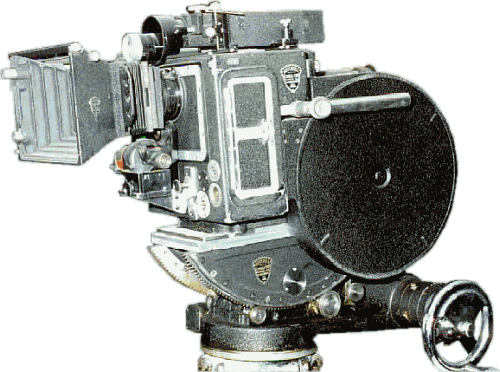
.. and the unit still being on a tripod.
-Monte
[ 02-25-2006, 12:26 PM: Message edited by: Monte L Fullmer ]
Posted by John Koutsoumis (Member # 1855) on 02-25-2006, 04:44 AM:
It would be nice to able to see inside the "Mitchell VV" camera and see how it's actually laced up. Might be a bit tricky.
I've seen a few Technicolor prints of films made in VistaVision in recent times and you just think "how did go from this back to 4/35?". Last Thursday night I screened a Technicolor print of Douglas Sirk's 1956 film "Written on the Wind". Even though it's only 4/35 widescreen it looked great but it's no VistaVision.
BTW, all the Technicolor prints I experience were illuminated by Carbon-Arc ![[Cool]](cool.gif)
Later this year i'll be screening a new print of "The Leopard" shot in Technirama and so far i've heard nothing but good things about how great it looks on screen.
I think it would be easier to convince someone to make a film in 8/35 as opposed to 65 and it will look just as good. I for one would but I'm not up to that phase yet and that's of I even get there...
Posted by Monte L Fullmer (Member # 2797) on 02-25-2006, 12:22 PM:
John, It's all
here in this site. You'll get stuck here for a few days..
-Monte
Posted by Bobby Henderson (Member # 840) on 02-25-2006, 02:05 PM:
quote: John Koutsoumis
I think it would be easier to convince someone to make a film in 8/35 as opposed to 65 and it will look just as good. I for one would but I'm not up to that phase yet and that's of I even get there...
Again, this has to do with what is available in terms of camera design and lens packages. There are 65mm camera models that can be hooked up to a Steadicam. Are there any for VistaVision? I doubt that. The last "new" VistaVision camera system I've heard about was the VistaGlide motion control camera system (introduced, I think, on the Back to the Future sequels. That's a huge computer controlled camera that rolls back and forth on a dolly.
Now, it's fully within the realm of physical possibility for companies like Panavision, Arri or others to make a compact, lightweight VistaVision movie camera and outfit it with a complete line of sperhical "VistaVision" and anamorphic "Technirama" lenses. But that R&D effort would cost a pretty serious amount of money. And right now all the rage seems to be over doing HD quality video, not film.
Maybe when the whole infatuation phase with video dies down a bit perhaps some key people might be able to take a more objective look at film formats like 8/35 -or at least consider what's already available in 65mm.
Posted by Ron Curran (Member # 3631) on 02-26-2006, 03:15 AM:
The industry’s creative accountants have told me that satellites, servers and card-swipe ticketing will mean that theatres will run with just a manager and a security guard. This brave new world should be in place by next Tuesday.
However, I was given that message six years ago. Kodak keeps introducing improved film stocks and audiences still march out of mediocre multis and into theatres that offer service and quality. I don’t think it is yet time to end it all and jump out of the projection port.
The other element, oft mentioned, is that audiences will not leave their plasma screens to see ‘Flesh Eaters 3’ in whatever format. This whole “film is dead” debate came up when studios were releasing product that nobody wanted to buy. It has been one of those rare periods when a single screen wasn’t such a bad thing.
Our video projector is happy occasionally showing video-originated movies and our 35mm system shows the regular stream of film. Digital, 35 and 70 may all be part of the future theatrical mix.
Improving 35 is only futile in the same way as improving that other endangered species - the internal combustion engine - has been.
Quoting Bobby Henderson:
“The other incremental ways to improve 35mm production are all valid to use in making movies. But the 35mm method for showing movies is going to quickly turn into an endangered species.” AND
“Put any 35mm print made today up against that and it will get its ass mercilessly kicked. Newly photographed 65mm material on new 70mm print film will beat ANYTHING on 35mm.”
If a 2006 35mm Vision stock can better 65mm of 3 decades ago, then an incremental improvement of 18-24% would surely be worthwhile, for 35mm reduction prints and for blow up to 70, rather than the existing 4/35 or cropped 35.
And quoting Larry Myers:
“All one needs to do for a 70mm lookalike show print from 35mm true scope is order a slow speed print directly from the negative. If not from the original neg then from a direct 2nd generation dup negative.”
Even closer if it doesn’t have to be blown up quite as much.
Nothing is impossible. We wouldn’t be in this business if we avoided what was difficult.
Posted by Bobby Henderson (Member # 840) on 02-26-2006, 12:14 PM:
I just don't agree with Larry's arguments that 35mm can be a replacement for 70mm. It just doesn't wash. And any step you take to improve the level of sharpness and color on 35mm can be applied to 70mm as well. When treating both gauges equally, 70mm will always hold a giant difference of superior quality.
And 35mm is limited to throwing images effectively onto only so large a screen. When screens get to a certain size, a larger film format and lamphouse is mandatory.
I really believe the future of film projection -really its last stand- is in large format processes. It's the one area video cannot effectively touch. The technology won't allow video images as sharp and bright as IMAX for a long time. Home viewers can't stick a screen the size of a giant billboard inside their house either.
Posted by John Koutsoumis (Member # 1855) on 02-26-2006, 06:02 PM:
quote: Ron Curran
If a 2006 35mm Vision stock can better 65mm of 3 decades ago, then an incremental improvement of 18-24% would surely be worthwhile, for 35mm reduction prints and for blow up to 70, rather than the existing 4/35 or cropped 35
I don't buy that at all. Many large format films of 1950/60's still hold today. Modern stocks may have the detail but they don't all look better. I don't know maybe it was the way films were lit and photographed back then.
Ok I hate to use DVD as an example but I will for this case. I checked out the DVD of Nicholas Ray's "King of Kings" shot in Technirama (although it's region 4 copy it was strangely in the NTSC format) and I was shocked at sheer detail and clarity of images. Put that up against similar films as "The Last Temptation of Christ" or "The Passion of the Christ" (one damn fine transferred DVD) and King of Kings still comes in front or equal to (btw, the latter 2 films were in PAL format).
Not only story wise but also in terms of photography a lot of films today look the same, there just pretty pictures but they don't have that brilliance of films shot in large format.
There might be one here and there but I overall I think not.
Posted by Bobby Henderson (Member # 840) on 02-26-2006, 07:07 PM:
In all fairness, one can't really compare the image detail from one film to another based on DVD releases of each. The DVD format has only 720 X 480 native pixels in the frame. That's far below the resolution levels of 35mm film.
Other factors that skew any judgments based on DVDs. Elements used to create the video transfer are one factor (few DVDs are transferred from original negative or from the interpositives/internegatives derived from the o-neg). The methods and bitrates used in the video transfer are another. The kind of encoding methods used to make the DVD and final bitrates going into DVD are further factors.
The best comparisons will happen between two different film strips with the best quality prints available representing the two.
Posted by John Pytlak (Member # 331) on 02-26-2006, 09:37 PM:
70mm has a big advantage for huge screens since it allows spreading the radiant energy of the lamphouse over a much larger image area. Filling a 70 or 80 foot wide screen with a 35mm image is problematic for focus flutter or even heat damage, and 70mm is much more suited to the task:
Splendor of 70mm Part 1
Splendor of 70mm Part 2
Heat Damage Part 1
Heat Damage Part 2
That's why 70mm prints look so much better than 35mm on a huge screen, even if they are made from the same 35mm negative.
Posted by Monte L Fullmer (Member # 2797) on 02-27-2006, 03:16 AM:
Interesting topics that John presented here. With reading the topics especially about the "Titanic" movie, I could easily see myself as that projectionist, for I did play "Titanic" on a 33x65 ft screen with just under a 100 ft throw in a house that seated 410 people with illumination from a 4500w bulb.
..and I fully agree what was posted in that article: dim lighting to make a dull picture, washed out contrasts, hard to read end credits, et.al. - all evident of a 35mm presentation that should have been a 70mm presentation on such a huge screen.
Later on, we were playing "Titanic" on smaller screens in this megaplex, and all of a sudden, the film was more enjoyable to watch due to the increased sharpness, brighter screen illumination and the end titles definitely readable.
-Monte
Posted by John Joseph Fink (Member # 3619) on 02-27-2006, 07:44 AM:
What about MaxiVision 48, which Roger Ebert championed a few years back I remember. Invented by Dean Goodhill, film moves at 48 FPS (with a 24FPS mode for low budget filmmakers) and it aparently only requires a $10,000 retrofit per projector.
Posted by Larry Myers (Member # 738) on 02-27-2006, 07:54 AM:
What John Pytlak is saying is correct. The bigger the image, the more light you get. Image area and light go by a somewhat different physics then resolution.
Example: a full 35mm scope frame blown up 2 times is the exact same size as a Cinemascope 55 frame. The 55 frame would be twice wide and twice or 8 perf high. If both negative stocks were the same, the 55 image would have twice the resolution but 4 times the light transmission.
So if you had two projectors side by side. One being a 35mm scope and the other being a 55mm scope if it existed, you would need 4 times the light with the 35mm projector to get the same brightness as the 55mm projector. Yes 4 times the brightness but only twice the resolution.
Some people think resolution goes by area. It does not. A 70mm frame is around 3 times the area of a 35mm frame letting 3 times the radiant energy through. Film that is 70mm 5 perf is only 1.5 times the resolution of 35mm true scope. This is not far from the jump in resolution of cropped 35mm 1.85 flat to 35mm true scope which is around 1.3 times resolution. Actually a 35mm 1.85 flat image would fit very nicely in a 70mm frame at two times the blowup. It would be 1.650 inches long by .880 inches high. Twice .825 and twice .440. Yet the 70mm frame has 4 times the area as a 1.85 35mm flat frame but only twice the resolution. Area is for light and magnification is for resolution.
Again it's all in the numbers.
So 70mm is really for getting all that radiant energy up on a 80 ft wide screen so 500 people can see it. If your running a show for only 50 people, then 35mm on a 40 foot wide screen might do. My home theater which uses a 8 foot wide screen is really only designed for about 6 people. Showing 35mm in that setting does very well indeed.
Posted by Ron Curran (Member # 3631) on 03-02-2006, 08:12 PM:
This string was never meant to be a 70 vs 35 punch-up. 70 is superior in every way. There are producers everywhere on the planet right now who are planning to shoot film. Most are planning to frame it 1.85 or Super 35.
Get hold of them and convince them that, for the sake of future generations, they MUST change their minds and shoot in 65mm. If you succeed, we will all be eternally grateful. Please give me plenty of warning so I can get a good deal on 70mm gear.
In the production world, the film frame in the camera has become smaller. The latest Kodak In Camera magazine profiles 2.35 feature film shoots. All were Super 35. Reasons stated include, in one case, the economy of 3-perf “a 20% saving” and, with 4-perf, the preference of digital effects people for freedom to move within the frame and, in another production, the desire to use spherical lenses.
So more productions are using a smaller area of the 35mm frame for 1.85 and 2.35. I was presenting a case for increasing that. If we are talking blow ups, I would rather see one from a 5/35CS neg giving 590 square mm than a Super 35 crop of about 260 square mm.
I agree with the proposal in “The splendour of 70mm” and 65mm filming. Bring it on. Get your business model sorted out for large theatres with giant screens.
In the meantime, all I am asking is for a feasible, affordable and better 35 format for the 6000 or so productions we are likely to see before the rebirth of 65 and the digital apocalypse. One small step for mankind. Is that so unreasonable? Optimised 35 will help smaller community cinemas and the multiplexes. Who can afford the real estate to have a multiplex with twenty 60-foot screens? A mix will be necessary.
One of the big problems we face is that film capturing and projection equipment (every gauge) is too damn reliable. There is a far more lucrative future in supplying digital boxes that none of us can fix and that will be superseded every few years. It is all part of consolidation.
Posted by Bobby Henderson (Member # 840) on 03-02-2006, 08:46 PM:
I think 35mm projection is now in some real danger, in light of recent business developments to get large numbers of 2K video projectors installed. In terms of theaters using film projection, large format venues may be the only ones left doing it a few years from now.
I'm not sure how that can be stopped, especially if distributors and other parties are paying for (or at least help pay for) all those video projectors.
In the end, the showdown is going to be film versus video on the production end. At this point, HDTV cameras (even those 24P cameras made by Sony and Panavision) can't really match good 35mm photography -even Super35 stuff.
4K video projection in theaters can give 35mm origination another steep advantage over video. I think it will be a long time before we see 4K resolution video cameras hitting the scene.
Posted by Mark Gulbrandsen (Member # 72) on 03-02-2006, 08:51 PM:
quote: John Joseph Fink
and it aparently only requires a $10,000 retrofit per projector.
Maxi-Vision is a great idea... nothing new really. Its apparent that he got the idea back from his old Aavid days and from the drove of high end 3 perf cameras that already exist to shoot television shows. $10,000.00 is a ludicrous figure to say the least to convert a projector, especially if they would want this format to fly on any scale. In fact thats more money than most projector-soundhead combos sell for! All it takes is a 12 tooth sprocket, new sprocket pad assy, freshly cut aperture plate, and a larger diameter pulley on the drive motor... about 300.00 in parts retail! Sadly SRD will not function at this linear speed so this system will have to be DTS based or a really good SR based analog system that would easily blow digital playback to simthereens! It's analog track could easily have a clean 30 khz frequency response at that film speed! Inaudible high frequency control tones could be used for audio steering purposes above 25 khz to create a psudo EX effect.
Mark
Posted by Ron Curran (Member # 3631) on 03-02-2006, 09:26 PM:
Maxivision48 is 1.85 (pity, but there is a fix) and they say they have a patented sound system but they are having trouble getting support from the industry. One of the cost factors would be a gizmo that lets the projector change from 3 to 4 perf on the fly.
Posted by David Stambaugh (Member # 1102) on 03-02-2006, 09:31 PM:
quote: Mark Gulbrandsen
about 300.00 in parts retail
Plus 18% if you use a credit card?
SORRY MARK, I COULDN'T HELP IT. ![[uhoh]](graemlins/uhoh.gif)
![[Razz]](tongue.gif)
![[Big Grin]](biggrin.gif)
Posted by John Pytlak (Member # 331) on 03-02-2006, 09:47 PM:
quote: Bobby Henderson
I think 35mm projection is now in some real danger, in light of recent business developments to get large numbers of 2K video projectors installed. In terms of theaters using film projection, large format venues may be the only ones left doing it a few years from now.
Worldwide there are well over 100,000 theatre screens using 35mm film. Today, seven years after all the hype at ShoWest 1999, Digital Cinema screens still number well under 1000. The business case for Digital Cinema still needs to be fully developed, and will face challenges. Kodak is becoming a major player in the world of Digital Cinema, but sees more of an evolution than a revolution ahead.
Posted by Paul Linfesty (Member # 214) on 03-02-2006, 10:28 PM:
quote: John Joseph Fink
What about MaxiVision 48, which Roger Ebert championed a few years back I remember. Invented by Dean Goodhill, film moves at 48 FPS (with a 24FPS mode for low budget filmmakers) and it aparently only requires a $10,000 retrofit per projector.
As far as the theatre end is concerned, $10K sounds reasonable. But for the studios making the prints, it would be half again as expensive per print. Multiply that by thousands of prints per title, and you have a much larger cost. And the distributors seemed determined to lower that cost, regardless of quality.
Posted by Bobby Henderson (Member # 840) on 03-03-2006, 09:12 AM:
The biggest problem facing MaxiVision is getting any filmmakers to originate using the process. One could have both 48fps and 24fps prints made from a MaxiVision film -if anyone would just make a movie using the process in the first place. Right now there just doesn't seem to be any desire to do so on the part of the filmmaking community.
If any filmmakers are wanting to use different processes, most are considering video rather than higher quality film formats. Pretty unfortunate.
Posted by Ramon Lamarca Marques (Member # 3621) on 03-04-2006, 05:37 PM:
quote: John Koutsoumis
I've seen a few Technicolor prints of films made in VistaVision in recent times and you just think "how did go from this back to 4/35?"
The answer is money, distributors did not want to pay the extra expense of producing dye transfer Technicolor prints, even though they were far superior then and Paramount did not want to pay the extra expense on film. If 65mm filming came back, perhaps Technicolor could bring back their superb dye transfer reduction prints for 35mm presentations.
I do not see digital as evolution. Digital is another way of showing films. If film projection disappears is because of saving money, not because of evolution. We will miss film projection when it disappears. ![[Frown]](frown.gif)
They forget that any improvement in digital projection for cinemas will also mean for home cinemas. You will get all of those DLP home cinema projectors being sold as see it the same way as in your local theatre. Cinemas have to move away from tellys if they want to do business, but it looks that they are becoming tellys. It's a sad world.
Posted by Mark Gulbrandsen (Member # 72) on 03-05-2006, 10:36 PM:
This is just one of at least 50 reasons why the distributers want to go "other directions" for exhibition. I'm not a fan of D-Cinema but there is a reality side to it all.
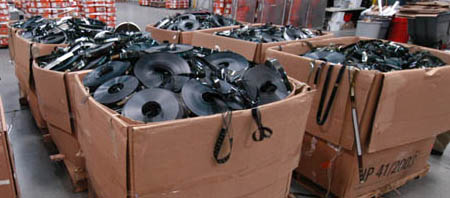
Regarding improving 35mm.....
Those of you that have never run 35mm dailies printed right off the camera negative don't have a clue as to how good 35mm really is today. Its quite spectaculuar!
Mark
Posted by Monte L Fullmer (Member # 2797) on 03-06-2006, 12:07 AM:
Thatsa lotsa "poly" heading back to the recyclers. A lot cheaper to stamp DVD's than to print film
Plus, with the demise of the "projectionist" and the increase of the 'booth operator', 'UsherBees', and the 'BoothClowns', this is the obvious reason for the increased interest in DC cinema.
Of this interest is that the customer, who goes to the "Goo-gooplex" are not getting the accurate and enjoyable presentation every time they attend. Also, with these growing complaints, refunds are issued, thus lost revenue is the result.
Megacompanies are screaming to find a quick and easy solution for this problem and the easy way out is for the usage of DC - instead of properly training procedures. Plus,let alone having to pay better wages for the fully trained employees which the Megacompanies don't want to do in the first place.
Posted by John Pytlak (Member # 331) on 03-06-2006, 03:03 PM:
Old prints should get recycled. The silver is recovered, and the polyester film base gets made into new plastic:
http://www.kodak.com/eknec/documents/bd/0900688a801a50bd/KES60_ENG.pdf
http://www.kodak.com/US/en/motion/hse/waste.jhtml?id=0.1.4.5.18.6&lc=en
quote:
Many film distributors assume responsibility for disposing of release prints after they are no longer needed. Many of them have contracted with FPC, Inc., a Kodak company located in Hollywood, Calif., which certifies destruction of film content and recycles the base or burns it as an alternate source of clean energy. This service protects the environment as well as the rights of copyright holders by ensuring that worn or unneeded prints do not fall into the wrong hands for unlawful purposes. If your film distributor isn't familiar with the services offered by , you might want to suggest that they contact them at 323-468-5778.
Posted by John Koutsoumis (Member # 1855) on 03-07-2006, 05:55 AM:
quote:
Those of you that have never run 35mm dailies printed right off the camera negative don't have a clue as to how good 35mm really is today. Its quite spectacular!
For sure. When I run screenings of short films on occasions in the last few years some of those prints are straight of the negative and the images just leap off the screen and of course they are super sharp too. Added with tons of light provided by the Carbon Arcs ( ) i'm always left gob smacked. Pity you don't see that in the Multiplexes.
Back in the good old days didn't they strike all the release prints from the camera negative?
Posted by John Pytlak (Member # 331) on 03-07-2006, 07:12 AM:
quote: John Koutsoumis
Back in the good old days didn't they strike all the release prints from the camera negative?
Duplicate negatives have been used for release printing for many decades. There is great risk in using the spliced original negative for producing release prints -- damage is very likely if even one of the hundreds of splices breaks in the printer, or if a misthread causes a scratch or other damage. Although printing originals are cleaned frequently, some dirt particles eventually become embedded in the emulsion, and may not be completely removable. Yet some producers (where print runs are relatively small) will not invest in the protection duplicate negatives offer, and make release prints directly from the original negative. Today, some "Bollywood" films still do this.
Early color duplication films (like EASTMAN Color Intermediate Film 5253) were quite grainy, and produced a noticeable degradation of image quality. More recent films like KODAK VISION Color Intermediate Film 2242 can produce duplicate negatives that yield prints almost indistinguishable from direct prints --- the Kodak SMPTE presentations that introduced the new generations of intermediate film actually showed "split screen" images where most experts could not see any loss in image quality.
One of the major reasons for increased unsteadiness and loss of sharpness is the practice of using continuous contact printing for all stages of duplication, so the correct short-pitch to long-pitch perforation relationship is not maintained for all printing steps. Correct practice is to only contact print short-pitch to long-pitch films, and use a pin-registered step printer for printing the master positive to the duplicate negative. Unfortunately, ever tighter production schedules often don't leave time for labs to "do it right" on the slower step printers.
Posted by Larry Myers (Member # 738) on 03-07-2006, 10:01 PM:
May I point out many decades could mean as late as 1985 but more then likely means around 1970. This is about the time an improvement came in both film and processing. Actually Kodak has several milestones in film and processing improvement.
It seems to me the first big improvement was around 1965. Next was around the very early 70's. Then about 1988 and the last around 2000 with the Vision stock series. It's the same as still photo improvement series like the jump from Kodachrome 10, Kodachrome 25, Kodachrome II, Kodachrome-X and so on. Likewise Ektachromes E1 E2 E4 E6 Also Kodacolor P-122 C-22 C-41 and so on.
This is just from memory. I am sure John knows the exact dates and there maybe one or two I have missed.
Posted by Monte L Fullmer (Member # 2797) on 03-08-2006, 12:06 AM:
still film and movie film - each uses completely different developing procedures.
Posted by Larry Myers (Member # 738) on 03-08-2006, 06:40 AM:
Yes this is very true because of the Jet Backing on motion picture film. This protects the film from scratches in the camera and needs to be scrubbed off in the process. Otherwise the rest of the chemistry is much the same. The difference only being in Ph level controls and replenish rates. Actually still camera chemistry is more in tune to expact way over and under exposure and film types differences then motion picture film chemistry.
Posted by John Koutsoumis (Member # 1855) on 03-08-2006, 07:52 AM:
quote: John Pytlak
Yet some producers (where print runs are relatively small) will not invest in the protection duplicate negatives offer, and make release prints directly from the original negative. Today, some "Bollywood" films still do this.
And it shows!!
Reason I asked about the original negative being used for the entire printing run is that sometime back I read some comments by Robert A. Harris that some films have butchered negatives because they were run through the printer 350 times! Maybe I read it wrong.. not sure.
quote: John Pytlak
More recent films like KODAK VISION Color Intermediate Film 2242 can produce duplicate negatives that yield prints almost indistinguishable from direct prints --- the Kodak SMPTE presentations that introduced the new generations of intermediate film actually showed "split screen" images where most experts could not see any loss in image quality.
That's great .
Actually I ran a print of the "The Worlds Fastest Indian" on Tuesday night and the quality was amazing. I suppose it is a limited release unlike major Hollywood product but the print looked great and sharp too!
quote: John Pytlak
One of the major reasons for increased unsteadiness and loss of sharpness is the practice of using continuous contact printing for all stages of duplication, so the correct short-pitch to long-pitch perforation relationship is not maintained for all printing steps.
And that's where the Digital Cinema folk start their noise claiming that at least in Digital format quality is maintained. I have yet to see a "film" in 2k or 4k ![[dlp]](graemlins/dlp.gif) so I can't comment on whether it's
so I can't comment on whether it's ![[bs]](graemlins/bs.gif) or . The way I see it though is no matter what resolution Cinema reaches it's not film and never will be. To me film has a certain aesthetic that digital cannot replicate.
or . The way I see it though is no matter what resolution Cinema reaches it's not film and never will be. To me film has a certain aesthetic that digital cannot replicate.
Posted by John Pytlak (Member # 331) on 03-08-2006, 07:54 AM:
quote: Larry Myers
Yes this is very true because of the Jet Backing on motion picture film. This protects the film from scratches in the camera and needs to be scrubbed off in the process. Otherwise the rest of the chemistry is much the same. The difference only being in Ph level controls and replenish rates.
The motion picture ECN-2 process has a prebath and rem-jet removal step, but also uses a different color developing agent (CD-3) than the consumer film C-41 process (uses CD-4).
Here is the recent Chronology of Kodak Motion-Picture Films:
Kodak Chronology 1960-1979
Kodak Chronology 1980-Present
1974 was a landmark year, and the beginning of the new era in film development:
quote:
1974
EASTMAN Color Negative II film, 5247. Tungsten, EI 100, Daylight 64. Sharper/finer grain than 5254 (EI 100) (E). Process ECN-2 (new process). EDTA bleach. Paper given 1972 SMPTE.
EASTMAN Color SP Print film, 7/5383. For higher temperature Process ECP-2. For greater release printing efficiency in larger labs. Quality similar to 7/5381 with which it will co-exist. Discontinued 1983.
Posted by Larry Myers (Member # 738) on 03-08-2006, 01:15 PM:
That right although, CD-3 is not all that different the CD-4 and for small runs, you could go back and forth with each agent without too much crossover. If you can get the Ram Jet backing off the film, motion picture film will run nicely in C-41. Again for small runs. The chemical composition ECN-2 is designed for large runs with correct exposure. Not something you get with 10,000 ft of 35mm rolls of consumer film all spliced together.
Posted by John Pytlak (Member # 331) on 03-08-2006, 02:33 PM:
quote: Larry Myers
That right although, CD-3 is not all that different the CD-4 and for small runs, you could go back and forth with each agent without too much crossover. If you can get the Ram Jet backing off the film, motion picture film will run nicely in C-41.
For hobbyist use, maybe okay. But professional motion picture labs make every effort to follow the H-24 Process Specifications closely, especially for the ECN-2 process used for camera originals:
Kodak H-24 Process Manuals
quote:
Module 1: Process Control 307KB
Module 2: Equipment and Procedures 629KB
Module 3: Analytical Procedures
Module 4: Reagent Preparations
Module 5: Chemical Recovery Procedures 496KB
Module 6: Environmental Aspects 305KB
Module 7: Process ECN-2 Specifications 670KB
Module 8: Effects of Mechanical and Chemical Variations in Process ECN-2 439KB
Posted by John Hawkinson (Member # 1135) on 03-08-2006, 02:47 PM:
John P.,
Is there any reasonable way to tell from looking at a release print whether the internegative was contact-printed or step-printed? It would be nice to be able to know how often this problem occurs in practice, and whether a given release print was struck from a contact-printed internegative.
(I'm not sure what any such clues/hints would be...I suppose it's asking too much for the labs to scribe "contact-printed interneg" on the leaders...)
--jhawk
Posted by Larry Myers (Member # 738) on 03-08-2006, 03:15 PM:
Yes, you would never run 10,000 ft of Vision 50 through C-41 although you might run 2 home load rolls of that same stock through C-41 if you can get the backing off first.
Sometimes if you load the Nikor developing can with 1/2 load of water and shake it like hell doing this about 10 times, you can get the ram jet backing off.
Posted by John Pytlak (Member # 331) on 03-08-2006, 03:34 PM:
quote: John Hawkinson
Is there any reasonable way to tell from looking at a release print whether the internegative was contact-printed or step-printed? It would be nice to be able to know how often this problem occurs in practice, and whether a given release print was struck from a contact-printed internegative.
(I'm not sure what any such clues/hints would be...I suppose it's asking too much for the labs to scribe "contact-printed interneg" on the leaders...)
Yes, if the step printing was done for the master positive ---> duplicate negative printing stage, the framelines would be opaque and coming from the aperture of the step printer. With continuous contact printing all the way, all you will see are the opaque framelines generated by the original camera apertures.
Since multiple cameras are often used on a feature film production, you may see variations in the framelines from scene-to-scene, depending on the cameras used. With a full length step-printed duplicate negative, the framelines would likely be consistent for the entire reel.
If you have consistent "hard matte" framelines on a "flat" feature, they likely were put there by step printing.
The reason labs often don't have the time to use pin-registered step printing for generating the duplicate negatives is they they usually need to print up to a dozen sets of printing negatives for worldwide use. Much faster on a 180 or 240 feet per minute continuous contact printer than a step printing going only a few frames per second.
Posted by Brad Miller (Member # 2) on 03-08-2006, 04:02 PM:
The REEL ID section shows examples of different framelines.
8 Below - black framelines
Dreamer - clear framelines
Brothers Grimm - hard matte framelines
Posted by John Hawkinson (Member # 1135) on 03-08-2006, 04:56 PM:
Thanks, Brad, for the examples, those are helpful for thinking about this.
John, I'm a bit confused. Shouldn't the camera aperture produce clear framelines, rather than opaque ones?
Perhaps I haven't been paying close attention, but it seems pretty rare that I actually see clear framelines on a release print, which suggests that it's pretty rare to find labs using this shortcut?
--jhawk
Posted by John Pytlak (Member # 331) on 03-08-2006, 08:29 PM:
quote: John Hawkinson
John, I'm a bit confused. Shouldn't the camera aperture produce clear framelines, rather than opaque ones?
Perhaps I haven't been paying close attention, but it seems pretty rare that I actually see clear framelines on a release print, which suggests that it's pretty rare to find labs using this shortcut?
If the camera aperture is 0.735 inches high, and each frame is 4 x 0.1866 = 0.7464 inches high, you have an unexposed area of negative film that is 0.0114 inches high. This clear unexposed area becomes the opaque frameline in a contact print. If the camera aperture were higher than the 0.7464 frame height, there would be a double exposure of the two adjacent frames in the frameline area.
White framelines often indicate that the negative itself was optically printed, perhaps as a blow up. The aperture of the optical printer creates the clear frameline on the master positive, which ends up as clear in the final prints. Clear framelines would also be produced if the master positive was generated using a laser recorder (i.e., digital intermediate).
An optical printer used for the master positive ---> duplicate negative stage produces opaque framelines in the final prints. So would the output of a laser recorded duplicate negative.
Posted by Monte L Fullmer (Member # 2797) on 03-09-2006, 03:15 AM:
Yea, "Dreamer" had those white frame lines being a Scope print - and with slightly overcut apertures, that was a stinker to keep in the middle so none of those white framelines would sneak into view. - Monte
Posted by Carl Martin (Member # 1146) on 03-09-2006, 04:37 AM:
quote: John Pytlak
White framelines often indicate that the negative itself was optically printed, perhaps as a blow up. The aperture of the optical printer creates the clear frameline on the master positive, which ends up as clear in the final prints.
...only if the printing of the master positive to internegative was done continuously, i.e. improperly, yes?
Posted by John Pytlak (Member # 331) on 03-09-2006, 07:30 AM:
quote: Carl Martin
...only if the printing of the master positive to internegative was done continuously, i.e. improperly, yes?
Yes. Step printing the master-positive to duplicate negative stage would result in having the opaque framelines from the pin-registered step printer aperture.
Posted by Ron Curran (Member # 3631) on 03-10-2006, 08:59 PM:
Please bear with me while I re-cap.
100,000 cinemas are presenting 35mm film, most of them on screen sizes well within the capability of that gauge, unless it is cropped too much. The case for gigantic screens belongs on the 70vsDC epic.
The vast majority of commercial feature output is being shot on 35mm film now and will be for at least five years to come. Film is too good. Still. The economic model is too solid to change to DC yet.
Most of those features are being shot in a format that uses too small a portion of the film for image, whether 1.85 or scope on Super 35.
Significant advances in film stocks and lenses have made it possible for film makers to be so wasteful.
People on this forum never sleep so I thought we might be getting some positive ideas by now.
An alternative film advance technology would provide a steadier image. Isn’t there a telecine example that could be developed?
Projectors in 1953 were routinely running film with CS perfs.
CS perfs on a 35mm negative leave 26.5mm width for the image.
Without scaring the horses, we could increase the image area on 35mm negative substantially.
A larger frame captured would be far better than current Super 35 for blow up to 70 and reduction to 35.
5/35CS anamorphic compared with Super 35 doubles the area.
Does anyone have a better idea?
Posted by Steve Guttag (Member # 268) on 03-10-2006, 09:39 PM:
Ron,
ISCOvision in the mid 1980s used a mild anamorphic squeeze on 35mm film for the purposes of using the entire available area for 1.85:1 films. It was proven to be brighter, steadier, sharper...etc...net result...dead.
Mr Pytlak also tried to revive this concept much more recently to revive this idea...net result...dead.
I do contend that 35mm film is NOT adequate for the majority of theatres today. If your screen is over 30-feet wide, 70mm would have a very noticable improvement.
I know of someone that is trying to develop a 48fps 35mm system that is 100% compatible with existing 24fps projectors (unlike Maxivision 48). While the image area is not improved, the frame rate should improve the perception of motion and detail in moving objects.
Another thing that could improve 35mm release prints is to shoot the film in 65mm or vista vision 35mm and release in anamorphic, regardless of aspect ratio (1.85 or 2.39). Light will be improved, steadiness will be improved and theatres will only need one lens (reduced costs).
Posted by Ron Curran (Member # 3631) on 03-10-2006, 09:51 PM:
At last! Thoroughly agree with the anamorphic release print for any ratio. The opening scenes of Horse Whisperer and Brother Bear are good examples (and didn't the audience love it when the masking opened to full width). There is an added benefit that cinemas could justify the cost of the best lens - Isco/Schneider.
Posted by David Stambaugh (Member # 1102) on 03-10-2006, 09:59 PM:
quote: Steve Guttag
I do contend that 35mm film is NOT adequate for the majority of theatres today. If your screen is over 30-feet wide, 70mm would have a very noticable improvement.
The best screens in Eugene are in relatively large houses (~480 seats) with relatively small screens: ~30' in scope. The image quality is often truly outstanding. It's pretty rare to see anything look as good on larger screens.
It almost seems like 40' is the practical upper limit for "acceptable/good". Beyond that, things seem to go downhill quickly. Just my personal observation.
Posted by Thomas Jonsson (Member # 1902) on 03-12-2006, 02:47 PM:
Just curious; on what do you base the figures 30 (or 40) feet as
the upper limit for 35mm? If you sit further away from a screen,
say, 50% larger with the same lenses and screen illumination,
shouldn´t the image look about the same? Or do you mean the
increased light will cause too much heat flutter?
Thomas
Posted by Steve Guttag (Member # 268) on 03-12-2006, 03:38 PM:
It is true that if you sit further away, a smaller guage film will look identical (grain wise). Above 40-feet, heat does start to play a significant factor on projecting the smaller gauges.
Posted by John Pytlak (Member # 331) on 03-13-2006, 09:37 AM:
For those who are SMPTE members, here is the presentation I gave about "Scope 1.5X, Squeezing Even Higher Quality from 35mm Prints":
http://smpte.org/members_only/library/download.cfm?file=pytlak.pdf
(SMPTE Membership is required to access SMPTE on-line library)
With the current 35mm "scope" image area of 0.825 x 0.690 inches, a 1.5X anamorphic system give an aspect ratio of 1.79:1 --- and an increase of 1.5X in light efficiency and image area over the "flat" format (and matches the aspect ratio of 16:9 widescreen HD for video release). Unfortunately, both Mr. Berggren's 1982 "IscoVision" presentation and my more recent SMPTE presentation and demo "fell on deaf ears", or more appropriately "blind eyes".
Posted by Ron Curran (Member # 3631) on 03-18-2006, 10:03 PM:
Could it benefit our cinemas if Film Tech or their agents issued a lobby card to customers saying something like:
We use the FilmGuard process so films look their best.
I should imagine that the cinemas where the system is in use clean the port glass occasionally and know where the focus and framing knobs are.
Powered by Infopop Corporation
UBB.classicTM
6.3.1.2