This is topic What problems do you have with 5 star sound heads? in forum Film Handlers' Forum at Film-Tech Forum ARCHIVE.
To visit this topic, use this URL:
https://ft-forum.com/ft/cgi-bin/ubb/ultimatebb.cgi?ubb=get_topic;f=1;t=007904
Posted by Eric Robinson (Member # 2966) on 04-06-2006, 12:07 AM:
I don't know about you, but considering the relative simplicity of a 5 Star sound head...I seem to encounter quite a few problems.
The number one problem I have is the guide rollers and friction roller binding up on the shaft of the sound arm. I can't tell you how many of these I have had to remove, completely disassemble, clean, and reassemble to restore the spring functionality to the inboard lateral guide roller. Then, (of course), a complete A chain analog and digital alignment.
Posted by Monte L Fullmer (Member # 2797) on 04-06-2006, 01:45 AM:
quote: Eric Robinson
guide rollers and friction roller binding up on the shaft of the sound arm.
do you have a humidity, or heat problem up there where there could be some sort of corrosion or gunk buildup on those shafts to bind up that friction pressure roller?
..interesting. I "babysit" 44 of them with no problems at all - outside of the usual maintainence of belt changeouts.. both round tooth variety and the older square tooth variety.
Last month I had to do a scanner drum bearing replacement on one unit.
In the past just keeping an eye on the main drive shaft support bearings - both small and large varieties...and had to only replace one bearing in the many years of playing with 5-star units.
Loved it when STRONG changed out the Bodine motors with Leeson motors..quicker and stronger startups.
..but as for the lateral guide roller assembly: I've never experienced any problems..just changing out the rubber pressure rollers that have started to crack. But, I do take caution of the roller hinge assembly that it swivels properly in its axis.
Only big thing that I have noticed is that, with age, that the large sprocket on the drive shaft that just is positioned on the shaft without an allen set screw, will eventually get its keyway worn some causing the two sprockets to have some slop when starting and running with that keyway play in the large sprocket.
Otherwise, maybe not the best heads out there, but take care of them and they do the job with no hitch..
-monte
Posted by Mark Gulbrandsen (Member # 72) on 04-06-2006, 08:08 AM:
A good tip with 5 stars and similar lateral guide roller assys. is to lubricate them with LaVezzi oil. This oil is synthetic and does not dry up and beccome gummy as if you used standard projector oil do do the job..... In a pinch you can also use Mobil-1 10W30. I always coat all parts in a projector rebuild with Mobil-1 before re-assembly. Makes getting things back apart at some later date ALOT easier......
For the sprocket shafts on 5 stars use bearinigs with rubber seals....Keeps the grease in and the belt crap out, these bearings typically last longer. On sound drum scanners use bearings that have just the shield so the bearing doesn't add any drag.
Mark
Posted by Eric Robinson (Member # 2966) on 04-06-2006, 09:53 AM:
I have the same problem at multiple locations, some in Northern California, Southern, and even the desert in Nevada. I find that if the inboard lateral guide roller is not working perfectly, you can kiss the lateral position alignment goodbye for digital.
I use TriFlo on just about everything. It is a great cleaning tool which leaves behind a lubricated surface.
quote:
Penetrating lubricant with Teflon, corrosion inhibitors, moisture displacers and solvents to soften and remove dirt and corrosion.
Sounds like I might be better of with LaVezzi oil though?
Posted by Brad Miller (Member # 2) on 04-06-2006, 10:56 AM:
quote: Monte L Fullmer
Loved it when STRONG changed out the Bodine motors with Leeson motors..quicker and stronger startups.
A faster startup is a bad thing, not a good one.
Funny everyone is looking at physical breakdown "problems" of 5 star soundheads, yet physical damage to the films isn't being listed as a problem. Yes I am talking about that stupid pinch roller.
Posted by John Eickhof (Member # 323) on 04-06-2006, 11:30 AM:
I used to call them the 5 star 'film shredder'!! Aside from the early Singer / Graflex design, they have evolved into a pretty decent soundhead, but I would still take a gear drive anyday! The newer models with the metric belts and larger bearings seem to do good. Like Mark noted, the lateral guide roller as well as pad roller shafts should be lightly coated with La Vezzi or Mobil-One synthetic oil and the problems with sticking should be eliminated! Same goes for older simplex & RCA guide rollers. Another thing to check is if the roller assy has been stuck for a while be sure to check the flanges for cuts and grooves from the film, if they are grooved be sure to replace! Or you will have "A chain" nightmares!!!
Posted by Monte L Fullmer (Member # 2797) on 04-06-2006, 12:54 PM:
quote: Brad Miller
A faster startup is a bad thing, not a good one.
..at least they don't "snap start" like the old Motiograph Mirrorphonic soundhead units..I always hated those the way you hit the switch and the machine was intant on - due to the units had no flywheel dampening.
.. never had any problems with the Leeson startups...
Posted by Pete Naples (Member # 761) on 04-06-2006, 03:23 PM:
Leeson motors are awful!
1. They start up too damned fast, many is the shredded main drive gear pair I've had to change on Century machines. We've invented a crude but effective soft start system for these motors.
2. They tend to hunt, or at least they do on 50Hz, combine that with the inadequate fixings of the drive pulleys to the shafts (look at the grub screws, there is only one, so the pulley tends to sit slightly eccentrically to the shaft), and you get a lovely throbbing vibration through the machine. So bad it'll make the film guidance rollers on the top visibly shudder and audibly rattle. I'm sure I don't need to explain what that does to the picture.
That said, the few Simplex installations we have here, the Leeson motors are better on them than they are on Century mechs.
Posted by John Eickhof (Member # 323) on 04-06-2006, 03:47 PM:
I remember the best test of young vs experienced in a booth..the Crest Theatre in Sacramento Cal. Had Motio SH-7500s with Brenkert BX-80s on them! They would startup so hard and fast the shearpins were snapping almost every reel change! ( They had an envelop of pins on the booth wall by each control station, and a screwdriver! )Andy Field the Manager finally set up some good old 5KW hand operated Variacs on each SH and the Union Operator would use the variac to start the machine! (2000ft changeovers! w/ Strong Excelite arc lamps!) Finally I convinced Andy into replacing the motios with XL soundheads..the shear pin problem went away! Well about 2 years later they were running a private employee show, and the film stopped..for quite a while..( younger IA operator and staff on duty ) After about 20 minutes! A friend of mine (life IA operator) finally went to the booth ..they had two Service techs and three operators there ) and they could not figure out why the picture head would not operate although the soundhead would! So Guy pointed out the shearpin on the Brenkert, showed them all how to replace it and the show was back on the screen! I also have seen the rubber motor couplings on the Motio soundheads 'ripped' apart from the sudden start!
Posted by Louis Bornwasser (Member # 3063) on 04-06-2006, 08:21 PM:
We used 200 watt 5 ohm adjustable resistors on the Motiograph to slow the starting time. Louis
Posted by Gordon McLeod (Member # 33) on 04-06-2006, 09:09 PM:
Most single phase motors I usually put a 1.5 ohm 200watt resistor in serries with it to rob the motor of some starting torque as standard install
Posted by Mark Gulbrandsen (Member # 72) on 04-06-2006, 10:35 PM:
quote: Eric Robinson
I use TriFlo on just about everything. It is a great cleaning tool which leaves behind a lubricated surface
You are not a very good tech if you are doing that. NEVER spray any solvent or supposed lubricant into any assembly. I guarantee that you are dong more damage than good and its certainly not the correct fix. Thats as bad a habbit as any tech an develop! Tear down the assembly , clean the parts, properly libricate them, and then re-assemble it. Coating shafts, etc. with a light true synthetic oil will cause you and your customer alot less grief in the long run than if you use regular projector oil.
Last October I had to dismantle and clean 10 Simplex lateral guide rollers because a theatre manager had repeatedly sprayed the stuff in them. Caused them all to rust, apparently the Tri-Flow reacted with what ever was on the shafts.... I posted pictures of the damage it did back about that time so a search might turn them up.
This is a list of the things not to spray into assembled Moving Picture Machines.....
Tri-Flow
WD-40
Lubri-Plate
Liquid Wrench...... Not for use on film either;).....
Carburator Cleaner*
Mr. Misty*
*I do use the last two items to clean dissassembled individual parts and bearings though.... they are powerful cleaners to be used following proper safety procedures.
My saying is DO IT RIGHT, IF YOU CAN'T THEN GET SOMEONE THAT CAN
Mark
Posted by Pete Naples (Member # 761) on 04-07-2006, 02:21 AM:
What the hell are;
Tri-Flow
Lubri-Plate
Liquid Wrench
Mr. Misty
? ![[Confused]](confused.gif)
Automotive carb/brake cleaner is good stuff for shifting old gunged up grease. Even WD40 has it's uses, but READ the label, it's NOT a lubricant!
There's an orange based product we use in teh workshop, you just throw the parts in a bucket of it and have a coffee. Rinse in hot water, dry thoroughly and you're done. Smells nice too.
Posted by Monte L Fullmer (Member # 2797) on 04-07-2006, 02:55 AM:
quote: Pete Naples
Tri-Flow
Lubri-Plate
..1-Tri-Flow is a lubricant spray with teflon in the mixture. You find this stuff in bicycle and key shops.
I used to use this stuff in lubricating the ruby jewel bearings that supported the double roller lateral guides in Christie P-35 traps.
Seen a lot of techs carry a small can of Tri-Flow in their workbags..
2- Lubri-plate.. is a white grease paste in a vinyl squeeze tube to lube the small spindle roller bearings assemblies on the Christie AW3(r) platter hubs.
3-Liquid Wrench .. if you got a stuck and rusted nut on a bolt..stuff was sprayed on the nut and was fluid enough to pass between the threads to looses a stuck nut.
(as for the other stuff..haven't a clue..)
-Monte
Posted by Dan Lyons (Member # 1454) on 04-07-2006, 01:39 PM:
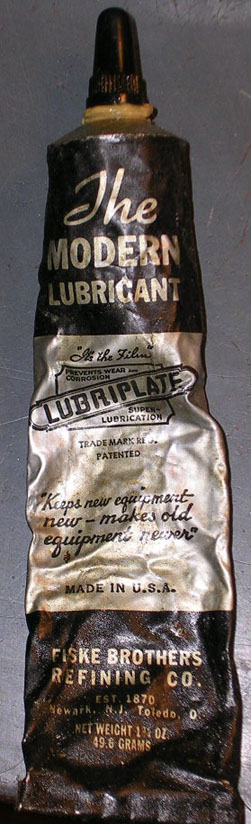
But it says it will make your old junk like new! ![[Wink]](wink.gif)
![[uhoh]](graemlins/uhoh.gif)
Posted by Brad Miller (Member # 2) on 04-07-2006, 02:51 PM:
No I didn't, that was Phil.
Posted by John Eickhof (Member # 323) on 04-07-2006, 05:42 PM:
Mark hit it on dead center!! All the items listed ar NO NOs! Misty, tri-flow, etc ARE SOLVENTS! The amount of 'teflon' found in Tri-Flow is too light of a concentration for continuous lubrication, it is meant as an aid in moving stuck parts one time! LUBRI-SHIT is probably the worst product ever introduced into moving picture machines! Especially in the dry western US! It was designed as a fine composite lubricant for temporary use when assembling engines and other large scale mechanical devices that would be started and operated within a few weeks of assembly! It was for initial lubrication untill the proper type oil reached the friction points and washed it OUT! In projectors , platters and other 'open air' machines it will eventually dry up to form a substance as hard as concrete! It also picks up dirt and debris easily while wet and is a very BAD thing for use in our industry! I have had to literally 'chisel' it off gears and shafts in Century and other heads! It also will coat nice shafts and retain moisture resulting in the famous 'brown scale' found on centurys and the AW platter bearing spindles! Unfortunately years ago someone at Christie got a good deal on tubes of it and recommended it's use, of course it is the primary cause of worn out oilite bushings in the AW platters! A good quality SHORT FIBRE grease is the BEST for long term use on platters and gears that require a lubricant. SO THERE!! My $.10 worth!! Ha ha!
Posted by Bob Koch (Member # 1062) on 04-07-2006, 08:09 PM:
John; thats the damndest thing I ever heard of, a Brenkert on top of a 7500. I`d certainly like to see that,hear that and watch that. Brenkerts shear pin worked a hell of a lot better on Evinrudes than on the projector. The unintended shear pin was most always the fibre shutter gear.I was guilty, early on, of using resistors on the Motio 7500 and RCA 1040`s to cure that jackrabbit start. When I was a boy I used screw in conical heater elements in various combos. Had to be careful though, it cut down the torque severely.
Posted by Eric Robinson (Member # 2966) on 04-07-2006, 10:13 PM:
Thanks for the input on TriFlo. This product was recommended to me by a highly skilled tech. As a point of clarification, I use the bottle of TriFlo with the long skinny tube to squeeze drops.
I think I will abandon it though as I have just ordered a bottle of Lavezzi synthetic oil.
Any opinions about Century grease? I use this on all Century gears and on the AW3 platter shaft rings and bearings. I also find it helpful on some of the interior parts on those crappy electric changeovers from Strong.
Posted by Mark Gulbrandsen (Member # 72) on 04-07-2006, 11:43 PM:
Present Century gear grease like the stuff Wolk provides is re-labeled Super Lube, its also available alot less expensivley at bearing supply houses in tubs. Its an excellent general purpose synthetic lube that works great for alot of things, it never turns into a cement like substance that has to be chisled off. I don't reccomend it on AW-3 platter bearings or spindles though... its a bit too heavy for that. Mobil-1 or Slick 50 synthetic wheel bearing grease is the best for that purpose. The color of the Slick 50 grease even matches the Christie light blue ![[Eek!]](eek.gif) .
.
By now you have gathered that I prefer to use synthetic lubes where ever I can... makes for less frequent re-lube and parts running with synthetics just plain last alot longer and give you less headaches.
Mark
Posted by Eric Robinson (Member # 2966) on 04-08-2006, 12:29 PM:
In Summary then,
Century gear grease aka Super Lube: excellent general purpose synthetic lube that works great for alot of things.
Slick 50 synthetic wheel bearing grease(light blue): great on AW3 platter bearings and spindles.
Lavezzi synthetic oil: use on parts which should slide or turn easily without becoming bound such as the lateral and friction rollers in the 5 Star sound head sound arm assembly.
Mobil-1 10W30: As a substitute for Lavezzi oil (in a pinch)
TriFlo: Solvent, good for cleaning only
Mr. Misty: Solvent, good for cleaning only
WD-40: Solvent, good for cleaning only
Lubri-Plate: = Lubri-Shit
Carburator Cleaner: Solvent, good for cleaning only
Liquid Wrench: if you got a stuck and rusted nut on a bolt
Looks like this is off topic a bit, but very helpful - to me.
Posted by Dave Macaulay (Member # 813) on 04-09-2006, 10:11 PM:
I like that ancient Lubriplate tube, my dad used to have one in his toolbox. He was wise enough to rarely use it, I think it was reserved for coating his car's battery studs.
Lubriplate now comes in spray cans too.
The problem is that it turns hard fairly quickly. I expect that the yellowish ring of "grease" around the cap on the pictured tube is about as hard as glass.
If you use it on a Century, you'll see that it's too thin (at first) to stay on the gears, so it flings off and hardens into interesting sculptures on the covers and all around the main drive gears.
Posted by Mark Gulbrandsen (Member # 72) on 04-09-2006, 11:19 PM:
Eric,
Your list is dead right!
Dave,
I like your description of how it forms sculptures! Funny thing is that it also takes a hammer and chisel to get rid of the stuff.
Mark
Posted by Eric Robinson (Member # 2966) on 04-10-2006, 11:14 AM:
I have had quite a few problems with the 5 Star pad roller arm. The most common problem is the shoulder bolt bending or shearing off. I was surprised to find a theatre which had removed the pad roller arm completely on four of their projectors and were running them without.
Does anyone know an easy way to install one of the new (P10015) shoulder bolts which protrude through the casting and are fastened on the belt side with a nylock? I found that I have to remove all of the parts on the belt side that are in the way to get the nylock on.
On one projector I removed the (P7614) projector drive timing belt pulley and the (P9837) sound head drive timing belt pulley
to gain access to the shoulder bolt. After reassembling I noted that there was rotational play between these two pulleys which are mounted on the same shaft. I then proceeded to disassemble and reassemble about three more times with no success. Wouldn't this type of play cause vertical jitter? Also, is there some way to eliminate this play?
ERIC
Posted by Cory Isemann (Member # 2517) on 04-10-2006, 11:22 AM:
Besides the usual lateral guide roller issues, I've broken off the screw that holds the pad roller arm to the casting.. that was no fun getting out either.
Posted by Eric Robinson (Member # 2966) on 04-14-2006, 11:02 AM:
Sorry guys I'm going to keep posting in this thread for a while.
I have a problem trying to figure out which belt I need for my 5 Star. Everytime I order a belt, the belt doesnt seem to match the belt pulley. Here are all the belts available:
RPM Teeth Motor Pulley Drive Belt Soundhead Pulley
1800 18 52-00120 51-05014 52-20268
1750 18 52-00120 51-05014 52-00071
1500 18 52-00120 51-05015 52-20550
1500 24 52-40127 51-05016 52-20558
1200 24 52-40127 51-05014 52-20147
1000 36 52-20559 51-05016 52-20558
It would seem that if I could identify the soundhead pulley, then I could use the table above to select the appropriate drive belt, but I'm not sure how to do this.
Is there perhaps a simpler way to figure out which drive belt you need?
Posted by Mark Gulbrandsen (Member # 72) on 04-14-2006, 11:35 AM:
First off there are Square Tooth Belts and Round Tooth Belts. Be sure which one you have... The round tooth belts which are metric and will not fit a US standard pulley are much heavier than the older lighter weight square tooth XL US standard belt type. Secondly look on the Outer Diameter of the belt for the belt number.... if it is still visible. Numbers like 280XL050 or something to that effect.... The round tooth belts will also have a number on them as well but it is somewhat different.
If there is no visible number left on the belt, and assuming that you may have a non-standard type belt for some odd reason I reccomend taking it to your nearest bearing house and have them measure it for you. Obtaining belts this way is also ALOT less expensive than from Strong whose prices are about triple!!
Mark
Posted by Sean R. Custer (Member # 3531) on 04-14-2006, 05:47 PM:
John:
I'll keep that in mind about the shear pins if we ever bolt up those Brenkerts again. The other huge problem with those I'm told was the oil viscosity that was recommended for them was incorrect -as supplied- from Wolk. It's hard for me to believe that went on so long... Right now we're running XL's w/SH-100's. I'm a happy guy. (Except for the jaxlights). The "Brenkert Fleet / Brenkert boneyard" has been sidelined, but not forgotten. I trip over them all the time.
It's kind of nice knowing I can reasseble an entire functioning c/o booth from parts if I had to. Hell, we could do a couple!
All I can do to further the thread in. re. the 5-stars is emphasize what people have already said about the lubricants. I made the egregious mistake once of spraying Misty in there to de-gunk 14 machines, which in all seriousness hadn't been cleaned in probably 9 months. A few months down the road and all lubed-up, came upon a lot of stiff and/or rusted bearings. In 3 years I think we ended up replacing them all, and thensome, as others came along and screwed it up too. So it goes.
I think they're a fine soundhead. Aside from the sound drum bearing seizing or moving slow, they don't really get cantankerous until the belt starts to go, but they give plenty of warning beforehand. And yeah, you can run happily with that pad roller clamp off, plenty of tension at that point. Peace of mind shouldn't be ignored though if it nags at you. -SRC
Posted by Eric Robinson (Member # 2966) on 04-18-2006, 07:55 PM:
Alright I think I have met an evil of my past. I just worked on a soundarm which I worked on perhaps a year ago (using TriFlo.) This thing was gunked up horribly. This time I used TriFlo to clean all the parts. I followed it up with a rubbing alchohol cleaning. Afterwhich, I used LAVESSI INTERMITTENT OIL HPO-3 to lube all the moving parts ie. casting pivot, friction roller, lateral guide rollers, and main sound arm pivot rod.
Is LAVESSI INTERMITTENT OIL HPO-3 the correct oil to use for trouble free lubrication of sound arm components?
Posted by Mark Gulbrandsen (Member # 72) on 04-18-2006, 10:27 PM:
quote: Eric Robinson
Is LAVESSI INTERMITTENT OIL HPO-3 the correct oil to use for trouble free lubrication of sound arm components?
YES! Guttag calls it "Magic Oil" for some reason or other. There's not much magic on it though.
Mark
Posted by Eric Robinson (Member # 2966) on 04-18-2006, 10:41 PM:
I know what "Magic Oil" is. But, I am unaware of "Guttag" ??
Posted by Monte L Fullmer (Member # 2797) on 04-18-2006, 11:50 PM:
..the magnificant..Mr. Steve Guttag .. who loves his cheese.
He'll probably chime in on this one.
Posted by Mark Gulbrandsen (Member # 72) on 04-19-2006, 10:10 PM:
quote: Eric Robinson
I know what "Magic Oil" is. But, I am unaware of "Guttag" ??
Guttag????? A new cheese I am pretty sure. Pass the Guttag please....... .
Mark
Posted by Eric Robinson (Member # 2966) on 04-19-2006, 10:44 PM:
I guess I have to keep raking the 5 Star over the coals, so here's my question.
In my opinion I would think that the film tensioner in the soundhead ,aka as a dashpot in a Christie, would cut down on vertical jitter if it has the proper amount of dampening fluid so that it moves very slowly. I try to keep all of mine in good shape either by adding dampening fluid or by replacing the spring. Has anyone noticed significant improvement to vertical jitter from servicing this component?
Also, when I show people how to thread the film in the sound head I tell them to pull the film taught, bringing the tensioner roller to the top of its travel, then back the film up about 1 or two sprockets. Does this sound appropriate?
Posted by Monte L Fullmer (Member # 2797) on 04-20-2006, 04:22 AM:
quote: Eric Robinson
I tell them to pull the film taught, bringing the tensioner roller to the top of its travel, then back the film up about 1 or two sprockets. Does this sound appropriate?
Okey...on that snub roller arm: you see two small stops on that small bracket that this assembly is mounted on - on behind and one in front of the snub roller arm?. That snub roller arm to be dead center inbetween the two stops.. - simple as that.
Done this way for years with these 5-stars.. - Monte
Posted by Steve Guttag (Member # 268) on 04-20-2006, 07:31 AM:
Actually, The 1-2 perforation setting is the correct one...setting in the middle is wrong. While it will work, it will not bring the impedance drum up to speed as fast and it creats excessive slack between the projector and soundhead upon start up.
If you trace through the manuals on the 5-star since that form of the soundhead came out...it was always designed for just 1-2 perforations off of the pin. If you run reel-to-reel with 5-stars you will also discover why setting in the middle is not a good choice.
As for the damped roller...there is a bit of skill involved on setting them just right...working with the spring and damping fluid. For good digital tracking, the rubber pinch roller must also be kept completely clean (Film Guard will tend to cake up a sticky residue on the rubber pinch roller so keep the roller clean). The better pinch rollers were the felt ones...they help digital track incredibly well.
Steve
Posted by Eric Robinson (Member # 2966) on 04-20-2006, 05:21 PM:
Alright so now I have to try one of these felt friction rollers. Anyone know where I can pick one up?
Also, supposing I wanted to redress a friction roller whos surface has become hard and slick, might I use some 400 grit sandpaper or some other abrasive to restore its grip?
Posted by Steve Guttag (Member # 268) on 04-20-2006, 07:06 PM:
The felt ones are long out of production and they DO require upkeep to keep sharp things off them and to desaturate them from any lubricants, including FilmGuard.
As for one that is worn out...just replace it with a new G-1985 roller. I prefer Strong's over others at the moment.
Posted by Mark Gulbrandsen (Member # 72) on 04-20-2006, 11:12 PM:
Actually I am kind of on Brad's side with using no roller at all. As long as there is no digital basement reader and you're running platter no roller si just fine. Otherwise use a roller... I agree with Steve on the rollers... the Strong rollers always seem to be more consistant and made to tighter tolerance... better materials.
Mark
Posted by Monte L Fullmer (Member # 2797) on 04-22-2006, 04:54 AM:
I've tried that trick of Brad's and it's pretty slick. Reminds me of a Cinemeccanica rim roller variety.
-Monte
Posted by Eric Robinson (Member # 2966) on 04-22-2006, 04:37 PM:
While browsing throught the manuals section in Film-Tech, I ran accross the following publication:
Strong 5 Star basement reader problems
FYI
Posted by Ian Bailey (Member # 1752) on 04-22-2006, 07:33 PM:
Hi
I've never fully understood "Brad's No Roller" method,any chance of a bit more explanation on this one!
Ian ![[beer]](graemlins/beer.gif)
Posted by Eric Robinson (Member # 2966) on 04-23-2006, 02:09 AM:
You could make reference to the following topic:
"Topic: What would cause this kind of damage to a film? (pictures)"
Posted by Monte L Fullmer (Member # 2797) on 04-23-2006, 02:23 AM:
quote: Ian Bailey
I've never fully understood "Brad's No Roller" method
First we know that the middle constant feed sprocket and the final holdback sprocket in the soundhead is what keeping the filmspeed constant between these two sprockets.
The snub roller is acting like the dashpot roller inbetween these two sprockets - like the dashpot(airpot) assembly on a Christie, and the dashpot assembly on the Century soundhead.
Basically, Brad's conversion is basically creating a version of what these two types of machines above are doing now.
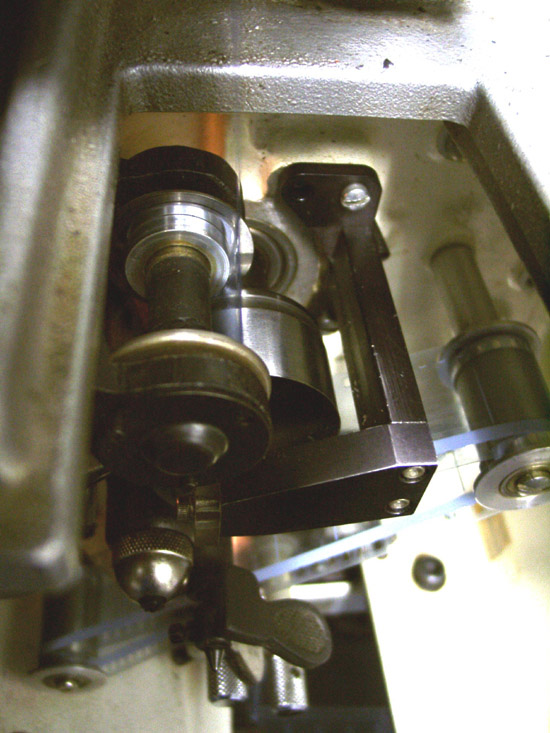
You thread the film to where the lateral guide roller, that just now has that spacer sleeve inbetween the two roller guides, is actually barely floating above the scanner drum with the film threaded rather snug between the two sprockets. The snub roller is keeping the floating lateral assembly under check. You just have to make the threading path rather more snug than before to make this really work...
-Monte
Posted by Dan Lyons (Member # 1454) on 04-23-2006, 04:24 AM:
This should explain it.
Posted by Gordon McLeod (Member # 33) on 04-23-2006, 12:31 PM:
I really doubt if the correct losses can be introduced into that conversion to make it perform as a true davis tight loop
Posted by Mark Gulbrandsen (Member # 72) on 04-23-2006, 12:46 PM:
Actually it does work fine but takes longer for the stabilizer to reach speed. It's still a tight loop no matter how you look at it. Eliminate the Silicon loaded damper roller and its not a tight loop any longer its then more an SH-1000.
Mark
Posted by Steve Guttag (Member # 268) on 04-23-2006, 05:36 PM:
IF one were to remake the sound drum to eliminate the recess where the inboard Lateral guide roller sits and then apply rubber drive tires to both lateral guide roller halves, it would work very well and eliminate the picture contact area.
Something that should be done to "Brad's" design is to have a stop screw such that the wrist of the assembly can't push the film down into the recess of the drum. Ever noticed that the Century LGRs have stop screws so they don't have contact with the drum?
Posted by Ian Bailey (Member # 1752) on 04-24-2006, 02:39 AM:
Thanks for the picture Dan.
So the only thing holding the film against the sound drum is the metal inside edge of the Lateral guide roller.Am I right in saying that the film is only being held on one side?...as far as I know the same point on the outside edge of the lateral guide roller does not come in contact with the sound drum.
To me it just doesn't look like there is enough holding the film against the sound drum to stop the film tracking laterally which would effect the sound quality.Also if the projector is left running with no film and the lateral guide roller engaged then you would have metal to metal contact which couldn't be good.
Narrow rubber tyres that line up with the outside edges of the print would be the go.
Ian
Posted by Monte L Fullmer (Member # 2797) on 04-24-2006, 04:10 AM:
quote: Ian Bailey
To me it just doesn't look like there is enough holding the film against the sound drum to stop the film tracking laterally
Granted, it does fool you on how it looks, but it really does work, and works pretty slick.
The trick is to have that film taught so the film doesn't have the chance of being weak in that area of the guide rollers - to where the stiffened edges DO hold up the guide rollers pretty well.
-Monte
Powered by Infopop Corporation
UBB.classicTM
6.3.1.2