This is topic How are 70mm prints packaged for delivery? in forum Film Handlers' Forum at Film-Tech Forum ARCHIVE.
To visit this topic, use this URL:
https://ft-forum.com/ft/cgi-bin/ubb/ultimatebb.cgi?ubb=get_topic;f=1;t=007906
Posted by Robert Burtcher (Member # 3227) on 04-07-2006, 06:09 AM:
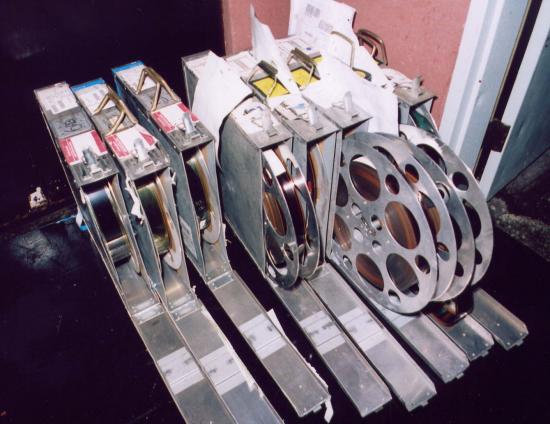
I was talking with my boss the other day about 70mm prints (in essence, me pleading to try and get something, anything in 70mm before our tech rips out our Cinemeccanica Vic 8, and my boss not sounding too enthusiastic about the idea) and he said he saw a 70mm print of something (Titanic, I believe) at the local ETS depot. He said the print was in individual reel cans, and there were 28(!) of them. Is this how 70mm prints are shipped to theatres, or are they packaged along the same lines as 35mm prints - split reels in multiple octagonal-shaped shipping cases?
Posted by Scott Norwood (Member # 30) on 04-07-2006, 07:32 AM:
Like this:
Posted by Louis Bornwasser (Member # 3063) on 04-07-2006, 08:54 AM:
Yes, even though they are somewhat heavy. (The main reason we don't have "large 35mm reels is that the container of two of them is "too heavy.") Wouldn't 2 35mm large reels be similar in weight to one 70mm reel? Louis
Posted by John Pytlak (Member # 331) on 04-07-2006, 09:08 AM:
Brad Miller would be able to say how many 70mm reels "Titanic" required, since he ran it at the GCC Northpark in Dallas.
But it's certainly less than 28! 5-perf 24fps 70mm prints run at 112.5 feet per minute.
AFAIK, the maximum length of 70mm film put on the normal shipping reels is less than 2500 feet, since that is the sales length of the 70mm print film Kodak sells.
Posted by Robert Throop (Member # 61) on 04-07-2006, 10:03 AM:
quote: John Pytlak
AFAIK, the maximum length of 70mm film put on the normal shipping reels is less than 2500 feet, since that is the sales length of the 70mm print film Kodak sells.
Back in the sixties "Grand Prix" had one reel that ran about 34 minutes (3825 feet). Also reel 8 of "Sound of Music" was around 30 minutes.
Bob
Posted by John Pytlak (Member # 331) on 04-07-2006, 10:52 AM:
quote: Robert Throop
Back in the sixties "Grand Prix" had one reel that ran about 34 minutes (3825 feet). Also reel 8 of "Sound of Music" was around 30 minutes.
Bob
I assume those had to have a splice somewhere in the middle of the reel?
Posted by Scott Norwood (Member # 30) on 04-07-2006, 01:49 PM:
Maybe someone combined two reels onto one? The print in the pictures is "The Abyss" and R7 and R8 will just barely fit onto a single reel.
Posted by John Pytlak (Member # 331) on 04-07-2006, 02:30 PM:
Assuming a 35mm to 70mm blow-up, a 35mm reel nominally edited for a full 2000 foot length (rarely done) would translate to 2500 feet of 70mm print:
2000 x (5/4) = 2500.
Posted by Paul Linfesty (Member # 214) on 04-07-2006, 02:43 PM:
Back when I use to time such things when watching, I remember 2 MGM 70mm's in the mid 70's: Wind and the Lion (1975)and LOGAN'S RUN(1976). Each film ran just under two hours, and there were 5 reels for each film: the first three reels were around thirty minutes, with the last half hour broken down into two reels. These were both Metrocolor films. However, another 70 I saw in 1975, Rollerball, had 20 minute reels.
Posted by Brad Miller (Member # 2) on 04-07-2006, 02:50 PM:
Titanic was 10 reels, just like it's 35mm counterpart. However when inspecting I assembled them onto 5 reels with plenty of space leftover on the shipping reels before plattering it, so that title could've easily fit on 5 standard length 70mm shipping reels.
The reason is because this was not a mag striped print and was also polyester base.
Posted by John Pytlak (Member # 331) on 04-07-2006, 02:58 PM:
Certainly, for anything recent, it's likely the 70mm reel lengths will directly correspond to their 35mm counterparts, even though the standard 70mm reels can accomodate much more film.
Posted by Aaron Sisemore (Member # 145) on 04-07-2006, 03:18 PM:
quote: Robert Burtcher
he said he saw a 70mm print of something (Titanic, I believe) at the local ETS depot. He said the print was in individual reel cans, and there were 28(!) of them.
It may have been a print of Branaugh's 1996 Hamlet; it was 20 reels.
-Aaron
Posted by Dick Vaughan (Member # 540) on 04-07-2006, 06:58 PM:
It was indeed 20 reels but they were all very short. We were asked to combine reels for return shipment as the UK transport companies charge per item so I think we returned it on 9 or 10.
We were allowed to keep the spare reels and transit cases for own use which have come in very useful over the years
Posted by Jeffry L. Johnson (Member # 453) on 04-07-2006, 07:05 PM:
quote: Paul Linfesty
However, another 70 I saw in 1975, Rollerball, had 20 minute reels.
The 70mm prints of Rollerball that I have handled had some, but not all, 30 minute A/B/C rolls, equivalent to 1 and 1/2 35mm reels. In several instances the 70mm prints were incomplete, so the equivalent 35mm reel(s) were played in place of the missing 70mm reel.
The 70mm print of Dick Ellman's Panorama Blue was 3 30-minute 70mm reels.
Posted by John Walsh (Member # 168) on 04-08-2006, 09:12 AM:
IIRC, the film "2001" came on 12 70mm reels, but several were only about half full, a sign of editing, I guess. Seems strange, today, to think that a 2h 20 min film 'needed' an intermission, although it may have ben keptjust because it was already there before the length was cut. I remember thinking how I wish I could combine a few reels, but chopping a 70mm print was considered taboo, even when I ran it in the early 1980's.
Posted by Bernard Tonks (Member # 809) on 04-08-2006, 11:13 AM:
When the 8 hour plus Russian version of “War and Peace” was screened in 70mm at the Curzon, Mayfair in London, there was a picture in one of the national newspapers of the projection room and the projectionist, with all the umpteen reels displayed.
I remember showing the 35mm version at the Phoenix, (previously the Rex) East Finchley in North London one Saturday during my last freelance days. There were three built in Intermission reels.
War and Peace (1968)
Runtime: UK:401 min (video version) / UK:511 min / USA:390 min
Country: Soviet Union
Language: Russian
Color: Color (Sovcolor)
Sound Mix: 70 mm 6-Track (70 mm prints) / Mono: RCA Sound System (35 mm prints)
Posted by Steve Guttag (Member # 268) on 04-08-2006, 02:46 PM:
Remember, the 70mm reel with a 22" flange and 8" hub was designed around accommodating a Todd-Ao film such as Oklahoma! which would have been mag-stiped AND run at 30fps. Those are the only films that have the reels look reasonably full.
Older titles that had 4-track mag counterparts...it is the 35mm prints that set the reel balance since those would fill up first. When you see one of those titles on 70mm reels, the reels look rather empty.
Now add in a modern film without mag tracks and printed on polyester stock and you get an even more empty looking reel.
The 70mm version will only by 25% longer (5-perfs versus 4) yet it has a notably larger flange.
Steve
Posted by Thomas Dieter (Member # 2507) on 04-09-2006, 11:30 AM:
My question for your guys now as Steve is going about how full reels get as you increase or decrease the size of the format. Naturally I would think the movie Titanic would have been on more reels in 70mm, but we have established they they were the same as 35mm. For those movies that do have more reels on 70mm, do they try to keep the change overs in about the same spot as their 35mm counterpart?
Posted by Gordon McLeod (Member # 33) on 04-09-2006, 12:41 PM:
My experience with 70mm is that the reel changeovers are in the same place. In some cases the exchanges mounted 2 70mm reels togather to reduce the shipping since the reel was designed for toddao at 30fps
Posted by Thomas Hauerslev (Member # 566) on 04-10-2006, 01:36 AM:
Fox´s new 70mm prints are delivered in 70mm cans on cores.
Posted by Per Hauberg (Member # 529) on 04-10-2006, 08:50 AM:
Yeah - and in a few years, 70mm will be found in bodybags...
Uh, it's sad !
Posted by Floyd Justin Newton (Member # 1316) on 04-10-2006, 05:49 PM:
Yeah - and in a few years, 70mm will be found in bodybags..
Per-- How true and how sad.
Posted by John Pytlak (Member # 331) on 04-11-2006, 08:02 AM:
70mm is still very much alive in IMAX theatres and other large format venues. IMHO, the "pull" for a revival of 5-perf 70mm must come from exhibition, who need to convince distributors that 70mm prints are needed for the largest screens, and that theatres have the skill and equipment to handle the more expensive prints properly.
Posted by Brian Guckian (Member # 1678) on 09-07-2006, 06:34 PM:
quote: Brad Miller
Titanic was 10 reels, just like it's 35mm counterpart. However when inspecting I assembled them onto 5 reels with plenty of space leftover on the shipping reels before plattering it, so that title could've easily fit on 5 standard length 70mm shipping reels.
The reason is because this was not a mag striped print and was also polyester base.
Given a modern 70mm print with DTS sound and polyester base, what does the maximum capacity of the standard Todd-AO shipping reel become? One could work it out mathematically, but how much of a shortfall should one leave towards the rim of the flange so you don't have slippage or shearing when handling, etc.?
Posted by Christian Appelt (Member # 1067) on 09-08-2006, 11:11 AM:
quote: John Pytlak
I assume those had to have a splice somewhere in the middle of the reel?
Many of the 1960s 70mm prints I screened (last was SHOES OF THE FISHERMAN) had lab splices, even when the reels were only three-quarter full.
Posted by Richard P. May (Member # 3598) on 09-08-2006, 11:31 AM:
Basically, these things just get heavy. When working on preservation of AROUND THE WORLD IN 80 DAYS, we borrowed a print from the Library of Congress. Someone had combined reels one and two, and it was quite a load just to get it onto a rewind.
In the heyday of 70mm, before platters, these reels had to be kept down to where the projectionist could lift them onto the upper magazine without going over backwards.
BEN-HUR's longest reel was not over 12 minutes. Mag striping, or course, added to the thickness, and also weight.
RPM
Posted by Monte L Fullmer (Member # 2797) on 09-08-2006, 12:53 PM:
quote: Richard P. May
BEN-HUR's longest reel was not over 12 minutes. Mag striping, or course, added to the thickness, and also weight.
Should have seen the 35mm counterpart of "BEN-HUR": 16 - 12 to 13 minute reels of mag-optical, IB technicolor film.There were also 165m release versions of this on Eastman on 9 reels.
Brad: was that 70mm print of "Titanic" encoded with the DTS track then since the print had no mag striping? I first thought of mag dubbers, but kinda think that process would be a little ancient for standard 5/70 releases, thus pointing towards the digital track.
-Monte
Posted by Rick Raskin (Member # 1561) on 09-08-2006, 05:08 PM:
Weight was one reason the Union wanted two operators for 70mm. In my experience 70mm prints were identical to 35mm both in number of reels and changeover locations.
Posted by Michael Coate (Member # 757) on 09-08-2006, 06:43 PM:
quote: Rick Raskin
In my experience 70mm prints were identical to 35mm both in number of reels and changeover locations.
...and attached trailers.
quote: Monte L Fullmer
was that 70mm print of "Titanic" encoded with the DTS track then since the print had no mag striping?
Yes.
And the original 35mm image was enlarged in a fashion where it did not extend to the outer edges of the 70mm print's frame area; the left and right edges of the image were positioned at the innermost point of where the mag stripes would normally be. In other words, hand inspecting a print would reveal a bit of black matting on the left and right edges, but if projected with a proper 2.20:1 (or close to that) plate, then the image would properly fill the screen.
Posted by Robert Throop (Member # 61) on 09-09-2006, 12:54 PM:
quote: Rick Raskin
In my experience 70mm prints were identical to 35mm both in number of reels and changeover locations.
In 1970 I visited the booth at Radio City Music Hall during the run of "Airport" in 70mm. At that time it was standard practice at the Music Hall to receive 4 prints of each feature. I asked one of the projectionists if they had 4 70mm prints of "Airport". He said they only had 2 70's but they also had 2 35's for backup. He went on to complain that the film was 6 reels on 70 but 8 reels on 35. "If we have a problem, we won't know what part of the picture we're in".
Eveyone should have such problems.
Bob
Posted by Bruce Hansen (Member # 281) on 09-10-2006, 12:27 PM:
quote: Robert Burtcher
print was in individual reel cans, and there were 28(!) of them
This might have been 2 prints plus some odd reels, or 3 prints with a couple of the reels containing 2 reels worth of film.
Posted by Rick Raskin (Member # 1561) on 09-10-2006, 04:12 PM:
quote: Robert Throop
the film was 6 reels on 70 but 8 reels on 35
Which makes me wonder if the 70 was just rolled on until the reels were filled? Add spliced on leaders and scribed cues and you have a recipe for sloppy changeovers. I once had a print where a changeover occurred right in the middle of Julie Andrews singing a solo number. We were good -- but not that good as to match frame for frame and not cut any words.
Posted by Monte L Fullmer (Member # 2797) on 09-10-2006, 06:42 PM:
..with this, couldn't one have undo the splices to get the proper reel changeover sequence correct for the 70mm prints, to correspond with the 35mm release prints?
Might have been some time to do this, but it seems that it could have also been possible.
(Unless, the 70mm prints were roadshow versions and the 35mm were standard release versions....)
-Monte
Posted by Brian Guckian (Member # 1678) on 09-10-2006, 06:45 PM:
quote: Robert Throop
At that time it was standard practice at the Music Hall to receive 4 prints of each feature
Crikey! Those were the days!
FWIW if anyone's interested, I've found an equation that John Pytlak kindly posted here before to determine reel capacity:
quote:
The roll diameter can be calculated from the following equation:
D = Squareroot [ ( (48 x L x t) / Pi) + (C x C) ]
Where:
D is roll diameter in inches
L is length of film roll in feet
t is film thickness in inches (about 0.0053 for Kodak VISION Color Print film)
C is core/hub diameter in inches
For example, for a shipping reel with a 4-inch core, and a film thickness of 0.0053 inches, 2000 feet of film will have the following diameter:
D = Squareroot [ ( (48 x 2000 x 0.0053) / Pi) + (4 x 4) ]
= 13.3 inches
If the reel diameter is known for 70mm (22 inches), and if one leaves a reasonable gap to the rim when fully wound of 0.5 ins, then D, the roll diameter, becomes 21 inches. The objective here is to find L, where:
C = 8 inches (typically) and
t = 0.0053 ins
Thus,
D = Squareroot [ ( (48 x L x t) / Pi) + (C x C) ] >>
21 = Squareroot [ ( (48 x L x 0.0053) / Pi) + (64) ] >>
21 = Squareroot [ ( (0.2544 x L) / Pi) + (64) ] >>
21 x 21 = [ ( (0.2544 x L) / Pi) + (64) ] >>
441 = (0.080978 x L) + 64 >>
377 = (0.080978 x L)
Therefore L = 4655.6 Feet or,
4655 ft 7 ins approx.
At 112.5 ft per minute (at 24fps), this yields a running time of 41 minutes 23 seconds, approx.
So certainly two 20 minute reels (in DTS-70) could be doubled up today for 70mm...or so it looks.
Posted by Jeffry L. Johnson (Member # 453) on 09-12-2006, 12:00 PM:
Some 70mm release print reels were comprised of A, B, and C rolls. That is, the 70mm reel is equivalent to 1 and 1/2 reels of 35mm (only A and B rolls).
One example of a print that had some A/B/C 70mm reels is Rollerball (1975). The 70mm version was 5 reels.
Another example is Panorama Blue (1974) which shipped on 3 full reels.
Posted by Brian Guckian (Member # 1678) on 09-14-2006, 08:42 AM:
That's very interesting, and prompts further questions about joining rolls in today's H&S-aware environment.
Note how some 70mm users recommend the use of lifting aids, etc. So you can increase capacity, but then you're into new film handling procedures to avoid backstrain / hernias, etc.
Perhaps this is another argument in favour of shipping prints on cores and in cans - but what pitfalls could there be with that solution?
Posted by Steve Guttag (Member # 268) on 09-14-2006, 09:59 AM:
To me, the biggest problem with shipping/storing 70mm on cores is that the cores are significantly smaller than the standard shipping reel hub (8") and are thus going to take on a core-set.
Other than that and the usual core/can problems (bad winds, loose winds, missing cores, destroyed cans, missing cores), I like the concept of shipping on cores.
I am not in favor of building up the reels though..particularly on magnetic 70mm...especially if the heads/tails are in tact. Since the magnetic head is prior to the gate, the splice in the sound telegraphs the upcoming splice in the picture.
Posted by John Hawkinson (Member # 1135) on 09-16-2006, 10:50 AM:
I'm under the impression that IMAX gets shipped around on cores frequently. Do they see core set issues?
--jhawk
Posted by Jeffry L. Johnson (Member # 453) on 09-16-2006, 11:31 AM:
I notice more "core set" on the 35mm-mag soundtrack, especially if it's been stored on a 2-inch core instead of a 3-inch or ideally a 4-inch core. I have not had "core set" issues with 70mm IMAX prints.
IMAX prints ship from the laboratory on 3-inch cores. If I receive a print on cores, I inspect and rewind onto normal 70mm house reels. I then load my MkII Reel Unit from the 70mm house reels.
If I receive a used IMAX print, it arrives on a shipping platter (or platters for a DMR print). I wind from the shipping platter to a house platter, either on the MkII or QTRU.
Once an IMAX print is assembled, it is not normally broken down to its original lab rolls. It ships on large platters having a hub of 9 inches.
The MkII platter hub is 15 inches.
The QTRU platter ring is 60 centimeters (about 23 1/2 inches).
Posted by Brian Guckian (Member # 1678) on 09-20-2006, 07:35 PM:
That's very useful - so perhaps a good compromise for any new 5-70 shipping method might be a 70mm 4-inch core. AFAIK only 3-inch 70mm cores are currently available (please correct me if I'm wrong), but it may be easy enough to fabricate 4-inch versions using their 35mm equivalents as a basis.
Powered by Infopop Corporation
UBB.classicTM
6.3.1.2