This is topic Where are the screen speakers in these older AMCs? in forum Film Handlers' Forum at Film-Tech Forum ARCHIVE.
To visit this topic, use this URL:
https://ft-forum.com/ft/cgi-bin/ubb/ultimatebb.cgi?ubb=get_topic;f=1;t=007923
Posted by Lyle Romer (Member # 1266) on 04-14-2006, 06:07 AM:
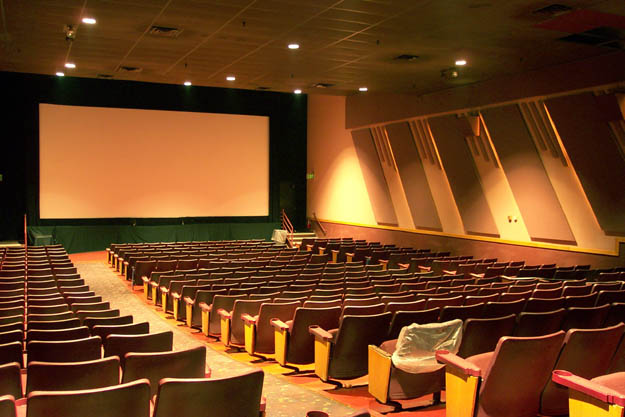
In this picture (former AMC now Gator Cinemas in picture warehouse) the screen appears to be almost flush with the wall. You can see the exit doors on about the same plane. There are a few older AMC theatres that I have been to that are like this. I have been around the back of the buildings or seen the sides at some locations and there don't seem to be any protrusions. So, the question is, where are the screen speakers and how do they fit?
Posted by Thomas Dieter (Member # 2507) on 04-14-2006, 12:06 PM:
If that theatre is anything like our theatre, they are behind the screen, unless the screen is flush with the wall. Our theatre as maybe 1.5' to 2' of a walk space. Very Cramped. Now one of our theatres has a sub, and that has a nice 3' - 4' walk space. Back when many of them were built, it was the idea to use as little space as possible for the theatre, and use the majority of it for the seating.
Our theatre, you can see where the seats went up to he screen and other companys has removed them.
Posted by Dave Macaulay (Member # 813) on 04-14-2006, 10:37 PM:
AMC also sometimes puts the screen speakers above the screen, sometimes putting the bass bin below and the mid/high unit above and sometimes the whole thing above. The obvious clue is the non-perforated screen.
This is a necessity with torus screens but they also do it in non-torus rooms if I recall correctly.
Posted by Iben Jimenez (Member # 3713) on 04-14-2006, 11:00 PM:
What is the purpose of torus screens and why they don't have perforations?
Posted by Thomas Dieter (Member # 2507) on 04-15-2006, 01:36 AM:
The purpose of a Torus screen is to get the effect of a concave and convex screen. Not only is the screen curved from left to right, but it's curved from top to bottem as it has a vacuum behind it. That's why it has no holes in it. The speakers are also in the ceiling and on the walls.
It allows for the focus of the screen to be almost perfectly on the sides and on the top and bottom. I don't know how many times I've tried to focus a concave screen on the top and bottom.
Posted by Sam D. Chavez (Member # 1841) on 04-15-2006, 01:14 PM:
The placing of the speakers not only not behind the screen, but also separating the Low Freq and High Freq components of the speaker to the top and bottom of the screen is a severe compromise to the sound to pursue the idea of an improved picture.
AMC has always been a company wiling to try ideas that were not conventional. Sometimes they work, mostly they don't.
There have been a number of instances where the screen vacuum pump fails allowing the screen to droop like a used condom. Is that too graphic for a Saturday morning?
Posted by Louis Bornwasser (Member # 3063) on 04-15-2006, 01:31 PM:
So, Sam, they solved a minor picture problem and created horrendous sound problems, incl. echo.
In high wind conditions, if there is any form of crack in the wall, the vacuum pump is overcome by wind pressure causing the "suck screen" to "blow" instead. Louis
Posted by Sam D. Chavez (Member # 1841) on 04-15-2006, 02:45 PM:
There a couple of instances where the behind screen area (sealed as it were)filled up with rain water and was not noticed until the air pump quit working complete with deflated screen.
Posted by Richard Fowler (Member # 893) on 04-15-2006, 04:49 PM:
In order for speech not to be impaired with above and below speaker location, the crossover over point has to be very low compared to a typical cinema speaker so as not to lose localization of the sound source; coaxial speaker designs work well in this situation. Aiming in a short room is also an issue. I have done a few rooms with solid Stewart Studio screens and one small room with a convex solid screen where we had good sound bouncing the sound off the screen surface ![[Cool]](cool.gif)
Posted by Frank Angel (Member # 248) on 04-15-2006, 07:13 PM:
Walking into a theatre to find Exits and stairs on one or both sides of the screen -- a theatre here in Brooklyn has a few rooms with Exits on only one side of the screen, forcing it to be painfully off-center -- aesthetically it's akin to walking into a 5 star restaurant and finding a dog turd next to your table. And those painted 2 inch plumbing pipes they are using for handrails at the exit stairs are a classy touch as well.
(How's that for Saturday evening, eh Sam?)
Posted by Eric Robinson (Member # 2966) on 04-18-2006, 11:32 PM:
Who ever invented and sold this craziness of vacuum formed screens?
Posted by Richard Hamilton (Member # 321) on 04-19-2006, 02:36 AM:
having never seen a room with a Torus screen, I'm curious if the picture quality is really that much better? Does anyone still install these? I can't imagine the nightmare the sound must be to set up. Can they even be set up to give the "illusion" that the sound is coming from behind the screen?
quote: Richard Fowler
I have done a few rooms with solid Stewart Studio screens and one small room with a convex solid screen where we had good sound bouncing the sound off the screen surface
Thats interesting. where were the speakers? Mounted on the ceiling? Seems like it would be hard to aim the sound.
quote: Eric Robinson
Who ever invented and sold this craziness of vacuum formed screens?
I think a guy who goes by L.J. (not Mr. Jennings) was heavily involved, but don't quote me on that, only something I heard years ago.
Posted by Jeffry L. Johnson (Member # 453) on 04-19-2006, 10:39 AM:
Sigma Design Group
Film Notes Issue #H-50-44
20th Anniversary/Torus screens/concessions lessons/Keep 'em coming back
2.35 Aspect Ratio Torus
quote:
This screen was developed by Gerald Nash (ray tracing), academy award winner anamorphic lens designer Glenn Berggren, and Don Stewart at the production end, under the firm name: Sigma Design.
Posted by Sam D. Chavez (Member # 1841) on 04-19-2006, 11:10 AM:
The concept was that of Glenn Bergrenn (sp) then of Schneider Optics, and Larry Jacobson of AMC. There is even a patent on it. The idea is to have a flatter light field with no hot spots which allows higher light levels without strobing. I believe it is a gain screen to boot.
I went to a demo in Burbank where they were running 28 Ft. Lts. instead of 16. Problem is, you could see matte shots and other imperfections not visible at normal light levels.
Another problem is the screen acts like a parabolic reflector for sound such that a person sitting in say row 5 just off the aisle can hear the conversations of patrons on the other side of the room.
After all, AMC's motto was "There is a Difference"
As to sound, that's another entire chapter.
Posted by Steve Guttag (Member # 268) on 04-19-2006, 12:22 PM:
I once confronted Glen on this (sound versus picture) and he asked point-blank..."So you are willing to compromise the picture for the sound?" And I responded: "Absolutely."
It isn't that the Torus screen doesn't work...it does and it is a fact with much doucmentation on the superior eveness in illumination with less lamp power than a traditional flat screen.
However, its been a long time since silent movies were the norm in theatres. I will gladly compromise the picture a little to have sound eminate from behind the screen where it belongs. I am a big believer in the cylindrical curve screen (one dimension) to improve the light and, in my opinion, improve the perceived image. But the speakers still must reside behind the screen.
Steve
Posted by Richard Hamilton (Member # 321) on 04-19-2006, 01:25 PM:
quote: Steve Guttag
once confronted Glen on this (sound versus picture) and he asked point-blank..."So you are willing to compromise the picture for the sound?" And I responded: "Absolutely."
Are you really compromising anything visually by not using the Torus screen? With the equipment that is available today, and then, I couldn't see the reason to want a Torus screen. On new installs, 16+ fl is usually easily attainable with a nice flat field of light. Does/did anyone else use this screen besides AMC? Sounds like a former AMC employee made a heck of a sell!
Posted by Steve Guttag (Member # 268) on 04-19-2006, 02:14 PM:
In terms of eveness of illumination...oh absolutely. The Torus screen offers a very uniform field of illumination as compared to most screen systems out there (including flat screens that are supposed to be matte white).
However, eveness of illumination is just ONE criteria...and as Brad has pointed out...depending on keystone issues, a curved screen can look wacky, doubly so on a compound curve like the Torus. Sound is another criteria. I wouldn't sacrifice to the nth degree all criterias just to improve one such as extreme eveness of illumination.
Posted by Louis Bornwasser (Member # 3063) on 04-19-2006, 02:32 PM:
Steve; how very OLD SCHOOL of you! ![[Smile]](smile.gif) Louis (I most certainly agree.)
Louis (I most certainly agree.)
Posted by Mark Gulbrandsen (Member # 72) on 04-19-2006, 07:47 PM:
I agree with Steve 100%! Just the proper blend of all aspects is better than a one sided blend. Old school perhaps but holds true more today than it actually did during the old school times.....
Mark
Posted by Frank Angel (Member # 248) on 04-19-2006, 10:54 PM:
The problem with the torus is not so much the curve -- it's the way you have to get it -- all that super-suck air pressure pumps and the air-tight room nonsense behind the thing. If a torus screen could be made by some sort of self-supporting rigid material that didn't require a vacuum system to maintain the curve, then an X/Y concave curve matched specifically to the throw is the theoritical ideal for absolute focus and light distribution.
Thing is, in the real world, today's lamphouses and the broad depth-of-field of modern lenses are more than capable of giving perfect corner-to-corner focus and illumination without the need for the torus dual curves. Besides, the place you really need to use a high gain screen without hotspotting (which is what the torus gives you), would be in the really larger screen sizes; there you might profit from the torus in that you wouldn't need to go up to extreme lamp sizes. But it is just in those larger size screens where the torus becomes much more of an unwieldy behemoth, needing bigger suction pumps and a larger airtight space behind it.
I never saw a torus, but this came to mind -- wouldn't you need to keep the pumps going all the time, not just when the theatre is opened? If you turned the vacuum pumps off, wouldn't the whole screen sag in on itself? I would guess that could leave creases. Or maybe it wouldn't crease and you could turn it off at night. Then when you opened, it would be: turn on the marquee, turn on the work lights, turn on the booth power, turn on the screen and watch it suck itself into postion. Weird.
But that's just the physical oddity of the thing. Then there are the anomolies that any large curved surface in a room with a sound system will present. Curved surfaces are an acoustician's nightmare. There are enough theatre builds that suffer from the lack of a good acoustical engineer involved with the design -- most owners just use the "just-throw-velour-on-all-the-walls" school of acoustical design; the last thing anyone needs is to have people designing theatres without benefit of a good acoustical engineer AND have one wall a double concave reflective surface.
As for speaker placement, I disagree with Steve about speaker needing to be behind the screen. I think in theory that might be right -- for the perception of sound coming from the image, the ideal is to have the speaker place behind the screen. But what trumps theory is what happens in the real world and I can tell you that I work in two venues which of necessity, both have speakers on either side of the screen with a center channel directly above it. And again, in theory this may seem like it detracts from the desired perception that voices are coming from the actors' mouths, but I can tell you that is not the practical reality. In both these rooms, even sitting in the first few rows (which are, blessedly, about 25-30 feet from the screen) your brain matches localization just as much as when speakers are closer to the actual image. Even in the older mag mixes with panned dialogue following the characters, the illusion is not broken by the outrigged Left and Right channels. This is true even moreso with today's mixes where dialog is kept dead center, the dialogue is not moving to the actor's location on the screen anyway -- it stays nearly always dead center; your brain moves it to where it needs to be. On a 50ft screen, if dialogue is coming from the center channel and a character is at either end of the screen, the sound is pretty removed from the image, yet you still perceive it as coming from that character.
Posted by Steve Guttag (Member # 268) on 04-19-2006, 11:51 PM:
Sorry Frank...I've had to contend with many a room where the speakers were not behind the screen...you had to be very deaf not to notice it. While the frequency response was good, the localization and perceived lip-sync sucked....and I mean every time.
You are talking to somone that has had a show ruined by a center speaker that was off center by about 9 or so inches...to the point I had to go behind the screen to figure out why the illusion of the sound was so ruined. Turns out, the frame had a center mounted support and the installer had to move the speaker.
I can generally localize a speaker to within a foot of its height and within inches on width. It is a big problem I have with the lack of panned dialog...when the sound stays centered but the image is to the side...it seems VERY disjointed to me.
Another thing on the speakers not mounted behind the screen (always happens in PAC type rooms)...many a room has paid us to go in after the fact to correct for that problem...every time we put the speakers behind the screen...every time the improvement was more than just SUBSTANTIAL.
You can get away with Left and Right outside of the screen a lot easier than the Center speaker above the screen or worse, a phantom of left and right.
Steve
Posted by Louis Bornwasser (Member # 3063) on 04-20-2006, 06:08 AM:
Doesn't everyone talk fom the top of their forehead? (The biggest complaint in this discussion.)
Seriously, certain things annoy certain people: pitch, absolute phase, level changes. Some things annoy erveryone. While this might not be that bad for you, it may be VERY bad for another person, Steve, for example. Louis
Posted by Richard Hamilton (Member # 321) on 04-20-2006, 08:30 AM:
quote: Steve Guttag
Turns out, the frame had a center mounted support and the installer had to move the speaker.
Steve, I have run into this where the front wall had a column, or duct work right down the middle and I made the installers move the frame out before they installed it. Amazing how we get and approve different revisions of prints than the contractor and other subs get.
Posted by Richard Fowler (Member # 893) on 04-20-2006, 09:10 AM:
A/C + electrical + roof drains have a bad habit of appearing in those "empty" spaces ![[Roll Eyes]](rolleyes.gif) I have done many field checks with master plans that would have 2 - 3 pages of our drawings detailing speaker and hardware location and watch the blank stares from other subs why we could not "live" with it.
I have done many field checks with master plans that would have 2 - 3 pages of our drawings detailing speaker and hardware location and watch the blank stares from other subs why we could not "live" with it.
Posted by Frank Angel (Member # 248) on 04-20-2006, 10:34 AM:
Well Steve, you've got some pretty acute hearing abilities, and I will agree with you that left and right localization would possibly suffer, IF dialogue was routinely placed near the screen extreme left and right edges of the screen, but as I said, even in 4trk mag mixes, dialogue is rarely placed exclusively in the left or right channel (and of course the given here is a 3 screen channel mix, not 70mm/5). Point is, localization is far more critical for left and right horizontal sound positioning than it is for vertical localization (otherwise we would have two additional ears, one on our forehead and the other on our chin). We evolved with very acute ability to hear what's coming from all around us (fast running predators of all sorts), but obviously there wasn't much threat from overhead.
Now I don't know if anyone has done any psycho-acoustical tests for this, but in my experience -- talking off the top of my forehead as Louis put sit -- I have never found that either lip sync or what I'll call "detachment" of an actor's voice from his image position on the screen, were problems that happened when a center channel speaker cluster is placed above the screen. If it is a 20ft high screen, then the center channel would be about fifteen feet away from dead center. I contend that in the vertical plane, that does not cause the problems for most of us that you say you can hear, especially in a large room where the audience concentration is usually around 30 ft from the screen. I am not denying that you are conscious of it, all I am saying is that most people are not even aware of the off-placement.
I am a recording engineer; I certainly am very much aware if and when both channels, left and right, are perfectly balanced or not, in the horizontal plane. But as for up or down....I mix sitting down, sometimes standing up, and I do this three feet from near-field monitors; in some studios the speakers are placed high, in another, right at the console level, but the vertical positioning is not critical -- and that's when you are close to the system. In a large PAC theatre, the audience is sitting a lot farther away than in a shoebox multiplex or in a screening room -- being good distance from the screen also minimizes the vertical displacement anomalies.
Bottom line is, we've had a parade of directors, cinematographers, post production mixing engineers, producers, etc., all watch their own films in our PAC with off-screen speakers and I never encountered even a minor mention that dialogue was detached or lip sync was off or that they were in any way unhappy with the sound -- one even voiced surprise when she went back stage for a Meet & Greet and noticed that there were no speakers back there. She had watched her own movie from start to finish and thought the speakers were behind the screen the whole time.
We had one client, the producer/director of a feature, use our theatre to show his film to prospective backers. He was ultra critical of every aspect of the presentation and even had his own people bring in their a CP200 to replace our older CP50. If anyone would have walked out and gone somewhere else if the sound wasn't absolutely perfect for him, it would have been this guy. He was very happy with everything, off-screen speakers and all.
So, I will grant that placement of left and right channel arrays off-screen would be problematic IF for some reason actors were routinly positioned to the far left or far right on the screen, but that rarely if ever happens. As for music, it doesn't care that the speakers are off-screen as long as there isn't a hole-in-the-middle created. As far as you saying that placing the center channel directly above the screen would somehow affect lip sync or ruin the illusion of dialogue coming from the actors, then your hearing is a lot better than most people.
Posted by Steve Guttag (Member # 268) on 04-20-2006, 11:05 AM:
Nope, I'm not going to let you have this one at all. If one's head is perfectly held, then the vertical displacement is not as apparent.
Just got through installing a CP650 in a place that HAD speakers behind the screen...then the new tech guy decided he didn't like having to rig the speakers for each film event...so he had the processor feed his mix board and fed his line-arrays (Left, Center and Right)...guess what...complaints soared afterwards. His solution was to upgrade the CP50 to the CP650 I just installed.
As for your directors and such that are happy with the sound...have any of them switched over to the "above the screen" method? I think not. Have you compared moving the speakers to behind the screen and then switch back and forth to see if you can hear the difference?
The fact you are getting away with it is nothing more than that...it seems to be working for your space but it doesn't for the bulk of the PAC out there. And it is definately very bad advise to tell someone that it is okay when in fact it is hit and miss, at best.
Another big problem is one spreads a speaker system out such that the bass and HF (and MF if a 3-way) get to be too tall for their own good...once again there is a discontinuity in the dialog and sometimes the sound is "bigger" than the image. Ever noticed how Altec always biased their LF horns as close as possible to the HF horns to keep them as tight as possible...even so...one has to be at least 20-feet back from an A-4 before the speaker sounds "normal."
Posted by Richard Hamilton (Member # 321) on 04-20-2006, 11:28 AM:
About 10 years ago, I was borrowing a Linear X from a friend who owns a high end car stereo shop. He complained to me that at the theater I was doing work at, the voices were no where near the images on the screen. This was one case where the speakers hung outside the brick wall, and there was a beam which put the center speaker about 12 inches off center. He had never seen where the speakers were in relation to the screen. Some people can tell. I have to look and listen for it.
Posted by John Pytlak (Member # 331) on 04-20-2006, 01:07 PM:
The "echo" problems with torus screens are inherent to any solid surface that "focuses" sound, as in a "whispering gallery" design:
Whispering Gallery Chicago MSI
quote:
The Whispering Gallery is a marvel of sound wave communication. The two parabolic dishes and the unique shape of the room carry the quietest message from your lips to someone’s ear
Whispering Gallery Design
quote:
A whispering gallery is an area with a domed ceiling where two people can softly converse even though they are standing many feet (or meters) apart. The two most famous examples are found within St. Paul's Cathedral in London and Statuary Hall in the US Capitol.
There is also one located in the dining concourse in front of the entrance to the Oyster Bar in NYC's Grand Central Station. There is no sign marking the gallery or any instructions posted on how to make it work. However, by waiting a few moments, an in-the-know couple will walk up and show you the way.
If that doesn't happen, you and a partner need to stand in opposite corners below the tiled ceiling. You need to be facing very close to the corners, around 2 to 3 inches from it. Speak in a soft to normal tone and your friend should be able to hear you quite clearly, as if you were standing next to one another.
Over the years, Grand Central's Whispering Gallery has become a romantic spot for paramours wishing to quaintly exchange sweet nothings. It's also a popular scene for proposing marriage, especially around Valentine's Day, so be careful what you are getting yourself into.
If someone asks you how or why it works, try to recite some of the following explanation and use lots of the big words. A whispering gallery occurs beneath a domed ceiling constructed in the form of an ellipsoid with a parabolic dish at each focus (usually a corner). When someone faces one dish and whispers, the sound telegraphs from this focus until it reaches an opposite dish, where another person waits to receive the message.
[ 04-20-2006, 02:54 PM: Message edited by: John Pytlak ]
Posted by Richard Hamilton (Member # 321) on 04-20-2006, 03:17 PM:
quote:
A whispering gallery is an area with a domed ceiling where two people can softly converse even though they are standing many feet (or meters) apart.
I was doing an install a couple of years ago at a planetarium when I realized the other tech in the middle of the dome could hear me perfect when I whispered something to him, even though I was 20 feet away. It was a cool, yet strange, effect! One day he was standing in the center of the dome talking to the museum director, and I was off in the shadows whispering bad words to him!!! He couldn't see where I was, but he was cracking up trying to keep a straight face while talking to the director!
Posted by Louis Bornwasser (Member # 3063) on 04-20-2006, 03:38 PM:
Another whispering gallery: Cincinnati's Union Terminal, just inside the front doors. Louis
Posted by Frank Angel (Member # 248) on 04-20-2006, 04:11 PM:
The old TransAm Airline terminal in JFK airport was one as well.
Posted by Steve Guttag (Member # 268) on 04-20-2006, 04:13 PM:
The original House of representatives at the US Capitol was a famous one...since the various factions would go off and caucus...the other side found out they could hear what the opponents were planning...this crap has been going on in the Capitol since its inception!
Posted by Matt Fields (Member # 3211) on 04-20-2006, 09:25 PM:
There is a natural place like that in Ohio called Ash Cave, which is a large recess cave with a waterfall (quite a beauitful place).
Pioneer settlers used to have church services and town meetings there because the speakers could be heard so well.
Ash Cave
Posted by Chris Hipp (Member # 1788) on 04-21-2006, 10:17 PM:
I worked at a building with 6 of these screens and a common problem is that after the fan or sensor goes out and the screen droops it sctretches a little. I had one screen where the bottom two feet of the screen looked like there was a flourescent light all the way along the bottom. Plus dust has a tendency to gather on the sloped bottom of the screen and makes it look terrible.
Posted by Bobby Henderson (Member # 840) on 04-21-2006, 11:52 PM:
I've been to several different AMC locations featuring rooms with Torus screens. Echo is a lot more noticeable in these places. Also with the speakers being placed above and below the screen the room has a hollow sound character to it. This is even more noticeable in the largest rooms.
One would figure echo wouldn't be quite so bad with the surround speakers stuffed in the ceiling and pointed at the top of audience members' heads.
As to the actual image quality benefit of using Torus screens, I haven't noticed enough of a difference to be impressed by it -at least as compared to theaters with normal screens and adequately bright and sharp projection.
Powered by Infopop Corporation
UBB.classicTM
6.3.1.2