This is topic What should I be looking for in a 16mm projector? in forum Film Handlers' Forum at Film-Tech Forum ARCHIVE.
To visit this topic, use this URL:
https://ft-forum.com/ft/cgi-bin/ubb/ultimatebb.cgi?ubb=get_topic;f=1;t=007941
Posted by Dan Chilton (Member # 2288) on 04-20-2006, 11:58 AM:
We're considering doing several outdoor events this summer, and I was thinking about getting a 16mm projector to show some old silent films. I've been searching on eBay for the last hour and can't believe how cheap 16mm projectors are... is that right? $50 to $80 for a working model? What kind of lamp would I need to throw roughly 15 to 20 feet? Is there a trusted manufacturer (I see a lot of Bell and Howell models)? Also, how is the sound outputted on these?
As always, thanks for your help!
Posted by Mitchell Dvoskin (Member # 751) on 04-20-2006, 12:07 PM:
For a 15 to 20 foot throw, almost any 16mm projector will do. Try to stay with either a hologen or xenon lamp. For hologen, Bell & Howell 1500 & 2500 series projectors, Elmo CL, and Eiki (not sure of which models) are all good projectors.
For Xenon models, you would want either an Elmo or an Eiki. B&H never made xenons, they made MARC & GEMINI arc bulb projectors, which are mercury vapor bulbs, that are expensive with very short life.
Posted by Kenneth Wuepper (Member # 1174) on 04-20-2006, 12:18 PM:
Dan,
Good fortune with your efforts to show 16mm outdoors. I have done it in the distant past and it is very much fun. You can make some arrangements with the local store to be open and sell to the audience. They usually helped pay your expenses as well. The local property owners association is also a good source for funding, advertising and locating your "show".
The projectors we used were carbon arc RCA 400 series machines. The local schools had them in their auditoriums but since TV/Big has come out they don't need them any more. Hence the cheap prices on that gear.
The Bell and Howell machines are very good if they have the Marc 300/16 lamp and power supply. They really belt out the light. You can get one of them from eBay most anytime and reasonably priced. This is the machine that the traveling lecturers used to do their travelogues.
The sound system can easily drive a horn speaker. We used a University 20" horn and it was very good for voice and it is weatherproof. The outdoor paging speakers are pretty tinny sounding for film. If you really want good sound, get a community outdoor full range horn system. (Might be ten times the cost of the projector though!)
There are some nice used folding matte white screens from time to time on eBay as well. I would suggest you stay smaller since they make a great sail in a sudden storm. If the wind comes up fast you can just lay it flat on the ground and weight the corners to prevent damage.
Let us know how you make out with this project.
KEN
Posted by Peter Mork (Member # 1336) on 04-20-2006, 01:56 PM:
I say there's nothing like a good old Kodak Pageant. They were so common and can be found easily everywhere. They are manual threaders. One feature that I really appreciate is the lever that lets you focus the exciter beam, thus assuring best sound whether the emulsion faces in or out (and with 16mm, there's no guarantee). Also, you can get extra lamps (up to 1,200 watts, quite good) and exciter bulbs on Ebay muy cheapo.
I don't like autothread projectors; they are far more likely to chew up film plus if you want to stop a film in the middle and de-thread, good luck.
[ 04-20-2006, 06:28 PM: Message edited by: Peter Mork ]
Posted by Steve Scott (Member # 630) on 04-20-2006, 02:31 PM:
Ebay usually has a good assortment of Eiki's with few hours and occasionally a xenon model, an abundance of Bell & Howells priced low enough to experiment & rebuild if necessary, and less Elmo's.
I've been told that, carefully selected from auctions where the projector has actually been tested with film, Bell & Howells from the 1500 and up series are alright. Manual threading are the ones to look for, but the Filmosound autoload machines can work well if properly lubricated & cleaned. Many of these autoloaders that don't get the needed attention snap film during operation because of years of grease has hardened in the mechanism. Find a clean B & H where the seller knows about running film & has tested the machine & you should find a keeper (for the life of the machine).
I've been told Pageant parts are hard to come by, same with some Elmo machines. There are some Telex/Singer machines out there too, I wouldn't buy one of these if there's a good B & H for around the same price. And usually there is.
If Ken Layton is around the forums, he can give you some excellent insight into 16mm machines.
Posted by John Pytlak (Member # 331) on 04-20-2006, 02:51 PM:
I agree with Peter Mork that the Kodak Pageants were workhorses, and very popular in schools and industry. Buying several used ones to choose the best, and than having a few to cannibalize for spare parts should set you up for years of good service.
Yes, although emulsion facing the lens is the "normal" 16mm orientation, many prints have the emulsion facing the lamp. So the adjustable sound focus is a really useful feature. Likewise the Pageants that had the automatically shifting shutter for three blade operation at silent speed, and two blade for better light efficiency at sound speed.
Posted by Peter Mork (Member # 1336) on 04-20-2006, 06:34 PM:
There you have it.
There's one tiny thing I don't like about them - the speaker uses a plug and jack of a non-standard size, so if you want to use a better speaker than the squawky lid-mounted one supplied (which I recommend) you have to replace the jack.
Then again, you're running silents so you might not care.
Posted by Frank Angel (Member # 248) on 04-21-2006, 12:59 AM:
16mm projection? You only have to know a word and a number: Eastman 25B.
Posted by Lindsay Morris (Member # 1430) on 04-21-2006, 05:21 AM:
If you can source a B&H 1568 Gemini (EZG lamp type) they are normally very good with rather nice "touch type" buttons and like their older brothers B&H 566 and 666 can be used as pairs with changeover facilities IF you get the special C/O cable.
Some of the 1568's had tempremental power paks and used to go bang regularly but if they had been modified they should be quite stable. The EZG lamp is still quite readily available but the EZM made for 566/666 and I believe used in Kodak Pagents as well is becoming hard to find as GE are reported to have ceased making them.
Most of the "school room" type modern machines Eiki,RT, NT SSL1 and SSL2, B&H 1600 series and Elmo 16CL and others that use lamp type ELC (24volt @ 250 watt) have quite good illumination on the screen up to around 4m wide outdoors so long as you are NOT competing with full moonlight or stray street lights etc.
The ELC has a lumen output of around 900 and the GE multimirror I am told goes up to around 1100 lumens.
When you go to EZM and EZG lamped machines the light output from a new EZM lamp is something like 4 times that of the ELC at almost 4000 lumens. The EZG because it has a smaller spot goes even higher at about 4200 lumens.
Run times of EZG/EZM lamps is normally around 50 hours IF you cool them down carefully after each session and do not over strike them.. 50 hours is a long time in terms of film run time.
However the 50 hours does not even compare $$$ wise with the easy 1000 hours one can get from a 500 watt Xenon BUT the light from a EZG or EZM unit at 300 watts is BETTER in side by side comparison to a 500 watt brand new Xenon.
I have compared my Eiki 4000P which has a 550 watt Xenon with a 38mm lens side by side with my B&H 666 with the same size lens and a 300watt EZM marc lamp throwing up a picture about 7.5m wide (so each illuminates half the screen) and the B&H 666 wins hands down every time. The light appears to be whiter and the Xenon looks bluish. BUT with film going thru you can barely pick the difference.
I have tried all manner of adjustments to the Xenon to improve the light but the only way to get it as white as the 666 is to create a nice big fat hotspot... not an option.
The older machines that use those nice big "radiator" type lamps of 750 to 1200 watts are really not in the hunt anymore. An Elmo 16CL with a ELC lamp wipes the floor with the older machines using those big lamps... the colour temperature and intensity is just not there... possibly on a small picture of around 2m they would be OK but forget them over that size.
In Australia the ELC lamp type of machine are quite cheap secondhand and perfectly OK for what you are trying to do. The lamps are cheap and plentiful but IF you can get a Marc or better still a Xenon machine at a good price go that way.
As to sound I do a few outdoor shows and I cart about a twin channel 100watt per chan amp and a couple of beefy speakers with 2 X 300mm drivers and a high powered HF horn all mounted in a box.
When you start to wind them up they perform very well... often have to wind it up as many of the shows I do are "freebies" for community groups. Those sorts of shows seem to attract the incessant talkers so you need the extra power to drown them out.
It also helps in windy situations with a bit of extra audio wattage.
I feed the projector sound output into a line transformer and then straight into a small mixer along with a CD or tape player for incidental music plus have facilities for Mic input as well.The mixer then drives the amp with stereo for CD/tape and mono only for movie and Mic.
Sometimes I feed the mono movie track into a "stereo simulator" and then feed the derived L & R into the mixer as a stereo signal... it does work well and creates a good ambience but only from more recent films. The older soundtracks do not have the freq response of the newer 16mm prints available today. The old ones are a bit scratchy and do not respond kindly to stereo simulation.. tend to sound harsh and tinny.
I set my gear up on the tray top of my ute and shoot over the cab roof and normally go back around 20 odd meters from the 4 screen with a fixed focus 50mm lens OR if I have to, I use the zoom convertor which screws on the front of both Eiki and B&H lens to adjust the screen image if I am too close or forced way back.
However the convertor does consume some light and it is quite noticeable on a machine using the ELC lamps but hardly so on a Marc or Xenon equipped machine... just a bit more light there to play about with.
Have fun.
Lindsay
Posted by Scott Norwood (Member # 30) on 04-21-2006, 08:23 AM:
Whatever you do, do _not_ get a Prevost P-16. This is a full-size theatre machine that was semi-popular at some point in the 1970s or 1980s in the US. These are on my all-time most-hated equipment list.
I second the suggestions for Pageants, Eikis, and Elmos, as well as manual-thread B&H (100- 200- and 300- series). I have a pair of Elmo 16CLs (tungsten model, also sold as the Kodak CT1000) and an Eiki EX-2000N 350w xenon and like them all. The Elmos are slightly better with damaged film.
Posted by Jeff Taylor (Member # 443) on 04-21-2006, 11:17 AM:
The one thing nobody's mentioned is that he plans to show some silents, and a lot of the 16mm machines you find today only show 24 fps. To use an Eiki or Elmo you'd have to find a special set of pulleys as the dual pulleys shipped with these machines were almost all 50/60 cycle rather than sound/silent. Some also have two-bladed shutters which also won't work with silent speed--the Eiki xenon's fall into this category. On the B&H 1500/2500 series, some had speed controls, but over time almost all will suffer from problems with the composite worm gear breaking down. Older machines like the Pageants or my favorite, the RCA 400, did have speed controls and may be more practical for showing silents. The old 100-300 B&H's also had a speed control and though noisy were reliable.
Posted by Dan Chilton (Member # 2288) on 04-21-2006, 11:40 AM:
Thanks for the help guys... now if only I can find a good, used Kodak Pageant.
Posted by Brad Miller (Member # 2) on 04-21-2006, 08:07 PM:
Another vote for the Kodak Pageant. Not only are they very simple machines that make for great workhorses, but they are by far the easiest 16mm portable projector to modify for an external light source if you really want to blast some light through there.
Posted by Steve Guttag (Member # 268) on 04-21-2006, 09:41 PM:
Just to be different...I like the Elmo LX1100 and LX2200 (1KW and 2KW xenon respectively). We've modified a gaggle of them for variable speed too (Elmo also offered the LX2200 with variable speed as a special order item as well).
The LX series are floor standing machines so they are semi-portable (for the last several years, we've been lugging them up 4 -5 flights of stairs for Baltimore, MD's Little Italy film festival that is held each summer in the restaurant district, sponsored by "LIRA" the Little Italy Restaurant Association.
I bring this up to emphasize what was already suggested about having the local businesses support your venture. Little Italy Film Festival Photos
Steve
Posted by Mark Gulbrandsen (Member # 72) on 04-22-2006, 10:07 AM:
Steve,
There even exists an Elmo that has a single bladed shutter and crystal refrence drive for live 24 or 30 fps filming off screen. I agree they are nice machines for the $$. Much nicer than the large trouble prone Eiki's.
Mark
Posted by Gordon McLeod (Member # 33) on 04-22-2006, 11:37 AM:
The prevost/zies favorite 16b is a very robust machine and produces a rock steady image the optical sound is the weak link but that too was workable
The hortson is also a robust machine
Posted by Mark Gulbrandsen (Member # 72) on 04-22-2006, 12:08 PM:
Gord,
The Prevost IS a very robust and heavy machine but as far as it running varying kinds of 16mm film it is a disaster as are the big Eikis with geneva pull down. Both U of U and BYU have the big Eikis which replaced the Prevosts. We are about to pull one of those out in favor of Kinotons dual gauge series. BYU has a huge 16mm film collection and some 35mm of tens of thousands of 16mm films all kept in an underground temp controlled vault. For me the Hortsons were the better of the two able to run just about anything fed through it. Just not a good machine for a university situation because of parts and obsolescence. Ditto for the fine Eastman 16mm stuff.
Mark
Posted by Steve Guttag (Member # 268) on 04-22-2006, 01:50 PM:
Oh in terms of new machines...the Kinoton FP38E series pretty much spanks ALL past entries in the 16mm market in both picture AND sound...it is so far out in front of the rest that they simply don't compare
Posted by Gordon McLeod (Member # 33) on 04-22-2006, 04:46 PM:
The issue with the hortson is usually picture jump
the prevost with water cooling can produce a massive steady image that I have yet to see met but it doesn't like damaged film
the bauer 16mm was a good machine
Posted by Mark Gulbrandsen (Member # 72) on 04-22-2006, 07:51 PM:
I agree Steve, Thats what we've qouted them.
Mark
Posted by Steve Guttag (Member # 268) on 04-22-2006, 08:54 PM:
Want to give them a real treat...use an ISCO Vario-Kiptaron 20-60mm. It is truely a remarkable lens. I just did an experiement with one on the ability to shift it in a PC-Cine application...it worked quite well running at effectively 28mm.
Comparing in an A/B situation to a Schneider Super-Cinelux 28mm...the Vario-Kiptaron was about twice as good on resolution as well as contrast. These are subjective measurements since the 16mm target film was not good enough to show how good the ISCO was.
Posted by Philip Borgnes (Member # 2383) on 07-20-2006, 09:24 AM:
quote: Lindsay Morris
When you go to EZM and EZG lamped machines the light output from a new EZM lamp is something like 4 times that of the ELC at almost 4000 lumens. The EZG because it has a smaller spot goes even higher at about 4200 lumens.
Run times of EZG/EZM lamps is normally around 50 hours IF you cool them down carefully after each session and do not over strike them.. 50 hours is a long time in terms of film run time.
However the 50 hours does not even compare $$$ wise with the easy 1000 hours one can get from a 500 watt Xenon BUT the light from a EZG or EZM unit at 300 watts is BETTER in side by side comparison to a 500 watt brand new Xenon.
I do outdoor screens now on a 9x12 and 12x16 screen with a B&H 1568B with the EZG Gemini-300 lamp. I also just purchased an Eiki Xenon EX3500S1 which is being sent to me. I thought the B&H output was in the neighboorhood of 1800 lumnens and the Eiki I just picked up is about 2200 lumens. I'm surprised at your numbers above for the 1568 since that quite a bit brighter than I would have expected. My experience is that the 1568 isn't nearly as bright on screen as a 3000 lumnen DLP projector I use so I don't understand the 4200 lumens you are getting. Can you help me understand? Thanks.
Posted by David Kilderry (Member # 142) on 07-21-2006, 10:03 AM:
Philip,
We once had a booking in one of our brand new theatres for a 16mm short to support a 35mm feature. The 16mm Bauer floor model with 1600 watt xenon was not available for installation in time for the first week. We hired a Bell and Howell with Gemini lamp for the short.
The results were very good. When we finally got the Bauer installed, with new xenon it was only equal and not better than the B and H Gemini portable. The picture was steady and the sound improved with the Bauer, but the light was no better.
We did not use the same lenses for the comparison, so certainly this was a variable, but bang for your buck the Gemini lamp was excellent.
Someone needs to defend the later model Bell and Howells......I have used many models in their range along with Graflex, Victor, Elmo, Eiki, Hokushin, Cinevox, Phillips, Fumeo, RCA Hollywood and Kodak Pageant. None were bad projectors (except the sound on the Cinevox Premiere that had a chrome skid in place of a rotary stabiliser!)
At home and in previous commercial engagements I have used a 1680 charcoal B&H slot loader. You get the best of both; no problems with poor leaders and the ability to unthread if required. Certainly they are more difficult to clean, but if you are thorough they offer excellent value with good light, image and sound.
For years I preferred my old B&H 642 manual thread, but I began to use my 1680 more frequently and over 15 years now it has not skipped a beat. For several years this particular 1680 projector ran commercial screenings in a small auditorium sometimes for several weeks straight. I've certainly burnt out some lamps and exciters, but it is still my favourite.
David
Posted by Christian Appelt (Member # 1067) on 07-21-2006, 10:43 AM:
Many older portable 16mm machines suffer from weak plastic gears. After 20+ years, especially Eiki parts have a tendency to break or just fall apart. For an art museum installation using an Eiki Xenon projector, the service tech had to cannibalize not less than five other Eikis to keep the machine running over half a year - even the original spare parts he had were desintegrating fastly. The same with the last series of cheapo Bell&Howell machines that actually were Eikis with a B&H label.
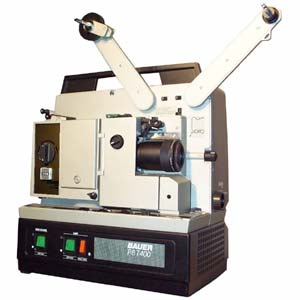
For non-xenon 16mm projection, the Bauer P8 T400 is a good solution too, if you can get one and have someone to service it. Bright, cool light from a HTI 400W/24V metal halide lamp rated at 750 hrs., runs fairly silent and is extremely gentle on film.
Posted by Monte L Fullmer (Member # 2797) on 08-04-2006, 02:30 AM:
Question - where can one find parts for these units - like shuttle assemblies, belts-both flat rubber cloth and the spring takeup belts, gears (since some units did use fibre or formica gears..et.al.), for I need shuttle assembly for a B&H 399 with the pulldown teeth that have badly grooved out causing the picture to jump irratic.
-thx Monte
Posted by Cameron Glendinning (Member # 3516) on 08-04-2006, 07:51 PM:
Bauer, Eiki, Hokushin, from experience are good portables,
Quality lenses are the biggest factor for quality. Prime lenses are not flexible but can be much sharper than a zoom.
Powered by Infopop Corporation
UBB.classicTM
6.3.1.2