This is topic Radio Sound at Drive-Ins --- When? in forum Film Handlers' Forum at Film-Tech Forum ARCHIVE.
To visit this topic, use this URL:
https://ft-forum.com/ft/cgi-bin/ubb/ultimatebb.cgi?ubb=get_topic;f=1;t=007947
Posted by Michael Coate (Member # 757) on 04-22-2006, 05:38 PM:
Who has experience working at or attending drive-in movies? I'm wondering when was your first encounter with "radio sound" (Cine-Fi, etc.) as opposed to hanging a speaker on your car door?
Drive-ins have never been of much interest to me and thus I haven't done much research on the subject. Recently, however, I came across some newspaper ads touting "sound via your car's FM-radio."
What surprised me was the timeframe of the ads (late 1960s) and at least one feature was actually advertised as being "in stereo." I guess I figured this FM thing came along later than the '60s and that even when employed the sound was mono.
Prior to the use of SVA optical prints, were the booths equipped with some sort of mixer to convert what I would presume was a conventional 4-track mag print into the two-channel system found in automobiles? Or, were special 2-track prints made especially for drive-in use?
Posted by John Vincent, Jr. (Member # 1791) on 04-22-2006, 07:32 PM:
This is the earliest I have heard of FM sound at a Drive-In. AM sound has been around since the early 60's I would guess. Before then it wouldn't have been practical since many cars didn't have radios at all.
Many drive-ins did have 4 track mag penthouses for print compatibility, so they could circuit with indoor houses.
Here in Wellfleet we added FM stereo in 1994, and still maintain 100% mono speakers in the field.
Posted by Mark Gulbrandsen (Member # 72) on 04-22-2006, 07:54 PM:
A drive In that I serviced in the past in Monroe, WI has been running a 25 watt Gates FM stereo exciter since the early 70's. A pull from a radio station owned by the same family. Only one of the Drive Ins that I have serviced over the years has all three. FM, AM, and speakers andits a twin in Bass Lake, IN. Its possible that he has since abandoned the AM stuff since I moved out here to Mountain Counrty.
Mark
Posted by Jonathan M. Crist (Member # 413) on 04-23-2006, 01:09 AM:
A drive-in that I worked at in the late 60's into early 70's had 4 track mag heads and the 4 tracks were merged into one output then into the mono sound system for the in-car speakers (that was all we had at that time). The mag heads had been installed as original equipment when the drive-in was built in 1955 due to print availability.
I remember that the mag heads had not been used for a very long time when we got the word we were getting "Kelly Heroes" and the only print that was available was mag only. The service tech and myself worked several hours to get the mag heads and system back up and running - all for a three day run of KH. I don't think the mag head system was ever used again after that.
Posted by Monte L Fullmer (Member # 2797) on 04-23-2006, 02:01 AM:
I worked at a drive-in that had Motiograph AA's setup with Motiograph mag penthouses with Motiograph amplifiers..and each pole had two speakers for stereo sound....
I do believe that the old Park-VU Dr.In, in SLC had basically the same setup since the booth was 35/70mm operational..and the screen was tall,curved and was huge!
Posted by Phil Blake (Member # 2012) on 04-23-2006, 07:55 AM:
It was about 1980 when we introducted Cine-Fi FM radio sound to our Drive In. We kept speakers on the front 4 ramps and fitted signal boosters to the poles on the rear ramps.
Posted by Sam D. Chavez (Member # 1841) on 04-23-2006, 11:10 AM:
Some of the DI mag systems had a switch on the penthouse that either chose center only or a "mix" of LCR. The purpose was to prevent a phase flip in one of the other channels causing a cancellation in the audio.
Posted by Jack Ondracek (Member # 1466) on 04-23-2006, 11:39 AM:
quote: Phil Blake
It was about 1980 when we introducted Cine-Fi FM radio sound to our Drive In.
That's interesting. I thought Cine-Fi was only AM... the system that Pacific Theatres imported from Japan.
Early use of FM radio station cast-offs makes sense, though none of that was done in our area. The Washington branch of Pacific's drive-ins (United Drive-In Theatres) had a ton of Cine-Fi AM stuff, but no FM that I ever heard of... at least not until last year.
No use of Mag sound up here, either. As far as I've been able to tell, we all transitioned from speakers to either AM, or FM. Two of our drive-ins still maintain their speaker systems. One is in almost new condition.
FM conversions up here were a little late... early to mid '80s. Most of our drive-ins closed before they had the chance to upgrade their original installs.
Any of you Seattle guys correct me if you know something I might miss here. I think the Altec and Simplex sound gear was popular with the United drive-ins. SRO used a lot of RCA. I didn't see a wall of Motiograph amplifiers at a drive-in until I moved to Oregon (WOW!).
Cine-Fi AM is still in use at United's last remaining drive-in (a 6-plex), though they've recently put FM on one of the screens.
Posted by Louis Bornwasser (Member # 3063) on 04-23-2006, 12:42 PM:
Most "stereo" in drive ins meant 2 speaker mono or 4 track downconverted to mono.
I used the LPB am transmitter in 1970 in a 1600 car drive-in here as a test. Owner would not buy it because he felt the car batteries would not start the car at the end of the night.
FM was slower because part 15 did not originally apply to FM. Louis
Posted by John Pytlak (Member # 331) on 04-24-2006, 01:22 PM:
When I worked at the Grandview Drive-In in Angola NY, I built a home brew AM transmitter in 1968 that was coupled to the underground speaker wiring. About half the audience preferred the AM radio sound, event though plenty of speakers were available on the lot. We played several films in "stereo" using the in-car speakers for one channel, and the AM for the other: GWTW (remix), "2001 A Space Odyssey" (during the week of the Apollo 11 moon landing in July 1969) and "Funny Girl".
Biggest problems at the time were nightime interference from Radio Havana on the frequency we chose (640 KHz), and older tube type car radios running down car batteries. We always had jumper cables handy for the dead batteries.
Posted by Mitchell Dvoskin (Member # 751) on 04-24-2006, 03:53 PM:
Carrier Current AM was legal from the early 1960's on. It allowed you to broadcast though electrical wires, and to be legal, could not be picked up more than 30 feet from your property. Many Drive-in's and college dorms used this format.
I was involved with the Paramus Drive-In (Paramus, NJ) in 1980-1981, and we had an illegal stereo FM transmitter that we broadcasted the left / right from our Dolby CP-50. You could pick us up on the Garden State Parkway, ¼ mile away. I believe low power FM was legalized somewhere in the late 1980's.
Posted by Michael Coate (Member # 757) on 04-24-2006, 05:09 PM:
quote:
I do believe that the old Park-VU Dr.In, in SLC had basically the same setup since the booth was 35/70mm operational..and the screen was tall,curved and was huge!
This is the drive-in I was referring to in my original post! The film in question was "The Sound Of Music" (two-week drive-in run during the summer of 1968).
Posted by Jonathan M. Crist (Member # 413) on 04-24-2006, 07:39 PM:
What about the Cinerama drive-in in California? Did that have stereo sound?
Posted by Mark Gulbrandsen (Member # 72) on 04-24-2006, 07:50 PM:
quote: Michael Coate
This is the drive-in I was referring to in my original post! The film in question was "The Sound Of Music" (two-week drive-in run during the summer of 1968).
Geez Michael,
Why didn't you just say the Park View.... I work with the guy that was the projectionist there. That D.I. had Bauer U-2 35/70 machines but never ran any 70mm. I am not sure that the 70mm mag head was ever hooked up but I can find out. If they did run S.O.M. there is was 99% for sure a 35mm print. He will know if they had FM sound as well.....
Will call the guy in a while and let you know......
Mark
Posted by Michael Coate (Member # 757) on 04-24-2006, 08:12 PM:
quote: Jonathan M. Crist
What about the Cinerama drive-in in California? Did that have stereo sound?
Of course! Seven speakers were used... one attached to each window, one on the hood, one on the roof, one on the trunk. ![[Smile]](smile.gif)
Seriously, I always wondered this myself. No mention of stereo in the newspaper ads when they ran three of the Cinerama travelogues in Spring 1964. I bet it was the seven-channel mag folded down to one.
Posted by David Kilderry (Member # 142) on 04-24-2006, 09:56 PM:
Here in my part of the world all drive-ins were 100% speakers until 1978. At this time the Village Drive-in circuit upgraded to Cine-Fi AM. They removed most of the speakers, but found many had to be returned as many did not have radios and the old Blue Cine-Fi hire radios were soon wrecked or stolen. The opening films here in Melbourne with Cine-Fi was the Grease + Saturday Night Fever double.
The first drive-in to have FM stereo here was the Dromana drive-in, I was aware they had it in 1984. Interestingly the other major drive-in circuit stayed all speakers until the end. The last two closed in 1990 still with all speakers and no radio sound. The speaker maintenance at these 1200 plus car drive-ins was never ending!
Many drive-ins here in Melbourne were 70mm equipped, they often ran 70 and 35 mag/op. I am not sure if they ever just used centre channel, I would say they simply would have folded all the channels down going by the switch pannels.
Today here at the Lunar Triple Drive-in we are all FM stereo. The AM Cine-Fi and speakers are long gone. I too have never heard of Cine-Fi FM.
David
Posted by Michael Coate (Member # 757) on 04-26-2006, 06:36 PM:
Thanks, everyone, for the replies. In reading the replies I realize that I need to apologize for not asking my question clearly. Not sure what I was thinking (apparently not at all!) but I think I may have complicated the question by mentioning specifically "FM" radio playback when my real question is in regard to radio sound in general, regardless if it was AM or FM.
I had thought that Cine-Fi was FM, but in checking some notes and ads I see that Cine-Fi, at least the Pacific drive-ins in Southern California in the late-'70s, was indeed AM.
Speaking of which, what exactly was/is Cine-Fi? Just a trade name? Or is there something uniquely different with Cine-Fi compared with other brands/types of radio drive-in sound?
Posted by Jack Ondracek (Member # 1466) on 04-26-2006, 09:19 PM:
The Cine-Fi system is/was a package of rack-mounted components, which could be mixed and matched to fit your theatre and budget. If you had a working speaker system, and wanted to eliminate speaker maintenance and replacements, Cine-Fi was the way to go. It was like the LPB systems, except it was designed to work with your existing speaker wiring, instead of leaky coax. As most of Pacific's drive-ins were paved, I can see how a system like this would have been attractive to them.
The system was provided in both full-sized racks and half-sized open "relay" racks, usually on wheels.
The transmitters were 10 watt units, which were designed to feed into a "splitter" box. That box had screwdriver-adjustable pots that let you feed a portion of the transmitter's output to each of the theatre's existing rows of speaker boxes (the speaker wiring hooked up to the splitter). Some installs had a monitor of sorts, which would include an automotive AM radio, a 12v power supply and in some models, a small oscilloscope for adjusting modulation levels. A CB-type microphone allowed for paging, and there was a tape deck input for "non-sync". Larger installations could be purchased with emergency standby transmitters and switching panels to route input audio and ouput RF lines.
The system was literally self-contained. The sound-head solar cell connected right up to the transmitter, which had mic-level inputs for the projector and paging mic. Given the vintage and intended use, there was never any accommodation for noise reduction. After replacing the outside speakers with antenna clips, installation was more or less complete. At one point, all of Pacific's drive-ins in Washington State, and maybe even in California used this system. The sound was roughly comparable to what you'd get from a window speaker, which was a shame, because most AM radios back then could do much better.
There was a great article about this. I tripped over it while doing a search for something else. Can't find it now, but here's what I remember (blatant disclaimer for any inaccuracies):
In Japan, somebody had a building with an elevated parking lot. There was an activity of some kind there... can't remember if it was a drive-in, though... maybe. Anyhow, poles and speakers were out. Somebody there came up with the idea of sticking an incredibly low RF level into a wire with a clip. You clip the wire to your antenna to get the sound. In practice, some radios can pick up the signal without the clip, but a lot depends on evening skip interference.
Somehow, someone at Pacific Theatres got wind of the Japanese system and sponsored/imported/licensed its use in the US. Inventor Kiichi Sekiguchi (then of Cine-Fi International) received the 1978 Technical Achievement Award for the development of the CINE-FI Auto Radio Sound System for Drive-in Theatres (clickie).
By today's standards, Cine-Fi is pretty seriously outmoded. Of the two transmitters they made, one had a vernier analog tuning dial... really great when transmitting to today's PLL-locked radios (the transmitters drifted horribly with changes in ambient temperature). They didn't have any processing, either... not even basic limiting. You'd have to add a lot of outboard processing to make it sound very good. Some of the parts in there are pretty hard to come by, if you can find them at all.
As for FM in the '70s, there weren't many options, other than being lucky enough to have an "in" at a radio station with a good junk box. As for the 'do it yourselfers', did Broadcast Warehouse, Ramsey, Decade or Panaxis exist? Mr. Microphone, maybe .
Shown below is a Cine-Fi installation, currently in use at the last "United Drive-Ins" location in Washington.
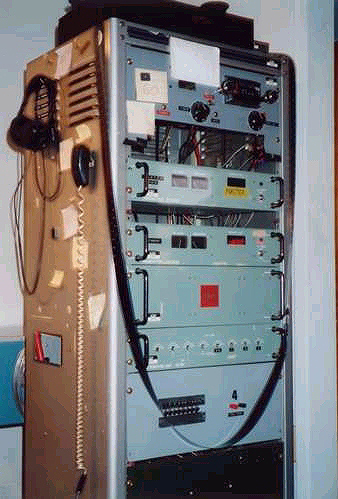
From top to bottom are:
The monitor panel (note the car radio at the upper right).
Two of the "newer" transmitters (dip switch frequency set with frequency readout, audio level and RF meters).
The "input panel", where source equipment is connected and leveled.
Finally, two versions of output splitting panels, to which the former speaker lines are connected.
Posted by John Pytlak (Member # 331) on 04-27-2006, 09:00 AM:
quote: Jack Ondracek
Of the two transmitters they made, one had a vernier analog tuning dial... really great when transmitting to today's PLL-locked radios (the transmitters drifted horribly with changes in ambient temperature). They didn't have any processing, either... not even basic limiting. You'd have to add a lot of outboard processing to make it sound very good. Some of the parts in there are pretty hard to come by, if you can find them at all.
My "home brew" AM transmitter was crystal controlled, so I needed a separate crystal for any frequency we chose to use. Trouble with AM is all the nightime interference from stations hundreds or thousands of miles away (like Radio Havana Cuba). Our system sounded pretty good when there was no interference, so many preferred it to the speakers on the lot.
Posted by Phil Blake (Member # 2012) on 04-29-2006, 12:40 AM:
The system we had was not an actual real mccoy Cine Fi it was a WA locally made system based on Cine - fi I do remember it was definately FM
Posted by Jack Ondracek (Member # 1466) on 04-29-2006, 05:12 AM:
quote: Phil Blake
The system we had was not an actual real mccoy Cine Fi it was a WA locally made system based on Cine - fi I do remember it was definately FM
Are you just talking about the general layout, Phil?
An FM system wouldn't have much use for old field speaker wiring, so most of the Cine-Fi concept wouldn't carry over.
Posted by John McConnel (Member # 2000) on 04-29-2006, 09:08 PM:
The Riverside Drive-in in Norman, OK, had radio sound in 1959, as well as field speakers. It was an AM system, built by J. Eldon Peek of Oklahoma Theatre Supply in Oklahoma City. The antenna was a wire stretched horizontally between posts behind the back ramp.
On a different subject, Mr. Peek devised a system for the Riverside that helped prevent speaker theft. If a speaker wire were cut, the change in impedance would cause an alarm bell to sound in both the projection room and the boxoffice. The lot attendant would close the exit gate. An indicator light identified the ramp where the speaker was cut, and whether it was on the left-hand side of the field or the right-hand side. The projectionist then pressed a button, and a meter identified which pole the speaker was on.
The projection room was built above the concession stand, and the projectionist would step outside and holler to the lot attendant the ramp and pole number, and shine a light in the area of the cut speaker. Nearly all speakers were recovered.
Norman, OK, is a college town, and every new crop of students cut speakers. But after a few of them got caught, word got around, and the speaker theft stopped.
Posted by Jack Ondracek (Member # 1466) on 04-30-2006, 01:10 AM:
I wonder if that relates to the test boards at the phone company central offices, where they track down breaks in their lines..?
Pretty cool, for someone to have it figured out that well back then.
Posted by Phil Blake (Member # 2012) on 05-04-2006, 01:41 AM:
Jack, all I can remeber is the guy quoting to us that this system was based on the popular Cine fi system , not having used an exact Cine fi I am not so sure as to what the simularities were. I rember it had a dual transmitter system and it was fm and it served our 450 car cinema really well.
I thought it was a real blessing , After nearly cutting my thumb off with a hacksaw while trying to open a speaker casing , this new system was putting an end to our horrid speaker fixing program !
I cant for the life of me recall the suppliers name , I am sure David Kilderry would be familiar with this unit even though it probably did not sell so well in the east.
Powered by Infopop Corporation
UBB.classicTM
6.3.1.2